R E S E A R C H
Open Access
An improved block diagonal precoding scheme
for MIMO multicast channel with two users
Xiaodong Xu
*, Zilong Zhang and Baisheng Du
Abstract
Matrix theory plays an important role in precoding methodology for multiple input multiple output (MIMO) systems. In this paper, an improved block diagonal (BD) precoding scheme is proposed for a MIMO multicast channel with two users, where the unitary precoding matrix is constructed in a block-wise form by joint triangularization
decomposition. In order to reduce large signal-to-noise ratios (SNRs) spread across different transmitted data streams and users, the combination of joint equi-diagonal triangularization (JET) and joint geometric mean decomposition (JGMD) is applied to submatrix construction in the inner process of this precoding scheme. An elaborate
implementation is presented, and the existence condition of JGMD is also investigated for two complex-valued matrices with two columns, where the analytical result reveals the connection with the particular channel realization and essentially determines when to consider JGMD for submatrix construction. In addition, the properties of the diagonal elements generated by joint triangularization decomposition are discussed as well as the computational complexity of the proposed scheme. Simulation results indicate that in general, JGMD is employed with high probability in the hybrid model, and the proposed scheme readily outperforms the JET scheme in terms of bit error rate (BER) performance in the moderate to high SNR regimes.
Keywords: MIMO; Multicast; Precoding; Block diagonal; JGMD
1 Introduction
Precoding techniques have gained extensive research interests in the literature due to their capability of achiev-ing the ergodic capacity and improvachiev-ing link reliability for wireless communication over multiple input multiple out-put (MIMO) channels (see, e.g., [1] and the references therein). Under the assumption of full channel state infor-mation (CSI) at the transmit side as well as at the receive side, matrix theory, including several decomposition approaches, is often used as a basic tool to facilitate the precoder design and performance analysis for different types of communication scenarios. For instance, singular value decomposition (SVD) probably serves as a prevail-ing way to construct the capacity-achievprevail-ing precoder for a single-user scenario by diagonalizing the MIMO channel matrix. To avoid introducing rather complicated bit load-ing strategies at the transmit side, the precodload-ing scheme in [2] using geometric mean decomposition (GMD) [3,4]
*Correspondence: [email protected]
Department of Electronic Engineering and Information Science, University of Science and Technology of China, Hefei, Anhui 230027, People’s Republic of China
and later the unitary channel decomposition (UCD) scheme [5] and the root-mean-square decomposition (RMSD) scheme [6] are successively proposed to achieve optimum bit error rate (BER) and channel throughput simultaneously.
Another attractive precoding scheme is recently intro-duced in [7] and [8] for MIMO multicast channels. Rely-ing on the so-called joint equi-diagonal triangularization (JET) or, equivalently, the joint unitary triangularization (JUT) with fixed diagonal ratio, the research effort therein focuses primarily on constructing one common unitary precoding matrix for two users by jointly triangularizing their channel matrices. However, as one can see, the JET scheme usually results in subchannels with vastly differ-ent signal-to-noise ratios (SNRs) for every user, and the BER performance is substantially dominated by those who have the smallest gain on the diagonal, provided that the same modulation and coding scheme is used for all sub-channels. Intuitively, conjecture that if there exists a joint GMD (JGMD) decomposition of two matrices, then each user can obtain multiple identical subchannels with equal
SNRs and the problem arising from JET can be elimi-nated thereafter. However, the existence condition of such a decomposition is available only for two 2×2 real-valued matrices [9]. To the authors’ best knowledge, the existence condition of JGMD is still unknown for more generalized cases.
In this paper, we aim to alleviate the gain spread of the subchannels for each user and improve the SNR of the worst subchannels under the assumption that the same constellations are employed over all the subchannels by ignoring bit loading. Inspired by the successful applica-tion of GMD for multiuser MIMO broadcast scenarios [10], we would like to propose an improved block diago-nal (BD) precoding scheme for a MIMO multicast channel with two users based on the hybrid usage of JET and JGMD, which can obtain better BER performance than the JET scheme counterpart. Given a prescribed dimension for every block, the idea behind the proposed precoding scheme lies in that for each submatrix of the block-wise unitary precoder, it can be selectively constructed by JET or JGMD according to particular channel realization. The main contributions are listed in the following:
1. The application of JGMD is considered, and the sufficient and necessary condition of the existence of JGMD is derived for the case of two complex-valued matrices with two columns. The analytical result reveals the connection with two-antenna channel realization so that JGMD can be conditionally used to perform submatrix construction for the proposed precoding scheme with more than two transmit antennas.
2. We reformulate and elaborately implement the BD precoding scheme by using JET as the unique submatrix construction algorithm, namely the pure BD-JET scheme in this paper, which can be seen as a supplemental work to [8]. New interesting insight into the property of diagonal elements is also shown for the upper triangular matrices.
3. Since JET may introduce large SNRs spread across different transmitted data streams and users, the hybrid usage of JET and JGMD is proposed to construct submatrices in the inner process of the precoding scheme. The existence condition of JGMD is used to determine whether JGMD is employed or not. The computational burden of the proposed precoding scheme is briefly discussed and compared with the JET scheme counterpart. Benefiting from the high probability of using JGMD instead of JET, the proposed scheme has the capability to guarantee a satisfactory BER performance for each user.
The remainder of this paper is structured as follows. Section 2 briefly describes the MIMO multicast channel
model. In the next section, the existence of JGMD is stud-ied and the proposed scheme is presented based on the combination of JET and JGMD. Section 4 illustrates sev-eral numerical examples to validate the advantage of the proposed scheme over the JET scheme. Finally, Section 5 summarizes this paper.
2 Physical-layer multicasting system
Consider a MIMO wireless physical-layer multicasting system consisting of one base station and two users. The
base station is equipped with Mtransmit antennas, and
the ith user is equipped withNi ≥ M,i = 1, 2, receive antennas. Assume that linear precoding is employed at the base station with a unitary precoding matrixP∈ CM×M,
and a common message s ∈ CM will be transmitted
through the multicast channel. At the receive side, theith user receives
yi=HiPs+zi, (1)
where Hi ∈ CNi×M is the channel matrix with full col-umn rank for theith user andzi ∈ CNi is the circularly symmetric Gaussian white noise vector at theith user.
If the base station entirely knows in advance the instan-taneous channel state, i.e., the full knowledge of matrix sequence{Hi}2i=1, JET is applicable to construct the uni-tary precoder Pby jointly decomposing {Hi}as follows:
Hi=aiUiDiP†, i=1, 2 (2)
with ai = MMj=1σi,j, where the sequence {σi,j}Mj=1 is
the singular value of Hi. U1 and U2 are unitary
matri-ces of dimensions N1 × N1 and N2 × N2, respectively,
D1andD2are generalized upper triangular matrices with
equal diagonal elements, and (·)†denotes the conjugate transpose.
Suppose a zero-forcing VBLAST (ZF-VBLAST) detec-tor [11] is performed at the receive side, hence theith user yields a nulling output by multiplyingU†i to both sides of (1), i.e.,
ˆ
yi=U†iyi=aiDis+ ˆzi, (3)
where zˆi = U†izi. Ignoring the error propagation effect, a sequential signal detector using successive interference cancellation (SIC) will getMparallel scalar subchannels, which can be expressed as
ˆ
yi,j=aidi,jjsj+ ˆzi,j, j=1, 2,. . .,M, (4)
JET scheme will be restricted by the subchannels with the smallest gain.
Notice that the JET precoding scheme explicitly adopts a promising unitary triangularization decomposition approach by (2) to jointly triangularize two matrices with one common unitary matrix. However, large spread of the diagonal elements{di,jj}Mj=1can be easily observed even for
ordinary channel conditions, which will inevitably lead to the BER performance attenuation. Based on this obser-vation, the motivation of this paper is to develop such a joint triangularization decomposition approach to dra-matically reduce the spread or, equivalently, enlarge the smallest diagonal elements. Khina et al. [9] investigated this situation, but unfortunately, the sufficient and neces-sary condition of JGMD is still unknown not only for the case of more than two users but also for the case of more than two transmit antennas, except for the special case of two real-valued 2×2 matrices.
3 The proposed precoding scheme
To meet the requirement of high-speed data transmis-sion, practical multicasting systems are usually expected to involve a large number of transmit antennas at the base station. Therefore, the equivalent channel matri-ces often contain columns larger than two in general. In particular, when the multicasting system encounters MIMO frequency-selective fading channels for all users, the dimensions of the equivalent channel matrices will dramatically increase, which will cause an inefficient use of JET at least for two aspects [12]: (1) the multiplication complexity equalsO(M2)while directly using a full-size unitary precoding matrix, which will increase with the increase ofM, and (2) the requirement of feedback bits from the receiver will also increase with the increase ofM
for encoding the precoding matrix.
In the sequel, we construct the block diagonal precoder for multicast channels with column dimensions larger than two. In this way, the aforementioned drawbacks will be mitigated to a great extent. Moreover, via matrix segmentation, it is possible to employ JGMD for reduced-dimensional submatrices to achieve better performance. But before that, let us first consider the existence of JGMD in the next subsection.
3.1 JGMD for complex-valued matrix case
For the case ofM= 2, without loss of generality, denote the unitary matrixPas
P=[p1,p2]= condition of JGMD for two complex-valued matrices.
Lemma 1. Lete=[σ1,1σ1,2,σ2,1σ2,2]Tbe the vector whose elements are products of the singular values of {Hi}2i=1. There exists JGMD for{Hi}2i=1if and only if the following equation:
c+Gx=e (6)
has solutions for real-valued vector x, where x
[cos 2θ, sin 2θcosψ, sin 2θsinψ]T,c = · Fstands for the Frobenius norm, and
G=
with hi,jk represented as the entry of the jth row and kth column of H†iHi.
Proof.For any unitaryP, one can obtain the QR decom-position ofHiPas follows:
HiP=QiRi, i=1, 2. (8)
In view of (5), the first column of both sides of (8) becomes Hip1 = Qi
ri,11, 0 T with ri,11 denoting the first
diago-nal element ofRi. Subsequently, the square form ofri,11is
obtained by
r2i,11=p†1Hi†Hip1, i=1, 2. (9)
Resorting to the statement of Lemma 1 in [13], the right-hand side of (9) can be transformed into the matrix form of c + Gx, while the left-hand side of (9) essentially represents the SNR of the first subchannel for the ith user. Therefore, if there exists JGMD for matrix sequence {Hi}2i=1, then bothr2i,11andr2i,22should be equal toσi,1σi,2 from the determinant viewpoint, which means that (6) has solutions, and vice versa.
Remark 1.Lemma 1 reveals the relationship between the existence condition of JGMD and the solution of a constraint equation for two complex-valued matrices. It is straightforward from this lemma that, if existing, the resulting solution of (6) has the form of
x=G‡(e−c)+ρg, (10)
where g is chosen from the unit-length basis vectors in the null space ofG, ρ is an arbitrary real value to meet the norm constraint ofx =1, and(·)‡denotes pseudo-inverse. Apparently, the sufficient and necessary condition that Lemma 1 tells is equivalent to the following one:
G‡(e−c)≤1. (11) When the solutionxis obtained, the corresponding
angu-lar parameters θ andψ can then be uniquely acquired
Remark 2.Consider more general cases of K > 2 users in one multicasting system with an extension ver-sion of c ∈ RK,e ∈ RK, and G ∈ RK×3, respectively. It is clear from (6) that no proper solution x ∈ R3 will exist with probability 1. Therefore, we only focus on pre-coding for multicasting systems with two users. For a
complex-valued matrix with column dimensionM > 2,
the existence condition of JGMD is still an open issue.
3.2 BD-JET decomposition with discussions about diagonal elements
With the merit of Lemma 1, we are now dedicated in jointly decomposing two matrices into upper triangu-lar forms with equal elements on each diagonal. Before proceeding with the design procedure, we are willing to reformulate BD-JET carefully with full implementation for reasons of completeness, which is not explicitly described in [8]. The following lemma indicates the principle of this decomposition approach.
Lemma 2. Full and equal column rank matrices{Hi}2i=1
can be jointly triangularized into B blocks as follows:
Hi=QiTiP†, i=1, 2, (12)
whereQiis an Ni×M semi-unitary matrix,Pis an M× M block diagonal matrix of the formdiag(P1,P2,. . .,PB), where each individual blockPjis a bj×bjunitary matrix andBj=1bj = M.{Ti}2i=1are M×M upper triangular matrices with equal diagonal ratio for each block.
Proof. Before starting the proof process, we are con-cerned with an equivalent structure of the regular-form JET via (2), which is referred to as an alternative-form JET in this paper. In other words, adopting JET to{Hi}2i=1will result in the following two equivalent forms:
Hi=ai
clarification, the arguments with ‘JET’ suffix denote that they are generated by the regular-form JET.
Relying on the principle of the BD-GMD algorithm [10], we can segment{Hi}2i=1to acquire
of the columns. For the first block, the alternative-form JET via (13) can be used to manipulate{Hi,1}2i=1as
Hi,1=αi,1Ui,1Di,1V†1,JET. (15)
From (15), it is reasonable to obtain the exact solution of P1,Ti,1, andQi,1 by settingP1 = V1,JET,Ti,1 = αi,1Di,1,
and Qi,1 = Ui,1, respectively. And the diagonal ratio
betweenT1,1andT2,1is fixed by αα1,12,1.
Due to the orthogonalization betweenQi,1andQi,r, the remainder ofHisatisfies that
I−Q†i,1Qi,1
Hi,r=Qi,rTi,rP†r, (16)
which has the same decomposition pattern as that ofHi,1.
Thus, we can continue the above operation recursively until all theBblocks have been factorized. Consequently, Qi,Ti, andPconsist of the output submatrices from every iteration, and finally, (12) is reached.
Remark 3.Lemma 2 allows for a block diagonal decom-position approach, named as BD-JET, to triangularize two matrices simultaneously. The proof is constructive and results in a detailed decomposition procedure, which is not pointed out in [8]. BD-JET can also be seen as a relaxed application of JET since JET is employed in the inner iteration process of BD-JET. Moreover, if there is
only one block instead, i.e., B = 1, then BD-JET will
be reduced to JET. And if B = M, as a result, the uni-tary matrixPwill degrade to an identity matrix. However, there are at least two evidences that state the differences between BD-JET and JET. The first one is that in JET mode
and in BD-JET mode, the unitary matrix P may have a
different structure, except for the same matrix dimension.
BD-JET possesses a block diagonal matrixP which
con-tains several unitary submatrices. The second one lies in that in JET mode, the ratio of the diagonal elements of Diis fixed; nevertheless, in BD-JET mode, the ratio of the diagonal elements ofTi, as mentioned in the next remark, is block-equal and not identical between blocks in general.
LetHi,k = Qi,kTi,kP†k denote the BD-JET results of the firstkj=1bjcolumns of matrices{Hi}2i=1. The following corollary describes the property of thekth block diagonal elements ofTi,k, defined as
ti,k,1,ti,k,2,. . .,ti,k,bk .
Corollary 1. The kth block diagonal entries of the upper triangular matrices{Ti,k}2i=1have the following property:
Proof.For the first block, i.e.,k = 1, it is apparent that
As a consequence, the connection between the determi-nants of adjacent blocks reads
ai,k=ai,k−1
bk
j=1
ti2,k,j. (19)
In other words, the product of the kth block diagonal entries of the upper triangular matricesTi,kis character-ized by (17).
Remark 4.From Corollary 1, the ratio of thekth block
elements between the upper triangular matrices {Ti}
holds forrk = 2bk
a
1,ka2,k−1
a1,k−1a2,k. In fact,rk may be controlled
inherently by determinants of the current block as well as the former one. As for JET, the ratio would be kept as
rJET = 2M
a
1,B
a2,B for the whole diagonal elements. For the
case ofB = 1,r1 = rJET holds true intuitively. However,
asBincreases, this relationship is invalid in general except that{Hi} have special matrix structures. In addition, we note that the ratiorkmajorizesrJETby majorization theory
[14], and it is proved by the numerical evaluations in the next section thatTi has relatively smaller gain spread in the diagonal thanDiwith high probability, which will lead to an improved smallest gain for the worst subchannels.
AssumingHˆi,kconsists of the lastbkcolumns ofHi,k, we can use the properties of the block matrix determinant to further get the following relationship:
ai,k=ai,k−1det
Although the BD-JET decomposition has no specific con-straint on the size of submatrices, the use of JET may still produce large gain spread across different subchan-nels in the decomposition procedure. In this subsection, we put forward an improved block diagonal precoding scheme for multicasting system with two users, where the unitary precoding matrix is constructed based on a com-bination of JET and JGMD. Actually, JGMD will act as
the major decomposition approach for every two subma-trices, thanks to the high existence probability, which is validated by numerical evaluations in the next section. Algorithm 1 summarizes the details of the proposed scheme.
Algorithm 1: The proposed scheme Input:{Hi}2i=1,{bj}Bj=1, andB
5 Obtain the angular parametersθ andψ
byx, then calculatePkaccording to (5);
6 Perform QR decomposition ofHi,kPkto
getQi,k,Ti,kby (8);
7 else
8 Perform the alternative-form JET ofHi,k
to getQi,k,Ti,kandPkby (15); the rest of the parts recursively by (17) in [10].
Remark 5.Bearing in mind that the existence of JGMD is questionable for higher dimensions (i.e., for more than two transmit antennas), all the variables {bj}Bj=1 should have equal values of two for matrices{Hi}2i=1who have even number of columns. For the case of odd number of columns in{Hi}2i=1, all the variables{bj}still have values
of two, but the last one where bB = M−
B−1
j=1 bj is guaranteed withB = M2−1. And JET is automatically assigned for the joint triangularization decomposition of the last block in the current situation, which is omit-ted in Algorithm 1 for concise clarification purposes. Besides, in contrast with the proposed scheme, we rename the aforementioned BD-JET scheme including JET as the unique algorithm for submatrix construction as the pure BD-JET scheme hereafter.
Remark 6.For simplicity, letN1 = N2 = N and each
approximately figured out in terms of the number of flops as
f =O(MNL)+OML2+OMN2
+O
(M−L)2NM
2+MN2+NML+LN2
2L
.
(21)
In contrast, the number of flops for JET can be computed by
fJET=O
NM2+OM3 (22)
for the same{Hi}2i=1. As can be seen from (21) and (22), the computational complexity of the proposed scheme is somewhat larger than the JET counterpart since typically,
L<M. Nevertheless, due to the bock diagonal decompo-sition, the resulting block diagonal precoderPcan reduce the multiplication complexity fromOM2toOM2
B
in general.
4 Simulation results
In this section, several numerical examples are performed to demonstrate the efficiency of the proposed scheme. A single-group multicasting system with two users is employed and without loss of generality, the number of receive antennas for each user is set equal to each other,
i.e., N1 = N2 = N. Transmit symbols are commonly
chosen from quadrature phase shift keying (QPSK) con-stellation throughout this paper.
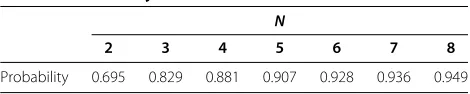
Example 1.For the proposed scheme, it is worth noting that the existence probability of JGMD seriously affects the gain spread along the diagonal of the upper trian-gular matrices. Too low probability will restrict the pro-posed scheme to have any advantage over the JET scheme. Theoretical analysis of this stochastic characteristics will become very cumbersome owing to the complicated prob-ability model. For this reason, we start by first estimating the probability of interest by Monte Carlo trials. Assum-ing that{Hi}2i=1are ofN×2 independent and identically distributed (i.i.d) Rayleigh fading channels, Table 1 estab-lishes the existence probability of JGMD versusN, where it is clear that JGMD exists in most cases, especially when
Nhas large values.
Given {Hi}2i=1 withN = M, Table 2 shows the possi-bility that whether or not the smallest diagonal elements
Table 1 Probability of the existence of JGMD
N
2 3 4 5 6 7 8
Probability 0.695 0.829 0.881 0.907 0.928 0.936 0.949
Table 2 Probability of improved smallest gain for MIMO frequency-flat channels
N=M
4 5 6 7 8
Probability 0.861 0.861 0.862 0.862 0.863
caused by the proposed scheme are greater than the pure BD-JET case. From this table, it appears that the proposed scheme always has high probability to produce subchan-nels with better SNRs than the pure BD-JET. Since JGMD is essentially unused for the case ofN = M ≤ 3, which means that the proposed scheme is equivalent to the pure BD-JET one in this case, therefore we do not consider this situation in this table. AssumingN= M, more evidences can be observed in Table 3, where the multicasting system
suffers from MIMO frequency-selective channels withμ
fading paths.
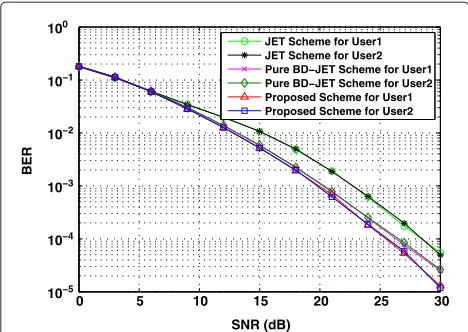
Example 2.In this example, the proposed scheme is investigated from the BER performance aspect for mul-ticasting in MIMO frequency-flat fading channels, where
the system parameters are set asM = N = 8,B = 4,
andbj = 2,∀j. Figure 1 depicts the comparative curves of average BER performance of each user versus SNR. As can be seen from this figure, each user almost has the same BER property, and the proposed scheme achieves superior performance over the JET scheme and the pure BD-JET scheme in moderate to high SNR regimes. Due to the unitary precoding, the proposed scheme is expected to have the same throughput as that of the JET scheme for the multicasting system. However, the smallest gain of the worst subchannels is improved by the proposed scheme at the cost of a small increase in computational complexity. The resulting performance gap implies the effective application of JGMD as the major decompo-sition approach for the inner process of the proposed scheme.
Notice that the unitary precoder P consists of four
2 × 2 unitary submatrices in this case. Therefore, it is clear that the block diagonal structure of P can reduce matrix multiplication complexity fromOM2toOM2
4
in comparison with the JET scheme.
Table 3 Probability of improved smallest gain for frequency-selective MIMO channels
μ
2 3 4 5 6 7 8
0 5 10 15 20 25 30 10−5
10−4
10−3
10−2 10−1
100
SNR (dB)
BER
JET Scheme for User1 JET Scheme for User2 Pure BD−JET Scheme for User1 Pure BD−JET Scheme for User2 Proposed Scheme for User1 Proposed Scheme for User2
Figure 1BER performance versus SNR for MIMO frequency-flat channel.
Example 3.Another favorite multicast scenario is about the block transmission through MIMO frequency-selective fading channels withμdistinguishable paths. In this example, the system uses a zero-padded transmission mechanism, which means that the system will transmitμ zero vectors afterτ symbol vectors in everyτ +μ sym-bol duration. In fact, we can acquire the(τ+μ)N×τM
equivalent channel matrix{Hi}in block Toeplitz structure in the current situation.
In the sequel, Figure 2 illustrates the trajectories of the
BER performance versus SNR for two users with M =
N = 2,μ = 4 effective paths, andτ = 4 symbol block
size. In this case, the equivalent channel matrix actually
has a dimension of 16× 8. Similar behaviors manifest
that the proposed scheme has reliable performance better
0 5 10 15 10−6
10−5 10−4 10−3
10−2
10−1
100
SNR (dB)
BER
JET Scheme for User1 JET Scheme for User2 Pure BD−JET Scheme for User1 Pure BD−JET Scheme for User2 Proposed Scheme for User1 Proposed Scheme for User2
Figure 2BER performance versus SNR for frequency-selective MIMO channel.
than the JET scheme in moderate to high SNR regimes. The pure BD-JET scheme is also examined and plotted in this figure. It is shown that in contrast to the pure BD-JET scheme, the proposed one can still yield a perfor-mance improvement about 1 dB in the high SNR case. The BER performance versus the symbol block sizeτ is also shown in Figure 3 at SNR = 15 dB. It is clear from this figure that although the bandwidth efficiency increases as τ increases, the BER performance degrades a lot for the proposed scheme as well as for the JET scheme. Similarly, performance properties have also been mentioned for the BD-GMD scheme in [12] for unicast scenarios.
5 Conclusions
In this paper, we present an improved block diagonal precoding scheme to construct a unitary precoder for a MIMO multicast channel with two users by using joint triangularization decomposition. An elaborate implemen-tation of the pure BD-JET scheme is provided by means of JET. Although the pure BD-JET scheme achieves rela-tive advantages without an explicit constraint on the size of submatrices, the use of JET may suffer from large SNR spread across different transmit data streams and users. Fully aware of the existence condition of JGMD for two transmit antennas, we introduce the hybrid application model of JGMD and JET to construct submatrices in the inner process of the precoding scheme. The high existence probability of JGMD is proved by numerical results so that in the proposed scheme, JGMD is observed to be the major decomposition algorithm for submatrix construc-tion, as compared with the JET counterpart. Besides the analytical result of the computational complexity, prop-erties of the diagonal elements are also derived to gather useful insights into the proposed scheme. Several numer-ical examples demonstrate that the proposed scheme can guarantee satisfactory BER performance over the JET
0 5 10 15 20 25 30 35 40
10−6
10−5
10−4
10−3
10−2
10−1
Symbol Block Size
BER
JET Scheme for User1 JET Scheme for User2 Proposed Scheme for User1 Proposed Scheme for User2
scheme in moderate to high SNR regimes, especially when the MIMO multicast system is equipped with large-scale antennas.
Competing interests
The authors declare that they have no competing interests.
Acknowledgements
This work was supported by the National Natural Science Foundation of China under grant number 61271272, the National Science and Technology Special Projects of China under grant number 2012ZX03001007-002, and the National High Technology Research and Development Program of China (863 Program) under grant number 2012AA01A502. The authors would like to acknowledge Prof. Xuchu Dai for his valuable comments and suggestions.
Received: 30 July 2013 Accepted: 18 March 2014 Published: 26 March 2014
References
1. M Vu, A Paulraj, MIMO wireless linear precoding. IEEE Signal Process. Mag. 24(5), 86–105 (2007)
2. Y Jiang, W Hager, J Li, The geometric mean decomposition. Linear Algebra Appl.396, 373–384 (2005)
3. P Kosowski, A Smoktunowicz, On constructing unit triangular matrices with prescribed singular values. Computing.64(3), 279–285 (2000) 4. J-K Zhang, A Kavcic, X Ma, KM Wong, Design of unitary precoders for ISI
channels, inProc. IEEE Intern. Conf. on Acous. Speech and Signal Processing, vol. 3 (Orlando, FL, USA, 13–17 May 2002), pp. 2265–2268
5. Y Jiang, W Hager, J Li, Uniform channel decomposition for MIMO communications. IEEE Trans. Signal Process.53(11), 4283–4294 (2005) 6. T Hwang, Y Kwon, Root mean square decomposition for EST-based spatial
multiplexing systems. IEEE Trans. Signal Process.60(3), 1295–1306 (2012) 7. A Khina, Y Kochman, U Erez, Decomposing the MIMO broadcast channel,
inProc. 48th Annual Allerton Conf. on Commun., Control and Computing
(Allerton, IL, USA, 29 Sept–1 Oct 2010), pp.102–106
8. A Khina, Y Kochman, U Erez, Joint unitary triangularization for MIMO networks. IEEE Trans. Signal Process.60(1), 326–336 (2012) 9. A Khina, A Hitron, U Erez, Modulation for MIMO networks with several
users, inProc. IEEE International Symposium on Information Theory(St. Petersburg, Russia, 31 July–5 Aug 2011), pp. 2452–2456
10. S Lin, WL Ho, YC Liang, Block diagonal geometric mean decomposition (BD-GMD) for MIMO broadcast channels. IEEE Trans. Wireless Commun. 7(7), 2778–2789 (2008)
11. GJ Foschini, GD Golden, RA Valenzuela, PW Wolniansky, Simplified processing for high spectral efficiency wireless communication employing multiple-element arrays. Wireless Personal Commun. 6, 311–335 (1999)
12. C-C Weng, PP Vaidyanathan, Block diagonal GMD for zero-padded MIMO frequency selective channels. IEEE Trans. Signal Process.59(2), 713–727 (2011)
13. B Du, Y Jiang, X Xu, X Dai, Transmit beamforming for MIMO multicast channels, inProc. IEEE International Conference on Commun(Ottawa, Cannada, 10–15 June 2012), pp. 3800–3805
14. DP Palomar, Y Jiang, MIMO transceiver design via majorization theory. Found. Trends Commun. Inform. Theory3, 331–551 (2006)
doi:10.1186/1687-6180-2014-39
Cite this article as:Xuet al.:An improved block diagonal precoding scheme
for MIMO multicast channel with two users.EURASIP Journal on Advances in
Signal Processing20142014:39.
Submit your manuscript to a
journal and benefi t from:
7 Convenient online submission 7 Rigorous peer review
7 Immediate publication on acceptance 7 Open access: articles freely available online 7 High visibility within the fi eld
7 Retaining the copyright to your article