ISSN(Online): 2319-8753 ISSN (Print): 2347-6710
I
nternational
J
ournal of
I
nnovative
R
esearch in
S
cience,
E
ngineering and
T
echnology
(A High Impact Factor, Monthly, Peer Reviewed Journal)
Visit:
www.ijirset.com
Vol. 7, Special Issue 2, March 2018
Supervised Deep Learning Approach To
Identify the Lung Cancer
Ram Nikhilesh.M
1, Indresh.M
2, Vishal Vineeth
3, Pranamita Nanda
4UG Student, Department of Computer Science and Engineering, Velammal Institute of Technology, Chennai,
Tamil Nadu, India
1,2,3Assistant Professor, Department of Computer Science and Engineering, Velammal Institute of Technology, Chennai,
Tamil Nadu, India
4ABSTRACT: With the huge development of technology and rapid growth of data in various sectors leads to the need
of extracting the knowledge from it. The knowledge could be achieved through the data analytics. The analytics has
found its application in industry, health care, information technology, e-commerce, education, banking, etc. Since India
is second in population, the diseases had coupled. This has necessitated the introduction of data analytics in health care
for diagnoses of diseases. Of this cancer is a fatal disease, it is diagnosed at the stage 4. Among all, the people are
affected more by lung cancer. It is estimated that 1.38 million cancer deaths per year worldwide. Lung cancer accounts
for more deaths than any other type of cancer. The diagnosing of lung cancer at early stage is quite difficult. The cancer
analysis needs complex equipment’s like X-Rays, Computer Tomography (CT) Scan, Sputum analysis and other
imaging process. They are not only complex but also costlier. These equipment’s provide accurate result when the
patient is at the last stages either stage 3 or stage 4. This could be overcome by developing a system which analyzes the
past history of an individual’s or a patient’s behavior and also based on the result of simple diagnosing method (blood
test) using Machine learning algorithm. This paper involves the process of identifying efficient algorithm to develop a
system. Based on the result of the pre-diagnosis, the doctor can perform confirm the cancer on further analysis and the
treatment can be started at early stages. The developed system might improve the survival rate of the patients.
KEYWORDS: lung cancer, data analytics, machine learning algorithm, diagnosis system
I.LITERATURE SURVEY
Juliet et.al
[1]does survey on various data mining techniques in predicting cancer and proposed a methodology of
introducing a data mining (Data Integration, Data Selection, Data Cleaning, Data Transformation, Data Classification)
instead of traditional diagnosis system. The author has considered the dataset which contains basic attributes, primary
and secondary symptoms. Artificial Neural Network and the self organizing map (SOM) yields better performance
even in the missing information. SOM is used for visualization. Data Cleaning is the challenging step.
Fatma et.al
[2]used Hopfield Neural Network and Fuzzy C-Mean algorithm to segment the cancer cells in CAD
(Computer Aided Diagnosis) system images. Hopfield Neural Network is one of the artificial neural networks to
segment colored and gray images. Fuzzy C-Mean is a clustering algorithm. It physically clusters the logically similar
objects. Fuzzy C-Mean uses reciprocal distance to calculate the fuzzy weights. Finally Hopfield Neural Network, has
segmented the images better than the Fuzzy C-mean.
ISSN(Online): 2319-8753 ISSN (Print): 2347-6710
I
nternational
J
ournal of
I
nnovative
R
esearch in
S
cience,
E
ngineering and
T
echnology
(A High Impact Factor, Monthly, Peer Reviewed Journal)
Visit:
www.ijirset.com
Vol. 7, Special Issue 2, March 2018
Copyright to IJIRSET www.ijirset.com 329
limitation with the existing systems are varied. First, the existing systems are costlier only rich people could afford to such prediction systems. And also, when it comes to individuals, it becomes even more costlier. Second, the prediction systems are generic and vague so far. So that, a machine can predict a certain disease but cannot predict the sub types of the diseases and diseases caused by the occurrence of one disease. For instance, if a group of people are predicted with Diabetes, probably some of them might have higher risk for Heart diseases due to the existence of Diabetes. The existing systems fail to predict all possible conditions of the patient.
III. PROPOSED SYSTEM
We begin with the concept that was not implemented by the predecessors. We implement Decision Tree machine learning algorithm for predicting disease as well as predicting all the other possible sub diseases. We employee MapReduce algorithm for partitioning the data such that a query would be analysed only in the specific partition, which will increase operational efficiency but reduce query retrieval time. In addition to that, we provide individual provisions for individual clients to check his/her condition. Thus making our application broadly accessible by all at affordable cost.
Subsystem
Data Collection
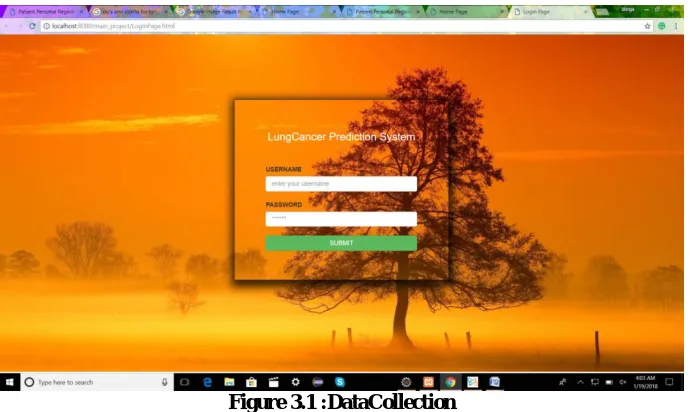
A login,logging in or logging on is the entering of identifier information into a system by a user in order to access that system (e.g., a computer or a website). It is an integral part of computer security procedures. A login generally requires the user to enter two pieces of information, first a user name and then a password. This information is entered into a login window on a GUI(graphical user interface) or on the command line in a console (i.e., an all-text mode screen), depending on the system and situation. A user name, also referred to as an account name, is a string (i.e., sequence of characters) that uniquely identifies a user. User names can be the same as or related to the real names of users, or they can be completely arbitrary.
Figure 3.1 :DataCollection
Data Pre-processing
ISSN(Online): 2319-8753 ISSN (Print): 2347-6710
I
nternational
J
ournal of
I
nnovative
R
esearch in
S
cience,
E
ngineering and
T
echnology
(A High Impact Factor, Monthly, Peer Reviewed Journal)
Visit:
www.ijirset.com
Vol. 7, Special Issue 2, March 2018
Module Training & Testing
ISSN(Online): 2319-8753 ISSN (Print): 2347-6710
I
nternational
J
ournal of
I
nnovative
R
esearch in
S
cience,
E
ngineering and
T
echnology
(A High Impact Factor, Monthly, Peer Reviewed Journal)
Visit:
www.ijirset.com
Vol. 7, Special Issue 2, March 2018
Copyright to IJIRSET www.ijirset.com 331
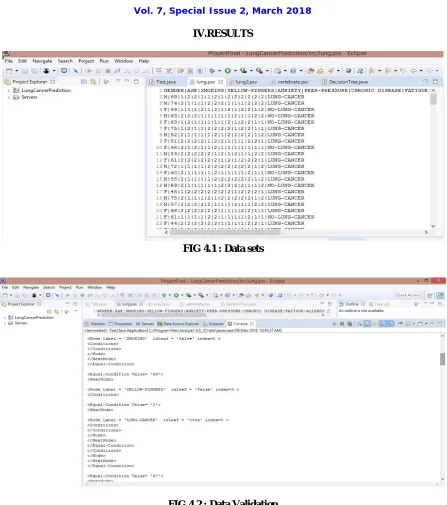
IV.RESULTS
FIG 4.1 : Data sets
ISSN(Online): 2319-8753 ISSN (Print): 2347-6710
I
nternational
J
ournal of
I
nnovative
R
esearch in
S
cience,
E
ngineering and
T
echnology
(A High Impact Factor, Monthly, Peer Reviewed Journal)
Visit:
www.ijirset.com
Vol. 7, Special Issue 2, March 2018
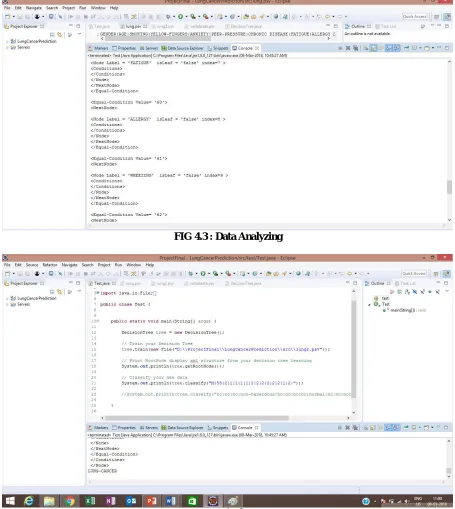
FIG 4.3 : Data Analyzing
ISSN(Online): 2319-8753 ISSN (Print): 2347-6710
I
nternational
J
ournal of
I
nnovative
R
esearch in
S
cience,
E
ngineering and
T
echnology
(A High Impact Factor, Monthly, Peer Reviewed Journal)
Visit:
www.ijirset.com
Vol. 7, Special Issue 2, March 2018
Copyright to IJIRSET www.ijirset.com 333
V. CONCLUSION
In this review we have attempted to explain, compare and assess the performance of different machine learning that are
being applied to cancer prediction and prognosis. Specifically we identified a number of trends with respect to the types
of machine learning methods being used, the types of training data being integrated, the kinds of endpoint predictions
being made, the types of cancers being studied and the overall performance of these methods in predicting cancer
susceptibility or outcomes.It is likely that the use of machine learning classifier will become much more commonplace
in many clinical and hospital settings.
REFERENCES
1. Juliet Rani Rajan and ChilambuChelvan C, “A Survey on Mining Techniques for Early Lung Cancer Diagnoses”,2013 IEEE..
2. https://www.ncbi.nlm.nih.gov/pmc/articles/PMC4991146/#sec1-1title .
3. FatmaTaher and RachidSammouda, “Lung cancer detection by using artificial neural network and fuzzy clustering methods”, 2011 IEEE GCC
Conference and Exhibition (GCC), February 19-22, 2011.
4. RitikaAgarwal, AnkitShankhadhar and Raj Kumar Sagar, “Detection of lung cancer using content based medical image retrieval”,2015 Fifth
International Conference on Advanced Computing & Communication Technologies, 2015 IEEE.
5. Hamid Reza Hassanzadeh, John H. Phan and May D. Wang, “A Multi-Modal Graph-Based Semi-Supervised Pipeline for Predicting Cancer
Survival”, 2016 IEEE International Conference on Bioinformatics and Biomedicine (BIBM).
6. Devi Nurtiyasari, DediRosadi and Abdurakhman, “The Application of Wavelet Recurrent Neural Network/or Lung Cancer Classification”,
2017 3rd International Conference on Science and Technology - Computer (lCST).
7. ThanhTrungGiang, Thanh Phuong Nguyen and Dang Hung Tran, “Stratifying Cancer Patients based on Multiple Kernel Learning and
Dimensionality Reduction”, 2017 IEEE 9th International Conference on Knowledge and Systems Engineering (KSE).
8. Xiaozhou Li, Rong Wang and Ming Lei “Analysis on data for detection of Lung cancer using serum auto-fluorescence”, 2011 IEEE.
9. Weixing Wang and Shuguang Wu, “A Study on Lung Cancer Detection by Image Processing”, 2006 IEEE Saranya P and Satheeskumar B, “A
Survey on Feature Selection of Cancer Disease Using Data Mining Techniques”, International Journal of Computer Science and Mobile Computing, Vol.5 Issue.5, May- 2016, pg. 713-719.
10. Dmitry Ignatov and AndreyIgnatov, “Decision Stream: Cultivating Deep Decision Trees”, 3 Sep 2017 IEEE.
11. Kelvin KF Tsoi1, Yong-Hong Kuo and Helen M. Meng, “A Data Capturing Platform in the Cloud for Behavioral Analysis Among Smokers An
Application Platform for Public Health Research”, 2015 IEEE.
12. Gonzalez-Alonso P, VilarR, Lupiañez-Villanueva F, “Meeting Technology and Methodology into Health Big Data Analytics Scenarios”, 2017
IEEE.
13. Balaji S, MeghanaPatil and Carolyn McGregor AM, “A Cloud based Big Data Based Online Health Analytics for Rural NICUs and PICUs in