© 2013, IJCSMC All Rights Reserved 46
International Journal of Computer Science and Mobile Computing
A Monthly Journal of Computer Science and Information Technology
ISSN 2320–088X
IJCSMC, Vol. 2, Issue. 11, November 2013, pg.46 – 62
RESEARCH ARTICLE
Investigation on Mobile
Phone Video Streaming
G. Sri Sanjeevini
1, B. Jayalakshmi
2, P.V.S. Srinivas
31PG Scholar, Department of Computer Science and Engineering,
TKR College of Engineering and Technology Hyderabad, A.P-500 097, India Email: [email protected]
2
Assistant Professor, Department of Computer Science and Engineering, TKR College of Engineering and Technology
Hyderabad, A.P-500 097, India
3Professor& Head, Department of Computer Science and Engineering
TKR College of Engineering and Technology Hyderabad, A.P-500 097, India
Abstract
Mobile phones are among the most popular consumer devices, and the recent developments of 3G networks and smart phones enable users to watch video programs by subscribing data plans from Tune-up providers. Due to the ubiquity of mobile phones and phone-to-phone communication technologies, data-plan subscribers can redistribute the video content to nonsubscribers. Such a redistribution mechanism is a potential competitor for the mobile Tune-up provider and is very difficult to trace given users’ high mobility. The Tune-up provider has to set a reasonable price for the data plan to prevent such unauthorized redistribution behavior to protect or maximize his/her own profit. Study the optimal price setting for the Tune-up provider by investigating the equilibrium between the subscribers and the secondary buyers in the content-redistribution network. the behavior between the subscribers and the secondary buyers as a non cooperative game and find the optimal price and quantity for both groups of users. Based on the behavior of users in the redistribution network, we investigate the evolutionarily stable ratio of mobile users who decide to subscribe to the data plan. Such an analysis can help the Tune-up provider preserve his/her profit under the threat of the redistribution networks and can improve the quality of Tune-up for end users.
© 2013, IJCSMC All Rights Reserved 47 I. INTRODUCTION
THE explosive advances o f m u l t i m e d i a p r o c e s s i n g t e c h n o l o g i e s a r e creating dramatic shifts in ways that video content is delivered to and consumed by end users. Also, the increased popularity of wireless networks and mobile devices is drawing lots of attentions on ubiquitous multimedia access in the multimedia community in the past decade. Network service providers and researchers are focusing on developing efficient solutions to ubiquitous access of multimedia data, particularly videos, from everywhere using mobile devices (laptops, personal digital assistants, or smart phones that can access 3G networks). Mobile-phone users can watch video programs on their devices by subscribing to the data plans from network service providers], and they can easily use their programmable hand devices to retrieve and reproduce the video content. To accommodate heterogeneous network conditions and devices, scalable video coding is also widely used in mobile video streaming Video applications over mobile devices have drawn lots of attentions in the research community, such as quality measure and error control. There is also a rich body of literature on user interactions in electronic commerce in wireless networks such as cooperative content caching in wireless ad hoc net- work and secure transactions . Therefore, it is important to understand end users’ possible actions in order to provide better ubiquitous video access services.
According to a survey on the popularity of mobile devices , almost every person has at least one cell phone in developed countries, and video consumption over mobile devices is an emerging trend . With such a high popularity and the convenient phone-to-phone communication technologies, it is very possible for data-plan subscriber to redistribute the video content without authorization. For example, some users who do not subscribe to the data plan may wish to watch television programs while waiting for public transportation, and some of them might want to check news from time to time. Hence, these users have incentives to buy the desired video content from neighboring data subscribers if the cost is lower than the subscription fee charged by the service provider. Unlike generic data, multimedia data can be easily retrieved and modified, which facilitates the redistribution of video content. In addition, subscribers also have incentives to redistribute the content with a price higher than their transmission cost, as long as such an action will not be detected by the content owner. Due to the high-mobility, time-sensitiveness, and small-transmission-range characteristics of mobile devices, each redistribution action only exists for a short period of time and is very difficult to track. Consequently, a better way to prevent copyright infringement is to set a pricing strategy such that no subscriber will have the incentive to redistribute the video. Nevertheless, the mobile network service provider might be more interested in setting the content price to maximize his/her own profit than protecting copyrights. The service provider’s profit can be represented as the total number of subscriptions times the content price. If the content price is high, mobile users have less incentive to subscribe to the data plan, which might result in less subscription. However, on the other hand, the con- tent price in the redistribution network may get higher due to less subscribers and more secondary buyers. In such a case, although a subscriber pays more for the video stream, he/she also gets more compensation by redistributing the data. Hence, setting the content price higher does not necessarily reduce the number of subscriptions, and it is not trivial to find the optimal price that maximizes the service provider’s utility. The service provider, the data-plan subscribers, and the secondary buyers who are interested in the video data interact with each other and influence each other’s decisions and performance. In such a scenario, the game theory is a mathematical tool to model and analyzes the strategic interactions among rational decision makers. Recently, the game theory has drawn great attention in multimedia signal processing . We first model the user dynamics in the redistribution network as a multiplayer non-cooperative game and obtain the equilibrium price from which all users have no incentives to deviate. Hence, such an equilibrium price will serve as the upper bound for the price set by the network service provider to prevent copyright infringement. Due to the small coverage area and the limited power of each mobile device, a subscriber can only sell the content to secondary buyers within his/her transmission range, and the distance between users and the channel conditions dominate users’ decisions. Then, we add the service provider as a player to the game to analyze the optimal pricing for the ser- vice provider in the video streaming marketing network. Since the mobile users can change their decisions on subscribing or resubscribing, the content owner is interested in the number of subscribers that is stable over the time. Therefore, a robust equilibrium solution is desired for the service provider. Hence, we formulate the video streaming marketing phenomenon as an evolutionary game and derive the evolutionarily stable strategy (ESS) for the mobile users, which is the desired stable equilibrium for the service provider.
© 2013, IJCSMC All Rights Reserved 48
multiple secondary buyers in Section IV. In Section V, the content owner is also considered as a player who sets the price to maximize his/her payoff but does not prevent the video redistribution among users. Conclusions are drawn in Section VI.
II. SYSTEM MODEL
In this section, we will introduce the channel, transmission, and video rate-distortion models for the transmission of video streams over wireless networks.
The system diagram is shown in Fig. 1. There are sub- scribers in the network, who are trying to sell the video content to secondary buyers. Here, we assume that the content is redistributed through direct links between the subscribers and the secondary buyers, i.e., these mobile users form an ad hoc network. Given the current technology, such direct link can be Bluetooth or Wi-Fi. At the beginning, each subscriber sends his/her own price per unit transmission power, as well as the probing signal to secondary buyers. Since the price information contains only a few bits, we assume that it can be immediately and perfectly received. The probing signal enables secondary buyers to estimate the maximal achievable transmission rate. A secondary buyer has to decide how much power he/she wants to buy from each subscriber. Since scalable video coding is widely used in mobile video streaming , secondary buyers can purchase different coding layers of the video from different sub- scribers and combine these streams during the decoding process. Any higher layer mechanisms for such wireless ad hoc networks such as bootstrapping algorithms can be applied to the redistribution network and will not change the analysis in the following sections.
Fig. 1. Example of a mobile video-stream redistribution network
Assume that the th secondary buyer purchases a part of the video stream from subscriber with transmission power . We assume that there is a channel dedicated for transmissions among users and this channel is a slow-fading channel with channel gain ; the distance between them is , and the variance of the additive white Gaussian noise at the receiver’s side is . Let be the set of subscribers from whom the secondary buyers purchase the video. Assume that the total bandwidth available for the video redistribution net- work is , which will be evenly allocated to all subscribers from whom secondary buyers purchase the video stream. The signal-to-noise ratio (SNR) and the maximal achievable bit rate of the video stream between and are
© 2013, IJCSMC All Rights Reserved 49
For video streaming services, two commonly used objective quality measurements are the video’s peak SNR (PSNR) and the streaming delay. Here, we adopt the polynomial delay model as in. The overall delay at the secondary buyers’ end is the network delay between the subscribers and the service provider plus the maximal processing time of the subscribers. Here, we assume the users for an ad hoc network, and the communication is through direct links. Therefore
where is the number of subscribers from whom the secondary buyers purchase the video stream and is the number of subscribers within the coverage of the same base station, who are currently using the data service but cannot establish direct link to secondary buyers or are not willing to redistribute the video content. is the maximal number of users that the network service provider can simultaneously afford.is the network delay between subscribers and the service provider, and is the processing time of subscriber . From (2), we can see that, when the secondary buyer is purchasing the video from more subscribers, both the network delay and the processing delay of the video stream will be higher.
Without loss of generality, in this paper, we use the two-parameter rate-distortion model [28], which is widely employed in a medium-to-high bit rate situation, and the analysis for other models is similar. The two-parameter rate-distortion model is given as follows:
Where α and are two positive parameters determined by the characteristics of the video content and R is the rate
of the video. Note that a secondary buyer is able to purchase the video from different subscribers in two different ways. Since the log and exponential functions are convex over IR+ and the exponential functions are non decreasing over IR+ , it is easy to prove that buying different layers from different subscribers is a better choice since buying all layers from one subscriber is just a special case. The total bandwidth for the redistribution network is W, which is equably shared among the subscribers who are going to transmit. Hence, when the number of sub- scribers from whom the secondary user purchases, i.e., N , increases, the bandwidth for transmitting each layer is smaller. Given the bit rate in (1), the mean square error of the video stream reconstructed by the secondary buyer is
© 2013, IJCSMC All Rights Reserved 50
III. OPTIMAL STRATEGIES FOR THE SINGLE-SECONDARY-BUYER CASE
In this section, we will first focus on the scenario where there is only one secondary buyer, i.e., . we will model the behavior of the subscribers and the secondary buyer as a Stackel- burg game and then analyze and prove the existence of the equilibrium that leads to the optimal strategies for all users. When there is only one secondary buyer, we can remove super- script for the secondary buyer index and have
Since the video-stream redistribution network is a dynamic system in which all users have high mobility that can join and leave anytime, it is very difficult to have a central authority to control the users’ behavior. In addition, since this redistribution is unauthorized and illegal, to minimize their risk of being detected by the service provider, the participating users (subscribers and secondary buyers) have no incentives to trust one extra person and the central authority, and a distributed strategy is preferred. Given the fact that there is only one secondary buyer, we propose a Stackelburg game model to analyze how the secondary buyer provide incentives for subscribers to redistribute the video stream and find the optimal price and quantity that the secondary buyer should offer. The ultimate goal of this analysis is to help the content owner to set an appropriate subscription fee such that the equilibrium of the game between the subscribers and the secondary buyers leads to negative payoffs. Thus, subscribers will have no incentive to redistribute the video. Before the game starts, each user, either a subscriber or the secondary buyer, will declare his/her presence to all other users within his/her transmission range.
• Game Stages: The first stage of the game is the subscribers’ (leaders’) move. For each subscriber , he/she pays each subscriber accordingly at the price that the subscriber sets in stage 1.
Utility function of the secondary buyer/follower: We first define the secondary buyer’s utility function and
© 2013, IJCSMC All Rights Reserved 51
Where DB is formulated as in (2) user-defined constant measuring the received reward if the PSNR of the reconstructed video is improved by 1 dB, and is D a constant measuring the user’s loss if the video stream is further delayed by 1 s.PSNRmax is the maximal PSNR of the video that can be obtained by subscribing to the service,po and is the price set by the content owner. The aforementioned utility definition can be viewed as the difference between the utility if the secondary buyer buys the video stream from the subscribers and the utility if he/she subscribes to the data plan. If the secondary buyer has subscribed to the data plan, then he/she will receive the video with the maximal PSNR, the delay of the video stream will only be the network delay, and the number of network users who are using the data service will be K+1 in this case. The first term in (6) reflects the visual quality difference between the subscriber’s video stream and the service provider’s video stream. The second term considers the delay difference between the subscriber’s video stream and the service provider’s video stream.DB was defined in (2), and Dq((K+1)/M) is the delay profile if the secondary buyer subscribes to the data plan and becomes an extra subscriber in the network. The third term indicates the price difference. The two constants Q and D control the balance between the gain and the loss of the secondary buyer. Since the service provider can always offer better video quality, i.e.,
PSNRmax≥PSNRB and DB≥Dq(K+1/M), all three terms of (6) are not positive. If the secondary buyer is very
concerned about the video quality, i.e., and are high, then (6) may be negative, and the secondary buyer will subscribe to the data plan himself/herself. Note that this redistribution behavior is not limited to video contents. For other digital contents, the reward terms of (6) will change according to the types of the content, but the payment term will remain the same.
• Utility functions of the subscribers: Each subscriber Si can be viewed as a seller, who aims to earn the payment that covers his/her transmission cost and also to gain as much extra reward as possible. We introduce parameter Ci, i.e., the cost of power for relaying data, which is determined by the characteristics of the device that subscriber Si uses. Hence, the utility of Si can be defined as
Where Pi is the power that subscriber uses to transmit to the secondary buyer. Thus, Si subscriber will choose price Pi that maximizes his/her utility ПSi.The choice of the optimal pricePi is affected by not only the subscriber’s own channel condition but also other subscribers’ prices, since different subscribers non cooperatively play and they compete to be selected by the secondary buyer. Thus, a higher price may not help a subscriber improve his/her payoff.
B. Equilibrium Analysis
The aforementioned video-stream redistribution game is a game with perfect information, and the secondary buyer has perfect information of each subscriber’s action (the selected price). According to backward induction , a game with perfect information has at least one equilibrium. Therefore, the optimal strategies for both the secondary buyer and the subscribers exist and can be obtained by solving the optimal decision for each stage using backward induction.
1) Secondary Buyer’s Optimal Strategy: We analyze the game using backward induction and first study the secondary buyer’s optimal strategy for a given price list from the subscribers. The secondary buyer B aims to determine the optimal power Pi that B should buy from each subscriber to maximize his/her own utility defined in (6).
Let L be the set including all subscribers who want to sell the video to the secondary buyer. Given that the secondary buyer purchases the transmission power Pi from subscriber Si , the secondary buyer’s received video rate is
© 2013, IJCSMC All Rights Reserved 52
where and is the video rate provided by the service provider.
Combining (5) and (6) with the aforementioned equation, we can formulate the utility function of B as a function of . According to , the network delay of the 3G network is reciprocal to the network utilization percentage. Hence, the optimal strategy for the secondary buyer
and is the network constant [27].Note that, in (10) and (8), and
are piecewise continuous functions and are not necessarily continuous cross different sets of S={i|Pi>0}. Therefore, the optimization problem cannot be solved at once for the whole feasible set and has to be divided into subsets. Define subset S(k)N1 as the set with indexes of all the N1 subscribers from whom the secondary buyer purchases the video stream and among whom subscriber k has the largest processing delay. Let P=[ P1,P2,..,PNs be the corresponding power vector, where Pi is the power that the secondary user purchases from subscriber i .
We can find the optimal power vector P(k)N1 for subset S(k)N1 by making the first-order derivative of ПB with respect to Pi be zero, i.e.,
Where Therefore, if the secondary buyer purchases from any N1 subscribers with the same maximal processing delay, then
© 2013, IJCSMC All Rights Reserved 53
maximizer on the boundary. From (12), given the same maximal processing delay and the same number of subscribers from whom the secondary buyer is going to purchase, the second buyer purchases less from subscribers with higher prices. Also, the secondary buyer tends to purchase more from subscribers with better channels.
After the maximize over each feasible subset is obtained, the secondary buyer should choose the one that gives himself/ herself the largest utility. Let P* be the optimal decision of the secondary user; then,
2) Subscribers’ Best Strategies: The optimal price should satisfy
or be on the boundary, which means . Given a set of subscribers , this problem is a convex optimization problem, and the solutions can be numerically found. Note that the subscriber is willing to redistribute the video stream only if he/she can profit from the redistribution action. Therefore, a subscriber’s claimed price should be higher than his/her cost.
C. Existence of the Equilibrium
In this section, we will prove that the optimal strategies of subscribers P*i in and that of the secondary buyers P* in (12) form an equilibrium. By definition, if ({P*i},P*) is an equilibrium, then P*i is the best response of subscriber if other subscribers choose {P*j}j!=iand the secondary buyer chooses P* , and P* is the secondary buyer’s best response if subscribers choose prices .
Note that the optimization problem in (10) can be only done by dividing the problem into sub problems with different sets of subscribers from whom the secondary buyer actually purchases
the video stream, i.e., . Therefore, here, we first prove that, given any , and form an equilibrium for the secondary buyer and all subscribers in . Then, the actual equilibrium is the one that maximizes the secondary buyer’s utility among these solutions. For any given , the optimization problem in (10) is equivalent
to
© 2013, IJCSMC All Rights Reserved 54
Moreover, ′B is a continuous function of . Pi Thus, for 0 ≤ Pi ≤ Pmax , ′B is strictly concave in Pi and jointly concave over P as well. Therefore, solution P+ in (12) is the global optimum that maximizes the secondary buyer’s utility ′B . Furthermore, in the real. scenario, the secondary buyer can gradually increase power Pi for each subscriber to reach the optimal solution P+ if there is information mismatch. For example, the knowledge of channel coefficients may change slowly, and the secondary buyer needs to adjust the strategy accordingly.
Then, we will show that, when other subscribers’ prices are fixed, subscriber Si cannot arbitrarily increase
price Pi to get higher payoff. Given S(k)N’, we take the first-order derivative of the optimal in (12) with respect to price , i.e.,
which means that is a decreasing function of . Such a phenomenon is reasonable since the secondary buyer tends to purchase less from subscribers with higher prices. Furthermore, when other subscribers’ prices and the power that the secondary buyer purchases from each subscriber are fixed, the utility of subscriber is a concave function of price Pi . The first-order derivative of subscriber ’s utility Si with respect to price Pi is
and we can also derive the second-order derivative of subscriber ’s utility , ′Si with respect to price Pi, i.e.,
Therefore, Si is concave with respect to price . Due to the concavity of Si , subscriber Si can always find its optimal price P+i . As a result, ({P
+ I },P
+
)form an equilibrium.
C. Simulation Results
In this section, we will show the equilibrium of the video stream redistribution game under different scenarios, as well as the optimal price for the content owner.
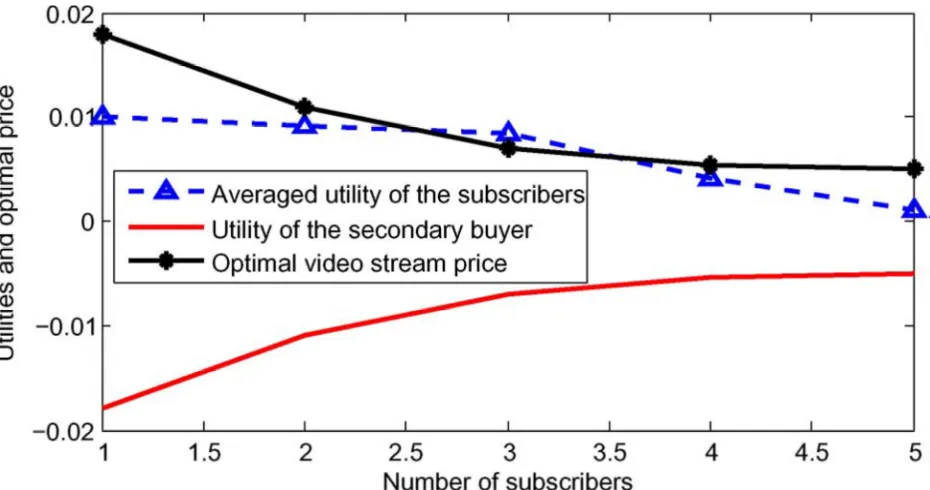
© 2013, IJCSMC All Rights Reserved 55 Fig. 2. Utilities of the users and the optimal video-stream price versus different number of subscribers utility is negative, then he/she has incentives to purchase the video stream from the content owner.
First, we let M-K=50 , and K , which is the number of subscribers who are currently using the data service but are not in the redistribution network, varies from 1 to 5, i.e., the network is not crowded and the number of subscribers is small when compared with the maximal number that the network can afford. In Fig. 2, we observe that, as the number of available subscribers increases, the competition among subscribers becomes more severe; thus, the optimal price for the content owner decreases. When there are no more than three subscribers, the averaged utility of the subscribers does not vary much. This is because, in such cases, the secondary buyer is trying to purchase the maximum video rate Rmax from all subscribers to increase the reconstructed video’s quality, and these subscribers are not competing with each other. However, when there are more subscribers, the secondary buyer can easily get the video quality close to PSNRmax , and subscribers compete with each other to motivate the secondary buyer to purchase from himself/herself. Such a phenomenon is the nature of free market with more sellers.
© 2013, IJCSMC All Rights Reserved 56
2) Multiple Secondary Buyers: We consider the system setup where secondary buyers are uniformly
distributed in a 100 m by 100 m square centered around the origin. There are three subscribers located at (25,10), (25, 10), and (0, 30), respectively. Other system parameters are the same as in the previous section.
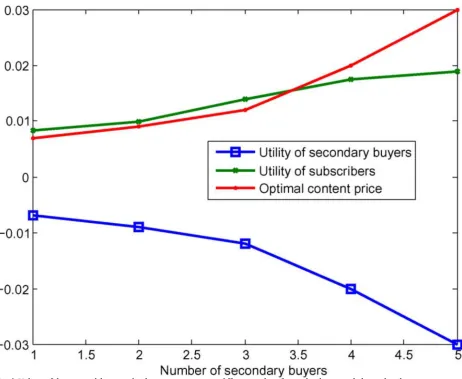
© 2013, IJCSMC All Rights Reserved 57 Fig. 4. Utilities of the users and the optimal video-stream price versus different number of secondary buyers with three subscribers.
Fig. 5 shows the convergence speed of the iterated algorithm to find the mixed strategy equilibria. It is clear that the algorithm converges. With more users in the network, the algorithm takes more iterations to find the equilibria.
TABLE I
EQUILIBRIUM PRICE AND RATE OFFERED BY EACH SUBSCRIBER. (A) SINGLE SECONDARY BUYER. (B) THREE SECONDARY BUYERS
© 2013, IJCSMC All Rights Reserved 58
set by subscriber 3 is higher than that of the other two subscribers because buyer 1 is located so far away from the other two subscribers that subscriber 3 is buyer 1’s only choice if buyer 1 wants to receive the highest-PSNR video. In both examples, the parameters (distance between users, bandwidth, number of secondary buyers, and maximal power) allow all secondary buyers to receive the same-quality video stream from the subscribers so that the dominating factor of pricing is the competition among users.
V. OPTIMAL PRICING FOR THE CONTENT OWNER
In the previous sections, we have discussed the equilibria and the optimal pricing strategy in the video redistribution network. Our assumption there is that the content owner would like to set price Pa smaller than the equilibrium price in the redistribution network. By doing so, the secondary buyers would have no incentives to purchase the video content from the subscribers and will always subscribe to the data plan from the service provider. However, such a strategy may not always maximize his/her total income, i.e., the price times the number of subscribers. In this section, we consider the scenario where the service provider’s goal is not the prevention of video redistribution but rather the maximization of his/her own income. We include the service provider as a player in the game and find his/her optimal strategies.
A. Pricing Game Model and Evolution Dynamics
Here, we model the video pricing problem for the content owner as a noncooperative game, which can be played several times. For example, in practical scenarios, the service provider can always change the price if the total income is below the expectation. Also, even when the price is fixed, mobile users can change their mind on whether to subscribe to the data plan or to purchase from other subscribers. Such natural repetitions help the players find the equilibrium.
The basic elements of the game are listed below.
• Game Stages: In the video pricing game, the first mover is the service provider, who first sets the price of the video content Pa. Then Na, mobile users who are interested in the video content decide whether to subscribe to the video streaming service. Since, based on the analysis in Sections III and IV, the redistribution of the video content is possible, mobile users also take into consideration the possible payoffs that they can get in the redistribution network when making the decision.
• Utility function of the service provider: Obviously, the content owner’s utility is the price times the number of subscribers, i.e.,
where Ns is the number of subscribers.With a higher price, there will be fewer subscribers and a smaller Ns value, particularly when it is possible for mobile users to receive the video content from the redistribution network. Therefore, the service provider cannot arbitrarily increase the data service price Po and has to consider mobile users’ utilities.
• Utility function of the mobile users: Each mobile user in Na has the choice to pay Pa to subscribe to the data plan or to purchase the content from other subscribers instead. Assume that, among the mobile users, of them subscribe to the data plan, and the rest of the users decide not to. Let and be the utilities that a subscriber and a secondary
buyer can get from the redistribution network as in Section IV, respectively.
© 2013, IJCSMC All Rights Reserved 59
where the first input “ n” in I (n,Na,Nb) denotes the action “do not subscribe.” Note that I (n,Na,Nb)=0 if Na or Nb is equal to 0.
The population evolution can be characterized by replicator dynamics as follows: at time , let Ns (t) denote the number of mobile users that subscribe to the data plan, then the subscribers’ population state Xs (t) is defined as
The rate of the increment is proportional to the difference between the payoff of adopting the pure strategy “subscribe” and the payoff achieved by using the mixed strategy X={Xa,xb}
Let , then in the homogeneous case, the utilities of the subscribers and the secondary buyers are.
respectively. The average utility of all mobile users is
Given the aforementioned equation, (29) can be rewritten as
Combining (29) and (34), we have
© 2013, IJCSMC All Rights Reserved 60 and the expected payoff of player 1 when he plays the mixed strategy Xi is
Then, we can write the reciprocal dynamics of Xi as
and similarly
© 2013, IJCSMC All Rights Reserved 61
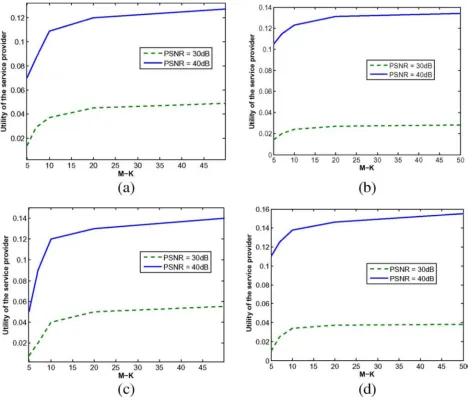
Fig. 8. Convergence speed and content provider’s utility versus number of the mobile users. (a) Utility versus number of users. (b) Convergence speed for PSNR =40 dB.
VI. CONCLUSION
© 2013, IJCSMC All Rights Reserved 62
a secondary buyer tends to purchase the video stream from fewer subscribers, and the price for the streaming service can be higher. Nevertheless, the service provider should always offer high-quality video stream to prevent the illegal redistribution of video via such redistribution networks.
REFERENCES
[1] G. Gualdi, A. Prati, and R. Cucchiara, “Video streaming for mobile video surveillance,” IEEE Trans. Multimedia, vol. 10, no. 6, pp.
1142–1154, Oct. 2008.
[2] H. Ibaraki, T. Fujimoto, and S. Nakano, “Mobile video communications techniques and services,” in Proc. SPIE, 1995, vol. 2501, p. 1024.
[3] D. F. S. Santos and A. Perkusich, “Granola: A location and bandwidth aware protocol for mobile video on-demand systems,” in Proc. Int.
Conf. SoftCom, Sep. 2008, pp. 309–313.
[4] S. Sudin, A. Tretiakov, R. H. R. M. Ali, and M. E. Rusli, “Attacks on mobile networks: An overview of new security challenge,” in Proc. Int.
Conf. Electron. Design, Dec. 2008, pp. 1–6.
[5] H. Lee, Y. Lee, J. Lee, D. Lee, and H. Shin, “Design of a mobile video streaming system using adaptive spatial resolution control,” IEEE
Trans. Consum. Electron., vol. 55, no. 3, pp. 1682–1689, Aug. 2009.
[6] T. Schierl, T. Stockhammer, and T.Wiegand, “Mobile video transmission using scalable video coding,” IEEE Trans. Circuits Syst. Video
Technol., vol. 17, no. 9, pp. 1204–1217, Sep. 2007.
[7] W. A. Vorbau, A. S. Mitchell, and K. O’Hara, ““My iPod is my pacifier”: An investigation on the everyday practices of mobile video consumption,” in Proc. IEEEWorkshop HotMobile,Mar. 2007, pp. 29–33.
Authors
1.G. Sri Sanjeevini Scholar, Department of Computer Science and Engineering, TKR College of Engineering and Technology Hyderabad, A.P-500 097, India
2.B.Jayalakshmi Assistant Professor, Department of Computer Science and Engineering, TKR College of Engineering and Technology