A FRAMEWORK FOR THE DIFFUSION OF BUILDING INFORMATION MODELLING (BIM) ADOPTION STRATEGY FOR THE PRIVATE CLIENT
ORGANISATION
AFIFUDDIN HUSAIRI BIN MAT JUSOH @ HUSSAIN
A thesis submitted in fulfilment of the requirements for the award of degree of
Doctor of Philosophy
UTM RAZAK School of Engineering and Advance Technology Universiti Teknologi Malaysia
DEDICATION
Specially dedicated to the construction stakeholders who still believe in the wind of
ACKNOWLEDGEMENT
My greatest gratitude is to Allah SWT for the successful of this PhD thesis. The preparation of this study has been a tremendous learning experience. I am extremely grateful to the following individuals, groups, and organisations that have supported my involvement in this learning journey.
To my thesis supervisory team for their invaluable encouragement, guidance and productive criticism. I cannot express my gratitude for all of your help. To all of the BIM and Rasch Measurement Model colleagues for their pushing, guidance, and motivation until I managed to complete this study. I hope our friendship will lasts forever! To the BIM and Rasch Professors and experts for their support, guidance, and constructive comments. I hope to have the opportunity to work with all of you in the future. To all my previous teachers and lecturers that have inspiring me to become a valuable person. You will always be my best teacher in my life. To all of my friends and relatives that were with me through all the up‘s and down‘s, always lending a helping hand, an ear, and shoulder and uplifting me with your contagious smile through my most stressful times. I could not have done it without you! To all of the respondents for this study, this is your idea, hope and inspiration. It is an honour for me to deliver your notion.
ABSTRACT
ABSTRAK
TABLE OF CONTENTS
CHAPTER TITLE PAGE
DECLARATION i
DEDICATION v
ACKNOWLEDGEMENT vi
ABSTRACT vii
ABSTRAK viii
TABLE OF CONTENTS ix
LIST OF TABLES xvi
LIST OF FIGURES xix
LIST OF ABBREVIATIONS xx
LIST OF APPENDICES xxii
1 INTRODUCTION 1
1.1 Research Background 1
1.2 Problem Statement 3
1.3 Research Aim, Questions, and Objectives 5
1.4 Significance of study 6
1.5 Scope of the Study 6
1.6 Overview of Research Process and Methodology
Framework 8
1.7 Structure of the Thesis 9
2 BIM ADOPTION IN CONSTRUCTION ORGANISATIONS 11
2.1 Introduction 11
2.2 BIM Adoption in Construction Industry 11
2.2.2 Review of the Definition of BIM 13 2.2.3 Revolution of BIM Adoption in the Construction
Industry 17
2.2.4 Worldwide BIM Adoption 18
2.2.4.1United States 21
2.2.4.2United Kingdom 22
2.2.4.3Singapore 25
2.2.5 An Analysis of the Direction of BIM Adoption in
Malaysia 27
2.3 Clients In Construction Project 30
2.3.1 Who is Client in Construction? 31
2.3.2 Issues of the Client Organisation 33 2.4 BIM implementation in Clients organisation 35
2.4.1 BIM Uses 35
2.4.2 Business Benefits of BIM Adoption 37
2.4.2.1Improve Productivity 37
2.4.2.2Improve the Design and Construction
Process 44
2.4.2.3Manage the Construction Information 46 2.4.2.4Improve the Collaboration Process 47 2.4.2.5Improve the Organisation‘s Competitiveness 48 2.4.2.6Enable Off-site Construction 48
2.4.3 Challenges of BIM Adoption 50
2.4.3.1People Factors 51
2.4.3.2Process Factors 54
2.4.3.3Technology Factors 57
2.5 Chapter summary 59
3 DEVELOPMENT OF THE FRAMEWORK 60
3.1 The Diffusion of BIM Adoption 60
3.1.1 Diffusion of Innovation in Organisation 60 3.1.2 General Analysis on the Model/Theory of
3.1.2.2The ICT Implementation Process Model 63
3.1.2.3Process Theory 65
3.1.2.4A Rationale for Employing the Diffusion of
Innovation Theory 65
3.1.3 Theory of Diffusion of Innovation (DoI) 67 3.1.3.1The Diffusion of Innovation (DoI) Model at
a Glance 67
3.1.3.2Elements of Diffusion of Innovation 70 3.1.3.3The Innovation-Decision Process 78 3.1.4 Diffusion of BIM Adoption in Malaysian
Construction Industry 80
3.2 The Research Framework 84
3.3 Chapter Summary 89
4 RESEARCH METHODOLOGY 90 4.1 Overview of the Research Design and Methodology 90
4.2 Research Phase 92
4.2.1 Stage 1: Empirical Study 92
4.2.1.1Justification of the Population 92
4.2.1.2Ethical Consideration 93
4.2.1.3Instrument Development 94
4.2.1.4Content Validity 97
4.2.1.5Pilot Study 98
4.2.1.6Rasch Measurement Model 99
4.2.1.7Outcome from the Pilot Study – Construct
Validity 101
4.2.2 Stage 2: Model Development 102
4.3 Summary 103
5 ANALYSIS ON THE DIFFUSION OF BIM ADOPTION IN
MALAYSIA 104
5.1 Introduction 104
5.1.1 Response Rate 105
5.2 Descriptive Statistical Analysis 109 5.2.1 Organisation Demographic Profiles 109 5.2.2 The General Respondents‘ Demographic
Information 110
5.3 Rasch Measurement Analysis 112
5.3.1 Objective 1: To Profile BIM Adopters and the
Potential Values of BIM Based on its Uses 112 5.3.1.1Goodness-of-Fit of the Data 112 5.3.1.2Profiling the Potential of Clients‘
Organisation towards Adopting BIM in
Malaysia 116
5.3.2 Objective 2: To Measure the Benefits that the
Organisations Expect to Gain from BIM Adoption 120 5.3.2.1Analysis on Goodness-of-Fit of Data 120 5.3.2.2Measure the Clients‘ Expected Benefit for
BIM Implementation in Malaysia 123
5.3.3 Objective 3: To Categorise the Challenges for
Organisations Who Wish to Adopt BIM 128 5.3.3.1Goodness-of-fit of the Data 128 5.3.3.2Analysis for Categorising the Challenges for
the Implementation of BIM 131
5.4 Qualitative Analysis on Open-Ended Question 136 5.4.1 Identification of the Significant Organisations
Expected Benefits from BIM Adoption 136 5.4.1.1Constructive Comments on BIM adoption 137 5.4.2 Identification of the significant organisations
challenges for BIM adoption 140
5.5 Analysis on the expected benefits and challenges for BIM
adoption 143
6 DISCUSSION AND MODEL DEVELOPMENT 146
6.1 Demographic Analysis 146
6.2 Response Rate 147
6.3 Discussion Profile of the Respondents and Their
Organisations 148
6.4 Research Objective 1: To Profile the Potential of BIM
Adoption Based on BIM Uses 150
6.4.1 Profile 1: Innovators 150
6.4.2 Profile 2: Early Adopters 151
6.4.3 Profile 3: Early Majority 152
6.4.4 Profile 4: Late Majority 153
6.4.5 Profile 5: Laggards 154
6.5 Research Objective 2: To Measure the Benefits that the
Organisations Expect to Gain from BIM Adoption 157 6.6 Research Objective 3: What Are the Challenges Faced by
the Organisations in Adopting BIM? 159
6.6.1 Challenges of Transformational Strategy 160 6.6.2 Challenges for Human Development Strategy 162 6.6.3 Challenges of the Operational Strategy 163 6.7 Research Objective 4: How to Diffuse BIM Adoption in
Malaysia? 165
6.7.1 The Development of BIM Decision Process
Framework 165
6.7.1.1Stage 1: Knowledge 167
6.7.1.2Stage 2: Persuasion 170
6.7.1.3Stage 3: Decision 172
6.7.2 Formulating the Strategy for Deployment of BIM
Adoption 175
6.7.2.1Transformational Strategy 177
6.7.2.2Human Development Strategy 179
6.7.2.3Operational Strategy 180
6.7.2.4Deployment of BIM Adoption Strategy
6.8 Framework Validation 187
6.8.1 The Validation Process 187
6.8.2 Response Rate 189
6.8.3 Respondents‘ Characteristics 189
6.8.4 Empirical Results and Analysis 190
6.8.5 Thematic Analysis on the Feedback from the
Respondents 193
6.9 Overall Discussion on the Development of Conceptual
Framework 195
7 CONCLUSION, CONTRIBUTION, LIMITATIONS AND
RECOMMENDATIONS 197
7.1 Revision of Research Aim and Process 197
7.2 Achievements of the Research Objective 199 7.2.1 Research Question 1: To Profile BIM Adopters and
the Potential Values of BIM Based on Its Uses 200 7.2.2 Research Objective 2: To Measure the Benefits that
the Organisations Expect to Gain From BIM
Adoption 201
7.2.3 Research Objective 3: To Categorise the Challenges
for Organisations that Wish to Adopt BIM 201 7.2.4 Research Objective 4: To Propose the Diffusion Of
BIM Adoption Strategy for Private Client‘s
Organisation in Malaysia 203
7.3 Contribution and Implication 205
7.3.1 Theoretical Contribution 205
7.3.2 Knowledge Contribution 206
7.3.3 Practical Contribution 207
7.3.4 Methodological Contribution 208
7.4 Limitation of the Findings in Relation to the Present
Knowledge 208
7.5 Recommendations for Further Research 209
REFERENCES 217
LIST OF TABLES
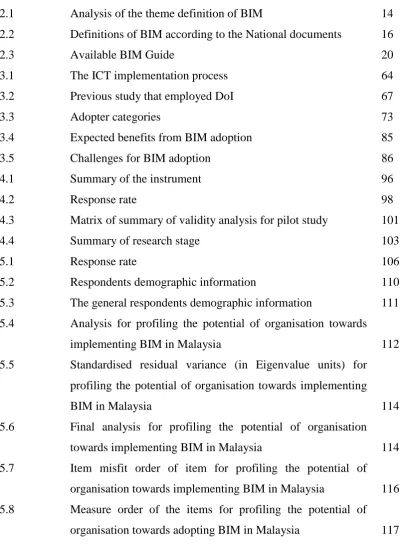
TABLE NO. TITLE PAGE
2.1 Analysis of the theme definition of BIM 14
2.2 Definitions of BIM according to the National documents 16
2.3 Available BIM Guide 20
3.1 The ICT implementation process 64
3.2 Previous study that employed DoI 67
3.3 Adopter categories 73
3.4 Expected benefits from BIM adoption 85
3.5 Challenges for BIM adoption 86
4.1 Summary of the instrument 96
4.2 Response rate 98
4.3 Matrix of summary of validity analysis for pilot study 101
4.4 Summary of research stage 103
5.1 Response rate 106
5.2 Respondents demographic information 110
5.3 The general respondents demographic information 111 5.4 Analysis for profiling the potential of organisation towards
implementing BIM in Malaysia 112
5.5 Standardised residual variance (in Eigenvalue units) for profiling the potential of organisation towards implementing
BIM in Malaysia 114
5.6 Final analysis for profiling the potential of organisation
towards implementing BIM in Malaysia 114
5.7 Item misfit order of item for profiling the potential of organisation towards implementing BIM in Malaysia 116 5.8 Measure order of the items for profiling the potential of
5.9 Matrix of categorisation for profiling the potential of an organisation towards adopting BIM in Malaysia 118 5.10 Final analysis for profiling the potential of organisation
towards measuring the clients‘ expected benefit for BIM
implementation in Malaysia 121
5.11 Standardised residual variance (in Eigenvalue units) for profiling the potential of organisation towards implementing
BIM in Malaysia 122
5.12 Misfit order of item statistics for measuring the clients‘ expected benefit for BIM implementation in Malaysia 123 5.13 Measure order of the items in measuring the clients‘ expected
benefit for BIM implementation in Malaysia 124 5.14 Matrix categorisation of the clients‘ expected benefit for BIM
implementation 126
5.15 Matrix categorisation of the item for the expected benefit for
BIM implementation 127
5.16 Final analysis for categorising the challenges for the
implementation of BIM 128
5.17 Standardised residual variance (in Eigenvalue units) for benefit of organisations implementing BIM in Malaysia 129 5.18 Misfit order of the items for categorising the challenges for
the implementation of BIM 130
5.19 Measure order of the items for categorising the challenges for
the implementation of BIM 131
5.20 Matrix of categorisation for categorising challenges for BIM
implementation 134
5.21 Matrix of challenging item measures and categorisation of
benefits 135
5.22 Matrix of qualitative analysis on expected benefit and
challenges of BIM adoption 143
6.1 Demographic profiling 155
6.2 Critical benefits for BIM adoption 157
6.4 Matrix of challenges, strategy category and objectives of
proposed strategy 176
6.5 Matrix of BIM adoption strategies 182
6.6 Demographic information 190
6.7 Summary statistics 191
6.8 Agreed with the proposed framework 193
LIST OF FIGURES
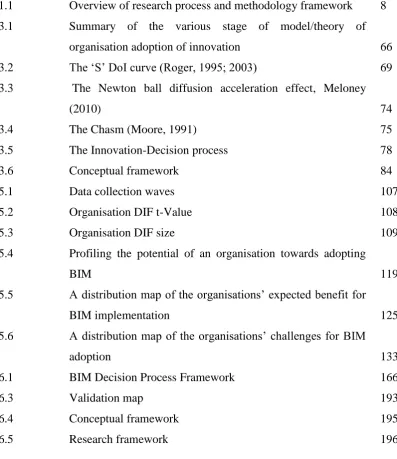
FIGURE NO. TITLE PAGE
1.1 Overview of research process and methodology framework 8 3.1 Summary of the various stage of model/theory of
organisation adoption of innovation 66
3.2 The ‗S‘ DoI curve (Roger, 1995; 2003) 69
3.3 The Newton ball diffusion acceleration effect, Meloney
(2010) 74
3.4 The Chasm (Moore, 1991) 75
3.5 The Innovation-Decision process 78
3.6 Conceptual framework 84
5.1 Data collection waves 107
5.2 Organisation DIF t-Value 108
5.3 Organisation DIF size 109
5.4 Profiling the potential of an organisation towards adopting
BIM 119
5.5 A distribution map of the organisations‘ expected benefit for
BIM implementation 125
5.6 A distribution map of the organisations‘ challenges for BIM
adoption 133
6.1 BIM Decision Process Framework 166
6.3 Validation map 193
6.4 Conceptual framework 195
LIST OF ABBREVIATIONS
2D - 2 Dimensional
3D - 3 Dimensional
4D - 4 Dimensional
5D - 5 Dimensional
AEC - Architectural, Engineering and Construction AGCA - Associated General Contractors of America AIA - American Institute of Architects
ASCE - American Society of Civil Engineers BIM - Building Information Modeling C&S - Civil and Structure Engineering CAD - Computer-aided drafting
CIDB - Construction Industry Development Board
CIFE - Center for Integrated Facility Engineering, Stanford CIMP - Construction Industry Master Plan
CITP - Construction Industry Transformation Programme CREAM - Construction Research Institute of Malaysia EPU - Economic Planning Unit
ETP - Economic Transformation Programme GDP - Gross domestic product
IBS - Industrialised Building System
ICT - Information & Communication Technology IFC - Industry Foundation Classes
IPD - Integrated Project Delivery
IS - Information System
MEP - Mechanical, Electrical and Plumbing
MP - Malaysia Plan
n-D - n Dimension
NIBS - National Institute of Building Standards PEMANDU - Performance Management and Delivery Unit PWD - Public Work Department
R&D - Research and Development
RICS - Royal Institute of Chartered Surveyor ROI - Return on Investment
U.K - United Kingdom
U.S - United States
LIST OF APPENDICES
APPENDIX TITLE PAGE
A Questionnaire (Pilot Survey) 235
B Questionnaire (Full Survey) 239
CHAPTER 1
INTRODUCTION
1.1 Research Background
In Malaysia, the construction industry is unquestionably one of the most productive sectors and it has constantly been one of the engines of national economic growth. Given that Malaysia aims to become a fully industrialised nation by 2020, the construction industry needs to provide the economic and social infrastructure to facilitate industrialisation. Existing evidence indicates that the construction industry has a strong correlation with economic development and made significant contributions towards the growth of Gross Domestic Product (GDP) rate, rising from RM19.82b in 2010 to RM26.90b in 2014 (Malaysia Productivity Corporation, 2015). This suggests that the construction industry in Malaysia has a vital role to play in the country‘s development as construction productivity flows across other industries.
capacities, (4) to innovate research and development in the creation of new construction methods, (5) to leverage on information and communication technology in the construction industry, and (6) to benefit from globalisation. Ultimately, CITP 2016–2020 envisions that the construction industry in Malaysia will soon become a world-class, innovative, and knowledgeable global solution provider.
Although the government has introduced and implemented policies and initiatives to enhance productivity in the Malaysian construction industry, these have been conducted at a slower pace compared to that of other developed countries. Previous researchers have highlighted that these issues are due to the heavy reliance on human capital (Othman and Jaafar, 2013; Ramayah et al., 2009) and the reluctance to adopt new technology (Abidin, Yusof, and Othman, 2013; T. K. Chan, 2009; Masrom et al., 2013). Given the foregoing discussion, the Malaysia Productivity Corporation (Malaysia Productivity Corporation, 2015) has concluded that Malaysia has yet to utilise the bulk of the productivity-enhancing systems. Apart from being expensive, the implementation of these systems may involve prohibitive cost, which may also lead to a shortage of skilled workers.
The recent advance of digital technology has revolutionised the productivity landscape of the global construction industry (Bricogne et al., and Ducellier, 2011). Although this is seen as a global phenomenon, the present study argues that digital technology can be capitalised until this leads to a digital revolution which may mitigate productivity issues in the Malaysian construction industry. The digital revolution of the construction organisation is regarded as a major impact with small beginnings.
of changes that are now happening in the construction industry at a global scale. Indeed, a large number of early adopter countries have embraced and gained the benefits of BIM adoption.
1.2 Problem Statement
Despite the fact that BIM has been adopted globally, there is still room for improvement for the construction industry in Malaysia. In spite of encouragement of the Malaysian government through various strategy and policies, the uptake for BIM adoption at the national level is still slow. Therefore, there are several key issues that need to be elucidated to address the current issues of BIM adoption:
i. BIM has the potential to improve productivity due to its global success. A number of early adopter countries have mandated BIM. Nevertheless, the current climate worldwide does not provide the impetus for BIM to grow rapidly in Malaysia. As a result, the Malaysian construction industry is indecisive with regard to BIM adoption. Hence, it is argued that there is a need to first explore the rationalisation of BIM adoption in Malaysia in order to understand the characteristics of the organisations that are ready to adopt BIM and those organisations that are not. This may be one reason why the adoption of BIM is still in its infancy.
ii. Since most studies suggest the tendency to concentrate on the success of BIM adoption in developed countries, little is known about its adoption in developing countries such as Malaysia. Hence, it appears that information regarding the BIM adoption, in terms of potential values, benefits, and challenges to Malaysia, is very scarce which points to a marked knowledge gap of the subject.
benefits that BIM is expected to bring (Ahbabi and Alshawi, 2015; Murphy, 2014; Sebastian, 2011). These types of organisational behaviour and the vital role played by client organisations form the basis for examining the antecedents of client organisation prior to their adoption of BIM. The limited literature on the antecedents of client organisation is another problematic issue, which provides a clear justification for the present study to be conducted.
iv. Even though there have been several studies on BIM adoption, the present study makes an assertion that while they may seem pertinent, the authenticity and generalisability of the findings of such studies to Malaysian construction organisation are still considerably a question of debate. There seems to be a void in the currently available body of literature that highlights the role of client organisations in ensuring the success of BIM adoption at the micro level and the future direction of BIM at the national level. Therefore, there is another need to uncover the reasons as to why Malaysia lags behind other early BIM adopter countries and to propose how the situation can be transformed by engaging client organisations to play an active role in the transformation process. In effect, the deployment of a BIM adoption strategy is vital in attempting to foster BIM implementation as it presents a new innovative technology within the construction industry.
1.3 Research Aim, Questions and Objectives
The problem discussed in the earlier section highlighted a few interlinking questions in terms of the BIM adoption strategy. Therefore, the aim of this study is to develop a framework for the diffusion of BIM adoption strategy for the client organisations.
In response to the research problem and aim, this study sought to answer the following research questions:
i. How do the organisations perceive the value of BIM use towards BIM adoption?
ii. What benefits do the organisations expect to gain from BIM adoption? iii. What are the challenges for organisations that wish to adopt BIM? iv. How can BIM adoption be diffused in Malaysia.
These questions were formulated to achieve the following research objectives:
i. To profile BIM adopters and the potential values of BIM based on its uses;
ii. To measure the benefits that the organisations expect to gain from BIM adoption;
iii. To classify the challenges for organisations that wish to adopt BIM; and, iv. To develop the diffusion of a BIM adoption strategy for private client‘s
1.4 Significance of Study
At present, the application of BIM is used widely in many countries including developed nations. Because of the adoption of BIM is relatively new in the Malaysian scenario, this study is carried out to analyse the viability of BIM in the Malaysian construction industry. At a theoretical level, it adds to the body of literature related to BIM adoption. At the practical level, the finding of this study will help policy makers to formulate new regulation based on informed decision.
1.5 Scope of the Study
While the findings of this study meant to provide a basis for generalisations to other settings and contexts, the scope of the present study needs to be identified in the following aspects:
i. The respondents: The setting of this research work involved 975 housing and property developers (subsequently referred to as clients) in Malaysia. The sample was drawn from a list of Housing and Property Developers over 2012–2013 periods, published by the Real Estate and Housing Developers‘ Association (REHDA) in Malaysia. Since this study concentrated on client organisations, this limitation constrained the findings to be generalised to other stakeholders. The details of justification for selection of clients are discussed in Section 2.3.
ii. Data collection period: The time setting for data collection was from March 2014 to January 2015. During this period, no government agency or body had mandated the usage of BIM. Research into BIM was also scarce as none of the academic institutions had set up a unit or department to look into BIM-related matters. In addition, although there were national scale reports or surveys on BIM usage, they were mainly conducted in developed countries and such was not the case with Malaysia (Mohd-Nor and Grant, 2014).
1.6 Overview of Research Process and Methodology Framework
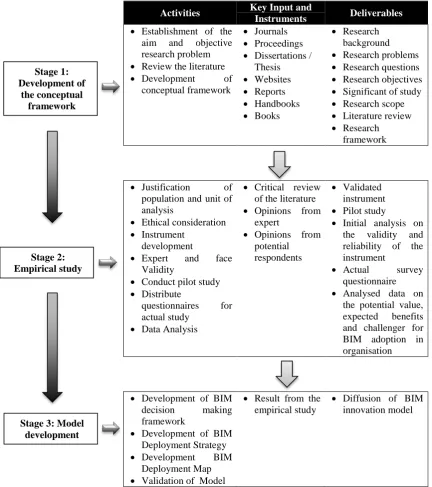
In order to fulfil its aim and objectives, this study has three phases; the first is the conceptual study, followed by the empirical study, and lastly the development of diffusion of BIM innovation framework.
Activities Key Input and
Instruments Deliverables
Establishment of the aim and objective research problem Review the literature Development of
conceptual framework
Journals Proceedings Dissertations /
Thesis Websites Reports Handbooks Books Research background Research problems Research questions Research objectives Significant of study Research scope Literature review Research
framework
Justification of population and unit of analysis
Ethical consideration Instrument
development
Expert and face Validity
Conduct pilot study Distribute
questionnaires for actual study
Data Analysis
Critical review of the literature Opinions from
expert
Opinions from potential respondents
Validated instrument Pilot study
Initial analysis on the validity and reliability of the instrument
Actual survey questionnaire Analysed data on
the potential value, expected benefits and challenger for BIM adoption in organisation
Development of BIM decision making framework
Development of BIM Deployment Strategy Development BIM
Deployment Map Validation of Model
Result from the empirical study
Diffusion of BIM innovation model
Figure 1.1 Overview of research process and methodology framework
Stage 1: Development of the conceptual framework Stage 2: Empirical study
1.7 Structure of the Thesis
Chapter One laid the foundation for this study. It begins with the description of the scenario surrounding the research background, and the discussion further narrows down to the definition of the research problem that justifies the rationale of this study. To support this proposition, the research aim, questions and objectives are presented. This chapter provides the justification regarding the scope of study. It also gives an overview of the research methodology. Finally, the structure of the thesis is presented.
Chapter Two provides a comprehensive review salient literature in the BIM adoption in construction industry at macro level and client organisation at micro level. At macro level, this chapter will review the overview of BIM implementation, definition, revolution and worldwide BIM adoption. This chapter also present an analysis of the direction of BIM adoption in Malaysia. At micro level, this chapter will define who is a client in construction. Furthermore, discussion on the issues, impact of BIM, BIM uses, business benefits and challenges for BIM implementation also presented.
Chapter Three provide review on the underpinning theory of Diffusion of BIM adoption. In essence, this chapter provides a conceptual framework for the whole research and propose framework for the diffusion of BIM adoption strategy for the private client.
Chapter Four aims to discuss the research design and methodology that are chosen for this study. The justification, relevance and adequateness of the research design and methods are presented in this chapter. This chapter opens with a discussion of the overview of research design and methodology. Following is a section which provides a discussion on the research phases (Stage 1—Conceptual study; Stage 2—Empirical study, and Stage 3—Model development).
analysis of organisation and respondents‘ demographic is presented. The second part presents the results of the Rasch measurement model and gives an analysis of the open-ended questions.
Chapter Six will triangulate the match and mismatch between the relevant literature, quantitative analysis of the survey, and analysis from the open-ended questions. The presentation of data and discussion of the findings Chapter Six is based on the themes generated according to the research objectives and research questions. For ease of presentation, each of these themes will be allocated a separate sub-section in which the results of data analysis and discussions of the findings to the relevant research questions will be presented in an integrated manner.