ABSTRACT
RODRÍGUEZ-VELÁZQUEZ, SORÁNGEL. Development of an Electrochemistry Teaching Sequence using a Phenomenographic Approach. (Under the direction of Maria T. Oliver-Hoyo).
Electrochemistry is the area of chemistry that studies electron transfer reactions
across an interface. Chemistry education researchers have acknowledged that difficulties in
electrochemistry instruction arise due to the level of abstraction of the topic, lack of adequate
explanations and representations found in textbooks, and a quantitative emphasis in the
application of concepts. Studies have identified conceptions (also referred to as
misconceptions, alternative conceptions, etc.) about the electrochemical process that
transcends academic and preparation levels (e.g., students and instructors) as well as cultural
and educational settings. Furthermore, conceptual understanding of the electrochemical
process requires comprehension of concepts usually studied in physics such as electric
current, resistance and potential and often neglected in introductory chemistry courses. The
lack of understanding of physical concepts leads to students‟ conceptions with regards to the
relation between the concepts of redox reactions and electric circuits. The need for
instructional materials to promote conceptual understanding of the electrochemical process
motivated the development of the electrochemistry teaching sequence presented in this
dissertation.
Teaching sequences are educational tools that aim to bridge the gap between student
conceptions and the scientific acceptable conceptions that instructors expect students to learn.
This teaching sequence explicitly addresses known conceptions in electrochemistry and
departs from traditional instruction in electrochemistry to reinforce students‟ previous
reactions and electric circuits during electrochemistry instruction. The scientific foundations
of the electrochemical process are explained based on the Gibbs free energy (G) involved
rather than on the standard redox potential values (E°ox/red) of redox half-reactions.
Representations of the core concepts from discipline-specific models and theories serve as
visual tools to describe reversible redox half-reactions at equilibrium, predict the spontaneity
of the electrochemical process and explain interfacial equilibrium between redox species and
electrodes in solution. The integration of physics concepts into electrochemistry instruction
facilitated describing the interactions between the chemical system (e.g., redox species) and
the external circuit (e.g., voltmeter).
The “Two worlds” theoretical framework was chosen to anchor a robust educational
design where the world of objects and events is deliberately connected to the world of theories and models. The core concepts in Marcus theory and density of states (DOS)
provided the scientific foundations to connect both worlds. The design of this teaching sequence involved three phases; the selection of the content to be taught, the determination of
a coherent and explicit connection among concepts and the development of educational
activities to engage students in the learning process. The reduction-oxidation and
electrochemistry chapters of three of the most popular general chemistry textbooks were
revised in order to identify potential gaps during instruction, taking into consideration
learning and teaching difficulties. The electrochemistry curriculum was decomposed into
manageable sections contained in modules. Thirteen modules were developed and each
module addresses specific conceptions with regard to terminology, redox reactions in
The electrochemistry teaching sequence was evaluated using a phenomenographic
approach. This approach allows describing the qualitative variation in instructors‟
consciousness about the teaching of electrochemistry. A phenomenographic analysis revealed
that the most relevant aspect of variation came from instructors‟ expertise. Participant A
expertise (electrochemist) promoted in-depth discussions of fundamental theories and models
that explain the electrochemical process while participant B expertise (general chemistry
instruction) emphasized a coherent and explicit presentation of such theories and models to
students. Other categories of variation were identified as: recognizing students‟ conceptions,
the use of teaching resources and instructors‟ expectations for the teaching sequence. For
example, while Participant B depended heavily on representations and explanations found in
textbooks, participant A recognized misleading representations and oversimplified statements
in general chemistry textbooks. Participant A was also more inclined to question the
significance of some conceptions such as the correlation between the use of the term circuit
and students‟ conceptions related to the movement of electrons in solution in an
electrochemical cell. The electrochemistry teaching sequence in this dissertation fulfils each
of the instructors‟ expectations with regards to the content that incorporated
discipline-specific theories and models, explicit connections and flow among concepts, and addressing
Development of an Electrochemistry Teaching Sequence using a Phenomenographic Approach
by
Sorángel Rodríguez-Velázquez
A dissertation submitted to the Graduate Faculty of North Carolina State University
in partial fulfillment of the requirements for the degree of
Doctor of Philosophy
Chemistry
Raleigh, North Carolina
2013
APPROVED BY:
_______________________________ ______________________________ Maria T. Oliver-Hoyo Edmond F. Bowden
Committee Chair Committee Co-chair
ii
DEDICATION
iii BIOGRAPHY
Sorángel Rodríguez-Velázquez was born on June 2nd, 1984 in Ponce, Puerto Rico.
She was a blessing to her mom Maritza Velázquez. She grew up in a very humble
neighborhood in Ponce with her brother (Julio Rodríguez), sister (Maria “Guty” González)
and her lovely grandparents (“buelito” and “buelita”). She attended Joaquín Ferrán
Elementary school, Eduardo Newman Gandía Middle school and Thomas Armstrong Toro
High school. Her love for science motivated her to begin a career in chemistry at the
University of Puerto Rico in Ponce where she spent two years and then transferred to the
University of Puerto Rico in Mayagüez (UPRM) where she completed a Bachelor‟s of
Science degree in Chemistry in May 2007. After graduating with Magna Cum Laude from
UPRM, Sorángel realized her potential as a scientist and decided to pursue a doctoral degree
in chemistry at North Carolina State University. Graduate school brought her many
challenges, including learning a new language and being away from home, but she knows
that these experiences are shaping her life in many positive ways.
iv
ACKNOWLEDGMENTS
This work could not have been possible without the support of my family, mentors
and friends. First, I must recognize the blessings that God has given me with the most loving
and supporting family in the world. I am extremely proud of my mom, who has worked very
hard to support me and my siblings. Mom, I love and thank you. I must also recognize the
invaluable role that my grandparents had contributed in my life. The values they instilled in
me are the most valuable gifts that I have. Thank you “buelito” and “buelita”, you are both
the love of my life. I also would like to acknowledge the support of my aunt Patricia, who
helped me translate many of my college assignments from Spanish to English and vice-versa.
I want you to know that you helped overcome the language barrier.
I am very grateful for the opportunity to work with Dr. Maria Oliver-Hoyo and Dr.
Edmond Bowden. I really enjoyed all of the insightful discussions that we had about
electrochemistry. I appreciate your time, dedication and invaluable contribution to this work,
you both inspired me to work very hard every day to improve my abilities as a scientist. I
would like to thank Maria for providing me with the opportunity to discover the passion for
chemical education research. I also would like to thank Dr. Bowden for always believing in
my potential and always being enthusiastic to talk about chemistry. I would like to thank Dr.
Lin He and Dr. Robert Beichner for serving on my doctoral committee and their advice
during the preliminary exam, which provided me with good guidance for this work.
Other people that I must acknowledge include current members in Oliver-Hoyo‟s
v
like to thank my dearest friends for all the support throughout the years. Particularly to my
best friend here in graduate school Jennifer D‟Antonio. I will always remember all the good,
vi
TABLE OF CONTENTS
LIST OF TABLES ... viii
LIST OF FIGURES ... ix
LIST OF ABBREVIATIONS ... xii
Chapter 1 Introduction and literature review ... 1
1.1 Introduction ... 1
1.2 Literature review ... 4
1.2.1 Language in science ... 4
1.2.2 Chemistry textbooks ... 5
1.2.3 Rote application of the concepts ... 6
1.2.4 Prevalence of students‟ conceptions in electrochemistry ... 7
1.2.5 Teaching difficulties and instructor conceptions in electrochemistry ... 11
1.2.6 Discrepancies between chemistry and physics instruction ... 12
1.2.7 Educational activities in electrochemistry ... 15
1.2.8 Teaching sequences as educational tools ... 17
References ... 20
Chapter 2 Educational theoretical framework and discipline-specific theories and models ... 25
2.1 Educational theoretical framework: “Two Worlds” ... 25
2.2 Electrochemistry models and theories ... 33
References ... 44
Chapter 3 Research proposal and methodology ... 47
3.1 Research proposal ... 47
3.2 Research methodology ... 48
3.2.1 Design of an electrochemistry teaching sequence ... 48
3.2.2 The phenomenographic approach ... 57
3.2.3 Rationale for the use of phenomenography in this study ... 58
3.2.4 Data collection ... 59
References ... 61
Chapter 4 Electrochemistry teaching sequence ... 64
4.1 Redox reactions terminology ... 64
4.2 Redox nomenclature ... 67
vii
4.4 Representational models of Gibbs free energy ... 75
4.5 Reference electrode ... 89
4.6 Redox solutions and inert metal electrodes ... 92
4.7 Electrodes ... 100
4.8 Electrochemistry conventions ... 103
4.9 Electrochemistry nomenclature ... 106
4.10 Electric current in electrochemical systems ... 109
4.11 The external circuit ... 111
4.12 Relating redox reactions and electric circuits ... 114
4.13 Nernst equation ... 121
References ... 128
Chapter 5 Results, conclusions and future work ... 132
5.1 Phenomenographic analysis ... 132
5.2 Conclusions ... 135
5.3 Proposed future work ... 136
References ... 138
APPENDICES ... 139
Appendix A. Electrochemical series activity ... 141
Appendix B. Gibbs free energy of the electrochemical process ... 143
Appendix C. Reference electrode ... 148
Appendix D. Interfacial equilibrium ... 150
Appendix E. Electrodes ... 153
Appendix F. The external circuit ... 156
Appendix G. Relating redox reactions and electric circuits ... 158
Appendix H. Nernst Equation ... 161
viii
LIST OF TABLES
CHAPTER 2
Table 2.1 Different methods used by experts and novices in the interpretation of representations ... 28
Table 2.2 Compilation of representative experimental Epzc values versus the normal
hydrogen electrode (NHE) reported by Trasatti ... 35
CHAPTER 3
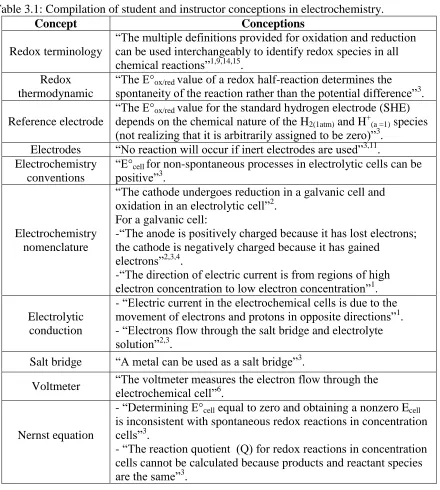
Table 3.1 Compilation of student and instructor conceptions in electrochemistry .. 48
CHAPTER 4
Table 4.1 IUPAC definitions for reduction and oxidation reactions ... 64
Table 4.2 Compilation of definitions for oxidizing and reducing agents found in general chemistry textbooks ... 70
Table 4.3 Proposed redox nomenclature ... 71
Table 4.4 Compilation of ΔH° values for the oxidation of metals (calculated using tabulated values) ... 76
Table 4.5 Comparison between the density of electronic states model for redox species in solution and band theory model for metal electrodes ... 96
CHAPTER 5
ix
LIST OF FIGURES
CHAPTER 2
Figure 2.1 Representation of the rendition to the Two Worlds theoretical
framework ... 27
Figure 2.2 Electrochemical cell connected to a voltmeter ... 30
Figure 2.3 Representation of the DOS model of metal electrodes (band theory) and redox species (Gerischer model) ... 31
Figure 2.4 Electrochemical cell at the interfacial equilibrium (equilibrium in each half-cell between electrode and redox species in solution) ... 33
Figure 2.5 Relation between Φ and Epzc for different crystal faces of Cu, Ag, and
Au ... 37
Figure 2.6 Effects of the applied potential (Eapplied) on the Gibbs free energy of
redoxspecies in solution ... 39
Figure 2.7 Density of electronic states for redox species in solution ... 41
CHAPTER 3
Figure 3.1 Proposed sequence of changes for the electrochemistry curriculum ... 51
CHAPTER 4
Figure 4.1 Representation of the mechanism of the reaction between nitrite and hypochlorous acid ... 64
Figure 4.2 Representation of a 1-electron transfer process ... 72
Figure 4.3 Representation of the thermodynamic cycle for the oxidation of a metal inaqueous solution ... 74
Figure 4.4 Thermodynamic cycle for the oxidation of H2(g) to H+(hyd) (BD = bond
x
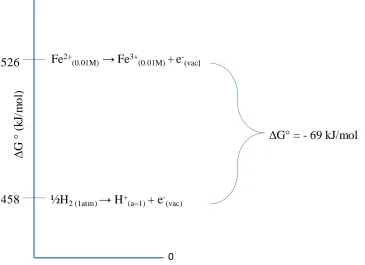
Figure 4.5 Scale for ΔG° values using H2(1atm) to H+(a=1) oxidation reaction as a reference
... 80
Figure 4.6 Gibbs free energy representation for a redox half-reaction at
equilibrium……… 82
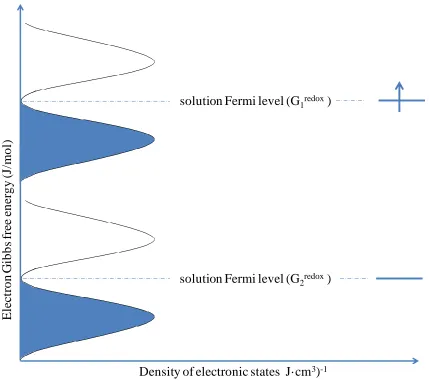
Figure 4.7 Gerischer model for the density of electron energy states. Shading designates occupied states. The figure represents a redox solution with equimolar concentrations of Ox and Red as can be deduced from the equal areas under the two curves ... 86
Figure 4.8 Distribution of electron energy states for two redox half-reactions and the energy states available for electron transfer between the two redox half-reactions. The diagram shown is for a reaction where electrons (represented
by ↑) can flow spontaneously from redox couple #1 to redox couple #2 ………. 88
Figure 4.9 Representation of an electrochemical cell connected to a voltmeter in which each half-cell contains a solution with both forms of a redox couple present ... 89
Figure 4.10 Electrochemical cell comprised of a redox half- cell at standard conditions connected to SHE. H2(1atm) is bubbled through the solution containing Pt wire
immersed in H+(a=1) solution so that dissolved H+ is in equilibrium with H2(1atm)
... 92
Figure 4.11 Electronic band structure of Au metal for s-type electrons. As the number of atoms increases (N), the number of interactions to form bonding and antibonding crystal orbitals also increases. As an extended structure is approached (N →∞), the discrete energy levels corresponding to the crystal orbitals can be considered as a continuum, hence the formation of an energy band……….. 95
Figure 4.12 Before and after the establishment of electrochemical equilibrium between redox species in solution and a metal electrode surface……… 98
Figure 4.13 Electrochemical equilibrium between redox couple and electrode in solution for two redox half-cells ... 99
Figure 4.14 Electrochemical cells using Pt and Au electrodes. Ecell calculated from ΔG
xi
Figure 4.15 Each electrochemical cell is connected to a low resistance circuit (100 Ω), which let electron transfer to take place between the two redox
half-cells ... 103
Figure 4.16 Basic circuit of a voltmeter in which current is measured in the ammeter and Ecell is determined according to Ohm‟s Law ... 114
Figure 4.17 Relation between external circuit resistance and electron transfer in an electrochemical cell ... 115
Figure 4.18 Representation of electrochemical cell as shown in textbooks ... 116
Figure 4.19 Representation of an electrochemical cell for the following redox process: Cu2+(aq) + Zn(s) → Cu(s) + Zn2+(aq) E°cell = + 1.1 V. Each redox couple in
solution with an electrode represents a redox half-cell (one in each container).The two half-cells are connected by a porous material saturated with electrolyte solution (e.g. KCl) known as the salt bridge. Each redox half-cell is connected to one end of a shunt resistor and the potential is measured in volts using a voltmeter ... 119
Figure 4.20 (Graph 1) Measured cell potential as shunt resistance changes. (Graph 2) Measured cell potential as the magnitude of current through the cell changes ... 120
Figure 4.21 Representation of interfacial equilibrium in an electrochemical cell ... 121
Figure 4.22 Representation of density of states model for a concentration cell. Each graph represents a redox half-reaction containing the ferro/ferri-cyanide redox couple at different concentrations. G values were identified from graphical analysis of the intersection points. ΔG was determined by subtracting G values of redox half-reactions 1 and 2 as follows: G°2 - G1 = - 31.38 kJ/mol -
xii
LIST OF ABBREVIATIONS
a Activity of the specie BD Bond dissociation energy
C Coulombs
Ciα Concentration of species i in phase α CRed Concentration of the reduced species
COx Concentration of the oxidized species
CR(0,t) Concentration of reduced species at the electrode surface
CO(0,t) Concentration of oxidized species at the electrode surface
DOS Density of states
D(vacant) Density of electron- vacant states
D(occupied) Density of electron-occupied states
E°ox/red Standard redox potential
E°cell Standard cell potential
Ecell Cell potential
Eapplied Applied potential
Eeq Equilibrium potential
Epzc Potential of zero charge
E° Energy corresponding to the standard potential
E Energy
F Faraday constant G Gibbs free energy
G° Standard Gibbs free energy
ΔG° Standard Gibbs free energy change Gred Gibbs free energy of the reduced species
Gox Gibbs free energy of the oxidized species
Geredox Gibbs free energy of the redox electron(s)
Gcathode Gibbs free energy for the cathode half-cell
Ganode Gibbs free energy for the anode half-cell
∆G eM Gibbs free energy change of the metal
ΔH° Standard enthalpy change
ΔH°atom Standard enthalpy of atomization
ΔH°hyd Standard enthalpy of hydration
IE Ionization energy
IUPAC International Union of Pure and Applied Chemistry
J Joules
K Boltzmann constant
M Metal
xiii N Number of atoms
N Number of electrons
ne Number of moles of electrons
n (vac) Vaccum electron(s)
n (redox) Redox electron(s)
NA Avogadro‟s number
NHE Normal hydrogen electrode Ox Oxidized species
P Pressure
Q Reaction quotient Red Reduced species
SHE Standard hydrogen electrode ΔS° Standard entropy change
T Time
T Temperature vac Vacuum
WR(λ,E) Probability density function for the reduced species
WR(λ,E) Probability density function for the oxidized species
Zeff Nuclear effective charge
zi Charge of the species i
μiα Chemical potential
μi0α Standard chemical potential
μiα Electrochemical potential of species i in phase α μeM Chemical potential of a metal
Ф Work function
Φ Electrostatic potential
γiα Activity coefficient of species i in phase α
v Stoichiometric coefficient λ reorganization energy
1 Chapter 1: Introduction and literature review
1.1Introduction
One of the challenges in chemistry instruction is for instructors to be able to explain
the relation between the observable events (macro level) and the corresponding scientific
models (micro level)1,2,3. The multilevel of representations in chemistry were described by
Johnstone as micro, macro and symbolic4. The micro representation refers to concepts such
as atoms, molecules and electrons while the macro representation includes the observation
and descriptions of the events. The equations and chemical formulas used to represent
chemical processes correspond to the symbolic representation. It is found that instructors
usually transition between levels of representation without an explicit motivation, purpose or
connection between the three levels1. Instructors often explain events at the micro level
without an explicit reference to the phenomena assuming that students understand the
purpose and limitations of the micro representations and can apply accurately the symbolism
involved3.
Research has been done with the aim to help students in the connection and transition
between levels of representation in chemistry5,6,7,8,9,10. Computer software has been
developed to help students visualize processes at the micro level and to simultaneously relate
the micro, macro and symbolic levels of representation during a chemical process8,9.
Teaching strategies that emphasize the three levels of representation during instruction have
shown to promote conceptual understanding11,12. Results indicate that the introduction of a
2
representations may increase students‟ motivation as well13
. However, in-depth research and
more teaching resources to help students in the conceptual understanding of diverse topics in
chemistry is needed2.
Electrochemistry is found to be one of the most difficult topics in chemistry for
students at different levels of instruction14,15,16. One of the reasons is that most of the
concepts studied in electrochemistry are at the micro level of understanding17. For example,
students have to understand that electrons are transferred during an electrochemical process
even when they are not able to directly observe such process. The symbolic language
manifests itself as an additional challenge as students must relate the concepts (e.g., reduced
species and oxidized species) to the processes (e.g., reduction and oxidation) in order to
successfully apply the terms. Furthermore, the study of electrochemistry requires the
understanding of concepts studied in physics such as potential, electric current and electric
circuits. However, there is a lack of adequate explanations about these concepts in
electrochemistry chapters in general chemistry textbooks18,19. Consequently, one of the
difficulties in electrochemistry instruction is to explicitly relate the concepts of redox
reactions and electric circuits20,21,22,23.
This project attempts to address the challenges that the study of electrochemistry
presents to students by developing a teaching sequence to promote conceptual understanding
about the electrochemical process. Teaching sequences are teaching tools aimed to bridge the
gap between the concepts to be taught (scientific knowledge) and students‟ conceptions24,25
.
3
represent the scientific accepted knowledge, which are commonly defined as misconceptions
or alternative conceptions23,26. For example, one common students‟ conception is that a
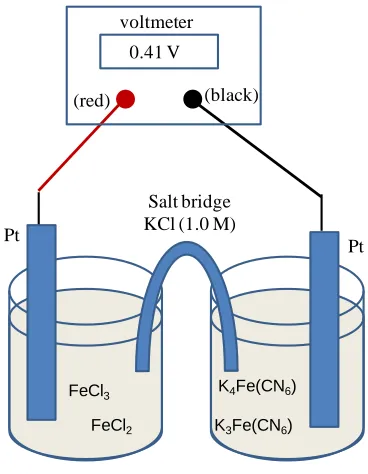
voltmeter measures the current through the electrochemical cell20. The development of the
teaching sequence should be theoretically framed taking into consideration students‟
conceptions27. We used Tiberghien et al. proposed framework for the design of teaching sequences that involves the explicit relation between the scientific theories and models to the
material world (objects and events)25. The proposed electrochemistry teaching sequence aims
at facilitating the explicit connection between the electrochemistry concepts (theories and
models) and the observed phenomena (e.g., measurements). The design of the teaching
sequence involved the reconstruction of the electrochemistry curriculum, as presented in
textbooks,18,19 considering teaching and learning difficulties. During the development of the
proposed electrochemistry teaching sequence we integrated educational theoretical
frameworks and discipline-specific theories and models. This resulted in the incorporation of
scientific models and theories often neglected in general chemistry textbooks during the
study of electrochemistry, which permitted the explicit and coherent connection among the
concepts of redox reactions and electric circuits during instruction.
In our approach, the teaching sequence served as well as a research tool to investigate
instructors‟ consciousness about the teaching of electrochemistry using a phenomenographic
approach. The phenomenography study consisted on identifying the qualitative variation in
instructors‟ consciousness about different aspects of the teaching of electrochemistry such as:
4
teaching expectations. Each instructor evaluated each module of the teaching sequence and
discussed with the researcher their expectations for the teaching of electrochemistry. The
results from these discussions allowed the development of an electrochemistry teaching
sequence from the instructors‟ perspective. The literature review, research proposal,
methodology, electrochemistry teaching sequence, conclusions and proposed future work are
presented in this dissertation.
1.2Literature review
1.2.1. Language in science
Students have to learn a new language when they are learning science. Often students
spent more time trying to understand and interpret the language used in chemistry than in
learning the actual concepts28. The terminology used to describe the concepts is one of the
sources of students‟ conceptions in electrochemistry23,29
. Most of the terms used in chemistry
have their meaning in everyday language and for novices that is the only meaning that they
know30. For example, the term “reduction” in everyday language might refer to a decrease in
size, amount or degree but electrochemistry reduction refers to a gain of electrons. Conflicts
with language come when students fail to translate the everyday meaning of a word to
chemistry language, or are unaware of the difference. For example, when referring to the
electrochemical cell as an electric circuit, the use of the term circuit can create confusion
regarding the movement of charge in the electrochemical process31. In everyday language the
5
not the case, where current through the circuit involves the movement of ions in opposite
directions in solution and electrons (from anode to cathode) through the external circuit.
Students often fail to solve a problem in chemistry because they do not comprehend the
scientific language used32. This illustrates the need for instructors to explicitly define terms
used during instruction. When instructors use a word to describe a concept there is a chance
that the students construct a completely different mental picture of what the instructor is
trying to convey33.
1.2.2. Chemistry textbooks
Textbooks are frequently used as a primary resource during instruction. This practice
benefits students and teachers since textbooks are sources of valuable information. However,
sometimes the statements, diagrams, and terminology used in textbooks could lead to
different interpretations and eventually to inaccurate conceptions. Figures representing
electrochemical cells in textbooks could communicate wrong ideas about the electrochemical
process34,35. As an example, most of the diagrams of electrochemical cells found in textbooks
show the anode on the left and the cathode on the right and this may promote students‟
conceptions regarding the dependency of the position of the electrodes and the direction of
the current flow34. When an electrochemical cell is represented connected to a voltmeter, a
continuous flow of electrons through the external circuit of the electrochemical cell is often
illustrated. This generates crucial students‟ conceptions regarding the characteristics and
function of the voltmeter, since the current through a high resistance voltmeter is almost
6
Direct connection between the language used in textbooks and some of the
conceptions that students develop has been found. The use of general statements and the lack
of explanations of concepts such as electric circuits lead to misinterpretations20,23. For
example, the use of the term “the salt bridge completes the circuit”19
to define the function of
the salt bridge in the electrochemical cell reinforces the students‟ conception that electrons
flow through the salt bridge and solution during an electrochemical process20.
1.2.3. Rote application of the concepts
Research demonstrated that students who can succeed in chemistry courses often fail
questions that require a conceptual understanding of the topic2. Students often memorize
rules and equations in order to successfully solve problems without reasoning about the
validity of the answers36. Unfortunately, electrochemistry instruction often emphasizes the
quantitative aspect of the subject resulting in a lack of conceptual knowledge among
students16. It is reported that often instructors promote the use of algorithms found in
textbooks without giving an appropriate explanation about the physical meaning of the
concepts21. For example, Greenbowe and Sanger indicated that the additive method to
calculate the standard cell potential used during instruction E°cell ( E°cell = E°ox + E°red),
might promote students confusion about the nature of the E°cell value, which is a potential
7
1.2.4. Prevalence of students’ conceptions in electrochemistry
Students around the world share the same conceptions about electrochemistry, although
differences in culture, educational resources and curricula14,15,20,21,22,23,29. Ogude et al. studied
pre-college and college African students‟ conceptions regarding ionic conduction and
electrical neutrality20,37. Some of students‟ conceptions are that electrons flow through the
solution15,20,22,23,29,37 and that electrical neutrality in the electrochemical cells means that one
half-cell is positively charged with cations in solution and the other half-cell is negatively
charged with an equal number of anions20.
Garnett and Treagust reported the challenges that Australian high school students
confront when studying electrochemistry22,29. The results indicated that students often are
unable to successfully apply the concept of cell potential (Ecell) to determine the direction of
electron transfer in electrochemical cells. One students‟ conception is that the Ecell is due to a
difference in electron concentration between two redox half-cells22. In addition, students
often described the electron transfer as from high electron concentration (anode) to low
electron concentration (cathode)29. Sanger and Greenbowe replicated Garnett and Treagust
study and found that American college students‟ experience the same students‟ conceptions
as reported for Australian high school students23.
De Jong and Treagust compiled the studies mentioned above and identified the main
areas of difficulties as: confusion when applying the multiple models to identify reduction
and oxidation reactions, misinterpretation of the use of plus and minus signs designation
8
need of a standard reference electrode to measure Ecell, lack of understanding about the
concept of electrolytic conduction, rote application of the Nernst equation and instructional
gaps in the connection between the concepts (e.g., electron transfer) and the observed
phenomena (e.g., measured Ecell)38.
Difficulties related to the topic of redox reactions
One common students‟ conception is that the three definitions provided for reduction and
oxidation reactions can be used simultaneously to identify all redox reactions22. However, the
use of multiple definitions (e.g., oxidation = increase in the oxidation state, removal of
electrons, or gain of oxygen) can generate confusion among students16,22,32,39,40. For example,
the use of oxidation states to identify redox reactions can lead to wrongful assumptions as
this is a hypothetical method that does not indicate a transfer of electrons between the
reactants. Furthermore, the use of “loss of oxygen and/or gain of hydrogen” to indicate
reduction can be confusing as not all redox reactants are organic substrates. Davis suggested
the use of multiple definitions in order to describe redox reactions in different contexts;
although the definitions provided do not apply to all redox processes39. However, this may
lead to inconsistencies in the identification of the redox reactions. There is a need for a more
consistent approach when defining redox reactions to emphasize the phenomena of electron
9
Difficulties related to identifying the anode and cathode
Greenbowe and Sanger found that most students mistakenly identified the anode and
cathode in galvanic cells according to the placement of the electrodes in diagrams in
textbooks (the anode commonly depicted on the left and the cathode on the right)23. In
addition, in many instances, students were unable to describe the redox processes occurring
in electrolytic cells when the same electrodes (e.g., same metal) or inert metals (not taking
part of the redox reaction) were used.
Furthermore, it is found that the plus and minus signs designation for the electrodes
generate confusion among students23,29,37. For example, one student conception is that the
redox process occurring in the anode and cathode depends on the charge on the electrode.
Subsequently, students incorrectly assume that the anode undergoes oxidation in galvanic
cells (where the anode is negative) and reduction in electrolytic cells (where the anode is
positive)23. Although the use of plus and minus signs to identify the electrodes is common in
textbooks, this concept is not necessary for the understanding of the fundamental aspects of
the electrochemical process16,37.
Difficulties related to recognizing the need for a reference
Students confront difficulties understanding the need for a reference to determine the
standard redox potential of a half-cell (E°ox/red) 23,29. One student conception is that E°ox/red is
an absolute value and can be used to determine the spontaneity of a redox process (e.g., a
10
is found that students confront difficulties understanding the fact that E°ox/red for the standard
hydrogen electrode (SHE) is arbitrarily assigned as zero. One student common conception is
that this value depends on the chemistry of H+ and H229.
Difficulties related to the concept of electrolytic conduction
Some students confront difficulties describing the concept of electrolytic conduction in
electrochemical cells15,20,22,23,29. One common conception is that electrons flow through the
electrolyte solution in electrochemical cells15,19,20,22,23,29. It is found that students often
describe the movement of electrons in electrochemical cells as: “electrons flowing from the
anode through the cathode along the wire, entering the solution from the cathode, traveling
through the solution and the salt bridge, and emerging at the anode to complete the circuit”23
.
In addition, students often confront difficulties understanding the function of the salt bridge15,
22,23,29,37. Some of the reported students‟ conceptions are represented by statements such as:
“the salt bridge can be replaced by a piece of metal wire”23
and “the salt bridge is used if you
want the reaction to last longer”37
.
Difficulties related to understanding the physical meaning of the Nernst equation
There is a lack of conceptual understanding of the relations among the concepts of E°cell,
Ecell and the reaction quotient (Q) for redox processes in electrochemical cells23,29. It is found
that students often confront difficulties determining Q for redox reactions in concentration
cells due to the fact that the reactants and products species are the same. In addition, they
11
Nernst equation23. Not surprisingly, students were able to calculate E°cell value, although they
confronted difficulties recognizing that E°cell is always zero for spontaneous redox processes
in concentration cells. These findings support the need for a conceptual approach to reinforce
the relation among E°cell, Ecell and redox couples concentration.
1.2.5. Teaching difficulties and instructor conceptions in electrochemistry
Students learning process depends strongly on the teacher performance during
instruction. Instructors‟ expertise influences their success in teaching electrochemistry, as it
is crucial when conveying conceptual understanding from teacher to student14,16,21,38. It has
been found that teachers and students have similar conceptions about electrochemistry.
Ozkaya et al. replicated Garnett and Treagust study and investigated conceptual difficulties in electrochemistry experienced by Turkish prospective instructors14,21. The studies showed
that instructors and students experience similar difficulties understanding the concepts of
potential, electrolytic conduction and redox reactions in electrochemical cells. For example,
one instructors‟ conception is that the placement of the electrodes in diagrams (anode on the
right and cathode on the left) is an International Union of Pure and Applied Chemistry
(IUPAC) convention14. Furthermore, the results of the study demonstrated a lack of
knowledge among the instructors about the fact that the electrochemical process involves an
interfacial equilibrium between the electrodes and redox couples in electrochemical cells21.
12
necessary and fruitful) suggested by Posner to facilitate students' conceptual understanding41. The results indicated that the instructors were not conscious about most of the teaching
difficulties identified by the researcher during instruction due to the lack of time and subject expertise. For example, the instructors claimed the necessity of using the oxidation state model to identify redox species even though this concept was removed from the Dutch curriculum due to the potential conceptions it can generate. Furthermore, redox terminology used by the instructors is inconsistent. For example, instructors often use different terms
(e.g., oxidizing agent and oxidant) to refer to the same specie (e.g., reactant that gain
electrons during the redox process), which might promote students‟ confusion when
identifying redox species in a reaction. In addition, the use of phrases such as “the reductant
is oxidized” refer to the specie (reactant losing electrons) and the state of this specie
(oxidized) can be confusing.
1.2.6. Discrepancies between chemistry and physics instruction
There are discrepancies in the use of teaching models and concept definitions
between physics and chemistry instruction42. Consequently, students perceive chemistry and
physics as disconnected subjects. For example, some students believe that physics is more
related to the real world than chemistry43. Garnett and Treagust investigated the difference in
students‟ conceptions about the electrochemical process between physics and non-physics
students22. The results showed that students taking physics and chemistry courses confront
more difficulties understanding the movement of electrons through the external circuit of an
13
the models of electric current between chemistry and physics as one of the sources of
students‟ difficulties in electrochemistry44
. In electrochemistry the concept of electric current
is described as the movement of electrons in a metal conductor and ions (cations and anions)
in solution. However, in physics electric current is modeled as the movement of electrons and
positive charge. The direction of the movement of positive charge through the conductive
material is defined as conventional current. The movement of electrons is defined as electron
current and it flows in opposite direction to the conventional current. This model of electric
current is introduced in basic physics in order to study the electric and magnetic properties of
a metal surface. However, the concept of conventional current can promote conceptions in
electrochemistry about positive charge (e.g., protons) flow through the wires (external
circuit) and electrolyte solution in an electrochemical cell22. Therefore, a unified approach
between chemistry and physics could benefit electrochemistry instruction.
Difficulties related to physics instruction
The understanding of concepts studied in physics courses such as resistance, electric
current and potential is essential during the study of electrochemistry. However, there is a
lack of adequate explanations about electric circuits during electrochemistry instruction
leaving the electrical part of the electrochemical process ambiguously explained22,31,45,46.
Consequently, a lack of understanding about the function of the external circuit of
electrochemical cells when studying electrochemistry is described in this literature
14
explanations about electric circuits into the electrochemistry curriculum in order to promote
conceptual understanding about the electrochemical process.
Researchers in physics education are also concerned about the students‟ difficulties in
relating the macro phenomena with the micro representations. It is reported that physics
students confront difficulties in constructing mental models about the mechanism of current
flow in electric circuits47,48. Thacker et al. found that students experienced difficulties connecting the scientific explanations about electric circuits (micro representations) to the
real phenomena (macro representation)47. They found that students often were unable to
construct models of electric circuits to describe the mechanism of a capacitor in practice. One
common conception among physics students is that electrons “jump” from one plate of the
capacitor to the other. Physics students also experience difficulties with the language used
during instruction as they confront problems in differentiating between the physics
terminology and everyday meaning of a concept49. For example, the meaning of the term
impulse in physics is related to the changes in force with time, but in everyday language the term impulse is related to a spontaneous response. In addition, there is no differentiation in the use of the terms current, electricity, energy and power in everyday language50. This
interchangeable use of the terms in everyday language limited the students to distinguish
between these concepts in the study of electric circuits51. It is common among students to use
current and energy as synonymous when they refer to an electrical process50,52. Furthermore,
it is found that physics and chemistry instructors experience similar problems when they
teach electric circuits39. Students in both courses experienced similar conceptions regarding
15
confront difficulties understanding that Ecell refers to a difference rather than to an absolute
value53. Therefore, educational tools that promote conceptual understanding about electric
circuits are needed.
1.2.7. Educational activities in electrochemistry
Educational activities to address students‟ conceptions in electrochemistry have been
developed. Greenbowe and Sanger reported the development of computer animations to
address student conceptions regarding the electrochemical process occurring at the micro
level8,9. Computer animations aim to help students connect micro and macro events during an
electrochemical process. The results indicated that the use of computer animations during
instruction promote conceptual understanding. However, the use of computer animations
during instruction depends on the students‟ learning strategies54 and requires to be coupled to
other educational tools6. Huddle et al. reported the development of a physical model of the
electrochemical cells10. In this model the ions and electrons are tangible objects that students
manipulate. This model addresses students‟ conceptions regarding the flow of ions and
electrons during an electrochemical process. However, since this is a static model, it does not
show the dynamic behavior of the process potentially misleading students about the nature of
the process.
The traditional teaching approach to electrochemistry consists of the explanation of
concepts and the application of routine calculations such as the determination of Ecell using
the Nernst equation38. Ahmad and Yeboah developed an experiment that illustrates the
16
of measuring the Ecell of a cell containing the ferro/ferri-cyanide redox couple at different
concentrations. A graphical analysis of the results indicates that the Ecell changes with
concentration according to the Nernst equation. Thompson and Kateley developed an
educational activity that aims to describe the validity of using the Nernst equation to
determine the formation constant (Kform) of diammine silver (I) complex56. The activity
consists of constructing a concentration cell for the Ag/Ag+ redox couple. Ecell is measured as
the concentration of silver ions changes in one of the half-cells by adding a known amount of
ammonia. Kform for the diammine silver (I) complex is determined by calculating the
remaining concentration of silver ions using the Nernst equation. However, these activities
lack conceptual explanations about fundamental aspects of the electrochemical process such
as the relation between the external circuit and redox couples in electrochemical cells when
measuring Ecell and the relation between redox concentration and Ecell predicted by the Nernst
equation.
Previous studies have introduced concepts studied in physics into the study of
electrochemical cells with the aim of helping students understand the electrochemical process
and the functionality of the electrochemical cells. Kelter et al. developed an educational activity where students apply Ohm‟ law to an electrochemical cell connected to a clock.
Students relate current, potential and resistance in order to determine the efficiency of the
cell when using orange juice as the electrolyte solution57. Williamson and Morikawa
developed an experiment to describe the second law of thermodynamics by modeling an
electrochemical cell as a calorimeter58. The experiment consists of measuring the heat
17
determine enthalpy change (∆H), entropy change (∆S) and Gibbs free energy change (∆G)
during the electrochemical process. The effect of these activities in promoting conceptual
understanding about the electrochemical process has not been investigated. Therefore,
research on the effect of educational resources that address students‟ conceptions and
conceptually relate the electrical and chemical aspects of an electrochemical process are
needed.
1.2.8. Teaching sequences as educational tools
Teaching sequences are educational tools to facilitate the link between the teaching
and learning of a topic59. The design of a teaching sequence involves identifying the teaching
goals and strategies needed to present the scientific knowledge to the students aiming for the
explicit and coherent connection between the concepts during instruction24. The development
of teaching sequences has shown to promote conceptual understanding among students
through the explicit connection between scientific explanations and students‟ conceptions
during instruction59,60. In this dissertation the development of a teaching sequence in
electrochemistry is proposed to explicitly relate the concepts of redox reactions and electric
circuits taking into account students‟ conceptions.
Teaching sequences in science
Researchers have developed teaching sequences that aim to address learning and
teaching difficulties for diverse topics including solubility, modeling in science and classical
18
school students‟ conceptions about the concept of solubility61
. The teaching sequence applies
the “particle model” to facilitate the understanding of the relation between the macro (e.g.,
mass of the solute) and micro (e.g., movement of the particles) properties of the
phenomenon. The teaching sequence aims to address students‟ difficulties related to the
language used when referring to concepts at the macro and micro level. For example,
students tend to erroneously use the term melting instead of dissolving when describing the solubility of particles in a solvent. Although most of the students were able to successfully
describe the concepts of dissolving and melting using the particle model, the results of the
study indicated no significant difference in students‟ understanding of the concept of mass
conservation and the macroscopic and quantitative aspects of solubility compared to the
traditional approach.
Saari developed a teaching sequence to investigate seventh-grade students‟ learning
difficulties regarding the concept of modeling62. This study was motivated by the
discrepancies in the scientific conception and students‟ everyday understanding of models.
The teaching sequence consisted of educational activities that aim to promote discussions
about modeling in science. During the activities students had to construct macro and micro
models to describe different states of matter (gas, liquid and solid). The teaching sequence
allowed the students to describe and construct scientific models according to the following
categories: definition of model, use and purpose of the models, fitness of the model and
reasons for changing the model. The analysis of these categories before and after intervention
19
Arriassecq and Greca developed a teaching sequence for the introduction of the
Special Relativity Theory (SRT) at the high school level63. The teaching sequence describes
historical, scientific and social aspects of the SRT taking into consideration students‟
conceptions about the concepts of time, space, observer, reference frame and simultaneity. A
qualitative evaluation of educational tools such as conceptual maps and graphical
presentations generated by students during instruction revealed that the teaching sequence
allowed the students‟ to describe these concepts in terms of classical mechanics.
Teaching sequences have shown to be valuable tools in addressing students‟
conceptions in science; however the development of a teaching sequence to address
difficulties in electrochemistry instruction has not been reported. This work developed an
electrochemistry teaching sequence aimed to provide students and instructors with the
20
REFERENCES
1. De Jong, O.; Van Driel, J., Prospective Teachers' Concerns about Teaching Chemistry Topics at a Macro- Micro Symbolic Interface. In Annual Meeting of the National Association for Research in Science Teaching, Boston, MA, 1999.
2. Gabel, D., The complexity of Chemistry and Implications for Teaching. Kluwer Academic Publishers: Great Betrain, 1998.
3. Treagust, D. F.; Chittleborough, G.; Mamiala, T. L., The role of submicroscopic and symbolic representations in chemical explanations. International Journal of Science Education 2003, 25 (11), 1353-1368.
4. Johnstone, A. H., Macro and microchemistry. Chemistry in Britain 1982, 18 (6), 409-410.
5. Russell, J. W.; Kozma, R. B.; Jones, T.; Wykoff, J.; Marx, N.; Davis, J., Use of simultaneous-synchronized macroscopic, microscopic, and symbolic representations to enhance the teaching and learning of chemical concepts. Journal of Chemical Education 1997, 74 (3), 330-334.
6. Burke, K. A.; Greenbowe, T. J.; Windschitl, M. A., Developing and using conceptual computer animations for chemistry instruction. Journal of Chemical Education 1998, 75 (12), 1658-1661.
7. Greenbowe, T. J. Chemistry Experiment Simulations, Tutorials and Conceptual Computer Animations for Introduction to College Chemistry (aka General Chemistry).http://group.chem.iastate.edu/Greenbowe/sections/projectfolder/flashfiles/
redox/home.html (accessed September 2012).
8. Sanger, M. J., Using computer animations and the conceptual change approach to address student misconceptions in electrochemistry. Journal of chemical education 1998, 75 (12), 1658.
9. Sanger, M. F.; Greenbowe, T. F., Addressing student misconceptions concerning electron flow in aqueous solutions with instruction including computer animations and conceptual change strategies. International Journal of Science Education 2000, 22 (5), 521-537.
21
11. Dori, Y. J.; Hameiri, M., Multidimensional analysis system for quantitative chemistry problems: Symbol, macro, micro, and process aspects. Journal of Research in Science Teaching 2003, 40 (3), 278-302.
12. Chandrasegaran, A. L.; Treagust, D. F.; Mocerino, M., Emphasizing Multiple Levels of Representation To Enhance Students' Understandings of the Changes Occurring during Chemical Reactions. Journal of Chemical Education 2009, 86 (12), 1433-1436.
13. Tsaparlis, G., Learning at the macro level: The role of practical work. In Multiple Representations in Chemical Education, Models and Modeling in Science Education, Gilbert, J. K.; Treagust, D., Eds. Springer Science + Business Media: 2009; Vol. 4, pp 109-136.
14. Ozkaya, A. R., Conceptual difficulties experienced by prospective teachers in electrochemistry: Half-cell potential, cell potential, and chemical and electrochemical equilibrium in galvanic cells. Journal of Chemical Education 2002, 79 (6), 735-738.
15. Sanger, M. J.; Greenbowe, T. J., Students' misconceptions in electrochemistry: Current flow in electrolyte solutions and the salt bridge. Journal of Chemical Education 1997, 74 (7), 819-823.
16. De Jong, O.; Acampo, J.; Verdonk, A., Problems in teaching the topic of redox reactions: Actions and conceptions of chemistry teachers. Journal of Research in Science Teaching 1995, 32 (10), 1097-1110.
17. A.H., J., Why is science difficult to learn? Things are seldom what they seem. Journal of computer asssisted learning 1991, 7, 75-83.
22
19. Chang, R.; Cruickshank, B. J., General Chemistry: The essential concepts. McGrawn Hill: 2006.
20. Ogude, A. N.; Bradley, J. D., Ionic conduction and electrical neutrality in operating electrochemical cells: Precollege and college students interpretations. Journal of Chemical Education 1994, 71 (1), 29-34.
21. Ozkaya, A. R.; Uce, M.; Sahin, M., Propective teachers' conceptual understanding of electrochemistry: Galvanic and electrolytic cells. University Chemistry Education 2003, 7, 1-12.
22. Garnett, P. J.; Treagust, D. F., Conceptual difficulties experienced by senior high school students of electrochemistry: Electric circuits and oxidation - reduction equations. Journal of Research in Science Teaching 1992, 29, 121-142.
23. Sanger, M. J.; Greenbowe, T. J., Common student misconceptions in electrochemistry: Galvanic, electrolytic, and concentration cells. Journal of Research in Science Teaching 1997, 34 (4), 377-398.
24. Buty, C.; Tiberghien, A.; Le Marechal, J. F., Learning hypotheses and an associated tool to design and to analyse teaching-learning sequences. International Journal of Science Education 2004, 26 (5), 579-604.
25. Tiberghien, A.; Vince, J.; Gaidioz, P., Design-based Research: Case of a teaching sequence on mechanics. International Journal of Science Education 2009, 31 (17), 2275-2314.
26. Abimbola, I. O.; Baba, S., Misconceptions and alternative conceptions in science textbooks: The role of teachers as filters. American Biology Teacher 1996, 58 (1), 14-19.
27. Ruthven, K.; Laborde, C.; Leach, J.; Tiberghien, A., Design Tools in Didactical Research: Instrumenting the Epistemological and Cognitive Aspects of the Design of Teaching Sequences. Educational Researcher 2009, 38 (5), 329-342.
28. Verbeek, K.; Louters, L., Chemical language skills - Investigating the deficit. Journal of Chemical Education 1991, 68 (5), 389-392.
23
30. Johnstone, A. H., You Can't Get There from Here. Journal of Chemical Education 2010, 87 (1), 22-29.
31. Garnett, P. J.; Treagust, D. F., Implications of research on students understanding of electrochemistry for improving science curricula and classroom practice. International Journal of Science Education 1990, 12 (2), 147-156.
32. Schmidt, H. J.; Volke, D., Shift of meaning and students' alternative concepts. International Journal of Science Education 2003, 25 (11), 1409-1424.
33. Eylon, B. S.; Ganiel, U., Macro-micro relationships - The missing link between electrostatics and electrodynamics in students reasoning. International Journal of Science Education 1990, 12 (1), 79-94.
34. Sanger, M. J.; Greenbowe, T. J., An analysis of college chemistry textbooks as sources of misconceptions and errors in electrochemistry. Journal of Chemical Education 1999, 76 (6), 853-860.
35. Bonicamp, J. M.; Clark, R. W., Textbook error: Short circuiting an electrochemical cell. Journal of Chemical Education 2007, 84 (4), 731-734.
36. Herron, J. D.; Greenbowe, T. J., What can we do about Sue - A case study of competence. Journal of Chemical Education 1986, 63 (6), 528-531.
37. Ogude, N. A.; Bradley, J. D., Electrode processes and aspects relating to cell EMF, current, and cell components in operating electrochemical cells: Precollege and college student interpretation. Journal of Chemical Education 1996, 73 (12), 1145-1149.
38. De Jong, O.; Treagust, D., The teaching and learning of electrochemistry. In Chemical Education: Towards Research-based Practice, al., J. K. G. e., Ed. Kluwer Academic Publishers.: Netherlands, 2002; pp 317–337.
39. Davis, A. J., A model approach to teaching redox. Education on Chemistry 1991, 28, 135-137.
40. Silverstein, T. P., Oxidation and Reduction: Too Many Definitions? Journal of Chemical Education 2011, 88 (3), 279-281.
24
42. Williams, H. T., Semantics in teaching introductory physics. American Journal of Physics 1999, 67 (8), 670-680.
43. Perkins, K. K.; Barbera, J.; Adams, W. K.; C.E., W., Chemistry vs Physics: A comparision of how Biology major view each discipline. In Physics Education Research Conference, McCullough, L.; Hsu, L.; Heron, P., Eds. 2006.
44. Alsoudi, H., Confusion over electrochemical conventions - A proposed solution. Journal of Chemical Education 1989, 66 (8), 630-630.
45. Schmidt, H. J.; Marohn, A.; Harrison, A. G., Factors that prevent learning in electrochemistry. Journal of Research in Science Teaching 2007, 44 (2), 258-283.
46. Baddock, M.; Bucat, R., Effectiveness of a classroom chemistry demonstration using the cognitive conflict strategy. International Journal of Science Education 2008, 30 (8), 1115-1128.
47. Thacker, B. A.; Ganiel, U.; Boys, D., Macroscopic phenomena and microscopic processes: Student understanding of transients in direct current electric circuits. American Journal of Physics 1999, 67 (7), S25-S31.
48. DePosada, J. M., Conceptions of high school students concerning the internal structure of metals and their electric conduction: Structure and evolution. Science Education 1997, 81 (4), 445-467.
49. Ortiz-Itza, S. F.; Rebello, N. S.; Zollman, D. A.; Rodriguez-Achach, M., The vocabulary of introductory physics and its implication for learning physics. The physics teacher 2003, 41, 330-336.
50. Pardhan, H.; Bano, Y., Science teachers' alternate conceptions about direct-currents. International Journal of Science Education 2001, 23 (3), 301-318.
51. Engelhardt, P. V.; Beichner, R. J., Students' understanding of direct current resistive electrical circuits. American Journal of Physics 2004, 72 (1), 98-115.
52. Taber, K. S.; de Trafford, T.; T., Q., Conceptual resources for constructing the concepts of electricity: the role of models, analogies and imagination. 2006; Vol. 41, pp 155-161.
25
54. Yang, E. M.; Andre, T.; Greenbowe, T. J., Spatial ability and the impact of visualization/animation on learning electrochemistry. International Journal of Science Education 2003, 25 (3), 329-349.
55. Ahmad, J.; Yeboah, E. M., Verification of the Nernst equation: A physical chemistry experiment. Chemistry 2004, 13 (4), 289-295.
56. Thompson, M. L.; Kateley, L. J., The Nernst equation: Determination of equilibrium constants for complex ions of silver. Journal of Chemical Education 1999, 76 (1), 95-96.
57. Kelter, P. B.; Carr, J. D.; Johnson, T.; CastroAcuna, C. M., The chemical and educational appeal of the orange juice clock. Journal of Chemical Education 1996, 73 (12), 1123-1127.
58. Williamson, B. E.; Morikawa, T., A chemically relevant model for teaching the second law of thermodynamics. Journal of Chemical Education 2002, 79 (3), 339-342.
59. Meheut, M.; Psillos, D., Teaching-learning sequences: aims and tools for science education research. International Journal of Science Education 2004, 26 (5), 515-535.
60. Develaki, M., Integrating Scientific Methods and Knowledge into the Teaching of Newton's Theory of Gravitation: An Instructional Sequence for Teachers' and Students' Nature of Science Education. Science & Education 2012, 21 (6), 853-879.
61. Kabapinar, F.; Leach, J.; Scott, P., The design and evaluation of a teaching-learning sequence addressing the solubility concept with Turkish secondary school students. International Journal of Science Education 2004, 26 (5), 635-652.
62. Saari, H.; Viiri, J., A research-based teaching sequence for teaching the concept of modelling to seventh-grade students. International Journal of Science Education 2003, 25 (11), 1333-1352.
26
Chapter 2: Educational theoretical framework and discipline-specific theories and models
The development of the teaching sequence for electrochemistry instruction used an
educational theoretical framework (Two Worlds) and discipline-specific theories and models
(Marcus theory and Density of States) in order to create a robust instructional resource. The
theoretical framework guided the development of the conceptual progression within the
electrochemistry sequence as well as the design of the components required to support the
implementation of the teaching sequence such as the activities developed for this sequence
(found in Appendices A-H). Concurrently, discipline-specific theories and models provided
the knowledge-based foundation necessary for effective electrochemistry instruction.
2.1. Educational theoretical framework: “Two Worlds”
Grand theories such as socio-constructivism (Vygotski ) and cognitive development
(Piaget) are useful tools to support the design of educational materials1. However, grand
theories do not provide specific guidance for the use of teaching strategies; therefore the
development of teaching resources requires a theoretical framework with a practical
approach2,3. The need for theories that provide specific direction in the design of educational
materials motivated Tiberghien et al. to develop the Two Worlds theoretical framework for
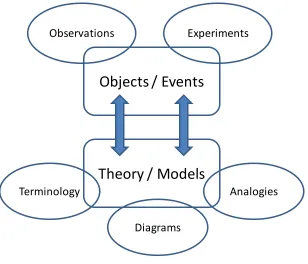
the design of a teaching sequence inphysics3. The “world” of objects and events include the
measurements and observations. The “world” of theories and models include the scientific
explanations to the observable events. The world of theories and models relates to the world
27
mental models of the concepts to explain the observable events. The Two Worlds theoretical
framework was adopted for the design of an electrochemistry teaching sequence that
explicitly relates the concepts of redox reactions and electric circuits to explain
electrochemical processes. In this proposed electrochemistry teaching sequence, students‟
conceptions in electrochemistry are addressed by relating the “world” of theories and models
using terminology, diagrams and analogies as teaching tools. Observations and experiments
are used to explore the “world” of objects and events. Figure 2.1 is my own rendition of this
framework relating objects, events, theories and models with the incorporation of teaching
tools such as observations, experiments, terminology, diagrams and analogies.
In this application of the Two worlds framework, the objects represent concepts studied in
electrochemistry (energy, oxidation, reduction, equilibrium) and the measurements (e.g.
potential, current) are considered the events. Experimentation provides the means to connect
objects and events since experiments allow the measurement of the events. The objects and
events connect to theories and models through the modeling activity (illustrated by the