Detection and Rectification of Distorted
fingerprints Based on Single Fingerprint
Image
Yogita Hagvane1, Prajakta Satarkar2
M.E Student, Dept. of CSE, Shri Vithal Education & Research Institute’s COE, Pandharpur, Solapur
University,Maharashtra, India1
Professor, Dept. of CSE, Shri Vithal Education & Research Institute’s COE, Pandharpur, Solapur
University,Maharashtra, India2
ABSTRACT: Elastic distortion of fingerprints is one of the major causes for false non-match. While this problem
affects all fingerprint recognition applications, it is especially dangerous in negative recognition applications, such as watch list and de duplication applications. In such applications, malicious users may purposely distort their fingerprints to evade identification. In this paper, we proposed novel algorithms to detect and rectify skin distortion based on a single fingerprint image. Distortion detection is viewed as a two-class classification problem, for which the registered ridge orientation map and period map of a fingerprint are used as the feature vector and a SVM classifier is trained to perform the classification task. Distortion rectification (or equivalently distortion field estimation) is viewed as a regression problem, where the input is a distorted fingerprint and the output is the distortion field. To solve this problem, a database (called reference database) of various distorted reference fingerprints and corresponding distortion fields is built in the offline stage, and then in the online stage, the nearest neighbour of the input fingerprint is found in the reference database and the corresponding distortion field is used to transform the input fingerprint into a normal one. Promising results have been obtained on three databases containing many distorted fingerprints, namely FVC2004 DB1, Tsinghua Distorted Fingerprint database, and the NIST SD27 latent fingerprint database.
The main contributions of this paper are:
1) Compiling case studies of incidents where individuals were found to have altered their fingerprints for circumventing AFIS, 2) Investigating the impact of fingerprint alteration on the accuracy of a commercial fingerprint matcher, 3) Classifying the alterations into three major categories and suggesting possible countermeasures, 4) Developing a technique to automatically detect altered fingerprints based on analysing orientation field and minutiae distribution, and 5) Evaluating the proposed technique and the NFIQ algorithm on a large database of altered fingerprints provided by a law enforcement agency. Experimental results show the feasibility of the proposed approach in detecting altered fingerprints and highlight the need to further pursue this problem.
KEYWORDS: Fingerprint, Distortion, registration, nearest neighbor regression.
I. INTRODUCTION
Although automatic fingerprint recognition technologies have rapidly advanced during the last forty years, there still exists several challenging research problems, for example, recognizing low quality fingerprints. Finger-print matcher is very sensitive to image quality as observed in the FVC2006 , where the matching accuracy of the same algorithm varies significantly among different data-sets due to variation in image quality. The difference between the accuracies of plain, rolled and latent fingerprint matching is even larger as observed in technology evaluations conducted by the NIST.
nition system, such as identifying persons in watch lists and detecting multiple enrolment under different names, the user of interest (e.g., criminals) is supposed to be uncooperative and does not wish to be identified. In a positive recog-nition system, low quality will lead to false reject of legitimate users and thus bring inconvenience. The consequence of low quality for a negative recognition system, however, is much more serious, since malicious users may purposely reduce fingerprint quality to prevent fingerprint system from finding the true identity. In fact, law enforcement officials have encountered a number of cases where criminals attempted to avoid identification by dam-aging or surgically altering their fingerprints .
Hence it is especially important for negative fingerprint recognition systems to detect low quality fingerprints and improve their quality so that the fingerprint system is not compromised by malicious users. Degradation of finger-print quality can be photometric or geometrical. Photomet-ric degradation can be caused by non-ideal skin conditions, dirty sensor surface, and complex image background (espe-cially in latent fingerprints). Geometrical degradation is mainly caused by skin distortion. Photometric degradation has been widely studied and a number of quality evaluation algorithms and enhancement algorithms have been proposed. On the contrary, geometrical degradation due to skin distortion has not yet received sufficient attention, despite of the importance of this problem. This is the problem this paper attempts to address. Note that, for a negative fingerprint recognition system, its security level is as weak as the weakest point. Thus it is urgent to develop distorted fingerprint (DF) detection and rectification algorithms to fill the hole.
Elastic distortion is introduced due to the inherent flexibility of fingertips, contact-based fingerprint acquisition procedure, and a purposely lateral force or torque, etc. Skin distortion increases the intra-class variations (difference among fingerprints from the same finger) and thus leads to false non-matches due to limited capability of existing fin-gerprint matchers in recognizing severely distorted finger-prints. the right one contains severe distortion. According to Veri-Finger 6.2 SDK [5], the match score between the left two is much higher than the match score between the right two. This huge difference is due to distortion rather than over-lapping area. While it is possible to make the matching algorithms tolerate large skin distortion, this will lead to more false matches and slow down matching speed.
In this paper, novel algorithms are proposed to deal with the fingerprint distortion problem. See Fig. 2 for the flowchart of the proposed system. Given an input finger-print, distortion detection is performed first. If it is deter-mined to be distorted, distortion rectification is performed to transform the input fingerprint into a normal one. A distorted fingerprint is analogous to a face with expression, which affects the matching accuracy of face recognition systems. Rectifying a distorted fingerprint into a normal fingerprint is analogous to transforming a face with expression into a neutral face, which can improve face recognition performance.
In this paper, distortion detection is viewed as a two-class classification problem, for which the registered ridge orientation map and period map of a fingerprint are used as the feature vector and a SVM classifier is trained to perform the classification task. Distortion rectification (or equivalently distortion field estimation) is viewed as a regression problem, where the input is a distorted fingerprint and the output is the distortion field. To solve this problem, a database of various distorted reference fingerprints and corresponding distortion fields is built in the offline stage, and then in the online stage, the nearest neighbour of the input fingerprint is found in the database of distorted reference fingerprints and the corresponding distortion field is used to rectify the input
II. RELATED WORK
In [2] author seeks to exploit stronger prior knowledge of fingerprints in order to further improve the performance. Realizing that ridge orientations at different locations of fingerprints have different characteristics, we propose a localized dictionaries-based orientation field estimation algorithm, in which noisy orientation patch at a location output by a local estimation approach is replaced by real orientation patch in the local dictionary at the same location. The precondition of applying localized dictionaries is that the pose of the latent fingerprint needs to be estimated. We propose a Hough transform-based fingerprint pose estimation algorithm, in which the predictions about fingerprint pose made by all orientation patches in the latent fingerprint are accumulated. Experimental results on challenging latent fingerprint datasets show the proposed method outperforms previous ones markedly.
In [3] author proposes a novel fingerprint orientation field estimation algorithm based on prior knowledge of fingerprint structure. We represent prior knowledge of fingerprints using a dictionary of reference orientation patches. which is constructed using a set of true orientation fields, and the compatibility constraint between neighbouring orientation patches. Orientation field estimation for latent’s is posed as an energy minimization problem, which is solved by loopy belief propagation. Experimental results on the challenging NIST SD27 latent fingerprint database and an overlapped latent fingerprint database demonstrate the advantages of the proposed orientation field estimation algorithm over conventional algorithms.
In [4] author propose a new fingerprint enhancement algorithm that selectively applies contextual filtering starting from automatically-detected high-quality regions and then iteratively expands toward low-quality ones. The proposed algorithm does not require any prior information like local orientations or frequencies. Experimental results over both real (FVC2004 and FVC2006) and synthetic (generated by the SFinGe software) fingerprints demonstrate the effectiveness of the proposed method.
In [5] As During the past decade, many efforts have been made to use palm prints as a biometric modality. However, most of the existing palm print recognition systems are based on encoding and matching creases, which are not as reliable as ridges. This affects the use of palm prints in large-scale person identification applications where the biometric modality needs to be distinctive as well as insensitive to changes in age and skin conditions. Recently, several ridge-based palmprint matching algorithms have been proposed to fill the gap. Major contributions of these systems include reliable orientation field estimation in the presence of creases and the use of multiple features in matching, while the matching algorithms adopted in these systems simply follow the matching algorithms for fingerprints. However, palm prints differ from fingerprints in several aspects: 1) Palm prints are much larger and thus contain a large number of minutiae, 2) palms are more deformable than fingertips, and 3) the quality and discrimination power of different regions in palm prints vary significantly. As a result, these matchers are unable to appropriately handle the distortion and noise, despite heavy computational cost. Motivated by the matching strategies of human palm print experts, we developed a novel palm print recognition system. The main contributions are as follows: 1) Statistics of major features in palm prints are quantitatively studied, 2) a segment-based matching and fusion algorithm is proposed to deal with the skin distortion and the varying discrimination power of different palm print regions, and 3) to reduce the computational complexity, an orientation field-based registration algorithm is designed for registering the palm prints into the same coordinate system before matching and a cascade filter is built to reject the non matched gallery palm prints in early stage. The proposed matcher is tested by matching 840 query palm prints against a gallery set of 13,736 palm prints. Experimental results show that the proposed matcher outperforms the existing matchers a lot both in matching accuracy and speed.
III.PROPOSED SYSTEM
A nearest neighbour regression approach is used to predict the distortion field from the input distorted fingerprint and then the inverse of the distortion field is used to transform the distorted fingerprint into a normal one.
Fingerprint Registration:
Fingerprint shaves to be registered in a fixed coordinate system. For this task, we propose a multi-reference based fingerprint registration approach. We collected a distorted fingerprint database called distorted fingerprint database. A FTIR fingerprint scanner with video capture functionality was used for data collection. Each participant is asked to press a finger on the scanner in a normal way, and then distort the finger by applying a lateral force of a torque and gradually increase the force. In the online stage, given an input fingerprint, we perform the registered reference fingerprints. Level 1features orientation map, singular points, period map are extracted using traditional algorithms. According to whether the upper core point is detected or not, the registration approach can be classified into two cases. If the upper core point is detected in the input fingerprint, we align the upper core point to the centre point of reference fingerprints. Finally ,we register the ridge orientation map and period map of the input fingerprint to the fixed coordinate system by using the obtained pose information.
Feature Vector Extraction:
A feature vector by sampling registered orientation map and period map. The sampling grid of period map covers the whole fingerprint, while the sampling grid of orientation map covers only the top part of the fingerprint. This is because the orientation maps below finger centre are very diverse even within normal fingerprints.
Statistical Modelling of Distortion Field:
In statistical fingerprint distortion model, the distortion fields (or deformation fields) between paired fingerprints (the first frame and the last frame of each video) in the training set. The distortion field between a pair of fingerprints can be estimated based on the corresponding minutiae of the two fingerprints. Unfortunately, due to the severe distortion between paired fingerprints, existing minutiae matchers cannot find corresponding minutiae reliably. Thus, we extract minutiae in the first frame using VeriFinger and perform minutiae tracking in each video. Since the relative motion between adjacent frames is small, reliable minutiae correspondences between the first frame and the last frame can be found by this method. Given the matching minutiae of a pair of fingerprints, we estimate the transformation using thin plate spline model. We define a regular sampling grid on the normal finger-print and compute the corresponding grid (called distortion grid) on the distorted fingerprint using the TPS model.
Fingerprint Distortion Detection:
Fingerprint distortion detection can be viewed as a two-class classification problem. We used the registered ridge orientation map and period map as the feature vector, which is classified by a classifier. Distorted Fingerprints are viewed as positive samples and normal fingerprints as negative samples. If a distorted fingerprint is classified as a positive sample, a true positive occurs. If a normal fingerprint is classified as a positive sample, a false positive occurs.
Distorted Fingerprint Rectification:
fingerprint rectification algorithm consists of an offline stage and an online stage. In the offline stage, a database of distorted reference fingerprints is generated by transforming several normal reference fingerprints with various distortion fields sampled from the statistical model of distortion fields. In the online stage, given a distorted input fingerprint(which is detected by our algorithm), we retrieval its nearest neighbour in the distorted reference fingerprint database and then use the inverse of the corresponding distortion field to rectify the distorted input fingerprint.
Fig.2 .flowchart of distorted fingerprint rectification.
The proposed distorted fingerprint rectification algorithm consists of an offline stage and an online stage. In theoffline stage, a database of distorted reference fingerprints is generated by transforming several normal reference fingerprints with various distortion fields sampled from the statistical model of distortion fields. In the online stage, given a distorted input fingerprint (which is detected by the algorithm described in Section 3), we retrieval its nearest neighbor in the distorted reference fingerprint database and then use the inverse of the corresponding distortion field to rectify the distorted input fingerprint. The distorted fingerprint rectification flowchart is shown in figure 2.
IV.SIMULATION RESULTS
Fig.3 Detection ROC curves of our previous algorithm and current algorithm on the (a)FVC2004 DB1 and (b)Tsinghua DF database.
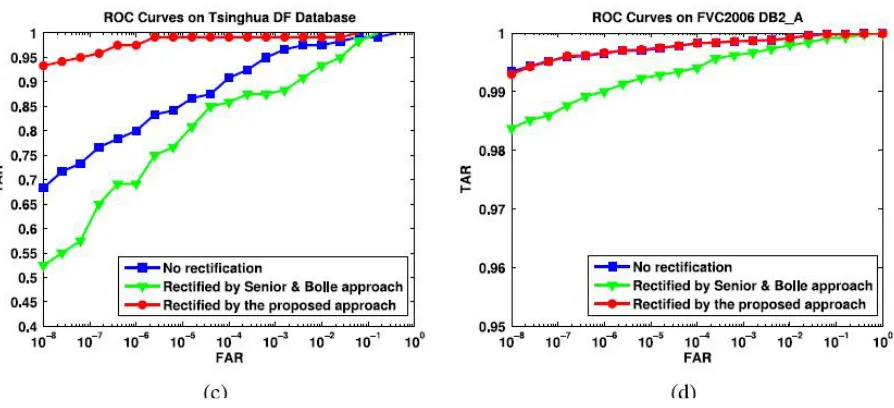
The final purpose of rectifying distorted fingerprints is to improve matching performance. To quantitatively evaluate the contribution of the proposed rectification algorithm to the matching accuracy, we conducted three matching experiments on each of the following four databases: FVC2004 DB1, distorted subset of FVC2004 DB1, Tsinghua DF database, and FVC2006 DB2_A. VeriFinger 6.2 SDK was used as the fingerprint matcher. The input images to Veri- Finger in the three experiments are original fingerprints, rectified fingerprints by Senior and Bolle approach, and rectified fingerprints by the proposed algorithms, respectively. No impostor matches were conducted because the matching score of VeriFinger is linked to the false accept rate (FAR). FVC2006 DB2_A was used to examine whether distortion rectification may have negative impact on matching accuracy in situations where distorted fingerprints are absent or scarce. The distorted subset of FVC2004 DB1 consists of 89 distorted fingerprints and mated normal fingerprints. It was separately tested in order to clearly evaluate the contribution of distortion rectification to matching distorted fingerprints alone. The ROC curves on the four databases are shown in Fig. 4.
Fig 5.The ROC curves of three fingerprint matching experiments on each of following four databases: (a)FVC2004 DB1,(b)distorted subset of FVC2004 DB1, (c)Tsinghua DF database and (d)FVC2006 DB2_A.
The input images to VeriFinger in three matching experiments are original fingerprints, fingerprint rectified by Senior and Bolle approach, and fingerprints rectified by the proposed approach respectively.
V. CONCLUSION AND FUTURE WORK
The simulation results showed that the proposed algorithm performs better than previous algorithms. This paper described a novel distorted fingerprint detection and rectification algorithm. For distortion detection, the registered ridge orientation map and period map of a fingerprint are used as the feature vector and a SVM classifier is trained to classify the input fingerprint as distorted or normal. For distortion rectification (or equivalently distortion field estimation), a nearest neighbour regression approach is used to predict the distortion field from the input distorted fingerprint and then the inverse of the distortion field is used to transform the distorted fingerprint into a normal one. The experimental results on FVC2004 DB1, Tsinghua DF database, and NIST SD27 database showed that the proposed algorithm can improve recognition rate of distorted fingerprints evidently.
A major limitation of the current approach is efficiency. Both detection and rectification steps can be significantly speeded up if a robust and accurate fingerprint registration algorithm can be developed. Another limitation is that the current approach does not support rolled fingerprints. It is difficult to collect many rolled fingerprints with various distortion types and meanwhile obtain accurate distortion fields for learning statistical distortion model. It is our ongoing work to address the above limitations.
REFERENCES
[1] X. Si, J. Feng, and J. Zhou, “Detecting fingerprint distortion from a single image,” in Proc. IEEE Int. Workshop Inf. Forensics Security,pp.1– 6,2012.
[2] V. N. Dvornychenko, and M. D. Garris, “Summary of NIST latent fingerprint testing workshop,” Nat. Inst. Standards Technol., Gaithersburg, MD, USA, Tech. Rep. NISTIR 7377, Nov. 2006.
[3] L. M. Wein and M. Baveja, “Using fingerprint image quality to improve the identification performance of the U.S. visitor and immigrant status indicator technology program,” Proc. Nat. Acad. Sci. USA, vol. 102, no. 21, pp. 7772–7775, 2005
.[4] S. Yoon, J. Feng, and A. K. Jain, “Altered fingerprints: Analysis and detection,” IEEE Trans. Pattern Anal. Mach. Intell., vol. 34, no. 3, pp. 451– 464, Mar. 2012.
[6] F. Alonso-Fernandez, J. Fi_errez-Aguilar, J. Ortega-Garcia, J. Gonzalez- Rodriguez, H. Fronthaler, K. Kollreider, and J. Big€un, “A comparative study of fingerprint image-quality estimation methods,” IEEE Trans. Inf. Forensics Security, vol. 2, no. 4, pp. 734–743, Dec. 2007.
[7]L. Hong, Y. Wan, and A. K. Jain, “Fingerprint image enhancement: Algorithm and performance evaluation,” IEEE Trans. Pattern Anal. Mach. Intell., vol. 20, no. 8, pp. 777–789, Aug. 1998.
[8] J. Feng, J. Zhou, and A. K. Jain, “Orientation field estimation for latent fingerprint enhancement,” IEEE Trans. Pattern Anal. Mach. Intell., vol. 35, no. 4, pp. 925–940, Apr. 2013.
BIOGRAPHY
Yogita Hagvane is a M.E. student in Computer Science and Technology ,Shri Vithal Education & Research Institute’s