Survey Paper on Generation of Facial
Expression Using Block Based Local Binary
Patterns for Face Recognition
Aiswarya U, Beshiba Wilson
PG Student, Dept. of CSE, Lourdes Matha College of Science and Technology, Trivandrum, Kerala, India
Associate Professor & HOD, Dept of CSE, Lourdes Matha College of Science and Technology, Trivandrum,
Kerala, India
ABSTRACT: Changes in the facial patches play an important role in facial expression recognition. For facial expression recognition is to extract emotions features accurately. Facial expression recognition based on two main categories on the type of geometry-based and appearance based feature. This paper shows the performance in automatically capturing facial movement features in static images based on expression recognition by using appearance features of selected facial patches. Majority of the areas are found around the mouth and eyes. JAFFE and CK database, show best performs. A basic six emotions anger creates most misrecognitions factor. Largest size of patches is requiresby the JAFFE database as compare to CK data base to retrieve useful information. Facial landmark detection method and also by using recently proposed CLM model based on DRMF method expression recognition. By using the facial landmark detection method and also by using recently proposed CLM model based on DRME method expression recognition is carried out recognition accuracy are similar in both cases.In this paper we evaluate facial expression recognition using salient facial patches. Here SVM classifier algorithm can be used for face detection. An automated Learning Free Landmark Detection, feature classification discriminative features can also be analysed for various methods of facial expression
KEYWORDS: Facial patches, Facial landmark detection, Feature selection, CLM,DRMF,JAFFE database
I. INTRODUCTION
Facial expression, being an important mode of communicating human emotions its application include human computer interaction, human behaviour understanding, detection of mental disorder, synthetic human expressions, social robot interactions. Various methods have been proposed for solving problem. This paper is about the discussion of various techniques used for recognition of face. The changes in facial feature consist of position of features and shape changes are mostly caused by the movement of facial elements and muscles during the flow of emotional expression. Facial expression analyses arebased on detection of basic emotions [1]: anger, fear, disgust, happiness, sadness, and surprise.
Viola and Jones was used to detect a face from an image. A human face is detected; a complex method was proposed to locate pupils so that the located face image can be rotated. An automatic facial expression recognition system is based on self-organizing feature maps (SOMs) [6].
Facial expression mainly based on appearance based and geometric based method. Here appearance based [9] method the active patches are chosen to be the pixel concentration values in an image of the object. These pixel intensities that directly to the effulgence of light emitted from an object along certain radiation in space. Ingeometricbased method [4] the recognition of expression by tracing the shape and size of facial landmarks using multiclass support vectormachines.
II. LITERATURE REVIEW
A. Analysis of Face Recognition under Varying Facial Expression[3]
Facial expression is a nonverbal communication [12]. The most of the researchers have investigated various algorithms to handle expression variation. Facial expression started in nineteen century. During communication facial expression can be acquired in uncontrollable condition like occlusion pose, illumination and expression variation etc. A different facial expression recognition algorithm provides to analyze the emotions produced by human faces. Here three different techniques can be used to analyze facial expression 1) motion-based 2) model-based and 3) muscles-based approaches. The scope for existing is to answering the question of effectively dealing with such problems. Facial expression was focused to many social psychologists, clinical and medical practitioners etc.
Advantages:
Recognize faces under varying facial expressions.
Even though some approaches provide desired results but do not offer more accurate domino effect Disadvantages:
More complex for automatic machine facial expression recognition.
B. Manifold of Facial Expression [4]
Manifold means various facial expressions. Here apply Active Wavelet Networks (AWN) on the image sequences for feature localization. There are two types of embedding in high dimensional space to a low dimensional space: locally linear embedding (LLE) [8] and Lipschitz embedding. LLE is used for visualizing expression manifolds. The expression can be approximately considered as a super-spherical surface in Lipschitz embedding. A nonlinear alignment algorithm offacial expression fromdifferent subjects to derive manifold. People can recognize facial expression easily and the appearance of the expression varies by different individuals. To authenticate the expression manifolds, images from different modes are formed for future testing. Emotional expressions can be used for the structure of the manifold.
Advantages:
A nonlinear alignment algorithm can be the similar on one generalized manifold. Disadvantages:
All facial expressions expressible by the human face can be classified under the six basic emotion categories
C. A Study of Techniques for Facial Detection and Expression Classification [5]
An automatic facial expression is an important component for human-machine interfaces. Applications are user authentication, person identification, video surveillance, information security, data privacy etc. Facial recognition is categorized into two types: holistic based facial recognition and feature based facial recognition. Holistic based on the image data as one entity without divide into different region in the face and feature based methods identify certain points on the face such as eyes, nose and mouth etc. In most expression recognition approaches that needs some control over the imaging conditions because different real-world applications require operational flexibility.
Advantages:
Knowledge Based
Active Shape Model
Appearance Based
Disadvantages:
Highly dynamic in theirorientation.
D. An SOM-based Automatic Facial Expression Recognition System [6]
Automatic facial expression recognition problem is a very challenging problem because it involves in three sub-problems: 1) face detection, 2) facial expression feature extraction, and 3) expression classification. An automatic facial expression recognition system depends on self-organizing feature maps, which provides an effective solution to the three sub-problems. The performance of the system was computed on two well-known facial databases. Their recognition rate is 90%. Human face is an elastic object that consists of organs, numerous muscles etc. The SOM algorithm is a well-known unsupervised learning algorithm. Here there are two facial features: Geometrical and appearance based. Appearance based [9][10] can be extracted on either the whole face and geometrical features focus on the extraction of shapes and locations.
Advantages:
Minimize computational time while achieving high detection accuracy.
Disadvantages:
Effective locate the regions of eyes but could not precisely locate the centers of the pupils.
E. A Dynamic Texture-Based Approach to Recognition of Facial Actions and Their Temporal Models [7]
A dynamic texture-based approach to the recognition offacial Action Units. In current automatic analysis of facial expressions there are two main solutions consider emotion detection and facial muscle action detection. Facial expression analysis can be divided into geometric and appearance-based approaches. Dynamic texture recognition can be seen as a generalization of appearance-based approaches. Geometric features include shapes and positions of face components. Both the spatial and temporal domain histogram descriptors are used to derive motion orientation. FFD method has been tested using the Cohn-Kanade database. Facial expressions can predict the onset and remission of depression that identify automate the analysis of facial expressions.
Disadvantages:
The selected features correspond reasonably well to the intuitively interesting features/regions for each AU.
III.PROPOSED SOLUTION
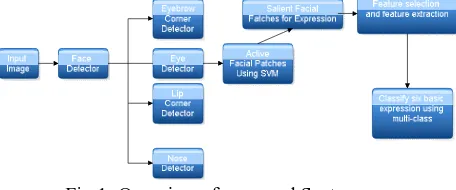
Changes in facial expressions involve shrinkage and expansion of facial muscles which alters the position of facial landmarks. Along with this, the texture area also changes. This project tries to understand the addition of different areas towards automatic facial expression. The overview of purposed method is shown in figure 2. The correct facial landmark detection and extraction of appearance features from active face regions develop the performance of expression recognition.
Fig 1: Overview of proposed System
IV.EXPECTED RESULTS
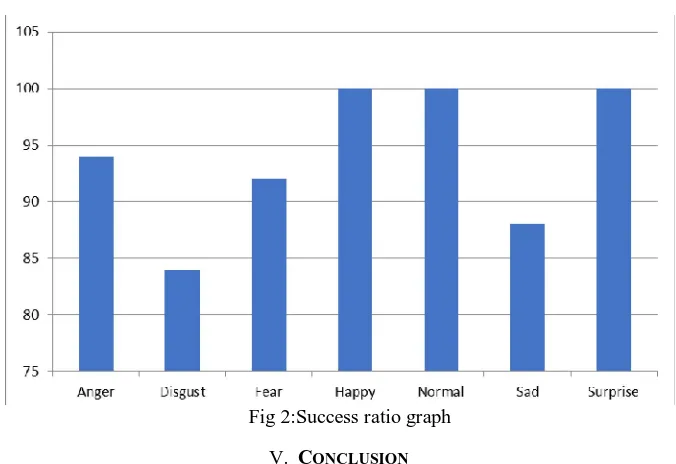
In proposed Solution the Experimental results of facial expression recognition based on the following dataset. Its recognition rate is 93.98.
Percentage Anger Disgust Fear Happy Normal Sad Surprise
Anger 94 0 0 0 6 0 0
Disgust 7 84 9 0 0 0 0
Fear 0 0 92 0 8 0 0
Happy 0 0 0 100 0 0 0
Normal 0 0 0 0 100 0 0
Sad 0 0 6 0 6 88 0
Fig 2:Success ratio graph
V. CONCLUSION
Automatic facial expression is an important component for human-machine interface. Facial landmark detection followed by features extraction. Accuracy is depending on the type of features extraction. The challenges are highly dynamic in their orientation, lightening, scale, facial expression and occlusion. Facial expression recognition is analysed with various methods of facial detection. Facial expression recognition is identified by various methods of facial detection, facial feature extraction and classification. An efficient method to identify facial expression is presented in this paper. Face detection can be used by Viola Jones algorithm. Training is implemented using SVM. An efficient facialexpression system that classify six basic expressions. During expression generation all the active facial patches are extracted. The system analyseactivepatches and find their respective areas on face which are used for different expressions. The recently proposed CLM model based on DRMF method. In two cases accuracy is almost similar.
REFERENCES
1. S L Happy, and Aurobinda Routray, “Automatic Facial Expression Recognition Using Features of Salient Facial Patches” IEEE Transactions on Affective Computing, vol. 6, no.1, January-March 2015.
2. P. Ekman, W. V. Friesen, and J. C. Hager, “FACS Manual,” Salt Lake City, UT, USA: A Human Face, May 2002.
3. Marryam Murtaza, Muhammad Sharif, Mudassar Raza, and Jamal Hussain Shah (2013), “Analysis of Face Recognition under Varying Facial Expression: A Survey”, International Arab Journal of Information Technology, Vol. 10, No. 4, July 2013.
4. Ya Chang, Changbo Hu,Matthew Turk, (2011), “Manifold of Facial Expression”, International Journal for Computer Vision 2011.
5. G.Hemalatha1, C.P. Sumathi (2014),” A Study of Techniques for Facial Detection and Expression Classification”, International Journal of Computer Science & Engineering Survey (IJCSES) Vol.5, No.2, April 2014.
6. Mu-Chun Su1 , Chun-Kai Yang1 , Shih-Chieh Lin(2013)”, An SOM-based Automatic Facial Expression Recognition System “,International Journal on Soft Computing, Artificial Intelligence and Applications (IJSCAI), Vol.2, No.4, August 2013.
7. Sander Koelstra, Maja Pantic”(2010), ‘A Dynamic Texture-Based Approach to Recognition of Facial Actions and Their Temporal Models’, IEEE Transactions On Pattern Analysis And Machine Intelligence, Vol. 32, No. 11, November 2010
8. Nathan Mekuz, Christian Bauckhage, and John K. Tsotsos ‘Face Recognition with Weighted Locally Linear Embedding’ Department of Computer Science, Center For Vision Research York University Toronto, Ontario, Canada
9. M. Bartlett, G. Littlewort-Ford, M. Frank, C. Lainscsek, I. Fasel, and J. Movellan, “Recognizing Facial Expression: Machine Learning and Application to Spontaneous Behavior,” Proc. IEEE Conf. Computer Vision and Pattern Recognition, pp. 568-573, 2005.
11. P. Ekman, W. Friesen, and J. Hager, The Facial Action Coding System: A Technique for the Measurement of Facial Movement. A Human Face, 2002.
12. Hsieh C., Lai S., and Chen Y., “An Optical FlowBased Approach to Robust Face Recognition under Expression Variations,” IEEE Transaction on Image Processing, vol. 19, no. 1, pp. 233-240, 2010.
BIOGRAPHY
Aiswarya U is a PG student in Computer Science and Engineering in Lourdes Matha College of Science and Technology, Trivandrum, Kerala. She did B Tech degree in Lourdes Matha College of Science and Technology.