Primordial germ cell migration
KATHLEEN MOLYNEAUX and CHRISTOPHER WYLIE*
Division of Developmental Biology, Children's Hospital Research Foundation, Cincinnati, Ohio, USA
ABSTRACT Mutational and antisense screens in Drosophila and zebrafish, and transcriptional profiling and time-lapse analysis in the mouse, have contributed greatly to our understanding of PGC development. In all three systems, the behavior of PGCs is controlled by growth factors which signal through G-protein coupled receptors and/or tyrosine kinase receptors. Additionally, regu-lated cell-cell and cell-substrate adhesion is important for PGC motility. Finally, localized growth factors may control PGC survival and consequently PGC position. Chemotaxis, regulated adhesion and cell survival are important for multiple migration processes which occur during development and disease. PGC migration shares these features.
KEY WORDS:
primordial germ cell, migration, Drosophila, zebrafish, mouse
0214-6282/2004/$25.00 © UBC Press
Printed in Spain www.ijdb.ehu.es
*Address correspondence to: Dr. Christopher Wylie, Division of Developmental Biology, Children's Hospital Research Foundation, Cincinnati, Ohio, 45229, USA. Fax: 513-636-4317. e-mail: [email protected]
Introduction
Directed migration of cells in culture is often initiated by growth factor mediated activation of tyrosine kinase receptors or G-protein coupled receptors. These initiate changes in the cytosk-eleton and alteration of the cell-substrate adhesion (reviewed in Ridley et al., 2003). Actin dynamics at the leading edge of a cell results in the extension of filopodia/lamellopodia and transloca-tion of the cell body. After extension, the trailing edge of the cell is retracted via a myosin dependent process. Cell culture models have allowed for the elegant analysis of the signaling machinery required for cell-shape changes and motility. It is likely that the general paradigm for cell migration established from in vitro studies will also apply to migratory populations that arise during embryogenesis or disease in vivo. However, the fact that these cell populations often migrate long distances and through tissue environments that change during migration adds an extra layer of complexity to the process of cell homing/metastasis in multi-celled organisms. In this review, we will discuss the process of PGC migration as an example of how cells move within a complex and changing tissue environment.
PGCs are the embryonic precursors of the gametes. The identification of the PGC marker gene alkaline phosphatase in the mouse (Chiquoine, 1954) and more recently the RNA-binding factor, vasa in flies and zebrafish (Schupbach and Wieschaus, 1986; Hay et al., 1988; Olsen et al., 1997; Yoon et al., 1997) have allowed PGCs to be visualized in the embryo. In all systems, PGCs form far from the site of the developing gonads and migrate to the sites of developing ovaries or testes. In the mouse (Fig. 1), PGCs can first be detected at embryonic day 7.5 (E7.5) as a
Abbreviations used in this paper: BMP, bone morphogenetic protein; Cx43, connexin 43; ECM, extracellular matrix; FGF, fibroblast growth factor; Foi, fear-of-intimacy; HmG-CoA reductase, 3-hydroxy-3-methylglutaryl coenzyme A reductase; LIF, leukemia inhibitory factor; LPP, lipid phosphate phosphohydrolase; PAP, phosphatidic acid phosphatase; PGCs, primordial germ cells; SDF-1, stromal derived factor 1; SGPs, somatic gonadal precursors; TGFβ, transforming growth factor β.
A
B
C
D
E
How is pgc migration initiated?
Mouse
PGCs in the mouse may be motile from their inception (E7.25) to the point where they colonize the genital ridge (E11.5). Expression of BMP4/BMP8b in extraembryonic tissue induces the formation of PGCs in the proximal epi-blast (Lawson et al., 1999; Ying et al., 2001). Shortly after formation, PGCs move through the posterior primitive streak and invade the definitive endo-derm and posterior extraembryonic structures. PGCs at this stage have a polarized morphology and have been observed extending processes in time lapse movies (Anderson et al., 2000). The initiation of PGC motility may have its roots in the formation of PGCs or in the subsequent gastrulation process. Two genes, stella and fragillis/mil-1 were recently identified in cDNA librar-ies created from nascent PGCs (Saito et al., 2002, Tanaka and Matsui, 2002). Stella is a novel gene with no known function. Fragilis is a member of an interferon inducible family of genes implicated in homotypic cell-cell adhe-sion and cell-cycle control. At E7.25, fragilis is expressed in the posterior epiblast with highest expression over-lapping the region where PGCs are formed. At this stage, PGCs are clus-tered and appear non-motile. 24 hrs. later fragilis expression has been downregulated and PGCs have scat-tered and moved into the endoderm (Saitou et al., 2002). This suggests that regulated adhesion may play a role in initiating PGC motility. How-ever, nascent PGCs were found to express two other members of the Within the past six years, a molecular model for PGC
develop-ment has started to emerge. Forward genetic screens in Drosophila (Moore et al., 1998) and in situ, antisense and genetic screens in Zebrafish have identified genes required at various stages of PGC migration (Doitsidou et al., 2002; Knaut et al., 2003; Weidinger et al., 2003). In the mouse, single cell transcriptional profiling has been used to identify genes expressed in nascent PGCs (Saitou et al., 2002; Tanaka and Matsui, 2002) and chip analysis has been used to identify genes that are differentially expressed in migratory and non-migratory germ cells (Molyneaux et al., 2004). In addition, lines of mice have been established that express a live marker (GFP) under control of germ cell specific promoters allowing for the first time direct observation of PGC behavior in the mammalian embryo (Anderson et al., 1999). From this wealth of new genetic and behavioral data, we can begin to piece together how PGCs initiate migration and how they home in on the positions of the gonads.
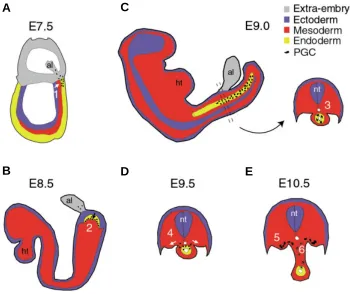
Fig. 1. Germ cell migration in the mouse. The behavior of PGCs can be divided into six stages based on time lapse analysis of PGCs in tissue dissected from E7.5 (Anderson et al., 2000) and from E9.0-E10.5 embryos (Molyneaux et al., 2001). The behavior of PGCs at E8.5 is inferred from PGC position and morphology at this stage. Arrows indicate the net direction of PGC movements. (A) PGCs are induced to form in the proximal epiblast. During gastrulation, they move through the primitive streak and invade the definitive endoderm, parietal endoderm and allantois (step 1). (B) PGCsin the definitive endoderm are incorporated into the hindgut pocket (step 2). This process may be passive or active. Some PGCs remain in the allantois at this stage and the fate of these cells is uncertain. (C) By E9.0, the hindgut has extended and closed to form a tube. PGCs are confined to the hindgut, but move freely around the cells of the hindgut epithelium (step 3). PGC motility appears random with respect to the body axes at this stage. PGCs circle the gut and/or move towards the anterior or posterior. (D) Betweeen E9.0 and E9.5, PGCs emerge from the dorsal side of the hindgut and migrate towards the developing genital ridges (step 4). (E) At E10.5, PGCs begin to cluster forming a network of migrating cells (step 5). PGCs are slowing. PGCs left in midline structures fragment and die (step 6). By E11.5 most PGCs have colonized the genital ridge. The entire migration process takes approximately four days (E7.5-E11.5). Abbreviations: al, allantois; ht, heart; nt, neural tube.
C
B
A
E
D
A
B
C
D
gastrulating cells for days after the process of gastrulation is complete.
Drosophila
In flies, localized maternal components control the formation of PGCs (reviewed in Starz-Gaiano and Lehmann, 2001) and initially these cells have a spherical non-motile morphology. There is confusion in the literature as to when PGCs in this system become motile. Based on the morphology of PGCs stained with antibodies to Vasa, it was proposed that PGCs are passively incorporated into the posterior midgut and initiate motility between stages 10 and 11 when they crawl out of the gut (Warrior, 1994). This process does not require inductive signals from the mesoderm or gonad (Jaglarz and Howard, 1994; Warrior, 1994), but may be initiated by changes in the epithelium of the midgut (Callaini et al., 1995; Jaglarz and Howard, 1995). Mutations that perturb midgut formation prevented PGCs from assuming a migratory shape. It was also found that PGCs arising from fluorescently labeled transplanted pole cells
that remained outside the embryo assumed a migratory morphol-ogy much earlier than PGCs within the midgut pocket suggesting that the early embryonic environment may have a repressive influence on PGC motility (Jaglarz and Howard, 1995). In support of this, explanted pole cells were found to be motile in culture (Jaglarz and Howard, 1995). More recent data demonstrated that PGCs in the embryo assume a migratory morphology earlier than initially proposed and this initiation of pole cell motility may be activated via Torso (Li et al., 2003). Torso is a maternally inherited transcript encoding for a tryosine kinase receptor involved in patterning the dorsal and ventral poles of the Drosophila embryo (reviewed in Duffy and Perrimon, 1994). Signaling via Torso was shown to be required for activation of Jak/Stat and Ras pathways within PGCs (Li et al., 2003). Hyperactivation of these pathways resulted in an increase in pole cell numbers and premature activation of migration. Likewise a loss of Torso signaling resulted in a reduction of pole cell numbers and sluggish PGC migration and poor internalization. Hence PGCs may actively migrate into the
Fig. 2. Germ cell migration in Drosophila. The behavior of PGCs can be divided into four stages based on the position and morphology of PGCs (Warrior, 1994) and the analysis of mutations affecting PGC position (Moore et al., 1998). Pole cells form at the posterior end of the embryo at the blastoderm stage (stage 5, 2 hpf (hours post fertilization)). (A) During germ band extension, the pole cells move anteriorly and become internalized along with the posterior midgut (step 1). This process may be passive or active. (B) PGCs emerge from the ventral side of the midgut and move into the overlying mesoderm (step 2). (C) Germ cells move towards the somatic gonadal precursors, forming two bilateral lines within parasegments 10-13 (step 3). (D) PGCs and SGPs adhere and re-arrange forming tight clusters of cells within parasegment 10 (step 4). The entire migration process takes approximately 7 hours (Stage 8-Stage14). Staging is based on a modification of the Hartenstein stages described in Weigmann et al. (2003). Abbreviations: fgp, fore gut pocket; mgp, midgut pocket.
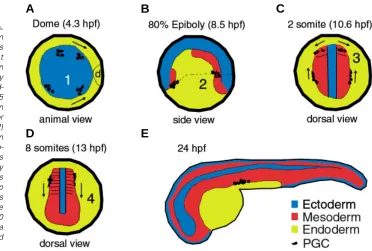
Fig. 3. Germ cell migration in Zebrafish. This figure is a simplification adapted from Weidinger et al. (1999). Four clusters of PGCs are formed during the cleavage stages. (A)At the dome stage (4.3 hpf), PGC clusters within the deep blastoderm begin to move dorsally (step 1). They are excluded from dorsal mid-line structures (d). (B) At 80% epiboly (8.5 hpf), PGCs form a line at the border between the head and trunk mesoderm (cluster 1), or align within the lateral mesoderm (cluster 2) (step 2). (C) PGC clusters move towards an intermediate target within the lateral meso-derm (step 3). They form bilateral clusters between the 1st and 3rd somite and may
temporarily cease moving. (D) PGC clusters move posteriorly to colonize the gonad (step 4). (E) By 24 hpf, PGCs have formed clusters between the 8th and 10th somite. The entire
midgut invagination (Li et al., 2003). Also, Torso signaling in flies may be analogous to the role of the receptor tyrosine kinase c-kit in PGC development in the mouse (see below) (Li et al., 2003).
Zebrafish
Dead end was the first factor found to play a specific role in the initiation of PGC motility. Dead end encodes a novel RNA-binding protein and was identified in zebrafish in a large-scale expression screen for transcripts expressed in PGCs (Weidinger et al., 2003). In zebrafish, PGCs are non-motile during the cleavage period and through most of the blastula period. They become motile at the dome stage (4.3 hrs. post-fertilization) and during gastrulation, the four PGC clusters found within the deep blastoderm move dorsally. Blocking dead end translation in zebrafish embryos blocked this initial migration step. At the dome stage, in dead-end depleted embryos, PGCs were no longer found in the deep blastoderm but were instead located in ectopic locations in the surface layer. These ectopic cells never assumed a motile phenotype, remained tightly adherent to each other and eventually died. Dead-end homologues have been identified in PGCs in Xenopus, chicken and mouse. However, in the mouse, dead end is expressed in PGCs after the migratory stages hence its function in PGC devel-opment may not be entirely conserved.
How do pgcs find their targets?
Mouse
Time lapse analysis of PGCs in tissue dissected from mouse embryos identified six distinct stages of PGC behavior (Fig. 1) including invasion of the endoderm (1), passive or active migration into the hindgut (2), random migration within the hindgut (3), migration from the gut to the genital ridges (4), clustering at the ridges (5) and cell death within midline structures (6). At E7.5, PGCs move through the primitive streak and into the definitive endoderm. Some PGCs also end up in the allantois and/or parietal endoderm. The fate of PGCs in extraembryonic structures remains uncertain, but PGCs in the definitive endoderm become incorpo-rated into the hindgut and by E9.0, can be found moving within and around the cells of the hindgut epithelium (Molyneaux et al., 2001). Morphogenetic movements of the embryo between E7.5 and E8.5 have made it difficult to observe PGC behavior during formation of the hindgut; hence it is unclear whether the colonization of the gut is an active or a passive process for PGCs. However, at E8.5, PGCs on the lip of the hindgut pocket have a rounded non-motile morphology suggesting that PGCs are passively incorporated into the gut and then re-initiate motility. At least two proteins regulate PGC behavior within the gut, E-cadherin and C-kit/Steel. Cells of the hindgut epithelium express the Ca++ dependent adhesion molecule E-cadherin; whereas PGCs within the gut do not (Bendel-Stenzel et al., 2000). The lack of strong adhesive interactions may allow PGCs to move freely within the gut. PGCs upregulate E-cadherin expression upon leaving the gut and this transition may be involved in the emigration process. The Steel-c-kit interaction is required for PGCs to colonize, survive and/or migrate within the gut. Mutations in the tyrosine-kinase receptor, Kit and its mem-brane-bound ligand, Steel Factor cause a dramatic reduction in PGC numbers by E9.5 (Besmer et al., 1993). Additionally, PGCs remaining in Kit mutant embryos are mislocalized. At E9.0, PGCs can normally be found scattered around the entire circumference
of the gut. However, PGCs in We/We (the White extreme allele of
Regulated PGC survival also appears to be an important mecha-nism for controlling PGC position in the mouse embryo. At E10.5, lagging PGCs found within the hindgut mesentery and the midline of the body wall fragment and die during time lapse analysis (Molyneaux et al., 2001). Loss of Bax, a pro-apoptotic member of the Bcl-2 family blocked this process and resulted in the accumulation of ectopic PGCs in midline structures (Stallock et al., 2003). Localized survival factors are likely to control PGC survival and hence, PGC position during the migratory stages. Many growth factors have been found to affect PGC survival in culture (reviewed in Donovan and de Miguel, 2003) and a cocktail of LIF, FGF2 and steel factor can immortalize PGCs (Matsui et al., 1992, Resnick et al., 1992). As discussed above, interactions between Steel and c-Kit are necessary to support PGC survival during the early migratory stages, but it is uncertain whether localized expression of Steel controls PGC behavior during directed migration. Also, the role of FGF2 and LIF in germ cell development in vivo remains unclear.
Drosophila
PGC migration in flies can be divided into four stages, internaliza-tion of the pole cells (1), emigrainternaliza-tion of PGCs from the gut (2), lateral migration of PGCs (3) and gonad coalescence (4) (Fig. 2). Torso activity is required for efficient incorporation of pole cells into the hindgut pocket (see above). Loosening of cell-cell contacts between the cells of the midgut epithelium allows PGCs to emigrate from the gut (Callaini et al., 1995; Jaglarz and Howard, 1995) and a repulsive signal mediated via Wunen/Wunen2 forces PGCs away from the gut towards the overlying mesoderm (Starz-Gaiano et al., 2001; Zhang et al., 1997). Wunen and wunen2 are Drosophila homologues of the mammalian lipid phosphate phosphohydrolases (LPPs), which are also called phosphatidic acid phosphatases (PAPs ). There are three homologues in the mouse (LPP1/Pap2a, LPP2/Pap2c and LPP3/ Pap2b). Only one of the mammalian LPPs (LPP2) has been targeted (Zhang et al., 2000). These animals have no obvious defect in PGC development hence it remains uncertain whether LPPs have a conserved role in PGC development. Wunens/LPPs are responsible for the turnover of small lipids implicated in chemotaxis and cell survival. Hence, their repulsive activity could be mediated directly (by generation of a lipid breakdown product that acts as a PGC repellent) or indirectly (by degradation of a lipid attractant). PGCs may be attracted to lipid intermediates generated by activity of HmG-CoA reductase as loss of this enzyme was found to prevent PGCs from colonizing the gonads and ectopic expression of Hmg-CoA reduc-tase was found to attract PGCs away from their normal migration route (Van Doren et al., 1998). Germ cell migration in the mouse may also be controlled by lipid attractants. In a recent chip screen,
migratory PGCs were found to express Edg2, a transcript encoding a G-protein coupled recep-tor for lysophosphatidic acid (Molyneaux et al., 2004). Additional attractants have been pro-posed for PGCs in Drosophila. Misexpression of the secreted factors hedgehog (Deshpande et al., 2001) and unpaired (Li et al., 2003) have been shown to perturb PGC development. Go-nad coalescence is the final step in PGC migra-tion in flies. During this process, PGCs associ-ate with the somatic cells of the gonad and form a tight cluster of cells in parasegment 10. Coa-lescence is thought to be mediated via the somatic gonadal precursors (SGPs) and is
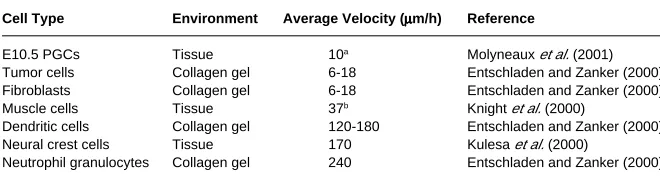
prob-Cell Type Environment Average Velocity (µµµµµm/h) Reference
E10.5 PGCs Tissue 10a Molyneaux et al. (2001)
Tumor cells Collagen gel 6-18 Entschladen and Zanker (2000)
Fibroblasts Collagen gel 6-18 Entschladen and Zanker (2000)
Muscle cells Tissue 37b Knight et al. (2000)
Dendritic cells Collagen gel 120-180 Entschladen and Zanker (2000)
Neural crest cells Tissue 170 Kulesa et al. (2000)
Neutrophil granulocytes Collagen gel 240 Entschladen and Zanker (2000)
a With spurts up to 30 µm/h. b With spurts up to 60 µm/h. TABLE 1
COMPARISON OF SOME MOTILE CELL TYPES
ably driven by cell-cell adhesive interactions. Mutations in E-cadherin and the recently identified FICL family member, Foi block gonad coalescence (Van Doren et al., 2003). FICL (named after the founding members Foi, Iar1, Catsup and Livi) comprises a family of membrane proteins that share weak homology to the ZIP family of metal transporters. FICL proteins may form membrane channels. Expression of FOI in the SGPs may control expression of E-cadherin (Van Doren et al., 2003).
Zebrafish
There are four stages of PGC migration in zebrafish. In this system, PGCs form as four clusters, which are randomly oriented with respect to the body axes of the embryo. Hence, germ cells in this system home in on their target zones from very divergent starting positions. This complicated migration process requires several intermediate targets (Weidinger et al., 2002). PGCs move dorsally during gastrulation (1) and then form a line at the border between the head and trunk mesoderm (2). Next, PGCs at this border, move towards an intermediate target within the lateral plate mesoderm (3). Finally, PGCs leave this intermediate target and migrate posteriorly to colonize the gonad (4). Despite this compli-cated series of steps, PGC position appears to be controlled via a very simple molecular mechanism in Zebrafish. PGCs are at-tracted to their intermediate and final targets via SDF-1 (Doitsidou et al., 2002; Knaut et al., 2003). The expression of SDF-1 in Zebrafish correlates much more strongly with PGC position than it does in the mouse. SDF-1 is expressed in a stripe between the head and trunk mesoderm at the time PGCs accumulate at this position. Later, SDF-1 expression becomes elevated in the lateral mesoderm surrounding the intermediate target. Finally, its expres-sion recedes posteriorly as PGCs migrate towards the gonad. Morpholino antisense oligos were used to block translation of SDF-1 and its receptor CXCR4 and in both cases PGC migration was perturbed. Finally, both studies demonstrated that ectopic expres-sion of SDF-1 could lure germ cells away from their normal migration routes.
Conclusions
early development of PGCs in flies and mouse is quite similar and the survival and early migration of PGCs in these systems require signaling via tyrosine kinase receptors (torso and c-kit respectively) (Besmer et al., 1993; Li et al., 2003). A tyrosine kinase receptor with a role similar to Torso/c-kit has yet to be identified in zebrafish. Initiation of PGC motility in zebrafish is controlled by the mRNA binding protein Dead end (Weidinger et al., 2003). PGC guidance mechanisms have been well studied in all three species and require chemoattractants that signal via G-protein coupled receptors (SDF-1 and/or lipid-based attractants) (Van Doren et al., 1998, Doitsidou et al., 2002; Knaut et al., 2003; Molyneaux et al., 2003), cell-cell adhesion (E-cadherin and foi) (Bendel-Stenzel et al., 2000; Van Doren et al., 2003) and probably require specific interactions be-tween PGCs and the ECM (β1 integrin) (Anderson et al., 1999). There is currently no data from any system on how PGCs downregulate motility upon reaching their final target. To complicate this issue even further, zebrafish PGCs (Knaut et al., 2002) and mouse PGCs may undergo periods of migration interspersed with stops at intermediate targets (lateral mesoderm in zebrafish and the lip of the hindgut pocket in mouse). The final loss of motility characteristics appears to correlate with the formation of strong PGC-PGC adhesive contacts in all three species. In the mouse, germ cell adhesion may be controlled via a PGC intrinsic clock as PGCs in culture cluster and become non-motile at approximately the same time as PGCs that have colonized the gonads (Gomperts et al., 1994). Similarly, a PGC intrinsic clock has been proposed to control entry of PGCs into meiosis in the mouse (reviewed in McLaren, 2003). However, PGCs in ectopic locations in the mouse were found to retain motility and expression of early germ cell markers (Stallock et al., 2003). This data makes a clock mechanism unlikely and instead suggests that interactions between the PGCs and the cells of the genital ridge stop PGCs from moving. Broad comparisons can be drawn between PGC behavior and the behavior of other migratory cell populations. Regulated cell-cell and cell-substrate adhesion is important for multiple migratory cell types. Also chemokines that signal via tyrosine kinase and/or G-protein coupled receptors provide guidance cues for many cell types. That said, PGC motility has some unique features. Germ cells are extremely slow moving cells (Table 1). In tissue they move with an average velocity of 10 µm/h and exhibit spurts up to 30 µm/h (Molyneaux et al., 2001). PGCs in culture move more quickly (50 µm/h for mouse and from 12-144 µm/h for Drosophila) (Donovan et al., 1987; Jaglarz and Howard, 1995). Slow migration interspersed with spurts may be characteristic of cells moving through tissue (Knight et al., 2000) and may reflect physical restraints imposed by the environment through which the cells migrate. Other slow moving cell types (fibroblasts and tumor cells) form strong integrin-depen-dent attachments to the ECM and the duration of these attachments is believed to control their speed (reviewed in Entschladen and Zanker, 2000). PGC migration resembles that of other embryonic cell populations (migrating muscle cells and neural crest) and it shares some features proposed for tumor cells undergoing metastasis (reviewed in Bogenrieder and Herlyn, 2003). Downregulation of cell-cell adhesion and upregulation of cell-cell-substratum adhesion is thought to initiate the process of metastasis. This is followed by the production of proteolytic enzymes (matrix metalloprotienases, ADAMs and uPA) in the tumor cells (or more commonly) in the stroma surrounding the tumor. Tumor cells then migrate into the vasculature and colonize other tissue via three proposed mechanisms, selective adhesion, selective survival and directed migration. In some species (avians)
PGCs are carried to their target tissue via the vasculature (Meyer, 1964) and chick PGCs were found to accumulate in gonadal tissue grafted into ectopic locations (Kuwana and Rogulska, 1999) sug-gesting that this guidance process is active. PGCs in the mouse, flies and zebrafish take other routes to reach the gonads. Regardless of the pathway, selective adhesion, selective survival and directed migration are all important aspects of PGC development. Regulation of cell-cell adhesion is vital for PGC motility. E-cadherin is expressed shortly after PGCs form and is required for their formation. It is downregulated when PGCs are in the gut and is then upregulated again as PGCs colonize the genital ridges. E-cadherin expression has a similar bi-phasic pattern in metastatic cancer. Loss of E-cadherin is associated with tumor invasiveness whereas expression is regained within secondary tumors. Also, regulation of PGC survival is important for PGC homing behavior. PGCs in ectopic locations die via apoptosis which is probably initiated by a lack of localized survival factors (Stallock et al., 2003). Finally, chemotaxis is vital for PGC development. SDF-1/CXCR4 directs PGC migration in mouse and zebrafish and this chemokine-receptor interaction has been shown to be involved in metastasis of many tumor cell-types (reviewed in Moore, 2001).
In conclusion, despite being slow and surrounded by a bewilder-ing array of tissue environments, PGC migration is quite similar to other migratory processes. Further confirmation of this will emerge as new tools allow for germ cell specific targeting of components implicated in cell-migration in culture. Additionally, it will be quite interesting to see whether localized proteolysis of the ECM is involved in PGC migration.
Acknowledgements
We acknowledge Chris Runyan for critical reading of the manuscript.
References
ANDERSON, R., COPELAND, T. K., SCHOLER, H., HEASMAN, J. and WYLIE, C. (2000). The onset of germ cell migration in the mouse embryo. Mech Dev 91, 61-8.
ANDERSON, R., FASSLER, R., GEORGES-LABOUESSE, E., HYNES, R. O., BADER, B. L., KREIDBERG, J. A., SCHAIBLE, K., HEASMAN, J. and WYLIE, C. (1999). Mouse primordial germ cells lacking beta1 integrins enter the germline but fail to migrate normally to the gonads. Development 126, 1655-64.
ARA, T., NAKAMURA, Y., EGAWA, T., SUGIYAMA, T., ABE, K., KISHIMOTO, T., MATSUI, Y. and NAGASAWA, T. (2003). Impaired colonization of the gonads by primordial germ cells in mice lacking a chemokine, stromal cell-derived factor-1 (SDF-1). Proc Natl Acad Sci USA 100, 5319-23.
BENDEL-STENZEL, M. R., GOMPERTS, M. andERSON, R., HEASMAN, J. and WYLIE, C. (2000). The role of cadherins during primordial germ cell migration and early gonad formation in the mouse. Mech Dev 91, 143-52.
BESMER, P., MANOVA, K., DUTTLINGER, R., HUANG, E. J., PACKER, A., GYSSLER, C. and BACHVAROVA, R. F. (1993). The kit-ligand (steel factor) and its receptor c-kit/W: pleiotropic roles in gametogenesis and melanogenesis. Dev Suppl, 125-37.
BOGENRIEDER, T. and HERLYN, M. (2003). Axis of evil: molecular mechanisms of cancer metastasis. Oncogene 22, 6524-36.
BUEHR, M., MCLAREN, A., BARTLEY, A. and DARLING, S. (1993). Proliferation and migration of primordial germ cells in We/We mouse embryos. Dev Dyn 198, 182-9.
CALLAINI, G., RIPARBELLI, M. G. and DALLAI, R. (1995). Pole cell migration through the gut wall of the Drosophila embryo: analysis of cell interactions. Dev Biol 170, 365-75.
DESHPANDE, G., SWANHART, L., CHIANG, P. and SCHEDL, P. (2001). Hedgehog signaling in germ cell migration. Cell 106, 759-69.
DOITSIDOU, M., REICHMAN-FRIED, M., STEBLER, J., KOPRUNNER, M., DORRIES, J., MEYER, D., ESGUERRA, C. V., LEUNG, T. and RAZ, E. (2002). Guidance of primordial germ cell migration by the chemokine SDF-1. Cell 111, 647-59.
DONOVAN, P. J., STOTT, D., GODIN, I., HEASMAN, J. and WYLIE, C. C. (1987). Studies on the migration of mouse germ cells. J Cell Sci Suppl 8, 359-67.
DONOVAN, P. J. and DE MIGUEL, M. P. (2003). Turning germ cells into stem cells.
Curr Opin Genet Dev. 13, 463-71.
DUFFY, J. B. and PERRIMON, N. (1994). The torso pathway in Drosophila: lessons on receptor tyrosine kinase signaling and pattern formation. Dev Biol 166, 380-95.
ENTSCHLADEN, F. and ZANKER, K. S. (2000). Locomotion of tumor cells: a molecular comparison to migrating pre- and postmitotic leukocytes. J Cancer Res
Clin Oncol 126, 671-81.
GINSBURG, M., SNOW, M. H. and MCLAREN, A. (1990). Primordial germ cells in the mouse embryo during gastrulation. Development 110, 521-8.
GODIN, I., WYLIE, C. and HEASMAN, J. (1990). Genital ridges exert long-range effects on mouse primordial germ cell numbers and direction of migration in culture. Development 108, 357-63.
GODIN, I. and WYLIE, C. C. (1991). TGF beta 1 inhibits proliferation and has a chemotropic effect on mouse primordial germ cells in culture. Development 113, 1451-7.
GOMPERTS, M., GARCIA-CASTRO, M., WYLIE, C. and HEASMAN, J. (1994). Interactions between primordial germ cells play a role in their migration in mouse embryos. Development 120, 135-41.
HAY, B., JAN, L. Y. and JAN, Y. N. (1988). A protein component of Drosophila polar granules is encoded by vasa and has extensive sequence similarity to ATP-dependent helicases. Cell 55, 577-87.
JAGLARZ, M. K. and HOWARD, K. R. (1994). Primordial germ cell migration in
Drosophila melanogaster is controlled by somatic tissue. Development 120,
83-9.
JAGLARZ, M. K. and HOWARD, K. R. (1995). The active migration of Drosophila
primordial germ cells. Development 121, 3495-503.
JUNEJA, S. C., BARR, K. J., ENDERS, G. C. and KIDDER, G. M. (1999). Defects in the germ line and gonads of mice lacking connexin43. Biol Reprod 60, 1263-70.
KNAUT, H., STEINBEISSER, H., SCHWARZ, H. and NUSSLEIN-VOLHARD, C. (2002). An evolutionary conserved region in the vasa 3’UTR targets RNA trans-lation to the germ cells in the zebrafish. Curr Biol 12, 454-66.
KNAUT, H., WERZ, C., GEISLER, R. and NUSSLEIN-VOLHARD, C. (2003). A zebrafish homologue of the chemokine receptor Cxcr4 is a germ-cell guidance receptor. Nature 421, 279-82.
KNIGHT, B., LAUKAITIS, C., AKHTAR, N., HOTCHIN, N. A., EDLUND, M. and HORWITZ, A. R. (2000). Visualizing muscle cell migration in situ. Curr Biol 10, 576-85.
KULESA, P., BRONNER-FRASER, M. and FRASER, S. (2000). In ovo time-lapse analysis after dorsal neural tube ablation shows re-routing of chick hindbrain neuraal crest. Development 127: 2843-2852.
KUWANA, T. and ROGULSKA, T. (1999). Migratory mechanisms of chick primordial germ cells toward gonadal anlage. Cell Mol Biol 45, 725-736.
KWAN, K. and KIRSCHNER, M. (2003). Xbra functions as a switch between cell migration and convergent extension in the Xenopus gastrula. Development 130, 1961-1972.
LANGE, U.C., SAITOU, M., WESTERN, P. S., BARTON, S. C. and SURANI, M. A. (2003) The fragilis interferon-inducible gene family of transmembrane proteins is associated with germ cell specification in mice. BMC Dev. Biol. 3, 1-11.
LAWSON, K. A., DUNN, N. R., ROELEN, B. A., ZEINSTRA, L. M., DAVIS, A. M., WRIGHT, C. V., KORVING, J. P. and HOGAN, B. L. (1999). Bmp4 is required for the generation of primordial germ cells in the mouse embryo. Genes Dev 13, 424-36.
LI, J., XIA, F. and LI, W. X. (2003). Coactivation of STAT and Ras is required for germ cell proliferation and invasive migration in Drosophila. Dev Cell 5, 787-98.
LO, C.W., COHEN, M.F., HUANG, G.Y., LAZATIN, B.O., PATEL, N., SULLIVAN, R., PAUKEN, C. and PARK, S.M. (1997). Cx43 gap junction gene expression and gap junctional communication in mouse neural crest cells. Dev Genet. 20:119-132.
MATSUI Y., ZSEBO K., HOGAN B. L. (1992). Derivation of pluripotential embryonic stem cells from murine primordial germ cells in culture. Cell 70, 841-7
MCLAREN, A. (2003). Primordial germ cells in the mouse. Dev Biol 262, 1-15.
MEYER, D.B. (1964). The migration of primordial germ cells in the chick embryo.
Dev. Biol. 10, 154-190.
MOLYNEAUX, K. A., STALLOCK, J., SCHAIBLE, K. and WYLIE, C. (2001). Time-lapse analysis of living mouse germ cell migration. Dev Biol 240, 488-98.
MOLYNEAUX, K. A., ZINSZNER, H., KUNWAR, P. S., SCHAIBLE, K., STEBLER, J., SUNSHINE, M. J., O’BRIEN, W., RAZ, E., LITTMAN, D., WYLIE, C. and LEHMANN, R. (2003). The chemokine SDF1/CXCL12 and its receptor CXCR4 regulate mouse germ cell migration and survival. Development 130, 4279-86.
MOLYNEAUX, K.A., WANG, Y., SCHAIBLE, K. and WYLIE, C. (2004). Transcrip-tional profiling identifies genes differentially expressed during and after migra-tion in murine primordial germ cells. Mech. Dev. GEP 4, 167-181.
MOORE, L. A., BROIHIER, H. T., VAN DOREN, M., LUNSFORD, L. B. and LEHMANN, R. (1998). Identification of genes controlling germ cell migration and embryonic gonad formation in Drosophila. Development 125, 667-78.
MOORE, M. A. (2001). The role of chemoattraction in cancer metastases. Bioessays
23, 674-6.
OKAMURA, D., KIMURA, T., NAKANO, T. and MATSUI, Y. (2003). Cadherin-mediated cell interaction regulates germ cell determination in mice. Develop-ment 130, 6423-30.
OLSEN, L. C., AASLAND, R. and FJOSE, A. (1997). A vasa-like gene in zebrafish identifies putative primordial germ cells. Mech Dev 66, 95-105.
RESNICK J. L., BIXLER L. S., CHENG L. and DONOVAN P.J. (1992) Long-term proliferation of mouse primordial germ cells in culture. Nature 359, 550-1.
RAZ, E. (2003). Primordial germ-cell development: the zebrafish perspective. Nat
Rev Genet 4, 690-700.
RIDLEY, A. J., SCHWARTZ, M. A., BURRIDGE, K., FIRTEL, R. A., GINSBERG, M. H., BORISY, G., PARSONS, J. T. and HORWITZ, A. R. (2003). Cell migration: integrating signals from front to back. Science 302, 1704-9.
SAITOU, M., BARTON, S. C. and SURANI, M. A. (2002). A molecular programme for the specification of germ cell fate in mice. Nature 418, 293-300.
SCHUPBACH, T. and WIESCHAUS, E. (1986). Germline autonomy of maternal-effect mutations altering the embryonic body pattern of Drosophila. Dev Biol
113, 443-8.
SPRAGUE, J., DOERRY, E., DOUGLAS, S. and WESTERFIELD, M. (2001). The Zebrafish Information Network (ZFIN): a resource for genetic, genomic and developmental research. Nucleic Acids Res. 29, 87-90.
STALLOCK, J., MOLYNEAUX, K., SCHAIBLE, K., KNUDSON, C. M. and WYLIE, C. (2003). The pro-apoptotic gene Bax is required for the death of ectopic primordial germ cells during their migration in the mouse embryo. Development
130, 6589-97.
STARZ-GAIANO, M., CHO, N. K., FORBES, A. and LEHMANN, R. (2001). Spatially restricted activity of a Drosophila lipid phosphatase guides migrating germ cells.
Development 128, 983-91.
STARZ-GAIANO, M. and LEHMANN, R. (2001). Moving towards the next
genera-tion. Mech Dev 105, 5-18.
TANAKA, S. S. and MATSUI, Y. (2002). Developmentally regulated expression of mil-1 and mil-2, mouse interferon-induced transmembrane protein like genes, during formation and differentiation of primordial germ cells. Gene Expr
Pat-terns 2, 297-303.
VAN DOREN, M., BROIHIER, H. T., MOORE, L. A. and LEHMANN, R. (1998). HMG-CoA reductase guides migrating primordial germ cells. Nature 396, 466-9.
VAN DOREN, M., MATHEWS, W. R., SAMUELS, M., MOORE, L. A., BROIHIER, H. T. and LEHMANN, R. (2003). fear of intimacy encodes a novel transmem-brane protein required for gonad morphogenesis in Drosophila. Development
130, 2355-64.
VIEBAHN, C., STORTZ, C., MITCHELL, S. A. and BLUM, M. (2002). Low prolifera-tive and high migratory activity in the area of Brachyury expressing mesoderm progenitor cells in the gastrulating rabbit embryo. Development 129, 2355-65.
WARRIOR, R. (1994). Primordial germ cell migration and the assembly of the
WEIDINGER, G., STEBLER, J., SLANCHEV, K., DUMSTREI, K., WISE, C., LOVELL-BADGE, R., THISSE, C., THISSE, B. and RAZ, E. (2003). dead end, a novel vertebrate germ plasm component, is required for zebrafish primordial germ cell migration and survival. Curr Biol 13, 1429-34.
WEIDINGER, G., WOLKE, U., KOPRUNNER, M., KLINGER, M. and RAZ, E. (1999). Identification of tissues and patterning events required for distinct steps in early migration of zebrafish primordial germ cells. Development 126: 5295-5307.
WEIDINGER, G., WOLKE, U., KOPRUNNER, M., THISSE, C., THISSE, B. and RAZ, E. (2002). Regulation of zebrafish primordial germ cell migration by attraction towards an intermediate target. Development 129, 25-36.
WEIGMANN, K., KLAPPER, R., STRASSER, T., RICKERT, C., TECHNAU, G. M., JÄCKLE, H., JANNING, W. and KLÄMBT, C. (2003). FlyMove – a new way to look at development of Drosophila.Trends in Genetics 19, 310-311.
XU, X., LI, W. E., HUANG, G. Y., MEYER, R., CHEN, T., LUO, Y., THOMAS, M. P., RADICE, G. L. and LO, C. W. (2001). Modulation of mouse neural crest cell motility by N-cadherin and connexin 43 gap junctions. J Cell Biol 154, 217-30.
YING, Y., QI, X. and ZHAO, G. Q. (2001). Induction of primordial germ cells from murine epiblasts by synergistic action of BMP4 and BMP8B signaling pathways. Proc Natl
Acad Sci USA 98, 7858-62.
YOON, C., KAWAKAMI, K. and HOPKINS, N. (1997). Zebrafish vasa homologue RNA is localized to the cleavage planes of 2- and 4-cell-stage embryos and is expressed in the primordial germ cells. Development 124, 3157-65.
ZHANG, N., SUNDBERG, J. P. and GRIDLEY, T. (2000). Mice mutant for Ppap2c, a homolog of the germ cell migration regulator wunen, are viable and fertile. Genesis
27, 137-40.
ZHANG, N., ZHANG, J., PURCELL, K. J., CHENG, Y. and HOWARD, K. (1997). The