Tokenization and Morphological Analysis for Malagasy 317
developing a morphological analyzer for Turkish, an agglutinative, morphologically complex language, in the context of the PARGRAM project.
For the Malagasy morphological analyzer, the researchers use Xerox finite-state tools LEXC and XFST [Beesley and Karttunen 2003], which are employed by many of the PARGRAM grammars. As with any finite-state morphological transducer, the Malagasy morphological analyzer is bidirectional: it can be used in grammatical analysis to produce morphologically analyzed input to a parser, or in generation to produce a surface form from a specification of lexical properties [Beesley and Karttunen 2003]. In the following, the authors often describe the tokenizer and morphological component in terms of analysis as opposed to generation of a surface string, but this is only for expository purposes.
2.
Malagasy Morphology: An Overview
As Keenan and Polinsky [1998] note, there is very little inflectional morphology in Malagasy: there is no verb agreement or nominal inflection for agreement features, for example. Keenan and Polinsky [1998] analyze certain alternations in deictic forms and demonstratives as inflection, but since the forms involved belong to a small closed class, the authors identify them by listing them in the lexicon. The morphological analyzer described here handles many of the productive cases of nominal and verbal derivational morphology, consisting primarily of affixal verbal morphology and genitive compounding.
Besides verbal affixation and genitive compounding, the third productive type of morphological process in Malagasy is reduplication [Keenan and Razafimamonjy 1998], in which a new root is formed by reduplicating all or part of a basic root, giving a diminished, attenuated, or pejorative meaning: for example, reduplication of the root fotsy ‘white’ gives fotsifotsy ‘whitish’. It is well known that reduplication requires special treatment in a
finite-state morphological model, and the COMPILE-REPLACE algorithm described by Beesley and Karttunen [2000; 2003] provides a means of treating these cases. The researchers have implemented and are currently testing a treatment of Malagasy reduplication using the COMPILE-REPLACE algorithm, but, as this has not yet been completely integrated into the full Malagasy grammar, the authors concentrate in the following on describing the treatment of nominal and verbal morphology.
3.
Lexical Information
318 Mary Dalrymple et al.
in the morphological lexicon.
This lexicon currently contains 2,446 roots, including 2,033 roots which form nouns, adjectives or verbs, 288 roots which form adjectives or verbs, and 125 roots which form only verbs. Indeclinable forms, including proper names, adverbs, some prepositions, and free pronouns, are not listed in the morphological lexicon, and so are passed through the morphological analyzer unchanged and treated by the syntax as unanalyzed tokens. Guessed roots are also allowed for and are defined in terms of permissible root patterns; these roots are marked with the tag +Guess, and are permitted, though dispreferred, in syntactic analysis. In treatment of guessed forms, the authors define Syllable (Syll) as in (1); this allows the definition of weak guessed roots as consisting of two syllables followed by one of the weak endings (na, ka, tra). Strong guessed roots are then defined as consisting of one to four syllables, and subtracting the weak root patterns:
(1)Syll = [((Nasal) ([t|d]) Consonant) (Vowel) Vowel]; WeakKTRoot = [Syllˆ2 [[[T|t] [R|r]|[K|k]] [A|a]]]; WeakNRoot = [Syllˆ2 [[N|n] [A|a]]];
StrongRoot = [Syllˆ{1,4}−[WeakKTRoot|WeakNRoot]];
The definitions in (1) follow standard XFST notation, as defined by Beesley and Karttunen [2003]: square brackets ‘[’ ‘]’ indicate grouping, parentheses ‘(’ ‘)’ indicate optionality, ‘|’ indicates union or disjunction, ‘−’ indicates subtraction of the second set of strings from the
first set of strings, and ‘ˆ’ followed by a number or range of numbers indicates the amount of times the immediately preceding string is repeated. Note that the use of ‘ˆ’ here is different than in the definition of the continuation classes and orthographic rules. In the latter case, ‘ˆ’ designates a feature to be interpreted by the XFST rules.
4.
Genitive Compounding
Tokenization and Morphological Analysis for Malagasy 319
4.1
Target Phenomena
The following informal rules follow the treatment of Keenan and Polinsky [1998], and represent alternations in the final and first syllables of Head and NPgen respectively. The hyphen, which sometimes alternates with apostrophe, is part of Malagasy orthography. The expressions ‘C’, ‘Co’ stand for consonants and ‘V’ and ‘Vo’ stand for vowels, whereas ‘S’ denotes a stop consonant. The lowercase characters denote the corresponding letters. The expression to the left of the ‘+’ sign stands for the final syllable of the head word, consisting of some strong consonant ‘C’ and some vowel ‘V’ in the case of (1a) and (2) and some vowel ‘V’ followed by one of the weak endings ‘ka’, ‘tra’, ‘na’ in (1b). The expression to the right of the ‘+’ sign stands for the initial character of the NPgen.
1. Head is weak, that is, it ends in one of ka, tra, na
(a) NPgen begins with a vowel Vo: CV + Vo → C-Vo (remove final vowel in Head and concatenate)
(b) NPgen begins with a consonant C with corresponding stop consonant S: i. Head ends in na:
Vna + C → Vn-S (S not bilabial), or Vna + C → Vm-S (S bilabial) ii. Head ends in ka or tra:
V{ka|tra} +C → V-S 2. Head is not weak:
(a) NPgen begins with a vowel Vo:
CV + Vo → CVn-Vo (prefix n-and concatenate)
(b) NPgen begins with a consonant Co with corresponding stop consonant S: CV + Co → CVn-S (S not bilabial), or
CV + Co → CVm-S(Sbilabial)
Similar to noun genitive expressions are pronominal suffixed genitives. If the Head ends in a non-weak syllable or na, then the GEN1 suffixes are attached to the Head. Otherwise, the GEN2 suffixes are attached.
(2) person GEN1 suffix GEN2 suffix
1sg. ko o
2sg. nao ao
3sg. or pl. ny ny
1pl. incl. ntsika tsika
1pl. excl. nay ay
320 Mary Dalrymple et al.
4.2
Implementation
The rules governing genitive expressions are quite regular and consistent. The morphology of such expressions is modelled by the Xerox finite-state calculus, with a tokenizer written in XFST, a lexicon written in LEXC, and more general orthographic and phonological rules written in XFST [Beesley and Karttunen 2003].
As with the other grammar development projects within the PARGRAM initiative, the grammar is implemented within the XLE grammar development environment ([Crouch et al. 2006], see also http://www2.parc.com/isl/groups/nltt/xle/). The XLE requires a tokenizer and morphological analyzer for the language being analyzed, and allows the specification of a sequence of alternative morphological analyzers to be used when analysis with the first alternative fails. The output of the morphological analyzer is the input to syntactic analysis, obviating the need for listing each surface form separately in the syntactic lexicon. Instead, the syntactic component contains information about the syntactic content and behaviour of each root and affix combination as analyzed by the morphological component.
XLE expects a string as input, which is first tokenized according to the rules of the tokenizer for the language being analyzed. Each token is then individually passed to the morphological analyzer for finite-state morphological analysis. Most grammars within the PARGRAM initiative employ at least two morphological analyzers: an analyzer for known forms, and a guesser for forms that fail to be analyzed by the known-form analyzer. Following this paradigm, the known-form transducer and guesser are extracted separately, and applied to the output of the tokenizer in sequence; only forms that fail to obtain an analysis with the known-form analyzer are passed to the guesser.
In most cases, tokenization in Malagasy is straightforward, with tokens usually delimited by whitespace. For the sentence Hanketo izy. ‘he will come here’, the tokenizer produces the following result, where TB indicates a token boundary:
(3)hanketo TB izy TB .
The tokenizer (optionally) decapitalizes the first word of the sentence, inserts token boundaries at spaces, and separates punctuation by a token boundary. Each token is then passed separately to the morphological analyzer for analysis.
Tokenization and Morphological Analysis for Malagasy 321
(4)akanjon-olona
akanjo (epenthetic N; cf. 2a above) (compound boundary) olona
In the original treatment of nonpronominal genitive compounding, this form was treated as a single token, and was handled by the morphological analyzer [Dalrymple et al. 2005]. However, this approach interacted badly with the standard configuration of XLE grammars, where the known-form analyzer and guesser are separate transducers, applied in sequence. If both roots are known, both can be analyzed by the known-form transducer; however, if one root is unknown, the entire compound fails to be recognized by the known-form analyzer. This means that the entire compound must be handled by the guesser, even if one of the roots is known. This undesirable result has led the researchers to revise the treatment of nonpronominal genitive compounds, moving most of the work to the tokenizer.
In the current treatment, the tokenizer ‘undoes’ the effects of the compounding rules given above, proposing one or more underlying forms for analysis by the morphological component. For example, the compound form akanjon-olona is tokenized as follows:
(5) akanjo TB +GEN+ TB olona
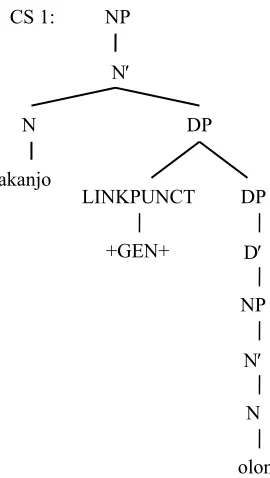
The root akanjo is a three-syllable root; the hypothetical root akanjona would have four syllables, which is impossible for a weak root. For this reason, Rule 1 (above), which requires that Head is a weak root, does not apply. Rule 2a covers the case in which the second member of the compound begins with a vowel; “undoing” rule 2a entails removing the epenthetic n inserted after the Head, producing akanjo. The compound boundary is treated as a separate token, represented by the special symbol +GEN+, to signal to the syntactic analysis component that genitive compounding has taken place. The phrase structure tree that is produced for akanjon-olona is shown in Figure 1, in which the leaves of the tree correspond to the tokens produced by the tokenizer.
Some forms can be tokenized in more than one way. For example, the compound volon-dRabe ‘Rabe’s month’/‘Rabe’s money’ is ambiguous [Keenan and Polinsky 1998]:
(a) Head is weak, reconstructed by the tokenizer as volana ‘month’, with Rule 1a requiring removal of the final vowel; or
322 Mary Dalrymple et al.
Figure 1. Phrase structure tree for akanjon-olona
After tokenization, the morphological analyzer is presented with all possible forms resulting from ‘undoing’ the compounding rules. Analysis proceeds as in the simple cases, with forms recognized by the known-form analyzer given preference in syntactic analysis over hypothetical forms analyzed by the guesser.
The current treatment of genitive compounding relies on the presence of the hyphen or apostrophe to signal the compound boundary. In a small minority of cases, however, genitive compounding involves only concatenation of roots, and is not signalled by special punctuation. The authors have left the treatment of these forms for future work, since it is unclear how the treatment of such forms will interact with the guesser: almost any simple form can be given a spurious analysis as a compound composed of two hypothetical, guessed roots.
Pronominal genitive compounds, on the other hand, are best treated by the morphological analysis component, which is now described. The LEXC lexicon is a finite-state transducer which specifies a relation between an Upper ‘lexical’ string and a Lower ‘surface’ string for a form [Beesley and Karttunen 2003]. Roots and affixes are organized into sublexicons according to their phonological and prosodic properties, e.g. whether the root is weak or strong. The lexicon also specifies possibilities for transitions when a particular form is encountered. For example, the noun root akanjo ‘clothes’ is listed in the Noun sublexicon with continuation class Nstrong, meaning that it takes the strong root suffixes listed in the Nstrong sublexicon. The Nstrong sublexicon adds the +Noun tag to the lexical/Upper side of the
CS 1: NP
N′
N
akanjo
DP
LINKPUNCT
+GEN+
DP
D′
NP
N′
N
Tokenization and Morphological Analysis for Malagasy 323
transducer, and permits the form to terminate with no suffixation, or alternatively allows genitive suffixation. Thus, the transducer relates the Lower string, the unsuffixed noun akanjo, to the morphologically analyzed lexical/Upper string which forms the input to syntactic analysis:
(6)LEXC transducer: Upper: akanjo +Noun Lower: akanjo ‘clothes’
The related form akanjoko ‘my clothes’ involves pronominal genitive suffixation; the NStrong sublexicon relates the first person singular genitive suffix ko on the surface/Lower side to the tag +1SgGen on the lexical/Upper side:
(7)LEXC transducer:
Upper: akanjo +Noun +1SgGen Lower: akanjoko
‘my clothes’
Here, the LEXC lexicon on its own is sufficient for analysis of the combination of the root akanjo and the pronominal genitive suffix -ko. The phrase structure tree that is produced for akanjoko is shown on the left side of Figure 2; the right side shows the root and series of tags that is output by the morphological analyzer and analyzed by the syntactic component.
Phrasal analysis Display of morphological structure
CS 1: NP
N′
N
N-BASE NSFX-BASE POSS-SFX-BASE
akanjo +Noun +1SgGen
CS 1: NP
N′
N
akanjoko
324 Mary Dalrymple et al.
5.
Verbal Morphology
In many cases, however, a set of XFST rules is also needed to cater to phonological and orthographic alternations induced by morphological operations. These rules apply irrespective of the individual entries to be combined, and are controlled by tags introduced by LEXC. These tags are orthographically distinguished from the lexical tags of the LEXC transducer by the use of a carat ‘ˆ’. The XFST rules define an XFST transducer, which is composed with the LEXC transducer in full morphological analysis. In the following, the authors describe the use of these tags in the analysis of verbal morphology.
5.1
Target Phenomena
Malagasy exhibits rich and complex verbal morphology [Randriamasimanana 1986; Keenan and Polinsky 1998]. Verbs are classified according to the case of their arguments: nominative, accusative and genitive. Verbs which take a genitive complement are non-active verbs, a category which includes passive verbs and circumstantial verbs. Passive verbs are formed in three different ways, each corresponding to different semantics. The following discussion follows Keenan and Polinsky [1998], though simplifying somewhat.
First, there are a small number of root passives, that is, roots which are passive verbs. These refer more to the result than the process. The LEXC transducer encodes the schematic relation for passive roots in Figure 3, which is very similar to patterns for noun roots with optional pronominal genitive compounding. ROOT represents the form of the passive root. ROOTTYPE is one of ˆStrongRoot, ˆWeakKTRoot or ˆWeakNRoot; this information is needed by the XFST rules to control certain morphological alternations. (GEN) represents optional genitive compounding with the agent argument of the passive verb, using the affixes listed in (2). An example for the root passive araka ‘be followed’ is:
(8)Lexical: araka +Verb +3Gen Surface: arany
‘be followed by him/them’
The LEXC transducer is composed with the XFST transducer, which performs necessary adjustments as the morphemes are concatenated.
Tokenization and Morphological Analysis for Malagasy 325
Passive roots
ROOT +Verb (GEN) ROOT ROOTTYPE ...
Suffix passives
TENSE (Caus) ROOT +Verb (C)VnaPass (GEN|IMP) ... amp ROOT ROOTTYPE (C)ina/ana ...
Prefix passives
VTPass ROOT +Verb (GEN|IMP) voa/tafa ROOT ROOTTYPE ...
Circumstantial form
TENSE (Caus) (ACTIVE) ROOT +Verb (C)VnaPass ... amp i/an ROOT ROOTTYPE (C)ina/ana
Active Verbs
(TENSE|NOM) [(Recip)(Caus)][ACTIVE PassROOT|NullPrefROOT] +Verb (IMP) ... if amp i/an PassROOT|NullPrefROOT ROOTTYPE ..
Figure 3. Verbal patterns
A third type of passive is prefix passives. These are formed by prefixing a root with any of a, voa, tafa. Passives in a refer to the process rather than the result, and usually their subject functions as an instrument. The imperative is formed by prefixing with a and adding the corresponding passive imperative suffix. Passives in voa/tafa refer to the end result rather than the process and have a perfective meaning. voa/tafa passives may not be prefixed by a tense prefix, while a passive does take a tense prefix.
In the circumstantial form of a verb, an oblique argument or adjunct of an active verb is made the subject. The circumstantial is built from roots prefixed by primary active affixes i, an and, possibly, secondary active affixes ank(a), amp by means of the suffixation -Cana,where C is the root-specific epenthetic consonant mentioned above in the context of suffix passives. Tense is marked in the same way as for suffix passives.
326 Mary Dalrymple et al.
imperatives is possible: present tense (m) actives take suffix a, where consonant mutation and epenthesis -(C)a apply. If no epenthetic consonant intervenes, they fuse an imperative with root final a. Active verbs can be marked for tense via a tense prefix TENSE (distinguishing past, present, and future). They can also receive a prefix for causality and reciprocation. The active verb roots may be null prefix or they can be prefixed by the active prefixes ank-/amp.
5.2
Implementation
As discussed above, the LEXC lexicons contain information about subclasses of individual roots as well as more general structural information regarding verb forms. For example, verbs are formed on the basis of a tense prefix sublexicon which contains separate past, present and future prefixes, including a ˆTNSˆ tag to control morphological alternations with overt tense prefixes. In the following, 0 represents the empty string.
LEXICON Tense
PresentTense+:0 Secondary; PastTense+:noˆTNSˆ Secondary; FutureTense+:hoˆTNSˆ Secondary; PresentTense+:0 Vroot; PastTense+:noˆTNSˆ Vroot; FutureTense+:hoˆTNSˆ Vroot;
The lexicon VPassRoot represents the passive verbs: inherently passive roots, or guessed passive verbs ending in either a strong or weak syllable.
LEXICON VPassRoot PassiveRoot ;
<StrongRoot %+Guess:0> StrongSuff ; ! guessed Strong root <WeakKTRoot %+Guess:0> KTWeak ; ! guessed Weak KT root <WeakNRoot %+Guess:0> NWeak ; ! guessed Weak N root
Roots are listed in the lexicon with information about the continuation classes of their suffixes:
LEXICON PassiveRoot
Tokenization and Morphological Analysis for Malagasy 327
In this example araka is a passive root; its continuation class indicates that it is a member of the class of morphologically weak roots. fantatra is a weak passive root with final syllable tra, where the TR2RWeak continuation class indicates that the tra suffix for this root is replaced with r during passive suffixation or the formation of imperatives. Thus, the passive form corresponding to fantatra is fantarina.
As above, the XFST rules deal with surface phenomena such as syllable deletion and consonant and vowel epenthesis, which take place during affixation. In the previous example, the continuation class TR2RWeak is used with roots where the weak final root syllable tra is converted to r during passive suffixation or the formation of imperatives. Other weak roots convert tra to one of a number of other consonants which must be lexically specified for each root. One way of handling these alternations would be to have a continuation class for each of the possible combinations of suffixes and final syllables of roots. Thus, even though there are only two passive suffixes ina/ana, one would need separate continuation classes for the formation of passives for weak roots ending in tra where tra is transformed to r, f, t, or other consonants.
However, this would result in an over-sized, untidy lexicon. Instead, the authors keep a small number of continuation classes corresponding to possible suffixes, and signal the final syllable root transformations by means of tags referenced by rules of the XFST transducer. These tags provide the context for the application of XFST rules for the various cases of epenthesis, deletion and transformation. For instance, the TR2RWeak continuation class is defined in the following way:
LEXICON TR2RWeak
+Verb:ˆWeakKTRoot WeakKTEnding ; +Verb:ˆWeakKTRootˆFtr2r Suffixes ;
The feature ˆFtr2r is referenced by the XFST rule in (9), which transforms tra to r if the tra syllable is followed by the feature ˆFtr2r.
(9)[t r a] → r || __ ˆFtr2r
328 Mary Dalrymple et al.
removal of the tag ˆWeakKTRoot, which separates the root from the ˆFtr2r tag in the Lower string of the LEXC transducer. Directly after the application of this rule, the rule to remove the tag ˆFtr2r applies, preventing its appearance in the surface string and its interference with the application of other rules. Similar rules cater to alternations with prefixation, passive and imperative formation.
Features are an efficient way of modelling local morphological dependencies and alternations. However, in the morphology of Malagasy verbs there are long distance dependencies which cannot be modelled by standard FST techniques. For instance, there are roots which can form the passive in either ana or ina but not both. Thus, we want fantarina and not fantarana to be recognized as the correct passive form of fantatra. This is a problem both in recognition and generation as we do not want our rules to accept or generate incorrect forms. A tag could be added to the root fantatra to exclude the passive formation in ana, but the tag may be separated from the position of ina/ana by other morphemes and tags during passive formation.
For example, if one decided to implement the lexical preference for passive suffixation in -ina rather than -ana as a feature, the lexical entry for fantatra in the lexicon would be accompanied by a feature ˆFpassi on the surface level as below. In the following hypothetical lexicon, the root and its associated tags are grouped together by angled brackets ‘<’and ‘>’ as is standard in LEXC:
LEXICON OtherRoot
<{fantatra} 0:ˆFpassi> TR2RWeak;
However, this means that when the features ˆWeakKTRootˆFtr2r are added by the continuation class TR2RWeak, they are not immediately next to the root, but rather ˆFpassi stands in the way. As a result the rule (9) above for the transformation of the weak syllable -tra to -r, which precedes passive suffixation, cannot apply.
Tokenization and Morphological Analysis for Malagasy 329
LEXICON OtherRoot
<{fantatra} @U.PASS.I@> TR2RWeak;
This information uses a U-type flag diacritic, represented as @U.PASS.I@, to associate the feature PASS with the value I for this root. This feature ensures that the root fantatra takes a passive in ina and not in ana. This is coupled with matching flag diacritics for the passive suffixes:
LEXICON PassaSuff
<+Passa:a 0:n 0:a @U.PASS.A@> #;
LEXICON PassiSuff
<+Passi:i 0:n 0:a @U.PASS.I@> #;
The passive suffix ina is associated with the flag diacritic @U.PASS.I@, which is defined as above as specifying the value I for the feature PASS, while the suffix ana is associated with the flag diacritic @U.PASS.A@ specifying the value A for the same feature. Whenever flag diacritics meet, they must match; therefore the form fantarana is not accepted, as the flag diacritics of ana do not match the flag diacritics of fantatra.
The researchers also make use of R-type flag diacritics to model long distance dependencies between prefixes and suffixes. R-type flag diacritics are similar in structure to U-type diacritics, and are specified in the same way; crucially, however, R-type diacritics check that a certain value of a feature has been previously set by another flag diacritic specification. For example, Malagasy verbs may be formed from roots which are lexically nouns or adjectives. Since this is a very general fact about Malagasy, the lexicon does not list every root form in both the noun lexicon and the verb lexicon; nevertheless, one must ensure that the prefixes that appear with a root are compatible with its suffixes, since, if a root appears with verbal prefixes, it allows verbal but not nominal suffixes.
Tokenization and Morphological Analysis for Malagasy 331
Acknowledgments
The authors are grateful to Charles Randriamasimanana for help in the development of the system.
References
Beesley, K. R., and L. Karttunen, “Finite-state non-concatenative morphotactics,” in Proceedings of the Fifth Workshop of the ACL Special Interest Group in Computational Phonology (SIGPHON-2000), 2000., pp. 1-12.
Beesley, K. R., and L. Karttunen, Finite-State Morphology. CSLI Publications, Stanford, 2003.
Butt, M., H. Dyvik, T. H. King, H. Masuichi, and C. Rohrer, “The Parallel Grammar Project,” in Proceedings of COLING-2002 Workshop on Grammar Engineering and Evaluation, Taipei, 2002.
Çetinoğlu, Ö., and K. Oflazer, “Morphology-syntax interface for Turkish LFG,” in Proceedings of the 40th Annual Meeting of the ACL, Philadelphia, 2006.
Crouch, D., M. Dalrymple, R. Kaplan, T. King, J. Maxwell, and P. Newman, XLE documentation. Technical report, Palo Alto Research Center, Palo Alto, CA. www2.parc.com/istl/groups/nltt/xle/doc/xle_toc.html, 2006.
Dalrymple, M., M. Liakata, and L. Mackie, “A two-level morphology of Malagasy,” in Proceedings of PACLIC 19, the 19th Asia-Pacific Conference on Language, Information, and Computation. Taipei: Academia Sinica, 2005.
Grimes, B. F, ETHNOLOGUE: Languages of the World. SIL International, 1999. URL www.sil.org/ethnologue/.
Keenan, E. L., and M. Polinsky, “Malagasy,” in Andrew Spencer and Arnold Zwicky (editors), The Handbook of Morphology. Blackwell Publishers, Oxford, 1998.
Keenan, E. L., and J. P. Razafimamonjy, “Reduplication in Malagasy,” in The Structure of Malagasy III: UCLA Working Papers in Syntax and Semantics. Los Angeles: UCLA Linguistics Department, 1998.