Can Statistical Post-Editing with a Small Parallel Corpus Save aWeak MT
Engine?
Marianna J. Martindale
Center for Applied Machine Translation U.S. Dept. of Defense, Ft. Meade, MD
Abstract
Statistical post-editing has been shown in several studies to increase BLEU score for rule-based MT systems. However, previous studies have relied solely on BLEU and have not conducted further study to determine whether those gains indicated an increase in quality or in score alone. In this work we conduct a human evaluation of statistical post-edited output from a weak rule-based MT system, comparing the results with the output of the original rule-based system and a phrase-based statistical MT system trained on the same data. We show that for this weak rule-based system, despite significant BLEU score increases, human evaluators prefer the output of the original system. While this is not a generally conclusive condemnation of statistical post-editing, this result does cast doubt on the efficacy of statistical post-editing for weak MT systems and on the reliability of BLEU score for comparison between weak rule-based and hybrid systems built from them.
Keywords:machine translation, machine translation evaluation, statistical post-editing
1.
Introduction
Statistical Machine Translation relies on large aligned par-allel corpora to produce acceptable results. Resources such as the Europarl corpus (Koehn, 2005) are considered a bare minimum with tens of millions of words (up to 55M) and in the constrained track of the NIST MT-09 evaluation ap-proximately 200M words of parallel Arabic-English data was available. State of the art systems may use consider-ably more data to maximize results, with BLEU score im-provements as the corpus size increases beyond the hun-dreds of millions and even billions of words (Brants et al., 2007).
For most less-commonly taught languages, parallel text does not exist and is difficult and expensive to create. Where efforts have been undertaken to obtain or create par-allel corpora for these languages, the resulting corpora may be only a fraction of the size of those expected for training SMT systems, such as the parallel corpora in the “language packs” created by Simpson et al. (2008). The largest of these are about 2M words but most are in the 200-500k word range—much smaller than the accepted minimum for training a general purpose SMT system from scratch. One possible solution is to create or use existing weak rule-based systems and use the limited available parallel data to improve them through techniques such as statistical poste-diting.
Statistical post-editing has recently been shown to improve scores on automated metrics for mature rule-based MT en-gines with relatively small parallel corpora (e.g., Dugast et al. (2007), Simard et al. (2007a), Simard et al. (2007b)), and Voss et al. (2008) and de Ilarraza et al. (2008) used sta-tistical post-editing for weak MT engines for low-resource languages with similarly successful results. These systems are a type of hybrid, treating the output of a rule-based sys-tem as the source language for a statistical syssys-tem. The statistical system is trained on output from the rule-based
system aligned with reference translations of the original source text.
Because the SMT step is an n-gram based process, it is not surprising that it yields vast improvements on the n-gram based BLEU metric. BLEU has been demonstrated to be capable of producing scores that do not correlate with hu-man judgments, with potential variability increasing when translation quality is low (Callison-Burch et al., 2006). Given this variability and the inherent bias of BLEU, can we trust the increase in BLEU score to indicate an overall improvement?
To answer this question, we compared a baseline lexicon transfer-based MT system with statistical and statistical post-editing systems built from various sizes of parallel data as described in section 2. The systems were evalu-ated using BLEU score and human evaluation as described in section 3. Section 4 gives the results of the evaluation, and section 5 discusses the implications on future research.
2.
MT Systems
For this experiment, we chose a language for which suffi-cient parallel text is available to build a minimal statistical system but that is not among the most frequently demon-strated languages, namely, Czech. We used the existing Czech capability in the baseline system and built new statis-tical and statisstatis-tical post-editing systems using off-the-shelf tools as described below.
2.1. Baseline System (GST)
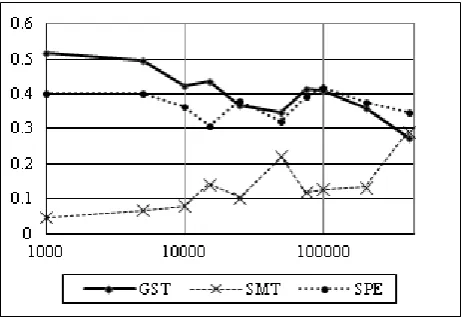
Figure 1: BLEU score vs training data size (in sentences). Figure 2: GoodEnough score vs training data size.
al (2007b): the statistical post-editing gives an immediate win over the rule-based system and even over the SMT, al-though in this case where the rule-based system is not a mature system it takes less data for the SMT to overtake the rule-based system.
4.2. Human Evaluation Results
The learning curves as scored in the human evaluation are shown in Figures 2 and 3. Only SPE with the full data set was able to surpass 50% GoodEnough, which is far below the performance we would hope to see. Surprisingly, the SMT had the lowest GoodEnough score—not even reach-ing 25% until the full data set was used. SPE performed similarly to Gister as measured by the GoodEnough score. Although the Gister translations remained the same, Gis-ter’s GoodEnough scores fluctuated between 39-49%. This is most likely due to sampling error. Although the inter-annotator agreement for Gister across data sizes was rea-sonable as calculated following Carletta (1996) yielding a Kappa of 0.734, the sentences for evaluation were drawn from too large a pool for too few evaluators so the majority of sentences were not evaluated at all and many were eval-uated for only one of the data sizes. This allowed the per sentence quality variability to have a greater effect than it should have. The GoodEnough score was more affected by this problem than the Rank score because it was particularly subjective and perhaps not defined well enough.
In the Rank score, SPE performed slightly worse than Gis-ter until the full data set was used. SMT was by far the least favorite, improving until the full data set was used when it surpassed Gister. One predicts that with more data the SMT would countinue to improve as observed in previous studies such as Brants et al. (2007).
5.
Conclusions and Future Work
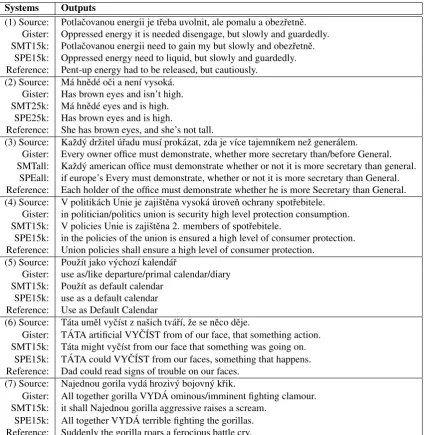
Examining the output of the systems reveals that each sys-tem had some strengths and weaknesses. Table 2 shows some examples of output from some of the systems in which at least one of the outputs was considered “Good Enough”.
The Gister output was considered “Good Enough” and ranked highest on segments where nearly all of the words
Figure 3: Rank score vs training data size.
translated and where the SPE introduced errors and where the SMT translated fewer words and/or introduced addi-tional error. In the first example, the SPE trained on 15k introduced error by changingit is needed disengagetoneed to liquid. Although the original word choice was highly dis-fluent, the replacement is still disfluent and further from the meaning. The SMT failed to translate three of the content words—not surprising, given that it was trained on such a small data set—effectively removing all connection to the meaning of the source sentence. In the second sentence, both the SMT and SPE omitted a critical negation. Even with the full training data some of these problems still oc-curred, as in the third example.
The SPE successfully improved on Gister and outranked the SMT when Gister translated most of the words but the translation was inaccurate or disfluent. In the fourth ex-ample, even with only 15k sentences of training data the SPE was able to replace confusing, disfluent phrases such
as protection consumptionwith more appropriate phrases
such as consumer protection). The fifth example demon-strates that SPE was sometimes successful in disambiguat-ing when Gister provided a slashed gloss for polysemous words.
Systems Outputs
(1) Source: Potlaˇcovanou energii je tˇreba uvolnit, ale pomalu a obezˇretnˇe. Gister: Oppressed energy it is needed disengage, but slowly and guardedly. SMT15k: Potlaˇcovanou energii need to gain my but slowly and obezˇretnˇe.
SPE15k: Oppressed energy need to liquid, but slowly and guardedly. Reference: Pent-up energy had to be released, but cautiously.
(2) Source: M´a hnˇed´e oˇci a nen´ı vysok´a. Gister: Has brown eyes and isn’t high. SMT25k: M´a hnˇed´e eyes and is high.
SPE25k: Has brown eyes and is high.
Reference: She has brown eyes, and she’s not tall.
(3) Source: Kaˇzd´y drˇzitel ´uˇradu mus´ı prok´azat, zda je v´ıce tajemn´ıkem neˇz gener´alem.
Gister: Every owner office must demonstrate, whether more secretary than/before General. SMTall: Kaˇzd´y american office must demonstrate whether or not it is more secretary than general.
SPEall: if europe’s Every must demonstrate, whether or not it is more secretary than General. Reference: Each holder of the office must demonstrate whether he is more Secretary than General. (4) Source: V politik´ach Unie je zajiˇstˇena vysok´a ´uroveˇn ochrany spotˇrebitele.
Gister: in politician/politics union is security high level protection consumption. SMT15k: V policies Unie is zajiˇstˇena 2. members of spotˇrebitele.
SPE15k: in the policies of the union is ensured a high level of consumer protection. Reference: Union policies shall ensure a high level of consumer protection.
(5) Source: Pouˇz´ıt jako v´ychoz´ı kalend´aˇr
Gister: use as/like departure/primal calendar/diary SMT15k: Pouˇz´ıt as default calendar
SPE15k: use as a default calendar Reference: Use as Default Calendar
(6) Source: T´ata umˇel vyˇc´ıst z naˇsich tv´aˇr´ı, ˇze se nˇeco dˇeje.
Gister: T ´ATA artificial VY ˇC´IST from of our face, that something action. SMT15k: T´ata might vyˇc´ıst from our face that something was going on.
SPE15k: T ´ATA could VY ˇC´IST from our faces, something that happens. Reference: Dad could read signs of trouble on our faces.
(7) Source: Najednou gorila vyd´a hroziv´y bojovn´y kˇrik.
Gister: All together gorilla VYD ´A ominous/imminent fighting clamour. SMT15k: it shall Najednou gorilla aggressive raises a scream.
SPE15k: All together VYD ´A terrible fighting the gorillas. Reference: Suddenly the gorilla roars a ferocious battle cry.
Table 2: Sample output from some of the systems for seven segments from the test corpus. The Gister translations of segments 1—3 were rated “Good Enough” and Gister ranked highest. Likewise, translations 4—5 for SMT and 6—7 for SPE were rated “Good Enough” with their respective engine ranked highest.
translate most of the words and the Gister output was highly disfluent. In the sixth example, the SMT trained on only 15k sentences was able to capture the meaning of most of the sentence in a fairly fluent manner. Gister, on the other hand, provided a translation that bears little resemblance to the meaning of the source. The SPE was able to improve the translation, but not enough to provide as much meaning as the SPE. When Gister missed a critical word, as in the sev-enth example, both the Gister translation and the SPE were very far from accurate. In this example, the SMT trained on the full data set still missed a word but was able to provide a usable transla-tion.
The evaluators’ collective preference for the rudimentary Gister translator over SPE and strong dislike of the SMT in this evaluation, while partly indicative of errors in the out-put of those two systems, is also due in part to the context of the evaluation. As stated earlier, CyberTrans is intended for
triage, filtering and selection tasks. This means that the use-fulness of a translation is based mostly on accuracy rather than fluency, with fluency playing a role only when it in-hibits understanding. Users of CyberTrans have most likely built a tolerance for the types of disfluencies often seen in Gister output such as word choice and word order. As a result, evaluators were more forgiving of this type of error than of errors that affected accuracy such as untranslated words, omitted words, and inserted words. That said, it is worth repeating that even these relatively forgiving evalua-tors did not rate any engine as GoodEnough more than 50% of the time.
weak. Because of the flaws in this study, we cannot con-clude with certainty that similar results would be obtained in other evaluation scenarios with other translation systems. However, the results of this study provide further evidence that BLEU score is insufficient for judging between weak MT systems. Further research is needed to determine con-clusively whether statistical post editing can be of help for weak MT systems in general and how mature an MT sys-tem must be to see consistent quality improvements based on human judgments rather than BLEU score alone.
6.
References
Ondˇrej Bojar and Zdenˇek ˇZabokrtsk´y. 2006. Czeng: Czech-english parallel corpus, release version. Prague Bulletin of Mathematical Linguistics, 86:59—-62. Thorsten Brants, Ashok C. Popat, Peng Xu, Franz J. Och,
and Jeffrey Dean. 2007. Large language models in ma-chine translation. InProceedings of the 2007 Joint Con-ference on Empirical Methods in Natural Language Pro-cessing and Computational Natural Language Learning-Prague Bulletin of Mathematical Linguistics, pages 858– 867, Prague, Czech Republic.
Chris Callison-Burch, Miles Osborne, and Philipp Koehn. 2006. Re-evaluating the role of bleu in machine transla-tion research. InProceedings of EACL-2006, pages 249– 256.
Jean Carletta. 1996. Assessing agreement on classifica-tion tasks: The kappa statistic. Computational Linguis-tics, 22:249–254.
Arantza Diaz de Ilarraza, Gorka Labaka, and Kepa Sara-sola. 2008. Statistical post-editing: A valuable method in domain adaptation of rbmt systems for less-resourced languages. InMATMT 2008: Mixing Approaches to
Ma-chine Translation, pages 27—-34, Donostia-San
Sebas-tian, Spain.
Lo¨ıc Dugast, Jean Senellart, and Philipp Koehn. 2007. Sta-tistical post-edition on systran rule-based translation sys-tem. In Proceedings of the Second Workshop On
Sta-tistical Machine Translation, pages 220––223, Prague,
Czech Republic.
Philipp Koehn, Hieu Hoang, Alexandra Birch, Chris Callison-Burch, Marcello Federico, Nicola Bertoldi, Brooke Cowan, Wade Shen, Christine Moran, Richard Zens, Chris Dyer, Ondrej Bojar, Alexandra Constantin, , and Evan Herbst. 2007. Moses: Open source toolkit for statistical machine translation. InProceedings of the
Annual Meeting of the ACL, Demonstration and session,
pages 177—-180, Prague, Czech Republic.
Philipp Koehn. 2005. Europarl: A parallel corpus for sta-tistical machine translation. InConference Proceedings:
the tenth MT Summit, pages 79—-86, Phuket, Thailand.
Kishore Papineni, Salim Roukos, Todd Ward, and Wei-Jing Zhu. 2002. Bleu: a method for automatic evaluation of machine translation. InProceedings of the 40th Annual Meeting of the Association for Computational Linguis-tics, pages 311—-318, Philadelphia, PA.
Michel Simard, Cyril Goutte, and Pierre Isabelle. 2007a. Statistical phrase-based post-editing. InProceedings of
NAACL-HLT 2007, pages 508—-515, Rochester, NY.
Michel Simard, Nicola Ueffing, Pierre Isabelle, and Ro land Kuhn. 2007b. Rule-based translation with statistical phrase-based post-editing. In Proceedings of the Sec-ond Workshop on Statistical Machine Translation, pages 203—-206, Prague, Czech Republic.
Heather Simpson, Christopher Cieri, Kazuaki Maeda, Kathryn Baker, and Boyan Onyshkevych. 2008. Human language technology resources for less commonly taught languages: Lessons learned. InProceedings of the LREC 2008 Workshop on Collaboration: interoperability be-tween people in the creation of language resources for
less-resourced-languages, pages 7–11, Marrakesh,
Mo-rocco.
Andreas Stolke. 2002. Srilm - an extensible language modelling toolkit. In Proceedings of the International
Conference on Spoken Language Processing, volume 2,
pages 901—-904, Denver, CO.