Evaluation of multilingual text alignment systems: the ARCADE II project
Yun-Chuang Chiao
1, Olivier Kraif
2, Dominique Laurent
3, Thi Minh Huyen Nguyen
4,
Nasredine Semmar
5, François Stuck
6, Jean Véronis
7, Wajdi Zaghouani
81. ELDA, 55-57, Rue Briallat Savarin, 75013 Paris France
2. LIDILEM, Université Stendhal Grenoble 3, 1180, Av. Centrale, 38400 Saint Martin d'Hères France 3. SYNAPSE Développement, 33, Rue Maynard, 31000 Toulouse France
4. LORIA, 615, Rue du Jardin Botanique, 54600 Villers-lès-Nancy France
5. LIST CEA de Fontenay aux Roses, 18, Route du Panorama, 92265 Fontenay aux Roses France 6. CRIM-INALCO, 2 Rue de Lille, 75007 Paris France
7. DELIC Université de Provence, 29, Av. Robert Schuman 13100 Aix-en-Provence France 8. European Commission, IPSC, Language technology group/JRC - T.P. 267 I - 21020 Ispra (VA) Italy
E-mail: [email protected], [email protected], [email protected], [email protected], [email protected], [email protected], [email protected], [email protected]
Abstract
This paper describes the ARCADE II project, concerned with the evaluation of parallel text alignment systems. The ARCADE II project aims at exploring the techniques of multilingual text alignment through a fine evaluation of the existing techniques and the development of new alignment methods. The evaluation campaign consists of two tracks devoted to the evaluation of alignment at sentence and word level respectively. It differs from ARCADE I in the multilingual aspect and the investigation of lexical alignment.
1.
Introduction
With the rising importance of multilingualism in language industries, parallel corpora, consisting of source texts along with their translations into other languages, have become key resources for the development of natural language processing tools. The applications based upon parallel corpora are growing in number: multilingual lexicography and terminology, machine and human translation, cross-language information retrieval, etc.
The ARCADE I project (Véronis & Langlais, 2000), started in 1995 and ended in 1999, was designed to provide standard methods for the evaluation and comparison of parallel text alignment systems. The ARCADE evaluation exercise has allowed important methodological advances in the field for sentence alignment and a limited form for word alignment (“translation spotting”). The results include methods and tools for the generation of reference data and a set of measures for system performance assessment. In addition, a large standardized bilingual corpus has been constructed and can be used as a gold standard in future evaluation.
However the ARCADE I project had a few limitations. Only one language pair was tested (i.e., French-English) while it is well-known that other languages, especially languages with a non-Latin script (e.g., Arabic, Chinese, etc.) alignment remains an important issue to be addressed. French and English are relatively close to each other in terms of words, compounds and expressions. For other languages, such as Chinese, the notion of words and compounds is significantly different from that of European language.
The ARCADE II1 project is one of the components of
the EVALDA project in the Technolangue2 framework
1 http://www.up.univ-mrs.fr/veronis/arcade/index.html
2http://www.technolangue.net
financed by the French Research Ministry. The project aims at exploring the techniques of multilingual text alignment through a fine evaluation of the existing techniques and the development of new alignment methods. ARCADE II consists of two tracks devoted to the evaluation of alignment at sentence and word level respectively.
The ARCADE II differs from ARCADE I project in the multilingual aspect and the type of alignment addressed. Using French as the pivot language, 10 language pairs have been studied in ARCADE II: English, German, Italian and Spanish for western European languages; Arabic, Chinese, Greek, Japanese, Persian and Russian for more distant languages using non-Latin scripts. Sentence-level alignment was tested on each of these pairs, but, as opposed to the ARCADE I exercise, a subset of raw data (not pre-segmented in sentences) was also used. The word-level task took the form of a named-entity alignment for the Arabic-French pair.
2.
Multilingual Parallel Corpora
One of the main results of ARCADE II has been to produce multilingual reference corpora in different languages. It is important to mention that until ARCADE II, there have been few projects of evaluation of parallel text alignment systems, notably the ARCADE I project and the Blinker project (Melamed, 1998), both deal with French-English alignment. Other works on word alignment evaluation were restricted to two or three languages pairs (Mihalcea and Pedersen, 2003; Martin et al., 2005). There were no formal evaluation exercises for multilingual parallel text alignment.
2.1. Data Format
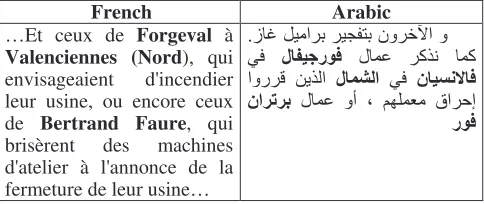
on a screen, as in multilingual concordance (Table 2), and the automatic construction of multilingual lexicons.
The scenario of this task was defined as follows: given a set of named entity tagged French texts, the participants had to identify the translation of the French named entities phrases in the untagged Arabic parallel texts.
4.1. Reference corpus
A subset of MD corpus was used in this experiment. For the purposes of this experiment, we hand annotated 60 French-Arabic parallel texts, designated as reference corpus. The named entities were tagged according the ESTER4 named entity guidelines (Le Meur et al., 2004). A
single annotator was used5. The French subset of the
reference corpus is composed of 72,990 words and 3,639 named entity phrases were annotated. For the Arabic subset, 2,924 named entity phrases were annotated. Some statistics on the reference corpus are presented in Table 3.
Pers. Loc. Org. GSP. Time
Fr. 546 44 397 1140 375 Ar. 550 44 368 1133 372
Table3. Number of major named entity types (person, location, organization, social-political grouping and time)
tagged in the reference corpus.
Many difficulties remain for the constitution of a reference corpus and for the evaluation. In fact, a single-token word may have a multi-word unit as its counterpart in the target (one-to-many alignments), either for lexical reasons or grammatical ones; conversely, the source word can be part of an expression which is translated as a whole (many-to-one alignments). Different types of named entities are translated differently (Table 4). In such cases, the exact correspondence between the two texts is particularly difficult to be identified.
Named entity type French Arabic
Location Pyongyang *)+ )
Temp. expression 1920 , + -%
Table4. Examples of named entity phrases annotated in the reference corpus: Pyongyang was translated by North
Korea and 1920 by 20’s.
4.2. Participants
Two systems were tested (P2 and P7), the output of the system P7 was restricted to few types of named entities (person and organization).
4.3. Evaluation Results
A simple algorithm was first applied to count the number of matches between the output of systems and the reference corpus. Initially, only exact matches were considered. Table 5 shows the preliminary results.
4 French national campaign for automatic broadcast news transcriptions systems. (www.technolangue.net/article60.html) 5 It may be rightfully argued that multiple annotators
should be used.
P2 P7
# of NE identified 2,697 699
# of exact matches 82 98
Table5. Results of exact matches for systems P2 and P7.
The human evaluation is still underway at the time of writing this paper and will be available for the oral presentation.
4.4. Discussion
Given the lack of prior experience and the short time span, the scope of the named entity alignment task was limited. The exercise was however useful for defining and testing a protocol and metrics. Manual annotation of French-Arabic named entity alignment has been tested and a preliminary set of guidelines has been drafted.
5.
Conclusions and Future Research
Although limited in too many respects and a short time-span, the ARCADE II exercise enabled the set of participants to build some expertise in handling new sets of languages, especially distant languages using non-Latin scripts. It also allowed the definition of an evaluation methodology and the production of reference resources which will be usable in future campaigns. It has shown that multilingual sentence-level alignment is a well-mastered task for languages based on the Latin script (although German poses some problems), and that the main difficulty in alignment in that of segmenting correctly the source text in sentences. Non-Latin scripts are still the source of many difficulties and results have been modest, both for sentence and named-entity alignment.
Acknowledgements
We would like to thank Olivier Hamon for his help and all the human evaluators.
6.
References
Le Meur C., Galliano S. and Geoffrois E. (2004). ESTER Convention d’annotations en Entités Nommées.
Langlais P., Simard M. and Véronis J. (1997). ARCADE Methods and Practical Issues in Evaluating Alignment Techniques. Technical report. http://www.up.univ-mrs.fr/veronis/arcade/arcade1/report1-en/index.html Martin J., Mihalcea R. and Pedersen T. (2005). Word
Alignment for Languages with Scarce Resources. In Proceedings of the ACL 2005 Workshop on "Building and Using Parallel Texts: Data Driven Machine Translation and Beyond", Ann Arbor, MI.
Mihalcea R. and Pedersen T. (2003). An Evaluation Exercise for Word Alignment. In Proceedings of the HLT-NAACL 2003 Workshop on "Building and Using Parallel Texts: Data Driven Machine Translation and Beyond", Edmonton, Canada. pp. 1-10.
Rijsbergen CJ. Van. (1979): Information Retrieval. Butterworths, London (UK).