Identity-Based Hybrid Signcryption
Fagen Li
1,2,3, Masaaki Shirase
3, and Tsuyoshi Takagi
31School of Computer Science and Engineering, University of Electronic Science and Technology of China,
Chengdu 610054, China
2Key Laboratory of Computer Networks and Information Security, Xidian University, Xi’an 710071, China
3School of Systems Information Science, Future University-Hakodate, Hakodate 041-8655, Japan
Email:{fagenli,shirase,takagi}fun.ac.jp
Abstract—Signcryption is a cryptographic primitive that fulfills both the functions of digital signature and public key encryption simultaneously, at a cost significantly lower than that required by the traditional signature-then-encryption approach. In this paper, we address a question whether it is possible to construct a hybrid signcryption scheme in identity-based setting. This question seems to have never been addressed in the literature. We answer the question positively in this paper. In particular, we extend the concept of signcryption key encapsulation mech-anism to the based setting. We show that an identity-based signcryption scheme can be constructed by combining an identity-based signcryption key encapsulation mechanism with a data encapsulation mechanism. We also give an example of identity-based signcryption key encapsulation mechanism.
I. INTRODUCTION
Identity-based (ID-based) cryptography was introduced by Shamir in 1984 [23]. The distinguishing property of ID-based cryptography is that a user’s public key can be any binary string, such as an email address that can identify the user. This removes the need for senders to look up the recipient’s public key before sending out an encrypted message. ID-based cryptography is supposed to provide a more convenient alternative to conventional public key infrastructure. Several practical ID-based signature schemes have been devised since 1984 [15], [16] but a satisfying ID-based encryption scheme only appeared in 2001 [7]. It was devised by Boneh and Franklin and cleverly uses bilinear maps (the Weil or Tate pairing) over supersingular elliptic curves.
Confidentiality, integrity, non-repudiation and authentication are the important requirements for many cryptographic appli-cations. A traditional approach to achieve these requirements is to sign-then-encrypt the message. Signcryption, first proposed by Zheng [27], is a cryptographic primitive that fulfills both the functions of digital signature and public key encryption simultaneously, at a cost significantly lower than that required by the traditional signature-then-encryption approach. The original scheme in [27] is based on the discrete logarithm problem but no security proof is given. Zheng’s original construction [27] was only proven secure by Baek, Steinfeld, and Zheng [3] who described a formal security model in a multi-user setting. A recent direction is to merge the concepts of ID-based cryptography and signcryption to design efficient ID-based signcryption schemes. Several ID-based signcryption schemes have been proposed so far, e.g. [4], [8], [9], [11], [20], [21].
The practical way to perform secrecy communication for large messages is to use hybrid encryption that separates the encryption into two parts: one part uses public key techniques to encrypt a one-time symmetric key; the other part uses the symmetric key to encrypt the actual message. In such a con-struction, the public key part of the algorithm is known as the key encapsulation mechanism (KEM) while the symmetric key part is known as the data encapsulation mechanism (DEM). A formal treatment of this paradigm originates in the work of Cramer and Shoup [12]. The resulting KEM-DEM hybrid encryption paradigm has received much attention in recent years [1], [18], [19]. It is very attractive as it gives a clear separation between the various parts of the cipher allowing for modular design. In [1], Abe, Gennaro, and Kurosawa introduced tag-KEM which takes as input a tag in KEM. Bentahar et al’s [5] extended KEM into identity-based setting and proposed several efficient constructions of ID-based KEM (ID-KEM). Chen et al. [10] proposed an efficient ID-KEM based on the Sakai-Kasahara key construction [22]. Kiltz and Galindo [17] proposed a direct construction of ID-KEM in the standard model, based on Waters’s ID-based encryption scheme [26].
The use of hybrid techniques to build signcryption schemes has been studied by Dent [13], [14]. He generalized KEM to signcryption KEM which includes an authentication in KEM. However, he only consider the insider security for authenticity. That is, if the sender’s private key is exposed, an attacker is able to recover the key generated by signcryption KEM. The full insider security [2] means that (a) if the sender’s private key is exposed, an attacker is still not able to recover the message from the ciphertext and (b) if the receiver’s private key is exposed, an attacker is still not able to forge a ciphertext. In 2006, Bjørstad and Dent [6] showed how to built signcryption schemes using tag-KEM. However, they also only consider the insider security for authenticity and not for confidentiality. In 2008, Tan [25] proposed full insider secure signcryption KEM and tag-KEM without random oracles (in the standard model). Tan’s schemes are insider secure for both authenticity and confidentiality.
All the above hybrid signcryption schemes [13], [14], [6], [25] is not ID-based. In this paper, we address a question whether it is possible to construct a hybrid signcryption scheme in ID-based setting. This question seems to have never been addressed in the literature. We answer the question
positively in this paper. In particular, we extend the concept of signcryption KEM to the ID-based setting. We show that an ID-based signcryption scheme can be constructed by com-bining an ID-based signcryption KEM (IDSC-KEM) with a DEM. We also give an example of ID-based signcryption KEM. Our schemes are insider secure for both authenticity and confidentiality.
The rest of this paper is organized as follows. We introduce the preliminary work in Section II. We give the formal model of ID-based signcryption KEM in Section III. We show how to construct an ID-based signcryption scheme using an ID-based signcryption KEM and a DEM in Section IV. An example of ID-based signcryption KEM is described in Section V. Finally, the conclusions are given in Section VI.
II. PRELIMINARIES
A. ID-Based Signcryption (IDSC)
A generic ID-based signcryption scheme consists of the following four algorithms.
• Setup:is a probabilistic polynomial-time (PPT) algorithm run by a private key generator (PKG) that takes as input1k
and outputs a master public key mpk and a master secret keymsk. Here kis a security parameter.
• Extract: is a key generation algorithm run by the PKG that takes as input the master secret keymskand an identity ID ∈ {0,1}∗, and outputs the corresponding private key
SID.
• Signcrypt: is a PPT algorithm that takes as input a plaintext message m, a receiver’s identity IDr, and a
sender’s private key SIDS, and outputs a ciphertext σ ←
Signcrypt(m, SIDs, IDr).
• Unsigncrypt: is a deterministic algorithm that takes as input a ciphertext σ, the receiver’s private key SIDr and the sender’s identityIDs, and outputs the original message
m or the symbol ⊥ if σ is an invalid ciphertext between identitiesIDsandIDr.
We make the consistency constraint that if
σ←Signcrypt(m, SIDs, IDr), then
m←Unsigncrypt(σ, SIDr, IDs).
Malone-Lee [21] defines the security notions for ID-based signcryption schemes. These notions are semantic security (i.e. indistinguishability against adaptive chosen ciphertext attacks (IND-CCA2) and existential unforgeability against adaptive chosen messages attacks (UF-CMA)). For the stronger notion of insider security, we use the notion of strong existential unforgeability (sUF-CMA). The strong existential unforge-ability means that an adversary wins if it outputs a valid message/signcryption pair (m, σ)for identities IDs andIDr
and the signcryption σ was not returned by the signcryption oracle when queried on the messagem.
For the confidentiality, we consider the following game played between a challenger C and an adversaryA.
• Initial: The challenger C runs (mpk, msk) ←
Setup(1k)and runsAon input(1k, mpk).
• Phase1: The adversary A can perform a polynomially bounded number of queries in an adaptive manner (that is, each query may depend on the responses to the previous queries).
– Key extraction queries: A chooses an identity ID. C computes SID←Extract(ID)and sendsSID toA.
– Signcryption queries: A produces a sender’s identity IDs, a receiver’s identity IDr and a plaintext m. C
computes the private key SIDs ← Extract(IDs) and σ←Signcrypt(m, SIDs, IDr)and sendsσ toA.
– Unsigncryption queries: A chooses a sender’s identity IDs, a receiver’s identity IDr, and a ciphertext σ. C
generates the private key SIDr ← Extract(IDr) and sends the result of Unsigncrypt(σ, SIDr, IDs) toA. • Challenge:The adversaryAdecides when Phase 1 ends.
Agenerates two equal length plaintextsm0, m1, a sender’s identity IDs∗, and a receiver’s identity IDr∗ on which it wishes to be challenged. The identity IDr∗ should not appear in any key extraction queries in Phase 1. The challenger C picks a random bit δ from {0,1}, computes σ∗←Signcrypt(mδ, SID∗
s, ID ∗
r), and returns σtoA.
• Phase2:The adversaryAcan ask a polynomially bounded number of queries adaptively again as in Phase 1 with the restriction that it cannot make a key extraction query on IDr∗ and cannot make an unsigncryption query on σ∗ to obtain the corresponding plaintext.
• Guess: The adversary A produces a bit δ0 and wins the game ifδ0=δ.
The advantage ofA is defined to be
AdvIDSCIND−CCA2(A) =|2Pr[δ0=δ]−1|,
wherePr[δ0=δ] denotes the probability thatδ0=δ.
Definition 1: An ID-based signcryption scheme is consid-ered to be IND-CCA2 secure, if for all PPT adversaries A, the advantage in the IND-CCA2 game is a negligible function of the security parameter k.
Notice that the adversary is allowed to make a key extraction query on identityID∗s in the above definition. This condition corresponds to the stringent requirement of insider security for confidentiality of signcryption [2]. On the other hand, it ensures the forward security of the scheme, i.e. confidentiality is preserved in case the sender’s private key becomes compro-mised.
For the strong existential unforgeability, we consider the fol-lowing game played between a challengerC and an adversary F.
• Initial: The challenger C runs (mpk, msk) ←
Setup(1k)and runsF on input(1k, mpk).
• Attack: The adversary F performs a polynomially bounded number of queries just like in the confidentiality game.
was not returned by the signcryption oracle on the input
(m∗, ID∗
s, IDr∗) during Attack stage. F wins the game
if the result ofUnsigncrypt(σ∗, S
ID∗
r, ID ∗
s)is not the⊥
symbol.
The advantage ofF is defined as the probability that it wins.
Definition 2: An ID-based signcryption scheme is consid-ered to be sUF-CMA secure, if for all PPT adversariesF, the advantage in the sUF-CMA game is a negligible function of the security parameterk.
Note that the adversary is allowed to make a key extraction query on the identity ID∗r in the above definition. Again, this condition corresponds to the stringent requirement of insider security for authenticity of signcryption [2].
B. Date Encapsulation Mechanism (DEM)
A DEM is a symmetric encryption scheme which consists of the following two algorithms.
• Enc:is a deterministic encryption algorithm which takes as input1k, a keyKand a messagem∈ {0,1}∗, and outputs a ciphertextc∈ {0,1}∗, where K∈ K
DEMis a key in the given key space, andm is a bit string of arbitrary length. We denote this asc←Enc(K, m).
• Dec:is a deterministic decryption algorithm which takes as input a keyKand a ciphertext c, and outputs the message m∈ {0,1}∗ or a symbol ⊥to indicate that the ciphertext is invalid.
For the purposes of this paper, it is only required that a DEM is secure with respect to indistinguishability against passive attackers (IND-PA). Formally, this security notion is captured by the following game played between a PPT adversaryAand a challenger C.
• Initial:Aruns on input1kand submits two equal length messages,m0 andm1.
• Challenge: C chooses a random keyK∈ KDEM as well as a random bit λ∈ {0,1}, and sends c∗ ←Enc(K, mλ)
toA as a challenge ciphertext.
• Guess: The adversary A produces a bit λ0 and wins the game ifλ0=λ.
The advantage of Ais defined to be
AdvDEMIND−PA(A) =|2Pr[λ0=λ]−1|,
wherePr[λ0=λ]denotes the probability thatλ0=λ.
Definition 3: A DEM is considered to be IND-PA secure, if for all PPT adversariesA, the advantage in the above game is a negligible function of the security parameter k.
III. ID-BASEDSIGNCRYPTIONKEM
In this section, we give the formal definition for ID-based signcryption KEM.
A. Generic Scheme
A generic ID-based signcryption KEM consists of the following four algorithms.
• Setup: is a PPT algorithm which takes as input 1k and
outputs the master public key mpk and the master secret keymsk. Here kis a security parameter.
• Extract: is a key generation algorithm which takes as input msk and an identity ID ∈ {0,1}∗, and outputs the corresponding private keySID.
• Encap: is a PPT key encapsulation algorithm which takes as input a plaintext messagem, a receiver’s identityIDr,
and a sender’s private keySIDs, and outputs an encapsula-tion key pair (K, ψ), where K ∈ KIDSC−KEM is a key in the space of possible session keys at a given security level, andψ ∈ EIDSC−KEM is the encapsulation of that key. We denote this as (K, ψ)←Encap(m, SIDs, IDr).
• Decap: is a deterministic key decapsulation algorithm which takes as input the sender’s identityIDs, the receiver’s
private key SIDr and the encapsulation of that key ψ, and outputs the corresponding key K or the error symbol ⊥. We denote this asK←Decap(ψ, SIDr, IDs).
• Verify: is a deterministic verification algorithm which takes as input a sender’s identityIDs, a receiver’s private
key SIDr, a messagem, and an encapsulationψ, and out-puts>for “true” or⊥for “false”. Note that the verification algorithm does not need to take the symmetric key K as input as it can be easily computed from the encapsulation ψ using the deterministic decapsulation algorithm.
We make the consistency constraint that if
(K, ψ)←Encap(m, SIDs, IDr), then
K←Decap(ψ, SIDr, IDs)and> ←Verify(ψ, m, SIDr, IDs).
B. Security Notions
An ID-based signcryption KEM should satisfy confiden-tiality and unforgeability. For the confidenconfiden-tiality, we consider the following game played between a challenger C and an adversaryA.
• Initial: The challenger C runs (mpk, msk) ←
Setup(1k)and runsAon input(1k, mpk).
• Phase1: The adversary A can perform a polynomially bounded number of queries in an adaptive manner (that is, each query may depend on the responses to the previous queries).
– Key extraction queries: A chooses an identity ID. C computes SID←Extract(ID)and sendsSID toA.
– Key encapsulation queries:Aproduces a sender’s identity IDs, a receiver’s identity IDr and a plaintext m. C
computes the private key SIDs ← Extract(IDs) and
(K, ψ) ← Encap(m, SIDs, IDr) and sends (K, ψ) to A.
– Key decapsulation queries:Achooses a sender’s identity IDs, a receiver’s identityIDr, and an encapsulationψ.
C generates the private keySIDr ←Extract(IDr)and sends the result of Decap(ψ, SIDr, IDs)toA.
– Verification queries: A chooses a sender’s identity IDs, a receiver’s identity IDr, a message m, and
an encapsulation ψ. C generates the private key SIDr ← Extract(IDr) and sends the result of
• Challenge: The adversary A decides when Phase 1 ends. A generates a message m∗, a sender’s identity
ID∗
s, and a receiver’s identity ID∗r on which it wishes
to be challenged. The identity ID∗r should not appear in any key extraction queries in Phase 1. C then runs
(K1, ψ∗)←Encap(m, SID∗
s, ID ∗
r) and randomly chooses
K0← KIDSC−KEM.Calso chooses a random bitb∈ {0,1} and sends(Kb, ψ∗)toAas a challenge encapsulation key
pair.
• Phase2:The adversaryAcan ask a polynomially bounded number of queries adaptively again as in Phase 1 with the restriction that it cannot make a key extraction query on ID∗r and cannot make a decapsulation query on (Kb, ψ∗)
to obtain the corresponding key.
• Guess: The adversary A produces a bit b0 and wins the game ifb0=b.
The advantage of Ais defined to be
AdvIDSCIND−−CCA2KEM(A) =|2Pr[b0=b]−1|,
wherePr[b0=b] denotes the probability thatb0=b.
Definition 4: An ID-based signcryption KEM is considered to be IND-CCA2 secure, if for all PPT adversaries A, the advantage in the IND-CCA2 game is a negligible function of the security parameterk.
For the unforgeability, we consider the following game played between a challenger C and an adversaryF.
• Initial: The challenger C runs (mpk, msk) ←
Setup(1k)and runsF on input(1k, mpk).
• Attack: The adversary F performs a polynomially bounded number of queries just like in the confidentiality game.
• Forgery: F produces a quaternion (m∗, ψ∗, IDs∗, IDr∗),
where the private key ofIDs∗ was not asked and ψ∗ was
not returned by the key encapsulation oracle on the input
(m∗, IDs∗, IDr∗) during Attack stage. F wins the game if the result of Verify(ψ∗, m∗, SID∗
r, ID ∗
s) is not the ⊥
symbol.
The advantage ofF is defined as the probability that it wins.
Definition 5: An ID-based signcryption KEM is considered to be sUF-CMA secure, if for all PPT adversaries F, the advantage in the sUF-CMA game is a negligible function of the security parameterk.
IV. IDENTITY-BASEDHYBRIDSIGNCRYPTION
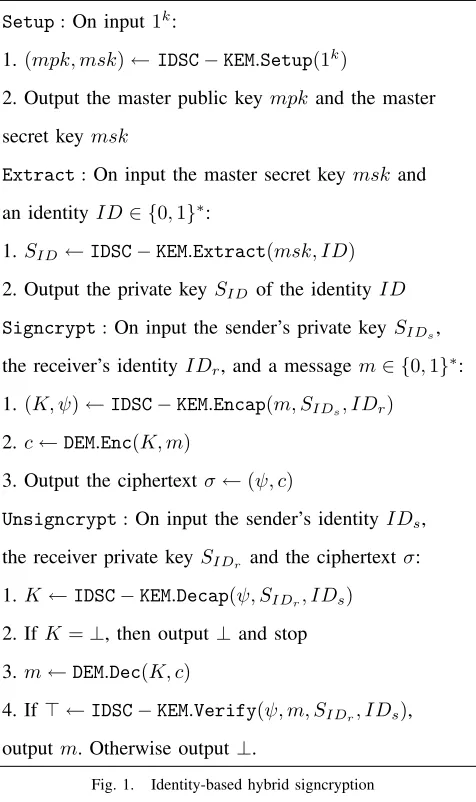
We can combine an ID-based signcryption KEM with a DEM to form an ID-based hybrid signcryption scheme. We describe it in Figure 1.
We give the security results for ID-based hybrid signcryp-tion in Theorems 1 and 2
Theorem 1: Let IDSC be an ID-based hybrid signcryption scheme constructed from an ID-based signcryption KEM and a DEM. If the ID-based signcryption KEM is IND-CCA2 secure and the DEM is IND-PA secure, then IDSC is IND-CCA2 secure. In particular, we have
AdvIDSCIND−CCA2(A)≤2AdvIDSCIND−−CCA2KEM(B1)+AdvINDDEM−PA(B2).
Setup: On input1k:
1. (mpk, msk)←IDSC−KEM.Setup(1k)
2. Output the master public keympk and the master
secret key msk
Extract: On input the master secret keymsk and
an identityID∈ {0,1}∗:
1. SID←IDSC−KEM.Extract(msk, ID)
2. Output the private keySID of the identityID
Signcrypt:On input the sender’s private key SIDs, the receiver’s identityIDr, and a messagem∈ {0,1}∗:
1. (K, ψ)←IDSC−KEM.Encap(m, SIDs, IDr) 2. c←DEM.Enc(K, m)
3. Output the ciphertext σ←(ψ, c)
Unsigncrypt:On input the sender’s identityIDs,
the receiver private key SIDr and the ciphertextσ: 1. K←IDSC−KEM.Decap(ψ, SIDr, IDs) 2. If K=⊥, then output⊥and stop
3. m←DEM.Dec(K, c)
4. If > ←IDSC−KEM.Verify(ψ, m, SIDr, IDs), output m. Otherwise output⊥.
Fig. 1. Identity-based hybrid signcryption
Proof:See the appendix A.
Theorem 2: Let IDSC be an ID-based hybrid signcryption scheme constructed from an ID-based signcryption KEM and a DEM. If the ID-based signcryption KEM is sUF-CMA secure, then IDSC is sUF-CMA secure. In particular, we have
AdvIDSCsUF−CMA(F)≤AdvIDSCsUF−−CMAKEM(B),
where AdvIDSCsUF−CMA(F) is the advantage of the sUF-CMA adversary against IDSC, andAdvIDSCsUF−−CMAKEM(B)is the advan-tage of the resulting sUF-CMA adversary against ID-based signcryption KEM.
Proof:See the appendix B.
V. ANEXAMPLE OFID-BASEDSIGNCRYPTIONKEM
Since Barreto et al.’s scheme uses the bilinear pairings, we first describe the basic definition and properties of the bilinear pairings.
A. Bilinear Pairings
LetG1,G2andGT be three cyclic groups of prime orderq.
LetP,Qbe generators ofG1andG2, respectively. A bilinear pairing is a map ˆe : G1×G2 → GT with the following
properties:
1) Bilinearity:∀(S, T)∈G1×G2,∀a, b∈Zq,ˆe(aS, bT) =
ˆ
e(S, T)ab.
2) Non-degeneracy: ∀S∈G1,ˆe(S, T) = 1 for allT ∈G2 iffS=O.
3) Computability:∀(S, T)∈G1×G2,ˆe(S, T)is efficiently computable.
4) There exists an efficient, publicly computable (but not necessarily invertible) isomorphismϕ:G2 →G1 such thatϕ(Q) =P.
The security of Barreto et al.’s scheme relies on the hardness of the following problems.
Definition 6: Define G1, G2, GT and ˆeas in this section.
The l-Strong Diffie-Hellman problem (l-SDHP) in the groups
(G1, G2) is to find a pair (c,c+1αP) with c ∈ Zq∗ given a
(l+ 2)-tuple(P, Q, αQ, α2Q, . . . , αlQ).
Definition 7: Define G1, G2, GT and ˆeas in this section.
The l-Bilinear Diffie-Hellman Inversion problem (l-BDHIP) in the groups (G1, G2, GT)is to compute ˆe(P, Q)1/α ∈GT
given(P, Q, αQ, α2Q, . . . , αlQ).
B. ID-Based Signcryption KEM
• Setup:DefineG1,G2,GT andˆeas in previous subsection.
LetH1,H2 andH3 be three cryptographic hash functions where H1 : {0,1}∗ → Z∗
q, H2 : {0,1}∗ ×GT → Zq∗
and H3 : GT → {0,1}n. Here n is the key length of a
DEM. Let Q ∈ G2, P = ϕ(Q) ∈ G1 be generators of G2 andG1, respectively andg= ˆe(P, Q)∈GT. The PKG
chooses a master secret keys∈Zq∗randomly and computes Qpub ← sQ ∈ G2. The PKG publishes system pa-rameters{G1, G2, GT, P, Q, g, Qpub,e, ϕ, Hˆ 1, H2, H3}and keeps the master keyssecret.
• Extract: Given an identity ID, the PKG computes the private keySID ←H 1
1(ID)+sQ∈G2. Then PKG sends the
private key to its owner in a secure way.
• Encap:Given a messagem, a receiver’s identityIDrand a
sender’s private keySIDs, this algorithm works as follows. 1) Choosex∈Zq∗ randomly and computer←gx.
2) ComputeK←H3(r). 3) Computeh←H2(m, r). 4) ComputeS←(x+h)ϕ(SIDs).
5) ComputeT ←x(H1(IDr)P+ϕ(Qpub)).
6) Setψ←(S, T). 7) Output(K, ψ).
• Decap: Given the sender’s identity IDs, the receiver’s
private key SIDr, and an encapsulation ψ, this algorithm works as follows.
1) Compute r←eˆ(T, SIDr). 2) Compute K←H3(r). 3) OutputK.
• Verify: Given the sender’s identity IDs, the receiver’s
private key SIDr, a message m, and an encapsulation ψ, this algorithm works as follows.
1) Compute r←eˆ(T, SIDr). 2) Compute h←H2(m, r).
3) Ifr= ˆe(S, H1(IDs)Q+Qpub)g−h, output symbol>.
Otherwise, output symbol⊥.
In a real implementation of this algorithm, we can store the value of r computed by the decapsulation algorithm and use it again in the verification algorithm. Such an implementation would be functionally identical to the above algorithm and would therefore be just as secure. We choose to separate the decapsulation and verification algorithms so that they can be studied independently. The security proof is similar to that of [4]. We omit it.
VI. CONCLUSIONS
In this paper, we extended the concept of signcryption KEM to the identity-based setting. We showed that an ID-based signcryption scheme can be constructed by combining an ID-based signcryption KEM with a DEM. To show that our framework is reasonable, we also gave an example of ID-based signcryption KEM ID-based on Barreto et al.’s ID-ID-based signcryption scheme.
REFERENCES
[1] M. Abe, R. Gennaro, and K. Kurosawa. Tag-KEM/DEM: a new frame-work for hybrid encryption. Journal of Cryptology, Vol. 21, No. 1, pp. 97–130, 2008.
[2] J.H. An, Y. Dodis, T. Rabin. On the security of joint signature and encryption. InAdvances in Cryptology-EUROCRYPT 2002, LNCS 2332, pp. 83–107, Springer-Verlag, 2002.
[3] J. Baek, R. Steinfeld, and Y. Zheng. Formal proofs for the security of signcryption.Journal of Cryptology, Vol. 20, No 2, pp. 203–235, 2007. [4] P.S.L.M. Barreto, B. Libert, N. McCullagh, and J.J. Quisquater. Efficient and provably-secure identity-based signatures and signcryption from bilinear maps. In Advances in Cryptology-ASIACRYPT 2005, LNCS 3788, pp. 515–532, Springer-Verlag, 2005.
[5] K. Bentahar, P. Farshim, J. Malone-Lee, and N.P. Smart. Generic constructions of identity-based and certificateless KEMs. Journal of Cryptology, Vol. 21, No 2, pp. 178–199, 2008.
[6] T.E. Bjørstad and A.W. Dent. Building better signcryption schemes with tag-KEMs. In Public Key Cryptography-PKC 2006, LNCS 3958, pp. 491–507, Springer-Verlag, 2006.
[7] D. Boneh and M. Franklin. Identity-based encryption from the weil pair-ing. InAdvances in Cryptology-CRYPTO 2001, LNCS 2139, pp. 213– 229, Springer-Verlag, 2001.
[8] X. Boyen. Multipurpose identity-based signcryption: a swiss army knife for identity-based cryptography. In Advances in Cryptology-CRYPTO 2003, LNCS 2729, pp. 383–399, Springer-Verlag, 2003.
[9] L. Chen and J. Malone-Lee. Improved identity-based signcryption. In Public Key Cryptography-PKC 2005, LNCS 3386, pp. 362–379, Springer-Verlag, 2005.
[10] L. Chen, Z. Cheng, J. Malone-Lee, N.P. Smart. Efficient ID-KEM based on the Sakai-Kasahara key construction. IEE Proceedings-Information Security, Vol. 153, No 1, pp. 19–26, 2006.
[12] R. Cramer and V. Shoup. Design and analysis of practical public-key encryption schemes secure against adaptive chosen ciphertext attack. SIAM Journal on Computing, Vol. 33, No. 1, pp. 167–226, 2003. [13] A.W. Dent. Hybrid signcryption schemes with outsider security. In
Information Security-ISC 2005, LNCS 3650, pp. 203–217, Springer-Verlag, 2005.
[14] A.W. Dent. Hybrid signcryption schemes with insider security. In Information Security and Privacy-ACISP 2005, LNCS 3574, pp. 253– 266, Springer-Verlag, 2005.
[15] A. Fiat and A. Shamir. How to prove yourself: practical solutions to identification and signature problems. In Advances in Cryptology-CRYPTO’86, LNCS 263, pp. 186–194, Springer-Verlag, 1986. [16] L. Guillou and J.J. Quisquater. A “Paradoxical” Identity-based signature
scheme resulting from zero-knowledge. In Advances in Cryptology-CRYPTO’88, LNCS 403, pp. 216–231, Springer-Verlag, 1988. [17] E. Kiltz and D. Galindo. Direct chosen-ciphertext secure identity-based
key encapsulation without random oracles. InInformation Security and Privacy-ACISP 2006, LNCS 4058, pp. 336–347, Springer-Verlag, 2006. [18] E. Kiltz. Chosen-ciphertext secure key-encapsulation based on gap hashed diffie-hellman. InPublic Key Cryptography-PKC 2007, LNCS 4450, pp. 282–297, Springer-Verlag, 2007.
[19] K. Kurosawa and Y. Desmedt. A new paradigm of hybrid encryp-tion scheme. InAdvances in Cryptology-CRYPTO 2004, LNCS 3152, pp. 426–442, Springer-Verlag, 2004.
[20] B. Libert and J.J. Quisquater. A new identity based signcryption schemes from pairings. In2003 IEEE Information Theory Workshop, pp. 155– 158, Paris, France, 2003.
[21] J. Malone-Lee. Identity based signcryption.Cryptology ePrint Archive, Report 2002/098, 2002.
[22] R. Sakai and M. Kasahara. ID based cryptosystems with pairing on elliptic curve.Cryptology ePrint Archive, Report 2003/054, 2003. [23] A. Shamir. Identity-based cryptosystems and signature schemes. In
Advances in Cryptology-CRYPTO’84, LNCS 196, pp. 47–53, Springer-Verlag, 1984.
[24] V. Shoup. OAEP reconsidered. In Advances in Cryptology-CRYPTO 2001, LNCS 2139, pp. 239–259, Springer-Verlag, 2001.
[25] C.H. Tan. Insider-secure signcryption KEM/tag-KEM schemes without random oracles. InThe Third International Conference on Availability, Reliability and Security-ARES 2008, pp. 1275–1281, Barcelona, Spain, 2008.
[26] B. Waters. Efficient identity-based encryption without random oracles. InAdvances in Cryptology-EUROCRYPT 2005, LNCS 3494, pp. 114– 127, Springer-Verlag, 2005,
[27] Y. Zheng. Digital signcryption or how to achieve cost (signature & encryption) cost (signature) + cost(encryption). In Advances in Cryptology-CRYPTO’97, LNCS 1294, pp. 165–179, Springer-Verlag, 1997.
APPENDIXA PROOF OFTHEOREM1
Proof: Our proof strategy is as follows. We define a sequence Game0, Game1, Game2 of modified attack games.
The only difference between games is how the environment responds to A’s oracle queries.
Let σ∗ ← (ψ∗, c∗) be the challenge ciphertext submitted to A by its challenge oracle that encrypts either m0 or m1 according to a bit b. Let K∗ denote the symmetric key used by the challenge oracle in the generation of the challenge ciphertext, or alternatively, the decapsulation ofψ∗ using the identitiesIDs∗andID∗r that are chosen by the adversary. For any i = 0,1,2, we let Si be the event that δ0 = δ in game
Gamei, whereδis the bit chosen byA’s challenge oracle and δ0 is the bit output by A. This probability is taken over the random choices of Aand those ofA’s oracles.
We will use the following useful lemma from [24].
Lemma 1: LetE,E0, andF be events defined on a prob-ability space such thatPr[E∧ ¬F] = Pr[E0∧ ¬F]. Then we
have
|Pr[E]−Pr[E0]| ≤Pr[F].
Game0 : We simulate the view of the adversary in a real
attack by running the key generation algorithm and using the resulting keys to respond toA’s queries. So the view of Ais the same as it would be in a real attack. Therefore, we have
|Pr[S0]−1
2|= 1 2Adv
IND−CCA2 IDSC (A).
Game1 : In this game, we slightly modify how the
un-signcryption oracle responds to queries from A. When a sender’ identity IDs, a receiver’s identity IDr, and(ψ, c) is
presented to the unsigncryption oracle after the invocation of the challenge signcryption oracle, ifIDs=IDs∗,IDr=IDr∗
and ψ = ψ∗, then the unsigncryption oracle does not use the genuine unsigncryption procedure for the hybrid scheme, instead it uses the keyK∗ to decryptcand returns the result to the adversaryA.
Clearly this change has no impact on the adversary and so
Pr[S1] = Pr[S0].
Game2: In this game, we modify Game1 by replacing K∗ with a random key K0 from KDEM. The result then follows from the following two lemmas.
Lemma 2: There exists a PPT algorithmB1, whose running time is essentially the same as that ofA, such that
|Pr[S2]−Pr[S1]|=AdvIDSCIND−−CCA2KEM(B1).
Proof:To prove this we demonstrate how to construct an adversaryB1of the ID-based signcryption KEM to violate the assumed security against adaptive chosen ciphertext attack.
• Initial: Given(1k, mpk),B
1 sends it toA.
• Phase1:WhenAmake a key extraction query on identity ID, B1 makes a key extraction query to its own key extraction oracle and forwards the answer to A. When A make a signcryption query with a sender’s identityIDs, a
receiver’s identity IDr and a plaintext m, B1 follows the steps below.
1) Make a key encapsulation query on(m, IDs, IDr)to
its own key encapsulation oracle to obtain(K, ψ). 2) Compute c←DEM.Enc(K, m).
3) Return the ciphertext σ←(ψ, c)toA.
When A make a unsigncryption query with a sender’s identity IDs, a receiver’s identity IDr and a ciphertext
σ←(ψ, c),B1 follows the steps below.
1) Make a key decapsulation query on(ψ, IDs, IDr)to
its own key decapsulation oracle to obtainK. 2) If K=⊥, return⊥and stop.
3) Compute m←DEM.Dec(K, c).
4) Make a verification query on (ψ, m, IDs, IDr)to its
own verification oracle to obtain > or ⊥. If > is obtained,B1 outputm. Otherwise output⊥.
ID∗r on which it wishes to be challenged. B1 follows the steps below.
1) Submit IDs∗ and ID∗r to its challenger to obtain
(Kb, ψ∗), where b∈ {0,1}.
2) Pick a random bitδfrom{0,1}. 3) Computec∗←DEM.Enc(Kb, mδ).
4) Return the ciphertextσ∗←(ψ∗, c∗)toA.
• Phase2:The adversaryAcan ask a polynomially bounded number of queries adaptively again as in Phase 1 with the restriction that it cannot make a key extraction query on ID∗r and it cannot make an unsigncryption query onσ∗←
(ψ∗, c∗) to obtain the corresponding plaintext.
• Guess:Aoutputsδ0. Ifδ0 =δ,B1outputsb0= 1indicating Kb is the real key; otherwise it outputs b0 = 0 indicating
Kb is a random key.
When Kb is the real key, A is run exactly as it would be
run inGame1. This means that
Pr[S1] = Pr[δ0=δ|b= 1] = Pr[b0= 1|b= 1].
WhenKb is the random key, Ais run exactly as it would be
inGame2. This means that
Pr[S2] = Pr[δ0=δ|b= 0] = Pr[b0= 1|b= 0].
From the definition of security for ID-based signcryption KEM, we have
AdvIDSCIND−−CCA2KEM(B1)=|2Pr[b0=b]−1|
=|Pr[b0= 1|b= 1]−Pr[b0= 1|b= 0]|
So the result holds.
Lemma 3: There exists a PPT algorithmB2, whose running time is essentially the same as that ofA, such that
|Pr[S2]−1
2|= 1 2Adv
IND−PA DEM (B2).
Proof: To construct such a B2 we simply run A as it would be run in game Game2. We run the ID-based key extraction step so we can respond to A’s queries before it calls its challenge signcryption oracle. When A calls its challenge signcryption oracle with a sender’s identity ID∗s, a receiver’s identity IDr∗, and messages (m0, m1), we simply relay (m0, m1) to the challenge encryption oracle of B2 to obtain c∗. We then make a key encapsulation query on
(m0, ID∗s, ID∗r)to obtain(K∗, ψ∗). We discardK∗and return
(ψ∗, c∗) toA.B2 continues to answer A’s queries as before. The only exception is that ifAqueries the decapsulation oracle on a ciphertext(ψ∗, c), we respond with⊥.
In this simulation A is run by B2 in exactly the same manner as the former would be run in gameGame2; moreover,
Pr[S2]corresponds exactly to the probability thatB2correctly determines the hidden bit of its challenge encryption oracle sinceB2 outputs whatever Aoutputs. The result follows.
APPENDIXB PROOF OFTHEOREM2
Proof: Suppose that F is an adversary that breaks the ID-based signcryption scheme with probability AdvIDSCsUF−CMA(F). We use this to construct an algorithm B that breaks the sUF-CMA game for the ID-based signcryption KEM with probability at leastAdvIDSCsUF−CMA(F) too.B runs as follow
• Initial: Given(1k, mpk),Bsends it toF.
• Attack:WhenF make a key extraction query on identity ID, B makes a key extraction query to its own key extraction oracle and forwards the answer to F. WhenF make a signcryption query with a sender’s identityIDs, a
receiver’s identity IDr and a plaintext m, B follows the
steps below.
1) Make a key encapsulation query on(m, IDs, IDr)to
its own key encapsulation oracle to obtain(K, ψ). 2) Compute c←DEM.Enc(K, m).
3) Return the ciphertext σ←(ψ, c)toF.
When F make a unsigncryption query with a sender’s identity IDs, a receiver’s identity IDr and a ciphertext
σ←(ψ, c),B follows the steps below.
1) Make a key decapsulation query on(ψ, IDs, IDr)to
its own key decapsulation oracle to obtainK. 2) If K=⊥, return⊥and stop.
3) Compute m←DEM.Dec(K, c).
4) Make a verification query on (ψ, m, IDs, IDr)to its
own verification oracle to obtain > or ⊥. If > is obtained,B1 outputm. Otherwise output⊥.
• Forgery: F outputs (m∗, σ∗, IDs∗, IDr∗), where
(ψ∗, c∗)←σ∗.Boutputs (m∗, ψ∗, ID∗s, ID∗r).