On Software Parallel Implementation of Cryptographic
Pairings
? ??P. Grabher, J. Großsch¨adl and D. Page
Abstract. A significant amount of research has focused on methods to improve the efficiency of cryptographic pairings; in part this work is motivated by the wide range of applications for such primitives. Although numerous hardware accelerators for pairing evaluation have used parallelism within extension field arithmetic to improve efficiency, similar techniques have not been examined in software thus far. In this paper we focus on parallelism within one pairing evaluation (intra-pairing), and parallelism between different pairing evaluations (inter-pairing). We identify several methods for exploiting such parallelism (extending previous results in the context of ECC) and show that it is possible to accelerate pairing evaluation by a significant factor in comparison to a naive approach.
1 Introduction
Generally speaking, one uses the term cryptographic pairing to describe a non-degenerate bilinear map of the form
e:G1×G2 −→GT.
In this paper we focus on the Ate pairing which takes the concrete form
e:E(Fp)×E(Fpk/2)−→F×pk
whereE is the quadratic twist of an elliptic curve E defined over Fpk/2. The type and
vol-ume of applications enabled by pairings of this form has dictated that methods for their evaluation remain an ongoing research challenge. This is magnified by the fact that said ap-plications have permeated both high-performance and embedded contexts: computational efficiency and storage footprint are both important. Improvements to high-level algorithms that relate to the pairing itself are clearly the most significant in terms of efficiency; for an overview of the evolution of this topic, see the excellent description by Scott [38]. In short, improvement of seminal but unpublished work by Miller [33] resulted in the first practical algorithms for evaluation of the Tate pairing [5, 19]. These results were further optimised by Duursma and Lee [15] who developed an inexpensive, closed form for specific parameterisations later improved by Kwon [29]. Their techniques were generalised and ex-tended to produce the Eta [4] and Ate [23] pairings, currently considered the fastest means of evaluation.
However, as well as the pairing itself, one depends on lower-level algorithms for arith-metic in the fieldsFp,Fpk/2 andFpk. Previous results have reported on analysis and efficient
?The work described in this paper has been supported in part by the European Commission through the
IST Programme under Contract IST-2002-507932 ECRYPT. The information in this document reflects only the author’s views, is provided as is and no guarantee or warranty is given that the information is fit for any particular purpose. The user thereof uses the information at its sole risk and liability.
realisation of said algorithms; see for example [27, 20, 13]. One can readily identify two types of parallelism within these algorithms and within pairing based cryptosystems more generally: that within a single pairing evaluation (intra-pairing) or between several pair-ing evaluations (inter-pairpair-ing). Put more simply, in the first case the aim is to compute R = e(P, Q) for some P and Q from the appropriate groups; our focus is on parallelism within algorithms for the pairing and constituent arithmetic. Efficient implementation of pairings in hardware have used this feature to great effect; see [26] for an example design where extension field arithmetic is realised using several parallel computational units to reduce latency. In the second case, the aim is to compute all n pairings Ri = e(Pi, Qi) for 0 ≤ i < n; our focus in on the fact that each Ri can be computed independently. Although Granger and Smart [21] describe a method to improve performance where the pairings form terms in a larger product, i.e. R = Qni=0−1e(Pi, Qi), actually capitalising on the parallelism between disjoint pairings is less well examined. This is despite the fact that numerous instances exist, verification of BLS signatures [9] to name one, where this could be useful.
Identifying parallelism in algorithms for the pairing and constituent arithmetic is only the first step: in order to exploit said parallelism, one must have effective methods to map an algorithm onto the capabilities of a given host platform. Often this mapping is difficult enough that any perceived advantage offered by parallelism is eliminated by implementa-tion overhead, in other cases the correct choice of technique is limited by issues such as parameterisation and use of the pairing in real applications. Our goal in this paper is to focus on parallelism, realised using software techniques, as a means of optimising concrete implementations of the Ate pairing. We organise the paper as follows. In Section 2 we recap on the Ate pairing and standard methods for parameterisation and evaluation. Then, in Section 3, we make a detailed study of parallelism within algorithms for the pairing and constituent arithmetic. Section 4 describes details of our implementation including an effi-cient algorithm for parallel multiplication in Fp. Using the identified techniques we present and analyse experimental results derived from their implementation on Intel Core2 and Pentium 4 processors; this is captured in Section 5. Finally, we summarise our findings and conclude in Section 6.
2 The Ate Pairing
To recap, the Ate pairing is a bilinear map of the form
e:E(Fp)×E(Fpk/2)−→F×pk.
Successful parameterisation requires an elliptic curve E(Fp) whose order n is divisible by some large prime r. Let k, the embedding degree of the curve, be the smallest positive integer such that r |pk−1. A Barreto-Naehrig curve or BN-curve [6] of the form
E(Fp) :y2 =x3+b
Algorithm 1: An algorithm to compute the Ate pairing.
Input :Q∈E(Fp),P ∈E(Fp2),s=t−1∈Z. Output:e(Q, P).
T ←P f←1
fori=|s| −2downto 0do f←f2·lT,T(Q) T ←2·T if si= 1 then
f←f·lT,P(Q)
T←T+P returnf(pk−1)/n
of Fp can be parameterised by x as follows
t(x) = 6x2+ 1
n(x) = 36x4−36x3+ 18x2−6x+ 1 p(x) = 36x4−36x3+ 24x2−6x+ 1.
We closely follow the excellent description of Devegili et al. [14] who show that by selecting x = −6917529027641089837 for example, one specifies a 256-bit value p and associated curve where n is of low Hamming weight. Selecting such an x makes the notation t(x), for example, extraneous; using this specific value of x we simply write t instead. Since the associated p satisfies various congruences, it enables an efficient construction of extension field arithmetic using the tower
Fp2 =Fp[X]/(X2−β)
Fp6 =Fp2[Y]/(Y3−ξ)
Fp12=Fp6[Z]/(Z2−ξ0)
whereβ =−2∈Fp,ξ=−1−√β ∈Fp2 andξ0= √3ξ ∈Fp6.
Evaluation of the pairing is achieved using Algorithm 1 wherelP,Q(R) denotes the line function between points P and Q evaluated at R. The selection of a sparse x allows for efficient realisation of the final exponentiation by (pk−1)/n as described fully by Devegili et al. [14].
3 Exploitation of Parallelism
a fixed vector length depends on the application. Often an instruction set will support a (somewhat) orthogonal set of operations and choices ofpand q. This approach has brought significant performance improvements in easily vectorised kernels such as those found in media processing; by making parallelism explicit the processor can maintain a high issue rate and ensure a good trade-off between provision of computational resources and their utilisation.
Use of SWAR style instruction sets have been successful used to accelerate kernels in symmetric cryptography; for example [11, 10, 31, 36, 32]. Although exploiting parallelism within point multiplication in vanilla Elliptic Curve Cryptography (ECC) is possible [2, 25], vectorisation of the public-key cryptography is often more problematic. Consider two n-bit multi-precision integers xandy represented byl=dn/wemachine words wherexi denotes the i-th such w-bit word. Values represented as such are commonly manipulated within cryptosystems such as RSA and ECC. For the sake of clarity, imagine we set n= 128 and q = w = 32 such that p = l = 4. This implies that we can store x and y in one SWAR register each, i.e.
(x0, x1, x2, x3)32 and (y0, y1, y2, y3)32
The problem is that to perform multi-precision addition, for example, one must deal with carry from one sub-word into another sub-word within the same vector. That is, say we want to computer=x+y. The addition ofxandyis not component-wise: for example, we need to take the carry produced by the primitive additionx0+y0 and factor it intox1+y1 thereby destroying the component-wise nature of computation and hence the SIMD style parallelism.
The flexibility of ECC parameterisations helps somewhat in resolving this problem. One might view specific field representations such as Residue Number Systems (RNS) and Optimal Extension Fields (OEF) [3] as more suitable for vectorisation; parameterisation and parallel implementation over F2n has also been effective [7] since carries are essentially eliminated by the nature of arithmetic. Motivated by application in RSA as well as ECC, there is a similar effort to accelerate arithmetic inFp (or more exactly modulo some integer p). Work by Acar [1] and reports by Intel [24] and Apple [12] all investigate the use of SIMD parallelism for implementing multi-precision integer arithmetic. Acar states that his implementation of RSA on a processor with an MMX instruction set runs significantly slower due to a lack of unsigned 16-bit and 32-bit multiplication. Intel are more positive in their results that focus on the SSE2 instruction set. Their method applies a form of recoding into a representation with a smaller digit size; this allows fast combination of partial products without requiring carries at all. Hankerson et al. [22, Chapter 5.1.3] also discuss the same technique within the context of ECC.
This previous work offers a natural way to exploit intra-pairing parallelism: one simply accelerates arithmetic in Fp which, in turn, accelerates all higher layers of arithmetic and therefore the pairing evaluation itself.
one might perform addition ofw-bit operandsx andyto producer =x+y, or component-wise XOR to produce ri = xi⊕yi for all 0 ≤ i < w. This ability is restricted however when an algorithm is required to perform some operation involving different bits from the same word. For example one might be required to combine xi and xj, where i 6=j, using an XOR operation in order to compute the parity of x. In this situation one is required to shift (and potentially mask) the bits so they are aligned at the same index ready for combination via a native, component-wise XOR. The technique of bit-slicing, proposed by Biham for efficient implementation of DES [8], offers a way to reduce the associated overhead. Instead of representing the w-bit value x as one machine word, we represent x using w machine words where word i contains xi aligned at the same fixed index j. As such, there is no need to align bits ready for use in a component-wise XOR operation. Additionally, since native word oriented logical operations in the processor operate on all w bits in parallel, one can pack w different values (say x[k] for 0 ≤ k < w) into the w words and proceed using an analogy of SIMD style parallelism. Conversion to and from a bit-sliced representation can represent an overhead but this can be amortised if the cost of computation using the bit-sliced values is significant enough: Biham used this technique to extract a five-fold performance improvement from DES using a 64-bit Alpha processor.
Although it overloads the term somewhat, one might describe previous SWAR based implementations of public-key cryptography as digit-serial in the sense that they try to extract parallelism from a series of digits representing one value. An alternative approach, which one might describe as digit-sliced SWAR, represents the digit based analogy of the bit based slicing approach outlined above. This seems to have been first investigated by Montgomery in the context of ECM based factoring [35] and then rediscovered and applied in the context of RSA by Page and Smart [37]. Following the example above, the basic idea is that instead of representing an l-word multi-precision integer x by packing the digits xi into one SWAR vector, we slice the digits into l separate SWAR vectors where vector i contains xi aligned at the same fixed indexj. For the case wheren= 128, q =w= 32 and p=l= 4 we therefore representx and y using four SWAR registers
(x0,·,·,·)32 (y0,·,·,·)32 (x1,·,·,·)32 and (y1,·,·,·)32 (x2,·,·,·)32 (y2,·,·,·)32 (x3,·,·,·)32 (y3,·,·,·)32
Algorithm 2: An algorithm to compute the Ate pairing.
Input :Q∈E(Fp),P ∈E(Fp2),s=t−1∈Z. Output:e(Q, P).
fori= 1upto|s| −1do
τf[i]←τf[i−1]2·lτT[i−1],τT[i−1](Q)
τT[i]←2·τT[i−1]
f0←1,T0← O
f1←1,T1← O
par
fori= 0 upto|s| −1do
if si= 1and i= 0 (mod 2)then f0←f0·τf[i]·lT0,τT[i](Q)
T0←T0+τT[i] fori= 0 upto|s| −1do
if si= 1and i= 1 (mod 2)then f1←f1·τf[i]·lT1,τT[i](Q)
T1←T1+τT[i]
f←f0·f1·lT0,T1(Q)
returnf(pk−1)/n
In terms of the pairing and constituent arithmetic, the technique of digit-slicing is po-tentially interesting. At any level, all the algorithms for arithmetic are (or are close to) control-flow invariant; for example for any given pairing evaluation using some fixed pa-rameterisation, one performs the same operation at a give step so only the data values differ. As such, one can deploy digit-slicing to exploit intra-pairing parallelism (for example performingcmultiplications inFp at once to accelerate arithmetic in Fp2), or inter-pairing
parallelism (for example evaluating cpairings at once).
Multi-core Processors. A modern trend in the design of microprocessors is that of multi-core, i.e. having say n physical processor cores on a single die. This philosophy is in part guided by the need to make effective use of advances in fabrication which allow dies to house huge number of transistors, and the so-called memory wall which posits that memory access dominates the performance of conventional single-core processors. In software, one can take advantage of multi-core processors using, for example, the OpenMP standard; with suitable compiler and operating system support this enables multiple code sequences to be executed in parallel, one on each core.
more thought. For example, one might redesign Algorithm 1 to allow parallelism between point arithmetic or line function evaluations.
Consider Algorithm 2 which is derived from a specialisation of so-called fixed-base win-dowing [22, Algorithm 3.41] forw= 1. Use of thepar keyword shows that after a precom-putation phase comprised of point (resp. line) doublings, two threads can compute point (resp. line) additions in parallel (one thread deals with odd-indexed bits in s, the other even-indexed bits). The clear advantage of this approach is parallelism; the clear disadvan-tage is the significant memory overhead for tables τf and τT, and the fact that the point (resp. line) additions are now projective rather than mixed.
4 Implementation Details
In the following we elaborate on the concrete implementation of the field arithmetic using scalar (i.e. non-SIMD) as well as SIMD (i.e. MMX, SSE) instruction sets. Both implementa-tions have in common that the modular multiplication (resp. squaring) operation is realised via Montgomery reduction [34]. The inversion is performed using the Extended Euclidean Algorithm (EEA).
4.1 Field Arithmetic with the IA32/IA64 Instruction Set
The IA32 architecture provides an add-with-carry instruction (adc) and a 32-bit unsigned multiply instruction yielding a 64-bit result (mul). Thanks to the availability of these two instructions, the arithmetic operations inFp can be implemented in a fairly straightforward way: a field element is simply represented in form of an array of single-precision (i.e. 32-bit) words and the software routines for addition and multiplication loop through these arrays and produce the result using the afore-mentioned instructions. Our implementation of the field arithmetic is written in ANSI C and contains some hand-optimised assembly language sections for the performance-critical inner-loop operations. As the size of the fields used in pairing-based cryptography is relatively small, it is possible to unroll the inner loops and gain some extra performance at the expense of a slight increase in code footprint.
Algorithm 3 shows the Coarsely Integrated Operand Scanning (CIOS) method for cal-culating the Montgomery product Z =A·B·2−nmodM [28]. The n-bit operands A,B, M are represented by arrays of ssingle-precision w-bit words. The algorithm has a nested loop structure with two inner loops; the first contributes to the calculation of the product A·B and the second implements the modular reduction operation. Both inner loops perform the same operation: two single-precision words are multiplied together, and then two other words are added to the product. Therefore, each iteration of the inner loop executes a mul, two add, and twoadc instructions, respectively.
4.2 Field Arithmetic with the MMX/SSE Instruction Set
Algorithm 3: Montgomery multiplication (CIOS method).
Input : Ans-word modulusM = (ms−1, . . . , m1, m0), two operandsA= (as−1, . . . , a1, a0) and
B= (bs−1, . . . , b1, b0) withA, B < M, and the constantm00=−m−01mod 2w.
Output: The Montgomery productZ=A·B·2−nmodM. Z ←0
forifrom0by1tos−1do u←0
forjfrom0by1tos−1do (u, v)←aj×bi+zj+u zj←v
(u, v)←zs+u
zs←v zs+1←u
q←z0×m00mod 2w
(u, v)←z0+m0×q
forjfrom1by1tos−1do (u, v)←mj×q+zj+u zj−1←v
(u, v)←zs+u zs−1←v
zs←zs+1+u if Z≥M then
Z←Z−M
returnZ = (zs−1, . . . , z1, z0)
64 bits 64 bits
29 bits 29 bits
Fig. 1.The packed 29-bit digits within a single 128-bit SSE register, as detailed by [24].
data types, which means that a 64-bit MMX operand can also be treated as either two 32-bit, four 16-bit, or eight 8-bit quantities. The Streaming SIMD Extensions (SSE) further enhance the capabilities of the IA32 architecture through the integration of eight 128-bit registers and appropriate instructions. For example, the SSE2 instruction pmuludq allows one to execute two 32×32-bit multiplications independently and in parallel, each yielding a 64-bit result. However, the main drawback of the MMX and SSE instruction sets in the context of multi-precision integer arithmetic is the lack of an add-with-carry instruction.
Table 1.Timings for Montgomery multiplication and squaring (in cycles as reported byrdtsc) on a Pentium 4 processor for 256-bit, 384-bit and 512-bit operands.
Implementation 256-bit 384-bit 512-bit SIMD Montgomery Mul. 1182 2104 2978 GMP (mpn mul n+redc) 1171 2429 3700 SIMD Montgomery Sqr. 1063 1875 2523 GMP (mpn sqr n+redc) 1051 2257 3151
must be performed at the very end to obtain the correct result. We implemented the CIOS method for Montgomery multiplication following these guidelines which also allowed us to fuse the two inner loops. This loop fusion does not only reduces the loop overhead, but also eliminates a number of load/store instructions as, for example, the quantity zj in Algorithm 3 needs to be loaded only once. However, a disadvantage of the multiplication technique described in [24] is that two arrays are necessary for storing the intermediate results during a Montgomery multiplication. This “redundant” representation makes the outer loop of Algorithm 3 relatively costly, in particular the calculation of the quotient q.
Table 1 compares the execution times (in clock cycles) of our Montgomery arithmetic implemented according to Algorithm 3 using the 29-bit representation detailed in [24], and the corresponding functions1 from the GMP library version 4.2.2. Our implementation is slightly slower for 256-bit operands, but outperforms GMP for 384-bit and 512-bit operands. As mentioned previously, our implementation of Algorithm 3 is characterised by a relatively costly outer loop, while the inner loop is extremely efficient. However, for short operands, the operations in the outer loop dominate the execution time, which renders the 29-bit representation less attractive.
5 Implementation Results
In order to evaluate the options for exploiting parallelism introduced in previous sections, we used two experimental platforms; the rational for their selection was that they repre-sent previous (NetBurst) and current (Core2) generation micro-architectures in commodity microprocessors:
Platform A housed a 2.80GHz Intel Pentium 4 processor running a 32-bit installation of Linux including a 2.6.9 series kernel and 32-bit Intel C compiler version 10.1. The SIMD instruction set on this platform was limited to SSE2 series (and earlier) instructions only.
Platform B housed a 2.40GHz Intel Core2 Duo processor running a 64-bit installation of Linux including a 2.6.18 series kernel and 64-bit Intel C compiler version 10.1. The SIMD instruction set on this platform was limited to SSE3 series (and earlier) instructions only.
Since our goal is to highlight issues with existing processors, we do not investigate the impact of altering the number of execution pipelines within a particular micro-architecture
1Note that GMP features a function for Montgomery reduction (redc), but not for Montgomery
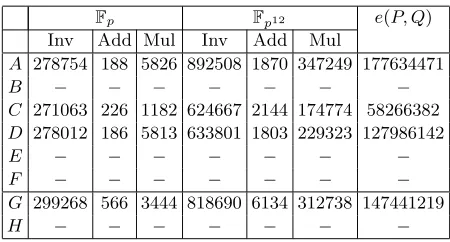
Table 2.Timings for major operations (in cycles as reported byrdtsc) on experimental platformA(Pentium 4).Fp is a 256-bit prime field.
Fp Fp12 e(P, Q)
Inv Add Mul Inv Add Mul
A 278754 188 5826 892508 1870 347249 177634471
B − − − − − − −
C 271063 226 1182 624667 2144 174774 58266382 D 278012 186 5813 633801 1803 229323 127986142
E − − − − − − −
F − − − − − − −
G 299268 566 3444 818690 6134 312738 147441219
H − − − − − − −
(which could be interesting). Note that the second experimental platform includes a multi-core processor: it has two processor multi-cores. Using the platforms we constructed eight separate implementations which represent a cross-section of the presented approaches to intra-pairing and inter-pairing parallelism (recalling that we have a fixed parameterisation where p is a 256-bit prime):
Implementation A uses the scalar (i.e. non-SIMD) instruction set and a 32-bit digit size; evaluates one pairing at a time using Algorithm 1.
Implementation B uses the scalar (i.e. non-SIMD) instruction set and a 64-bit digit size; evaluates one pairing at a time using Algorithm 1.
Implementation C uses the SIMD (i.e. SSE) instruction set and a 29-bit digit size to perform digit-serial Fp arithmetic; evaluates one pairing at a time using Algorithm 1.
Implementation D uses the SIMD (i.e. SSE) instruction set and a 32-bit digit size to perform 2-way digit-sliced Fp2 arithmetic (i.e. two Fp operations in parallel); evaluates
one pairing at a time using Algorithm 1.
Implementation E takes ImplementationB as a starting point, uses OpenMP to perform parallel Fp6 arithmetic within Fp12 and parallel Fp2 arithmetic within Algorithm 1 in
order to evaluate one pairing at a time.
Implementation F takes Implementation B as a starting point, but uses OpenMP to implement Algorithm 2 and thereby evaluate one pairing at a time.
Implementation G uses the SIMD (i.e. SSE) instruction set and a 32-bit digit size to perform 2-way digit-sliced pairing evaluation (i.e. two e(P, Q) operations in parallel) and therefore evaluates two pairings at a time.
Implementation H takes Implementation B as a starting point, but uses OpenMP to execute two instances of Algorithm 1 in parallel and therefore evaluate two pairings at a time.
5.1 Analysis of Results
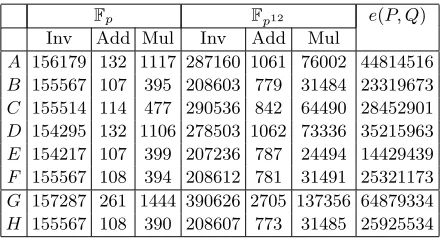
Table 3.Timings for major operations (in cycles as reported byrdtsc) on experimental platformB(Core2 Duo).Fp is a 256-bit prime field.
Fp Fp12 e(P, Q)
Inv Add Mul Inv Add Mul
A 156179 132 1117 287160 1061 76002 44814516 B 155567 107 395 208603 779 31484 23319673 C 155514 114 477 290536 842 64490 28452901 D 154295 132 1106 278503 1062 73336 35215963 E 154217 107 399 207236 787 24494 14429439 F 155567 108 394 208612 781 31491 25321173 G 157287 261 1444 390626 2705 137356 64879334 H 155567 108 390 208607 773 31485 25925534
Although our results are not exhaustive, for the given parameterisation they prompt some interesting conclusions. On the Pentium 4 based platform, if one is required to evalu-ate a single pairing then the best option is to parallelise arithmetic in Fp (Implementation C); if the requirement is for two pairing evaluations, the best option is actually two invo-cations of Implementation C. On the Core2 based platform, if one is required to evaluate a single pairing then it makes more sense to use 64-bit scalar arithmetic in Fp and multi-core parallel arithmetic withinFp12 and the pairing itself (ImplementationE) than consider
SIMD parallelism; if the requirement is for two pairing evaluations, the slightly moronic con-clusion is that one can perform one pairing on each core (Implementation H), doubling the performance versus two sequential invocations of any other method that does not already use multi-core parallelism internally.
5.2 Analysis of Platforms
Design of SIMD Instruction Sets. Interestingly, in early 2008 Intel announced an updates to the SSE lineage of SIMD instruction sets, and a totally new instruction set specialised toward implementation of AES. Specifically, the Advanced Vector Extensions (AVX) includes the pclmulqdqinstruction for carryless multiplication that can be used to accelerate arithmetic in binary finite fields. In addition, the Advanced Encryption Standard Instructions Set (AES-NI) includes instructions that perform whole AES rounds with the view to improving performance and eliminating cache based side-channel attack.
In a sense, it is not a surprise that Implementation B outperformsC on the Core2 plat-form. For example, the SSE3 instruction set allows 2-way parallel 32×32-bit multiplication; the cost of such multiplication plus the overhead of data reorganisation will intuitively be greater than native 64×64-bit multiplication. Furthermore, the SSE3 instruction set lacks a method for performing an add-with-carry operation that exists in the scalar instruction set. As such, enhancements over SSE3 such as the pshufbinstruction help to reduce said overhead but the instruction set still lacks features which could improve performance of our results. For example, the PLX [30] processor eases the issue of shuffles between sub-words by including odd and even multiplication, i.e. both
r2i+1...2i+0 =x2i+0·y2i+0
and
r2i+1...2i+0 =x2i+1·y2i+1
fori∈ {0,1}. Another improvement would be provision of hardware support for add-with-carry via vector-add-with-carry registers; Fournier [18] investigates this approach within the context of a dedicated vector processor. The upcoming SSE5 instruction set offers an alternative approach by departing from purely 3-address instructions by adding support for a range of 4-address alternatives. In this context, it seems possible to extend the instruction set further and allow explicit specification of a vector-carry register rather than via an implicit, special purpose register as proposed by Fournier.
Effective Utilisation of Multi-core. Another interesting feature is that using the multi-core capabilities of the Core2 platform to evaluate one pairing, we are presented with two problems. Firstly, the overhead from use of OpenMP limits where we can exploit the inher-ent parallelism within field arithmetic; if the processor had a more light-weight means of managing fine-grained threads, Implementation E would potentially be even more lucrative. The results from using course-grained threads in Algorithm 2 are underwhelming. The low Hamming weight ofscoupled with the significant overhead introduced by using projective rather than mixed point (resp. line) addition means it is slower than the non-parallel alter-native. The first problem motivates research into fine-grained multi-core and multi-threaded processors; an exemplar design is the XCore. The second problem motivates research into forms of easily parallelised pairing algorithms.
6 Conclusions
on a naive approach, we identified areas for further improvement through study of new algorithm types and changes to processor architecture. The results for arithmetic in Fp have a direct implication for vanilla ECC in which it seems a similar argument wrt. to implementation approach should apply.
Acknowledgements
The authors would like to thank Peter Schwabe for helping to correct some problems with initial performance results.
References
1. T. Acar. High-Speed Algorithms & Architectures For Number-Theoretic Cryptosystems. PhD Thesis, Oregon State University, 1997.
2. K. Aoki, F. Hoshino, T. Kobayashi and H. Oguro. Elliptic Curve Arithmetic Using SIMD. InInformation Security Conference (ISC), Springer-Verlag LNCS 2200, 235–247, 2001.
3. D.V. Bailey and C. Paar. Efficient Arithmetic in Finite Field Extensions with Application in Elliptic Curve Cryptography. InJournal of Cryptology14(3), 153–176, 2001.
4. P.S.L.M. Barreto, S. Galbraith, C. ´O h ´Eigeartaigh and M. Scott. Efficient Pairing Computation on Supersingular Abelian Varieties. InDesigns, Codes and Cryptography,42(3), 239–271, 2007.
5. P.S.L.M. Barreto, H. Kim, B. Lynn and M. Scott. Efficient Algorithms for Pairing-Based Cryptosystems. InAdvances in Cryptology (CRYPTO), Springer-Verlag LNCS 2442, 354–368, 2002.
6. P.S.L.M. Barreto and M. Naehrig. Pairing-friendly Elliptic Curves of Prime Order. InSelected Areas in Cryptography (SAC), Springer-Verlag LNCS 3897, 319–331, 2005.
7. R. Bhaskar, P.K. Dubey, V. Kumar, A. Rudra and A. Sharma. Efficient Galois Arithmetic on SIMD Architectures. In ACM Symposium on Parallel Algorithms and Architectures, ACM Press, 256–257, 2003.
8. E. Biham. A Fast New DES Implementation in Software. InFast Software Encryption (FSE), Springer-Verlag LNCS 1267, 260–272, 1997.
9. D. Boneh, B. Lynn and H. Shacham. Short signatures from the Weil pairing. InJournal of Cryptology, 17(4), 297–319, 2004.
10. A. Bosselaers, R. Govaerts and J. Vandewalle. SHA: A Design for Parallel Architectures ? InAdvances in Cryptology (EUROCRYPT), Springer-Verlag LNCS 1233, 348–362, 1997.
11. C.S.K. Clapp. Optimizing a Fast Stream Cipher for VLIW, SIMD, and Superscalar Processors. InFast Software Encryption (FSE), Springer-Verlag LNCS 1267, 273–287, 1997.
12. R. Crandall and J. Klivington. Vector Implementation of Multiprecision Arithmetic. Technical Report, 1999.
13. A.J. Devegili, C. ´O h ´Eigeartaigh, M. Scott, and R. Dahab, Multiplication and Squaring on Pairing-Friendly Fields, InCryptology ePrint Archive, Report 2006/471, 2006.
14. A.J. Devegili, M. Scott and R. Dahab. Implementing Cryptographic Pairings over Barreto-Naehrig Curves InPairing Based Cryptography (PAIRING), Springer-Verlag LNCS 4575, 197–207, 2007. 15. I. Duursma and H. Lee. Tate Pairing Implementation for Hyperelliptic Curvesy2 = xp−x+d. In
Advances in Cryptology (ASIACRYPT), Springer-Verlag LNCS 2894, 111–123, 2003.
16. J. Fan, K. Sakiyama and I. Verbauwhede. Montgomery Modular Multiplication Algorithm on Multi-Core Systems. InIEEE Workshop on Signal Processing Systems: Design and Implementation (SIPS), 261–266, 2007.
17. J. Fan, K. Sakiyama and I. Verbauwhede. Elliptic Curve Cryptography on Embedded Multicore Systems. InWorkshop on Embedded Systems Security (WESS), 17–22, 2007.
18. J.J.A. Fournier. Vector Microprocessors for Cryptography. PhD Thesis, University of Cambridge, 2007. 19. S. Galbraith, K. Harrison and D. Soldera. Implementing the Tate Pairing. InAlgorithmic Number
Theory Symposium (ANTS-V), Springer LNCS 2369, 324–337, 2002.
21. R. Granger and N.P. Smart. On Computing Products of Pairings. InCryptology ePrint Archive, Report 2006/172, 2006.
22. D. Hankerson, A. Menezes and S. Vanstone. Guide to Elliptic Curve Cryptography. Springer-Verlag, 2004.
23. F. Hess, N.P. Smart and F. Vercauteren. The Eta Pairing Revisited. InTransactions on Information Theory52, 4595–4602, 2006.
24. Intel Cooperation. Using Streaming SIMD Extensions (SSE2) to Perform Big Multiplications. Technical Report, 2000.
25. T. Izu and T. Takagi. Fast Elliptic Curve Multiplications with SIMD Operations. In4th International Conference on Information and Communications Security (ICICS), Springer-Verlag LNCS 2513, 217– 230, 2002.
26. T. Kerins, W.P. Marnane, E.M. Popovici and P.S.L.M. Barreto. Efficient Hardware for the Tate Pair-ing Calculation in Characteristic Three. In Cryptographic Hardware and Embedded Systems (CHES), Springer-Verlag LNCS 3659, 412–426, 2005.
27. N. Koblitz and A. Menezes. Pairing-based Cryptography at High Security Levels. InCryptography and Coding, Springer-Verlag LNCS 3796, 13–36, 2005.
28. C.K. Koc, T. Acar and B.S. Kaliski. Analyzing and Comparing Montgomery Multiplication Algorithms. InIEEE Micro,16(3), 26–33, 1996.
29. S. Kwon. Efficient Tate Pairing Computation for Elliptic Curves over Binary Fields. In Information Security and Privacy (ISP), Springer-Verlag LNCS 3574, 134–145, 2005.
30. R.B. Lee and A.M. Fiskiran. PLX: A Fully Subword-Parallel Instruction Set Architecture for Fast Scalable Multimedia Processing InIEEE International Conference on Multimedia and Expo (ICME), 117–120, 2002.
31. H. Lipmaa. IDEA: A Cipher for Multimedia Architectures? In Selected Areas in Cryptography (SAC), Springer-Verlag LNCS 1556, 248–263, 1998.
32. M. Matsui and J. Nakajima. On the Power of Bitslice Implementation on Intel Core2 Processor. In
Cryptographic Hardware and Embedded Systems (CHES), Springer-Verlag LNCS 4727, 121–134, 2007. 33. V. Miller. Short programs for functions on curves. Available at:http://crypto.stanford.edu/miller/
miller.pdf
34. P.L. Montgomery. Modular Multiplication without Trial Division. In Mathematics of Computation, 44(170), 519–521, 1985.
35. P.L. Montgomery. Vectorization of the Elliptic Curve Method. Available at:ftp://ftp.cwi.nl/pub/ pmontgom/ecmvec.psl.gz
36. J. Nakajima and M. Matsui. Performance Analysis and Parallel Implementation of Dedicated Hash Functions. InAdvances in Cryptology (EUROCRYPT), Springer-Verlag LNCS 2332, 165–180, 2002. 37. D. Page and N.P. Smart. Parallel Cryptographic Arithmetic Using a Redundant Montgomery
Repre-sentation. InIEEE Transactions on Computers,53(11), 1474–1482, 2004.
![Fig. 1. The packed 29-bit digits within a single 128-bit SSE register, as detailed by [24].](https://thumb-us.123doks.com/thumbv2/123dok_us/1861268.1241846/8.612.91.527.52.368/fig-packed-bit-digits-single-sse-register-detailed.webp)