PARAMETERS ESTIMATION FOR A MECHANISTIC MODEL OF HIGH DOSE IRRADIATION DAMAGES USING NELDER-MEAD SIMPLEX METHOD AND GENETIC ALGORITHM
MOHAMAD HIDAYAD AHMAD KAMAL
A dissertation submitted in partial fulfilment of the requirements for the award of the degree of
Master of Science
Faculty of Science Universiti Teknologi Malaysia
iii
iv
ACKNOWLEDGEMENT
Bismillahirrahmanirrahim. In the name of Allah, The Most Greatest and Most Merciful. Praise Upon the Beloved Prophet, His Family and Companion. There is no power except by the power of Allah and I humbly return my acknowledgement that all knowledge belongs to Allah. Alhamdulillah, I thank Allah for granting me this opportunity to broaden my knowledge in this field.
First and foremost I would like to express my deepest appreciation to my supervisor, Dr. Fuaada and co supervisor Dr. Farhana for their enthusiastic guidance, invaluable help, encouragement and patient for all aspect in helping me throughout this research. Their numerous comment, criticism and suggestion during the preparation of this research are gratefully praised.
I acknowledge, appreciate, and return to the love and support of my family, without whom I would be lost. To my mother, Pn Asiah binti Ahamad and beloved sisters, Ku Yu and Ku Dik thank you very much for your continuous support.
I wish to express my thank to Azrin, Ida, Nadia, Am and Syitah who actually works tirelessly and patiently to guide me the most how to work with MATLAB and LATEXsoftware until the completion of this thesis
v
ABSTRACT
vi
ABSTRAK
vii
TABLE OF CONTENTS
CHAPTER TITLE PAGE
DECLARATION ii
DEDICATION iii
ACKNOWLEDGEMENT iv
ABSTRACT v
ABSTRAK vi
TABLE OF CONTENTS vii
LIST OF TABLES x
LIST OF FIGURES xi
LIST OF ABBREVIATIONS xiii
1 INTRODUCTION 1
1.1 Background of the Research 1
1.2 Statement of the Problem 4
1.3 Objective of Research 5
1.4 Scope of the Research 5
1.5 Significance of the Research 5
1.6 Thesis Outline 6
2 LITERATURE REVIEW 8
2.1 Introduction 8
2.2 Cell, DNA and Its Properties 8
2.3 Radiation and Its Properties 12
viii
2.3.2 Ionising Radiation 12
2.3.3 Radiation Damage 13
2.4 Cell Population Model 15
2.5 Parameter Estimation 16
2.6 Conclusion 18
3 RESEARCH METHODOLOGY 19
3.1 Introduction 19
3.2 Research Chronology 19
3.3 Operational Framework 21
3.4 Local and Global Optimisation 22
3.4.1 Nelder-Mead Simplex Method 22
3.4.2 Genetic Algorithm 28
3.5 Conclusion 33
4 A MECHANISTIC MODEL OF HIGH DOSE
IRRADIATION DAMAGE 34
4.1 Introduction 34
4.2 Formulation of the Model 34
4.2.1 Initial Condition 36
4.2.2 Repair Rates 37
4.2.3 Death Rates 37
4.3 The Solution of the System of ODE 38
4.4 Conclusion 43
5 MODEL OF PARAMETERS ESTIMATION FOR CELL POPULATION EVOLUTION AFTER
IRRADIATION 44
5.1 Introduction 44
5.2 Parameter Estimation of the Model 44
5.2.1 Experimental Data 45
ix
5.2.3 Parameter Estimation Using Nelder-Mead
Simplex Method 47
5.2.4 Parameter Estimation Using Genetic Algorithm 48 5.3 Parameter Estimation Results and Discussions 48
5.4 Conclusion 56
6 CONCLUSIONS AND RECOMMENDATIONS 57
6.1 Conclusion 57
6.2 Recommendation for Future Research 59
REFERENCES 61
x
LIST OF TABLES
TABLE NO. TITLE PAGE
5.1 The parameters range interval from Siam 2014 for each
interval. 47
5.2 The estimated parameter values (mean) and sum of
square error (SSE) using NM simplex method and GA. 48 5.3 The correlation between experimental data with number
of calculated survival cell and parameter estimation for
LQ relation when˛exp D0:2790andˇexp D0:0357. 50 5.4 The sample mean,xN and the sample standard deviation,
s of the estimated value of each parameter data using
Nelder-Mead simplex and Genetic Algorithm. 51 5.5 The computational time to minimise objective function
(SSE) using Nelder-Mead simplex method and Genetic
Algorithm. 52
5.6 The 95% confidence interval for the six parameters of the model for number of survival cell using
xi
LIST OF FIGURES
FIGURE NO. TITLE PAGE
1.1 The simple cross section of animal cell. 1
2.1 The structure of the DNA double helix made up of sugar
and phosphate molecule 10
2.2 The structure of the cromosome and its parts. 11 2.3 The illustration of cell cycles with several stage. 11 2.4 DNA types of damage; single strand break (SSBs) or
double strand break (DSBs) 13
3.1 The operational framework sequence for the current research. 21 3.2 The flowchart in optimising using Nelder-Mead simplex
method. 26
3.3 The flowchart in optimising using Genetic Algorithm. 31 4.1 Schematic description of the cell survival model
determined by the value ofkandm 35
4.2 Simulation result for data fitted to LQ relation by using
Nelder-Mead simplex method. 40
4.3 Simulation result for data fitted to LQ relation by using
Genetic Algorithm. 41
4.4 The simulation result at T D 24 hours for different
xii
5.1 The survival data of human melanoma cell lines Mel202 (triangles) for low LET and mouse embryonic cells
C3H10T1/2 (asterisks) for high LET. 45
5.2 Graph of the objective function with number of iteration
for Nelder-Mead simplex method. 53
5.3 Graph of the objective function with number of iteration
xiii
LIST OF SYMBOLS, ABBREVIATIONS AND NOTATION
A - Adenine
AI - Artificial Interlegence
ANM - Advance Nelder Mead
B - Best vertax
C - Contraction
CI - Contract Inside
CO - Contract Outside
C - Cytosine
C3H10T1/2 - Mouse embryonic cells
CI - Confident Interval
CPP - Compound Poisson Process
CPU - Central Processing Unit
D - Radiation Dose
DNA - Deoxyribonucleic acid
DSBs - Double Strand Breaks
E - Expression
G - Good vertex
G - Guanine
GA - Genetic Algorithm
GBNM - Globalized Bounded Nelder Mead
GHz - Gigahertz
HRR - Homologous Recombine Repair
xiv
IR - Irradiation
k - Number of DSB
KM - Michaelis-menten constant
LET - Linear Energy Transfer
LPL - Lethal and Potential Lethal
LQ - Linear Quadratic
M - Midpoint
m - Number of misrepair lesion
MATLAB - Matrix Laboratory
Mel202 - Melanona cell
N - Number of survival cell
NHEJ - Nonhomologous End Join
NM - Nelder-Mead
NO - Nitric Oxide
ODE - Ordinary Differential Equation
p - Probability successful
PDE - Partial Differential Equation
r2 - Correlation
R - Reflection
RMR - Repair Misrepair
S - Shrink
s - Sample Standard Deviation
SSBs - Single Strand Breaks
SSE - Sum of Square Error
T - Thymine
TGF - Transforming Growth Factor
UV - Ultra Violet
UTM - Universiti Teknologi Malaysia
Vk - Vertex
xv
W - Worse Point
N
x - Sample mean
Z - Integer
˛exp - Lethal lesions produced by one-track action from experiment
˛model - Lethal lesions produced by one-track action from model
˛1 - Misrepair rate constant
˛2 - Lethal binary misrepair rate constant
ˇ - Death rate
ˇexp - Lethal lesions made by two-track action from experiment
ˇmodel - Lethal lesions made by two-track action from model
- Repair rate
ı - Radiosensitivity of the cell
- Initial parameter set
o - Parameter set
- Poisson distribution
TM - Trademark
CHAPTER 1
INTRODUCTION
1.1 Background of the Research
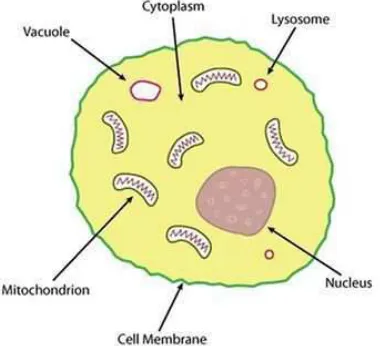
All living organism made up of tissue and cell as a basic unit of life. Cell is the basic structural, functional, and biological unit of all known living organisms. In general cells are divided into two part that are animal cell and plant cell. The biggest differences between animal cell and plant cell is the existence of cell wall that decide the shape of the organism. As shown in Figure 1.1, the main component of animal cell main are the membrane cell, the cytoplasm and the nucleus which carries out the activities of the cell. The membrane cell or the plasma membrane is a biological membrane that separates interior part of the cells from the outside environment [1].
2
The cell membrane is selectively permeable to ions that allow the movement of substances in and out of cells. Cytoplasm which is walled by membrane cell consists of thick solution that fills each cell. It mainly composed about 80% water and usually colourless. The last part is nucleus that control the activity of the cell. It contains most of the genetic material to maintain the reliability of these genes present as outsized variation of protein call as Deoxyribonucleic Acid (DNA).
However, we are always surrounded by radiation which can damage DNA molecules. Radiation can be classified physically as an emission of energy in form of waves energy or particles movement through medium [2]. Radiation is often characterized into two parts which are ionising or non-ionising depend on energy of the radiated particles. Ionisation occurs when an electron is ”knocked out” from an electron shell of the atom, which leaves the atom with a net positive charge.The most commonly known types of irradiation are gamma ray and X-ray. In contrast, non-ionising is happen when insufficient energy produce as a part of electromagnetic spectrum such as magnetic field and radio waves. See section 2.3 for detail.
Radiation for medical purpose or known as radiotherapy is a therapy using ionising radiation to control or kill harmful cell in human body. Radiation therapy is commonly applied to the cancerous tumour because of its ability to control cell growth. Ionising radiation works by damaging the DNA of cancerous tissue lead to cellular death of the cell. It is also common to combine radiation therapy with surgery, chemotherapy, hormone therapy and immunotherapy.
3
of living cells and, more important the DNA in those cells can be damaged by ionisation radiation, therefore exposure to ionising radiation is considered to increase the risk of cancer [3].
Radiation might be effected nearby tissue located at the treatment area. This living tissue will be affected and can lead to secondary cancer cell. This problem is discussed in detail in [4] to identify the cell population evolution after irradiation. However [5] has claimed that the model in [4] left out too many factors that cause it less accurate.
Parameters are descriptive measures of an entire population. However, their values are usually unknown because it is infeasible to measure an entire population. Because of this, you can take a random sample from the population to obtain parameter estimates. Parameter estimation is the computational numerical values for parameters from the available observation [6]. The parameter estimation term itself refers to the process of using sample data to estimate the parameters of the selected distribution.
Parameter estimation plays a critical role in accurately describing system behaviour through mathematical models such as statistical probability distribution functions. Other than that parameter estimation may act as adaptive filtering where the variable parameters will adjust itself according to optimisation algorithm [7]. Parameter estimation also can identify the model system [8] such as time-series modelling in signal processing theory. Last but not least it can control the mathematical model of the dynamic system by providing the estimated values to the model [9].
4
The goal in this present thesis is to understand a better cell population model suggested by [3] and to estimate the number of cell survived following high dose irradiation. This research will help us in provide the information related to the model for cell population evolution after irradiation. Other than that, this research also provides the information for surviving cell fraction if the parameters in the model vary.
1.2 Statement of the Problem
Radiation therapy is one of the most common treatments for cancer. It use high-energy particles or waves, such as x-rays, gamma rays, electron beams, or protons, to destroy or damage cancer cells. In 2011, [10] suggested that irradiation was successful in the novel theranostic technique involving co-treatment with heptamethine dyes to clarify tumour cells and attenuate their growth with minimal side effects.
During the treatment, the radiation can also damage the nearby normal tissue at the treatment areas. Consequently it can lead to development of secondary cancer cell due to damages of genes in DNA.
In 2014, a mechanistic model of high dose irradiation damage on mammalian cell has been proposed by [3]. The model proposed six parameters that involved in cell population evolution after irradiation which explained the dynamics of the problem.
5
1.3 Objective of Research
The objective of the study are:
1. To estimate the model parameters by using Nelder-Mead simplex method and Genetic Algorithm.
2. To compare the performance of Nelder-Mead simplex method and Genetic Algorithm in term of objective function, number of iteration and computational time.
1.4 Scope of the Research
In this research a system of ordinary differential equations (ODE) in [3] which described the cells surviving fraction following high dose irradiation were considered. The model contains of six parameters which are to be estimated. In this work, implementation will be focussing on Nelder-Mead simplex method and Genetic Algorithm to find an optimal model parameters value. By using MATLAB the performance of this two algorithm will be compared.
1.5 Significance of the Research
The significance of the study are as follows:
1. Enhance understanding on realistic mathematical model in cell population evolution following high dose irradiation.
2. Describe cell population nature after radiated by irradiation with different doses through cell survival curve.
6
4. Prove the best optimiser for the problem from the performance between Nelder-Mead simplex method and Genetic Algorithm.
1.6 Thesis Outline
The present thesis concentrates on the parameter estimation of model suggested in [3]. It begins with Chapter 1 which is introduction of the study, including the background of the research, problem statement, objective of the research, scope of the research and significance of the study.
Chapter 2 dealt with the literature review on fundamental background of cell population evolution after radiation. Some biological facts will explained so that the reader will understand more about the problem. The related works on model of the problem and implication using ionising radiation were also will reviewed.
Then, Chapter 3 describes and explains in more detail about the research methodology that adopted in this study. The chronology and flow of the study will be explained in order to solve the problem. The methods of solution that used in the research were introduced in this chapter. Some related previous works related to solving method, algorithm and example will explained carefully.
In Chapter 4, the formulation of the model of cell evolution following irradiation suggested by [3] is briefly discussed. In addition the governing equation with the initial conditions for the problem is introduced.
7
REFERENCES
1. Singleton, P.Bacteria in Biology, Biotechnology and Medicine Bacteria in Biology, Biotechnology and Medicine. 5th Edition. New York: Wiley. 1999.
2. Gale, R. P. and Lax, E.Radiation: What It Is, What You Need To Know.1st Edition. United State: Alfred A. Knopf. 2013.
3. Siam, F. M. Modelling Effects of Ionising Radiation. Ph.D. Thesis. University of Strathclyde; 2014.
4. Albright, N. A Markov formulation of the repair-misrepair model of cell survival. Journal of Radiation Research. 1989. 118(1): 1–20.
5. Eric, J. and Hall, A. J. Radiobiology for the Radiologist. 6th Edition. Philadelphia USA: Lippincott Williams & Wilkins. 2006.
6. van den Bos, A. Parameter Estimation for Scientists and Engineers. United State of America: John Wiley & Sons. 2007.
7. Raol, J. R. and Singh, J.Modelling and Parameter Estimation of Dynamic Systems. London: The Institution of Engineering and Techology. 2004.
8. Pintelon, R. and Schoukens, J. System Identification A Frequency Domain Approch. Belgium: The Institution of Electrical and Electronic Engineers. 2001.
9. DiMasi, G. B., Gombani, A. and Kurzhansk, A. B. Modeling, Estimation and Control of Systems with Uncertainty. Springer Science and Business Media. 1999.
10. X Tan, S. L. and Wang, D. A new heptamethine dye with intrinsic cancer targeting, imaging and photosynthesizing properties. Journal of Biomaterials China. 2011. 33(7): 2230–2239.
62
12. Lodish, H., Berk, A. and Darnell, J. Molecular Cell Biology. 5th Edition. New York: W. H. Freeman Publishers. 2004.
13. Alberts, B. and Johnson, A. Molecular Biology of the Cell. 4th Edition. America: Garland Science. 2002.
14. Alberts, B. and Johnson, A. Molecular Biology of the Cell. 6th Edition. America: Garland Science. 2004.
15. Roy, D. Biotechnology: Cytogenetics, Biotechnology and Bioinformatics. 1st Edition. United Kingdom: Alpha Science Intl Ltd. 2010.
16. Mashaghi, A. and Katan, A. A Physicist’s View of DNA. De Physicus. 2013. vol(24)(3): 59-61.
17. Paun, R., Gheorghe, S. and Arto, G.DNA Computing New Paradigms. 1st Edition. Germany: Springer. 1998.
18. Meijer, L., Jezequel, A. and Docummun, B. Progress in Cell Cycle Research. 1st Edition. Vol. 4. America: Springer Science and Business Media New York. 2000. 19. Kellerer, A. M. and Rossi., H. D. Theory of dual radiation action. Radiation
Research. 1972. vol(8): 85–158.
20. Kellerer, A. M. and Rossi, H. H. A generalized formulation of dual radiation action. Radiation Research. 1978. vol(75)(3): 471–488.
21. Prise, K. M. and Sullivan, J. M. Radiation-induced bystander signalling in cancer therapy. Nature Reviews Cancer. 2009. vol(9)(5): 351–360.
22. Meijer, L., Jezequel, A. and Docummun, B. Progress in Cell Cycle Research. 1st Edition.. vol. 4. New York: Springer Science and Business Media. 2000.
23. Paun, G. On the splicing operation. Discrete Application Mathematics. 1996. vol(70): 57–79.
24. Wink, M. An Introduction to Molecular Biotechnology. 1st Edition. Germany: WILEY-VCH Verlag GmbH & Co. 2006.
25. Curtis, S. B. Lethal and potentially lethal lesions induced by radiation. Radiation Research. 1986. vol(106): 252–270.
63
27. Han, W., Chen, S. and Wu, L. Nitric oxide mediated dna double strand breaks induced in proliferating bystander cells after alpha-particle irradiation. Mutation Research. 2010. vol(684): 81–89.
28. Mothersill, C. and Seymour, C. B. Radiation-induced bystander effects and the dna paradigm: An out of field perspective. Mutation Research. 2006. vol(597): 5–10.
29. Ojima, M., Furutani, A. and Kai, M. Persistence of DNA double-strand breaks in normal human cells induced by radiation-induced bystander effect. Radiation Research. 2011. vol(175)(1): 90–96.
30. Sachs, R. K., and Brenner, D. J. The link between low-let dose-response relations and the underlying kinetics of damage production/repair/misrepair. International Journal Radiation Biological. 1997. vol(72): 351–374.
31. Partouche, J. Stochastic modelling of the cell killing effects of low and high radiation. Master Thesis. A and M University, Texas. 2004.
32. Stewart, R. D. Two-lesion kinetic model of double-strand break rejoining and cell killing. Radiation Research. 2001. vol(156): 365–378.
33. Trken, A., Zlem, A. and Apaydin. Estimating the earthquake source parameter: Simulated annealing versus nelder-mead simplex algorithm. Communications Series A1 Mathematics & Statistics. 2013. 62(2): 53–66.
34. Mesbahi, T., Khenfri, F., Rizoug, N., Chaaban, K., Bartholomes, P. and Moigne, P. L. Dynamical modeling of li-ion batteries for electric vehicle applications based on hybrid particle swarmneldermead (psonm) optimization algorithm. Electric Power Systems Research. 2016. 131: 195-204.
35. Baghmisheh, M. V., Peimani, M., Sadeghi, M. H., Ettefagh, M. M. and Tabrizi, A. F. A hybrid particle swarmneldermead optimization method for crack detection in cantilever beams. Applied Soft Computing. 2012. 12(8): 2217-2226.
64
37. Zolpakar, N. A., Mohd-Ghazali, N. and Ahmad, R. Experimental investigations of the performance of a standing wave thermoacoustic refrigerator based on multi-objective genetic algorithm optimized parameters. Applied Thermal Engineering. 2016. 100: 296-303.
38. Wen, J., Yang, H., Tong, X., Li, K., Wang, S. and Li, Y. Optimization investigation on configuration parameters of serrated fin in plate-fin heat exchanger using genetic algorithm.International Journal of Thermal Sciences. 2016. 101:116-125. 39. Sarker, R. S. and Newton, C. S. Optimization Modelling: A Practical Approach.
1st Edition. New York: Taylor & Francis Group. 2008.
40. Mosat, A. Deterministic and Stochastic Batch Design Optimization Techniques. 1st Edition. Switzerland: Swiss Federal Institute of Technology. 2006.
41. Kiranyaz, S., Ince, T. and Gabbouj, M. Multidimensional Particle Swarm Optimization for Machine Learning and Pattern Recognition. 4th Edition. Finland: Springer. 2008.
42. Ouriaa, A. and Toufigha, M. Application of nelder-mead simplex method for unconfined seepage problems.Applied Mathematical Modelling. 2009. vol(33)(9): 3589–3598.
43. Luersena, M. A. and Richec, R. L. Globalized Nelder-Mead method for engineering optimization. Computers & Structures. 2004. vol(82): 2251–2260. 44. Xiong, Q. and Jutan, A. Continuous optimization using a dynamic simplex
method. Chemical Engineering Science. 2003. vol(58): 3817–3828.
45. Zahara, E., Fan, SK. S and Tsai, D. M. Optimal multi-thresholding using a hybrid optimization approach.Pattern Recognition Letters. 2005. vol(26)(8): 1082–1095. 46. Pandi, M. and Premalatha, K. An advanced Nelder-Mead simplex method for clustering of gene expression data. International Journal of Computer, Electrical, Automation, Control and Information Engineering. 2014. vol(8)(4): 1–9.
47. Hermawanto, D. Genetic algorithm for solving simple mathematical equality problem. 2013.
65
49. Gordini, N. A genetic algorithm approach for sees bankruptcy prediction: Empirical evidence from Italy. Expert Systems with Applications. 2014. vol(41)(14): 6433–6445.
50. Hoque, M. S., Mukit, M. A. and Bikas, M. A. An implementation of intrusion detection system using genetic algorithm. International Journal of Network Security & Its Applications. 2012. vol(4)(2): 1–12.
51. Mitchell, M. An Introduction to Genetic Algorithms. 1st Edition. London, England: First MIT Press Paperback addition. 1998.
52. Tuljapurkar, S. and Calwell, H. Structured-Population Models in Marine, Terrestrial, and Freshwater Systems. 1st Edition. Florence: Springer. 1997.
53. Archdeacon, T. J. Correlation and Regression Analysis A Historian’s Guide. 5th Edition United State of America: The University of Wisconsis Press. 1994. 54. Johnson, R. and Kuby, P. STAT 2. 2nd Edition. Bostan USA: Richard Stratton.
2011.