Key Exchange with Anonymous Authentication using
DAA-SIGMA Protocol
Jesse Walker and Jiangtao Li
Intel Labs
{jesse.walker, jiangtao.li}@intel.com
Abstract. Anonymous digital signatures such as Direct Anonymous Attestation (DAA) and group signatures have been a fundamental building block for anonymous entity authentication. In this paper, we show how to incorporate DAA schemes into a key exchange protocol between two entities to achieve anonymous authentication and to derive a shared key between them. We propose a modification to the SIGMA key exchange protocol used in the Internet Key Exchange (IKE) standards to support anonymous authentication using DAA. Our key exchange protocol can be also extended to support group signature schemes instead of DAA. We present a secure model for key exchange with anonymous authentication derived from the Canetti-Krawczyk key-exchange security model. We prove that our DAA-SIGMA protocol is secure under our security model.
1 Introduction
Anonymous digital signatures such as group signatures [22, 2, 5, 6], Direct Anonymous Attestation (DAA) [7, 8, 23, 24, 14], and anonymous credentials [15–17] play an important role in privacy en-hanced technologies. They allow an entity (e.g., a user, a computer platform, or a hardware device) to create a signature without revealing its identity. Anonymous signatures also enable anonymous entity authentication.
The concept of group signature scheme was first introduced by Chaum and van Heyst [22] in 1991. In a group signature scheme, all the group members share a group public key, yet each member has a unique private key. A group signature created by a group member is anonymous to all the entities except a trusted group manager. Many group signature schemes have been proposed, e.g., in [2, 5, 6, 29]. Direct Anonymous Attestation (DAA) was first introduced by Brickell, Camenisch, and Chen [7] for remote anonymous authentication of a Trusted Platform Module (TPM). DAA can be seen as a special group signature scheme without the “open” feature. DAA has received a lot of attentions in the trusted computing community, and many DAA schemes have been developed recently, e.g., in [8, 23, 25, 24, 14].
Anonymous digital signatures have attracted a lot of industry attentions recently. For example, the Trusted Computing group (TCG), a global industrial standard body [35], adopted the original DAA scheme [7] and standardized it in the TCG TPM Specification v1.2 [34]. The same DAA scheme has recently been adopted by ISO/IEC as an international standard [1]. DAA has been implemented and already shipped in millions of TPMs. Intel has implemented an extension of DAA called Enhanced Privacy ID [10–12] in the Intel P55 Ibex Peak chipsets [13]. Recently, ISO/IEC starts to develop two new international standards: one on anonymous digital signatures including group signature schemes and DAA schemes, the other on anonymous entity authentication using anonymous digital signatures.
verifier anonymously using his private key to create a DAA signature on the message. After verifying the DAA signature, the verifier is convinced that the group member is a valid DAA signer, but he does not learn who created the signature. TPM uses this method for anonymous authentication in order to obtain an attestation identity key credential from an issuer. This authentication method is limited because the group member did not verify the verifier’s credential and there is no shared key derived from the authentication.
Consider the following scenario: a trusted computing platform wants to download some pro-tected resources from an Internet server and may also upload some of its sensitive data to the server. The platform wants to authenticate the server before it sends the data out. In the same time the server wants to make sure the platform is indeed trusted, e.g., ensure that the platform can protect the server’s resources. DAA can be used in this example if the platform wants to authenticate to the server anonymously. However the na¨ıve authentication method in the previous paragraph does not work well in this scenario for the following reasons:
1. The platform and server need to authenticate to each other at the same time.
2. It is desired to have a session key derived after the mutual authentication so that the platform does not need to repeatedly authenticate to the server, when each time it wants to get some resources from the server.
A natural extension of DAA in anonymous authentication is to embed DAA in a Diffie-Hellman key exchange protocol, so that two entities can authenticate to each other and derive a shared ses-sion key for future communication. There have been several proposals to incorporate DAA into key exchange protocols. Balfe et al. [3] proposed anonymous authentication in peer-to-peer networks by embedding DAA with TLS and IPsec. Leung and Mitchell [32] introduced an anonymous authenti-cation protocol based on DAA. Recently, Cesena et al. [20] proposed an anonymous authentiauthenti-cation protocol based on TLS and DAA including a reference implementation.
1.1 Our Contribution
It is easy to design simple Diffie-Hellman (DH) based key exchange protocols, but it is easier to get them wrong. For example, many DH-based key exchange protocols are vulnerable to man-in-the-middle attacks or identity misbinding attacks [28]. Although there have been several proposals to use DAA in Diffie-Hellman key exchange protocols [3, 32, 20] in the literature, to the best of our knowledge, there is no formal security model provided and none of these protocols has formal security proof to prove the security of these protocols. This is the motivation of this paper. There are two contributions of this paper. We describe each contribution briefly as follows.
A security model for key exchange with anonymous authentication.We give a rigorous
treatment to anonymous authentication and introduce a new security model for key exchange with anonymous authentication. Our security model derives from the Canetti-Krawczyk key exchange security model [18, 19]. In the Canetti-Krawczyk security model, identity plays an important role in the proof of security. However in anonymous authentication, the identity of the entity who wants to be anonymous cannot be revealed in the key exchange. This creates a significant challenge in the definition of secure model and in the design of the key exchange protocol.
A secure key exchange protocol with anonymous authentication.We develop a new
call our protocol thedaa-sigmaprotocol. We present a formal security analysis of ourdaa-sigma
protocol based on our security model.
1.2 Related Work
Besides using DAA for anonymous authentication in key exchange protocols [3, 32, 20], other mech-anisms of anonymous authentication have been proposed recently. Cui and Cao proposed an anony-mous authentication and key exchange protocol based on ring signatures [26]. Viet et al. proposed a password-based anonymous authentication key exchange protocol [36]. Yang and Zhang improved Viet et al.’s scheme with another anonymous password-based key exchange protocol [37]. Chai et al. proposed an efficient password-based authentication scheme that preserves user privacy [21].
Besides the Canetti-Krawczyk key exchange model [18] for security analysis of key exchange protocols, other models and tools have been proposed in the literature. For example, Meadows used an automated protocol analyzer to study the security of key exchange protocols [33]. Datta et al. developed a symbolic logic analyzer for proving security properties of key exchange protocols [27]. Bellare and Rogaway formalized the security of key exchange protocols in the realistic setting of concurrent sessions [4]. In this paper, we choose to use the Canetti-Krawczyk key exchange model as the basis because this model is well established and has been used to analyze the security of the SIGMA key exchange protocol.
1.3 Organization of the Paper
Rest of this paper is organized as follows. We first introduce our notation and briefly review the DAA schemes and the SIGMA key exchange protocol in Section 2. We then propose the security model of key exchange protocol with anonymous authentication in Section 3. We present our daa-sigma
protocol in Section 4 and give the security proof in Section 5. We discuss some extensions of our
daa-sigma protocol in Section 6. We conclude our paper in Section 7.
2 Background and Building Blocks
In this section, we first review our notations and terminologies then briefly review the basic concepts of DAA. Next we review the SIGMA key exchange protocol.
2.1 Notations
We use the following notations in this paper. LetP and Q to be two entities of the key exchange protocol.
– mack(m): a message authentication code of m computed using the key k.
– sigP(m): a signature ofm created by the entity P.
– idP: an identity of the entity P.
– certP: a public key certificate of the entity P.
2.2 Review of DAA
In this section, we review the specification and security model of DAA proposed in [9]. The security model in [9] is simpler than the original DAA definition [7] and easier to understand the security properties of DAA. There are four types of players in a DAA scheme: an issuer I, a TPM Mi, a
host Hi and a verifier Vj.Mi and Hi form a platform in the trusted computing environment and
share the role of a DAA signer Si. To simplify our notation, we treat the DAA signer as a single
entity in the rest of this paper. A DAA scheme has following polynomial-algorithms or interactive protocols (Setup,Join,Sign,Verify,Link):
Setup: On input of a security parameter 1k,I uses this randomized algorithm to produce a pair
(gpk,isk), whereiskis the issuer’s secret key, and gpkis the public key including the global public parameters.
Join: A signerSi and the issuer I run an interactive join protocol. In the end of the protocol,Si
outputs a secret key ski and a membership credentialcrei issued by I. We denote theski and crei pair as the signing key ofSi. Note that the value of ski is unknown to I.
Sign: On input of gpk, ski, crei, a basename bsnj, and a message m, Si uses this algorithm to
produce a signature σ on m. The basename bsnj can be either the name string of the verifier Vj or a special symbol⊥ and it is used for controlling the linkability.
Verify: On input of gpk,bsnj,m, a candidate signature σ on m, and a revocation list RL,Vj uses
this deterministic algorithm to determine whetherσ is valid. The revocation is out of the scope of this paper.
Link: On input of two signaturesσ0 andσ1,Vj uses this deterministic algorithm to return linked,
unlinked, or invalid signatures.
The formal security definition of DAA can be found in [7, 9]. For completeness of this paper, we review the formal security model of DAA in [9] in Appendix A. Informally, a DAA scheme is secure if the following properties hold:
– Correctness. A signature created using a valid signing key can be verified by any verifiers correctly.
– Anonymity. An adversary who are not in possession of a secret key skcannot learn the identity of the signer of signatures created using sk.
– Unforgeability. An adversary cannot forge a valid signature if he does not have a signing key or his signing keys have been all revoked.
– User-controlled linkability. Signatures created by the same set of sk, cre, bsn can be linked, if bsn 6=⊥. However, signatures cannot be linked if they are created using different bsn or if bsn=⊥.
If a signatureσwas created usingbsn=⊥, then we callσa random based signature; otherwise, we call σ a name based signature. For the daa-sigma protocol, we first focus on random based
signatures. We shall discuss how to adopt name based signatures in Section 6.
LetI be a DAA issuer. LetP be a DAA signer who has a valid signing key issued byI. We use the following notations in the rest of the paper:
– idI: the identity of the issuerI. For simplicity, we assume I creates only one group public key gpk. One can figure out the corresponding gpk from idI. If the issuer creates multiple group
– certI: a public key certificate ofI issued by a certificate authority to certify the group public
key gpk.
– daa-sigP(m): a DAA signature on messagemcreated by the entityP. LetskP beP’s secret key
andcreP beP’s membership credential, thendaa-sigP(m) denotesSign(gpk,skP,creP,bsn, m)
where bsn=⊥if bsnis not provided as input.
2.3 Review of SIGMA Key Exchange Protocol
We now review the SIGMA key exchange protocol. This key exchange protocol is one of the Internet Key-Exchange (IKE) protocols [30] used to establish secret shared keys for use in the Internet Protocol Security (IPsec) standards [31]. The SIGMA key exchange protocol uses Diffie-Hellman key exchange with “sign-and-mac” mechanism. It is presented as follows: Let P and Q be two entities of the key exchange protocol, where P is the protocol initiator who activates the session and Q is the intended peer of the session. Let G be a cyclic group of prime order q where the Decisional Diffie-Hellman (DDH) problem is hard and g be a generator of G. Let s be a unique session identifier chosen by P,Q, or both. The SIGMA protocol has the following messages.
Message 1 (P →Q) : s, gx
Message 2 (P ←Q) : s, gy,idQ,mack
1(s,idQ),sigQ(s, g
x, gy)
Message 3 (P →Q) : s,idP,mack
1(s,idP),sigP(s, g
y, gx)
In the above protocol, P chooses a random integer x and computes the ephemeral DH public key
gx. Analogously, Q chooses a random integer y and compute its ephemeral DH public key gy. By
exchanging gx and gy, both entities can compute gxy, but “man-in-the-middle” attackers cannot.
Both entities then derive a session keyk0 and amackeyk0 from gxy. In message 2, Qcomputes a
macof its identity using k1 and signs the ephemeral DH public keys (gx, gy) using its signing key. P can verify the signature to ensure that the message 2 indeed comes from entity Qand verify the
mac to ensure that Q knows k1, thus knows the session key k0 as well. Similarly, P computes a macof its identity and a signature of the DH public keys in message 3. AfterQverifies the message
3, both entities have established a session keyk0 and can usek0 for further communications.
3 Security Model
In this section, we first review the Canetti-Krawczyk key exchange model [18, 19], and then describe how to extend this key exchange model to support anonymous authentication.
3.1 Review of Canetti-Krawczyk Key Exchange Model
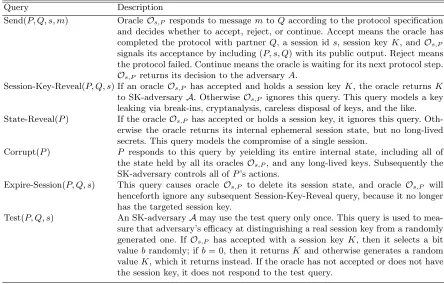
This section reviews the Canetti-Krawczyk model [18] for authenticated key establishment proto-cols. Asession key adversary, orSK-adversary,Ais a probabilistic polynomial time algorithm that controls all communication between any parties using the set of queries specified in Table 1 below. An SK-adversary accomplishes this control by issuing queries to a set of oracles Os,P. An oracle Os,P represents the protocol instance identified bysinitiated by principalP. This communications
instance is called a session. Each oracle responds to the queries, and the outputs of all the oracles
Os,P collectively represent the history of the protocol. The SK-adversary receives all output, and
Table 1.Adversarial Queries
Query Description
Send(P, Q, s, m) Oracle Os,P responds to message mtoQaccording to the protocol specification
and decides whether to accept, reject, or continue. Accept means the oracle has completed the protocol with partner Q, a session ids, session keyK, and Os,P
signals its acceptance by including (P, s, Q) with its public output. Reject means the protocol failed. Continue means the oracle is waiting for its next protocol step.
Os,P returns its decision to the adversaryA.
Session-Key-Reveal(P, Q, s) If an oracle Os,P has accepted and holds a session keyK, the oracle returnsK
to SK-adversaryA. OtherwiseOs,P ignores this query. This query models a key
leaking via break-ins, cryptanalysis, careless disposal of keys, and the like. State-Reveal(P) If the oracleOs,P has accepted or holds a session key, it ignores this query.
Oth-erwise the oracle returns its internal ephemeral session state, but no long-lived secrets. This query models the compromise of a single session.
Corrupt(P) P responds to this query by yeielding its entire internal state, including all of the state held by all its oracles Os,P, and any long-lived keys. Subsequently the
SK-adversary controls all ofP’s actions.
Expire-Session(P, Q, s) This query causes oracle Os,P to delete its session state, and oracle Os,P will
henceforth ignore any subsequent Session-Key-Reveal query, because it no longer has the targeted session key.
Test(P, Q, s) An SK-adversaryAmay use the test query only once. This query is used to mea-sure that adversary’s efficacy at distinguishing a real session key from a randomly generated one. If Os,P has accepted with a session key K, then it selects a bit
value brandomly; ifb= 0, then it returnsK and otherwise generates a random valueK, which it returns instead. If the oracle has not accepted or does not have the session key, it does not respond to the test query.
A session is calledexposed if an SK-adversary issues a session-key-reveal query against its oracle or an state-reveal or corrupt query against one of the session’s principals.
As noted, the model uses the test query to formalize the efficacy of an attack. The adversary may apply the test query to any session that is not exposed. The test session returns a real or randomly generated key each with probability half and the adversary must guess whether the returned key is real. The adversary is called successful if it can distinguish the real key with probability significantly larger than 1/2.
An instance of protocol execution results in a partnership or agreement between two oracle instances of principals’ communication. Partnership is a tricky notion, because the identity of the parties can be unknown before the protocol instance completes. In [18] Canetti and Krawcyzk accommodate this by allowing the communicating oracles to learn the identity of the other party from the protocol instance.
Definition 1. Suppose oracleOs,P has accepted with output(P, s, Q). The oracleOs,R is called the
matching session of Os,P if either
1. Os,R has accepted with output (R, s, S), where R =Q andS =P, or,
2. Os,R has not completed.
With this background, it is possible to define security in the model.
1. If two uncorrupted partiesP and Qcomplete matching sessions Os,P and Os,Qof π with public
outputs (P, s, Q) and (Q, s, P), respectively, then the session key K output in these sessions is the same except with a negligible probability.
2. A succeeds in distinguishing the output from its test query with probability not more than 1/2 plus a negligible fraction.
3.2 Security Model for Key Exchange with Anonymous Authentication
In this paper, we first consider unilateral anonymous authentication and use DAA as the funda-mental building block for anonymous authentication. The case of mutual anonymous authentication and use of group signatures shall be discussed in Section 6. In our model, we always assume that the protocol initiator P has a DAA private key and the protocol responderQ has a regular signature key. In the example in Section 1 where a trusted platform mutual authenticates with an Internet server, it is natural to have the anonymous entity as the protocol initiator. If the adversary starts a session with the protocol initiator who does not have a DAA private key or with the protocol responder who does not have a regular signature key, the session would fail.
Note that anonymous authentication in our model is different from anonymity without authen-tication, whereP does not show any identity or signatures toQ. Anonymous authentication in our context means that P authenticates toQas a member of a DAA group created by an issuerI, but
Qdoes not learn the actual identity of P.
Canetti and Krawcyzk prove that the SIGMA protocol in Section 2.3 is secure in the key ex-change model described above. However, this security model assumes concrete identity of each party revealed during the protocol, so we will need to extend their model to accommodate anonymous authentication where the actual identity of the protocol initiator cannot be disclosed. The technical need is to have a specific identity to use to establish the matching sessions property. In particular, each partyP must verify that the peerQis the same entity throughout an instance of the protocol. To this end we make the following
Definition 3. Suppose P is a member of a group identified by idI, and let f(x) denote a one-way
function. Apseudo identity of P is a pair (idI, f(n)), where nis a randomly selected nonce.
We substitute anonymous identity instances in place of concrete identities in the SIGMA pro-tocol. A principalP outputs ( ˆP , s, Q) where ˆP = (idI, f(n)), and argue that this is an appropriate
identity for the Canetti-Krawcyzk key exchange model. Indeed,P’s DAA signature proves its mem-bership in a specific DAA group, but this by itself does not prove that the messages of the protocol instance are exchanged with one single group member. To accomplish this, the definition of pseudo identity requires P to send a commitment f(n) of the random value n to its peer Q, and then
P proves it knows n as part of authentication. The allows the matching sessions property to be established, because an adversary cannot arrange for a second group member R to interject itself into the protocol, becauseRdoes not know the value of n. We now define security of key exchange with anonymous authentication in below.
Definition 4. A key exchange protocol with anonymous authenticationπ issecureif it isSK-secure
and anonymous.
Definition 5. A key exchange protocol with anonymous authentication π is SK-secure if for all polynomial-time SK-adversaries A the following holds:
1. If two uncorrupted partiesP and Qcomplete matching sessions Os,P and Os,Qof π with public
outputs( ˆP , s, Q)and(Q, s,Pˆ), respectively, wherePˆis the pseudo identity ofP, then the session key K for these two sessions is the same except with negligible probability.
2. A succeeds in distinguishing the output from its test query with probability no more than 1/2 plus a negligible fraction.
We now define the anonymous property of a key exchange protocol with anonymous authen-tication. Roughly speaking, a key exchange protocol π is anonymous if the protocol initiator P
remains anonymous to its peer in the key exchange session. The definition of anonymity follows the definition of the underlying anonymous digital signature schemes used in the protocol. For example using DAA, we define the anonymity of a key exchange protocolπ by following the user-controlled-anonymity property of DAA in Appendix A. General speaking, a key exchange protocol with anonymous authentication π is anonymous if there is no probabilistic polynomial-time adver-sary can win the following game between a challenger C and an adversary Aas follows:
– Initial: C assigns each entity a unique DAA private key. C also assigns a unique identity and a regular signature key to A.
– Phase 1: C is probed byA who makes the following queries:
• Key exchange. Asubmits an entity’s identityP of his choice toC, who runs a key exchange protocolπ usingP as the protocol initiator with Aas the protocol responder.
• Corrupt. A submits an entity’s identity P of his choice toC, who responds with the DAA private key ofP.
– Challenge: At the end of Phase 1, A chooses two entities P0 and P1 of his choice. Amust not have made any corrupt query on either P0 or P1. To make the challenge, C chooses a bit b uniformly at random, then runs a key exchange protocol π using Pb as the protocol initiator
with Aas the protocol responder.
– Phase 2:Acontinues to probeCwith the same type of queries that it made in Phase 1. However, he is not allowed to corrupt either P0 or P1.
– Response: Areturns a bit b′. We say that the adversary wins the game if b=b′.
Definition 6. Let Adenote an adversary that plays the game above. A key exchange protocol π is
anonymous if for any polynomial-time adversary A, the probability of Ain breaking the anonymity game is no more than 1/2 plus a negligible fraction.
Note that the above definition of anonymity is generic to any group-based anonymous digital signature schemes. We can modify the above definition to be DAA specific such that the identity of the protocol initiator is unrevealed in the protocol but could be linkable under the entity’s control. Similarly, we can modify the above definition for group signatures such that the identity of the protocol initiator is anonymous but openable by a trusted group manager.
4 Proposed DAA-SIGMA Protocol
We now describe our daa-sigma key exchange protocol as follows. Our key exchange protocol
signs the ephemeral DH public keys and (2) P uses (idI, gx) as its pseudo identity in the protocol
where the one-way function is defined as f(x) =gx.
We assume the following initial information. LetP andQbe the two parties of the daa-sigma
key exchange protocol, where P is the protocol initiator who activates the session and Q is the intended peer of the session.
– P has a DAA signing key issued by an issuerI whose identity isidI.P can use the DAA signing
algorithm daa-sig to create DAA signatures.
– Q has an identityidQ and a public-private key pair.Q can use his private key and a signature
algorithm sigto create a signature.
– Both entities agree on G, a cyclic group of prime orderq in which the DDH problem is hard, and g, a generator of G. For example, one can choose primes p and q such that q|p−1, and then choose a number g whose multiplicative order modulop is q.
– The protocol uses a message authentication code family mac and a pseudorandom function
family prf.
The daa-sigmaprotocol has the following messages and steps.
Message 1 (P →Q) : s, gx
Message 2 (P ←Q) : s, gy,idQ,mack
1(s,idQ),sigQ(s, g
x, gy)
Message 3 (P →Q) : s,idI, gx,mack
1(s,idI, g
x),daa-sig
P(s, gy, gx)
Sending Message 1
1. P chooses a session ids. Alternatively, session id scan be pre-negotiated byP and Q. 2. P picks a randomx←Zq and computes its ephemeral DH public key gx.
3. P sends{s, gx} to Q.
Sending Message 2
1. Q picks a randomy ←Zq and computes its ephemeral DH public keygy.
2. Q computes gxy = (gx)y.
3. Q derives two keysk0 =prfgxy(0), and k1 =prfgxy(1). 4. Q securely erases y and gxy from its memory.
5. Q computes mack
1(s,idQ).
6. Q computes sigQ(s, gx, gy) using its private key.
7. Q sends {s, gy,id
Q,mack1(s,idQ),sigQ(s, g
x, gy)}to P.
Receiving Message 2
1. P computesgxy = (gy)x.
2. P derives two keysk0=prfgxy(0), andk1 =prfgxy(1). 3. P securely erases xand gxy from its memory.
4. P verifiesmack
1(s,idQ) using derived keyk1. 5. P retrieves the public key ofQfrom idQ.
6. P verifiessigQ(s, gx, gy) usingQ’s public key.
7. If one of the above verification steps fails, the session is aborted and outputs “failure”.
1. P computesmack
1(s,idI, g
x).
2. P uses its DAA signing key to computedaa-sigP(s, gy, gx).
3. P sends{s,idI, gx,mack
1(s,idI, g
x),daa-sig
P(s, gy, gx)} to Q.
4. P completes the session with public output ((idI, gx), s,id
Q) and secret session key k0.
Receiving Message 3
1. Q verifiesmack
1(s,idI, g
x) using derived keyk
1.
2. Q retrieves the DAA group public key of the issuerI from idI.
3. Q verifiesdaa-sigP(s, gy, gx) using the DAA group public key.
4. If one of the above verification steps fails, the session is aborted and outputs of “failure”. 5. Q completes the session with public output (idQ, s,(idI, gx)) and secret session key k0.
5 Security Proof of the DAA-SIGMA Protocol
In Theorem 6 of [19] Canetti and Krawczyk prove that the SIGMA protocol is secure in their model. Our security proof of the daa-sigma protocol follows their security proof. We replace the
signing algorithm of the protocol initiator P with the DAA signing algorithm and P’s identity with the pseudo identity (idI, gx), where id
I is the identity of the issuer and gx is an ephemeral
Diffie-Hellman valueP generates. To prove the security of ourdaa-sigmaprotocol, we begin with a
review of the definition of the Decisional Diffie-Hellman (DDH) assumption, which is the assumption underlying the security of all Diffie-Hellman based key exchange protocols.
Assumption 1 Let G, generated by g, be a cyclic group of prime order q. The DDH assump-tion in G holds if the probability distributions of Q0 = {hg, gx, gy, gxyi : x, y ← Zq} and Q1 =
{hg, gx, gy, gri:x, y, r←Z
q} are computationally indistinguishable.
In addition to the DDH assumption, the security of the key exchange protocol in Section 4 also depends on the security of the underlying cryptographic primitives, namely, digital signatures, message authentication codes, pseudo-random functions, and DAA. We have the following theorem.
Theorem 1. Under the DDH assumption in Gand assuming the security of the underlying cryp-tographic functions sig, mac, prf, daa-sig, the daa-sigma protocol in Section 4 issecure in the
model defined in Section 3.
To prove the above theorem, we prove the following two lemmas.
Lemma 1. If the underlying DAA scheme is secure, the daa-sigma protocol isanonymous in the
model defined in Section 3.2.
Proof. In the daa-sigmaprotocol, the protocol initiator P reveals sand gx to its peer in the first
message, and revealss,idI,gx,mac
k1(s,idI, gx), anddaa-sigP(s, gy, gx) in the final message. Since sand gx are randomly chosen at each session, if the DAA signature is anonymous,P only reveals
its pseudo identity (idI, gx) to its peer, but not the real identity. To prove thedaa-sigmaprotocol
is anonymous, we use the following reduction. Suppose there exists a polynomial-time adversaryA
that breaks the anonymity game in Section 3.2, we can construct an algorithm B that breaks the user-controlled-anonymity of DAA defined in Appendix A by interacting with Aas follows:
– B creates nentities, but does not assign any DAA private key to each entity. – B chooses an identity idI for the DAA group and sends idI andgpk to A.
– B picks a unique identity and a regular signature key for A. – B is probed byA with following two types of queries:
• A makes a key exchange query on an entityP. IfP has not been queried before,Bfirst runs a join query with the challenger to create a DAA private key for P. Note that B does not know the DAA private key ofP.B simulates thedaa-sigma protocol withA as follows:
1. B randomly chooses a session idsand x.B computes gx and sendssand gx to A. 2. B receives thedaa-sigma message 2 fromA and validates the message.
3. B computes gxy and derives k
0 and k1 by following thedaa-sigmaprotocol. 4. B computes mack
1(s,idI, g
x). B then makes a sign query on P to the challenger with
the messagem= (s, gy, gx) and obtains daa-sig
P(s, gy, gx).
5. B sends s,idI,gx,mack
1(s,idI, g
x), and daa-sig
P(s, gy, gx) to A.
• A makes a corrupt query on an entity P. If P has not been queried before, B first runs a join query with the challenger to create a DAA private key forP.B then makes a corrupt query to the challenger to obtainP’s DAA private key. B forwards the private key toA. – B receives the challenge fromA with entities P0 and P1.B makes sure both entities have not
been corrupted.Bsimulates thedaa-sigmaprotocol withAas in the key exchange query above,
except in step 4, B makes a challenge query to the challenger withP0,P1, and m= (s, gy, gx) as input and obtains a DAA signature σ on (s, gy, gx) using P
b’s DAA private key, where b is
unknown to B. In the end, B sends s, idI, gx, mack
1(s,idI, g
x), and σ to A to simulate the
message 3 of the daa-sigmaprotocol.
– A can continue make key exchange and corrupt queries toBas far asA does not make corrupt queries on either P0 or P1.
– A outputsb′ by guessingb.B outputs the sameb′.
Let ǫbe the probability thatA succeeds in breaking the anonymity game of the key exchange protocol. Bhas the same probabilityǫ in breaking the user-controlled-anonymity game of DAA. Lemma 2. Under the DDH assumption in G and assuming the security of the underlying cryp-tographic functions sig, mac, prf, daa-sig, the daa-sigma protocol in Section 4 is SK-secure in
the model defined in Section 3.2.
The proof of this lemma follows the security proof of the SIGMA protocol in [19]. Let us use the term Σ-attacker to denote an SK-adversary attacking against the daa-sigma protocol. We need
to prove the two properties of secure key exchange protocol defined in Definition 5. P1. If two uncorrupted partiesP andQcomplete matching sessions ((idI, gx), s,id
Q) and (idQ, s,
(idI, gx)) respectively under the daa-sigma protocol then, except for a negligible probability,
the session key output in these sessions is the same.
P2. No efficient Σ-attacker can distinguish a real response from a random response with non-negligible probability. More precisely, if a given Σ-attacker we define
1. Preal(A) = Pr [Aoutputs 1 when given the real test session key] 2. Prandom(A) = Pr [A ouptus 1 when given a random test session key]
5.1 Proof of Property P1
The proof for the first property in [19] goes over unchanged if we substitute our notion of a pseudo identity for the identity of the initiator and if we replace the initiator’s signature scheme with DAA. LetAbe aΣ-attacker and letP and Qbe two uncorrupted entities that complete matching sessions ((idI, gx), s,idQ) and (idQ, s, (idI, gx)). We want to prove that both sessions output the
same session keyk0 regardless of A’s operations. It is enough to show that both entities compute the same DH value gxy from which k
0 is derived.
Let us useuP to denote the DH public key send in the message 1 byP whereuP =gx with x
chosen by P, and vP to denote the DH public key received in the message 2 of sessions. Similarly,
letuQ be the DH public key received byQin the message 1 and vQ be the DH public key send by Q in the message 2 where vQ =gy with y chosen by Q. The signature produced by Q during the
sessionsissigQ(s, uQ, vQ), while the signature thatP verifies the message 2 issigQ(s, uP, vP). As sis unique per session, the first signature is the only one thatQever produces with the valuesas session id, then it must be that either all arguments of the first and second signatures are the same, or A creates a forgery on the second signature. As we assume sig is a secure signature scheme, it
follows that except for a negligible probably, uP =uQ and vP =vQ. Now the DH value computed
by P is vx
P = vxQ = (gy)x =gxy, while the DH value computed by Q is u y Q = u
y
P = (gx)y =gxy.
Thus both compute the same session key. This concludes our proof of property P1.
5.2 Proof of Property P2
The strategy in [19] to prove the second property is to show that any attacker who can distinguish the real key from a random key with non-negligible probability can be used to construct a second attacker against the DDH assumption or one of the underlying primitives – the signature scheme
sig, the MAC scheme mac, or the pseudo-random function prf. In our setting, we must replace
the initiator’s signature with a DAA signature, and its identity with a pseudo identity.
We now sketch the proof as follows. We show that any Σ-attacker A that succeeds in distin-guishing between a real and a random response to the test session query, we can build a DDH distinguisherDthat distinguishes triple (gx, gy, gxy) from random triples (gx, gy, gr) with the same
success advantage as A, or there is an algorithm that we can construct explicitly that breaks one of the underlying cryptographic primitives (i.e., sig, mac, prf, or daa-sig). The distinguisher D
gets input (gx, gy, z) where z is either gxy or gr forr ← Z
q. D starts by simulating a run of A on
a virtual instantiation of the daa-sigma protocol Σ and use the values gx and gy from the input
triple as the DH public keys in the messages 1 and 2 of a randomly chosen session denoted s0, initiated byAin this execution of thedaa-sigma protocol. If Ahappens to choose this sessions0
as its test session, thenDcan provideA withzas the response to the test query. In this case, ifA
outputs that the response was real then D will decide that z =gxy, otherwise, D will decide that z is random.
and k1 used in the simulation of thes0 session. ˆ
S-real: k0←prfgxy(0), k1 ←prfgxy(1) ˆ
S-rprf: k0←prfk(0), k1 ←prfk(1), k←random()
ˆ
S-allr: k0←random(), k1←random()
ˆ
S-hybr: k0←random(), k1←prfk(1), k ←random()
ˆ
S-rand: k0←random(), k1←prfgxy(1)
ˆ
S-real is the simulator that corresponds to a “real” run of A while ˆS-rand corresponds to a
“random” experiment where the session key in sessions0 provided to Ais chosen as a random and independent valuek0. The rest of the simulators are “hybrid” simulators. It was shown in [19] that either all the distributions generated by these simulators are computationally indistinguishable, or that a successful distinguisher against DDH or against prffamily exists. From this we get a proof
that ˆS-real and ˆS-rand are actually indistinguishable, and we conclude that the values Prandom
and Preal differ by at most a negligible quantity.
In the security proof of the second property by [19], several properties of the protocol are shown that related to the authentication elements such as signatures (Lemma 7 in [19]) andmac(Lemma
11 in [19]). In the daa-sigma protocol, we replace the protocol initiator’s signature with a DAA
signature. We can show that
– If A does not have access to any legitimate DAA private keys, then Lemma 7.4 in [19] can be used to break the unforgeability property of DAA.
– If A does control some valid DAA private keys, then the commitment in the pseudo identity guarantees that the adversary cannot break the session key of two uncorrupted parties unless he can break DDH assumption.
The above arguments easily follow the proof in [19]. The details will be given in the full paper.
6 Discussions and Extensions
In this section, we discuss several variants and possible extensions of the ourdaa-sigma protocol.
We begin with how to use group signature in the SIGMA key exchange protocol.
6.1 Using Group Signatures Instead of DAA
Although this paper primarily focuses on DAA, ourdaa-sigma protocol can be easily extended to
support group signatures [2, 5, 6, 29]. Both DAA and group signatures are group-based anonymous signature schemes. That is, there is an issuer in both schemes who creates a group of members and a group public key. Each group member has an individual private key. A DAA signature or a group signature can be verified using the corresponding group public key. Group signatures are different from DAA in that group signatures can be opened by a trusted authority and the identity of the actual signer can be extracted, whereas DAA signature cannot be opened.
To use a group signature scheme in the key exchange protocol for anonymous authentication, we can replace the DAA signature in the daa-sigma protocol with a group signature. We called
key issued by an issuerI. We useidI to denote the identity of the issuer andgs-sigP(m) to denote
a group signature on m created byP. The gs-sigma protocol has the following messages
Message 1 (P →Q) : s, gx
Message 2 (P ←Q) : s, gy,idQ,mack
1(s,idQ),sigQ(s, g
x, gy)
Message 3 (P →Q) : s,idI, gx,mack
1(s,idI, g
x),gs-sig
P(s, gy, gx)
Thisgs-sigmaprotocol is secure in the key exchange model for anonymous authentication defined
in Section 3, if the DDH assumption holds and if the underlyingsig,mac,prf, andgs-sigfunctions
are secure. The security proof is straight-forward from Section 5.
6.2 Use Certificates Instead of Identities
In the daa-sigma protocol presented in Section 4,idI and idQ represent the real identities of the
issuer and the partyQ, respectively. We assume that P can obtainQ’s public key using idQ, and
similarly Qcan obtain P’s DAA public key from the identity of the issueridI. In practice, we can
replace the identities with full certificates signed by a trusted Certificate Authority (CA). More specifically, assume all the parties share the public key of the trusted CA. If an entity has a regular public and private key pair, we assume it has a public-key certificate issued by the trusted CA. If an entity has a DAA private key, we assume it has a certificate issued by the trusted CA to certify the issuer and the DAA public key, denoted as certI. The certificate-based daa-sigma protocol
is presented as follows.
Message 1 (P →Q) : s, gx
Message 2 (P ←Q) : s, gy,certQ,mack
1(s,certQ),sigQ(s, g
x, gy)
Message 3 (P →Q) : s,certI, gx,mack
1(s,certI, g
x),daa-sig
P(s, gy, gx)
Note that, in the above protocol, the protocol participants P andQdo not need to retrieve public keys from the identities. Instead, they can use the public keys embedded in the certificate to verify the signatures in messages 2 and 3. Canetti and Krawczyk proved the certificate-based SIGMA protocol is secure in [19]. The security proofs for our certificate-based daa-sigmaprotocol should
work as well.
6.3 Supporting User-Controlled-Traceability and Revocation of DAA
As we mentioned earlier, the DAA signing algorithm takes the verifier’s basenamebsnas an optional input. If the basename is not given in the signing algorithm, we treat bsn =⊥. DAA signatures are unlinkable if bsn=⊥and linkable otherwise. This feature is called user-controlled-traceability
in [9], as the signer and verifier can negotiate whether to use basename. Thedaa-sigma protocol
in Section 4 only supports unlinkable DAA signatures, but it can be easily extended to support user-controlled-traceability by passing the basename value in the protocol messages.
revocation list. To support this type of revocation, the verifier needs to sends the revocation list to the signer so that signer can prove innocent. To support this revocation method in thedaa-sigma
protocol, the revocation list sRLneeds to be passed in the protocol messages.
We now extend the daa-sigma protocol to support the above two functionalities of DAA as
follows. In the following protocol, variables in brackets are optional fields.
Message 1 (P →Q) : s, gx,[idI]
Message 2 (P ←Q) : s, gy,idQ,[bsnQ,sRL],mack
1(s,idQ,[bsnQ,sRL]),sigQ(s, g
x, gy)
Message 3 (P →Q) : s,idI, gx,mack
1(s,idI, g
x),daa-sig
P(s, gy, gx)
Note that without the optional fields (i.e.,idI in the message 1 andbsnQandsRLin the message 2),
the above protocol is exact the samedaa-sigmaprotocol as in Section 4. To support
user-control-traceability feature of DAA, Qcan send its basename bsnQ in the message 2 so thatP can create
the DAA signature with bsnQ as input. To support signature-based revocation, P first reveals
its DAA group (in this case, the identity of the issuer idI) to Q who can find the corresponding
revocation listsRLof the DAA group.Qthen sendssRLtoP in the message 2 so thatP can prove he has not been revoked in the message 3 as part of the DAA signature.
6.4 Mutual Anonymous Authentication using DAA
The daa-sigma protocol presented in Section 4 is a key exchange protocol with unilateral
anony-mous authentication. Take the example in Section 1, it is natural to have the protocol initiator as the anonymous entity. It may not make sense for mutual anonymous authentication over the Internet, as the protocol initiator needs to know who is the protocol responder in order to know where to send the first message. Mutual anonymous authentication may be useful for ubiquitous computing environments or for vehicle communication where two entities (e.g., mobile devices or cars) are already physically close to each other and want to authenticate to each other anonymously. We can extend thedaa-sigmaprotocol to support mutual anonymous authentication as follows.
Assume each protocol party have a DAA private key for computing anonymous signatures, i.e., P
has a DAA key issued by an issuer I and Q has a DAA key issued by an issue I′, where I and
I′ could be the same entity or two separate entities. The messages 1 and 3 are the same as in the Section 4. In message 2, Q uses (idI′, gy) as its pseudo identity instead of revealing its actual identityidQ in order to be anonymous in the key exchange.
Message 1 (P →Q) : s, gx
Message 2 (P ←Q) : s, gy,id
I′,mack1(s,idI′, gy),daa-sigQ(s, gx, gy) Message 3 (P →Q) : s,idI, gx,mack
1(s,idI, g
x),daa-sig
P(s, gy, gx)
7 Conclusions and Future Work
We presented in this paper a new security model for key exchange with anonymous authentication derived from the Canetti-Krawczyk key exchange model. We proposed a modification to the SIGMA key exchange protocol with DAA incorporated and with the notion of pseudo identity to achieve anonymous authentication. We proved our daa-sigma key exchange protocol is secure under the
1. Provide a formal security model for mutual anonymous authentication and prove our mutual anonymous authentication protocol in Section 6 is secure.
2. Study how to incorporate DAA into SSL/TLS protocol with provable security under our new security model.
Acknowledgement
We thank Liqun Chen for her helpful discussions and feedback.
References
1. ISO/IEC PAS DIS 11889: Information technology – Security techniques – Trusted platform module.
2. Giuseppe Ateniese, Jan Camenisch, Marc Joye, and Gene Tsudik. A practical and provably secure coalition-resistant group signature scheme. In Advances in Cryptology — CRYPTO ’00, volume 1880 of LNCS, pages 255–270. Springer, 2000.
3. Shane Balfe, Amit D. Lakhani, and Kenneth G. Paterson. Trusted computing: Providing security for peer-to-peer networks. InProceedings of the 5th IEEE International Conference on Peer-to-Peer Computing, pages 117–124, August 2005.
4. Mihir Bellare and Phillip Rogaway. Entity authentication and key distribution. InAdvances in Cryptology — CRYPTO ’93, volume 773 ofLNCS, pages 232–249. Springer, 1993.
5. Dan Boneh, Xavier Boyen, and Hovav Shacham. Short group signatures. InAdvances in Cryptology — CRYPTO ’04, volume 3152 ofLNCS, pages 41–55. Springer, 2004.
6. Dan Boneh and Hovav Shacham. Group signatures with verifier-local revocation. InProceedings of 11th ACM Conference on Computer and Communications Security, pages 168–177, October 2004.
7. Ernie Brickell, Jan Camenisch, and Liqun Chen. Direct anonymous attestation. InProceedings of the 11th ACM Conference on Computer and Communications Security, pages 132–145. ACM Press, 2004.
8. Ernie Brickell, Liqun Chen, and Jiangtao Li. A new direct anonymous attestation scheme from bilinear maps. InProceedings of 1st International Conference on Trusted Computing, volume 4968 of LNCS, pages 166–178. Springer, 2008.
9. Ernie Brickell, Liqun Chen, and Jiangtao Li. Simplified security notions of direct anonymous attestation and a concrete scheme from pairings. International Journal of Information Security, 8(5):315–330, 2009.
10. Ernie Brickell and Jiangtao Li. Enhanced Privacy ID: A direct anonymous attestation scheme with enhanced revocation capabilities. InProceedings of the 6th ACM Workshop on Privacy in the Electronic Society, pages 21–30, October 2007.
11. Ernie Brickell and Jiangtao Li. Enhanced Privacy ID: A remote anonymous attestation scheme for hardware devices. Intel Technology Journal: Advances in Internet Security, 13(2), 2009.
12. Ernie Brickell and Jiangtao Li. Enhanced Privacy ID from bilinear pairing for hardware authentication and attestation. InProceedings of 2nd IEEE International Conference on Information Privacy, Security, Risk and Trust, 2010.
13. Ernie Brickell and Jiangtao Li. Enhanced Privacy ID: Hardware attestation beyond TPM. First Workshop on Anonymous Digital Signatures: Mechanisms & Usages, 2010.http://www.trust2010.org/workshop-anon.html. 14. Ernie Brickell and Jiangtao Li. A pairing-based DAA scheme further reducing TPM resources. InProceedings of 3rd International Conference on Trust and Trustworthy Computing, volume 6101 of LNCS, pages 181–195. Springer, 2010.
15. Jan Camenisch and Anna Lysyanskaya. An efficient system for non-transferable anonymous credentials with optional anonymity revocation. InAdvances in Cryptology — EUROCRYPT ’01, volume 2045 of LNCS, pages 93–118. Springer, 2001.
16. Jan Camenisch and Anna Lysyanskaya. A signature scheme with efficient protocols. InProceedings of the 3rd Conference on Security in Communication Networks, volume 2576 ofLNCS, pages 268–289. Springer, 2002. 17. Jan Camenisch and Anna Lysyanskaya. Signature schemes and anonymous credentials from bilinear maps. In
Advances in Cryptology — CRYPTO ’04, volume 3152 ofLNCS, pages 56–72. Springer, 2004.
19. Ran Canetti and Hugo Krawczyk. Security analysis of IKE’s signature-based key-exchange protocol. InAdvances in Cryptology — CRYPTO ’02, volume 2442 ofLNCS, pages 143–161. Springer, 2002.
20. Emanuele Cesena, Hans L¨ohr, Gianluca Ramunno, Ahmad-Reza Sadeghi, and Davide Vernizzi. Anonymous authentication with tls and daa. In Proceedings of 3rd International Conference on Trusted and Trustworthy Computing, volume 6101 ofLNCS, pages 47–62. Springer, 2010.
21. Zhenchuan Chai, Zhenfu Cao, and Rongxing Lu. Efficient password-based authentication and key exchange scheme preserving user privacy. In1st International Conference on Wireless Algorithms, Systems, and Applica-tions, volume 4138 ofLNCS, pages 467–477, 2006.
22. David Chaum and Eug`ene van Heyst. Group signatures. In Advances in Cryptology — EUROCRYPT ’91, volume 547 ofLNCS, pages 257–265. Springer, 1991.
23. Liqun Chen, Paul Morrissey, and Nigel P. Smart. Pairings in trusted computing. In Proceedings of the 2nd Internation Conference on Pairing-Based Cryptography, volume 5209 ofLNCS, pages 1–17. Springer, 2008. 24. Liqun Chen, Dan Page, and Nigel P. Smart. On the design and implementation of an efficient DAA scheme. In
Proceedings of the 9th Smart Card Research and Advanced Application IFIP Conference. Springer, 2010. 25. Xiaofeng Chen and Dengguo Feng. Direct anonymous attestation for next generation TPM.Journal of Computers,
3(12):43–50, 2008.
26. Hui Cui and Tianjie Cao. An novel anonymous authenticated and key exchange protocol. Journal of Networks, 4(10):985–992, 2009.
27. Anupam Datta, Ante Derek, John C. Mitchell, and Bogdan Warinschi. Computationally sound compositional logic for key exchange protocols. InProceedings of 19th IEEE Computer Security Foundations Workshop, pages 321–334, 2006.
28. Whitfield Diffie, Paul C. van Oorschot, and Michael J. Wiener. Authentication and authenticated key exchanges. Designs, Codes and Cryptography, 2(2):107–125, 1992.
29. Jun Furukawa and Hideki Imai. An efficient group signature scheme from bilinear maps. IEICE Transactions, 89-A(5):1328–1338, 2006.
30. D. Harkins and D. Carrel. The Internet key exchange (IKE). IETF RFC 2409, November 1998.
31. S. Kent and R. Atkinson. Security architecture for the Internet protocol. IETF RFC 2401, November 1998. 32. Adrian Leung and Chris J. Mitchell. Ninja: Non identity based, privacy preserving authentication for ubiquitous
environments. InProceedings of 9th International Conference on Ubiquitous Computing, volume 4717 ofLNCS, pages 73–90. Springer, 2007.
33. Catherine Meadows. Analysis of the Internet key exchange protocol using the NRL protocol analyzer. In Proceedings of IEEE Symposium on Security and Privacy, pages 216–231, 1999.
34. Trusted Computing Group. TCG TPM specification 1.2, 2003. http://www.trustedcomputinggroup.org. 35. Trusted Computing Group website. http://www.trustedcomputinggroup.org.
36. Duong Viet, Akihiro Yamamura, and Hidema Tanaka. Anonymous password-based authenticated key exchange. InProgress in Cryptology - INDOCRYPT ’05, volume 3797 ofLNCS, pages 244–257. Springer, 2005.
37. Jing Yang and Zhenfeng Zhang. A new anonymous password-based authenticated key exchange protocol. In Progress in Cryptology - INDOCRYPT ’08, volume 5365 ofLNCS, pages 200–212. Springer, 2008.
A Review Security Model of DAA
In this section, we review the specification and security model of DAA proposed in [9]. There are four types of players in a DAA scheme: an issuer I, a TPMMi, a host Hi and a verifier Vj.Mi
andHi form a platform in the trusted computing environment and share the role of a DAA signer.
A DAA scheme has three polynomial-algorithms (Setup,Verify,Link) and two interactive protocols (Join,Sign):
Setup: On input of a security parameter 1k,I uses this randomized algorithm to produce a pair
(gpk,isk), whereiskis the issuer’s secret key, and gpkis the public key including the global public parameters.
Join: This randomized algorithm consists of two sub-algorithms Joint and Joini. Mi uses Joint to
produce a pair (ski,commi), whereskiis the TPM’s secret key andcommi is a commitment ofski.
with ski. Note that the value crei is given to both Mi and Hi, but the value ski is known to Mi only.
Sign: On input ofski,crei, a basenamebsnj (the name string ofVj or a special symbol⊥), and a
messagemthat includes the data to be signed and the verifier’s noncenV for freshness,Mi and Hi use this randomized algorithm to produce a signature σ on m under (ski,crei) associated
with bsnj. The basenamebsnj is used for controlling the linkability.
Verify: On input of m, bsnj, a candidate signature σ for m, and a set of revoked secret keys RL, Vj uses this deterministic algorithm to return either 1 (accept) or 0 (reject). How to build the
revocation list is out the scope of the DAA scheme.
Link: On input of two signatures σ0 and σ1, Vj uses this deterministic algorithm to return 1
(linked), 0 (unlinked) or ⊥ (invalid signatures). Link will output ⊥ if, by using an empty RL, either Verify(σ0) = 0 orVerify(σ1) = 0 holds. Otherwise,Link will output 1 if signatures can be linked or 0 if the signatures cannot be linked.
A DAA scheme is secure if it is correct, user-controlled-anonymous, and user-controlled-traceable.
Correctness If both the signer and verifier are honest, that implies ski 6∈ RL, the signatures and
their links generated by the signer will be accepted by the verifier with overwhelming probability. This means that the DAA scheme must meet the following consistency requirement.
(gpk,isk)←Setup(1k), (ski,crei)←Join(isk,gpk),
(mb, σb)←Sign(mb,bsnj,ski,crei,gpk)|b={0,1},
=⇒1←Verify(mb,bsnj, σb,gpk,RL)|b={0,1} ∧ 1←Link(σ0, σ1,gpk)|bsnj6=⊥.
User-Controlled-Anonymity A DAA scheme is user-controlled-anonymous if there is no probabilistic polynomial-time adversary can win the following game between a challenger Cand an adversaryA
as follows:
– Initial: C runsSetup(1k) and gives the resultingiskand gpkto A.
– Phase 1: C is probed byA who makes the following queries:
• Sign. A submits a signer’s identity S, a basename bsn (either ⊥ or a data string) and a message m of his choice toC, who runsSignto get a signature σ and responds with σ.
• Join.Asubmits a signer’s identity S of his choice to C, who runsJoint withA to createsk
and to obtain crefromA.C verifies the validation of creand keeps sk secret.
• Corrupt.Asubmits a signer’s identity S of his choice to C, who responds with the value sk
of the signer.
– Challenge: At the end of Phase 1,Achooses two signers’ identitiesS0and S1, a messagem and a basename bsnof his choice to C.A must not have made any Corrupt query on either S0 or
S1, and not have made the Sign query with the same bsnif bsn6=⊥with either S0 or S1. To make the challenge, C chooses a bitb uniformly at random, signsm associated withbsnunder
(skb,creb) to get a signature σ and returns σ to A.
– Phase 2: Acontinues to probeC with the same type of queries that it made in Phase 1. Again, it is not allowed to corrupt any signer with the identity either S0 or S1, and not allowed to make any Sign query with bsnif bsn6=⊥with either S0 or S1.
Definition 7. LetAdenote an adversary that plays the game above. We denote by Adv[Aanon
DAA] =
|Pr[b′ =b]−1/2| the advantage of Ain breaking the user-controlled-anonymity game. We say that
a DAA scheme is user-controlled-anonymous if for any probabilistic polynomial-time adversary A,
Adv[Aanon
DAA]is negligible.
User-Controlled-Traceability A DAA scheme is user-controlled-traceable if there is no probabilistic polynomial-time adversary can win the following game between a challenger Cand an adversaryA
as follows:
– Initial: C executes Setup(1k) and gives the resulting gpkto A. It keepsisk secret.
– Probing: C is probed byA who makes the following queries:
• Sign. The same as in the game of user-controlled-anonymity.
• Semi-sign.A submits a signer’s identity S along with the data transmitted from Hi to Mi
inSign of his choice to C, who acts as Mi in Signand responds with the data transmitted
fromMi to Hi in theSignprotocol.
• Join. There are two cases of this query. Case 1:Asubmits a signer’s identity S of his choice toC, who runsJointo createskandcrefor the signer. Case 2:Asubmits a signer’s identity
S with a sk value of his choice to C, who runsJoini to create cre for the signer and puts
the given sk intoRL.C responds the query withcre. Suppose that A does not use a single S for both of the cases.
• Corrupt. This is the same as in the game of user-controlled-anonymity, except that at the end C puts the revealedsk into the list ofRL.
– Forge: A returns a signer’s identity S, a signatureσ, its signed message m and the associated basename bsn. We say that the adversary wins the game if
1. Verify(m,bsn, σ,gpk,RL) = 1 (accepted), but σ is neither a response of the existing Sign queries nor a response of the existing Semi-sign queries (partially); and/or
2. In the case ofbsn6=⊥, there exists another signatureσ′ associated with the same identity and bsn, and the output ofLink(σ, σ′) is 0 (unlinked).
Definition 8. Let A be an adversary that plays the game above. Let Adv[Atrace
DAA] =Pr[A wins]