Parallelizing the Camellia and SMS4 Block Ciphers - Extended
Version
Huihui Yap1,2, Khoongming Khoo1,2 and Axel Poschmann2⋆ 1 DSO National Laboratories, 20 Science Park Drive, Singapore 118230 2
Division of Mathematical Sciences, School of Physical and Mathematical Sciences Nanyang Technological University, Singapore
{yhuihui,kkhoongm}@dso.org.sg,[email protected]
Abstract. Then-cell GF-NLFSR (Generalized Feistel-NonLinear Feedback Shift Register) structure [8] is a generalized unbalanced Feistel network that can be considered as a generalization of the outer functionF O of the KASUMI block cipher. An advantage of this cipher over othern-cell generalized Feistel networks, e.g. SMS4 [11] and Camellia [5], is that it is parallelizable for up ton rounds. In hardware implementations, the benefits translate to speeding up encryption by up ton times while consuming similar area and significantly less power. At the same timen-cell GF-NLFSR structures offer similar proofs of security against differential cryptanalysis as conventionaln-cell Feistel structures. We also ensure that parallelized versions of Camellia and SMS4 are resistant against other block cipher attacks such as linear, boomerang, integral, impossible differential, higher order differential, interpolation, slide, XSL and related-key differential attacks.
Keywords: Generalized Unbalanced Feistel Network, GF-NLFSR, Camellia, SMS4
1
Introduction
1.1 Background and Motivation
Two very important security properties of block cipher structures are low differential and linear proba-bility bounds for protection against differential and linear cryptanalysis. Choy et al. [8] had proven that the “true” differential/linear probabilities of any n rounds of the n-cell GF-NLFSR structure is p2 if the differential/linear probability of the nonlinear function of each round isp. However, this result is applicable only if we use a nonlinear function with good provable differential/linear probability. One option is to use an S-box. However if the nonlinear function takes in 32-bit input, an S-box of this size would be infeasible to implement in terms of logic gates in hardware or as a look-up-table in memory. Other options would be to build a SDS (Substitution-Diffusion-Substitution) structure [21], use a Feistel structre [2] or even a nested Feistel structure for the nonlinear function [3], because there are provable bounds for the differential and linear probabilities of these structures.
However these nonlinear functions are too complex, and not suitable for space and speed efficient im-plementation. Therefore, the Substitution-then-Diffusion structure is usually implemented for the nonlinear functions. These structures are commonly called Substitution Permutation Networks (SPN) in the litera-ture. Numerous examples of implementations where the SPN structure is used for the nonlinear functions of Feistel and Generalized Feistel Structures exist. They include DES [1], Camellia [5], SMS4 [11] and Clefia [22], to name a few. Motivated by these considerations, we would like to investigate the practical differential and linear probability bounds of the n-cell GF-NLFSR structure when the nonlinear function is a SPN structure.
⋆
As applications, we would like to parallelize some of the abovementioned ciphers, where we replace the (Generalized) Feistel structures by the parallelizable GF-NLFSR structures, while keeping the internal components like S-boxes and linear diffusion to be the same. This would make encryption speed faster by up tontimes. Two candidates which we find promising for parallelizing are the Camellia and SMS4 ciphers.
1.2 Related Works
In order to analyze the resistance of a block cipher against differential and linear cryptanalysis, we would like to lower bound the number of active S-boxes (S-boxes which contribute to the differential/linear prob-ability) in any differential/linear characteristic path over a fixed number of rounds. Using such bounds, the cipher designer can choose a large enough number of rounds so that there are too many active S-boxes for differential/linear cryptanalysis to be successful.
Kanda [16] has proven that for a Feistel cipher with an SPN round function having branch number B
(a measure of dispersion, please refer to Section 2 for the exact definition), the number of active S-boxes in any differential and linear characteristic path over every 4rrounds is at leastrB+⌊r2⌋. Based on this lower bound, the authors of [5] designed the block cipher Camellia, which has practical provable security against differential and linear cryptanalysis.
1.3 Our Contribution
In Section 3, we provide a neat and concise proof of the result that for a 2nr-round parallelizable n-cell GF-NLFSR structure with an SPN round function having branch numberB, the number of active S-boxes in any differential characteristic path is at leastrB+⌊r
2⌋. The result holds for anyn≥2 in general, and we expect the result to be useful in the design and analysis of block cipher structures. For the case of a 2-cell GF-NLFSR structure, we haverB+⌊r
2⌋active S-boxes over every 4rrounds, which is the same as Kanda’s result [16] for a conventional 2-cell Feistel structure. Motivated by this observation, we propose in Section 4 a parallelizable version of Camellia, p-Camellia, where we change the conventional Feistel structure to a 2-cell GF-NLFSR structure but keep all other components such as S-boxes and linear diffusion maps to be the same. We also ensure p-Camellia is secure against other cryptanalysis such as linear, boomerang, integral, impossible differential, higher order differential, interpolation and slide attacks. In addition, we assess the advantages of hardware implementations. For this reason we briefly introduce design strategies for hardware implementations. We then show that especially for applications with high throughput requirements, a 2-cell GF-NLFSR such as p-Camellia offers significant advantages over a conventional 2-2-cell Feistel structure such as Camellia. In particular, we show that an implementation of p-Camellia that processes two rounds in parallel has a maximum frequency that is nearly twice as high as it would be for Camellia while having similar area demands and significantly less power demands. We also show that for fully pipelined implementations a conventional 2-cell Feistel structure requires twice as many pipeline stages, and hence twice as many clock cycles delay, to achieve the same frequency as it is the case for a 2-cell GF-NLFSR.
this advantage increases to a nearly four times higher maximum frequency while having similar area demands and significantly less power demands. In general the advantage is dependent on the number of branches, hence ann-cell GF-NLFSR has an advantage of a nearly ntimes higher maximum frequency.
2
Definitions and Preliminaries
In this section, we will list some definitions and summarize the results of Kanda in [16]. He has proven the upper bounds of the maximum differential and linear characteristic probabilities of Feistel ciphers with bijective SPN round function. More explicitly, the round function F-function comprises the key addition layer, theS-function and the P-function. Here we neglect the effect of the round key since by assumption, the round key, which is used within one round, consists of independent and uniformly random bits, and is bitwise XORed with data. TheS-function is a non-linear transformation layer withmparalleld-bit bijective S-boxes whereas theP-function is a linear transformation layer. In particular, we have
S: (GF(2d)m→(GF(2d)m,X = (x
1,· · · , xm)7→Z =S(X) = (s1(x1),· · ·, sn(xn)),
P : (GF(2d)m→(GF(2d)m,Z= (z1,· · · , zm)7→Y =P(Z) = (y1,· · ·, yn),
F : (GF(2d)m→(GF(2d)m,X 7→Y =F(X) =P(S(X)).
Definition 1. Let x, z∈GF(2d). Denote the differences and the mask values ofxandz by∆x,∆z, and,
Γ x,Γ z respectively. The differential and linear probabilities of each S-boxsi are defined as:
DPsi
(∆x→∆z) =#{x∈GF(2 d)|s
i(x)⊕si(x⊕∆x) =∆z}
2d ,
LPsi(Γ z→Γ x) = (2×#{x∈GF(2
d)|x·Γ x=s
i(x)·Γ z
2d −1)
2.
Definition 2. The maximum differential and linear probabilities of S-boxes are defined as:
ps= max
i ∆xmax6=0,∆zDP
si(∆x→∆z),
qs= max
i Γ x,Γ zmax6=0LP si
(Γ z→Γ x).
This means that ps, qs are the upper bounds of the maximum differential and linear probabilities for all
S-boxes.
Definition 3. Let X = (x1, x2,· · ·, xm) ∈ GF(2d)m. Then the Hamming weight of X is denoted by
Hw(X) = #{i|xi6= 0}.
Definition 4. [25] The branch numberB of linear transformationθ is defined as follows:
B= min
x6=0(Hw(x) +Hw(θ(x)).
Consider Feistel ciphers with bijective SPN round functions as described previously. As mentioned in [16], for the differential case,Bis taken to be thedifferentialbranch number, i.e.B= min∆X6=0(Hw(∆X) +
Hw(∆Y)), where ∆X is an input difference into the S-function and ∆Y is an output difference of the
P-function. On the other hand, for the linear case, B is taken to be the linear branch number, i.e. B = minΓ Y6=0(Hw(P∗(Γ Y)) +Hw(Γ Y)), where Γ Y is an output mask value of the P-function and P∗ is a diffusion function of mask values concerning the P-function. Throughout this paper,B is used to denote differential or linear branch number, depending on the context.
Theorem 1. Let D(r) andL(r) be the minimum number of all differential and linear active S-boxes for a
r-round Feistel cipher respectively. Then the maximum differential and linear characteristic probabilities of the r-round cipher are bounded bypDs(r) andqL
(r)
s respectively. Note that Theorem 1 applies to any block cipher in general.
Theorem 2. [16] The minimum number of differential (and linear) active S-boxesD(4r)for4r-round Feistel
ciphers with SPN round function is at leastrB+⌊r2⌋.
3
Practical Security Evaluation of GF-NLFSR against Differential and Linear
Cryptanalysis
GF-NLFSR was proposed by Choy et al. in [8]. It is an n-cell extension of the outer function F O of the KASUMI block cipher which is a 2-cell structure [8].
Throughout this paper, we consider GF-NLFSR block ciphers with SPN (S-P) round function, as de-scribed in Section 1.2. In this paper, we assume that both theS-function andP-function are bijective.
.
. . .
. . .
. . .
F X
X Y
( )
( )
( + 1 )
i i
i
..
.
.
Fig. 1.i-th round of GF-NLFSR
With reference to Figure 1 , letX(i)and Y(i)be the input and output data to thei-th round function respectively. Then the GF-NLFSR block cipher can be defined as
X(i+n)=Y(i)⊕X(i+1)⊕X(i+2)⊕ · · · ⊕X(i+n−1), fori= 1,2,· · · . (1)
3.1 Differential Cryptanalysis
We now investigate the minimum number of differental active S-boxes for GF-NLFSR block cipher. From equation (1), it can be shown almost immediately that there must be at least 2 differential active S-boxes over (n+ 1)-round of n-cell GF-NLFSR cipher.
Proof. Without loss of generality, we assume that then+ 1 consecutive rounds run from the first round to the (n+ 1)-th round. Since the SPN round function is bijective,∆Y(1)= 0 if and only if∆X(1)= 0. From equation (1), we have
∆X(n+1)=∆Y(1)⊕∆X(2)⊕∆X(3)⊕ · · · ⊕∆X(n), (2) from which it follows that there must exist at least two non-zero terms in equation (2) in order for equation (2) to hold. Therefore
D(n+1)=Hw(∆X(1)) +· · ·+Hw(∆X(n+1))≥2.
⊓ ⊔
Lemma 1. Let X= (x1, x2,· · ·, xm)andX′ = (x′1, x′2,· · ·, xm′ )∈GF(2d)m. Then
Hw(X⊕X′)≤Hw(X) +Hw(X′).
Proof.
Hw(X⊕X′)
= #{s|xs6= 0 andx′s= 0}+ #{t|xt= 0 andx′t6= 0}+ #{u|xu6= 0 andx′u6= 0 andxu6=x′u}
≤Hw(X) + #{t|xt= 0 andx′t6= 0}
≤Hw(X) +Hw(X′)
⊓ ⊔
Lemma 2 is a straightforward generalization of Lemma 1.
Lemma 2. Let X1,X2,· · ·,Xk∈GF(2d)m. Then
Hw(X1⊕X2⊕ · · · ⊕Xk)≤Hw(X1) +Hw(X2) +· · ·+Hw(Xk).
As stated in Theorem 1, to investigate the upper bound of the maximum differential characteristic probability of the GF-NLFSR cipher, we need to find a lower bound for D(r), the number of differential active S-boxes forrconsecutive rounds of the cipher. Then the differential characteristic probability of the
r-round GF-NLFSR cipher is at mostpD(r)
s .
Lemma 3. For n-cell GF-NLFSR cipher, the minimum number of differential active S-boxes in any 2n
consecutive rounds satisfies D(2n)≥ B.
Proof. Without loss of generality, we assume that the 2nconsecutive rounds run from the first round to the 2n-th round. For j= 1,· · ·, n, note that at least one of∆X(j)6= 0. Letibe the smallest integer such that
∆X(i)6= 0, where 1≤i≤n. Then
D(2n)=Hw(∆X(1)) +Hw(∆X(2)) +· · ·+Hw(∆X(2n))
≥Hw(∆X(i)) +Hw(∆X(i+1))· · ·+Hw(∆X(i+n))
≥Hw(∆X(i)) +Hw(∆X(i+1)⊕ · · · ⊕∆X(i+n)), by Lemma 2, =Hw(∆X(i)) +Hw(∆Y(i))
≥ B.
⊓ ⊔
Remark 1. From the above proof, we see that with probability 1− 1
As a consequence of Lemma 3 and using a similar approach as [16], we have the following result.
Theorem 3. The minimum number of differential active S-boxes for2nr-roundn-cell GF-NLFSR cipher with bijective SPN round function satisfies
D(2nr)≥rB+⌊r
2⌋.
In particular, when n= 2, the minimum number of differential active S-boxes for 4r-round 2-cell GF-NLFSR cipher with bijective SPN round function is at leastrB+⌊r2⌋. Hence we see that 2-cell GF-NLFSR cipher with bijective SPN round function has similar practical security against differential cryptanalysis as Feistel ciphers with bijective SPN round functions. Moreover, 2-cell GF-NLFSR has an added advantage that it realizes parallel computation of round functions, thus providing strong motivation for parallelizing ciphers with SPN round functions, as described in Section 4.
3.2 Linear Cryptanalysis
For the purpose of parallelizing Camellia and SMS4, we shall investigate the practical security of 2-cell and 4-cell GF-NLFSR cipher against linear cryptanalysis. Again from Theorem 1, to investigate the upper bound of the maximum linear characteristic probability of the GF-NLFSR cipher, we need to find a lower bound forL(r), the number of linear active S-boxes forr consecutive rounds of the cipher. Then the linear characteristic probability of the r-round cipher is at most qL(r)
s . We first consider the 2-cell GF-NLFSR cipher, followed by the 4-cell GF-NLFSR cipher.
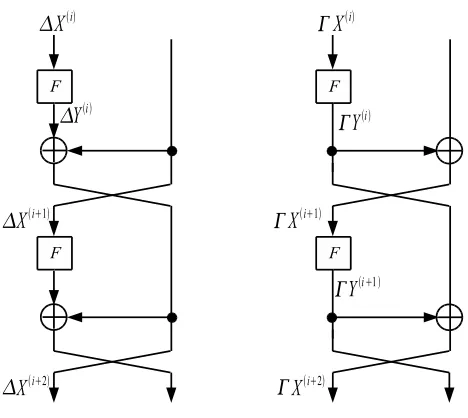
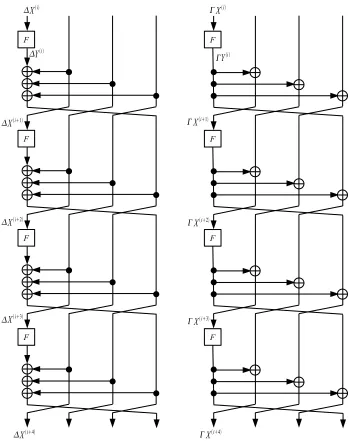
Duality between Differential Characteristic and Linear Approximation As discussed in Section 3 of [18], when analyzing mask values in linear cryptanalysis, we need to consider the duality between differential characteristic and linear approximation, where each XOR is replaced by a joint and each joint is replaced by an XOR. Hence, in the case of 2-cell GF-NLFSR cipher, with reference to Figure 2, we have
Γ X(i+2)=Γ Y(i)⊕Γ Y(i+1), fori≥1, (3)
where the input and output mask values to the i-th round F function are denoted by Γ X(i) and Γ Y(i) respectively.
Similarly, for 4-cell GF-NLFSR cipher, with reference to Figure 3, we have
Fig. 2.(Left)2-cell GF-NLFSR cipher; (Right) Dual of 2-cell GF-NLFSR cipher
Lemma 4. For 2-cell GF-NLFSR cipher with bijective SPN round function and linear branch number
B= 5, the minimum number of linear active S-boxes in any4 consecutive rounds satisfies L(4)≥3.
Proof. Let the input and output mask values to thei-th roundF function beΓ X(i)andΓ Y(i)respectively. Note that since the F function is bijective, Γ X(i)= 0 if and only ifΓ Y(i)= 0. Without loss of generality, we assume that the 4 consecutive rounds run from the first round to the fourth round. Thus the minimum number of linear active S-boxes over 4 consecutive rounds is given by
L(4)=Hw(Γ Y(1)) +Hw(Γ Y(2)) +Hw(Γ Y(3)) +Hw(Γ Y(4)). As discussed in the previous section, we have, from Equation (3),
Γ X(i+1)=Γ Y(i−1)⊕Γ Y(i),
for i= 2 and 3. We consider all cases as follows, where L(ir) denotes the number of linear active S-boxes overrrounds for casei:
Case 1: Γ X(1)= 0
This implies thatΓ X(2)6= 0 and Γ X(3) =Γ Y(2). HenceL(3)
1 ≥Hw(Γ X(2)) +Hw(Γ X(3)) =Hw(Γ X(2)) +
Hw(Γ Y(2))≥ B= 5≥3. ThusL(4)1 ≥ L (3) 1 ≥3. Case 2: Γ X(1)6= 0 andΓ X(2)= 0
This implies that Γ X(3) =Γ Y(1). HenceL(3)
2 ≥Hw(Γ X(1)) +Hw(Γ X(3)) =Hw(Γ X(1)) +Hw(Γ Y(1))≥
B= 5≥3. ThusL(4)2 ≥ L (3) 2 ≥3.
Case 3: Γ X(1)6= 0,Γ X(2)6= 0 and Γ X(3) = 0 This implies that Γ X(4) =Γ Y(2). HenceL(4)
3 ≥Hw(Γ X(1)) +Hw(Γ X(2)) +Hw(Γ X(4)) = Hw(Γ X(1)) +
Case 4: Γ X(1)6= 0,Γ X(2)6= 0, Γ X(3) 6= 0 andΓ X(4)= 0
Then we obtain L(4)4 ≥Hw(Γ X(1)) +Hw(Γ X(2)) +Hw(Γ X(3))≥1 + 1 + 1 = 3.
Case 5: Γ X(1)6= 0,Γ X(2)= 0,6 Γ X(2) 6= 0 andΓ X(4)6= 0
Then we obtain L(4)5 =Hw(Γ X(1)) +Hw(Γ X(2)) +Hw(Γ X(3)) +Hw(Γ X(3))≥1 + 1 + 1 + 1 = 4≥3 . ThereforeL(4) ≥3.
⊓ ⊔
Theorem 4. For 2-cell GF-NLFSR cipher with bijective SPN round function and linear branch number
B= 5, we have
(1) L(8)≥7, (2) L(12)≥11, (3) L(16)≥15.
Proof. Without loss of generality, we begin from the first round.
(1) From the proof of Lemma 4, over 8 rounds, we only need to check the case forΓ X(1) 6= 0,Γ X(2) 6= 0,
Γ X(3) 6= 0 andΓ X(4) = 0. (In all remaining cases, there will be at least 7 linear active S-boxes over 8 rounds.) HoweverΓ X(3)6= 0 andΓ X(4)= 0 correspond to Case 1 of Lemma 4 for the four consecutive rounds that begin from the 4th round and end after the 7th round. Hence there will be at least 3 + 5 = 8 linear active S-boxes. ThereforeL(8)≥7.
(2) From (i), over 12 rounds, we only need to consider the case forΓ X(i)6= 0 fori= 1,· · · ,7 andΓ X(8)= 0. Following a similar argument to (i), we are definitely ensured of at least 7 + 5 = 12 linear active S-boxes. Hence L(12)≥11.
(3) The proof is similar to that of (i) and (ii).
⊓ ⊔
We conclude this section with the study of minimum number of active S-boxes for 4-cell GF-NLFSR.
Proposition 1. Assume that the linear branch numberB= 5. Then the minimum number of linear active S-boxes for 5-round4-cell GF-NLFSR cipher with bijective SPN round function satisfies L(5) ≥2.
Proof. LetΓ X(i)andΓ Y(i)be the input and output mask to theith round function respectively. Since the round function is bijective,Γ X(i)= 0 if and only if Γ Y(i) = 0. It is evident from equation (4) that there cannot exist exactly one non-zero input mask for five consecutive rounds. The result now follows easily. ⊓⊔
Theorem 5. Assume that the linear branch number B = 5. Then the minimum number of linear active S-boxes for 10-round4-cell GF-NLFSR cipher with bijective SPN round function satisfies L(10)≥ B+ 1.
Proof. With no loss of generality, assume that the 10 rounds run consecutively from the first round to the tenth round. Let Γ X(i) and Γ Y(i) be the input and output mask to the ith round function respectively. Recall that due to the duality between differential characteristic and linear approximation, equation (4) holds. LetM={Γ X(1), Γ X(2), Γ X(3), Γ X(4)}. We consider all the following cases, whereL(r)
j denotes the number of linear active S-boxes forr rounds for casej.
ThenΓ X(5) =Γ Y(i)6= 0. Since for four consecutive rounds, the input masks cannot be zero at the same time, we obtain
L(9)1 =Hw(Γ X(i)) +Hw(Γ X(5)) +Hw(Γ X(6)) +· · ·+Hw(Γ X(9))
≥Hw(Γ X(i)) +Hw(Γ Y(i)) + 1
≥ B+ 1.
Case 2 : All input masks inMare non-zero. By Proposition 1, we obtain
L(9)2 =Hw(Γ X(1)) +· · ·+Hw(Γ X(4)) +Hw(Γ X(5)) +· · ·+Hw(Γ X(9))
≥4 + 2 = 6
≥ B+ 1.
Case 3 : There are exactly three non-zero input masks inM.
LetS ={Γ X(5), Γ X(6), Γ X(7), Γ X(8)}. If there are at least three non-zero input masks inS, then we are done. Also, since the input masks for four consecutive rounds cannot be zero at the same time, at least one input mask inS is non-zero. This implies that we only need to check the following:
(i) There is exactly one non-zero input difference inS. ThenΓ X(9)=Γ Y(j) forj= 5, 6, 7 or 8. Hence
L(9)3 ≥3 +Hw(Γ X(j)) +Hw(Γ X(9))≥ B+ 3. (ii) There are exactly two non-zero input masks inS.
– Suppose Γ X(5) = 0 and Γ X(6) 6= 0. Then Γ Y(1)⊕Γ Y(2)⊕Γ Y(3)⊕Γ Y(4) = 0 and it follows that
Γ X(6)=Γ Y(1) 6= 0. Hence we are ensured of at leastB+ 2 active S-boxes.
– Suppose Γ X(6) = 0 and Γ X(7) 6= 0. Then Γ Y(2)⊕Γ Y(3)⊕Γ Y(4)⊕Γ Y(5) = 0 and it follows that
Γ X(7)=Γ Y(2) 6= 0. Hence we are ensured of at leastB+ 2 active S-boxes.
– SupposeΓ X(6)=Γ X(7) = 0,Γ X(5)6= 0 andΓ X(8)6= 0. Then it can be deduced easily that Γ X(8) =
Γ Y(3)6= 0, and there must be at leastB+ 2 active S-boxes.
– Suppose Γ X(7) = Γ X(8) = 0, Γ X(5) = 0 and6 Γ X(6) 6= 0. It follows directly that Γ X(9) = Γ Y(4). If Γ X(9) =6= 0, then we are done. Otherwise Γ X(4) = 0 which implies that Γ X(3) 6= 0. However, 0 =Γ X(8)=Γ Y(3)6= 0, which is a contradiction.
Case 4 : There are exactly two non-zero input masks inM. (i) SupposeΓ X(5)= 0. Then Γ X(6)=Γ Y(1).
– IfΓ X(1)6= 0, then L(6)
4 ≥Hw(Γ X(1)) +Hw(Γ Y(1)) + 1≥ B+ 1.
– IfΓ X(1)= 0 and Γ X(2) 6= 0, thenΓ X(7)=Γ Y(2) and so we obtain,
L(7)4 ≥Hw(Γ X(2)) +Hw(Γ Y(2)) + 1≥ B+ 1.
– IfΓ X(1)= 0 and Γ X(2) = 0 , thenΓ X(3)= 0 and6 Γ X(4)6= 0. HenceΓ X(8)=Γ Y(3), from which
L(8)4 ≥Hw(Γ X(3)) +Hw(Γ X(4)) +Hw(Γ X(8))≥ B+ 1, follows.
(ii) SupposeΓ X(5) 6= 0 andΓ X(6)= 0. It follows thatΓ X(7)=Γ Y(2).
– IfΓ X(2)6= 0, then L(7)
– IfΓ X(2)= 0 and Γ X(3) 6= 0, thenΓ X(8)=Γ Y(3). This implies that
L(8)4 ≥Hw(Γ X(3)) +Hw(Γ Y(3)) + 1≥ B+ 1.
– IfΓ X(2)= 0 andΓ X(3)= 0, thenΓ X(1)= 0 and6 Γ X(4)6= 0. This implies thatΓ X(9)=Γ Y(4), and so
L(9)4 ≥Hw(Γ X(4)) +Hw(Γ X(9)) +Hw(Γ X(1))≥ B+ 1. (iii) SupposeΓ X(5) 6= 0,Γ X(6)6= 0 andΓ X(7)= 0. Then Γ X(8)=Γ Y(3).
– IfΓ X(3)6= 0, then L(8)
4 ≥Hw(Γ X(3)) +Hw(Γ Y(3)) + 1≥ B+ 1.
– IfΓ X(3)= 0 and Γ X(4) 6= 0, thenΓ X(9)=Γ Y(4). This implies that
L(9)4 ≥Hw(Γ X(4)) +Hw(Γ Y(4)) + 1≥ B+ 1.
– If Γ X(3) = 0 andΓ X(4) = 0, thenΓ X(1) = 0 and6 Γ X(2)6= 0. This implies thatΓ X(10) =Γ Y(5) 6= 0. So
L(10)4 ≥Hw(Γ X(5)) +Hw(Γ X(10)) +Hw(Γ X(1)) +Hw(Γ X(2)) +Hw(Γ X(6))≥ B+ 3.
(iv) SupposeΓ X(5)6= 0, Γ X(6) 6= 0 andΓ X(7)6= 0. IfΓ X(8)6= 0 orΓ X(9)6= 0, then there will be at least 6 linear active S-boxes and we are done. Otherwise Γ X(8) =Γ X(9) = 0 and Γ X(10) =Γ Y(5) 6= 0 and we obtain
L(10)4 ≥Hw(Γ X(5)) +Hw(Γ X(10)) +Hw(Γ X(6)) +Hw(Γ X(7))≥ B+ 2.
Hence considering all cases, we conclude thatL(10)≥ B+ 1. ⊓⊔
Corollary 1. The minimum number of linear active S-boxes for 9-round 4-cell GF-NLFSR cipher with bijective SPN round function satisfiesL(9) ≥4.
Proof. The result follows easily from the proof of Theorem 5. ⊓⊔
4
Application 1: Parallelizing Camellia
4.1 Brief Description of Camellia
Camellia was jointly developed by NTT and Mitsubishi Electric Corporation. According to [5], Camellia uses an 18-round Feistel structure for 128-bit key, and a 24-round Feistel structure for 192-bit and 256-bit keys, with additional input/output whitenings and logical functions called theF L-function andF L−1-function in-serted every 6 rounds. ItsF-function uses the SPN (Substitution-Permutation Network) structure, whereby the non-linear layer comprises eight S-boxes in parallel while the linear layer can be represented using only bytewise exclusive-ORs. Note that theF-function is bijective.
For security against differential and linear cryptanalysis, the branch number of the linear layer should be optimal, i.e. branch number = 5. In addition, the S-boxes adopt functions affine equivalent to the inversion function inGF(28) which achieves the best known of the maximum differential and linear probabilities 2−6 [5].
The key schedule of Camellia is slightly different for the 128-bit key version and the 192-bit/256-bit key version. Despite the slight differences, the key schedule is relatively simple and consists of two main steps. One (or two) 128-bit subkey materials are first derived from the secret key via some Feistel network. The round keys are then generated by rotating the secret key itself and the derived subkeys by various amounts.
4.2 Parallelizing Camellia : p-Camellia
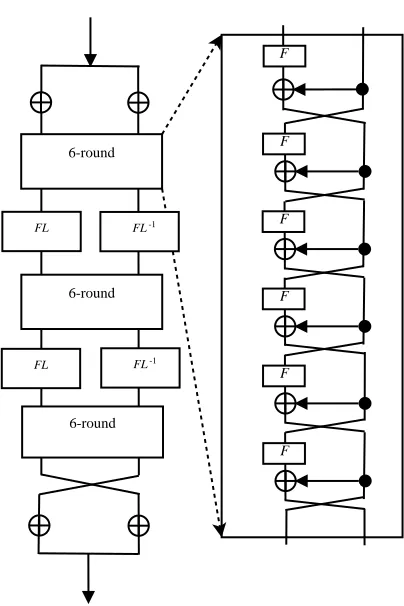
In this section, we propose another version of the existing Camellia block cipher, which we call p-Camellia (“parallelizable” Camellia). As described previously, Camellia uses a Feistel network structure. For the encryption procedure of p-Camellia, we shall replace the Feistel network with the 2-cell GF-NLFSR block cipher structure instead, as depicted in Figure 4 of Appendix. Other components such as number of rounds,
S-function,P-function and the key schedule for the different key versions etc remain unchanged. In addition, similar to Camellia, there are input/output whitenings which are represented by the XOR symbols at the beginning/end of p-Camellia cipher in Figure 4.
5
Figure of p-Camellia
FL
6-round
-1
FL
6-round
FL-1
6-round
FL
F
F
F
F
F
F
-1
Fig. 4.p-Camellia block cipher structure
5.1 Differential and Linear Cryptanalysis of p-Camellia
Following the same approach in [4], denote the maximum differential and linear characteristic probabilities of p-Camellia reduced to 16-round bypandqrespectively. Recall that since both p-Camellia and Camellia use the sameF-function, in the case of p-Camellia, the maximum differential and linear probability of the S-boxes are 2−6. From [4], the differential branch numbers is equal to 5. By considering theP∗-function of
Over 16 rounds, there are four 4-round blocks. By virtue of Theorem 3, wheren= 2 andr= 4, we have
p≤(2−6)4×5+2= 2−132<2−128.
By Theorem 4, we obtainq≤(2−6)15= 2−90. This implies that an attacker needs to collect at least 290 chosen/known plaintexts to mount an attack, which is not feasible in practice.
This implies that there is no effective differential or linear characteristic for p-Camellia reduced to more than 15 rounds. In other words, p-Camellia offers sufficient security against differential and linear attack.
5.2 Other Attacks on p-Camellia
In this section, we briefly examine the protection of Camellia against various known attacks. Since p-Camellia uses the same components as p-Camellia, we expect that p-p-Camellia offers similar level of protection against most of the attacks, as compared to Camellia.
Boomerang Attack To perform boomerang attack, the cipher is split into two shorter ciphers E0 and
E1 such that the differential probability of each part is known to be large. Suppose an adversary split 16 rounds intoE0 andE1withrand 16−rrounds respectively. By Theorem 3, the characteristic differential probability of each sub-ciphers would be bounded byp0≤(2−30)⌊r/4⌋andp1≤(2−30)⌊(16−r)/4⌋. (Note that we ignore the last term in the upper bound of Theorem 3 for ease of calculation.) It can be easily verified that⌊r/4⌋+⌊(16−r)/4⌋ ≥3 forr= 1, . . . ,15. Consequently,
p20×p21≤2−60×3= 2−180<2−128, and thus p-Camellia is secure against boomerang attack.
Impossible Differential Attack Impossible differential attack is a chosen plaintext attack and is an extension of differential cryptanalysis. The main idea of this attack is to construct an impossible differential characteristic which is then used to filter wrong key guesses. Employing similar techniques as [23], we can prove the following result.
Proposition 2. Lete1denote a subblock which is non-zero in the first byte position and zero in the
remain-ing byte positions. For 2-cell GF-NLFSR cipher with bijective SPN round function and differential branch number B ≥ 3, there is at least one 5-round impossible differential, namely of the form (e1,0) 95 (β, β),
whereβ is a non-zero fixed difference.
(Note that here we only considerB ≥3since linear transformation layers withB= 2are unlikely to be used as they do not aid in the protection of the cipher against differential attack.)
Proof. Suppose for a contradiction that (e1,0)→5(β, β) is possible. In the direction of encryption, after 3 rounds, we have (e1,0)→(P S(e1), P S(e1)⊕P SP S(e1)). On the other hand, decrypting two rounds, we obtain (S−1P−1(β),0)←(β, β). Hence
P S(e1)⊕P SP S(e1) = 0, P(S(e1)⊕SP S(e1)) = 0,
S(e1)⊕SP S(e1) = 0. (5)
However,
Hw(SP S(e1)⊕S(e1))≥(B −1)−1 =B −2≥3−2 = 1,
which is a contradiction with equation 5. ⊓⊔
Integral Attack In an integral attack, the attacker studies the propagation of multisets of chosen plaintexts of which part is held constant, and another part varies through all possibilities (also said to beactive) through the cipher. There is a 4-round integral distinguisher of 2-cell GF-NLFSR [8], namely (A, C) → (S0, S1), whereCis constant,Ais active andS0⊕S1 is active. We have not found integral distinguishers with more than 4 rounds. An adversary can extend an integral attack distingusher by at most three rounds. That means he would need to extend the integral attack distinguisher from 4 to 18−3 = 15 rounds which seems unlikely.
Slide Attack The slide attack works on ciphers with cyclical structures over a few rounds. According to [5], theF L- and F L−1- functions are inserted between every 6 rounds to provide non-regularity across rounds. In addition, different subkeys are used for every round, making slide attack unlikely.
We now proceed to examine the protection of p-Camellia against higher order differential attack and interpolation attack. We will adopt a similar approach as [5], which is somewhat heuristic but adequate for us to have a comprehensive and insightful discussion.
Higher Order Differential Attack Higher order differential attack was introduced by Knudsen in [17]. This attack works especially well on block ciphers with components of low algebraic degree such as the KN-Cipher [13], whereby the ciphers can be represented as Boolean polynomials of low degree in terms of the plaintext. The attack requiresO(2t+1) chosen plaintext when the cipher has degreet.
p-Camellia uses exactly the same S-boxes as Camellia and it was confirmed in [5] that the degree of the Boolean polynomial of every output bit of the S-boxes is 7 by finding Boolean polynomial for every outpit bit of the S-boxes. Hence, similar to Camellia, the degree of an intermediate bit in the encryption process should increase as the data passes through many S-boxes. Indeed, let (αi, βi) be the input to the (i+1)-th round of p-Camellia. Suppose deg(α0) = deg(β0) = 1. After the first round, deg(α1) = deg(β0) = 1 while deg(β1) = deg(F(α0)⊕β0) = 7. Continuing this process, we see that the degrees of αi and βi for
i= 0,1,2,· · ·, increases as follows: (1,1),(1,7),(7,7),(7,49),(49,49),(49,127),(127,127),· · ·
That is, the degrees increase exponentially as the number of rounds increase and reach the maximum degree of 127 after the 6th round, implying that it is highly unlikely that higher order differential attack will work.
Interpolation Attack The interpolation attack [14] works on block ciphers that can be expressed as an equation in GF(2d) with few monomials. p-Camellia uses the same components as Camellia and it was shown in [5] that as the data passes through many S-boxes and theP-function, the cipher became a complex function which is a sum of many multi-variate monomials over GF(28). Hence we also expect p-Camellia to be secure against interpolation attack.
5.3 Implementation Advantages
maximum frequency but also requires the gates to drive a higher load (fanout), which results in larger gates with a higher power consumption. By inserting intermediate registers (a technique called pipelining), it is possible to split the critical path into fractions, thus increasing the maximum frequency. Once the pipeline is filled, a complete encryption can be performed in one clock cycle with such an architecture. Consequently, this implementation strategy yields the highest throughput at the cost of high area demands. Furthermore, since the pipeline has to be filled, each pipelining stage introduces a delay of one clock cycle.
A(i)
F B(i)
F
A(i)
F B(i)
F
A(i+2) B(i+2)
A(i+2) B(i+2)
p-Camellia
Camellia
critical path normal signals
Fig. 5.Possible hardware architecture of two rounds of Camellia (left) and p-Camellia (right).
From a lightweight perspective, i.e. if we consider serialized architectures, it is no wonder that area, power and timing demands stay the same for Camellia and p-Camellia, since no operation was introduced or removed. Also a round-based p-Camellia implementation is as efficient as a round-based Camellia im-plementation. However, if we consider applications that require high throughput, p-Camellia has significant advantages. If we consider an architecture that implements two rounds in one clock cycle (see Figure 5), Camellia’s critical path involves two functions and two 2-input XOR gates, compared to only one F-function and one 3-input XOR gate for p-Camellia. Since Camellia inserts every six rounds the F L and
F L−1 functions, it is advantageous to parallelize this fraction of Camellia/p-Camellia. In this case the critical path of Camellia consists of six F-functions, six 2-input XOR gates and the delay of F L/F L−1 while p-Camellia’s critical path only consists of three F-functions, three 3-input XOR gates, and the delay of F L/F L−1. Given the fact that the F-function consists of a 2-input XOR gate (key addition), several combinatorial gates (S-box) and an extensive XOR network (P-function), the delay difference between a 2-input and a 3-input XOR gate is negligible. Hence p-Camellia can achieve a maximum frequency that is nearly twice as high as it would be for Camellia while having similar or lower area and power demands. In case pipelining is applied, Camellia requires twice as much pipelining stages as p-Camellia to achieve the same maximum frequency, resulting in a delay that is twice as high.
Table 1.Comparison of the implementation results of the round function of Camellia and p-Camellia on UMC180 nm ASIC technology.
Camellia p-Camellia
1 round 2 rounds 1 round 2 rounds
abs. % abs. % abs. % abs. %
Area (GE) 4877 100 9754 200 4877 100 9754 200
power∗(mW) 2.65 100 8.38 316.5 2.65 100 5.2 196.2 max Freq. (MHz) 229.4 100 117.8 51.4 229.4 100 221.2 96.5 max T’put (Gbps) 29.4 100 30.2 103 29.4 100 56.6 192.9 ∗at a frequency of 100 MHz and a supply voltage of 1.8V.
round implementation. However, as depicted in Figur 5 the critical path for two consecutive instances of the round function of Camellia is nearly twice as long as for p-Camellia. Consequently, the maximum frequency achievable for Camellia drops to 51.4% while it only slightly decreases to 96.5% for p-Camellia. p-Camellia cannot achieve exactly twice the maximum frequency, because it XORs three summands, while Camellia only XORs two summands. The maximum throughput of a 1 round implementation is the same for Camellia and p-Camellia and achieves 29.4 Gbps (Giga bits per second). A two round Camellia implementation slightly increases the maximum throughput by a mere 2.7% to 30.2 Gbps, while p-Camellia boosts the maximum throughput to 56.6 Gbps - an increment of 92.9% compared to the 1 round Camellia implementation and still 87.8% higher than the 2 round Camellia implementation.
For all architectures we simulated the power consumption at a frequency of 100 MHz and a supply voltage of 1.8 Volt. 1 round of Camellia and p-Camellia require both 2.65 mW. While the power consumption for the 2 rounds implementation of Camellia increases more than 3 times (+216%) to 8.38 mW, it less than doubles for the 2 rounds implementation of p-Camellia (+96%) to 5.2 mW compared to the 1 round implementations. These figures highlight the advantages of p-Camellia over Camellia from a power perspective.
6
Application 2: Parallelizing SMS4
6.1 Brief Description of SMS4
According to [11], SMS4 takes in a 128-bit key and uses a 32-round generalized Feistel structure to transform the plaintext to the ciphertext. Each round of the generalized Feistel transformation transforms four 32-bit wordsXi,i= 0,1,2,3, as follows:
(X0, X1, X2, X3, rk)7→(X1, X2, X3, X0⊕T(X1⊕X2⊕X3⊕rk)), (6)
where rkdenotes the round key. In each round, the nonlinear function T does the following operations in sequence: 32-bit subkey addition, S-box Subsitution (layer of four 8-bit S-boxes) and lastly, a 32-bit linear transformationL.
It is well-known that the S-boxes adopt functions affine equivalent to the inversion function inGF(28) [15, 10], which achieves the best known maximum differential and linear probabilities of 2−6. Furthermore, it can be verified that the branch number of the linear transformation L is Ld = 5. This gives optimal spreading effect which increases the number of active S-boxes for protection against differential and linear cryptanalysis.
The key schedule of SMS4 XORs the secret key M K with a constant F K and passes it through a nearly-identical 32-round structure as the main SMS4 cipher. The only difference is that the 32-bit linear transformation L is replaced by a simpler linear transformationL′, which can be verified to have branch
number L′
6.2 Parallelizing SMS4: p-SMS4
In this section, we propose another version of the existing SMS4 block cipher, which we call p-SMS4 ( “par-allelizable” SMS4). As described previously, SMS4 uses a generalized Feistel network structure described by equation (6). For the encryption procedure of p-SMS4, we shall replace the generalized Feistel network with the 4-cell GF-NLFSR block cipher structure described by:
(X0, X1, X2, X3, rk)7→(X1, X2, X3, X1⊕X2⊕X3⊕T(X0⊕rk)). (7) Other components such as number of rounds and the T-function, which consists of four S-boxes and a
L-function, remain the same as SMS4. One round of p-SMS4 corresponds to a 4-cell version of the structure in Figure 1, where the nonlinear functionF(·) is theT-function used in SMS4.
The key schedule of p-SMS4 XORs the secret key M K with a constant F K and passes it through an identical 32-round structure as the main cipher of p-SMS4 described by equation (7). The constant F K, S-box and the linear transformation L′ of the key schedule remain the same as SMS4. We need the key
schedule to have the same structure as the main cipher so that it is also parallelizable in hardware, and thus can be made “on-the-fly”.
6.3 Differential and Linear Cryptanalysis of p-SMS4
Su et al. proved bounds for the differential characteristic probability of the SMS4 cipher in [19]. One of the results they proved was that in every 7 rounds of the SMS4 cipher, there are at least 5 active S-boxes. However, there are currently no known bounds on the linear characteristic probability of SMS4 to the best of our knowledge.
Similarly for the p-SMS4 cipher, we can easily compute the differential characteristic bound by Theorem 3. Denote the maximum differential probability of p-SMS4 reduced to 29-round byp(we assume a minus-3 round attack where the attacker guesses three subkeys with complexity 296).
Recall that both p-SMS4 and SMS4 use the same T-function. In the case of p-SMS4, the maximum differential probability of the S-boxes is 2−6andL
d= 5. By virtue of Theorem 3 withn= 4 andr= 5, the first 24 rounds has 5×3 +⌊3/2⌋= 16 active S-boxes. Over the next 5 rounds, we have 2 active S-boxes by Proposition 1. Therefore the differential characteristic probability over 29 rounds satisfies:
p≤(2−6)16×(2−6)2= 2−108.
This implies that an attacker needs to collect at least 2108 chosen plaintext-ciphertext pairs to launch an attack. This is not feasible in practice. Moreover by Remark 1, for random input differences, we have at least 5 active S-boxes every 5 rounds with probability 1−2−32. Only 2−32 of the time do we need 8 rounds to ensure at least 5 active S-boxes. Thus we expect the bound for the differential characteristic probability to be even lower. In summary, we have shown that p-SMS4 offers sufficient security against differential cryptanalysis.
Denote the maximum linear probability of p-SMS4 reduced to 28-round byq. Recall that the maximum linear probability of the S-boxes is 2−6 and the linear branch number is 5. By Theorem 5 and Corollary 1, we deduce that there must be at least 16 linear active S-boxes. Henceq≤(2−6)16= 2−96. This implies that an attacker needs to collect at least 296 chosen/known plaintexts to mount a linear attack, which is not feasible in practice.
This implies that there is no effective differential or linear characteristic for p-SMS4 reduced to more than 29 rounds. In other words, p-SMS4 offers sufficient security against differential and linear attack.
6.4 Related-Key Differential Attack on p-SMS4
are non-zero differential inputs into both the cipher and the key schedule. The adversary tries to find a differential characteristic path in the key schedule with probabilitypk and a differential characteristic path in the main cipher with probabilitypc|k that holds, on the condition that the key schedule differential path is true. The attacker can then launch the attack with complexityO(1/(pk×pc|k)) where he can tweak the secret key 1/pk times to get that many related keys. In AES-256, we have pk = 2−35 andpc|k = 2−93.
Because the p-SMS4 key schedule uses a 4-cell GF-NLFSR structure, we can try to bound the probability
pk of a differential characteristic path in the key schedule by Theorem 3. However, Theorem 3 cannot be directly applied to the main cipher to derive the differential characteristic probabilitypc|kbecause there are subkey differential input into every round.
We use the fact that the key schedule uses the inversion S-box with differential probability 2−6and that the linear transformL′ has branch numberL′
d= 4. By Theorem 3 withn= 4 andr= 4, every 24 rounds of the key schedule has 4×3 +⌊3/2⌋= 13 active S-boxes. With a computation similar to Section 6.3, we have another 2 active S-boxes over the next 5 rounds giving:
pk≤(2−6)13×(2−6)2= 2−90.
over 29 rounds of the key schedule. That means the complexity of any minus-3 round related-key differential attack is at least O(290) and uses at least 290 related keys, which is not feasible in practice. Again, by a similar explanation as in Section 6.3 based on Remark 1, most of the time we have 5 active S-boxes per 5 rounds and we expectpk to be lower and the attack complexity to be higher.
In [6], a related-key boomerang attack on AES-256 with a complexity of 2119 using 4 related keys is presented but it assumes a more powerful adverserial model. In a similar way, we can show through the p-SMS4 key schedule differential structure that related-key boomerang attack is infeasible.
6.5 Other Attacks on p-SMS4
Boomerang Attack Suppose an adversary performs a minus-3 round attack on 29 rounds of p-SMS4. He would need to split 29 rounds into two sub-ciphersE0,E1withrand 29−rrounds respectively, wherer= 1,· · · ,28. By Proposition 1 and Theorem 3,p0≤(2−6)5×⌊
r
8⌋+2×⌊
rmod 8
5 ⌋andp1≤(2−6)5×⌊
29−r
8 ⌋+2×⌊
(29−r) mod 8
5 ⌋.
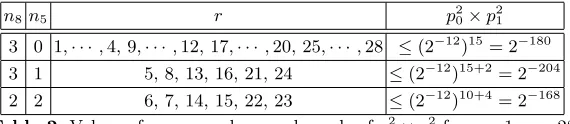
(Note that we ignore the last term in the upper bound of Theorem 3 for ease of calculation.) For r = 1,· · · ,28, letn8=⌊r8⌋+⌊298−r⌋andn5=⌊rmod 85 ⌋+⌊(29−r) mod 85 ⌋. It can be easily checked that there are only three combinations of values thatn8 andn5can take, as summarized in the Table 2.
Nowp0×p1≤(2−6)5n8+2n5. This implies that
p20×p21≤(2−12)5n8+2n5. The upper bounds ofp2
0×p21 for each combination ofn8andn5are also given in Table 2. From Table 2, we see thatp2
0×p21<2−128. Hence p-SMS4 is secure against boomerang attack.
n8n5 r p20×p
2 1
3 0 1,· · ·,4, 9,· · ·,12, 17,· · ·,20, 25,· · ·,28 ≤(2−12
)15
= 2−180
3 1 5, 8, 13, 16, 21, 24 ≤(2−12
)15+2
= 2−204
2 2 6, 7, 14, 15, 22, 23 ≤(2−12
)10+4
= 2−168 Table 2.Values ofn8,n5 and upper bounds ofp20×p
2
Impossible Differential Attack According to [8, 20, 24], there is at least one 18-round impossible differ-ential distinguisher in the 4-cell GF-NLFSR, which results in a 25-round impossible differdiffer-ential attack with complexity 2123 and uses 2115 chosen plaintext encryptions. An identical attack is applicable to 25-round p-SMS4 with the same complexity. However, that attack is unlikely to work on the full p-SMS4 cipher, which has 32 rounds.
Integral Attack According to [8, 20], there is at least one 16-round integral attack distinguisher in the 4-cell GF-NLFSR starting with one active 32-bit word. A naive key guessing attack can extend this distinguisher by at most 3 rounds at the end (guessing more rounds of keys may make the complexity too close to 2128). An adversary may extend the attack by 4 rounds in front, starting with 3 active words and using the method of [12]. Using these means, we expect a 4 + 16 + 3 = 23 round attack on p-SMS4 and the full 32 rounds will be secure against integral attack.
Slide Attack The slide attack works on ciphers with cyclical structures over a few rounds. However the subkeys used in every round are nonlinearly derived from the previous subkey. Thus the subkeys are all distinct and there is no simple linear relation between them, making slide attack unlikely.
XSL Attack In [15], Ji and Hu showed that the eprint XSL attack on SMS4 embedded inGF(28) can be applied with complexity 277. A similar analysis can be applied on p-SMS4 to show that the complexity of the eprint XSL attack on p-SMS4 embedded inGF(28) is also 277. However, it was shown in [10] by Choy et al. that Ji and Hu’s analysis might be too optimistic and the actual complexity of the compact XSL attack on embedded SMS4 is at least 2216.58. We can use an analysis identical to the ones used in [10] to show that the complexity of the compact XSL attack on p-SMS4 is also at least 2216.58.
Using a similar approach as [5], we discuss the protection of p-SMS4 against higher order differential attack and interpolation attack in the remaining of this section.
Higher Order Differential Attack As mentioned previously, higher order differential attack is generally applicable to ciphers that can be represented as Boolean polynomials of low degree in terms of the plaintext. The attack requiresO(2t+1) chosen plaintext when the cipher has degreet.
p-SMS4 uses exactly the same S-boxes as SMS4 where the degree of the Boolean polynomial of every output bit of the S-boxes is 7. Making the assumption that when we compose tworandomly chosenS-boxes
F, G of degree t1, t2, F ◦G should have degree t1t2. We expect the degree of an intermediate bit in the encryption process to increase exponentially as the data passes through many S-boxes.
Indeed, by the 4th round, every output bit will have degree 7. By the 8th round, every output bit will have degree 72= 49. By the 12th round, every output bit will have degreemin(73,127) = 127 in terms of the plaintext bits. Therefore p-SMS4 is secure against higher order differential attack.
Interpolation Attack The interpolation attack works on block ciphers that can be expressed as an equation in GF(2d) with few monomials. p-SMS4 uses the same components as SMS4 and as the data passes through many S-boxes and L-functions, the cipher will became a complex function which is a sum of exponentially many multi-variate monomials overGF(28). Hence we expect p-SMS4 to be secure against interpolation attack.
6.6 Implementation Advantages
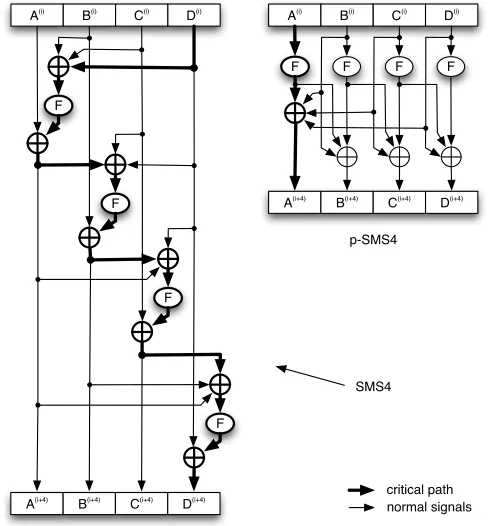
forms the input to the F-function and its output is XORed to the last branch while p-SMS4 uses one branch as the input for the F-function and XORs its output to the remaining three branches. This difference allows more flexible implementations of p-SMS4 compared to SMS4, because the XOR sum of four signals can be achieved by either using three 2-input XOR gates or combining a 3-input XOR gate with a 2-input XOR gate. The first option is faster (0.33 ns vs. 0.45 ns) while the second option requires less area (256 GE vs. 235 GE), which is an advantage for lightweight implementations. Beside this flexibility, p-SMS4 has similar characteristics as SMS4 for a serialized implementation. The critical path of a round-based p-SMS4 implementation is shorter than that of SMS4, since it consists of the F-function and a 2-input XOR gate compared to a 3-input XOR gate, the F-function and a 2-input XOR gate for SMS4.
A(i)
F B(i)
A(i)
F B(i)
F
A(i+4) B(i+4)
p-SMS4
SMS4 C(i)
D(i)
F
F
C(i+4) D(i+4)
F
A(i+4) B(i+4) C(i+4) D(i+4)
C(i)
D(i)
F F
critical path normal signals
Fig. 6.Possible hardware architecture of four rounds of SMS4 (left) and p-SMS4 (right).
For parallelized implementations p-SMS4 offers even greater advantages. If we consider an implementa-tion that processes four rounds in one clock cycle (see figure 6), the critical path of p-SMS consists only of the F-function and two 2-input XOR gates while SMS4’s critical path consists of four F-functions, four 2-input XOR gates and four 3-input XOR gates. Hence, the maximum frequency and thus the maximum throughput that can be achieved with p-SMS4 using such an architecture is around four times higher while the area and power consumption are similar or lower compared to a corresponding SMS4 implementation. A similar frequency can be achieved for SMS4 by inserting three pipelining stages, which significantly increases the area and power consumption and introduces a delay of three clock cycles.
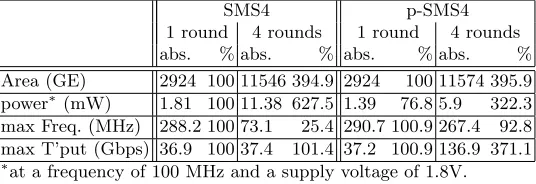
Table 3.Comparison of the implementation results of the round function of SMS4 and p-SMS4 on UMC180 nm ASIC technology.
SMS4 p-SMS4
1 round 4 rounds 1 round 4 rounds
abs. % abs. % abs. % abs. %
Area (GE) 2924 100 11546 394.9 2924 100 11574 395.9 power∗(mW) 1.81 100 11.38 627.5 1.39 76.8 5.9 322.3 max Freq. (MHz) 288.2 100 73.1 25.4 290.7 100.9 267.4 92.8 max T’put (Gbps) 36.9 100 37.4 101.4 37.2 100.9 136.9 371.1 ∗at a frequency of 100 MHz and a supply voltage of 1.8V.
same for SMS3 and p-SMS4 and nearly quadruple to 11546 GE and 11574 GE for four instances. The 1 round implementation of p-SMS4 achieves a slightly higher maximum frequency of 290.7 MHz compared to SMS4 with 288.2 MHz. However, as depicted in Figur 6 the critical path for four consecutive instances of the round function of SMS4 is nearly four times as long as for p-SMS4. Consequently, the maximum frequency achievable for SMS4 drops to 25.4% while it only slightly decreases to 92.8% for p-SMS4. The maximum throughput of a 1 round implementation is the about same for SMS4 and p-SMS4 and achieves 36.9 Gbps and 37.2 Gbps, respectively. A four round SMS4 implementation slightly increases the maximum throughput by a mere 1.4% to 37.4 Gbps, while p-SMS4 boosts the maximum throughput to 136.9 Gbps -an increment of 271.1% compared to the 1 round SMS4 implementation and still 266% higher than the 4 round SMS4 implementation.
For all architectures we simulated the power consumption at a frequency of 100 MHz and a supply voltage of 1.8 Volt. 1 round of SMS4 requires 1.81 mW and a similar p-SMS4 implementation rewuires 1.39 mW. While the power consumption for the 4 rounds implementation of SMS4 increases more than 6 times (+528%) to 11.38 mW, it less than quadruples for the 4 rounds implementation of p-SMS4 (+222%) to 5.85 mW compared to the 1 round implementations. These figures highlight the advantages of p-SMS4 over SMS4 from a power perspective.
From these estimates it becomes clear that the implementation advantages of our newly proposed par-allelizable Feistel-structure becomes even larger with a growing number of branches. In fact, an n-cell GF-NLFSR can be implemented usingn rounds in parallel while having nearly the same critical path as for a single round implementation. This translates to an about n times higher maximum frequency while the area and power consumption are similar then for a conventional Feistel structure.
7
Conclusion
In this paper we proposed the use ofn-cell GF-NLFSR structure to parallelize (Generalized) Feistel struc-tures. We used two examples, p-Camellia and p-SMS4, and showed that they offer sufficient security against various known existing attacks. At the same time, as compared to their conventional Feistel structure coun-terparts Camellia and SMS4, their hardware implementations achieve a maximum frequency that is about
ntimes higher, where nis the number of Feistel branches, while having similar area demands and signifi-cantly less power demands. These estimates indicate that ofn-cell GF-NLFSRs are particularly well suited for applications that require a high throughput.
References
1. National Bureau of Standards, Data Encryption Standard, FIPS-Pub.46. National Bureau of Standards, U.S. Department of Commerce, Washington D.C., January 1977.
3. “Universal Mobile Telecommunications System (UMTS); Specification of the 3GPP confidentiality and integrity algorithms; Document 2: Kasumi specification” athttp://www.etsi.org/website/document/algorithms/ts_ 135202v070000p.pdf.
4. K. Aoki, T. Ichikawa, M. Kanda, M. Matsui, S. Moriai, J. Nakajima and T. Tokita, “Specification of Camellia - A 128-Bit Block Cipher”, 2000. athttp://info.isl.ntt.co.jp/camellia/.
5. K. Aoki, T. Ichikawa, M. Kanda, M. Matsui, S. Moriai, J. Nakajima and T. Tokita, “Camellia: A 128-Bit Block Cipher Suitable for Multiple Platforms, Design and Analysis ”, SAC 2000, LNCS 2012, pp. 39-56, Springer-Verlag, 2001.
6. A. Biryukov and D. Khovratovich, “Related-Key Cryptanalysis of the Full AES-192 and AES-256”, IACR eprint server, 2009/317 (June 2009),http://eprint.iacr.org/2009/317.
7. A. Biryukov, D. Khovratovich, and I. Nikolic, “Distinguisher and Related-Key Attack on the Full AES-256 (Extended Version)”, IACR eprint server, 2009/241 (June 2009),http://eprint.iacr.org/2009/241.
8. J. Choy, G. Chew, K. Khoo and H.Yap, “Cryptographic Properties and Application of a Generalized Unbalanced Feistel Network Structure (Revised Version)”,Cryptology Eprint Archive, Report 2009/178 (July 2009). (Revision of [9])
9. J. Choy, G. Chew, K. Khoo and H.Yap, “Cryptographic Properties and Application of a Generalized Unbalanced Feistel Network Structure”, ACISP 2009, LNCS 5594, pp. 73-89, Springer-Verlag, 2009.
10. J. Choy, H.Yap and K. Khoo, “An Analysis of the Compact XSL Attack on BES and Embedded SMS4”, to appear in proceedings of CANS 2009, Springer-Verlag, 2009.
11. W. Diffe and G. Ledin, “SMS4 Encryption Algorithm for Wireless Networks”, Cryptology ePrint Archive: Report 2008/329.
12. K. Hwang, W. Lee, S. Lee, S. Lee and J. Lim, “Saturation Attacks on Reduced Round Skipjack”, LNCS 2365, FSE 2002, pp. 100-111, Springer-Verlag, 2002.
13. T. Jakobsen and L. R. Knudsen, “The Interpolation Attack on Block Ciphers”, LNCS 1267, FSE 1997, pp. 28-40, Springer-Verlag, 1997.
14. T. Jakobsen and L. R. Knudsen, “Attacks on Block Ciphers of Low Algebraic Degree”, Journal of Cryptology, Vol. 14, pp. 197-210, Springer, 2001.
15. W. Ji and L. Hu, “New Description of SMS4 by an Embedding overGF(28
)”, LNCS 4859,Indocrypt 2007, pp. 238-251, Springer-Verlag, 2007.
16. M. Kanda, “Practical Security Evaluation against Differential and Linear Cryptanalysis for Feistel Ciphers with SPN Round Function”, SAC 2000, LNCS 2012, pp. 324-338, Springer-Verlag, 2001.
17. L. R. Knudsen, “Truncated and Higher Order Differentials”, LNCS 1008,FSE 1994, pp. 196-211, Springer-Verlag, 1995.
18. M. Matsui, “On Correlation Between the Order of S-boxes and the Strength of DES”, Eurocrypt 1994, LNCS 950, pp. 366-375, 1995.
19. B. Su, W. Wu and W. Zhang, “Differential Cryptanalysis of SMS4 Block Cipher”,Cryptology Eprint Archive, Report 2010/062 (Feb 2010).
20. R. Li, B. Sun and C. Li, “Distinguishing Attack on a Kind of Generalized Unbalanced Feistel Network”, Cryp-tology Eprint Archive, Report 2009/360 (July 2009).
21. S. Park, S. Sung, S. Lee, J. Lim, “Improving the Upper Bound on the Maximum Differential and the Maximum Linear Hull Probability for SPN Structures and AES”, FSE 2003, LNCS 2887, pp. 247-260, Springer-Verlag, 2003.
22. T. Shirai, K. Shibutani, T. Akishita, S. Moriai, T. Iwata, “The 128-Bit Blockcipher CLEFIA (Extended Ab-stract)”, FSE 2007, LNCS 4593, pp. 181-195, Springer-Verlag, 2007.
23. Y. Wei, P. Li, B. Sun and C. Li, “Impossible Differential Cryptanalysis on Feistel Ciphers with SP and SPS Round Functions”,ACNS 2010, LNCS 6123, pp. 105-122, Springer, 2010.
24. W. Wu, L. Zhang, L. Zhang and W. Zhang, “Security Analysis of the GF-NLFSR Structure and Four-Cell Block Cipher”,Cryptology Eprint Archive, Report 2009/346 (July 2009).
Appendix: Test Vectors
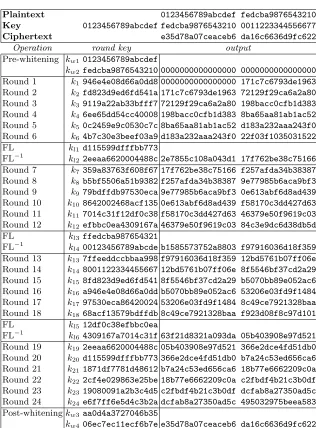
Here we provide test vectors for p-Camellia with 128, 192, and 256 bit keys (Tables 4 to 6) and for p-SMS4 with a 128 bit key (Table 7). We stick to the test vector format of the corresponding original ciphers, Camellia and SMS4.
Table 4.Test Vector for p-Camellia-128
Plaintext 0123456789abcdef fedcba9876543210
Key 0123456789abcdef fedcba9876543210
Ciphertext defcf36c09623e05 018e2cbe8f56b8d5
Operation round key output
Pre-whitening kw10123456789abcdef
kw2fedcba9876543210 0000000000000000 0000000000000000
Round 1 k1eea36580448142e6 0000000000000000 9b8d4b3590733c4d
Round 2 k26f90d050fe0bbe7d 9b8d4b3590733c4d 980912c9086ee08f
Round 3 k3a2b3c4d5e6f7ff6e 980912c9086ee08f 414509b219335b44
Round 4 k45d4c3b2a19080091 414509b219335b44 da0823938d86088a
Round 5 k5b2c02240a17337c8 da0823938d86088a 11b9c2d3140d6f0d
Round 6 k668287f05df3ef751 11b9c2d3140d6f0d f8e2ea3adda357d9
FL kl1112050b99be43414
FL−1
kl23f82ef9f7ba8d960 ae543cec364dee2f 074935c3d3a31cdf
Round 7 k779bdffdb97530eca 074935c3d3a31cdf d7bc446d2558b71f
Round 8 k88642002468acf135 d7bc446d2558b71f 35a14189576f51e2
Round 9 k9285ccdf21a0a1fc1 35a14189576f51e2 6fcd64be097d4302
Round 10 k1000123456789abcde 6fcd64be097d4302 2bcf3494f5cc36f9
Round 11 k1166f90d050fe0bbe7 2bcf3494f5cc36f9 e1376d1f82a7d0db
Round 12 k12deea36580448142e e1376d1f82a7d0db ac3b5fa60d77ff6a
FL kl397530eca86420024
FL−1
kl468acf13579bdffdb 67f4a5f18081c8ce d1c4a05d8c7ebf40
Round 13 k131d950c840048d159 d1c4a05d8c7ebf40 b8013fe2ccca5214
Round 14 k14e26af37bffb72ea6 b8013fe2ccca5214 3a02d81ca092f03e
Round 15 k153f82ef9f7ba8d960 3a02d81ca092f03e c356213d32c0c94e
Round 16 k16112050b99be43414 c356213d32c0c94e 2c5c47a3889f8ffa
Round 17 k1719080091a2b3c4d5 2c5c47a3889f8ffa a0fd1b76e77ec7d0
Round 18 k18e6f7ff6e5d4c3b2a a0fd1b76e77ec7d0 01c2043dbba21c45
Post-whiteningkw3df3ef751b2c02240
Table 5.Test Vector for p-Camellia-192
Plaintext 0123456789abcdef fedcba9876543210
Key 0123456789abcdef fedcba9876543210 0011223344556677
Ciphertext e35d78a07ceaceb6 da16c6636d9fc622
Operation round key output
Pre-whitening kw10123456789abcdef
kw2fedcba9876543210 0000000000000000 0000000000000000
Round 1 k1946e4e08d66a0dd8 0000000000000000 171c7c6793de1963
Round 2 k2fd823d9ed6fd541a 171c7c6793de1963 72129f29ca6a2a80
Round 3 k39119a22ab33bfff7 72129f29ca6a2a80 198bacc0cfb1d383
Round 4 k46ee65dd54cc40008 198bacc0cfb1d383 8ba65aa81ab1ac52
Round 5 k50c2459e9c0530c7c 8ba65aa81ab1ac52 d183a232aaa243f0
Round 6 k64b7c30e3beef03a9 d183a232aaa243f0 22f03f1035031522
FL kl1d115599dfffbb773
FL−1
kl22eeaa6620004488c 2e7855c108a043d1 17f762be38c75166
Round 7 k7359a83763f608f67 17f762be38c75166 f257afda34b38387
Round 8 k8b5bf5506a51b9382 f257afda34b38387 9e77985b6aca9bf3
Round 9 k979bdffdb97530eca 9e77985b6aca9bf3 0e613abf6d8ad439
Round 10 k108642002468acf135 0e613abf6d8ad439 f58170c3dd427d63
Round 11 k117014c31f12df0c38 f58170c3dd427d63 46379e50f9619c03
Round 12 k12efbbc0ea4309167a 46379e50f9619c03 84c3e9dc6d38db5d
FL kl3ffedcba987654321
FL−1
kl400123456789abcde b1585573752a8803 f97916036d18f359
Round 13 k137ffeeddccbbaa998 f97916036d18f359 12bd5761b07ff06e
Round 14 k148001122334455667 12bd5761b07ff06e 8f5546bf37cd2a29
Round 15 k158fd823d9ed6fd541 8f5546bf37cd2a29 b5070bb89e052ac6
Round 16 k16a946e4e08d66a0dd b5070bb89e052ac6 53206e03fd9f1484
Round 17 k1797530eca86420024 53206e03fd9f1484 8c49ce7921328baa
Round 18 k1868acf13579bdffdb 8c49ce7921328baa f923d08f8c97d101
FL kl512df0c38efbbc0ea
FL−1
kl64309167a7014c31f 63f21d8321a093da 05b403908e97d521
Round 19 k192eeaa6620004488c 05b403908e97d521 366e2dce4fd51db0
Round 20 k20d115599dfffbb773 366e2dce4fd51db0 b7a24c53ed656ca6
Round 21 k211871df7781d48612 b7a24c53ed656ca6 18b77e6662209c0a
Round 22 k222cf4e029863e25be 18b77e6662209c0a c2fbdf4b21c3b0df
Round 23 k2319080091a2b3c4d5 c2fbdf4b21c3b0df dcfab8a27350ad5c
Round 24 k24e6f7ff6e5d4c3b2a dcfab8a27350ad5c 495032975beea583
Post-whiteningkw3aa0d4a3727046b35
Table 6.Test Vector for p-Camellia-256
Plaintext 0123456789abcdef fedcba9876543210
Key 0123456789abcdef fedcba9876543210
0011223344556677 8899aabbccddeeff
Ciphertext 15e3eef9b879ebcd d8204f9436564e0c
Operation round key output
Pre-whitening kw10123456789abcdef
kw2fedcba9876543210 0000000000000000 0000000000000000
Round 1 k18a5189e3b3d105c5 0000000000000000 487d45ecf3404dc7
Round 2 k21daae720c89263ca 487d45ecf3404dc7 e66963613ebf68c7
Round 3 k39119a22ab33bc44c e66963613ebf68c7 6b1f28f6f41644cd
Round 4 k4d55de66ef77f8008 6b1f28f6f41644cd c2c6cb8ca0535412
Round 5 k5671465d1b2160e57 c2c6cb8ca0535412 09e62c405dc5b786
Round 6 k6bcd4f117fd2b818f 09e62c405dc5b786 ae86bd493cdca41d
FL kl1d115599de2266aae
FL−1
kl2f3377bbfc004488c f609c3ee5fcda78 6525a51d498f80735
Round 7 k7ecf44171476ab9c8 525a51d498f80735 4cd907551429dc24
Round 8 k8322498f2a2946278 4cd907551429dc24 b313976933fd7a24
Round 9 k979bdffdb97530eca b313976933fd7a24 d4cd98ff068beac2
Round 10 k108642002468acf135 d4cd98ff068beac2 7058010931524a06
Round 11 k116c858395ef353c45 7058010931524a06 68acfb7d01e73e3c
Round 12 k12ff4ae063d9c51974 68acfb7d01e73e3c 6c7c32deb7811418
FL kl3ffedcba987654321
FL−1
kl400123456789abcde bf531012d0bea86e 93e78e00b7851c18
Round 13 k1378899aabbccddeef 93e78e00b7851c18 15c67729db978ee7
Round 14 k14f001122334455667 15c67729db978ee7 474795e9e443e49b
Round 15 k1551daae720c89263c 474795e9e443e49b af3bb8f76290ced6
Round 16 k16a8a5189e3b3d105c af3bb8f76290ced6 762f5f82c62e0f8b
Round 17 k1797530eca86420024 762f5f82c62e0f8b cb67a0a09434a577
Round 18 k1868acf13579bdffdb cb67a0a09434a577 58a9b0d80095ffb8
FL kl5ef353c45ff4ae063
FL−1
kl6d9c519746c858395 341945d7027ee576 343c4f65209ded70
Round 19 k19f3377bbfc004488c 343c4f65209ded70 1c0f7737506e358c
Round 20 k20d115599de2266aae 1c0f7737506e358c 612a4c06b75fa8e1
Round 21 k21788bfe95c0c7b38a 612a4c06b75fa8e1 a1972fbb555d9a6c
Round 22 k2232e8d90b072bde6a a1972fbb555d9a6c 9f58893990e4fe98
Round 23 k2319080091a2b3c4d5 9f58893990e4fe98 5ac2c14145c62a45
Round 24 k24e6f7ff6e5d4c3b2a 5ac2c14145c62a45 2406abd17c883225
Post-whiteningkw331e54528c4f1d9e8
Table 7.Test Vector for p-SMS4
Plaintext 0123456789abcdef fedcba9876543210 Key 0123456789abcdef fedcba9876543210 Ciphertext b1bc0608ef02423c c3fbd3daab51b248
Operation round key output
Round 0 rk[ 0] = 91daf39c X[ 0] = de546515
Round 1 rk[ 1] = c064f752 X[ 1] = 37df26d1
Round 2 rk[ 2] = 94e493e3 X[ 2] = a4ec9909
Round 3 rk[ 3] = de78427b X[ 3] = 52425f79
Round 4 rk[ 4] = 2db76314 X[ 4] = d24a93d6
Round 5 rk[ 5] = 73451fb4 X[ 5] = f5f06a45
Round 6 rk[ 6] = 06daf312 X[ 6] = 6b38d201
Round 7 rk[ 7] = 86788fc8 X[ 7] = dfa666eb
Round 8 rk[ 8] = 5b2a143a X[ 8] = 023d696e
Round 9 rk[ 9] = be03897b X[ 9] = 6e33c8db
Round 10 rk[10] = 0f3b7112 X[10] = 68adf8a8
Round 11 rk[11] = 0062e41b X[11] = a80ce0c1
Round 12 rk[12] = eef9fa01 X[12] = 868f5476
Round 13 rk[13] = 62678f1b X[13] = 6e6ff87b
Round 14 rk[14] = a62c3624 X[14] = 1f7a4d1d
Round 15 rk[15] = e276a56a X[15] = 57cf029d
Round 16 rk[16] = a1e07f93 X[16] = 336dce80
Round 17 rk[17] = cd493f68 X[17] = 052af90a
Round 18 rk[18] = 25935606 X[18] = fd43fa3b
Round 19 rk[19] = cc82ba7f X[19] = b4f7dbaf
Round 20 rk[20] = 97ddff3e X[20] = 053c1645
Round 21 rk[21] = f19615bf X[21] = c28b9543
Round 22 rk[22] = af40d76d X[22] = eb913b2a
Round 23 rk[23] = 371225f4 X[23] = 42f09763
Round 24 rk[24] = 56f5df7d X[24] = 938296fd
Round 25 rk[25] = e18e3f68 X[25] = 57f0a98c
Round 26 rk[26] = 51de4d8e X[26] = fa771ab4
Round 27 rk[27] = 3e8cf9ba X[27] = 08b74c18
Round 28 rk[28] = 863f59db X[28] = ab51b248
Round 29 rk[29] = cf23b8c6 X[29] = c3fbd3da
Round 30 rk[30] = b3cd61a9 X[30] = ef02423c