Lower and Upper Bounds for Deniable Public-Key Encryption
Rikke Bendlin1,?, Jesper Buus Nielsen1,?,??, Peter Sebastian Nordholt1,?, and Claudio Orlandi2,? ? ?
1 Aarhus University, Denmark, {rikkeb, jbn, psn}@cs.au.dk 2 Bar-Ilan University, Israel, [email protected]
Abstract. A deniable cryptosystem allows a sender and a receiver to communicate over an insecure channel in such a way that the communication is still secure even if the adversary can threaten the parties into revealing their internal states after the execution of the protocol. This is done by allowing the parties to change their internal state to make it look like a given ciphertext decrypts to a message dierent from what it really decrypts to. Deniable encryption was in this way introduced to allow to deny a message exchange and hence combat coercion.
Depending on which parties can be coerced, the security level, the avor and the number of rounds of the cryptosystem, it is possible to dene a number of notions of deniable encryption.
In this paper we prove that there does not exist any non-interactive receiver-deniable cryptosystem with better than polynomial security. This also shows that it is impossible to construct a non-interactive bi-deniable public-key encryption scheme with better than polynomial security. Specically, we give an explicit bound relating the security of the scheme to how ecient the scheme is in terms of key size. Our impossibility result establishes a lower bound on the security.
As a nal contribution we give constructions of deniable public-key encryption schemes which establishes upper bounds on the security in terms of key length. There is a gap between our lower and upper bounds, which leaves the interesting open problem of nding the tight bounds.
1 Introduction
Alice and Bob live in a country ruled by an evil dictator, Eve. If Alice wants to communicate with Bob, standard public-key cryptography can be used by Alice if she wants to keep Eve from learning the subject of her communication with Bob. However, if Eve controls the network she will be able to observe that a ciphertext is traveling from Alice to Bob. Once the evil Eve knows that a conversation took place, she might get suspicious and force Bob to reveal the content of the conversation. Can cryptography oer any help to Alice and Bob against such a powerful adversary? To solve this problem Canetti, Dwork, Naor and Ostrovsky [CDNO97] introduced the notion of deniable encryption as a tool to combat coercion.
Using a deniable cryptosystem Alice and Bob can communicate over an insecure channel in a way such that even if Eve records the transcript of the communication and later coerces Alice (resp. Bob, or both) to reveal their internal state (secret keys, randomness, . . . ), then Alice (resp. Bob, or both) has an ecient strategy to produce an alternative internal state that is consistent with the transcript and with a message dierent than the original one.
Threat model: First note that deniable encryption does not help if Eve has physical access to Alice and Bob's computers. In this case nothing can prevent Eve from seeing everything that Bob sees and therefore learn the encrypted messagesince we want Alice and Bob to actually communicate information between them, this is unavoidable. On the other hand, if Alice and Bob can erase their secret information, they could simply lie about the content of a ciphertext: the standard indistinguishability security requirement implies that Eve cannot check whether the ciphertext is really an encryption of the message that Alice and Bob claim it to be. Therefore, as in [CDNO97], we consider the case where the parties hand their private keys and randomness ?Supported by the Danish National Research Foundation and The National Science Foundation of China (under
the grant 61061130540) for the Sino-Danish Center for the Theory of Interactive Computation.
to Eve, who can then check that the revealed message is in fact consistent with the ciphertext she observed earlier. If the parties are able to produce a reasonable explanation for the ciphertext that Eve observes, this is enough to ght this kind of coercion.
Sender/Receiver/Bi-Deniability: We distinguish between three kinds of deniability, according to which parties can be coerced by Eve. Note that, up to the number of rounds required by the protocol, sender and receiver deniability are equivalent: Bob can use a sender-deniable scheme to send a random keyK to Alice, who can
use it to encrypt the message M using a one-time pad and send back C =M⊕K. Now if Bob is coerced
he can claim to have received a dierent messageM0 by using the sender-deniable property and explain the
transcript as if it contained a dierentK0.
When we consider bi-deniability, the case where Eve can coerce both Alice and Bob, the only coordination that we allow between Alice and Bob is to agree on which message to fake the ciphertext to. In particular this means that the parties cannot communicate to each other their internal states, when they have to produce a fake explanation. This seems to be the only meaningful denition: if Alice and Bob could communicate this information through a channel not controlled by Eve, why would they not use this channel to communicate the original message in the rst place?
Fully-Deniable vs. Multi-Distributional: In a multi-distributional deniable cryptosystem a ciphertext pro-duced with a fake encryption algorithmEF can be later explained as an encryption of any message under
the standard encryption algorithmE. In other words, for anym, m0 it is possible to nd appropriate
ran-domness for E,EF such that E(m0) =EF(m). Note however, that Eve might not believe that the ciphertext
was produced usingE and ask to see the internal state forEF and in this case the parties have no ecient
strategy to lie about the content of the ciphertext. A fully-deniable scheme is a scheme where E=EF and
therefore does not present this issue.
Public-key vs. Interactive Cryptosystems: A (receiver/sender/bi)-deniable public-key cryptosystem is a public-key cryptosystem that is (receiver/sender/bi)-deniable. I.e., the cryptosystem consist of a public key known by the sender and the communication protocol consists of sending a ciphertext to the receiver. A generic, or interactive, cryptosystem might involve arbitrary interaction.
Security Level: All notions of deniability can be quantied by ε : N → R+ which measures how indis-tinguishable the faked states are from the honest states. As an example, an ε-receiver-deniable public-key
cryptosystem is one in which the faked secret key is ε-indistinguishable from the honest secret key to a
computationally bounded distinguisher. We will distinguish between schemes whereεis a negligible function
and where εis of the form 1/p, for some polynomialp. We will idiosyncratically say that the former kind
has negligible security and the latter polynomial security.
Prior Work, Our Contributions and Open Questions: Deniable encryption was rst introduced and dened in [CDNO97]. They constructed a sender-deniable public-key cryptosystem with polynomial security, and therefore a receiver-deniable interactive cryptosystem. In [OPW11] O'Neill, Peikert and Waters showed how to construct multi-distributional bi-deniable public-key encryption with negligible security. This is the rst scheme that achieves any kind of deniability when both parties are corrupted. Recently, Dürmuth and Freeman announced a fully-deniable (receiver/sender)-deniable interactive cryptosystem with negligible security [DF11]. However their result was later showed to be incorrect by Peikert and Waters.
Our contribution to the state of the art on deniable-encryption is to derive upper and lower bounds on how secure a deniable public-key encryption scheme can be as a function of the key-size.
Lower bounds: As for lower bounds, we have the following results.
Receiver: We show that any public-key cryptosystem with σ-bit keys can be at most 1
2(σ+ 1)
−1 -receiver-deniable.
Bi: Since bi-deniable public-key encryption with σ-bit keys implies receiver-deniable public-key
encryp-tion with σ-bit keys, any public-key cryptosystem with σ-bit keys can be at most 12(σ+ 1)−1
-bi-deniable.
Upper bounds: We show three upper bounds.
Receiver: If we letκdenote the length of the secret key of the best multi-distributional receiver-deniable
public-key encryption scheme, then there exists a1/n-receiver-deniable public-key encryption scheme
with key lengthσ=O(n2κ).
Sender: If we letκdenote the length of the sender randomness in the best multi-distributional
sender-deniable public-key encryption scheme, then there exists a1/n-sender-deniable public-key encryption
scheme where the sender randomness has lengthσ=O(nκ).
Bi: If we letκdenote the length of the secret key of the best multi-distributional bi-deniable public-key
encryption scheme, then there exists a1/n-bi-deniable public-key encryption scheme with key length σ=O(n4κ).
We phrase the upper bounds in terms of the upper bounds for multi-distributional schemes. The reason for this is that we do not know of any assumption which allows to construct deniable public-key encryption with polynomial security, which does not also allow to construct multi-distributional deniable encryption. And, we do not know of any direct construction of deniable public-key encryption with polynomial security which is more ecient than going via a multi-distributional scheme. It therefore seems that multi-distributional schemes are the natural building block for deniable public-key encryption with polynomial security.
Our upper bounds for receiver-deniability and sender-deniability are similar to bounds which can be derived from constructions in [OPW11]. Our upper bound for bi-deniability is new. In [OPW11] a construction of a bi-deniable public-key encryption scheme is hinted, but no explicit construction is given which makes it impossible to estimate the complexity. The hinted construction is, however, dierent from the one we give here.
Our lower bound for receiver-deniability is a generalization of a result in [CDNO97], where a similar bound was proven for any so-called separable public-key encryption scheme. An encryption scheme being separable is, however, a very strong structural requirement, so it was unclear if the bound in [CDNO97] should hold for any scheme. In fact, we have not been able to nd even a conjecture in the more than a decade of literature between [CDNO97] and the present result that polynomial security should be optimal in general. Our proof technique is completely dierent from the one in [CDNO97], as we cannot make any structural assumption about the encryption scheme in question.
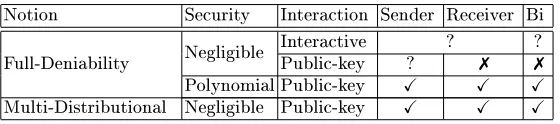
Notion Security Interaction Sender Receiver Bi
Full-Deniability Negligible InteractivePublic-key ? ? 7 ?7
Polynomial Public-key X X X
Multi-Distributional Negligible Public-key X X X
Table 1. The current state of the art for deniable encryption. The rst column distinguishes between fully-deniable schemes and schemes with multi-distributional deniability. The Sender/Receiver/Bi columns contains X if any construction is known; a 7 indicates an impossibility result; a ? marks a question that is still open.
Our work leaves a number of interesting open problems.
2. Our lower bounds do not apply to sender-deniable public-key encryption. Is it possible to construct sender-deniable public-key encryption with better than polynomial security?
3. Our lower bounds do not apply to interactive encryption schemes. Is it possible to construct deniable encryption schemes with better than polynomial security when arbitrary interaction is allowed?
4. There is a gap between our upper and lower bounds of at least a factor κ. Since κitself is typically,
for practical purposes, a rather large number (multi-distributional schemes are not simple objects on themselves), this gap is important in practice. What are the tight bounds on the security of a deniable public-key encryption scheme? We conjecture that the bound is in the order of σ−1.
Non-committing encryption: Canetti, Feige, Goldreich and Naor introduced the notion of a non-committing cryptosystem, which is similar to the notion of a bi-deniable cryptosystem, but it is only required that the faking can be done by a simulator. This simulator is allowed to use public keys with a dierent distribu-tion than those in the protocol. This is needed when showing adaptive security in simuladistribu-tion-based models. It is known [CFGN96] how to implement non-committing encryption with negligible security. Several im-provements over the original scheme (both in terms of eciency and assumptions) have been published in [Bea97,DN00,KO04,GWZ09,CDSMW09].
In [Nie02] it was shown that non-interactive non-committing encryption is impossible. This does not imply the negative result we are proving here, as receiver-deniable public-key encryption does not imply non-committing encryption. In non-committing encryption both sides have to be faked. In receiver-deniable encryption, only the receiver has to be faked. In this sense non-committing encryption is a stronger notion than receiver-deniable encryption. But, in fact, the notions are incomparable, as receiver-deniable encryption on other axes is stronger than non-committing encryption. As an example, it can be shown that if a public-key encryption scheme is receiver-deniable, then the parallel composition of the scheme where the same public key is used to encrypt many massages is also receiver-deniable. This is a property which non-committing encryption provably does not have. And, in fact, this self composition property is crucial in the proof of our lower bound. Also, the result in [Nie02] addresses the case of perfect non-committing encryption (the real-world and the simulated real-world must be indistinguishable). We are interested in the exact level of security which can be obtained i.e., given a public-key encryption scheme with a certain secret-key length, how deniable can the scheme be?
Structure: In Section 2 we formally dene the dierent avors of deniable public-key encryption. In Section 3 we show that receiver-deniability is maintained under parallel self-composition with at most a linear security loss. We use that fact to derive our lower bounds giving us the impossibility result of fully-receiver deniable encryption. Finally, section 4 contains our results on poly-deniable encryption schemes.
2 Deniable Public-Key Encryption
In this section we dene three dierent notions of deniable public-key encryption schemes. These notions correspond respectively to an adversary with the ability to coerce the receiver, the sender or both parties simultaneously. We model coercion by letting the adversary request the secret information used in the encryption scheme by the coerceable parties. Deniability is obtained by letting the coerceable parties supply fake secret information.
Basic Scheme. All schemes are dened based on the following denition of a standard public-key encryption scheme consisting of three probabilistic polynomial-time algorithms(G,E,D):
G(1κ)generates a key-pair(pk, sk), wherepkis the public key,skis the secret key andκis the security parameter. Note that we consider skto be the randomness used inG(1κ).
Epk(m;r)generates a ciphertextcwhich is an encryption under the public keypkof messagem∈ {0,1}` using randomnessr. We sometimes write Epk(m)to make the randomness be implicit.
Let negl : N → R+ be a negligible function. For all notions dened below we require correctness, i.e., we require that Pr[Dsk(Epk(m)) = m] > 1−negl(κ), and IND-CPA security i.e., we require that ∀ PPT
(A1, A2),∃negl(·):
Pr[(pk, sk)←G(1κ),(m0, m1,st)←A1(pk),
c=Epk(mb), b0←A2(c,st) :b=b0]<1/2 + negl(κ).
Multi-distributional Encryption. We dene a general form of deniable public-key encryption called multi-distributional deniable key encryption. Such a scheme essentially consists of two standard public-key schemes sharing a common decryption algorithm.
The honest scheme(G,E,D)does not provide deniability in itself.
The fakeable scheme (GF,EF,D) provides deniability in the sense that, for a ciphertext c fake secret
information can be generated. The faked secret information will makec appear as an encryption of any
chosen messagem0in the honest scheme. How this is done depends on the notion of deniability as dened
below.
For a multi-distributional deniable public-key encryption scheme to be correct we require standard correctness of all public-key schemes(G0,E0,D)whereG0∈ {G,GF} andE0∈ {E,EF}.
The idea behind having two dierent schemes is to use the fakeable scheme to encrypt a message mon
which the parties would like to have deniability. When coerced the parties simply claim that they used the honest scheme to encrypt the fake messagem0. This approach has two disadvantages. First, the parties must
decide beforehand whether they later want to deny. Secondly, is the question of why a coercer should believe the parties, when they claim to have used the honest scheme. Note that we cannot guarantee deniability, if the coercer insists on getting the secret information used in the faking process.
Fully-deniable Encryption. An important special case of multi-distributional deniable public-key encryp-tion is fully-deniable public-key encrypencryp-tion (or just deniable public-key encrypencryp-tion). This noencryp-tion addresses the disadvantages of multi-distributional encryption mentioned above. For a fully-deniable public-key encryption scheme we have that(G,E,D) = (GF,EF,D), that is there are no special faking key generation and encryption
algorithms. We will often omit the prex `fully' for simplicity.
Receiver-Deniability. A multi-distributional receiver-deniable public-key encryption scheme consists of ve probabilistic polynomial-time algorithms(G,GF,E,D,FR). Here(G,E,D)is the honest scheme and(GF,E,D)
is the fakeable scheme. Notice that the honest and fakeable encryption algorithm are the same since faking is only done on the receiver's side. The faking algorithmFR is dened as follows:
For (pk, sk)←GF(1κ)and c←Epk(m),FR(sk, c, m0)generates an alternative secret key sk0 such that
Dsk0(c) =m0.
Sender-Deniability. A multi-distributional sender-deniable public-key encryption scheme consists of ve probabilistic polynomial-time algorithms(G,E,EF,D,FS). Here(G,E,D)is the honest scheme and(G,EF,D)
is the fakeable scheme. The faking algorithmFS is dened as follows:
FS(pk, m, r, m0)generates alternative randomnessr0 such thatEFpk(m;r) =Epk(m0;r0).
Bi-Deniability. We assume here to be in a setting where receiver and sender have individual faking al-gorithms. This models the fact that, after an initial stage where the parties can agree on which message to fake to, the sender and the receiver cannot communicate over a channel that is not controlled by the adversaryotherwise they could be using this channel to communicate the messagemin the rst place.
A multi-distributional bi-deniable public-key encryption scheme consists of seven probabilistic polynomial-time algorithms(G,GF,E,EF,D,FR,FS). The faking algorithmsFRandFS are dened similar to the
For(pk, sk)←GF(1κ)andc←EFpk(m),FR(sk, c, m0)generates an alternative secret keysk0 such that
Dsk0(c) =m0.
FS(pk, m, r, m0)generates alternative randomnessr0 such thatEFpk(m;r) =Epk(m0;r0).
2.1 Security Notions
The security notions of the three schemes above, are dened in terms of the following experiments performed with an adversaryA= (A1, A2), wherem, m0∈ {0,1}`.
Honest Game (Receiver) Faking Game (Receiver)
(pk, sk)←G(1κ) (pk, sk)←G
F(1κ)
(m, m0,st)←A1(pk) (m, m0,st)←A1(pk)
c←Epk(m0;r) c←Epk(m;r)
sk0 ←FR(sk, c, m0)
b←A2(st, c, sk) b←A2(st, c, sk0) Honest Game (Sender) Faking Game (Sender)
(pk, sk)←G(1κ) (pk, sk)←G(1κ)
(m, m0,st)←A
1(pk) (m, m0,st)←A1(pk)
c←Epk(m0;r) c←EFpk(m;r)
r0 ←FS(pk, m, r, m0)
b←A2(st, c, r) b←A2(st, c, r0) Honest Game (Bi) Faking Game (Bi)
(pk, sk)←G(1κ) (pk, sk)←GF(1κ)
(m, m0,st)←A1(pk) (m, m0,st)←A1(pk)
c←Epk(m0;r) c←EFpk(m;r)
sk0 ←F
R(sk, c, m0)
r0 ←FS(pk, m, r, m0)
b←A2(st, c, sk, r) b←A2(st, c, sk0, r0)
Let hA(κ) and fA(κ)be the random variables describing b when running the honest game and faking game respectively with security parameterκ. The advantage of Ais
AdvA(κ) =|hA(κ)−fA(κ)|.
We say that a scheme is (receiver/sender/bi)-deniable if AdvA is negligible in κ for any ecient A. Let
ε:N→R+. We say that a scheme isε-(receiver/sender/bi)-deniable ifAdvA(κ)≤ε(κ) + negl(κ).
2.2 Full Bi-Deniablity implies Full Sender/Receiver-Deniability
Any fully bi-deniable scheme can trivially be turned into both a receiver-deniable and a sender-deniable scheme. On the surface this seems obvious, if both parties can fake then they should be able to fake individ-ually as well. Surprisingly, however, this conclusion cannot be drawn in the multi-distributional settingin [OPW11] the authors show that in this setting bi-deniability does imply sender deniability but not receiver deniability. As stated in Lemma 1 similar subtleties do not arise in the fully-deniable case. A proof of this can be found in Appendix A.
Lemma 1. If(G,E,D,FR,FS)is a fullyε-bi-deniable encryption scheme, then(G,E,D,FS)is a fullyε
3 Impossibility of Fully Receiver/Bi-Deniable Encryption
In this section we prove the impossibility of fully receiver-deniable and fully bi-deniable public-key encryption with better than inverse polynomial security. Since, by Lemma 1, any fully bi-deniable public-key encryption scheme is also a fully receiver-deniable public-key encryption scheme, it is sucient to prove impossibility of fully receiver-deniable public-key encryption. It turns out that the impossibility follows readily from the fact that full receiver-deniability is preserved under parallel self-composition with only a linear security loss. We will use a slightly modied denition of receiver-deniability. Recall that in the denition from section 2 the faking algorithmFR is invoked as FR(sk, c, m0), especially it is not given the sender's randomness r.
In this section we will allow FR to have access to r, that isFR is invoked as FR(sk, m, r, m0). Since we are
proving an impossibility result, this does not weaken the result.
3.1 Security of Parallel Self-Composition
Let (G,E,D,FR) be any receiver-deniable public-key cryptosystem. Let n: N→ Nbe a polynomial in the
security parameterκ. We dene the parallel self-composition(Gn,En,Dn,FRn)as follows:
Gn(1κ) =G(1κ)
Enpk(m1, . . . , mn;r1, . . . , rn) = (Epk(m1;r1), . . . ,Epk(mn;rn)) Dnsk(c1, . . . , cn) = (Dsk(c1), . . . ,Dsk(cn))
FRn(sk,(m1, . . . , mn),(r1, . . . , rn),(m01, . . . , m0n)) =sk0 , wheresk0=sk,ski←FR(ski−1, mi, ri, m0i)fori= 1, . . . , n andskn =sk0.
Lemma 2. If(G,E,D,FR)is ε-receiver-deniable, then (Gn,En,Dn,FRn)isnε-receiver-deniable.
Proof. Let An = (An1,An2) be any probabilistic polynomial-time attacker against (Gn,En,Dn,FRn). For
h = 1, . . . , n we construct from An a probabilistic polynomial-time attacker Ah = (Ah,1,Ah,2) against
(G,E,D,FR). We can then describe the advantage ofAn in terms of the advantages of Ah forh= 1, . . . , n. Since, by assumption on(G,E,D,FR), we have a bound on the advantage of eachAh, this gives us the bound on the advantage ofAn. The attackerAh runs as follows:
1. Ah,1: Receivespk.
2. Ah,1: Inputpk toAn1 and run A n
1 to obtain(m1, . . . , mn),(m01, . . . , m0n)and statestAn. 3. Ah,1: Fori= 1, . . . , h−1, sampleci ←Epk(m0i).
4. Ah,1: Output(mh, m0h, stAh)wherestAh = ((m1, . . . , mn),(m
0
1, . . . , m0n),stAn,(c1, . . . , ch−1)). 5. Ah,2: Receive(stAh, c, sk). Letch=candskh=sk.
6. Ah,2: Fori=h+ 1, . . . , n, sampleci←Epk(mi;ri)andski ←FR(ski−1, mi, ri, m0i). 7. Ah,2: Input(stAn,(c1, . . . , cn), skn)toAn and run it to obtain a bitb∈ {0,1}. 8. Ah,2: Outputb.
Let b0h be the distribution of the bit b output by Ah when run in the honest game and let b1h be the distribution of the bitb output byAhwhen run in the faking game.
When Ah is run in the honest game, then skn is computed from an honest secret key skh as ski ← FR(ski−1, mi, ri, m0i) fori =h+ 1, . . . , n. When Ah is run in the faking game, then skn is computed from an honest secret key skh−1 as ski ← FR(ski−1, mi, ri, m0i) for i = h, . . . , n, where the rst computation
skh←FR(skh−1, mh, rh, m0h)is performed by the faking game beforeskhis input toAh. It follows that when
Ah is run in the honest game and Ah+1 is run in the faking game, the values input to An have identical distributions, so b1
h = b0h−1. Let AdvAh denote the advantage of Ah against (G,E,D,FR) and AdvAn be the advantage of An against (Gn,En,Dn,FRn). We then have by denition AdvAh(κ) = |b
0
Notice that Lemma 2 means that a faked secret keyskn, resulting fromFRn, must somehow remember the
faking of each ciphertext involved in the process. In other wordsskn must not only fake a single ciphertext, it must ensure that every ciphertextci decrypts to the faked messagem0i with high probability. To see why consider the ecient adversaryAof the receiver-deniable game against(Gn,En,Dn,FRn)that simply outputs
b= 1ifm0i=Dsk(ci)for alli= 1, . . . , n andb= 0otherwise. By correctness of the encryption scheme and by Lemma 2 the above property ofskn becomes clear.
Letsbe a bit string of lengthn. In the proof of the following theorem we use this property to show how
to associate each bit ofswith a faking of a ciphertext and thus how to storesin the memory of the faked
secret keyskn. The impossibility result arises from the fact that this can be done even for randomslonger thanskn.
3.2 Lower Bound
We here show a lower bound on ε in an ε-receiver-deniable encryption scheme. This bound immediately
gives that one cannot obtain better than polynomial security. The bound is stated formally in the following theorem:
Theorem 1. Let(G,E,D,FR)beε-receiver deniable, and letσbe an upper bound on the length of the secret
keys of(G,E,D,FR), including the faked ones. Thenε≥ 12(σ+ 1)−1−negl(κ).
Proof. We reach our bound via impossibility of compressing uniformly random data. Let n = σ+ 1. We
can assume that(G,E,D,FR)can encrypt at least one bit, so(Gn,En,Dn,FRn)can encryptn-bit messages.
Furthermore(Gn,En,Dn,FRn)isnε-receiver-deniable.
Consider the following communication protocol parametrized by κ. Here is how the sender works:
1. Sample (pk, sk)←Gn(1κ).
2. Sample uniformly random m0← {0,1}n and letm= 0n. 3. Sample c←Enpk(m;r).
4. Letsk0 ←FRn(sk, m, r, m0).
5. Send(c, sk0).
On receiving(c, sk0)the receiver outputsm00=Dnsk0(c).
To bound the probability that this protocol fails i.e., that m00 6= m0, consider the following adversary
A = (A1,A2) for the receiver-deniable security games against (Gn,En,Dn,FRn). On input pk A1 outputs
(m, m0,st), where the messagesmandm0 are sampled as in step 2 of the sender algorithm above. The state
st is set to be m0. On input (st, c, sk0) A
2 computesDnsk0(c) = m00 and outputs 1 if m00 = m0 =st and 0 otherwise. Now notice that steps 1-4 of the sender algorithm above correspond to the rst four steps of the receiver-deniable faking game againstA. That is the probability that the communication protocol fails i.e.,
that m00 6= m0, is exactly the same as A2 outputting 0 in the faking game. In the honest game we have by correctness of(Gn,En,Dn,FRn) that A2 only outputs 0 with negligible probability. Thus bynε-receiver deniability we have Pr [m006=m0] ≤ nε(κ) + negl(κ). We later use this bound on the correctness of the
communication protocol to derive our bound, but rst we transform the protocol a bit.
For each κ, letrκ be the value which minimizes the probability that m00 6=m0 when cκ =Epk(0n;rκ). Consider then the following non-uniform communication protocol parametrized byκ. Here is how the sender
works:
1. Sample (pk, sk)←G(1κ). 2. Sample m0← {0,1}n. 3. Letsk0 ←FR(sk,0n, rκ, m0). 4. Sendsk0.
of uniformly random data it follows thatPr [m00=m0]≤2σ−n = 2−1, as the protocol sends onlysk0, which
is at mostσbits long and becausem0 is uniformly random andn=σ+ 1bits long. Combining these bounds
we get thatε(κ)≥1 2(σ+ 1)
−1−negl(κ). ut
In words, this bound says that any public-key cryptosystem withσ-bit keys can be be at most 1 2(σ+1)
−1 -receiver-deniable. Thus to get negligible receiver-deniability keys must be superpolynomial in size. This however would contradict the key generation algorithm being polynomial-time as required by our denition of a public-key cryptosystem.
4 From Multi-Distributional To Poly Deniability
We now give explicit constructions of poly-(sender/receiver/bi)-deniable public-key encryption schemes from any multi-distributional (sender/reciever/bi)-deniable public-key encryption scheme respectively. As in [CDNO97,OPW11], the basic idea in all these constructions is to encrypt a message bitbby rst writing
it as b = Ln
i=1bi for random bi's, and then encrypting each bi independently using randomly either the honest or the fakeable encryption scheme. To fake we just have to identify an index j where the fakeable
scheme was used and use the corresponding faking algorithm. This is no problem for sender and receiver deniablility since in those cases whoever is running the faking algorithm knows exactly on which indices the fakeable scheme was used. The bi-deniable case however is more challenging because sender and receiver must agree on an index j where they both used the fakeable scheme. As discussed in the introduction, a
dierent solution for this problem was hinted in [OPW11]. All the constructions are for bit encryption: for longer plaintext space one can simply run the scheme in parallel.
In the following subsections we will need two technical lemmas which we state here. Let a randomized encoding E be a randomized function from {0,1}to {0,1}n. Consider the following game
a(A, E)between
a randomized encodingE and an adversaryA(an interactive Turing machine):
1. RunAto make it output a bitb∈ {0,1}.
2. Sample (b1, . . . , bn)←E(b).
3. Input(b1, . . . , bn)toAand run it to produce a guess g∈ {0,1}. 4. Output g.
We dene the advantage ofAin distinguishing two randomized encodingsE0andE1to beAdvA(E0, E1) =
|Pr [a(A, E0) = 0]−Pr [a(A, E1) = 0]|. Notice that if we xb, then E0(b)andE1(b)are random variables, making the statistical distance between them well-dened. Let σb denote the statistical distance between
E0(b)andE1(b)and letσ(E0, E1) = max(σ0, σ1).
Lemma 3. It holds for all adversaries A and all randomized encodings E0 and E1 that AdvA(E0, E1) ≤
σ(E0, E1).
Lemma 4. Let s= 1,2, . . . be a parameter. LetN :N→N, whereNs=N(s)is the number of samples at settings. For each s, let
Ds=
−p with probability q q with probability p
0 with probability 1−p−q ,
wherepandqmight be functions ofs. LetXs,1, . . . , Xs,Ns beNs i.i.d. variables, distributed according toDs. Let Xs=PNi=1s Xs,i and letSs= Pr [Xs∈[0,12)]. Then
Ss≤
1
p
pq(p+q)Ns
p2+q2
p+q +
1
2√2π
.
4.1 Poly-Sender-Deniability
As a warm up we show that a multi-distributional sender-deniable scheme implies a poly-sender-deniable scheme. From a scheme(G,E,EF,D,FS)we produce a scheme (G0,E0,D0,FS0) which encrypts a single bitb.
The produced scheme is basically the Parity Scheme of [CDNO97] only whereas our scheme is based on a multi-distributional sender-deniable scheme, the scheme in [CDNO97] is based on a so-called translucent set. Key Generation G0(1κ): Output(pk, sk)←G(1κ).
EncryptionE0pk(b): Sample a uniformly random index j ∈ {0, . . . , n} so thatj is even forb= 0 and odd
forb= 1. Fori= 1, . . . ndo the following.
1. Fori≤j sampleci←EFpk(1;ri). 2. Fori > j sampleci←Epk(0;ri). Output C= (ci)ni=1.
Decryption D0sk(C): ParseCas (ci)ni=1. Computebi=Dsk(ci)fori= 1, . . . , n and outputb=Lni=1bi. Fake FS0(pk, b,(j,(ri)i=1n ), b0): Ifb=b0 output(j,(ri)ni=1). Otherwise letrj0 =FS(pk,1, rj,0)andj0=j−1.
Let allr0
i=ri fori6=j and output(j0,(ri0)ni=1).
Theorem 2. If (G,E,EF,D,FS) is multi-distributional sender-deniable, then (G0,E0,D0,FS0) is 4/n
-sender-deniable.
Proof. Correctness and semantic security is obvious. To prove poly-sender-deniability we rst consider the following hybrid gameH1.
H1 proceeds exactly as the faking game for sender-deniability only it modies the faking algorithmFS0
by simply sampling rj0 as randomness for the honest encryption algorithm E, and replaces the ciphertext
C = (ci)ni=1 with C0 = (c0i) n
i=1 where c0j = Epk(0;r0j) and c0i = ci for all i 6= j. Notice that the H1 only changes the distribution ofr0j andc0j, the distribution of all other inputs to the adversary remains the same.
In other words distinguishing the two games comes down to distinguishing an honest encryption of 0 from
an encryption faked to an honest encryption of 0. Thus by the multi-distributional sender-deniability of (G,E,EF,D,FS)the advantage of any adversary in distinguishing the two games will be negligible inκ.
Now consider another hybrid game H2. H2 proceeds exactly as the honest game for sender-deniability except that it modies the encryption algorithmE0by pickingjin the following way: rst it picks a uniformly
random index i ∈ {0, . . . , n} such that i is odd for b = 0 and even forb = 1 (i.e., the opposite of how E0 picks j) and then sets j = i−1. Notice now that H2 outputs exactly the same as H1 to the adversary only the output is generated in a slightly dierent order. I.e., H1 and H2 are perfectly indistinguishable. However sinceH2proceeds exactly as the honest game, except that it picks j from a dierent distribution, distinguishingH2 from the honest game comes down to distinguishing the two dierent distributions ofj.
In order to utilize Lemma 3 we can view these distributions as randomized encodings. Let us denote by
E0 and E1 the encodings that encodes a bitbas j 1's followed by n−j 0's. For E0 j is sampled as in the honest game where the adversary outputs b and for E1 j is sampled as in the hybrid game H2 where the adversary outputsb. If j =−1 in the hybrid gameE1 will encode this as a special string, say a0 followed byn−1 1's. First notice that forb = 0both games samplej uniformly random in{0,2,4, . . . , n−1}, i.e., σ0 = 0. However for b = 1 the honest game samples j uniformly random in {1,3,5, . . . , n} whereas H2 samples uniformly random in{−1,1,3, . . . , n−2}. Thus clearlyσ1= 4/n.
Now by Lemma 3 we have that any adversary has advantage at most4/nin distinguishing the honest game
fromH2. By the above hybrid argument it follows that any adversary has advantage at most4/n+ negl(κ) in distinguishing the honest game from the faking game. I.e.,(G,E,EF,D,FS)is4/n-deniable. ut
4.2 Poly-Receiver-Deniability
We show that a multi-distributional receiver-deniable scheme implies a poly-receiver-deniable scheme. From a scheme(G,GF,E,D,FR)we produce a scheme(G0,E0,D0,FR0)which encrypts a single bitb.
Key generation G0(1κ): For i = 1, . . . , n sample uniformly random bits a
i ∈ {0,1} and then sample
EncryptionE0P K(b): Parse P K as (pki)ni=1. Fori = 1, . . . , n−1, sample bi uniformly at random and let
bn=b⊕L
n−1
i bi, computeci←Epki(bi)and outputC= (ci) n i=1.
Decryption D0SK(C): Parse SK as (ski, ai)ni=1 and C as (ci)ni=1. Compute bi =Dski(ci)for i = 1, . . . , n and outputb=Ln
i=1bi.
Fake FR0(SK, C, b0): Ifb0 =D0SK(C)outputSK. Otherwise parseSK as(ski, ai)ni=1andC as(ci)ni=1. Pick a uniformly random index ifor whichai= 1, computebi =Dski(ci)and letsk
0
i=FR(ski, ci,1−bi)and
a0i= 0. For allj 6=i, letsk0j=skj anda0j =aj. OutputSK0= (skj0, a0j)nj=1.
If κ is they key length of the underlying scheme then the above scheme has keys of length nκ. The
following result then implies that one can build a1/n-receiver deniable scheme with keys of sizeσ=O(n2κ). Theorem 3. If(G,GF,E,D,FR)is multi-distributional receiver-deniable, then(G0,E0,D0,FR0)is(n−1)−1/2
-receiver-deniable.
Proof. In the following we assume for simplicity thatnis odd, a similar analysis can be made in the case ofn
even. Correctness and semantic security is obvious. Using a hybrid argument, the distinguishing probability of any poly-time adversary against the above scheme is negligible close to the best distinguishing advantage between the two randomized encodingE0 andE1dened as follows:
1. E0(b) = (b1, . . . , bn), where the bi ∈ {0,1} are uniformly random and independent except that b =
Ln
i=1bi.
2. E1(b) = (b1, . . . , bn) is sampled as follows. First sampleb0i ∈ {0,1} as in E0(b⊕1). Then, ifPib0i = 0, let(b1, . . . , bn) = (b01, . . . , bn0). Otherwise, pick a uniformly random j∈ {1, . . . , n} for which b0j = 1 and then letbj = 0and letbi=b0i fori6=j.
The event P
ib
0
i = 0 happens with negligible probability, so we can analyze under the assumption that this does not happen. In that case the bits bn and b0n can be computed as bn = b⊕L
n−1
i=1 bi respectively
b0n = b⊕
Ln−1
i=1 b0i. So, one can distinguish D0(b) = (b1, . . . , bn−1) and D1(b) = (b01, . . . , b0n−1) with the same advantage as one can distinguishE0(b)andE1(b). The distribution D0(b)consists ofn−1 uniformly random bits. The distribution D1(b) consists of n−1 uniformly random bits, where we ipped a random occurence of 1 to 0. For b ∈ {0,1}n−1, let #
1(b) = Pni=1−1bi be the number of 1's in the vector and let
#0(b) =n−1−#1(b)be the number of 0's. By the symmetry of the distributions, it is easy to see that one can distinguish #1(D0(b))and #1(D1(b)) with the same advantage as one can distinguish D0(b) and
D1(b). Since #1(D0(b))is binomially distributed with expectation n−21 and#1(D1(b)) = #1(D0(b))−1, it follows that an optimal distinguisher for#1(D0(b))and#1(D1(b))is to guess0if#1(D)≥ n−22 and guess
1otherwise, as this is a maximum likelyhood distinguisher. The advantage of this distinguisher is Adv = 1
2 Pr
#1(D0(b))≥
n−2
2
−Pr
#1(D1(b))≥
n−2
2 =1 2 Pr
#1(D0(b))≥
n−2
2
−Pr
#1(D0(b))≥
n−2
2 + 1
=1 2Pr
#1(D0(b))∈
n
−2 2 ,
n−2
2 + 1
.
From #1(D0(b)) = (n−1)−#0(D0(b)), we get that 2#1(D0(b)) = #1(D0(b)) + (n−1)−#0(D0(b)), so
#1(D0(b)) = n−21+12(#1(D0(b))−#0(D0(b))), and it follows that
Adv = 1 2Pr
1
2(#1(D0(b))−#0(D0(b)))∈
−1 2, 1 2 = 1 2Pr 1
2#1(D0(b))− 1
2#0(D0(b))∈
0,1
2
.
The last equality follows fromnbeing odd. Consider then Lemma 4, with p=q= 21 andNs=s−1. The variableXsin the premise then has exactly the same distribution as 12#1(D0(b))−12#0(D0(b))whens=n. Pluggingp=q=12andNs=n−1into Lemma 4 we get thatPr [12#1(D0(b))−12#0(D0(b))∈[0,12)]≤√s2−1.
4.3 Poly-Bi-Deniability
We show that a multi-distributional bi-deniable scheme implies a poly-bi-deniable scheme. From a scheme
(G,GF,E,EF,D,FS,FR)we produce a scheme (G0,E0,D0,FS0,FR0)which encrypts a single bit.
Key generation G0(1κ): For i = 1, . . . , n2 sample random bits ai ∈ {0,1} and then sample (pki, ski) ← Gai(1κ), where G0 = G and G1 = G
F. Sample the ai's independently with Pr [ai= 0] = 1/n. Output
(P K, SK) = ((pki)n
2
i=1,(ski, ai)n
2
i=1). EncryptionE0P K(b): ParseP K as (pki)n
2
i=1. Fori= 1, . . . , n2
1. Sample uniformly randombi ∈R{0,1} andmi∈R{0,1}κ such thatb=Ln
2
i=1bi. 2. Computeci←Ebpkii(m
0
i, ri), where m0i=bimi (0mi = 0κ and1mi=mi),E0=EandE1=EF.
Output C= (ci)n
2
i=1.
Decryption D0SK(C): ParseSK as (ski, ai)n
2
i=1 andC as (ci)n
2
i=1. Fori= 1, . . . , n2, computem0i=Dsk(ci) and letb0i = 1ifm0i6= 0andb0i = 0ifm0i= 0. Outputb=Ln2
i=1b
0
i. Fake (sender) FS0(P K, b,(ri, mi, bi)n
2
i=1, b0): Ifb=b0output(ri, mi, bi)n
2
i=1. Otherwise parseP Kas(pki)n
2
i=1. Let m0 = min{m0
i =bimi|i ∈ {1, . . . , n2} ∧m0i 6= 0κ} and pick the unique (ewnp.) index k for which
m0k=bkmk =m0 (notice this impliesbk = 1). I.e.,k is the index of theci containing the smallest non-zero plaintext. The minimum is taken according to lexicographic order. Then letrk0 =FS(pkk, m0k, rk,0κ),
m0
k=mk andb0k= 0. For allj6=k, letr0j=rj,m0j =mj andb0j =bj. Output (rj, mj, bj)n
2
j=1. Fake (receiver) FR0(SK, C, b0): If D0SK(C) = b0 output SK. Otherwise parse SK as (ski, ai)n
2
i=1 and C as (ci)n
2
i=1 and compute m0i = Dsk(ci). Let m0 = min{m0i|i ∈ {1, . . . , n2} ∧m0i 6= 0κ} and pick the unique (ewnp.) indexkfor whichm0k=m0. I.e.,kis the index of theci containing the smallest non-zero plaintext. The minimum is taken according to lexicographic order. Ifak= 0, then give up. Ifak = 1, then letsk0k=FR(skk, ck,0κ)anda0k = 0. For allj6=k, letskj0 =skjanda0j =aj. OutputSK0= (skj0, a0j)n
2
j=1. Theorem 4. If (G,GF,E,EF,D,FS,FR) is multi-distributional bi-deniable, then (G0,E0,D0,FS0,FR0) is
O(n−1/2)-bi-deniable.
Proof. Correctness follows by observing thatb0i=bi unless one of the uniformly randomκ-bit messagesmi happens to be0κ, which is a negligible event. Semantic security is obvious. As for bi-deniability, by a hybrid
argument similar to that in the proofs of Thm. 2 and Thm. 3, distinguishing the honest and faking game comes down to distinguishing the following two random encodings of a bitb.
1. E0(b) = (b1, . . . , bn2, a1, . . . , an2), where the bi ∈ {0,1} are sampled uniformly at random except that
Ln2
i=1bi=band theai∈ {0,1} are sampled such thatPr[ai= 0] = 1/n.
2. E1(b) = (b1, . . . , bn2, a1, . . . , an2)is sampled as follows. First sampleb0i, a0i∈ {0,1}as inE0(b⊕1). Then,
if P
ib
0
i = 0, let (b1, . . . , bn2) = (b01, . . . , b0n2). Otherwise, pick a uniformly random k ∈ {1, . . . , n2} for
whichb0k = 1and then letbk = 0and letbk =b0k fori6=k. Ifa0k = 1letak= 0and let ai =a0i fori6=k. It happens that a0k= 0 with probability1/n, so by adding 1/n to the bound in the end, we can analyse
under the assumption that a0k = 1. In that case we can describe E1(b) as above, except that we pick k uniformly at random among the i's for which b0i = 1and ai0 = 1. Then we setbk = 0and ak = 0and set
bi6=k=b0iand ai6=k=a0i.
Given a vector v = (b1, . . . , bn2, a1, . . . , an2), we let #00(v)be the number of i's for which bi =ai = 0
and we let#11(v)be the number ofi's for whichbi=ai = 1. For simplicity we assume thatb is uniformly random, such thatb1, . . . , bn2 is uniform in{0,1}n
2
. Deriving the same bound for xed b= 0 andb= 1 is
straight-forward. Letp=2n1 be the probability thatai= 0andbi= 0. Letq= n2n−1 be the probability that
ai = 1andbi = 1. The expected value of #00(E0(b))ispn2. The expected value of#11(E0(b))is qn2, and
that its advantage is 1
2Pr [q#00(E0(b))−p#11(E1(b))∈[0, 1
2)]. Using Lemma 4 as in the proof of Thm. 3, withs=n,Ns=s2 and thepandq dened above, it follows that
Pr [q#00(E0(b))−p#11(E1(b))∈[0,
1 2)]≤
1
√ s
√
2 +√1 π
.
The theorem then follows from√2 +√1
π ≤2. ut
Acknowledgements: the authors would like to thank Adam O'Neill, Chris Peikert and Brent Waters for sharing with us an early copy of [OPW11].
References
[Bea97] Donald Beaver. Plug and play encryption. In CRYPTO, pages 7589, 1997.
[CDNO97] Ran Canetti, Cynthia Dwork, Moni Naor, and Rafail Ostrovsky. Deniable encryption. In CRYPTO, pages 90104, 1997.
[CDSMW09] Seung Geol Choi, Dana Dachman-Soled, Tal Malkin, and Hoeteck Wee. Improved non-committing encryption with applications to adaptively secure protocols. In ASIACRYPT, pages 287302, 2009. [CFGN96] Ran Canetti, Uriel Feige, Oded Goldreich, and Moni Naor. Adaptively secure multi-party computation.
In STOC, pages 639648, 1996.
[DF11] Markus Dürmuth and David Mandell Freeman. Deniable encryption with negligible detection probabil-ity: An interactive construction. In EUROCRYPT, pages 610626, 2011.
[DN00] Ivan Damgård and Jesper Buus Nielsen. Improved non-committing encryption schemes based on a general complexity assumption. In CRYPTO, pages 432450, 2000.
[GWZ09] Juan A. Garay, Daniel Wichs, and Hong-Sheng Zhou. Somewhat non-committing encryption and ecient adaptively secure oblivious transfer. In CRYPTO, pages 505523, 2009.
[KO04] Jonathan Katz and Rafail Ostrovsky. Round-optimal secure two-party computation. In CRYPTO, pages 335354, 2004.
[KS10] V. Yu. Korolev and I. G. Shevtsova. On the upper bound for the absolute constant in the BerryEsseen inequality. Theory of Probability and its Applications, 54(4):638658, 2010.
[Nie02] Jesper Buus Nielsen. Separating random oracle proofs from complexity theoretic proofs: The non-committing encryption case. In CRYPTO, pages 111126, 2002.
[OPW11] Adam O'Neill, Chris Peikert, and Brent Waters. Bi-deniable public-key encryption. In CRYPTO, pages 525542, 2011.
A Bi-Deniability implies Receiver- and Sender-Deniability
We here give a full proof of Lemma 1:
Lemma 1. If(G,E,D,FR,FS)is a fullε-bi-deniable encryption scheme, then(G,E,D,FS)is a fullε
-sender-deniable encryption scheme and(G,E,D,FR)is a full ε-receiver-deniable encryption scheme.
Proof.
Sender-deniability
Assume that there exists an attackerA = (A1,A2)attacker breaking the sender-deniability property having advantage greater than ε. We will construct an attackerB = (B1,B2)breaking the bi-deniability property having advantage greater thanε.
The attacker B runs as follows:
1. B1: Receivepk.
2. B1: Inputpk toA1 and runA1to obtainm,m0 and stA. 3. B1: Output(m, m0, stB)wherestB = (m, m0, stA).
6. B2: Outputb.
In the aboveBis simply forwarding all its inputs toAexcept for the secret key which is simply ignored.
Therefore the advantage ofBwill be exactly the same as the advantage forA. Since the advantage ofA is
greater thanε, so is the advantage ofB. This is in contradiction to the assumption that(G,E,D,FR,FS)is
ε-bi-deniable.
Receiver-deniability
Now we assume an adversary A breaking the receiver-deniability property, from this we construct an
adversary breaking the bi-deniability property. We do exactly as in the sender-deniable case, that is, simply forwarding all inputs and outputs received. The only dierence is that instead of invoking A2 with r or r0 we useskorsk0. Once again it should be clear that the distinguishing probabilities are the same. ut
B On the probability that a sum of i.i.d.s hits close to the expected value
In this section we derive a parametrized version of the central limit theorem for us in bounding the advantage of our adversaries. We look at a special cases of getting a bound on the probability mass in a small interval close to the expected value.
Lemma 2. Let s= 1,2, . . . be a parameter. LetN :N→N, whereNs=N(s)is the number of samples at setting s. For each s, let Ds be a distribution with nite support and with E[Ds] = 0. Let σ(s) =
p
E[D2 s] be the standard deviation of Ds, and let ρ =E[|Ds|3] be the third moment of Ds. Let Xs,1, . . . , Xs,N(s) be
N(s) i.i.d. variables, each distributed according toDs. Let Xs=P Ns
i=1Xs,i. LetI :N→R specify a series
of intervalsIs= [0, I(s)). Let Ss= Pr [Xs∈Is]. Then
Ss≤
1
σs
√ Ns
I(s)
√
2π+ ρs
σ2 s
.
Proof. LetYs=Xs/Ns, letZs= Ys
√
Ns
σs , and letFs(x) = Pr [Zs≤x]be the cumulative distribution function ofZs. Then by the Berry-Esseen inequality we have that
|Fs(x)−Φ(x)| ≤
ρs
2σ3 s
√ Ns
,
whereΦ(x)is the cumulative distribution function of the standard normal distributionN(0,1).[KS10] Note
thatXs∈IsiσsNsZs/
√
Ns∈Is iZs∈
h
0,σI(s)
s √ Ns i . So,
Pr [Xs∈Is]−Pr
N(0,1)∈
0, I(s) σs √ Ns
≤ ρs σ3
s
√ Ns
.
Since the density function ofN(0,1) is upper bounded by √1
2π it follows that
Pr
N(0,1)∈
0, I(s) σs
√ Ns
≤ √1
2π I(s)
σs
√ Ns
.
So,
Ss≤
1
√
2π I(s)
σs
√ Ns
+ ρs
σ3 s
√ Ns
B.1 A Special Case
We now look at the special case that
Ds=
−p with probability q q with probability p
0 with probability 1−p−q ,
wherepandqmight be functions ofs, and Is=12. We have that
E[Ds] =q(−p) +pq+ (1−p−q)0 = 0,
σs2=qp2+pq2=pq(p+q), ρs=qp3+pq3=pq(p2+q2).
So,
ρs
σ2 s
= p
2+q2
p+q ,
Is
√
2π =
1
2√2π , ρs
σ2 s
+√Is
2π =
p2+q2
p+q +
1
2√2π ,
1
σs
√ Ns
= p 1
pq(p+q)Ns
,
Ss≤
1
p
pq(p+q)Ns
p2+q2
p+q +
1
2√2π
.
Lemma 3. Let s= 1,2, . . . be a parameter. LetN :N→N, whereNs=N(s)is the number of samples at settings. For each s, let
Ds=
−p with probability q q with probability p
0 with probability 1−p−q ,
wherepandqmight be functions ofs. LetXs,1, . . . , Xs,N(s)beN(s)i.i.d. variables, each distributed according toDs. LetXs=P
Ns
i=1Xs,i. Let Ss= Pr [Xs∈[0,12]]. Then
Ss≤
1
p
pq(p+q)Ns
p2+q2
p+q +
1
2√2π
.
Ifp=q= 12 and Ns=s, then
1
p
pq(p+q)Ns
p2+q2
p+q +
1
2√2π
= p 1
1 2 1 2( 1 2+ 1 2)s
1
2 2+1
2 2 1 2 + 1 2 + 1 2√2π
= √2 s
1
2 + 1
2√2π
Ifp= s2s−1 andq=2s1 andNs=s2, then
1
p
pq(p+q)Ns
p2+q2
p+q +
1
2√2π
=q 1
s−1 2s
1 2s(
s−1 2s +
1 2s)Ns
s−1 2s
2
+2s12
s−1 2s +
1 2s
+ 1 2√2π
!
≤q1
1 8ss2
1
4 1 2
+ 1 2√2π
=√1 s
√
8
1 2 +
1
2√2π
=√1 s
√
2 + √1 π