Cryptographic Schemes Based on the
ASASA
Structure: Black-box,
White-box, and Public-key
Alex Biryukov, Charles Bouillaguet, and Dmitry Khovratovich
University of Luxembourg and University of Lille
{alex.biryukov,dmitry.khovratovich}@uni.lu,[email protected]
Abstract. In this paper we pick up an old challenge to design public key or white-box constructions from symmetric cipher components. We design several encryption schemes based on theASASAstructure ranging from fast and generic symmetric ciphers to compact public key and white-box constructions based on generic affine transformations combined with specially designed low degree non-linear layers. While explaining our design process we show several instructive attacks on the weaker variants of our schemes.
Keywords: ASASA, multivariate cryptography, white-box cryptography, cryptanalysis, algebraic, sym-metric.
1 Introduction
Since the development of public key cryptography in the late 1970’s it has been an open challenge to diversify the set of problems on which such primitives were built as well as to find faster alternatives, since most public key schemes were several orders of magnitude slower than symmetric ones. One of the directions was to design public key schemes from symmetric components. As public key encryption requires trapdoors, they have been hidden in secret affine layers [59], field representations [67], biased S-boxes and round functions [71, 74, 83], structure of connection polynomials in stream ciphers [2]; however most of these schemes were broken [45, 52, 66, 80]. We recall that a typical symmetric cipher is built from layers of affine transformations (A) and S-boxes (S), a design principle dating back to Shannon [77]. It is thus natural to see what designs can be made from such components. Whereas the classical cipher AES-128 consists of 10 rounds with 19 layers in total [65], it is striking that a lot of effort has been put into designing public-key schemes with only 3 layers, using the ASA (affine-substitution-affine) structure. This has indeed been the mainstream of what is known as multivariate cryptography. However, in this case, the non-linear layer is usually an ad-hoc monolithic function over the full state, as opposed to an array of independent S-boxes.
It has been known that the schemeSASASwith two affine and three nonlinear layers is vulnerable to a structural attack if the nonlinear layer consists of several independent S-boxes [13]. The scheme ASA, though secure for a random monolithic S-box, has been shown weak in concrete multivariate proposals. In the seemingly unrelated area of white-box cryptography the ASA approach to build obfuscated lookup tables failed multiple times. This suggests exploring the shortest scheme unbroken so far — the ASASA construction with injective S-boxes — in the application to symmetric (black-box), public-key, and white-box cryptography. Let us overview the related areas.
Retrospective of multivariate cryptography
The idea of multivariate cryptography dates back to the Shannon’s idea [77] that recovering the secrets in any cryptographic scheme could be reduced to solving particular systems of (boolean) equations. Since nearly all forms of cryptology implicitly rely on the hardness of solving some kind of equation systems, then it must be possible to design cryptographic schemes thatexplicitly rely on the hardness of this problem. In multivariate public-key schemes, the public-key itself is a system of polynomial equations in several variables. It is well-known that solving such systems is NP-hard, even when the polynomials are quadratic (hence the name of the MQ problem, which stands for Multivariate Quadratic polynomial systems). An additional advantage of the MQ cryptosystems is that they seem invulnerable to quantum algorithms and hence are candidates for Post-Quantum cryptography.
public-key scheme explicitly based on the hardness of MQ. It made it to the general crypto community a few years later under the name C∗ [59].
Several years later, in 1995, Patarin [66] found a devastating attack against C∗, allowing to decrypt and to forge signatures very efficiently. Thereafter many multivariate scheme have been proposed (we counted at least 20 of them), including a plethora of bogus and vainly complicated proposal with a short lifespan. A few constructions stood out and received more attention than the others because of their simplicity and their elegance, such as HFE [67], SFLASH [68] and UOV [51].
However, the practical break of the first HFE challenge, supposed to offer 80 bits of security in 2003 [38], and the demise of SFLASH in 2007 [33], just after the NESSIE consortium proposed it to be standardized, shattered the hopes and trust of the cryptographic community at large in multivariate cryptography. This brought the multivariate fashion to a stop.
The main problem in multivariate crypto is that the selection of candidates for the nonlinear layer S is scarce (we will discuss this in Section 4). What remains usually has so strong a structure within, that it can be detected and exploited even in the presence of unknownAlayers. A very recent example is the promising matrix-based scheme ABC [78] and its subsequent analysis in [63]. In the last years, a few researchers started designing public-key schemes based on the hardness ofrandom instances of the MQ problem [47, 75], though no drop-in replacement for conventional public-key encryption schemes has been proposed. Still, they are promising because there is a concensus that random instances are hard, and all known algorithms are exponential and impractical on random systems.
This overview clearly indicates the need of a larger structure for multivariate cryptosystems, and suggests truly random polynomials in this context, which we use in our schemes.
Retrospective of white-box cryptography
In a parallel development a notion ofwhite-box cryptography (WBC) has been introduced in [24]. The initial motivation was to embed symmetric secret keys into the implementation of popular standards like AES or DES in a way that binds the attacker to the specific implementation for DRM purposes. Several proposals have been made [22, 23] with the main idea to obfuscate key-dependent parts of the cipher and publish them as lookup tables, so that the entire encryption routine becomes just a sequence of table lookups. The obfuscation constitutes of wrapping the nonlinear transformation (S) with random affine transformations (A) so that the affine layers would cancel each other after composition.
As a result, the lookup tables are just instantiations of the ASA structure. Moreover, since the nonlinear layers of AES and DES consist of independent S-boxes, the resulting ASAstructure is very weak and can be attacked by a number of methods [11, 43, 62, 64]. As demonstrated by Biryukov and Shamir [13], even as large structure as SASAS is weak if the S-layers consist of smaller S-boxes. Surprisingly overlooked by the designers of white-box schemes, the generic attack [13] exploits multiset and differential properties of SASAS and applies to all the published white-box proposals so far. It appears that the mainstream ciphers are just poor choice for white-box implementations due to high diffusion properties and the way how the key is injected.
To formalize the problem, two notions have been suggested [76,81]. Theweak white-box imple-mentation of a cryptographic primitive protects the key and its derivatives i.e. aims to prevent the
key-recovery attack. This ensures that unauthorized users can not obtain any compact information (e.g. the key or the set of subkeys) to decrypt the protected content.
The strong white-box implementation of a primitive protects from the plaintext-recovery attack, i.e. does not allow to decrypt given the encryption routine with the embedded key. Such an implementation may replace the public-key cryptosystems in many applications, in particular if it is based on an existing symmetric cipher and is reasonably fast for a legitimate user. The existing white-box implementations of AES and DES [23,24] do not comply with in this notion, since they are easily invertible, which is strikingly different from the black-box implementations of these ciphers. So far the only proposed candidate is the pairing-based obfuscator scheme with poor performance [76].
Our contributions
We continue to explore the design space of compact schemes built from layers of affine mappings and S-boxes. We first note that there is no known generic attack on the 5-layered ASASA scheme with injective S-boxes in the flavour of [13], which makes the ASASAstructure a promising framework for future white-box, black-box, and public-key schemes. Based on this principle, we propose and analyze the following constructions in this paper:
• Two public-key / strong white-box variants of the ASASA symmetric scheme: one is based on Daemen’s quadratic S-boxes [26] (previously used in various hash functions) and another based on random expanding S-boxes. (Section 2). We explore standard cryptanalytic attacks such as differential, linear and others, the recent decomposition attacks [40, 41], and a new interpolation attack on weakened variants of our schemes (Section 3). We demonstrate that our set of parameters offers a comfortable security margin with respect to the existing attacks.
• A concrete instantiation for a fast symmetric ASASA-based blockcipher with secret S-boxes and affine layers and comparable with AES in it’s encryption/decryption speed (Section 4).
• A concept ofmemory-hard white-box implementation for a symmetric blockcipher and a concrete family of ciphers with tunable memory requirements (Section 5). It prevents key recovery and requires the adversary to share the entire set of lookup tables to allow an unauthorized user to decrypt. Therefore, the cipher solves the problem ofweak white-box implementation.
Related work. The idea of theASASA structure dates back to [69]. The scheme named “2R” (which stands for “2 Rounds”) had non-injective S-boxes and was subsequently broken in [9,39,82]. Modified versions of 2R have been later attacked by decomposition algorithms [40, 41], and no countermeasure has been suggested. The idea of adding perturbation, or noise, to the output of ASA-type MQ-scheme has been proposed by Patarin et al. in the design of C+∗ [70], and later by Ding [30]. It is also related to the LWE (Learning with Error) problem, extensively discussed in [73] and used in an MQ-based hybrid encryption scheme [47].
In Section 5 we design a weak white-box-ready blockcipher out of small components, i.e. block ciphers with small block size. Ciphers with small blocks were also explored within shuffling-based schemes by Granboulan and Pornin [44], and later by Hoang et al. [46]. Ciphers working on arbitrary (possibly small) domains are often offered for format-preserving encryption [5].
2 Asymmetric ASASA schemes: strong white-box and public-key
The first ASASAcryptosystem, designed by Patarin and Goubin, was a public-key scheme with non-bijective S-boxes and was easily broken by Biham, exploiting this property in [9]. Shortly afterwards, Biryukov and Shamir explored multi-layer schemes with bijective S-boxes and demonstrated a generic attack on the structure SASAS with two affine layers [13]. The outer S-boxes are recovered with a variant of the Square attack, whereas the inner affine layers are peeled off with linear algebra methods. It was clearly demonstrated that these properties disappear in larger schemes, and no attack onASASA or other larger structures has been proposed since.
2.1 Strong white-box security
We start with the notion of the strong white-box security that summarizes the discussion in [81].
Definition 1. Let the pair of algorithms (E, D) be a private-key encryption scheme, which takes key
K as parameter. Let OEK be a function that computes EK. We say that OEK is a secure strong
white-box implementation for EK if it is computationally hard to obtain D0 equivalent to DK given
full access to OEK.
In other words, an adversary should be unable to decrypt given the white-box implementationOEK
of EK. This notion closely resembles the definition of a trapdoor permutation [50] used to construct
2.2 Outline
We propose several asymmetric instantiations of the ASASA structure, which may serve both in the white-box and public-key setting. We have not found any reasonable use for lookup tables in this framework1 and hence look for polynomial-based S-boxes. In order to keep the reasonable size of
the description, we restrict to polynomials of degree two over some finite field, so that the resulting scheme has degree four. This approach brings us to the area ofmultivariate cryptography, which aims to design cryptographic primitives based on multivariate polynomials over finite field.
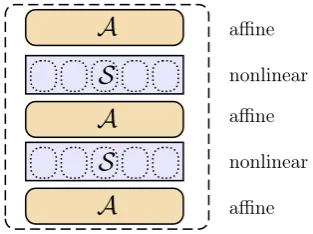
S
A
nonlinear
nonlinear affine
affine
S
A
affine
A
Fig. 1. TheASASA structure: two nonlinear layers surrounded by affine layers
Let us introduce the following notations. The public key/white-box implementation is exposed as a set of polynomials b, which is constructed out of the following composition:
b=U ◦a2◦ T ◦a1◦ S, (1)
where a1,a2 are nonlinear transformations, andU,T,S are affine transformations.
There have been many proposals for nonlinear layers in the ASA structure, and various attacks exploited these choices. Most attacks are not evidently translated into degree 4, as they compute, e.g., differentials of the public key, which are linear functions the ASA case. The notable exception is the decomposition attack [40, 41], that will be discussed in Section 2.3.
We offer two fresh ideas for the nonlinear layers in ASASA. The first candidate is the so called χ-function. It derives from invertible cellular automata and was brought into symmetric cryptography by Daemen. To the best of our knowledge, it has never been used in multivariate cryptography.
The second candidate is a set of random injective S-boxes of degree 2. Since the families of low degree permutations are small and do not absorb much randomness, we propose to use expanding S-boxes, which can be key-dependent. Having the expansion rate of 2, it is rather easy to obtain injective transformations and still keep them quadratic2.
Limitations for expanding schemes. Whatever construction is used, an expanding scheme has a clear limitation in the public-key and white-box setting. It implies that only a tiny subset of potential ciphertexts is decryptable, which makes the encryption and decryption process non-interchangeable. As a result, the expanding scheme can be used for encryption only and can not produce signatures. Also in the white-box context, it can not be used for decrypting the content. On the other hand, it can still be used to ensure tamper-resistance of software [61].
2.3 Defeating decomposition algorithm with perturbations
The authors of recently published decomposition algorithms [40, 41] claim to break ASASA schemes with quadratic nonlinear layers with complexity O(n9), where n is the number of variables. The
1 So far all attempts to hide a trapdoor in lookup table-based designs failed. We investigated this problem and conjecture
that such scheme just does not exist, at least given the state-of-the-art in the design of preimage-resistant functions.
decomposition problem is formulated as follows: given a set of polynomials h = (h1, . . . , hu) over
polynomial ring K[x1, . . . , xn] (K denoting an arbitrary field) find any f = (f1, . . . , fu) and g =
(g1, . . . , gn) over K[x1, . . . , xn] whose composition is equal toh:
h= (h1, . . . , hu) = (f1(g1, . . . , gn), . . . , fu(g1, . . . , gn)).
and their degree being smaller than h.
In the context of theASASAstructure with quadratic S-boxes, the setsf andg, that are produced by a decomposition algorithm, are linearly equivalent to the internal ASA structures. This does not fully constitute a break, since the adversary still needs to invert bothASAconstructions. The proposed algorithms also have not been applied to the parameters and fields that we choose. Nevertheless, it is desirable to find some countermeasure.
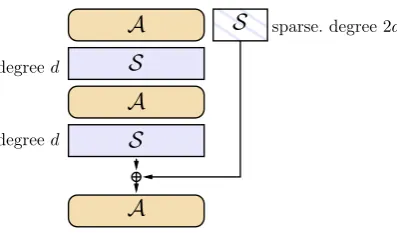
Our idea is to introduce some perturbation just after the secondSlayer in the form of several key-dependent secret polynomials of degree 4 (Figure 2). A similar approach has been used by Ding in his modification of C∗ [30] and HFE [31], and by Bringer et al. [19] in their modification of the traceable block cipher. In some cases (notably HFE), the “perturbation” would be identified and removed [34], thanks to a differential attack exploiting properties of the non-linear transformations. The use of perturbation polynomials has been also linked to the LWE (Learning with Error) framework in [47], but the full application of LWE to multivariate cryptography is still to be explored in the future.
Denoting the perturbation polynomials as another nonlinear transformation ap we obtain the
modified public key bp:
bp=U ◦[ap+ (a2◦ T ◦a1◦ S)], (2)
so
bp(x) =b(x) +Uap(x).
Hence the perturbation polynomials are mixed by the last affine transformation and spread over the public key. The encryption process remains exactly the same, while for decryption we have to guess the values of these polynomials. Suppose that we work over F2so that ap is sparse and contains
only w polynomials. Let each polynomial be non-zero in q ·2n points. Then the noise on average
consists of qwbit flips, and we guess their positions after about qww
attempts. For instance,ap with
8 non-zero polynomials of weight ≈2n−1 requires 26 trial decryptions on average.
We distinguish true plaintexts from false ones either by recomputing the perturbation polynomials or by using expanding S-boxes so that noisy bits prohibit inversion. Padding the plaintexts with zero bits also helps but disallows turning encryption to decryption. The position of noisy bits does not matter much, since it would be concealed by the affine transformation. However, if we filter out noise with expanding S-boxes, it makes sense to spread the noisy bits so that an S-box can still be inverted in the presence of noise.
A S
S A
A
S sparse. degree2d
degreed
degreed
2.4 χ-scheme
Our first idea was to build the nonlinear transformation out of a popular quadratic S-boxχ[26, Section 6.6.2], which has been used in hash the functions Panama [27], RadioGatun [7], Keccak [8]. The transformation χ can be defined for every odd lengthk= 2t+ 1 and has the following features:
– It has degree 2 in the forward direction, but degree (t+ 1) in the backward direction. – It can be efficiently inverted for every size (Appendix D).
– Its differential and linear properties have been widely studied [26].
The S-box χ of lengthk is defined as follows:
χ(x0, x1, x2, . . . , xk−1) = (y0, y1, y2, . . . , yk−1),
where
yi=xi⊕xi+1xi+2⊕xi+2,
and indices are computed modulok.
Regardless of theχ length (and hence the size of the S-box), we can formulate properties of the whole scheme and its features:
1. For the standard block size of 128 bits, we get approximately (since the S-box size might not divide 128) 27 input variables. Thus each output coordinate ofb is a polynomial of degree 4 of 27
variables, has about 247
≈ 224.5 terms, so the full scheme description is about 224.5+7−3 = 228.5
bytes, or 300 MBytes.
2. The private key size is much more compact, and is dominated by three matrices with 214bits each
(hence 213 bytes in total). If the matrices are deterministically produced out of some secret key
(e.g., 128-bit), the description is even smaller.
3. The inverse polynomial of our schemes has degree (t+ 1)2 for S-boxes of size 2t+ 1.
The S-box size (length of χ) has negligible effect on the performance because of the internal structure of χ and its inverse (see Appendix). Hence it only affects the security of the scheme. We choose a single S-box a of length 127, so that its inverse has degree 64, and will show later that a system with small S-boxes is insecure.
In order to defeat decomposition algorithms and hide the ASASA structure we suggest using perturbation polynomials. More precisely, we propose 24 random polynomials of degree 4 for the perturbation layer ap. We pad each plaintext with 8 zero bits, so that for each guess the probability
to fit the padding is 2−8. As a result, we get 216 candidate plaintexts, and then check if we correctly
computed the noise. This filters out all wrong plaintexts with probability 1−2−8.
Overall security. We have found a number of attacks on theχ-scheme in different variants (Section 3), so it appears that its algebraic structure yields it vulnerable. Nevertheless, the variant with added perturbation remains unbroken, and we offer it as cryptanalytic challenge, but not for the practical use. We expect the perturbation theory to develop in the near future, which would suggest a more secure set of parameters.
2.5 Scheme with expanding S-boxes
This variant provides a more compact description of the scheme since we may switch to a larger field. First, we want the nonlinear layer be a degree-2 polynomial over Fq, q > 2, and define the linear
(affine) transformations over the same field. Though a few examples of bijective transformations of degree 2 over a field not equal toF2 exist [55], they appear to be vulnerable to Groebner basis attacks
in our own experiments. As a solution, we suggest expanding S-boxes, whose output is twice as big as the input. It is rather easy to design injective S-boxes of degree 2 with this property. Indeed, a random function with expansion rate 2 has no collisions with probability around 1/2, and hence there are enough injective transformations of the desired form.
– Input length 128 bits (32 variables), output length 512 bits (128 variables); – All polynomials and affine transformations are defined overF16;
– S-boxes map 16 bits to 32 bits and hence are described by 8 degree-2 polynomials overF16 of four
variables. The inverse is computed with lookup tables of size 216.
– The first nonlinear layer has 8 S-boxes and doubles the state size to 256 bits. The second layer has 16 S-boxes and further doubles to 512 bits. Accordingly, the affine transformationsS, T, U operate on 128-, 256-, and 512-bit states, respectively.
The output of the scheme is a set of 27 degree-4 polynomials over
F16over 32 input variables (each
variable is encoded with 4 bits). There are 245
≈216.5 possible terms, hence, taking 4-bit constants
into account, each polynomial is described by 220.5 bits, or 220.5+7−3 = 224.5 bytes, which is about 24
MBytes.
The private key is smaller: affine layers contain 27+7+1+ 26+6+1+ 25+5+1≈214.2 elements of
F16.
The 48 S-boxes are described as 25.5+3 polynomials of 21≈24.5 terms each, hence 213 elements, plus
a few noise polynomials. In total, the private key fits into 214 bytes.
We also suggest using perturbation polynomials here. Due to the large expansion rate, we can use rather dense perturbation layer ap and still ensure a unique decryption. We use two random
polynomials over F16 of degree four at each S-box, hence 32 polynomials in total. While decrypting
we face 162 = 28 options for each S-box output. As a result, the probability of having non-unique
decryption of the last S layer is 24·216+8−32= 2−4, and if this happens the next layer filters out wrong
candidates.
As we already mentioned, the expanding character of the scheme allows only public-key and white-box encryption, but not signature generation.
3 Security analysis of our white-box/public-key schemes
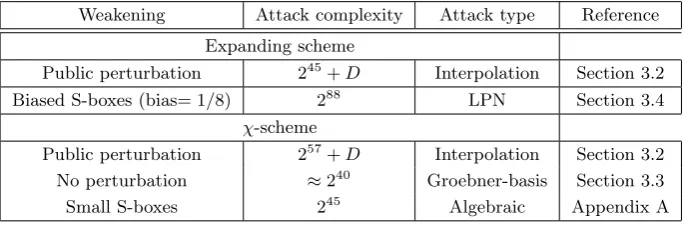
In this section we apply various attacks to weakened versions of our schemes, thus demonstrating the design rationale behind them. We demonstrate that the added perturbations are crucial in both schemes, and that they must be secret. We also show that S-boxes in the χ-scheme must be large, that linearity (in contrast to affinity) of Amay weaken the scheme, and that the expanding S-boxes should not be biased (these results are presented mainly in Appendix). Our attacks are summarized in Table 1.
These attacks allow us to evaluate the security margin of the unbroken variants of our schemes. Since only the perturbation protects the χ-scheme from a number of practical attacks, we conclude that it is rather fragile, but might become a good candidate for a strong white-box implementation when the complexity of generic algorithms applied to the perturbed version is better understood. In contrast, the expanding scheme appears to be more resistant to generic attacks, and we propose it as a ready-to-use public-key encryption scheme and a strong white-box implementation.
Weakening Attack complexity Attack type Reference
Expanding scheme
Public perturbation 245+D Interpolation Section 3.2
Biased S-boxes (bias= 1/8) 288 LPN Section 3.4 χ-scheme
Public perturbation 257+D Interpolation Section 3.2
No perturbation ≈240 Groebner-basis Section 3.3
Small S-boxes 245 Algebraic Appendix A
3.1 Generic attacks
Given the public-key of a multivariate scheme, an attacker may directly try to solve the multivariate polynomial equations using a generic algorithm. If the public-key is a vector of m polynomials in n over Fq, then a plaintext can always be found by exhaustive search in time O(qn). The other main
family of algorithms to solve systems of polynomial equations are Groebner-basis algorithms, such as Buchberger’s algorithm [20] and all its derivatives [36, 37].
Without going into details (the interested reader is referred to a standard textbook such as [25]), given a system of polynomial equations f1 = · · · = fm = 0 in x1, . . . , xn, a Groebner basis of the
ideal spanned by the fi’s is an equivalent system of equations with nice properties. If the system
admits a single solution (a1, . . . , an), then a Groebner basis is precisely the vector of polynomials:
x1−a1, . . . , xn−an. It follows that if a Groebner basis can be computed, then the system of equations
can be solved.
Groebner basis algorithms work by performingpolynomial elimination,i.e.,by trying to eliminate some terms by summing suitable multiples of other polynomials. The complexities of these algorithms are difficult to analyze [3, 4]. They are essentially exponential in the highest degree reached by the polynomials created and manipulated by the algorithms during their execution. On “generic” systems ofnequations innvariables, this degree is typicallyn. However, in some special cases it can be lower. For instance, the first HFE Challenge could be broken because in HFE, for some ranges of parameters, this degree was roughly O(logn).
3.2 Interpolation attack on the ASASA scheme with public perturbation polynomials
We stressed that the perturbation polynomials must be secret. A reader may wonder why this is required, since these polynomials are seemingly mixed by the last affine transformation U.
In this subsection we outline an attack that peels off the perturbation polynomials and recovers the core ASASA scheme in almost practical time. Suppose we work over a field F2 and the scheme
adds perturbation polynomials at r bit positions after the nonlinear transformation a2 (cf. Eq. (2)
and Figure 2), and the total number of variables in the scheme is n. Then we collectN plaintextsxi
such that
ap(xi) = 0.
Since polynomials of ap do not have any structure, finding a common zero is an NP-hard problem,
and we expect that 2r plaintexts must be tried to find a right one. Hence the naive complexity of this
step isN2r evaluations3 of a
p.
Then we evaluate the right plaintexts on the perturbed schemebp. Since ap is zero, we have
bp(xi) =U ◦a2◦ T ◦a1◦ S(xi).
Therefore, we know the evaluation of theASASAscheme without perturbations onN plaintexts. Since the scheme has degree 4, the polynomial coefficients can be recovered by the Lagrange interpolation. There are P4
i=0
n i
monomials of degree 4 or smaller, hence N must slightly exceed P4 i=0
n i
to allow for linear dependencies among plaintexts. For the typical value n = 27 we need about 225
right plaintexts to fully recover the core ASASA polynomials and then launch the decomposition attack. However, the interpolation itself is not a trivial procedure, since we deal with a multivariate function. Only recently an algorithm with complexity quadratic in the number of monomials has been proposed [1]. Equipped with it, we recover a single polynomial in 250 bit operations, and the entire
bp in 257 operations. In turn, 225 right plaintexts can be obtained for 16 noisy bits in 241 evaluations
of ap, and for 24 noisy bits – in 249 evaluations, which is close to 255 bit operations. Therefore, the
total complexity of recovering (x) is about 257 bit operations.
This attack clearly shows that the perturbation polynomials must not be public and should not have any structure that would allow the adversary to find their common zeros. We do not see how the attack can be applied to secret polynomials.
3.3 Algebraic attack on the plain χ-scheme
Althoughχ has been used successfully in the symmetric world, it turns out to be a complete disaster in a multivariate context. AnASAconstruction whereS=χ, withn= 127 variables overF2 is broken
in a few seconds by a direct Groebner basis computation. A two-layerASASAconstruction is not more secure, and can be broken in less than two hours using the implementation of the F4 algorithm of the MAGMA computer algebra system [18] (and 100Gbytes of RAM). This happens because a Groebner basis can be computed by manipulating polynomials of small, constant degree (typically 3 or 6).
Let us give some detailed explanation for the insecurity of theASAconstruction. We work within the polynomial ring R=F2[x0, . . . , xn−1], and we consider the ideal of R:
I =
f0, . . . , fn−1, x02−x0, . . . , xn−12−xn−1
wherefi =xi+xi+2+xi+1xi+2+ai (all indices are taken modulon), and where theai are constants.
Any solution (in the xi’s) making all the polynomials in I vanish simultaneously, is a solution of
χ(x1, . . . , xn) = (a0, . . . , an−1). Such a solution always exists, and is unique.
We will show that there are many linear polynomials in this ideal, and that they can be “easily” discovered (by manipulating small-degree polynomials). Indeed:
xi+1·fi−xi+2· xi+12−xi+1
+fi−1 = (xi−1+xi+1)−(ai−1+ai+1)
The expression on the left-hand side is a polynomial combination of elements ofI, therefore it belongs to I. As a consequence, the linear polynomial on the right-hand side can be found inside I after performing a few steps of polynomial elimination on polynomials of degree less than 3.
After thesenlinear relations have been found, another few steps of polynomial elimination allows all the variables but one to disappear. This shows that a Groebner basis of the idealIcan be computed in polynomial time. Now, performing a (random) linear change of coordinate in I, or replacing the generators of I by (random) linear combinations thereof does not change this fact. As a conclusion, theASA construction, whereS is the χ-function, falls victim to a direct algebraic attack, by running any Groebner basis algorithm on the equations defining the “white-box”.
This reasoning extends to the ASASA construction where both non-linear layers are χ (however, this time the degree is 6). It is an open question of how much the added perturbation slows the Groebner-basis attacks (our implementation does not break the selected noise parameters in reasonable time).
3.4 Attack on the expanding scheme with biased S-boxes
If S-box output bits are biased, an attack exploiting this bias can be applied. The last affine trans-formation can be viewed as affine overF2, so the further analysis without loss of generality applies to
any field of characteristic two.
We target a single biased bitbafter the second layer of expanding S-boxes: the probabilityP[b= 1] of its equality to 1 is equal top6= 1
2. Ify is a ciphertext, then following previous notations, the biased
bit is theb-th component of U−1·y. In other terms, ifudenotes theb-th line ofU−1, thenhu, yi=b.
Now, assume we collect a large number (say N) of ciphertexts. We stack them vertically into a matrix C, which thus has N rows. Let us also assume that b is biased towards zero. Then we have the “noisy linear system”:
u·C=e,
whereeis a vector of i.i.d. random variables following the Bernoulli distribution with meanp. Recov-eringu is exactly an instance of theLearning Parity with Noise (LPN) problem.
The best known algorithms to solveLPNare variants of the BKW algorithm [15], whose complexity is of order O 2n/logn
. The only actual implementation (along with algorithmic improvements) is described in [56], and some more tweaks are given in [6]. The actual complexities of these algorithms depend on the bias (their efficiency decreases when the bias gets closer to zero).
tradeoffs, plus algorithmic improvements, allow [6] to conclude that the same problem can be solved in 259 bits memory and less than 2100 bits operations. If 280 bits of memory are available, then the
running-time could be decreased to 288 bit operations.
This beats more naive approaches, such as, for instance, enumerating all the possible sparse pos-sibilities for the first n components of e, and solving the corresponding linear system for each trial. The above instance would require more than 2120 operations to be solved using the naive approach.
Of course, the attack has to be repeated for each row of U−1, and possibly twice for each row
(assuming that the targeted bit is biased towards zero, or towards one). Note that the above esti-mates are extremely pessimistic; in random expanding S-boxes of degree 2, the biases we observed experimentally are much lower than what was used above (we observed P[b= 1]≈0.49).
AfterU is recovered, we can view the output of expanding S-boxes, and are likely to recover them by interpolation due to low degree.
4 Black-box ASASA schemes
Given rather low performance and large key size of the public-key ASASA schemes, a reader may wonder if significant performance increase can be achieved with lower security goals. We answer this question twofold. First, we propose a generic black-box symmetric cipher based on the five layerASASA. The cipher is expected to have a very fast software implementation thanks to vector instructions in modern processors. Secondly, we use a small version of this cipher as a building block in achieving weak white-box security (Section 5).
4.1 Design
We propose a symmetric cipher with a classical set of parameters, widely used in AES and other designs. It has a block of n = 128 bits with m = 8 bit S-boxes and a choice of key-sizes 128 – 256 bits. Let us outline specific parameters for linear and nonlinear layers.
Affine layers. A key-dependent n×n affine transformation can be produced out of the master key K by any secure key derivation function HK (for example a fast stream cipher, or a block cipher in
the counter mode (Appendix B)), and checking that the resultant matrix is invertible, this can be done in O(n3) steps, and we also generate an n-bit constant 4. The branch number of the matrix [28]
determines the minimum number of active S-boxes in a differential trail, and thus the upper bound on the trail probability. Since the matrix is random, we expect the branch number to be close to the maximum possible (the number of S-boxesn/mplus one). Note that for each affine layer a new matrix is generated.
Nonlinear layers. Typically, nonlinear layers of symmetric ciphers consist of several small S-boxes, which have a compact description [16, 28]. For the ASASA scheme we propose to use 32 randomly generated 8-bit invertible S-boxes, which are all different and key-dependent. We note that efficiency of generic attacks on the SASASstructure [13] increases if smaller S-boxes are used, and thus it may be interesting in the future to explore full block size non-linear layers, for which such attack would not work.
Large S-box alternatives. The choice for large block algorithmic S-boxes is surprisingly limited. Un-less the S-boxes are themselves multi-layer permutations (e.g., fixed-key ciphers), a compact descrip-tion is typically delivered in the algebraic form as a funcdescrip-tion over an appropriate finite field. The resulting permutation polynomials have become an active research topic in the recent years. The well known example is X2k+1
over F2n (scheme C* [59]); the more recent and interesting include
X2k
+X+a−l +X over F2n by Zeng et al. [84] (derived from Helleseth-Zinoviev polynomials)
4 Non-anonymous final version of this paper will link to implementations of our schemes and challenges gradually
and Xpk
−X+a
pn+1 2
+Xpk
+X over Fpn where p is odd [85]. Further nontrivial examples can
be found in [14, 21, 54, 55, 57]. It thus can be an interesting second challenge to break the symmetric ASASAscheme with known block-wide non-linear layers. Note however that fixed S-boxes do not offer implementation advantage and thus we would keep S-boxes secret and randomly generated in the main variant of our scheme.
Implementation. The combined SA transformations can be implemented quite cheaply. It is well known from, e.g., fast AES implementations, that a multiplication ofn-bit vector byn×n-bit matrix over F2 can be expressed as n XORs of n-bit vectors, and with table lookups — as n/16 XORs and
n/16 lookups in tables of size 216. Let’s consider the specific choice of n= 128 andm= 8 and assume
that SIMD 128-bit operations can be performed in a single clock cycle (this is a reasonable assumption when a cipher is used, e.g., in the CTR mode). Then we need 16 table lookups and 16 XORs for the layers: A, SA, SA, which gives us 48/16=3 lookups and 3 XORs per byte, which is probably faster than optimized software implementations of AES [49] (without the special AES instructions). Total memory requirement for such implementation is: 3·2m(n
m)
2 = 28·16·3·16≈196 Kbytes. The private
key size is even smaller: 14 KBytes (3 matrices of size 211 bytes and 32 S-boxes of 28 bytes each).
A byteslice implementation of the black-box ASASA in the CTR mode would require tables only 4 times as large as in AES, and would allow to work with a single table many times, so we do not expect cache problems on modern CPUs. We stress that such an implementation is a black-box, not a white-box implementation of a cipher, i.e. the lookup tables should not be available to the attacker.
4.2 Security analysis
Differential and linear attacks. We expect the secret linear layers to hide all differential [10] and linear [58] properties of the cipher, since it becomes impossible to figure out any high-probability differential or linear trail. It can be argued, however, that the existence of high-probability charac-teristics may lead to efficient distinguishers. For instance, Dunkelman and Keller showed in [35] that if for every α the differential probabilities {α → β} are much higher (or much lower) than for a random permutation, then this can be used as a distinguisher. The authors further suggested the parameter of effective linearity that essentially measures the average probability of the boomerang difference quartet (α, K) over all possible α, K and is supposed to take even unknown characteristics into account.
It is rather easy to show that only a tiny fraction of input differences may lead to high-probability differentials. Indeed, with probability 1−2(16−1)−64= 1−2−49at least 8 S-boxes at the first S layer are
active. The highest differential probability is then delivered by a trail that activates all S-boxes in the second S layer. In turn, the highest differential probability that we expect for every input difference α can be upper bounded by 2−5. Therefore, we expect that only 2−49 of all input differences yield
characteristics with probabilities higher than 2−5·24= 2−120.
There exist characteristics that activate 16 + 1 = 17 active S-boxes and probabilities of about 2−85 or slightly higher. They are even easy to find in the known-key setting. However, finding them
in the secret-key setting is likely to require a birthday-like approach to activate only a few S-boxes. This implies the complexity close to 260 to find such a characteristic, which puts the complexity of
the attack close to the exhaustive search.
Finally, we have not found any use for the efficient linearity parameter, as it seems to be difficult to estimate it for our construction. The authors of [35] did it for the 2-round Feistel scheme surrounded by Vaudenay’s decorrelation module [79], which should be compared to the SAS structure wrapped with A layers in our case. The latter problem is not only more difficult, but also would yield a random variable as the answer. Distinguishing whether this variable follows the distribution expected from the random permutation is a separate and challenging problem.
Algebraic attacks. We expect the random S-box of widthm to have the algebraic degree m−1 = 7. As a result, the entire scheme can be represented by a polynomial of degree 49 over F2. As observed
Therefore, an attacker can distinguish the ASASA construction from random given 249data and time.
However, this does not lead to the disclose of the plaintext.
Other attacks. The boomerang and impossible differential attack can be also of concern. We have tried basic and improved versions of these attacks, and in all cases the randomness of the affine layers prevented us from mounting an attack. However, it is possible to build boomerang quartets in the known-key setting by activating a single S-box at both sides of the boomerang. Whether such properties can be carried out to the secret-key setting is the object of the future research. Impossible differential attacks typically rely on truncated differentials with probability 1 which exist in some ciphers due to incomplete diffusion. Since in our case the random affine layers provide complete diffusion and since the entrance into and the exit from the scheme are both guarded by these affine layers, chosen plaintext attacks have little chance of predicting truncated values somewhere inside the scheme.
Our scheme should be more secure than a two-round Even-Mansour cipher [17], where the subkeys are simply xored to the internal state (as opposed to applying a full-blown secret affine transformation to the internal state). The recent attack on the 2-round Even-Mansour [32] explicitly requires the access to the internal permutation and thus can not be immediately used in our setting.
The meet-in-the-middle attacks [29, 48] do not apply to our scheme, because the amount of key material used to compute any matching variable is too large (several S-boxes and a large part of the affine transformation). The cube attacks do not apply, since there is no compact polynomial representation of the scheme.
Structural attack. Finally, we investigate the structural attack from [13]. We will see that even though it does not apply to the 128-bit ASASA cipher, it allows to bound the security level of schemes with smaller block, which are used in Section 5. First, we recall the main property preserved by the SASA structure with m-bit S-boxes:
Theorem 1 ( [13]). Let {x1, x2, . . . , x2m} be the inputs to the SASA structure such that the input bits to one S-box take all possible combinations whereas the other bits are constant. Then the XOR of all outputs is the all-zero bit vector:
M
i
SASA(xi) = (0,0, . . . ,0).
Now consider the input y to some m-bit S-box in the first S layer of the ASASA schemeE. It is an affine function of the scheme input y:
y=M ·x⊕c,
where M is an (m×n)-matrix andc is a constant. Let L be an (n×n)-matrix such that
M×L= M00 0· · · 0,
(3)
where M0 is a (m×m)- submatrix. If we apply E to L·x, then y depends only on the first m bits of x. Thus we compose inputs {x1, x2, . . . , x2m} as in Theorem 1, multiply them byL and apply E.
The output bits must sum to 0 bitwise. This property allows to recover the outer affine layer and eventually all the components of E. Equation (3) holds with probability 2−(n−m)m, which makes the
attack impractical for large n. However, for small n it might be efficient. Therefore, the maximum security level of the ASASA scheme with n variables and m-bit S-boxes does not exceed (n−m)m bits.
5 Proposal for weak white-box security: ASASA-based block cipher
5.1 Weak white-box security
Definition 2. Let the pair of algorithms (E, D) be a private-key encryption scheme, which takes key
K as a parameter. We callF(K) the equivalent key set for key K, if from any element from F(K) it is easy to get an algorithm equivalent to EK, i.e. there is an (efficient) algorithm
A(K)→ E0,
where E0 equivalent to EK.
Definition 3. The function OEK is a T-secure weak white-box implementation for EK if it is com-putationally hard to obtain K ∈F(K) of length less thanT given full access toOEK.
In other words, an adversary who gets a secure weak white-box implementation is unable to find out any compact (shorter than T) equivalent representation of it. In the practical sense, an adversary who wants to share a protected implementation of the encryption routine, would have to share the entire code. Such ciphers are motivated by DRM applications, which aim to prohibit the users of protected content from sharing the information needed to decrypt it. Clearly, in this context there is little practical difference between sharing the key and sharing, say, the set of subkeys as long as the other cipher operations are independent of the key. Therefore, naive methods of key protection, e.g. transforming it with a preimage-resistant hash function, would not prevent an attack. Ideally, the adversary would have to isolate and extract the entire decryption routine, which might be hard per se.
5.2 Weak white-box cipher proposal
In this section we propose a blockcipher family, which conforms to the weak white-box security notion, so that it is computationally infeasible to derive a key or any other compact secret information from the white-box implementation.
We further say that the white-box implementation is memory-hard if it requires a pre-specified and large enough amount of memory in the spirit of memory-hard key-derivation functions [72]. This concept is even stronger than the T-secure weak WB implementations, as an adversary is unable to reduce the implementation size at all and thus would have to publish the entire set of lookup tables. In contrast to earlier white-box designs, we offer a set of ciphers with a wide range of memory requirements.
Our memory-hard cipher consists of a number of smaller components, which are exposed as lookup tables in the white-box implementation. Each component is either a small-blockASASAcipher, adapted from the construction in Section 4, or just a single S-box. The S-boxes are minimum 8-bit wide to avoid equivalence problems [12], but 10-, and 12-bit ones are also used. All S-boxes and affine layers are derived in a deterministic way from the secret key. In fact, it is enough to have linear, not affine, layers, since the constant can be kept in the S-boxes. To estimate memory requirements, we assume for simplicity that each table output fits an integer number of bytes (e.g., 2 bytes for 10-bit S-boxes).
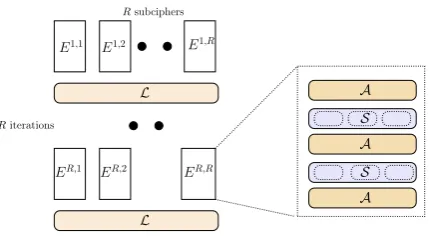
We propose the SPN structure for the cipher, i.e. we alternate layers of smaller ciphers (denote their number by R) with a public linear transformation L. Any transformation with good diffusion shall be fine. For the 64-bit block it could be the MixBytes transformation of Grøstl [42], and for the 128-bit block — two pairs of this transformation separated by shuffling the 32-bit subwords between the outputs. Recalling that AES can be partitioned into 5 rounds with 4 32-bit Super S-boxes in each, we propose R layers for similar security margin. The cipher’s pseudocode is as follows (Figure 3):
– RepeatR times;
• ApplyR parallel ASASA-based distinct blockciphers;
We outline specific parameters and memory requirements for 64- and 128-bit blockciphers in Table 2. The 16-bit S layer has two 8-bit S-boxes, the 18-bit – 8-bit and 10-bit S-boxes, the 20-bit – two 10-20-bit S-boxes, and the 24-20-bit – three 8-20-bit S-boxes. We see that whereas the black-box implementation is a few dozen KBytes, the white-box implementation can be made large enough in the range from 2 MBytes to several GBytes.
Rows Component type Components in row Security level
(bits) White-box memory Black-box memory 64-bit block
4 ASASA 4×(16-bit) 64 2MB 16 KB
4 ASASA 3×(18-bit) + 10-bit 64 9 MB 32 KB 128-bit block
8 ASASA 8×(16-bit) 64 8 MB 64 KB
8 ASASASA 8×(16-bit) 128 8 MB 96 KB
8 ASASA 6×(18-bit) + 2×(10-bit) 80 36 MB 130 KB 8 ASASA 24-bit + 6×(16-bit) +8-bit 64 384 MB 64 KB 8 ASASASA 24-bit + 6×(16-bit) +8-bit 128 384 MB 96 KB 6 ASASA 5×(24-bit) + 8-bit 128 1.4 GB 75 KB 5 ASASA 4×(28-bit) + (16-bit) 64 20 GB 85 KB 5 ASASASA 4×(28-bit) + (16-bit) 128 20 GB 130 KB
Table 2. Parameters and memory requirements of white-box and black-box implementations for the 128-bit blockcipher. We assume that n-bit component occupies dn
8e2
n bytes of memory in the
white-box implementation.
E1,1
L
Rsubciphers
Riterations
E1,2 E1,R
ER,1 ER,2 ER,R
L
A S A S A
Fig. 3. Blockcipher family for weak white-box security.
Security analysis. Our ASASA components have very small block and only a few S-boxes in the S layer. Some attacks that are infeasible on the 128-bit block, may have practical complexity on the 16-bit block. The best attack we could find was presented in Section 4.2 and has complexity 2(n−m)m
for m-bit S-boxes and the n-bit block. As a result, the 16-bitASASA components with 8-bit S-boxes have maximum security level of 64 bits, the 20-bit components — 100 bits, and 24-bit components with 8-bit S-boxes — 128 bits.
Acknowledgements
We thank Willi Meier for fruitful comments and the discussion about the results of this paper. We also thank anonymous reviewers for comments, which helped to improve the paper.
6 Conclusion
We have explored deeply the state of the art in black-box, white-box, and multivariate public key cryp-tography, and concluded that the ASASA structure is the minimal generic construction which is still unbroken. We constructed cipher candidates for all these settings. We designed two ASASA schemes for public-key cryptography based on multivariate polynomials. We showed how to avoid existing attacks on multivariate schemes, including the recent powerful decomposition algorithms by adding appropriate perturbation functions. In the traditional black-box setting we offered a cryptanalytic challenge of a fast cipher with small random S-boxes and random affine layers.
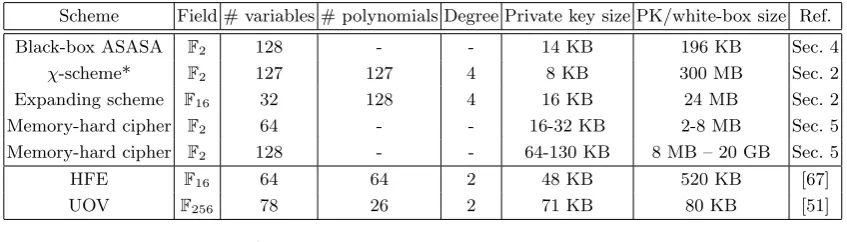
We proposed several solutions for white-box cryptography, both in weak and strong security no-tions. In the weak model, we designed a memory-hard cipher, which prohibits key extraction and requires an adversary to spend a large, pre-defined amount of memory. It is based on small ASASA components. We showed how our multivariate schemes can be used as strong white-box implementa-tions, as they are not invertible without the key and allow fast encryption and decryption for legiti-mate users. We compare the implementation size of our schemes with other unbroken MQ-systems in Table 3.
Our findings indicate a number of future research directions. First, it would be interesting to explore algorithmic large S-boxes in the black-box ASASA structure, e.g. instantiated with recently found permutation polynomials. Secondly, a theory of perturbation layers as a countermeasure to generic decomposition algorithms needs to be developed, possibly along the concept of LWE (Learning with Error). Thirdly, we suggest investigating the actual security level of small-block (16-,20-, 24-bit) ASASA schemes to figure out which components are suitable for weak white-box implementations. Finally, open question is to develop constructions with smaller descriptions (e.g., within 1 MByte), which are bijective, suitable for digital signatures, and allow strong white-box implementations.
Scheme Field # variables # polynomials Degree Private key size PK/white-box size Ref.
Black-box ASASA F2 128 - - 14 KB 196 KB Sec. 4
χ-scheme* F2 127 127 4 8 KB 300 MB Sec. 2
Expanding scheme F16 32 128 4 16 KB 24 MB Sec. 2
Memory-hard cipher F2 64 - - 16-32 KB 2-8 MB Sec. 5
Memory-hard cipher F2 128 - - 64-130 KB 8 MB – 20 GB Sec. 5
HFE F16 64 64 2 48 KB 520 KB [67]
UOV F256 78 26 2 71 KB 80 KB [51]
* — several variants broken in this paper.
Table 3.Our schemes in comparison, along with (presumably) secure parameters for UOV and HFE.
References
1. Frederik Armknecht, Claude Carlet, Philippe Gaborit, Simon K¨unzli, Willi Meier, and Olivier Ruatta. Efficient computation of algebraic immunity for algebraic and fast algebraic attacks. In EUROCRYPT’06, volume 4004 of
Lecture Notes in Computer Science, pages 147–164. Springer, 2006.
2. Jean-Philippe Aumasson, Matthieu Finiasz, Willi Meier, and Serge Vaudenay. Tcho: A hardware-oriented trapdoor cipher. InACISP’07, volume 4586 ofLecture Notes in Computer Science, pages 184–199. Springer, 2007.
4. Magali Bardet, Jean-Charles Faug`ere, and Bruno Salvy. On the complexity of Gr¨obner basis computation of semi-regular overdetermined algebraic equations. InProc. International Conference on Polynomial System Solving (ICPSS), pages 71–75, 2004.
5. Mihir Bellare, Thomas Ristenpart, Phillip Rogaway, and Till Stegers. Format-preserving encryption. In Selected Areas in Cryptography’09, volume 5867 ofLecture Notes in Computer Science, pages 295–312. Springer, 2009. 6. Daniel J. Bernstein and Tanja Lange. Never trust a bunny. InRFIDSec, volume 7739 ofLecture Notes in Computer
Science, pages 137–148. Springer, 2012.
7. Guido Bertoni, Joan Daemen, Michael Peeters, and Gilles Van Assche. RadioGatun, a belt-and-mill hash function, 2006. NIST Cryptographic Hash Workshop, available athttp://radiogatun.noekeon.org/.
8. Guido Bertoni, Joan Daemen, Michael Peeters, and Gilles Van Assche. The Keccak reference, version 3.0, 2011. http://keccak.noekeon.org/Keccak-reference-3.0.pdf.
9. Eli Biham. Cryptanalysis of Patarin’s 2-round public key system with S-Boxes (2R). InEUROCRYPT’00, volume 1807 ofLecture Notes in Computer Science, pages 408–416. Springer, 2000.
10. Eli Biham and Adi Shamir. Differential Cryptanalysis of the Data Encryption Standard. Springer, 1993.
11. Olivier Billet, Henri Gilbert, and Charaf Ech-Chatbi. Cryptanalysis of a white box AES implementation. InSelected Areas in Cryptography’04, volume 3357 ofLecture Notes in Computer Science, pages 227–240. Springer, 2004. 12. Alex Biryukov, Christophe De Canni`ere, An Braeken, and Bart Preneel. A toolbox for cryptanalysis: Linear and
affine equivalence algorithms. InEUROCRYPT’03, volume 2656 ofLecture Notes in Computer Science, pages 33–50. Springer, 2003.
13. Alex Biryukov and Adi Shamir. Structural cryptanalysis of SASAS. InEUROCRYPT’01, volume 2045 ofLecture Notes in Computer Science, pages 394–405. Springer, 2001.
14. A. Blokhuis, R.S. Coulter, M. Henderson, and C.M. O-Keefe. Permutations amongst the Dembowski-Ostrom poly-nomials. Finite Fields and Their Applications, pages 37–42, 2001.
15. Avrim Blum, Adam Kalai, and Hal Wasserman. Noise-tolerant learning, the parity problem, and the statistical query model. J. ACM, 50(4):506–519, 2003.
16. Andrey Bogdanov, Lars R. Knudsen, Gregor Leander, Christof Paar, Axel Poschmann, Matthew J. B. Robshaw, Yannick Seurin, and C. Vikkelsoe. PRESENT: An ultra-lightweight block cipher. In CHES’07, volume 4727 of
Lecture Notes in Computer Science, pages 450–466. Springer, 2007.
17. Andrey Bogdanov, Lars R. Knudsen, Gregor Leander, Fran¸cois-Xavier Standaert, John P. Steinberger, and Elmar Tischhauser. Key-alternating ciphers in a provable setting: Encryption using a small number of public permutations. InEUROCRYPT’12, volume 7237 ofLecture Notes in Computer Science, pages 45–62. Springer, 2012.
18. Wieb Bosma, John J. Cannon, and Catherine Playoust. The Magma Algebra System I: The User Language. J. Symb. Comput., 24(3/4):235–265, 1997.
19. Julien Bringer, Herv´e Chabanne, and Emmanuelle Dottax. White box cryptography: Another attempt. IACR Cryptology ePrint Archive, 2006. available athttp://eprint.iacr.org/2006/468.
20. Bruno Buchberger.Ein Algorithmus zum Auffinden der Basiselemente des Restklassenringes nach einem nulldimen-sionalen Polynomideal. PhD thesis, University of Innsbruck, 1965.
21. Xiwang Cao and Lei Hu. New methods for generating permutation polynomials over finite fields. Finite Fields and Their Applications, 17(6):493–503, 2011.
22. Vincent Carlier, Herv´e Chabanne, and Emmanuelle Dottax. Grey box implementation of block ciphers preserving the confidentiality of their design. IACR Cryptology ePrint Archive, 2004:188, 2004.
23. Stanley Chow, Philip A. Eisen, Harold Johnson, and Paul C. van Oorschot. White-box cryptography and an AES implementation. In Selected Areas in Cryptography’02, volume 2595 ofLecture Notes in Computer Science, pages 250–270. Springer, 2002.
24. Stanley Chow, Philip A. Eisen, Harold Johnson, and Paul C. van Oorschot. A white-box DES implementation for DRM applications. InDigital Rights Management Workshop, volume 2696 ofLecture Notes in Computer Science, pages 1–15. Springer, 2002.
25. David A. Cox, John Little, and Donal O’Shea. Ideals, Varieties, and Algorithms: An Introduction to Computational Algebraic Geometry and Commutative Algebra, (Undergraduate Texts in Mathematics). Springer-Verlag New York, Inc., Secaucus, NJ, USA, 1991.
26. Joan Daemen. Cipher and Hash Function Design Strategies based on linear and differential cryptanalysis. PhD thesis, Katholieke Universiteit Leuven, Leuven, Belgium, March 1995.
27. Joan Daemen and Craig S. K. Clapp. Fast hashing and stream encryption with PANAMA. InFSE’98, volume 1372 ofLecture Notes in Computer Science, pages 60–74. Springer, 1998.
28. Joan Daemen and Vincent Rijmen. The Design of Rijndael. AES — the Advanced Encryption Standard. Springer, 2002.
29. Whitfield Diffie and Martin Hellman. Special feature exhaustive cryptanalysis of the NBS Data Encryption Standard.
Computer, 10:74–84, 1977.
30. Jintai Ding. A new variant of the Matsumoto-Imai cryptosystem through perturbation. InPublic Key Cryptogra-phy’04, volume 2947 ofLecture Notes in Computer Science, pages 305–318. Springer, 2004.
31. Jintai Ding and Dieter Schmidt. Cryptanalysis of HFEv and internal perturbation of HFE. In Serge Vaudenay, editor, Public Key Cryptography’05, volume 3386 of Lecture Notes in Computer Science, pages 288–301. Springer, 2005.
33. Vivien Dubois, Pierre-Alain Fouque, Adi Shamir, and Jacques Stern. Practical cryptanalysis of SFLASH. In
CRYPTO, volume 4622, pages 1–12. Springer, 2007.
34. Vivien Dubois, Louis Granboulan, and Jacques Stern. Cryptanalysis of HFE with internal perturbation. In Tatsuaki Okamoto and Xiaoyun Wang, editors, Public Key Cryptography’07, volume 4450 of Lecture Notes in Computer Science, pages 249–265. Springer, 2007.
35. Orr Dunkelman and Nathan Keller. A new criterion for nonlinearity of block ciphers. IEEE Transactions on Information Theory, 53(11):3944–3957, 2007.
36. Jean-Charles Faug`ere. A new efficient algorithm for computing Gr¨obner bases (F4). Journal of Pure and Applied Algebra, 139(1-3):61–88, June 1999.
37. Jean-Charles Faug`ere. A New Efficient Algorithm for Computing Gr¨obner Bases Without Reduction to Zero (F5). In T. Mora, editor,ISSAC ’02: Proceedings of the 2002 International Symposium on Symbolic and Algebraic Com-putation, pages 75–83, New York, NY, USA, July 2002. ACM Press. isbn: 1-58113-484-3.
38. Jean-Charles Faug`ere and Antoine Joux. Algebraic cryptanalysis of Hidden Field Equation (HFE) cryptosystems using Gr¨obner bases. In Dan Boneh, editor,Advances in Cryptology - CRYPTO 2003, volume 2729 ofLNCS, pages 44–60. Springer, 2003.
39. Jean-Charles Faug`ere and Ludovic Perret. Cryptanalysis of 2r−schemes. InCRYPTO’06, volume 4117 ofLecture Notes in Computer Science, pages 357–372. Springer, 2006.
40. Jean-Charles Faug`ere and Ludovic Perret. An efficient algorithm for decomposing multivariate polynomials and its applications to cryptography. J. Symb. Comput., 44(12):1676–1689, 2009.
41. Jean-Charles Faug`ere, Joachim von zur Gathen, and Ludovic Perret. Decomposition of generic multivariate poly-nomials. InISSAC’10, pages 131–137. ACM, 2010.
42. Praveen Gauravaram, Lars R. Knudsen, Krystian Matusiewicz, Florian Mendel, Christian Rechberger, Martin Schlf-fer, and Sren S. Thomsen. Grøstl – a SHA-3 candidate. Submission to NIST (Round 3), 2011.
43. Louis Goubin, Jean-Michel Masereel, and Micha¨el Quisquater. Cryptanalysis of white box DES implementations. InSelected Areas in Cryptography’07, volume 4876 ofLecture Notes in Computer Science, pages 278–295. Springer, 2007.
44. Louis Granboulan and Thomas Pornin. Perfect block ciphers with small blocks. InFSE’07, volume 4593 ofLecture Notes in Computer Science, pages 452–465. Springer, 2007.
45. Mathias Herrmann and Gregor Leander. A practical key recovery attack on basic TCHo. InPublic Key Cryptogra-phy’09, volume 5443 ofLecture Notes in Computer Science, pages 411–424. Springer, 2009.
46. Viet Tung Hoang, Ben Morris, and Phillip Rogaway. An enciphering scheme based on a card shuffle. InCRYPTO’12, volume 7417 ofLecture Notes in Computer Science, pages 1–13. Springer, 2012.
47. Yun-Ju Huang, Feng-Hao Liu, and Bo-Yin Yang. Public-key cryptography from new multivariate quadratic assump-tions. In Marc Fischlin, Johannes Buchmann, and Mark Manulis, editors,Public Key Cryptography, volume 7293 of
Lecture Notes in Computer Science, pages 190–205. Springer, 2012.
48. Takanori Isobe. A single-key attack on the full GOST block cipher. J. Cryptology, 26(1):172–189, 2013.
49. Emilia K¨asper and Peter Schwabe. Faster and timing-attack resistant AES-GCM. In CHES’09, volume 5747 of
Lecture Notes in Computer Science, pages 1–17. Springer, 2009.
50. Jonathan Katz and Yehuda Lindell. Introduction to Modern Cryptography. Chapman and Hall/CRC Press, 2007. 51. Aviad Kipnis, Jacques Patarin, and Louis Goubin. Unbalanced Oil and Vinegar Signature Schemes. In
EURO-CRYPT, pages 206–222, 1999.
52. Aviad Kipnis and Adi Shamir. Cryptanalysis of the HFE public key cryptosystem by relinearization. InCRYPTO’99, volume 1666 ofLecture Notes in Computer Science, pages 19–30. Springer, 1999.
53. Hugo Krawczyk. Cryptographic extraction and key derivation: The HKDF scheme. In CRYPTO’10, volume 6223 ofLecture Notes in Computer Science, pages 631–648. Springer, 2010.
54. Gohar M. M. Kyureghyan. Constructing permutations of finite fields via linear translators. J. Comb. Theory, Ser. A, 118(3):1052–1061, 2011.
55. Yann Laigle-Chapuy. A note on a class of quadratic permutations over f2n. InAAECC, volume 4851 ofLecture
Notes in Computer Science, pages 130–137. Springer, 2007.
56. ´Eric Levieil and Pierre-Alain Fouque. An improved lpn algorithm. In SCN’06, volume 4116 of Lecture Notes in Computer Science, pages 348–359. Springer, 2006.
57. Nian Li, Tor Helleseth, and Xiaohu Tang. Further results on a class of permutation polynomials over finite fields.
Finite Fields and Their Applications, 22:16–23, 2013.
58. Mitsuru Matsui. Linear cryptanalysis method for DES cipher. InEUROCRYPT’93, volume 765 ofLecture Notes in Computer Science, pages 386–397. Springer, 1993.
59. Tsutomu Matsumoto and Hideki Imai. Public quadratic polynominal-tuples for efficient signature-verification and message-encryption. InEUROCRYPT’88, volume 330 ofLecture Notes in Computer Science, pages 419–453. Springer, 1988.
60. Willi Meier. Personal communication, 2014.
61. Wil Michiels and Paul Gorissen. Mechanism for software tamper resistance: an application of white-box cryptogra-phy. InDigital Rights Management Workshop, pages 82–89. ACM, 2007.
62. Wil Michiels, Paul Gorissen, and Henk D. L. Hollmann. Cryptanalysis of a generic class of white-box implemen-tations. InSelected Areas in Cryptography’08, volume 5381 ofLecture Notes in Computer Science, pages 414–428. Springer, 2008.
64. Yoni De Mulder, Peter Roelse, and Bart Preneel. Cryptanalysis of the xiao - lai white-box AES implementation. In
Selected Areas in Cryptography, volume 7707 ofLecture Notes in Computer Science, pages 34–49. Springer, 2012. 65. National Institute of Standards and Technology (NIST), available athttp://csrc.nist.gov/publications/fips/
fips197/fips-197.pdf. FIPS-197: Advanced Encryption Standard, November 2001.
66. Jacques Patarin. Cryptoanalysis of the matsumoto and imai public key scheme of eurocrypt’88. InCRYPTO’95, volume 963 ofLecture Notes in Computer Science, pages 248–261. Springer, 1995.
67. Jacques Patarin. Hidden fields equations (HFE) and isomorphisms of polynomials (IP): Two new families of asym-metric algorithms. InEUROCRYPT’96, volume 1070 ofLecture Notes in Computer Science, pages 33–48. Springer, 1996.
68. Jacques Patarin, Nicolas Courtois, and Louis Goubin. FLASH, a fast multivariate signature algorithm. In David Naccache, editor,CT-RSA, volume 2020 ofLecture Notes in Computer Science, pages 298–307. Springer, 2001. 69. Jacques Patarin and Louis Goubin. Asymmetric cryptography with s-boxes. InICICS’97, volume 1334 ofLecture
Notes in Computer Science, pages 369–380. Springer, 1997.
70. Jacques Patarin, Louis Goubin, and Nicolas Courtois. c∗±and hm: Variations around two schemes of T. Matsumoto
and H. Imai. In Kazuo Ohta and Dingyi Pei, editors, ASIACRYPT, volume 1514 of Lecture Notes in Computer Science, pages 35–49. Springer, 1998.
71. Kenneth G. Paterson. Imprimitive permutation groups and trapdoors in iterated block ciphers. InFSE’99, volume 1636 ofLecture Notes in Computer Science, pages 201–214. Springer, 1999.
72. Colin Percival. Stronger key derivation via sequential memory-hard functions. Self-published, 2009.
73. Oded Regev. On lattices, learning with errors, random linear codes, and cryptography. J. ACM, 56(6), 2009. 74. Vincent Rijmen and Bart Preneel. A family of trapdoor ciphers. In FSE’97, volume 1267 of Lecture Notes in
Computer Science, pages 139–148. Springer, 1997.
75. Koichi Sakumoto, Taizo Shirai, and Harunaga Hiwatari. Public-key identification schemes based on multivariate quadratic polynomials. InCRYPTO, volume 6841 ofLecture Notes in Computer Science, pages 706–723. Springer, 2011.
76. Amitabh Saxena, Brecht Wyseur, and Bart Preneel. Towards security notions for white-box cryptography. In
ISC’09, volume 5735 ofLecture Notes in Computer Science, pages 49–58. Springer, 2009.
77. Claude E. Shannon. Communication theory of secrecy systems. Bell System Technical Journal, 28:656–715, 1949. 78. Chengdong Tao, Adama Diene, Shaohua Tang, and Jintai Ding. Simple matrix scheme for encryption. In
PQCrypto’13, volume 7932 ofLecture Notes in Computer Science, pages 231–242. Springer, 2013. 79. Serge Vaudenay. Decorrelation: A theory for block cipher security. J. Cryptology, 16(4):249–286, 2003.
80. Hongjun Wu, Feng Bao, Robert H. Deng, and Qin-Zhong Ye. Cryptanalysis of rijmen-preneel trapdoor ciphers. In
ASIACRYPT’98, volume 1514 ofLecture Notes in Computer Science, pages 126–132. Springer, 1998.
81. Brecht Wyseur. White-Box Cryptography. PhD thesis, Katholieke Universiteit Leuven, Leuven, Belgium, March 2009.
82. Dingfeng Ye, Kwok-Yan Lam, and Zong-Duo Dai. Cryptanalysis of “2R” schemes. InCRYPTO’99, volume 1666 of
Lecture Notes in Computer Science, pages 315–325. Springer, 1999.
83. Adam L. Young and Moti Yung. Monkey: Black-box symmetric ciphers designed for monopolizing keys. InFSE’98, volume 1372 ofLecture Notes in Computer Science, pages 122–133. Springer, 1998.
84. Xiangyong Zeng, Xishun Zhu, and Lei Hu. Two new permutation polynomials with the form (x2k+x+d)s+xover Fn2. Appl. Algebra Eng. Commun. Comput., 21(2):145–150, 2010.
85. Zhengbang Zha and Lei Hu. Two classes of permutation polynomials over finite fields. Finite Fields and Their Applications, 18(4):781–790, 2012.
A Attack on χ-scheme with small S-boxes and linear transformations
Let’s consider a weakened version of the χ-scheme, where we remove constants from the affine trans-formations, and consider small S-boxes. In this section we show a very efficient attack on the modified scheme, which works for very large block sizes. As a result, the affinity should be explicitly required from the first two A layers, but can be changed to linearity for the last one.
The public key is then defined as follows:
b=U◦a◦T◦a◦S, (4)
where aconsists of 14 9-bit S-boxes. Hence the inverse of bhas degree 52= 25.
Let us consider the degree-1 part of polynomialsb and a. We have the following equation:
b(1) =U ×a(1)×T ×a(1)×S. (5)
Whereas S, T, U are regular matrices, the matrix a(1) is singular, and its kernel is the linear span of the kernels of χ(1). The latter consists of two vectors: 1 = (1,1, . . . ,1
| {z }
9
) and 0 = (0,0, . . . ,0), so has
dimension 1, and
Now we note that
kerb(1) = kera(1)×T ×a(1)×S
so kerb(1)≤2·kera(1) = 28. In fact, we expect that kerb(1)= 28.
The attack proceeds as follows. We select vector q ∈ kera(1) = (1,1, . . . ,1
| {z }
63
,0,0, . . . ,0). Then we
randomly select vectorp∈kerb(1). SinceS−1(q)∈kerb(1), we get
P[S(p) =q]≥2−28.
Assuming that S(p) =q, we computebp=b(x+p):
bp=U◦a◦T◦a◦S(x+p) =U◦a◦T◦a(S(x) +q) =U ◦a◦T ◦[a+Lq]◦S(x),
where Lq(y) = a(y) +a(y+q) — a first-order derivative of a (hence a linear function of y). Due to
specific form of Lq (see details below), we obtain the following matrix equation
A1A2
A3A4
=b(1)p +b(1) =V ×Lq×S =
V1S10 V1S20
V3S10 V3S20
, (6)
where V =U×a(1)×T.
Our next assumption is that both V1 and V3 are invertible, which for random V holds with the
total probability 2−4 (Appendix C). Then we get a system of four matrix equations:
A1=V1S10;
A2=V1S20;
A3=V3S10;
A4=V3S20.
(7)
where we multiply both sides by either V1(−1) or V3(−1). Hence we get a quadratic system of 4·632
linear equations, which we solve with probability 2−2.
Therefore, we computeV1 andV3 from one guess ofp with the total probability 2−28−4−2= 2−34.
Now we show how to exploit equivalences in linear transformations, increase the probability to 2−18,
and recover the whole V with complexity of about 245 bit operations.
Details. We note that
χ(x+1) =χ(x) +−→x +−→−→x ,
where−→x is the rotation ofxto the right by 1. Hence the matrixLq is quasi-diagonal, with 7 matrices
R9 along the lead diagonal in the beginning and zeros afterwards.
R9
R9
R9 0
0
0 0
126×126
R
9=
L
q=
1 1 0
1 1 0 0
1 0
1 0 1
9×9 0
0 0
1 00
Note that the position of blocks R9 depend on the structure of q.
The linear part ofbp is defined as follows:
b(1)p =U◦a(1)◦T◦ha(1)+Lq i