Available online:
https://edupediapublications.org/journals/index.php/IJR/
P a g e | 1801Efficient method of MMSE Channel Estimation for
MIMO-OFDM Using Spatial and Temporal Correlations
Epuri. Mahesh & Mr. P.A.S.S.Chari
M.Tech Student Scholar Department of Digital Electronics & Communication Systems Dr. SAMUEL GEORGE INSTITUTE OF ENGINEERING AND ECHNOLOGY, MARKAPUR,A.P, India.
Assoc professor Department of Electronics & Communication Engineering, Dr. SAMUEL GEORGE INSTITUTE OF ENGINEERING AND TECHNOLOGY, MARKAPUR A.P, India
ABSTRACT: Channel has been introduced to achieve high data speed and better bit rate. The system becomes more efficient when OFDM (Orthogonal Frequency Division Multiplexing) is combined with MIMO to obtain high transmission rates, good quality of service and minimize the probability of error. Channel estimation is of great importance in MIMO-OFDM system. Channel estimation is used to estimate the transmitted signal using the corresponding receiver signal. This project proposes a parametric sparse multiple input multiple output (MIMO)-OFDM channel estimation scheme based on the finite rate of innovation (FRI) theory, whereby super-resolution estimates of path delays with arbitrary values can be achieved. Meanwhile, both the spatial and temporal correlations of wireless MIMO channels are exploited to improve the accuracy of the channel estimation. For outdoor communication scenarios, where wireless channels are sparse in nature, path delays of different transmit-receive antenna pairs share a common sparse pattern due to the spatial correlation of MIMO channels. Meanwhile, the channel sparse pattern is nearly unchanged during several adjacent OFDM symbols due to the temporal correlation of MIMO channels. By simultaneously exploiting those MIMO channel characteristics, the proposed scheme performs better than existing state-of-the-art schemes. Furthermore, by joint processing of signals associated with different antennas, the pilot overhead can be reduced under the framework of the FRI theory
I.INTRODUCTION
MULTIPLE Input Multiple Output (MIMO) – OFDM is key technology for future wireless communication due to its highspectral efficiency and superior robustness to multipath fading channels [2]. For MIMO-OFDM systems, better channel estimationis essential for system performance [3]. Generally, there are two categories of channel estimation schemes for MIMO-OFDMsystems. The first one is nonparametric approach, which utilizes orthogonal frequency domain pilots or time domain trainingsequence to convert the channel estimation in MIMO-OFDM system to single antenna system[3] .In this paper I proposed Timedomain training based orthogonal pilot (TTOP) for example of this channel estimation approach.However, these sort schemes
suffers from high pilot overhead when number of transmit antennas increases. The secondapproach is parametric channel estimation which utilizes sparsity of wireless channels to reduce the pilot overhead [4],[5] .This ismuch useful for future advancement since it can achieve better higher spectral efficiency.However, path delays of sparse channels are assumed to be located at the integer multiples of sampling period, which isunrealistic in practice. In this paper, a more practical sparse MIMO-OFDM channel estimation scheme based on spatial andtemporal correlation of sparse wireless MOMO channels is proposed to deal with arbitrary path delays.
The proposed scheme can achieve super-resolution estimates of arbitrary path delays, Which is more suitable for wirelesschannels in practice. Due to the small scale of the transmit and receive antenna arrays compared to long signal transmissiondistance in typical MIMO antenna geometry, channel impulse responses (CIR) of different transmit receive antenna pairs sharecommon path delays[6] ,which can be translated to as a common sparse pattern of CIRs due to spatial correlation of MIMOchannels. Due to temporal correlation of such common sparse pattern doesn’t change along several adjacent OFDM symbolspreviously the MIMO channel estimation schemes were proposed such that they exploit spatial correlation or temporalcorrelation. But by exploiting both correlations the estimation accuracy will be increases. In this method we reduce pilot overheadby utilizing Finite Rate Innovation (FRI) theory.This technique can recover the analog sparse signal with very low sampling rate;as a result channel sparsitylevel will decide average pilot overhead length per antenna instead of channel length.
II. SPARSE MIMO CHANNEL MODEL
Available online:
https://edupediapublications.org/journals/index.php/IJR/
P a g e | 1802A) Channel Sparsity:In typical outdoor
communication scenarios ,due to several significant characteristics CIR is intrinsically sparse..For an Nc X Nr MIMO system , the CIR ℎ(𝑖𝑗) (t) between the
ith transmit antenna and jth receive antenna can be modeled as [1]
(1) Where δ (•) is the Dirac function, P is the total number of resolvable propagation paths, and 𝜏𝑝
(𝑖,𝑗)
and 𝛼𝑝 (𝑖,𝑗)
denote the pathdelay and path gain of pth path respectively.
B) Spatial Correlation
Because transmitter and receiver antenna array is small compared with the transmitting distance very similar scattering happensin channels of different transmit-receive antenna pairs. Path delays delay difference from the similar scatters is far less thansampling period for most communication systems. Even though the path gains are different CIRs of different transmit-receiveantenna pairs share common sparse pattern [6].
C) Temporal Correlation
For wireless channels, the path delays are not as fast varying as the path gains. And path gains vary continuously. Thus, thechannel sparse pattern is nearly unchanged during several adjacent 0FDM symbols, and the path gains are also correlated [8].
III. MMSE ESTIMATION
A flat block-fading narrow-band MIMO system with Mt transmit antennas and Mr receive antennas is considered. Later on, Mvalue is fixed to 4. The relation between the received signals and the training sequences is given by
(2)
Where Y is the Mtx N complex matrix representing the received signals, P is the Mtx N complex training matrix, which includestraining sequences (pilot signals); H is the Mr x Mt complex channel matrix and V is the Mtx N complex zero mean white noisematrix.
Assuming the training matrix is known, the channel matrix can be estimated using the minimum mean square error (MMSE)method, as
(3)
With MSE estimation error given by
(4)
(5)
In (5) Q is the unitary eigenvector matrix and is the diagonal matrix with nonnegative Eigenvalues. By substituting (5) into (4),one can get
(6)
To minimize the estimation error (4) 𝑄𝐻Q𝑃𝐻needs to
be diagonal [3] [4] [5]. To satisfy this condition, the training sequencedeveloped in [6] [7] can be used. Then using (6), the MSE can be expressed as:
(7)
Where Rt and Rr are spatial correlation matrices at transmitter and receiver, respectively; is the power oftraining sequence
IV. SPARSE MIMO-OFDM CHANNEL ESTIMATION
In this section, the widely used pilot pattern is briefly introduced first, based on which a super-resolution sparse MIMO –OFDMchannel estimation method is then applied. Finally, the required number of pilots is discussed under the framework of the FRItheory. A. pilot Pattern
Available online:
https://edupediapublications.org/journals/index.php/IJR/
P a g e | 1803Fig 2. Spatial and temporal correlations of MIMO OFDM channels
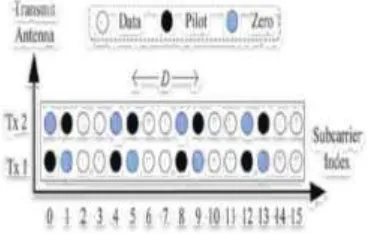
Fig.3 Pilot pattern. Note that the specificNt=2, D =4 , Np =4, and Np-total =8 are used for illustration
purpose.
In frequency domain Np pilots are uniformly spaced with pilot interval D ( e.g. D = 4 in Fig. 3 Meanwhile, every pilot isallocated with a pilot index l for 0 ≤ l ≤ Np−1, which is ascending with the increase of the subcarrier index. Each transmitantenna uses A subcarrier index to distinguish MIMO channels associated with them. Which has initial phase for 1 ≤ i ≤Nt and(Nt−1) zero subcarriers to ensure the orthogonality of pilot. Therefore for ith transmit antenna, the subcarrier index of the lthpilot is
(8)
Consequently, the total overhead per transmit antenna is Np-total = NtNp, and thus, Np can be also referred as the averagepilot overhead per transmit antenna in the letter.
B Super – Resolution Channel Estimation
The equivalent baseband channel frequency response (CFR) H (f) can be expressed at receiver as
(9)
Where superscript i and j in (1) are omitted for convenience is the system bandwidth, and Ts is the sampling period.Meanwhile, the N-point discrete Fourier transform (DFT) of the time-domain equivalent baseband channel can be expressed as[5], i.e.,
(10)
Therefore for ( i , j )th transmit-receive antenna pair , according to (8)-(10) , the estimated CFRs over pilots can be written as
(11)
Where 𝐻(𝑖,𝑗)[l] for 0 ≤ l ≤ Np − 1 can be obtained by
using the conventional minimum mean square error (MMSE) or least square (LS) method, and is the additive white Gaussian noise (AWGN).
Eq. (5) can be also written in a vector form as
Available online:
https://edupediapublications.org/journals/index.php/IJR/
P a g e | 1804(12)
When all transmit antennas are considered based on (12), we have
(13)
By Comparing the formulated problem and the classical direction-of-arrival (DOA) problem , I find out that they aremathematically equivalent. Traditional DOA problem is to estimate the DOAs of the P sources from a set of time-domainmeasurements, which are obtained from the sensors outputs at distinct time instants (time-domain samples).In this case, we try to estimate the path delays of P multipath from a set of frequency-domain measurements, which are acquiredfrom pilots of distinct antenna pairs (antenna-domain samples). To efficiently estimate path delays with arbitrary valuesit has been verified by the total least square estimating signal parameters via rotational invariance techniques (MMSE) algorithmcan be applied to (8).
(14)
Furthermore, to improve the accuracy of the channel estimation we can also exploit the temporal correlation of wirelesschannels. First, path delays of CIRs during several adjacent OFDM symbols are nearly unchanged which is equivalently referredas a common sparse pattern of CIRs due to the temporal correlation of MIMO channels.Thus, the Vander monde matrix V in (8) remains unchanged across several adjacent OFDM symbols. Moreover, pathgains during adjacent OFDM symbols are also correlated due to the temporal continuity of the CIR, so As in (8) for severaladjacent OFDM symbols are also correlated. Therefore, when estimating CIRs of
the qth OFDM symbol, we can jointly exploitĤs of several adjacent OFDM symbols based on (8) ,i.e.,
(15)
Where the subscript ρ is used to denote the index of the OFDM symbol, and the common sparse pattern of CIRs is assumed in 2R+1adjacent OFDM symbols, Hence effective noise can be reduced, so the improved channel estimation accuracy is expected. Ourproposed scheme exploits the sparsity as well as the spatial and temporal correlations of wireless MIMO channels to first acquireestimations of channel parameters, including path delays and gains, and then obtain the estimation of CFR, which is contrast tonon parametric schemes which estimates the channel by interpolating or predicting based on CFRs over pilots[1].
C. Discussion on Pilot Overhead
Compared with the model of the multiple filters bank based on the FRI theory, it can be found out that CIRs of transmit receive antenna pairs are equivalent to the semi period sparse subspaces, and the Np pilots are equivalent to the Npmultichannel filters. Therefore, by using the FRI theory, the smallest required number of pilots for each transmit antenna is Np=2P in a noiseless scenario. For practical channels with the maximum delay spread , although the normalized channel lengthis usually very large, the sparsely level P is small, i.e., P << L
Consequently, in contrast to the nonparametric channel estimation method where the required number of pilots heavily dependson L, our proposed parametric scheme only needs 2P pilots in theory. Note that the number of pilots in practice is larger than 2Pto improve the accuracy of the channel estimation due to AWGN.
(V) SIMULATION RESULTS
Available online:
https://edupediapublications.org/journals/index.php/IJR/
P a g e | 1805channel estimation scheme [4] was selected as an example of the conventional parametric scheme. System parameters were set as follows: the carrier frequency is fc = 1 GHz, the system bandwidth is fs = 10 MHz, the size of the OFDM symbol is N = 4096, and Ng = 256 is the guard interval length P, which can combat channels whose maximum delay spread is 25.6 μs. The International Telecommunication Union Vehicular B (ITU-VB) channel model with the maximum delay spread 20 μs and the number of paths P = 6 [4] were considered.
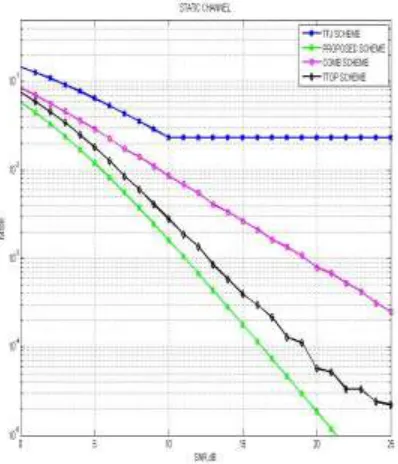
Figure 4 MSE performance comparison of different schemes in a 4 × 4 MIMO System Static channel
Figure: 5 MSE performance comparisons of different
schemes in a 4 × 4 MIMO
System time-varying channel with the mobile speed of 90km/h
Fig.5& Fig.5 compares the mean square error (MSE) performance of different channel estimation schemes. Both the static ITUVB channel and the time-varying ITU-VB channel with the mobile speed of 90 km/h in a 4 × 4 MIMO system were considered. The comb-type pilot based scheme used Np= 256pilots, the TTOP scheme used Np= 64
pilots with T adjacent OFDM symbols for training, where T = 4 for the time-varying channel and T = 8 for the static channel to achieve better performance, the TFJ scheme adopted time-domain training sequences of 256-length and Np= 64 pilots, and our
proposed scheme used Np= 64 pilots with R = 4 for
Available online:
https://edupediapublications.org/journals/index.php/IJR/
P a g e | 1806Figure 6 MSE performance of the proposed scheme in 4 × 4, 8 × 8, and 12 ×12 MIMO systems.
The MSE performance of the proposed schemein 12 × 12 MIMO system is superior to that in 8 × 8 MIMOsystem by 5 dB with the same Np and outperforms that in4 × 4 MIMO system with the reduced Np. These simulationsindicate that with the increased number of antennas, theMSE performance improves with the same Np. Equivalently,to achieve the same channel estimation accuracy, the requirednumber of pilots Np can be reduced.
As a result, the totalpilot overhead Np_total in
our proposed scheme does not increaselinearly with the number of transmit antennas Ntbecausethe
required Np reduces when Ntincreases accordingly.The reason is that with the increased number of antennas,the dimension of the measurement matrix [e.g., ˆH in (8)]in the TLS-ESPRIT algorithm or the number of the samplingin the model of multiple filters bank [10] increases; thus, theaccuracy of the path delay estimate improves accordingly.The superior performance of the proposed scheme is contributedby following reasons.
First, the spatially commonsparse pattern shared among CIRs of different transmit-receiveantenna pairs is exploited in the proposed scheme, such thatwe can employ the TLS-ESPRIT algorithm to obtain superresolutionestimations of path delays with arbitrary values.
Meanwhile, the FRI theory indicates that the smallest requirednumber of pilots is Np = 2P in a noiseless scenario. Therefore,the pilot overhead can be reduced as compared with conventionalnonparametric schemes. Second, our scheme exploitsthe temporal correlation of wireless channels, namely, acrossseveral adjacent OFDM symbols, the sparse pattern of theCIR remains unchanged, and path gains are also correlated.Accordingly, by joint processing of signals of adjacent OFDMsymbols based on (8), the effective noise can be reduced, andthus, the accuracy of the channel estimation is improvedfurther.
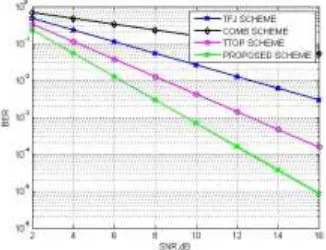
Figure 6 BER performance comparisons of different schemes in a 4 × 4 MIMO System Static channel
(VI) CONCLUSION
The proposed super-resolution sparse MIMO channel estimation scheme exploits the sparsity as well as the spatial and temporal correlations of wireless MIMO channels. It can achieve super-resolution estimates of path delays with arbitrary values and has higher channel estimation accuracy than conventional schemes. Under the framework of the FRI theory, the required number of pilots in the proposed scheme is obviously less than that in nonparametric channel estimation schemes. Moreover, simulations demonstrate that the average pilot overhead per transmit antenna will be interestingly reduced with the increased number of antennas.
VII. REFERENCES
[1] Zhen Gao, Linglong Dai,, Zhaohua Lu, Chau Yuen, “Super- Resolution Sparse MIMO- OFDM Channel Estimation Based on Spatial and Temporal correlation ”,IEEE communications letters,vol. 18,no.7, july 2014.
[2] G. Stuber et al., “ Broadband MIMO-OFDM wireless communications,” Proc. IEEE, vol. 92,no. 2, pp. 271–294, Feb.2004.
[3] I. Barhumi, G. Leus, and M. Moonen, “ Optimal training design for MIMO OFDM systems in mobilechannels,” IEEE Trans. Signal Process.vol. 3, no. 6, pp. 958–974, Dec. 2009
Available online:
https://edupediapublications.org/journals/index.php/IJR/
P a g e | 1807transCommun.,vol.60,no.12,pp.3705–3716, Dec. 2012.
[7] I.Telatar and D.Tse,“ Capacity and mutual information of wide band multipath fading channels,” IEEE Trans. Inf.Theory, vol. 46, no. 4, pp. 1384– 1400, Jul 2000
[8] L. Dai, J. Wang, Z. Wang, P. Tsiaflakis , and M. Moonen, “ Spectrum and energy - efficient OFDM based onsimultaneous multi- channel reconstruction” IEEE Trans Signal process.,vol. 61, no. 23, pp. 6047– 6059 ,Dec. 2013.
[9] P. L. Dragotti, M. Vetterli, and T. Blu, “Sampling Moments and reconstructing signals of finite rate ofinnovation: Shannon meets Strang-Fix,” IEEE Trans. Signal Process.,vol. 55,no. 5, PP.1741– 1757,May 2007