On the Outage Performance of Partial Relay Selection Aided NOMA
System with Energy Harvesting and Outdated CSI over
Non-Identical Channels
Pius A. Owolawi1 and Kehinde O. Odeyemi2, *
Abstract—In this paper, the outage probability performance of energy harvesting based partial relay selection aided non-orthogonal multiple access (NOMA) system under outdated channel state information is studied. The source to relays link is assumed to follow Rayleigh fading distribution while the relay nodes to users are subjected to Nakagami-m distribution. The relay nodes employ an energy harvesting power splitting-based relaying protocol to transmit the source information to the users. At the destination, each user is equipped with multiple antennas, and maximum ratio combining is considered for signal reception. In order to evaluate the system performance, the outage probability closed-form expression for the concerned system is derived. The results demonstrate the significant impact of system and channel parameters on the system performance. In addition, the advantage of NOMA over the conventional orthogonal multiple access is also presented. Finally, the accuracy of the derived outage expression is validated through the Monte-Carlo simulation.
1. INTRODUCTION
Recently, non-orthogonal multiple access (NOMA) has emerged as a potential technique for 5th generation (5G) multiple access systems due to high traffic volume and optimize spectral efficiency [1]. As a result, it has capacity to improve the spectrum efficiency and system throughput compared to conventional orthogonal multiple access (OMA) [2]. In NOMA systems, power domain is utilized to achieve multiple-access strategies in order to avoid abusing time/frequency/code resources [3]. Based on this, less power is allocated to the user with better channel condition in order to balance the trade-off between the system throughput and user fairness of the network [4]. At the system receiving end, successive interference cancellation (SIC) is employed to separate the signal of multiple users. This enable the user with the best channel condition to decode other users signal before decoding its own signal [5].
Cooperative relaying technique has been recognized as an effective means of enhancing the transmission reliability as well as improving the system capacity without additional transmit power [6, 7]. It involves the source that communicates with multiple users via a decode-and-forward (DF) or amplify-and-forward (AF) relay node(s). The advantage of a cooperative relaying scheme with multiple antennas have inspired researchers to employ relaying technique in NOMA communication systems. The outage performance of an AF-based NOMA system with transmit antenna selection and maximum ratio combining (TAS/MRC) at the source and destination respectively was investigated in [6]. In [8]. performance analysis for downlink relaying aided non-orthogonal multiple access networks with imperfect channel state information (CSI) over Nakagami-m fading was presented. The performance of
Received 3 July 2019, Accepted 13 August 2019, Scheduled 2 September 2019
* Corresponding author: Kehinde O. Odeyemi ([email protected]).
1Department of Computer Systems Engineering, Tshwane University of Technology, Pretoria 0001, South Africa. 2 Department of
a cooperative NOMA downlink network is investigated over Nakagami-m fading channels with channel estimation errors in [4]. The authors considered direct links between the source and users. However, all these aforementioned existing works on cooperatively NOMA relaying systems were specifically limited to a single relay node. Under multiple relays deployment, attention has been given to different relay selection schemes which significantly improve the system performance. A dual-hop AF-NOMA relaying network with partial relay selection protocol over Nakagami-m fading channels was studied. In [9], the performance of NOMA schemes with partial relay selection was investigated, and direct link was considered between the source and users.
Energy harvesting (EH) has been regarded as a breakthrough for several energy-constrained terminal devices, such as tremendous energy consumption, unfeasible traditional recharging, and additional power equipment, in wireless communication systems [10]. In this case, energy could be harvested from available and free ambient sources such as solar, vibration, wind, and other physical phenomena [7]. However, due to unavailability of these sources as a result of environment or climate, energy harvesting through radio frequency (RF) signals has been considered for use in wireless communication systems [11]. Therefore, harvesting energy from RF signals can be divided into time switching (TS) and power splitting (PS) protocols. In TS protocol, the transmission time is divided into two parts where the receiver nodes spend one to harvest energy from the source and the remaining for information transmission. In PS protocol on the other hand, the relay nodes used part of the receive power for EH and the other for information processing [12, 13]. Combining energy harvesting with NOMA relaying systems to prolong the lifetime of energy-constrained wireless networks has recently received significant attention. In [7], the performance analysis for NOMA energy harvesting relaying networks with TAS and MRC over Nakagami-m fading was studied. However, the work only employed a single relay based energy harvester for signal transmission to the users. The performance analysis of partial relay selection in cooperative NOMA systems with RF energy harvesting was studied in [14], but outdated CSI was not considered for cooperative NOMA relaying system. Motivated by this fact, this paper presents the outage probability performance of an energy harvesting based partial relay selection aided NOMA system under outdated CSI. The relay nodes employ an energy harvesting power splitting-based relaying protocol to transmit source information to the users. The source to relay nodes is assumed to follow Rayleigh fading distribution while the relay nodes to users are subjected to Nakagami-m distribution. The exact closed-form of outage probability is derived for the concerned system. The impacts of channel and system parameters on the system performance are presented.
The rest of the paper is structured as follows. In Section 2, the system model is provided. We derive analytical expressions of the outage probability in Section 3. Numerical results and discussions are detailed in Section 4, and finally, concluding remarks are given in Section 5.
2. SYSTEM MODELS
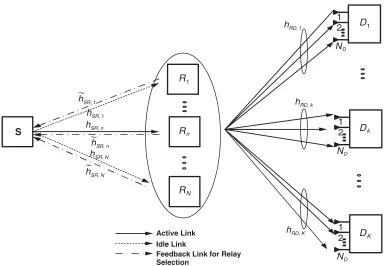
An energy harvesting based partial relay selection (PRS) aided NOMA cooperative system under outdated CSI is illustrated in Figure 1. The system operates in half-duplex mode and consists of a source (S), multiple N relay nodes, and K users (Dk) with multiple receive antennas. Due to deep
fading, the direct links between the source and the users are unavailable. The S-to-Rn and Rn-to-Dk
links are respectively assumed to follow Rayleigh fading and Nakagami-m distributions. Therefore, the complex channel coefficient between the S andRnis defined as hSR,n ∼CN(0,ΩSR,n), n∈ {1,2, . . . , N}, and the complex channel coefficient between the Rn and Dk is denoted as hRD,k ∼CN(0,ΩRD,k), k∈
{1,2, . . . , K}. Based on the PRS scheme, the source monitors the S-to-RnCSI quality through the local feedback. As a result of channel fast fading, the source selects a single relay with thenth worst S-to-Rn
link based on outdated CSI. Thus, the instantaneous SNR of the first link and the one used for PRS are two correlated random variables with channel correlation coefficient ρ. Therefore, the transmission between the source and users is divided into two time-slots, and AF relay protocol is employed to establish the operation.
During the first time slot, the source transmits the unit-power superposition symbol xs =
K
k=1 √
∼
∼
∼ S
R
R
R 1
n
N
Active Link
Idle Link
Feedback Link for Relay Selection
hSR, 1
hSR, 1
hSR, n
hSR, n
hSR, N
hSR, N
hRD, 1
hRD, k
hRD, K
D
D
D 1
k
K N
1 2
D
N 1 2
D
N 1 2
D
Figure 1. Partial relay selection based energy harvesting cooperative NOMA system model.
received signal at the relay nodeRncan be expressed as:
yRn =hSR, n
N
n=1
akPsxk+zRn (1)
wherewRn is the AWGN denoted as zRm∼CN(0, σR2m).
In this study, PSR energy protocol is considered in which the received source signal at the nth relay node is divided intoβ: 1−β parts. One part is used for the energy harvesting, and the other part is used for information processing. Thus, the energy harvested at thenth relay node can be expressed as [15, 16]:
PR, n=ηβPs|hSR, n|2 (2) wherePs is the source transmit power, and 0≤η ≤1 is the energy conversion efficiency
During the second time slot, the selected relay Rn amplifies the source signal with amplifying
coefficient G=
PR, n/[(1−β)Ps|hSR, n|2+ (1−β)σ2Rn]. Thus, the received signal at userDk can be defined as:
yRD, k =
(1−β)GhRD, khSR, n N
n=1
akPsxk+GhRD, kzRn+zDk (3)
where zRn =
(1−β)zRn is the AWGN at the relay node, and zDk ∼CN(0, σD2k) denotes the AWGN at thekth user.
Since MRC is assumed to combine the received signal at the kth user, the MRC output at thekth user can be expressed as:
˜
yRD, k=(1−β)GhRD, khSR, n N
n=1
akPsxk+GhRD, kzRn+hHRD, kzDk
/hRD, k (4)
Moreover, the SIC is employed to eliminate the effect of inter-user interference on each user Dn. The
. . . ,≤ |hRD, K|2). Without loss of generality, Ps = PR,n = P, σ2Rm = σD2n = σ2, and the average SNR of the system can be defined as ¯γ =P/σ2 with ψ1,n =|hSR, n|2, ψ2,k =|hRD, k|2. Thus, signal-to
interference-and-noise ratio (SINR) for thekth user to decode the signal of theith user can be expressed as:
γRD, i→k= ai¯γψ1, nψ2, k
¯
γψ1, nψ2, k
K
j=i+1aj +μψ2, k+ξ
, fori=K (5)
whereξ = 1/(1−β) and μ= 1/(εηβ) with εrepresenting a constant factor.
This SIC will be iterated until the k-th user decodes all its signals, and the k-th SINR can be defined as:
γRD, k = akγψ¯ 1, nψ2, k ¯
γψ1, nψ2, k
K
k=i+1aj+μψ2, k +ξ
(6)
The Kth user needs to decode all the other users’ signals, and the SNR for theKth user to decode its own signal can be expressed as:
γRD, K = aKγψ¯¯ 1, n+ψ2, k
γψ2, k+ξ
(7)
3. OUTAGE PROBABILITY ANALYSIS
The outage probability is a vital metric which occurs when the k-th user fails to decode its own signal or the i-th user signal (1≥i≥k), then the transmission fails. The outage probability for thek-th user can be expressed as [17]:
Pout =
φk
o
fψ2,k(x)dx+ ∞
φk
fψ2,k(x)Fψ1,n
φkξ
μ(x−φk)
dx
F ψ2,k(φk)
R1 +
∞
φk
fψ2,k(x)Fψ1,n
φkξ
μ(x−φk)
dx R2 (8) where ⎧ ⎪ ⎪ ⎪ ⎪ ⎨ ⎪ ⎪ ⎪ ⎪ ⎩
φk= max [θ1,θ2, . . . , θk]
θi= γ¯thi
¯ γ
⎛
⎝ai−¯γthi K
j=i+1
aj
⎞ ⎠
, forai>¯γthi K
j=i+1
aj (9)
Since the S-to-R link follows Rayleigh distribution, the channel PDF can be expressed by following the same approach detailed in [18] as:
fψ1,n(x) =n Nn n−1
q=0
n−1 q
(−1)q
((N −n+q) (1−ρ) + 1) ΩSR,nexp − Ψ ΩSR,nx
(10)
where Ψ = (N −n+q+ 1)/((N −n+q)(1−ρ) + 1) and it CDF can be defined as:
Fψ1,n(x) = 1−n Nn n−1
q=0
n−1 q
(−1)q
((N −n+q) + 1)exp − Ψ ΩSR,nx
(11)
Similarly, since each user is considered to employ MRC for signal combining, the PDF of the unordered R-to-Dk channel is given as [19]:
fψ2, k(x) = m ΩRD, k
mND
xmND−1
Γ (mND)exp − m ΩRD, kx
wheremis the fading parameter for the R-to-Dk channel. In other words, its CDF can be expressed as:
Fψ2, k(x) = 1−
mND−1
t=0
exp − m
ΩRD, kx
mx
ΩRD, k
t
t! (13)
Thus, through the order of statistics, the ordered R-to-Dk channel PDF can be defined as [20]:
fψ2, k(x) =
K! (K−k)! (k−1)!
K−k
p=0
(−1)p K−k p
fψ2, k(x)
Fψ2, k(x) k+p−1
(14)
then, its CDF can be given as:
Fψ2, k(x) =
K! (K−k)! (k−1)!
K−k
p=0
(−1)p k+p
K−k p
fhRD(x)
FhRD(x) k+p
(15)
Thus,R2 in Eq. (8) can be expressed by putting Eqs. (11) and (14) into Eq. (8) as follows:
R2 = 1−R1−
Δkn Γ (mND)
m ΩRD, k
mND N
n
K−k
p=0 n−1
q=0
n−1 q
K−k p
(−1)p+q ((N −n+q) + 1)
×
∞
φk
xmND−1exp − mx ΩRD, k
exp − Ψφkξ
ΩSR, nμ(x−φk) Fψ2, k(x) k+p−1
J1
dx (16)
where Δk=K!/((K−k)!(k−1)!).
The termJ1 in Eq. (16) can be determined by using Eq. (13), and through binomial expansion,J1
can be expressed as follows:
J1 = k+p−1
s=0
(−1)s k+p−1 s
exp − mx
ΩRD, k
mND−1
t=0
1 t!
mx ΩRD, k
ts
λ
(17)
Thus,J1 can be further expressed by applying binomial expansion to the termλ as:
J1= k+p−1
s=0
k+p−1 s
(−1)sΣsΛsΞsxˆsexp − msx ΩRD, k
(18) where ⎧ ⎪ ⎪ ⎪ ⎪ ⎪ ⎪ ⎪ ⎪ ⎪ ⎪ ⎪ ⎪ ⎪ ⎨ ⎪ ⎪ ⎪ ⎪ ⎪ ⎪ ⎪ ⎪ ⎪ ⎪ ⎪ ⎪ ⎪ ⎩
Σs=
s
s1=0 s−s1
s2=0
. . .
s−s1−...smND−2
smND−1=0
Λs= s
s1
s−s1
s2
. . . s−s1s−. . . smND−2
mND−1
Ξs=
mND−1
t=0
mt t!ΩtRD,k
st+1
m ΩRD,k
mND−1
1 (mND −1)!
s−s1−...smND−1
ˆ
s= (mND−1) (s−s1)−(mND−2)s2−(mND−3)s3−. . . smND−1
(19)
By puttingJ1 into Eq. (16), R2 can be expressed as:
R2 = 1−R1−
Δkn Γ (mND)
m ΩRD, k
mND N
n
K−k
p=0 n−1
q=0 k+p−1
s=0
n−1 q
K−k p
k+p−1 s
×ΣsΛsΞs(−1)p+q+s
((N −n+q) + 1) ∞
φk
xmND+ˆs−1exp − mx
ΩRD, k
exp − msx
ΩRD, k
exp − Ψφkξ
ΩSR, nμ(x−φk)
J2
dx (20)
Ify =x−φk, then theJ2 term in (20) can be expressed as:
J2 =
mND+ˆs−1
r=0
mND+ ˆs−1
r
φmNk D+ˆs−r−1exp −m(s+ 1)φk ΩRD, k
×
∞
0
yrexp− (s+ 1) ΩRD, ky
exp− Ψφkξ μΩSR, ny
dy (21)
By applying the integral identity defined in [21, Eq. (3.471.9)], theJ2 can be solved as:
J2 =
mND+ˆs−1
r=0
mND+ ˆs−1
r
φmNk D+ˆs−r−1exp −m(s+ 1)φk ΩRD, k
×2 ΨφkξΩRD, k (s+ 1)μmΩSR, n
r+1/2
Kr+1
2 mΨφkξ(s+ 1) μΩSR, nΩRD, k
(22)
whereKv(·) is the vth order of modified Bessel function of second kind.
By substituting Eqs. (20) and (22) into Eq. (8), the outage probability for the under studied system can be expressed as:
Pout = 1−Γ (2ΔmNkn D)
m ΩRD, k
mND N
n K−k
p=0 n−1
q=0 k+p−1
s=0
mND+ˆs−1
r=0
n−1 q
K−k
p
k+p−1 s
× mND+ ˆr s−1
ΣsΛsΞs(−1)p+q+s ((N−n+q) + 1)φ
mND+ˆs−r−1
k exp −m
(s+ 1)φk
ΩRD, k
× ΨφkξΩRD, k
(s+ 1)μmΩSR, n r+1/2
Kr+1
2 mΨφkξ(s+ 1) μΩSR, nΩRD, k
(23)
4. NUMERICAL RESULTS AND DISCUSSIONS
In this section, the numerical results for the outage performance of NOMA PSR based system are presented. Three users K = 3 are assumed with respective power coefficients given as a1 = 1/2,
a2 = 1/3, and a3 = 1/6. In addition, the users’ threshold values are respectively assumed to be
γth,1= 0.9 dB,γth,2 = 1.5 dB, andγth,3= 2 dB. The distance between the source and users is normalized
such that dSR,m+dRD,n = 1 and is related to path exponent α. Thus, we obtain ΩSR,m = d−SR,mα , ΩRD,n=d−RD,nα , andα= 4. Except otherwise stated,m= 2,ND = 2,η= 0.9,ε= 0.8, and the number of multiply relays employed for the system is set to N = 4. Also, the system is subjected to two relay selection modes, i.e., best relay selection and worst relay selection.
The outage performance of the concerned system with different users of receiving antenna configurations is illustrated in Figure 2. It can be deduced that the analytical result perfectly agreeds with the simulation results which indicate the accuracy of our derived expression. The results depict that the outage performance of the users is significantly improved with the increase in the number of users of receiving antenna.
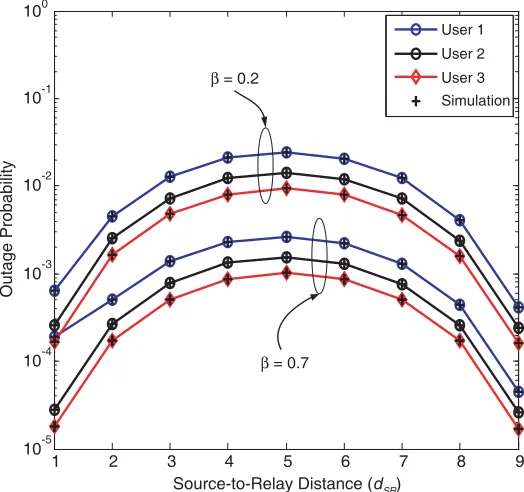
In Figure 3, the outage probability of the system as a function of source-to-relay distancedSR,n is
and less energy is harvested at the relay nodes for the information processing. However, when an optimumdSR,n is reached, the distance between the relays and destination becomes closer, and then the
system performance becomes improved. This proves that better outage performance is achieved when the relay nodes are either close to the source or destination. It can also be deduced that as the power splitting ratio increases, the system outage performance becomes better.
0 5 10 15 20 25 30 35 40 45 50 10-5
10-4 10-3 10-2 10-1 100
Average SNR (dB)
Outage Probability
Simulation User 1 User 2 User 3
N D= 1
N D= 2
Figure 2. Outage probability performance as a function of average SNR under the effect of ND for
N =n= 4, ρ= 0.2, β= 0.2 and dSR, n = 7.
1 2 3 4 5 6 7 8 9
10-5 10-4 10-3 10-2 10-1 100
Source-to-Relay Distance (d )
Outage Probability
Simulation User 1 User 2 User 3
SR β= 0.2
β= 0.7
Figure 3. Outage probability vs source-to-relay distance under different values of β for N =n = 4, ¯
0 0.1 0.2 0.3 0.4 0.5 0.6 0.7 0.8 0.9 1 10-5
10-4 10-3 10-2 10-1 100
Power Splitting Ratio, β
Outage Probability
Simulation User 1 User 2 User 3
ρ = 0.2
ρ = 0.8
Figure 4. Outage probability as a function of power splitting ratioβ under different values of coefficient correlation ρ forN =n= 4, ¯γ = 30 dB, and dSR, n= 7.
0 0.1 0.2 0.3 0.4 0.5 0.6 0.7 0.8 0.9 1
10-5
10-4
10-3
10-2
10-1
100
Correlation Coefficient, ρ
Outage Probability
Simulation User 1 User 2 User 3
γ = 20 dB
γ = 30 dB
Moreover, the outage probability as a function of power splitting ratio β is presented in Figure 4 under different values of coefficient correlation ρ. The results indicate that the increase in the channel coefficient correlation ρ significantly improves the system outage performance. In both cases, the increase in β offers users better performance. It can be observed that the analytical and simulated results are in excellent agreement which indicates the correctness of the derived outage expression.
The outage probability vs coefficient correlationρunder different values of average SNR is depicted in Figure 5. It can be deuced from the results that the increase in channel coefficient correlation significantly improves the users’ outage performance. It can also be observed that as the transmit power increases, the system outage performance becomes better since relay nodes harvest more energy to process the source information.
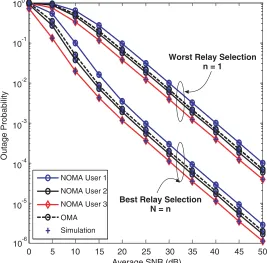
The performance comparison between NOMA and OMA systems under different relay selections is presented in Figure 6. It can be observed from the result that the outage probability performances of users 2 and 3 of NOMA system outperform the OMA system. However, the outage performance of user 1 of NOMA is worse than OMA, but NOMA can offer better spectral efficiency than OMA since users are served simultaneously. In both cases, the results show that the system under the best relay selection performs better than the worst relay selection scenario.
0 5 10 15 20 25 30 35 40 45 50
10-5 10-4 10-3 10-2 10-1 100
Average SNR (dB)
Outage Probability
10-6
Simulation NOMA User 1 NOMA User 2 NOMA User 3
OMA
Worst Relay Selection n = 1
Best Relay Selection N = n
Figure 6. Performance comparison between NOMA and OMA systems under different relay selections forρ= 0.2,β = 0.2 anddSR,n= 7.
5. CONCLUSION
REFERENCES
1. Bariah, L., S. Muhaidat, and A. Al-Dweik, “Error probability analysis of non-orthogonal multiple access over Nakagami-m fading channels,” IEEE Transactions on Communications, Vol. 67, No. 2, 1586–1599, 2019.
2. Liang, X., Y. Wu, D. W. K. Ng, Y. Zuo, S. Jin, and H. Zhu, “Outage performance for cooperative NOMA transmission with an AF relay,”IEEE Communications Letters, Vol. 21, No. 11, 2428–2431, 2017.
3. Liu, H., N. I. Miridakis, T. A. Tsiftsis, K. J. Kim, and K. S. Kwak, “Coordinated uplink transmission for cooperative NOMA systems,”Proceedings of 2018 IEEE Global Communications
Conference (GLOBECOM), 1–6, 2018.
4. Men, J., J. Ge, C. Zhang, M. Li, and Y. Hu, “The impact of channel estimation errors on the performance of cooperative nonorthogonal multiple access 5G systems under Nakagami-m fading,”
Transactions on Emerging Telecommunications Technologies, Vol. 29, No. 3, e3253, 2018.
5. Men, J. and J. Ge, “Performance analysis of non-orthogonal multiple access in downlink cooperative network,” IET Communications, Vol. 9, No. 18, 2267–2273, 2015.
6. Aldababsa, M. and O. Kucur, “Outage performance of NOMA with TAS/MRC in dual hop AF relaying networks,” Proceedings of 2017 Advances in Wireless and Optical Communications
(RTUWO), 137–141, 2017.
7. Han, W., J. Ge, and J. Men, “Performance analysis for NOMA energy harvesting relaying networks with transmit antenna selection and maximal-ratio combining over Nakagami-m fading,” IET Communications, Vol. 10, No. 18, 2687–2693, 2016.
8. Men, J., J. Ge, and C. Zhang, “Performance analysis for downlink relaying aided non-orthogonal multiple access networks with imperfect CSI over Nakagami-m fading,”IEEE Access, Vol. 5, 998– 1004, 2016.
9. Lee, S., D. B. da Costa, Q.-T. Vien, T. Q. Duong, and R. T. de Sousa, Jr., “Non-orthogonal multiple access schemes with partial relay selection,” IET Communications, Vol. 11, No. 6, 846–854, 2016. 10. Bao, V. N. Q. and N. T. Van, “Incremental relaying networks with energy harvesting relay
selection: Performance analysis,” Transactions on Emerging Telecommunications Technologies, Vol. 29, No. 12, e3483, 2018.
11. Ye, Y., Y. Li, D. Wang, F. Zhou, R. Q. Hu, and H. Zhang, “Optimal transmission schemes for DF relaying networks using SWIPT,”IEEE Transactions on Vehicular Technology, Vol. 67, No. 8, 7062–7072, 2018.
12. Nasir, A. A., X. Zhou, S. Durrani, and R. A. Kennedy, “Relaying protocols for wireless energy harvesting and information processing,”IEEE Transactions on Wireless Communications, Vol. 12, No. 7, 3622–3636, 2013.
13. Ye, J., Z. Liu, H. Zhao, G. Pan, Q. Ni, and M.-S. Alouini, “Relay selections for cooperative underlay CR systems with energy harvesting,” IEEE Transactions on Cognitive Communications and Networking, Vol. 5, No. 2, 358–369, 2019.
14. Hoang, T. M., N. T. Tan, and S.-G. Choi, “Analysis of partial relay selection in NOMA systems with RF energy harvesting,”Proceedings of 2018 2nd International Conference on Recent Advances in Signal Processing, Telecommunications &Computing (SigTelCom), 13–18, 2018.
15. Michalopoulos, D. S., H. A. Suraweera, and R. Schober, “Relay selection for simultaneous information transmission and wireless energy transfer: A tradeoff perspective,” IEEE Journal on Selected Areas in Communications, Vol. 33, No. 8, 1578–1594, 2015.
16. Anh, P. V. T., V. N. Q. Bao, and K. N. Le, “On the performance of wireless energy harvesting TAS/MRC relaying networks over Nakagami-m fading channels,”Proceedings of 2016 3rd National Foundation for Science and Technology Development Conference on Information and Computer Science (NICS), 1–5, 2016.
18. Soysa, M., H. A. Suraweera, C. Tellambura, and H. K. Garg, “Amplify-and-forward partial relay selection with feedback delay,”Proceedings of 2011 IEEE Wireless Communications and Networking Conference, 1304–1309, 2011.
19. El-Malek, A. H. A., A. M. Salhab, S. A. Zummo, and M.-S. Alouini, “Security-reliability trade-off analysis for multiuser SIMO mixed RF/FSO relay networks with opportunistic user scheduling,”
IEEE Transactions on Wireless Communications, Vol. 15, No. 9, 5904–5918, 2016.
20. Men, J. and J. Ge, “Non-orthogonal multiple access for multiple-antenna relaying networks,”IEEE Communications Letters, Vol. 19, No. 10, 1686–1689, 2015.