Agency
Coordination,
State
and Public
Involvementin Resource
Planning
Highlight: The early years of this country’s development were years in which relatively little interplay was exercised in the exploitive endeavors of society, whether these were in range resources, wood products, minerals, or water. It is questionable whether the present generation, given the same set of circumstances, would manage these endeavors any differently; yet each generation would be operating on a common base of facts. These facts consist of some simple but fundamental environmental truths having to do with soil, water, and vegetation-how and for what they are used, their capacity for yielding the needs of society, and their integrity for future use. The immutable interrelationship between this
environmental trinity-soil, water, vegetation-and between on-site and off-site interests, are the genesis of the absolute necessity for coordinated resource planning.
This series of papers was presented as part of a panel discussion at the 27th Annual Meeting of the Society for Range Management, Tucson, Arizona, February 5, 1974.
an economic system solidified, and a world power achieved. Although it is an exciting example of man’s energies, skills, and vision, it is not without its frailties. Endless growth buttressed with a fantastic technological and mechanized capacity fostered the “sacred cow” of Gross National Product, which became the byword for all that was good and wholesome.
Discretion and prudence in the exploitation and use of our
dominant position in the decision-making process. The rugged resources was not, until recently, the cardinal principle in
and lusty virtues of the free enterprise system have abundantly resource planning. On the contrary, institutional, political, social, and economic postures sought minimum restraints and
maximum individual opportunity or maneuvered for a
Viewpoint of the Concerned
Public
PHILLIP W. SCHNEIDER
The subject of resource planning has been with us a long time. It has taken many forms and has reflected the objectives of many and varied interests.
While resource planning has been under way in other parts of the world for many centuries, we have, even here in America, over a century of experience. The national interest in an area we know as Yellowstone National Park was a resource planning effort; the Homesteader of yore reflected a resource plan of a benevolent government; the mining law of 1872; the Creative Act of 1891 for the establishment of forest reserves and the Organic Administrative Act of 1897 provided for the protection and managed use of forest preserves. A host of later laws reflect an effort at resource planning consistent with a nation’s needs and the desires of the times. Furthermore, the evolution in the application of the large body of state and federal law which followed reflected, in large measure, a response to the desires and needs of various groups, ranging all the way from grazing to residential subdivisions.
In a nation endowed with abundant resources, a growing population, and a continent available for exploitation,’ we moved to the exploitive task with increasing capacity and enthusiasm. In less than two centuries a continent was settled,
The author is regional executive, National Wildlife Federation, Portland, Oregon.
demonstrated the potentials of a competitive doctrine that yielded returns to society in goods and services that exceeded any developmental experiment in any previous societies.
Sought Objectives Unilaterally
By and large, this achievement was done by the earnest and energetic thrust of many interests seeking their objectives unilaterally. Whether it has been in range resources, wood products, national treasures of unique areas in water or minerals, the early years of this country’s development were ones in which relatively little interplay was exercised in the exploitive endeavors of society.
Whether this performance has been good or bad depends upon each individual perspective. Whether this generation, given the same set of circumstances, would do any differently is questionable. In either case however, each generation would be operating from a common base of facts.
These facts, as I believe a large body of the interested public view them, are some simple but fundamental environmental truths. These truths have to do with soil, water, and vegetation-how and for what we use them, their capacity for yielding the needs of society, and their integrity for future use. Furthermore, what we do with one is reflected in the other two and on society elsewhere. The immutable interrelationship between this environmental trinity and between both on-site and off-site interests are the genesis of the absolute necessity for coordinated planning.
about which we will hear more in our time. Here is where communications become urgent and where the best in factual information is essential.
Much is being said about the techniques of planning. That is the province of the planning technician, whose expertise has advanced the state of the art to its present competence. There is a need on the part of the decision makers, whether they be individual property owners, corporate conglomerates, or public land administrators to avoid too much preoccupation with the details of the technology. Of equal importance are the conceptual questions that establish the parameters for decisions. It is abundantly clear that changes have occurred in American attitudes toward the environment. These changes are reflected in the mounting array of in-depth studies, in new and proposed legislation, in case histories of court actions, and in people involvement.
middle. Rangelands have simply assumed a more important place in the scheme of things. The customary values of commodity production will continue, but they will continue along with such sought-after values as energy resources, open space, attractive or unique landscapes, natural phenomena, water, fish and wildlife, and clean air. To accommodate these varied and growing demands the system of management will expand and become more complicated. This challenge can be successfully met so long as the following program objectives are developed to the maximum degree possible: (1) a solid base of resource data; (2) open planning with appropriate institutional changes where needed; (3) involvement of the widest possible spectrum of people and interests; (4) the identification of alternatives before a decision is reached; and (5) recognition of land as a resource.
From the public standpoint, I believe there is an interest in the three essential legs of effort; namely, planning, coordination, and execution. The mission of execution is the point most difficult to achieve. Often the question relates to individual or small group needs and inputs. At other times it may relate to community, regional, or national desires. To accommodate all is most difficult.
Objective Consideration of All Inputs
To accomplish the kind of land stewardship I believe the public is demanding will require an objective consideration of all inputs. From the point of view of the general public, the commodity user, the preservationist, and the multiple-use disciple, there is nothing evil in their particular objectives. Evil comes into play in permitting violence to the land itself or to society elsewhere. This is often difficult to define. Firm support of environmental restraints is required as well as a dedication to long range integrity of the land in its totality. Dominance by any one interest must be rejected; instead, the land must be husbanded in its basic components with appropriate allocation of uses in keeping with land capability and uniqueness of each area involved.
Conceptually this suggests the application of the currently over-used term of ecosystems management. Call it what you will-and it’s been so designated by many range managers-it speaks to both the land itself and to the desires of people. It focuses attention and responsibility for protecting the range environment and its basic components of soil, water, and vegetation. Any use which does irrevocable damage to any range component becomes subject to restraint. Because these uses originate with people, they must be brought into the planning process, but not unilaterally. All interests should be simultaneously represented, and with that representation goes responsibility for input. The acid test of stewardship must ultimately be the record on the ground in soil stability, vegetative condition, and water quality. The use of any other criteria may temporarily accommodate short term objectives of some, but it will not assure the long term mission of preserving a precious land legacy which can yield many values to society in perpetuity, both on the land itself and elsewhere. In short, the ecosystem itself becomes the dominant value to preserve. In that context the profesional range manager should be the most militant of all preservationists.
I believe there is a way to do this, but it is going to be difficult because the historical pattern of uses is not the same today as it was in the past. It will be difficult because institutional devices for administering rangelands came into being at a different time and for different objectives. It will be difficult because there are more people and those people view rangelands in various ways. It will be challenging because we have new and persuasive laws and judicial decisions which emphatically assert that things will be done in another way. It will be far more complicated by virtue of emerging technologies not heretofore having a high priority.
Viewpoint
of a Federal
Agency
T. A. SCHLAPFER
S:,ch recent events as BLM’s problem with off-road vehicles in the California Desert or Yheir recent issuance of geothermal resource leasing regulations demonstrate the broadened base of interest in rangelands. The fact that the U.S. Forest Service proposed regulations for mining activities of December, 1973, after 70 years of nonregulation demonstrates a response to the times. The potential spatial requirements of a breakthrough in solar energy technology and the enormous impact of strip mining on rangelands, as examples, portend to the future.
The most current issue that resource managers, politicians, and public administrators are facing today in resource manage- ment is planning for the future. Resource managers and our federal and state legislators have spent much time wrestling with this subject. The goal is to put an end to destructive expansion and to allow for the orderly classification of land and the harvest of resources. Along with the need to identify land uses, we must also meet increasing demands for products. As an example, we need to step up red meat production on our public and private lands.
The implementation of the National Environmental Policy Act or the many judicial decisions either pending or already issued suggests the rapid evolution in the need for coordination.
Demands for meat are increasing. Ranges are capable of producing more forage to raise animals, and this can be done competitively with other feed sources. In this day of energy shortages it is even more important that a well-managed rangeland can produce feed with much less fossil fuel. Science magazine in an article in November, 1973, reported that it
Change creates challenge and the range manager is in the Oregon. The author is regional forester, U. S. Forest Service, Portland,
JOURNAL OF RANGE MANAGEMENT 28(3), May 1975 167
about which we will hear more in our time. Here is where communications become urgent and where the best in factual information is essential.
Much is being said about the techniques of planning. That is the province of the planning technician, whose expertise has advanced the state of the art to its present competence. There is a need on the part of the decision makers, whether they be individual property owners, corporate conglomerates, or public land administrators to avoid too much preoccupation with the details of the technology. Of equal importance are the conceptual questions that establish the parameters for decisions. It is abundantly clear that changes have occurred in American attitudes toward the environment. These changes are reflected in the mounting array of in-depth studies, in new and proposed legislation, in case histories of court actions, and in people involvement.
From the public standpoint, I believe there is an interest in the three essential legs of effort; namely, planning, coordination, and execution. The mission of execution is the point most difficult to achieve. Often the question relates to individual or small group needs and inputs. At other times it may relate to community, regional, or national desires. To accommodate all is most difficult.
Objective Consideration of All Inputs
To accomplish the kind of land stewardship I believe the public is demanding will require an objective consideration of all inputs. From the point of view of the general public, the commodity user, the preservationist, and the multiple-use disciple, there is nothing evil in their particular objectives. Evil comes into play in permitting violence to the land itself or to society elsewhere. This is often difficult to define. Firm support of environmental restraints is required as well as a dedication to long range integrity of the land in its totality. Dominance by any one interest must be rejected; instead, the land must be husbanded in its basic components with appropriate allocation of uses in keeping with land capability and uniqueness of each area involved.
I believe there is a way to do this, but it is going to be difficult because the historical pattern of uses is not the same today as it was in the past. It will be difficult because institutional devices for administering rangelands came into being at a different time and for different objectives. It will be difficult because there are more people and those people view rangelands in various ways. It will be challenging because we have new and persuasive laws and judicial decisions which emphatically assert that things will be done in another way. It will be far more complicated by virtue of emerging technologies not heretofore having a high priority.
Such recent events as BLM’s problem with off-road vehicles in the California Desert or Their recent issuance of geothermal resource leasing regulations demonstrate the broadened base of interest in rangelands. The fact that the U.S. Forest Service proposed regulations for mining activities of December, 1973, after 70 years of nonregulation demonstrates a response to the times. The potential spatial requirements of a breakthrough in solar energy technology and the enormous impact of strip mining on rangelands, as examples, portend to the future.
The implementation of the National Environmental Policy Act or the many judicial decisions either pending or already issued suggests the rapid evolution in the need for coordination.
Change creates challenge and the range manager is in the
middle. Rangelands have simply assumed a more important place in the scheme of things. The customary values of commodity production will continue, but they will continue along with such sought-after values as energy resources, open space, attractive or unique landscapes, natural phenomena, water, fish and wildlife, and clean air. To accommodate these varied and growing demands the system of management will expand and become more complicated. This challenge can be successfully met so long as the following program objectives are developed to the maximum degree possible: (1) a solid base of resource data; (2) open planning with appropriate institutional changes where needed; (3) involvement of the widest possible spectrum of people and interests; (4) the identification of alternatives before a decision is reached; and (5) recognition of land as a resource.
Conceptually this suggests the application of the currently over-used term of ecosystems management. Call it what you will-and it’s been so designated by many range managers-it speaks to both the land itself and to the desires of people. It focuses attention and responsibility for protecting the range environment and its basic components of soil, water, and vegetation. Any use which does irrevocable damage to any range component becomes subject to restraint. Because these uses originate with people, they must be brought into the planning process, but not unilaterally. All interests should be simultaneously represented, and with that representation goes responsibility for input. The acid test of stewardship must ultimately be the record on the ground in soil stability, vegetative condition, and water quality. The use of any other criteria may temporarily accommodate short term objectives of some, but it will not assure the long term mission of preserving a precious land legacy which can yield many values to society in perpetuity, both on the land itself and elsewhere. In short, the ecosystem itself becomes the dominant value to preserve. In that context the profesional range manager should be the most militant of all preservationists.
Viewpoint
of a Federal
Agency
T. A. SCHLAPFER
The most current issue that resource managers, politicians, and public administrators are facing today in resource manage- ment is planning for the future. Resource managers and our federal and state legislators have spent much time wrestling with this subject. The goal is to put an end to destructive expansion and to allow for the orderly classification of land and the harvest of resources. Along with the need to identify land uses, we must also meet increasing demands for products. As an example, we need to step up red meat production on our public and private lands.
Demands for meat are increasing. Ranges are capable of producing more forage to raise animals, and this can be done competitively with other feed sources. In this day of energy shortages it is even more important that a well-managed rangeland can produce feed with much less fossil fuel. Science magazine in an article in November, 1973, reported that it
The author is regional forester, U. S. Forest Service, Portland, Oregon.
takes about 22 gallons of gasoline per acre to produce corn. Range livestock production has a much lower requirement, maybe about 1/20th for the same gross energy production.
The question then is: “How do we increase production substantially on our rangelands to meet the projected con- sumption of meat ?” I propose cooperative resource planning as one of the most dramatic ways to accomplish this.
In June, 1965, the Bureau of Land Management (BLM) and Soil Conservation Service (SCS) signed a Memorandum of Agreement outlining policy and procedure for working with Soil and Water Conservation Districts (SWCD) and their Cooperators. In 1966, BLM and the Forest Service updated their original 195 1 agreement, which was primarily aimed at range management, to include a broader spectrum of resource planning. The stated purpose of the agreement is to encourage cooperation between the agencies to improve management of resources for which each agency is responsible as well as the associate private and other public lands. The Memorandum also provides for the creation of regional, state, and local agreements. In 1969 the Forest Service in Oregon was invited to participate with BLM, SCS, and the Soil and Water Conservation Districts as a cooperative organization. The original emphasis in Oregon was to improve range manage- ment. Over the years, however, it became evident that no single resource could be planned without considering the other resources and services that must come from the same land area. This evolutionary process led into the cooperative range resource planning efforts now being developed in Oregon and other states by agencies, landowners, and permittees.
One of the biggest advantages of having a ranch plan prepared by and with the commitment of adjacent landowners is the greater flexibility it offers the rancher in overall management operations. For example, the coordination of “turn-on” dates. In the past there have been many times when the Forest Service has delayed opening dates for summer range past the closing date of BLM’s lands. This, of course, left the permittee with a choice-to trespass on BLM or to move into trespass on the National Forest. A plan prepared in advance allows for these exigencies so that the rancher is not caught in the middle. During the northwest drought in the summer of 1973, permittees with good plans and grazing systems which improved range conditions and increased forage were allowed extensions for use of National Forest land.
More than Grass
Coordinated planning recognizes more than just grass. Soils, water quality, wildlife, forestry, and other resource needs are considered. Potential conflicts are resolved before they develop. And “many heads are better than one.” A plan developed by several parties with commitment by everyone is more likely to result in a successful program. Furthermore, if one person transfers, the new man is fit into an existing team and he must get concurrence of the team to change things.
One benefit of interagency coordination that should not be overlooked is the breaking down of traditional barriers that inhibited interagency coordination. There was a time that the Forest Service would not accept range analysis techniques of other agencies, and other agencies felt the same about Forest Service methods and techniques. After several years of coordinated planning effort, these barriers have almost disappeared.
In some cases, however, there are still some startling philosophical differences in land management by local agency
people. Operating independently, they often negate each other’s programs. This is principally lack of understanding caused by poor communication. When agencies work together on the ground, particularly in cooperative ranch planning,
these barriers are broken down by strengthened
communications and working relationships. On the whole, technical guidelines are becoming more uniform between agencies every year.
Coordinated plans not only deal with the grazing aspects of the rancher’s economic unit, but they also spell out management prescriptions for other resources within the area.
A Total Resource Plan
Murderer’s Creek area in Grant County, Oregon, is an example of a total resource plan, The plan, completed in March of 1973, covers an area a little over 100,000 acres. The overall objective of the plan is to prepare one document from which the Oregon State Wildlife Commission, BLM, the Forest Service, and the livestock permittees can operate in harmony. The specific objectives are: (1) to improve the quantity and quality of forage and habitat for domestic and wild animals; (2) to offer for harvest the maximum amount of forest products compatible with the other resource values; (3) to offer recreational opportunities and development of a transportation system; (4) to maintain a high quality fisheries habitat; and (5) to provide sanctuary for a herd of 100 free-roaming horses.
The overriding prescription is to enhance the resources and land uses of the area while offering the maximum protection to land values.
The plan goes on to discuss in detail what will be done on the ground to meet the management objectives. There is a plan for big game and upland game birds, fisheries, water impoundments, irrigation, a grazing system, and so forth. By cooperation of all the agency personnel and the grazing permittee, there will be a gradual improvement in the quality of the biota and of the goods and services produced from this unit.
Another cooperative plan has been implemented by the Big Butte Cattle Association in southern Oregon on an area of nearly 145,000 acres. Besides the association consisting of four ranchers, the other participants include Medco and Boise
Cascade-both timber companies, BLM, Oregon Wildlife
Commission, Forest Service, and the SCS. The area supports a cow-yearling livestock operation, critical winter range for deer, timber production, recreation, and it also contains the water supply for the city of Medford. As in the other example previously mentioned, the objectives are to maximize the land capability in terms of resource production, to improve the quality of goods and services from the unit, and to identify and reduce potential conflicts between the resources and the public. The package includes a grazing system plan, a timber
management plan, as well as plans for developing
improvements, managing wildlife habitat, public recreation, and water production.
As of now there have been about 66 coordinated ranch plans written in Oregon. In 1973, more than 800,000 acres were covered in Oregon by coordinated plans. We really feel that this approach to ranch operations makes a lot of sense. If all of the adjacent landowners and interested agency personnel have the opportunity to mold the plan to meet their respective needs, the combined effort will be a more satisfactory basis from which to work. The payoff to the rancher will be a more
coordinated approach to scientific range management, which should yield more animal unit months, more production of red meat, and fewer problems in dealing with agencies.
While we are working on cooperative ranch planning, the Forest Service is also deeply involved with other agencies in an overall land planning effort.
The last two administrations have emphasized the need for partnership planning between local, state, and federal governments. There is only so much land and resource base in public and private ownership. The resource capability of this country has been estimated as adequate for a population of about 160 million. As you know, our most recent census puts the United States population at well over 200 million. In determining how our needs may be satisfied, there are many critical questions to answer. How much recreation, timber, grazing land, and wildlife habitat can federal lands provide? How much can come from state, local, and private lands? Why are the small woodlot owners not producing their share of the timber volume needed to meet national needs?
These are the questions to which a national planning effort must be directed. To get at these problems all planning agencies must work in concert with each other. The common denominator for this effort must be communication. During the entire planning process, the state and local governments and private land owners must be intimately involved. The process will be complex-recognition of both local and national needs, and coordination with state and local plans, as well as private industry plans.
Another cooperator in land planning is the public. As you know, agencies are making a real effort now to invite the public to participate in program preparation. Through open meetings, mailings, ad hoc committees, and an open door policy, people are being heard. I feel that this has resulted in better plans, because if compromises are reached now with interested parties, we should be able to reduce the number of incidents which end up in court. Land management should not be determined by judicial process. As long as people maintain the interest that has been shown in the last couple of years, and if we continue to have an open door policy, the overall operation will only improve.
Needs On-ground Application
No plan is worth more than the paper it’s written on if the results are not applied to the ground. A policy statement and some new objectives for range management for the Pacific Northwest region of the Forest Service were recently signed into effect. We believe these objectives, developed by myself and the forest supervisors, will result in better management that is visible on the ground. I want to share this with you.
Grazing is, and will remain, an important use on all public lands that have a forage resource that can be used in perpetuity and in harmony with other equally valuable resources and uses. Three basic elements-planning, permittee cooperation, and administration-are essential in developing and maintaining the region’s goal of a quality range program that contributes its due share of meat and fiber for an ever-expanding population.
To meet our goal, the range program must achieve a new vitality. It must have well-defined objectives, realistic targets, and a commitment by line officers to devote a fair share of their time and finances. Full integrity of range management
appropriations must be maintained, and maximum
accomplishment wilI have to be extracted from the present
short supply of dollars. The establishment of program objectives relevant to our real needs will permit the region to make its case for adequate financing.
Will Note All Resources, Values
The land use planning process will not overlook or underrate the presence of a usable range resource, and land use plans will assess and define the role of grazing in relation to other resources and values. Where range problems are identified on otherwise suitable range, resolution of these-not elimination of grazing-will be our basic mission. The land use planning process and supporting land classification efforts will also identify those situations where present land ownership patterns might be adjusted to meet our objective of favorably influencing sound range management practices on associated private and other related lands. In addition, range planning (in cooperation with appropriate state and federal agencies) will give maximum attention to integrating lands of all ownerships under a single ranch unit management plan where this will enhance proper land use objectives, without regard to property boundaries. Finally, short-range and long-range planning efforts will identify unused and underused suitable range areas and develop strategies for optimum harvest of the usable resource.
Increased permittee involvement and full acceptance of management responsibilities will be essential to fulfillment of the range program. To get this involvement, permittees must be full partners in the planning and administration effort. Disinterest in full participation which has, and is, resulting in resource abuse and deterioration must not be tolerated; line officer action to reverse deterioration must be prompt, fair, and firm.
Just as the permittee has definite responsibilities in use of the range resource, so does the forest supervisor have the responsibility to provide all interdisciplinary technical expertise (including research findings) necessary to develop standards, analyze problems, prescribe solutions, devise satisfactory management systems, and conduct essential surveillance of grazing operations and results. He also has a responsibility to help organize range users to collectively make more effective use of available resources-grazing associations and allotment combinations will be promoted in lieu of isolation and division.
Grazing is a highly visible use of the National Forests and, by design on the part of forest supervisors, will become more visible both inside the service and to the public. Every allotment must become a demonstration allotment. Increased attention to the placement of structural improvements on the land which meet standards and exhibit craftsmanship, as well as complement the landscape visually and environmentally, is an essential accretion to the initiation of satisfactory management systems.
A dynamic, continuous system of allotment evaluation and comparison with standards and objectives must be maintained as an integral part of the range program.
To achieve this we plan to:
(1) Analyze all allotments to determine present management level and develop investment costs and specific targets to place all allotments under quality management by 1984. In the interim, implement a level of range management on all allotments which tolerates no unacceptable resource damage.
(2) Maximize permittee responsibility and accountability in both planning and executing the range program.
(3) Obtain range scientist input into all unit plans and utilize an interdisciplinary approach in developing all new and revised range management plans, to insure a balanced resource allocation.
(4) Provide the. necessary range scientist input for land use planning and land adjustment activities to insure that land ownership patterns are considered in the light of their effectiveness in promoting sound conservation practices on associated private and public rangelands.
(5) Make maximum use of the interagency coordinating planning approach in developing all allotment plans to promote better management on associated public and private rangelands.
(6) Identify areas of unused or underused suitable range and place these in production, under proper management, for the benefit of the nation.
(7) Generate an effective cadre of range trained people (both line and staff) needed to accomplish the goal. Provide a continuing training program with development opportunities and an essential career ladder in order to attract and maintain a high level of range expertise.
This policy statement and objectives have specific targets for accomplishment. As a measure of progress, we will meet annually to see where we are. We believe this approach will provide better management visible on the ground. The key to good future land and resource management really lies in the willingness of everyone to cooperate and to accept any trade-offs that become more apparent as time goes on. If we plan the proper allocation of resources, with the best mix of uses, we will be able to optimize what we have. And if we do a more intensive job, we should be able to approach the 21st century confident that we will be able to provide an adequate supply of necessary products including red meat for the people of the nation through coordinated land planning.
Viewpoint
of a Wildlife
Manager
JOHN W. McKEAN
Aldo Leopold, the father of wildlife management in North America, defined wildlife management as “the art of making the land produce sustained annual crops of wildlife for retreat ional use.”
The wildlife manager has the difficult task of practicing that art on lands that are owned by someone else and dedicated primarily to other uses. This is one reason coordination, cooperation, and compromise are essential tools of the trade. Another reason is that the wildlife he plans for is the common property of all the people of the State or, more often, all 200 million U. S. citizens, most of whom want a voice in any decision.
For these reasons coordination in wildlife management planning has historically been a must, but as recreational demands approach the limits of tolerance of either the wildlife resource or landowners, more sophisticated systems of
The author is director, Oregon State Wildlife Commission, Portland, Oregon.
coordination and planning become essential.
A diversity of multi-discipline planning systems have been developed, but in my experience they fall in two major categories: (1) Problem or area-oriented planning; and (2) comprehensive land use planning-county, state, and national.
The wildlife manager must be aggressive in both categories, so I will tell you briefly of some of our experiences in Oregon. One of our first applications of a true multi-disciplinary approach to a resource problem occurred in the 1950’s on a controversial deer winter range which had a long history of abuse by domestic livestock, wildlife, rodents, insects, drouth, etc. Several years of the pot calling the kettle black was achieving no constructive end until an interdisciplinary team composed of representatives of the Soil Conservation Service, Forest Service, Bureau of Land Management, Extension Service, Wildlife Department, and landowners objectively inventoried the problem area and developed a plan for constructive solution of problems. Not all of the remedies conceived by this task force have been implemented, but at least the landowners have a better understanding of the nature of the problem and potential solutions, and the public better understands the need for some regulation of wildlife densities on those lands.
Similar interdisciplinary planning programs have been
conducted on selected problem areas or geographic
subdivisions in much of our state and the federal land management agencies are now commonly using that approach in developing resource plans for federal lands.
A similar interdisciplinary approach has been used by the Oregon Wildlife Department in developing land use plans for over 100,000 acres of land within state wildlife management areas.
This kind of coordination in resource planning is:
Logical-because it is based upon inventories and knowledge of natural systems.
Simple-because it pools knowledge of many disciplines. Flexible-because the resulting plans can easily be changed. Practical-because it saves time and money.
The wildlife manager has a definite role in the broader mission of comprehensive land, water, and resource planning. Recognizing that man’s manipulation of the environment is the dominant factor affecting the production of wildlife, wildlife agencies throughout the nation have necessarily become deeply involved in those decisions.
Using the “carrot and stick” approach, the Bureau of Sport Fisheries and Wildlife through the Pittman-Robertson and Dingell-Johnson Acts has offered some real incentives for the states to develop a meaningful data base for resource planning and to establish management goals. In addition to offering federal assistance in planning, they have provided that a state which has an approved state plan will not be required to write up detailed annual plans for approvable segments of the planned programs. Partially for that reason, but more importantly with the objective of developing a data base that could help land and water use planning bodies make better decisions, we launched an aggressive planning program in 1969.
Our first step was to assemble an inventory of all available fish and wildlife habitat in the State and the distribution and density of all major species of wildlife within those habitat types. With the assistance of other agencies we also made some guesses as to the changes that might occur during the next 20 years (1990).
(2) Maximize permittee responsibility and accountability in both planning and executing the range program.
(3) Obtain range scientist input into all unit plans and utilize an interdisciplinary approach in developing all new and revised range management plans, to insure a balanced resource allocation.
(4) Provide the necessary range scientist input for land use planning and land adjustment activities to insure that land ownership patterns are considered in the light of their effectiveness in promoting sound conservation practices on associated private and public rangelands.
(5) Make maximum use of the interagency coordinating planning approach in developing all allotment plans to promote better management on associated public and private rangelands.
(6) Identify areas of unused or underused suitable range and place these in production, under proper management, for the benefit of the nation.
(7) Generate an effective cadre of range trained people (both line and staff) needed to accomplish the goal. Provide a continuing training program with development opportunities and an essential career ladder in order to attract and maintain a high level of range expertise.
This policy statement and objectives have specific targets for accomplishment. As a measure of progress, we will meet annually to see where we are. We believe this approach will provide better management visible on the ground. The key to good future land and resource management really lies in the willingness of everyone to cooperate and to accept any trade-offs that become more apparent as time goes on. If we plan the proper allocation of resources, with the best mix of uses, we will be able to optimize what we have. And if we do a more intensive job, we should be able to approach the 21st century confident that we will be able to provide an adequate supply of necessary products including red meat for the people of the nation through coordinated land planning.
Viewpoint
of a
Wildlife
Manager
JOHNW.McKEAN
Aldo Leopold, the father of wildlife management in North America, defined wildlife management as “the art of making the land produce sustained annual crops of wildlife for retreat ional use.”
The wildlife manager has the difficult task of practicing that art on lands that are owned by someone else and dedicated primarily to other uses. This is one reason coordination, cooperation, and compromise are essential tools of the trade. Another reason is that the wildlife he plans for is the common property of all the people of the State or, more often, all 200 million U. S. citizens, most of whom want a voice in any decision.
For these reasons coordination in wildlife management planning has historically been a must, but as recreational demands approach the limits of tolerance of either the wildlife resource or landowners, more sophisticated systems of
The Oregon.
author is director, Oregon State Wildlife Commission, Portland,
coordination and planning become essential.
A diversity of multi-discipline planning systems have been developed, but in my experience they fall in two major categories: (1) Problem or area-oriented planning; and (2) comprehensive land use planning-county, state, and national.
The wildlife manager must be aggressive in both categories, so I will tell you briefly of some of our experiences in Oregon. One of our first applications of a true multi-disciplinary approach to a resource problem occurred in the 1950’s on a controversial deer winter range which had a long history of abuse by domestic livestock, wildlife, rodents, insects, drouth, etc. Several years of the pot calling the kettle black was achieving no constructive end until an interdisciplinary team composed of representatives of the Soil Conservation Service, Forest Service, Bureau of Land Management, Extension Service, Wildlife Department, and landowners objectively inventoried the problem area and developed a plan for constructive solution of problems. Not all of the remedies conceived by this task force have been implemented, but at least the landowners have a better understanding of the nature of the problem and potential solutions, and the public better understands the need for some regulation of wildlife densities on those lands.
Similar interdisciplinary planning programs have been
conducted on selected problem areas or geographic
subdivisions in much of our state and the federal land management agencies are now commonly using that approach in developing resource plans for federal lands.
A similar interdisciplinary approach has been used by the Oregon Wildlife Department in developing land use plans for over 100,000 acres of land within state wildlife management areas.
This kind of coordination in resource planning is:
Logical-because it is based upon inventories and knowledge of natural systems.
Simple-because it pools knowledge of many disciplines. Flexible-because the resulting plans can easily be changed. Practical-because it saves time and money.
The wildlife manager has a definite role in the broader mission of comprehensive land, water, and resource planning. Recognizing that man’s manipulation of the environment is the dominant factor affecting the production of wildlife, wildlife agencies throughout the nation have necessarily become deeply involved in those decisions.
Using the “carrot and stick” approach, the Bureau of Sport Fisheries and Wildlife through the Pittman-Robertson and Dingell-Johnson Acts has offered some real incentives for the states to develop a meaningful data base for resource planning and to establish management goals. In addition to offering federal assistance in planning, they have provided that a state which has an approved state plan will not be required to write up detailed annual plans for approvable segments of the planned programs. Partially for that reason, but more importantly with the objective of developing a data base that could help land and water use planning bodies make better decisions, we launched an aggressive planning program in
1969.
Our first step was to assemble an inventory of all available fish and wildlife habitat in the State and the distribution and density of all major species of wildlife within those habitat types. With the assistance of other agencies we also made some guesses as to the changes that might occur during the next 20 years (1990).
Our biologists recorded the required information on 1.2 million forms that were designed for reading by an optical scanner, and all of the data was ultimately deposited in EPA’s STORET system. We now have the capability of retrieving that data by watershed, county, administrative district, wildlife management unit, or as a state summary in a matter of a few hours. As with most such sophisticated systems, we are finding some errors and omissions that are troublesome but the system is easy to update as better data become available. Our next goal is to interpret this massive resource data base and projections of demographic data into a strategic fish and wildlife management plan for our state. This plan will establish broad goals and strategies for achieving them.
The next step will be to develop operating plans that will implement the selected strategies. These will relate to geographic units of land and will require intimate coordination with many agencies and people who control the use of land and water. This kind of planning is important but I am confident that our greatest benefit will accrue from our capability to present accurate resource data to the county, state, and national planning bodies.
Some of the ecologically naive and preemptive resource management decisions that have come from Congress in the last two years shake my confidence in the rational approach to resource planning. Examples are the Wild Horse Act, predator control, the Marine Mammal Act, the recent Endangered Species Act, all of which propose to cure a sore finger by amputating an arm.
Similar emotional approaches have been used to expand the wilderness system in defiance of the orderly procedure specified in the Wilderness Act of 1964. It is clear that many urban people have been led to believe that consumptive use of wildlife, forage or timber on federal lands is in some manner damaging their equity in those properties. We as professionals have the challenge of getting the truths to them and developing those truths into meaningful plans that will assure them that we can continue to use the renewable wildlife and plant resources without jeopardizing the productivity of the land or resources for future generations. This will require a new kind of coordination.
Summary of Significant
Points
E. WILLIAM ANDERSON
It is fair to claim that we range resource managers currently know how to maintain or improve almost any rangeland resource. We have the science and experience. We have innumerable examples in existence that prove this can be done. This does not say that we know all there is to know. In this respect, however, we stand on a firm foundation of knowledge and know-how.
Knowing how to do the job is one thing. Actually getting it done is something else. Getting the job done by-and-large
hinges on the effectiveness and thoroughness of
communications between the key persons or groups involved. Among the many facets of communications in resource planning, coordination between agencies and the involvement
The author is state range specialist, U. S. Department of Agriculture, Soil Conservation Service, Portland, Oregon.
JOURNAL OF RANGE MANAGEMENT 28(S), May 1975
of state and public groups is paramount.
Coordinated resource planning is not new. My first experience with a coordinated plan was in 1948 when I was a District Conservationist for the Soil Conservation Service. In 195 1, soil conservation districts in the West were pushing a coordinated approach to the development and conservation of public and private lands, which some may recall was called their Pilot District Program. These and many other early efforts were localized and sporadic. Generally speaking, no real advancement was made.
Within the last 10 years the situation hay changed. Coordinated resource planning has become an accepted operating procedure. In Oregon, we have an executive group consisting of the heads of Forest Service, Bureau of Land Management, Soil Conservation Service, State Wildlife Commission, State Conservation Commission, and both the Oregon and National Association of Conservation Districts. A task group made up of staff specialists is assigned to provide leadership, training, and special assistance to the program. Other key groups that are often involved in coordinating planning include Cooperative Extension, State Forestry, and State Lands. Operators of private resources in the planned area are always involved in the planning process.
Guided development of coordinated resource planning in recent years has evolved several points, in addition to the gross necessity for working together, that are significantly appropriate in today’s resource program.
1. There is a great need for resource planning to give full consideration to the second and third order of consequences that likely will take place as the result of a planned achievement.
2. The “good top inch of soil” and similar basic resource considerations need to be revitalized because they are often forgotten in today’s dollar-oriented resource management. 3. There is no substitute for a sound, ecologically-based resource inventory as the foundation for decisions dovetailing management of all major resources of the planned area-water, wood, wildlife, forage-each of which should no longer be planned independently.
4. The economics of managing a resource-oriented enterprise logically involves the total land area used by the enterprise. Therefore, if a resource plan for an enterprise is to be sound and practical, it, too, should cover all the land ownerships and resources involved yearlong.
5. Current concerns with the environment and increasing knowledge of cause-effect interactions in resource use have brought into perspective and emphasized the need for combinations of measures, treatments, and developments-a resource management system-instead of piecemeal application of single practices. In resource management systems the focus is on changes and improvements that meet the objectives of the people concerned, consistent with requirements for maintaining or improving the resources.
6. Well-meaning, but often misinformed, uninformed, tunnel-visioned, or antagonistic persons or groups still exist in resource work; however, to a lesser degree than just, a few years ago. The ameliorating force that can be most effective in resolving this problem in communications is a face-to-face
exchange of viewpoints on objectives and
alternatives-coordinated planning.
7. If resource users, owners and managers will collectively make resource decisions, the courts will not have to do this.
Our biologists recorded the required information on 1.2 million forms that were designed for reading by an optical scanner, and all of the data was ultimately deposited in EPA’s STORET system. We now have the capability of retrieving that data by watershed, county, administrative district, wildlife management unit, or as a state summary in a matt .er of a few hours. As with most such sophisticated systems, we are finding some errors and omissions that are troublesome but the system is easy to update as better data become available. Our next goal is to interpret this massive resource data base and projections of demographic data into a strategic fish and wildlife management plan for our state. This plan will establish broad goals and strategies for achieving them.
The next step will be to develop operating plans that will implement the selected strategies. These will relate to geographic units of land and will require intimate coordination with many agencies and people who control the use of land and water. This kind of planning is important but I am confident that our greatest benefit will accrue from our capability to present accurate resource
state, and national planning bodies.
data to the county,
Some of the ecologically naive and preemptive resource management decisions that have come from Congress in the last two years shake my confidence in the rational approach to resource planning. Examples are the Wild Horse Act, predator control, the Marine Mammal Act, the recent Endangered Species Act, all of which propose to cure a sore finger by amputating an arm.
Similar emotional approaches have been used to expand the wilderness system in defiance of the orderly procedure
specified in the Wilderness Act of 1964. It is clear that many urban people have been led to believe that consumptive use of wildlife, forage or timber on federal lands is in some manner damaging their equity in those properties. We as professionals have the challenge of getting the truths to them and developing those truths into meaningful plans that will assure them that we can continue to use the renewable wildlife and plant resources without jeopardizing the productivity of the land or resources for future
new kind of coordination.
generations. This will require a
Summary
of Significant
Points
E. WILLIAM ANDERSON
It is fair to claim that we range resource managers currently know how to maintain or improve almost any rangeland resource. We have the science and experience. We have innumerable examples in existence that prove this can be done. This does not say that we know all there is to know. In this respect, however, we stand on a firm foundation of knowledge and know-how.
Knowing how to do the job is one thing. Actually getting it done is something else. Getting the job done by-and-large
hinges on the effectiveness and thoroughness of
communications between the key persons or groups involved. Among the many facets of communications in resource planning, coordination between agencies and the involvement
The author is state range specialist, U. S. Department of Agriculture, Soil Conservation Service, Portland, Oregon. \_
of state and public groups is paramount.
Coordinated resource planning is not new. My first experience with a coordinated plan was in 1948 when I was a District Conservationist for the Soil Conservation Service. In 195 1, soil conservation districts in the West were pushing a coordinated approach to the development and conservation of public and private lands, which some may recall was called their Pilot District Program. These and many other early efforts were localized and sporadic. Generally speaking, no real advancement was made.
Within the last 10 years the situation hay changed. Coordinated resource planning has become an accepted operating procedure. In Oregon, we have an executive group consisting of the heads of Forest Service, Bureau of Land Management, Soil Conservation Service, State Wildlife Commission, State Conservation Commission, and both the Oregon and National Association of Conservation Districts. A task group made up of staff specialists is assigned to provide leadership, training, and special assistance to the program. Other key groups that are often involved in coordinating planning include Cooperative Extension, State Forestry, and State Lands. Operators of private resources’in the planned area are always involved in the planning process.
Guided development of coordinated resource planning in recent years has evolved several points, in addition to the gross necessity for working together, that are significantly appropriate in today’s resource program.
1. There is a great need for resource planning to give full consideration to the second and third order of consequences that likely will take place as the result of a planned achievement.
2. The “good top inch of soil” and similar basic resource considerations need to be revitalized because they are often forgotten in today’s dollar-oriented resource management. 3. There is no substitute for a sound, ecologically-based resource inventory as the foundation for decisions dovetailing management of all major resources of the planned area-water, wood, wildlife, forage-each of which should no longer be planned independently.
4. The economics of managing a resource-oriented enterprise logically involves the total land area used by the enterprise. Therefore, if a resource plan for an enterprise is to be sound and practical, it, too, should cover all the land ownerships and resources involved yearlong.
5. Current concerns with the environment and increasing knowledge of cause-effect interactions in resource use have brought into perspective and emphasized the need for combinations of measures, treatments, and developments-a resource management system-instead of piecemeal application of single practices. In resource management systems the focus is on changes and improvements that meet the objectives of the people concerned, consistent with requirements for maintaining or improving the resources.
6. Well-meaning, but often misinformed, uninformed, tunnel-visioned, or antagonistic persons or groups still exist in resource work; however, to a lesser degree than just ,‘a few years ago. The ameliorating force that can be most effective in resolving this problem in communications is a face-to-face
exchange of viewpoints on objectives and
alternatives-coordinated planning.
7. If resource users, owners and managers will collectively make resource decisions, the courts will not have to do this.
Table 1. Standing stock of forage remaining after summer grazing. North of Highway 16, Elk Island National Park, August, 1972, (lb/acre oven-dry).
Kind of forage and Yield lb/acre cover type it 2 std. errors
Area of type Acres Percent
Total yield (lb)
Approx. % grass and sedge
Weight of grass and sedge (lb) Herbage yield
Upland grass Wet meadow Shrub meadow Dense Populus forest
1,718 f 288l 2,938 10.8 5,047,4842 74.5 3,760,376
3,320 +- 430 2,938 10.8 9,754,160 go,3 2,202,0023
1,241 1 338 4,275 15.7 5,305,275 69.9 3,708,387
2242 13 17,139 62.7 3,829,136 42.4 1,623,554
Totals 27,290 100.0 23,946,055 1 1,294,31g4
Browse yield’
(all cover types) 1,805,4404
’ 2
1 lb/acre = 1.12 kg/ha.
1 lb = 0.454 kg.
‘Reduced to ‘/4 because much of the biomass of large sedges is either unpalatable or unavailable. 4 Utilizable surplus: grass and sedge, 11,294,319 X .50 = 4,647,159 lbs
winter browse, 1,805,440 X .60 = 1,083,264 lbs 5Total yield, 1971, of woody twigs, 2-8 ft above ground, of 10 preferred species.
Elk Island National Park-a Representative Area General Description
Elk Island National Park is located in central Alberta on a dead ice moraine known as the Beaver Hills. The region is considered to be an outlying area of the mixedwood forest region and is surrounded by aspen parkland (Rowe, 1972). The park is thus a rather typical section of the boreal aspen forests. Elk Island was established as a federal game reserve in 1906 to protect a relict herd of native elk. In 1907 plains bison were introduced there and a semidomestic population of bison has persisted to the present. In 1930 the area was established as a national park. The original fenced area included a few moose as well as the elk, and mule deer were also common. Under protection, all of these species increased until, by 1937, it was deemed necessary to reduce their numbers. Since then the animals have been periodically removed to protect their range, reduce winter mortality, and prevent disease problems that could affect neighboring agricultural areas.
The present area of Elk Island is 75 miles2, of which approximately 62.9 miles2 are available ungulate range. It consists of two portions, one of approximately 50 miles2 north of Highway 16, which we will describe further, and another section of over 25 miles2 south of the highway. The area to the south of the highway is currently used as a rearing enclosure for rare wood bison (Bison bison athabasceae). Ungulate Populations
In spite of herd reductions in the past, the population of ungulates at Elk Island has at times been high. Holsworth (1960) estimated that there had been maximum densities of 33 bison, 27 elk, and 13 moose per mile2 in the park, all at the same time. During his studies in 1959, he believed that there were 14 bison, 13 elk, and 7 moose per mile2. Since that time the moose have attained populations that approached 12 per mile2 on the north side of the Park (Blood, 1973) and may have reached 20 per mile2 on the south side (J. McGillis, pers. comm.). Subsequently, the southern population was reduced by mortality from range overuse, and by a program of
controlled slaughters. By February, 1972, an aerial survey of the north side of the park showed a population of 4.8 moose and 10.0 elk per mile2. At the same time, the Park records provided an estimate of 4.3 bison per mile2.
174
The dense population of bison that existed in past decades was, to some extent, supported by a regular program of winter feeding. Other ungulates, notably the elk, also made use of the hay provided for the bison during winter. During the past few years the Park policy has been to reduce bison populations on the north side to 300 or 400 animals, and to eliminate winter feeding except during unusual winters. Such feeding has occurred in only two of the past eight winters (R. Jones, pers. comm.).
Range Surveys and Carrying Capacity Estimates
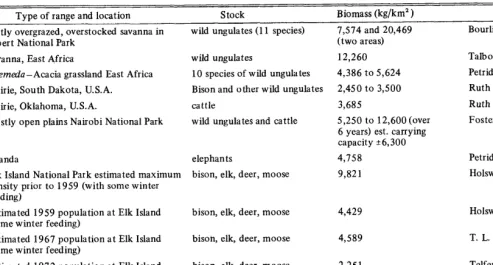
Biological data have been collected by personnel of the Canadian Wildlife Service in order to determine the optimum level of stocking in the pastures at Elk Island. Although internal reports suggested optimum stocking rates for bison (Flook, 19 68) and for cervids (Flook and McGillis, 1968), recent problems with elk mortality led to more detailed studies of the range (Telfer, 1972). The results of those studies have allowed the calculation of the usable surplus of forage (Table l), and the biomass of ungulates that this surplus would support (Table 2).
In estimating the carrying capacity of Elk Island National Park from Telfer’s range survey, the following assumptions were made:
1. A carry-over of 50% of the net yield of the grasses and sedges at the end of the previous growing season was considered desirable (Stoddard and Smith, 1955).
2. A large amount of grass and sedge was available in the
wet meadow type. However, many meadows around the
fringes of sloughs and in glacial kettles are small and are seldom used by bison. On the other hand, some of the large wet meadows are heavily used. It therefore seemed advisable to reduce the weight of usable herbage in the wet meadow type to 25% of the total. That reduction, while arbitrary, reflected the current situation, and it is possible that greater densities of bison might result in increased use of the smaller patches of wet meadow.
3. Winter browse was considered to be the twigs of woody plants found between the heights of 2 ft and 8 ft above the ground. Twigs below 2 ft in height would be buried in the snow during an average winter, while little feeding occurred above 8 ft. Browse estimates included twigs of the ten species of woody plants most important for ungulate browse [hazel