On the (In)Security of IDEA
in Various Hashing Modes
?Lei Wei1, Thomas Peyrin1, Przemys law Soko lowski2, San Ling1, Josef Pieprzyk2, and Huaxiong Wang1
1 Division of Mathematical Sciences, School of Physical and Mathematical Sciences,
Nanyang Technological University, Singapore
[email protected], [email protected] 2
Macquarie University, Australia
Abstract. In this article, we study the security of theIDEAblock cipher when it is used in various simple-length or double-length hashing modes. Even though this cipher is still considered as secure, we show that one should avoid its use as internal primitive for block cipher based hashing. In particular, we are able to generate instantaneously free-start collisions for most modes, and even semi-free-start collisions, pseudo-preimages or hash collisions in practical complexity. This work shows a practical example of the gap that exists between secret-key and known or chosen-key security for block ciphers. Moreover, we also settle the 20-year-old standing open question concerning the security of the Abreast-DM and Tandem-DM double-length compression functions, originally invented to be instantiated withIDEA. Our attacks have been verified experimentally and work even for strengthened versions of IDEA with any number of rounds.
Key words: IDEA, block cipher, hash function, cryptanalysis, colli-sion, preimage
1 Introduction
Hash functions are considered as a very important building block for many security and cryptography applications. Informally, a hash function H is a function that takes an arbitrarily long message as input and outputs a fixed-length hash value of size n bits. In cryptography, we want these functions to fulfill three security requirements, namely collision resistance
and (second)-preimage resistance. It should be impossible for an adversary to find a collision (two different messages that lead to the same hash value) in less than 2n/2 hash computations, or a (second)-preimage (a message hashing to a given challenge) in less than 2nhash computations. Most of nowadays hash functions divide the whole input message into blocks after padding it, and then process the blocks in an iterative way. A very known and utilised example is the Merkle-Damga˚ard algorithm [12, 33], which uses an n-bit compression function h in order to process the m message blocks Mi:CVi+1 =h(CVi, Mi), whereCVi is then-bit internal state (or
chaining variable) that is initialized by a fixed public value CV0 = IV
and the final hash value isHm. This algorithm is very interesting because
it allows to reduce the collision/preimage security of the hash function to the collision/preimage security of the compression function. However, in order to guarantee the soundness of the construction, a designer must ensure that an attacker can not break the collision/preimage resistance of the compression function. One can identify different security properties for a compression function:
• free-start collision: in less than 2n/2 computations, find two different
pairs (CV, M)6= (CV0, M0) such that they lead to the same compres-sion function output value:h(CV, M) =h(CV0, M0),
• semi-free-start collision: in less than 2n/2computations, find one
chain-ing variableCV and two different message blocksM 6=M0 such that they lead to the same compression function output value:h(CV, M) =h(CV, M0),
• preimage: in less than 2n computations, find one chaining variable
CV and one message block M such that they lead to a given output challengeX:h(CV, M) =X.
relevant since there exist a meet-in-the-middle algorithm that in most cases can turn them into a preimage attack for the full hash function.
The separation between a block cipher and a compression function has always been blurry. Constructions are known to turn the former into the latter [7, 36] or the latter into the former [31]. For example, the Davies-Meyer mode [1] converts a secure block cipher E into a secure compres-sion function and is incorporated in a large majority of the currently known hash functions. While very satisfying solutions exist to transform a secure n-bit block cipher into an n-bit compression function (Davies-Meyer, Miyaguchi-Preneel, Matyas-Meyer-Oseas modes [1] or see [7, 36] for a systematic study of this problem), there is still a lot of research being actively conducted on double-block length compression functions (where the block cipher size is n bits and the compression function output size is 2n), from simple-key block ciphers such asAES-128 or double-key such asAES-256 [11].
A major difference between the cryptanalysis of block ciphers and compression functions is that the attacker can fully control the inner be-havior of the compression function. In other words, the attacker can use more efficiently the freedom degrees available on the input (i.e. the num-ber of independent binary variables he has to determine). A new security model for block ciphers, the so-calledknown-key model [24], was recently proposed in order to fill the gap between these two situations. In this model, the secret key is known to the adversary and its goal is to distin-guish the behavior of a random instance of the block cipher from the one of a random permutation by constructing a set of (plaintext, ciphertext) pairs satisfying an evasive property. Such a property is easy to check but impossible to achieve with the same complexity and a non-negligible prob-ability using oracle accesses to a random permutation and its inverse. In general, these known-key attacks are not regarded as problematic when the block cipher is used in a classical “secret key” setting. Moreover, it is rare that such threats are extended to attacks on the compression function.
A potential candidate for hashing is the 64-bit block cipherIDEA[26, 39] that uses 128-bit keys. While a simple-length hashing mode would only provide a 64-bit hash output, insufficient for most of nowadays secu-rity applications, a double-block length construction (DBL) would allow 128-bit hash outputs which can be sufficient in some scenarios. As IDEA
6 of [39]). These modes were later studied in much details [16, 17, 28, 30], but the security they provide when instantiated withIDEA remains a 20-year-old standing open question. In classical “secret key” setting, IDEA
has already been studied a lot [2–6, 9, 10, 13, 18] and is still considered as a secure cipher despite its age and despite the current best attack [5] that requires 263 data (half the codebook) and 2114 computations to recover the secret key for IDEA reduced to 7.5 rounds over a total of 8.5 (the at-tack on the full cipher from [5] is very marginal with 2126.8 computations and the one from [22] requires 2126 computations and 252 chosen plain-texts). One can also cite the work of [6], that exposes a weak-key class of size 264. Note also that a first step towards analysis of IDEA in hashing mode was done in [21] where a 3-round chosen-key attack is described and in [9] where the authors show how to find a free-start near collision (only a subset of the output collides) when IDEA is plugged into the Hi-rose DBL mode [9] (and also a free-start collision if the internal constant c is controlled by the attacker).
particular, one should strictly avoid the use of a block cipher for which weak-keys exist, even if only a single weak-key is known.
2 The IDEA block cipher
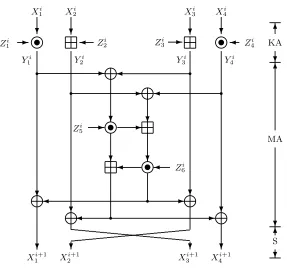
The International Data Encryption Algorithm (IDEA) is a 64-bit block cipher handling 128-bit keys and designed by Lai and Massey [26, 39] in 1990. While its use is reducing over the recent years, it remains deployed in practice and has not been broken yet despite its advanced age. It has a very simple design, performing 8.5 rounds composed of only 16-bit wide XOR, additions and multiplications. More precisely, one round is composed of three layers: first the key addition layer (denoted KA), a multiplication-addition layer (denoted MA) and a middle words switching layer (denoted S). For the eighth round, the switching is omitted.
Let Xi represent the 64-bit internal state of IDEA before applica-tion of the i-th round and we can view it as four 16-bit subwords Xi =
(X1i, X2i, X3i, X4i), with 1≤i≤9. Also,Yi= (Y1i, Y2i, Y3i, Y4i) will stand for the intermediate internal state value ofIDEAduring the i-th round, right between the KA and the MA layers. We denote by ⊕ the bitwise XOR operation, by the addition modulo 216 and by the multiplication modulo 216+ 1, where the value 0 is considered as 216 and vice-versa. Fi-nally, Zi = (Zi
1, Z2i, Z3i, Z4i, Z5i, Z6i) represents the six 16-bit subkeys used
during thei-th round (only the first four subkeys for the last half round). The KA layer simply incorporates four subkeys:
Y1i =X1iZ1i, Y2i=X2iZ2i, Y3i =X3iZ3i, Y4i =X4iZ4i.
The MA layer first computes B = Z6i ((Y2i⊕Y4i)(Z5i (Y1i⊕Y3i))) and A=B(Z5i(Y1i⊕Y3i)). Then, after application of the S layer we have:
X1i+1 =Y1i⊕B, X2i+1 =Y3i⊕B, X3i+1=Y2i⊕A, X4i+1=Y4i⊕A.
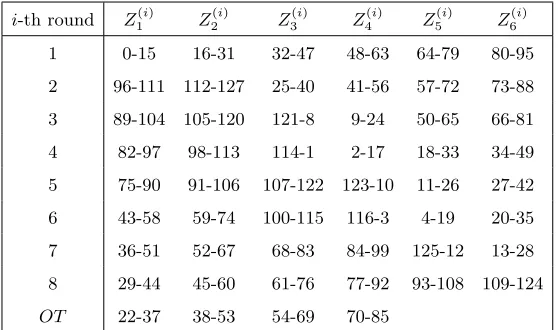
All the subkeys are simply determined by choosing consecutive bits in the 128-bit master key according to the Table 2 given in Appendix A. Finally, ciphering the plaintextP withIDEAto obtain the ciphertextC is defined as:C= KA◦S◦{S◦MA◦KA}8(P). Figure 1 provides a schematic
view of one round ofIDEA.
KA
MA
Z1i
Zi
6 Z5i
Xi
3 X4i Xi
2 Xi
1
Zi
4 Z3i
Zi
2
Y1i Y2i Y3i Y4i
X1i+1 X2i+1 X3i+1 X4i+1
S
Fig. 1.One round ofIDEA
3 Hashing with a double-length key block cipher
We will study the security of the various block cipher-based constructions that can use IDEA as the internal primitive. Therefore, we only consider the ones that use a double-key block cipher. More precisely, we denote C = EK(P) the process of ciphering the 64-bit plaintext P with IDEA
using the 128-bit keyK.
3.1 Simple-length compression function
A simple-length compression function construction withIDEAwill provide a 64-bit output CVi+1.
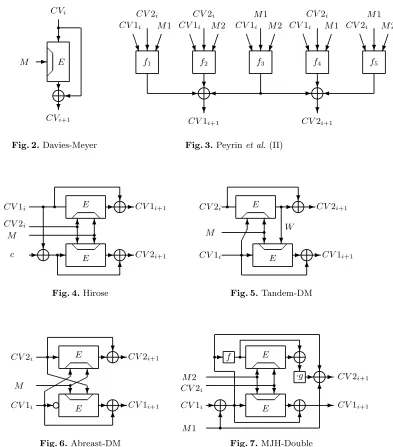
Davies-Meyer is the most usual simple-length mode [1] and it handles 128-bit message blocks:CVi+1 =EM(CVi)⊕CVi. Most standardized hash
and proved in the ideal cipher model [7]. Namely, we should expect at least 232and 264computations respectively to generate a (semi)-free-start collision or preimage for the compression function. Note that Miyaguchi-Preneel and Matyas-Meyer-Oseas simple-block length modes [1] are not considered in this article since they require the internal primitive to have the same block and key size, which is not the case for the IDEA block cipher.
3.2 Double-length compression function
A more interesting design strategy with IDEAwould be to define double-block length constructions, in order to get 128-bit output, represented by two 64-bit wordsCV1iandCV2i. This problem has already been studied
a lot and remains a very active research domain, even when the internal primitive is a double-key block cipher.
Abreast-DM and Tandem-DM will of course be considered in this article since they both have been especially designed for IDEA [27, 39]. Tandem-DM handles a 64-bit message blockM. We defineW =ECV1i||M(CV2i)
and then we have
CV1i+1=EM||W(CV1i)⊕CV1i,
CV2i+1=W ⊕CV2i.
Abreast-DM also handles a 64-bit message block M:
CV1i+1=EM||CV2i(CV1i)⊕CV1i, CV2i+1=ECV1i||M(CV2i)⊕CV2i,
whereX stands for the bitwise complement ofX.
Hirose proposed a construction that contains two independent block cipher instances [19], later improved to only a single instance [20] by using a constant cto simulate the two independent ciphers:
CV1i+1 =ECV2i||M(CV1i)⊕CV1i,
Peyrinet al. described in [35] a compression function (denoted Peyrinet al.(II)) that utilizes 5 calls to independent 3n-to-n-bit compression func-tions, advising to be instantiated with double-key internal block ciphers such as AES-256 or IDEA. It handles two 64-bit message blocks M1 and M2:
CV1i+1=f1(CV1i, CV2i, M1)⊕f2(CV1i, CV2i, M2)⊕f3(CV1i, M1, M2),
CV2i+1=f3(CV1i, M1, M2)⊕f4(CV1i, CV2i, M1)⊕f5(CV2i, M1, M2),
where the functionsfi can be build for example by using theIDEA block
cipher into a Davies-Meyer mode and we can simulate their independency by XORing distinct constants to the plaintext inputs, as it is done in [20]: fi(U, V, W) =EU||V(W⊕i)⊕W (note that XORing the constants on the
key input would be avoided in practice because it would lead to very frequent rekeying and therefore reduce the overall performance of the hash function). Since no real candidate was proposed by the authors, all possible position permutations of the three fi inputs will be considered.
Note that when cryptanalysing this scheme, we will attack the functionsfi
independently. Thus, we will not use any weakness coming from potential dependencies between the functionsfi(apart of course that all 5 functions
are based on IDEA).
MJH-Double is a rate 1 double-block length compression function re-cently published by Lee and Stam [29]. It uses a double-key block cipher and handles two 64-bit message blocks M1 andM2:
CV1i+1=EM2||CV2i(CV1i⊕M1)⊕CV1i⊕M1,
CV2i+1=g·(EM2||CV2i(f(CV1i⊕M1))⊕f(CV1i⊕M1))⊕CV1i,
wheref is an involution with no fixed point andg6= 0,1 is a constant. For all these double-block length proposals, the conjectured security is 264 and 2128 computations respectively to generate a (semi)-free-start collision or preimage for the compression function or hash function. We summarize all of them in Appendix D.
4 Weak-keys for IDEA
biggest possible class of weak-keys, so as to get the highest possible prob-ability that a weak-key will indeed be chosen. In the case of compression function cryptanalysis, the key input is fully known or even controlled by the attacker. The goal is therefore not to find the biggest possible class of weak-keys, but to find the weakest possible key. As we will show for
IDEA, even if only one weak-key is found, its weakness might directly lead to successful attacks on the whole compression or hash function.
4.1 Analysis of the internal functions
When looking at the internal round function of IDEA, one might wonder what would be a weak-key. InIDEA, the most annoying functions for the cryptanalyst are clearly the multiplications in Z216+1. Indeed, these
op-erations are strongly non-linear and provide good diffusion between the different bit positions. On the contrary, XOR operations are linear and do not provide any diffusion between the bit positions, while the additions inZ216 can be easily approximated linearly and the diffusion between the
bit positions only happens through the carry. Moreover, XOR and addi-tions are even weaker in IDEA since no rotations are present, comparing with Addition-Rotation-XOR (ARX) designs. Here the rotation is done through the multiplications in Z216+1 and our goal is therefore to avoid
them.
When adding (a+b) mod 216, we can avoid any diffusion by forcing one operand to 0. When multiplying (ab) = (a·b) mod 216+ 1, the good diffusion will happen especially when (a·b)≥216+ 1. An easy way to avoid this is to fix one of the two operands to 1. In that case, we have (a1) = (a·1) mod 216+ 1 =amod 216. As already remarked in [10], a good choice is also 0, since
(a0) mod 216= ((a·216) mod (216+ 1)) mod 216
= (((a·216+a) + (216+ 1)−a) mod (216+ 1)) mod 216
= (0 + 216+ 1−a) mod 216= 1−amod 216
= 2 + (216−1−a) mod 216= (2 +a) mod 216
and the multiplication is reduced to only a complement and an addition with a constant.
4.2 Weak-keys classes
first obvious candidate is the null key (all bits set to zero), which will force all the subkeys to zero as well. As a consequence, all subkeys additions can be simply removed and all subkeys multiplications can be replaced by a complement (or XOR with 0xffff) and an addition with value 2. At this point, all the operations in IDEA with null key are either XOR or additions. Therefore, by inserting differences only on the Most Signif-icant Bit (MSB) of the four 16-bit plaintext input words, the attacker is ensured that only the MSB of the four output words will contain a difference. Even better, the mapping from an MSB input difference pat-tern to an MSB output difference patpat-tern is completely deterministic (is it linear since on the MSB no carry is propagated). Such a property is largely sufficient to consider the null key as weak. This reasoning can be generalized by observing that the attacker does not necessarily need all subkeys to be null, but only the ones that are multiplied to an internal word which contains a MSB difference. Since the MSB differential paths are quite sparse, many of the null constraints on the subkeys are relaxed and one finally gets 235 weak-keys.
4.3 The null weak-key
We show that the null key is particularly weak for hash function utiliza-tion. Even if other keys belong to a weak-key class, they do not present the same special properties as the null key.
Almost half-involution When using the null key, we remark that all subkeys will be null as well. Then, all rounds layers will be the same and we write KA0 and MA0 the KA and MA layers with null subkeys. A
nice practical feature ofIDEAis that the decryption is done using the very same algorithm as encryption, but with different subkeys. The decryption subkeys for the MA layer are the same as the encryption ones since the MA layer is an involution (i.e. MA=MA−1). The decryption subkeys for the KA layer are the respective multiplicative and additive inverses of the encryption subkeys. However, note that a null subkey is both its own multiplicative and additive inverse and the KA layer becomes an involution as well (i.e. KA0=KA−01). To summarize, using the null key,
we are ensured that KA0=KA−01 and MA0=MA−01. Note that we trivially
Now, since the KA layer and S layer commute,IDEAwith null key can be rewritten as
C= KA0◦S◦ {S◦MA0◦KA0}8(P)
= KA0◦S◦ {S◦MA0◦KA0}3◦S◦MA0◦KA0◦ {S◦MA0◦KA0}4(P)
= KA0◦MA0◦ {S◦KA0◦MA0}3
| {z }
σ−1
◦KA0◦S
| {z }
θ
◦ {MA0◦KA0◦S}3◦MA0◦KA0
| {z }
σ
(P)
which eventually givesC=σ−1◦θ◦σ(P). One can check that since KA0,
MA0 and S are involutions, the operation denoted byσ−1 is indeed the
inverse of the one denoted by σ. Thus, using the notation
P σ −1
−→U −→θ V −→σ C
whereU and V are internal state values, we have
P ←−σ U −→θ V −→σ C.
We will use this almost half-involution property in Section 6 to find free-start collisions and even hash function collisions for someIDEA-based constructions.
T-function: When using the null key, we have already described that all operations remaining are either XOR or additions. These operations are triangular functions [23] (or T-functions) in the sense that any output bit at positionionly depends on the input bits located at a positionior lower. A composition of T-functions is itself a T-function, therefore the whole permutation defined by IDEAwith the null key is a T-function. As shown in [34], this property might be very dangerous in a hash function design. We will explain in Section 7 how to exploit this weakness and compute preimages by guessing the input words bit layer by bit layer.
5 Simple collision attacks
difference only on the MSB and by ∆M SB = (δM SB, δM SB, δM SB, δM SB)
the 64-bit difference composed of 4 words with difference δM SB. Then,
∆M SB propagates to itself with probability 1 through one round ofIDEA,
or through its last half-round. Therefore, we have with probability 1
∆M SB
IDEAK=0
−−−−−−−−−→∆M SB.
Note that instead of using δM SB only, one can generalize the input
difference space and obtain other very good differential paths for the encryption ofIDEAwith the null key. However, we omit this generalization here since the methods described in later sections already provide much better attacks.
Davies-Meyer. Finding a free-start collision on Davies-Meyer mode in-stantiated with IDEA is very easy. Since the difference ∆M SB is mapped
to itself through the IDEA encryption process with the null key, the at-tacker only has to pick M = 0. Then, any value of CV with difference ∆M SB applied to it will lead to a collision with probability 1. We give in
Appendix C.1 examples of such a free-start collision.
Hirose. The same method as for Davies-Meyer mode can be applied to the Hirose mode in order to find free-start collisions. The attacker fixes CV2 = 0 and M = 0 so as to force the null key to both encryptions. Then, any value of CV1 with a difference ∆M SB applied to it will lead
to a collision with probability 1, since∆M SB will appear on the plaintext
input of both encryptions with the null key. We give in Appendix C.3 examples of such a free-start collision.
Abreast-DM. This technique seems impossible to apply to the Abreast-DM mode since forcing a difference∆M SB on any of the two encryptions
plaintext input will imply a difference inserted in the key input of the other encryption block. Therefore, one cannot use ∆M SB difference on
plaintext input with null key in both encryption blocks. Even if the at-tacker tries to attack only one encryption block with this method, the other block will not be controlled and he will have to deal with random differences on its output. These random differences cannot be dealt with some birthday technique because fixing all inputs of one encryption block will fix all inputs of the other one as well.
Peyrin et al.(II). We have to separate in two groups the possible in-stances of this construction, obtained by permuting the position of the three inputs of each internal functionfi. If all compression function inputs
CV1, CV2, M1 and M2 appear in at least one of the IDEA key inputs of any fi internal function, then the attack will not apply. Indeed, since
all inputs will be involved at least one time, the attacker will necessarily have to insert a difference in at least one IDEA key input and he will not be able to use the differential path with probability 1. Note that these instances would be avoided in practice because they would lead to more frequent re-keying and therefore reduce the overall performance of the hash function. If this condition is not met, then we can apply the fol-lowing free-start collision attack. Let X ∈ {CV1, CV2, M1, M2} denote the input that is missing in all the IDEA key inputs of the compression function. The attacker simply fixes the difference ∆M SB on X (one can
give any value to X) and all other inputs are set to 0 in order to get the null key in every internal IDEA. The attacker ends up with several Davies-Meyer in parallel, with either no difference at all or with null key and∆M SB as plaintext input difference. Thus, he obtains a collision with
probability 1. If X 6∈ {CV1, CV2}, then this attack finds semi-free-start collisions.
MJH-Double. The MJH-Double mode prevents this simple attack since even if we fix CV2 = 0 and M2 = 0 in order to get the null key in both encryptions, it is hard to force the difference ∆M SB on both their
plaintext inputs. Indeed, the f operation will randomize the difference
and in order for the attack to run, we would require ∆M SB f
−→ ∆M SB
which is unlikely to happen.
6 Improved collision attacks
6.1 Exploiting the almost half-involution
We have already shown in Section 4 that when the key is null, IDEA
encryption process can be rewritten as
P ←−σ U −→θ V −→σ C
where
σ ={MA0◦KA0◦S}3◦MA0◦KA0 and θ= KA0◦S.
We denote∆U the XOR difference between two 64-bit internal state valuesU andU0, i.e∆U =U⊕U0, andδUirepresents the 16-bit difference
on thei-th word of∆U, that is∆U= (δU1, δU2, δU3, δU4). Let us consider
two random 64-bit internal state values U and U0 such that δU2 = δU3
and we denote this 16-bit difference δM. For truly random values U and
U0, this condition happens with probability 2−16. One can check that applying θ on U and U0 to obtain V and V0 respectively will lead to δV2 = δV3 = δM since layer S only switches the two middle words and
layer KA0 has no effect on them (addition of null subkeys).
Let δL and δR represent the difference on δU1 and δU4 respectively,
i.e. ∆U = (δL, δM, δM, δR). Applying function θ to U and U0, we
would like the same differences to appear on internal state V and V0: ∆V = (δL, δM, δM, δR). The previous condition with probability 2−16
al-ready ensures the two middle differences being the same δM. Concerning
differences δL and δR, they will both be unaffected by layer S, but they
might be modified through layer KA0 that applies a multiplication with
a null subkey. Therefore, we need to study the probability that a random differenceδ is mapped to itself through a multiplication by the null sub-key. We show in Appendix B that this probability is equal to 2−1.585 and
finally we have Pr[(δL, δM, δM, δR) θ
−→(δL, δM, δM, δR)] = 2−3.17.
At this point, we proved that for randomly chosen internal state values U andU0, we will observe with probability 2−19.17 the same difference on U andV, i.e.∆U =∆V.
V =θ(U) withθbeing a very light function. Moreover, we remarked that almost each time that we got the same difference on P and C, the same differences were observed as well in all rounds of the forward and back-ward σ computations (the round success probability increasing with the number of rounds already processed). Because all the rounds are not in-dependent and becauseU andV are strongly related, it is very difficult to compute theoretically the probability of observing the same difference on P and C and we leave this as an open problem. Therefore, we measured it by choosing random values of U, δL, δM, δR, computing V = θ(U),
and checking for collisions on the difference ofP andC. The probability obtained was 2−16.26 for about 228tests (note that this probability some-how contains the 2−3.17probability computed previously, but we can not separate them because the two events are not independent).
To conclude, the probability that two randomly chosen internal state valuesU andU0give the same difference onP andCis equal to 2−16−16.26= 2−32.26 (instead of 2−64expected for a random function). In other words,
using the birthday paradox, one can find such a pair with about 216.13 computations.
Interestingly, we have observed that most of the pairs fulfilling the differential path for the full IDEA will also be valid for a strengthened version of the cipher with any number of additional rounds. Since the subkeys are always null, strengthening the cipher would mean that σ = {MA0 ◦ KA0 ◦S}t◦ MA0 ◦KA0 for any t > 3. We checked that the
probability that two randomly chosen internal state values U and U0 give the same difference on P and C tends to 2−32.54 when t tends to infinite. Thus, similarily to the method presented in the previous section, the attacks using this almost half-involution property will work for any number of rounds.
6.2 Improving collision attacks
Davies-Meyer. A first obvious application of having the same difference in P and C is collision search on Davies-Mayer mode, where the feed-forward will cancel the two differences in the output. The attack finds collisions for the whole hash function and the procedure is very simple: we start from the IV and add random differences in the first message block M0. This will cause random differences in the the first chaining
variable CV1. For the second message block M1, we will set all its bits 0
(M1 = 0), forcing the internalIDEAcomputation to use the null key. Since
pair of inputs has a probability 2−32.26 to give the same input/output difference, one can use the birthday paradox to generate a collision on CV2with only 216.13distinct message blocksM0. We give in Appendix C.2
examples of hash collisions for the Davies-Meyer mode. Note that finding semi-free-start collisions with this technique is impossible since we would have to insert differences in the message input, which forbids the use of the null key in the internal cipher.
Hirose. We already showed how to find free-start collisions for the Hi-rose mode. However, finding semi-free-start collisions with this technique is impossible since we would have to insert differences in the message input, which forbids the use of the null key in the internal cipher. Also, concerning hash collisions, it seems hard as well because forcing the null key during iterationirequires us to obtain a chaining variableCV2i−1= 0
during the previous iteration. This half-preimage already costs the same complexity as a generic collision search on the entire compression func-tion.
Abreast-DM. One can derive a free-start collision attack for the Abreast-DM compression function using this technique. The attacker first fixes CV1 = 0 andM = 0. Then, he builds a set of 248.13 distinct values CV2 and checks if a pair of this set leads to a collision. The probability that a pair leads to a collision on the first (top) branch is 2−32.26 (since the internal cipher on this part has the null key), and 2−64 on the other half. Overall, using the birthday paradox on the set of 248.13 values CV2 is sufficient to have a good chance to obtain a collision. Note that finding a semi-free-start collision for the compression function or a collision for the hash function seems impossible with this method, for the same reasons as the Hirose mode.
for the compression function or a collision for the hash function seems impossible with this method, for the same reasons as the Hirose mode.
Peyrin et al.(II). We showed in previous section how to find (semi)-free-start collisions with probability 1 for a certain subset of Peyrin et al.(II) constructions, but here we provide attacks on a bigger subset. If all compression function inputs CV1, CV2, M1 and M2 appear in at least one of the IDEA key inputs of f1, f2, f3 (left side) and in at least
one of theIDEA key inputs of f3,f4,f5 (right side), then the attack will
not apply. Indeed, for both left side and right side of the compression function, the attacker will necessarily have to insert a difference in at least one key input (since all inputs will be involved) and he will not be able to use the null key completely. Note that these instances would be avoided in practice because they would lead to more frequent rekeying and therefore reduce the overall performance of the hash function. However, if this condition is not met, then we can apply the following free-start collision attack. Let X ∈ {CV1, CV2, M1, M2} denote the input that is missing in all the IDEA key inputs of f1, f2, f3 (wlog the reasoning
is the same with f3, f4, f5). The attacker first fixes all inputs but X
to 0 in order to get the null key in every internal IDEA on the left side. Then he chooses 248.13 random values for X and checks among them if any pair collides on the whole compression function output. Since he has a probability 2−32.26 to get a collision on the left side and 2−64 on the right side, using a birthday search the attacker finds a solution with complexity 248.13. Again, ifX6∈ {CV1, CV2}, then this attack finds semi-free-start collisions. However, finding a collision for the hash function seems impossible with this method, because at least one of the chaining variable inputsCV1 andCV2 will be present as key input for one of the
IDEA internal emcryption. Setting this word to 0 is equivalent to a half-preimage that already costs the same complexity as a generic collision search on the entire hash function.
M1 leads to a collision after the feed-forward of both encryptions (on the output of the bottom block and just before the application of g on the top block). Therefore, with a birthday technique, one can find such a pair with only 232.26computations. Note that while this pair will directly lead to a collision on the bottom CV1 output, the difference on M1 is injected two times before computing the top CV2 output. Two times of the same difference will cancel themselves and we eventually get a full semi-free-start collision. Note that it seems hard to extend this attack to a hash collision since the attacker would require to force the incoming chaining variable CV2 to be equal to 0 and this half-preimage already costs the same complexity as a generic collision search on the entire hash function.
7 Preimage attacks
We showed in Section 4 that if used with the null key, the whole permu-tation defined byIDEA is a T-function. Since any output bit at positioni only depends on the input bits located at a positioni or lower, we reuse the idea of preimage attack for hash functions based on T-functions [34] where the preimage is computed bit layer by bit layer, starting from the LSB. However, here our situation is different than the functions studied in [34] since we do not have any truncation or reduction of the internal state at the end of the process.
We denote by p the probability that given a random challenge, our algorithm outputs a preimage for this challenge. We denote bys the av-erage number of preimage solutions that the algorithm will output, given that at least one is found. The average number of solutions outputted by our algorithm is thenA=s·p. For ann-bit ideal compression function, a generic attack restricted toCcomputations can generateA=C·2−n so-lutions on average. Thus, we can consider that a preimage attack is found if we exhibit an algorithm that outperforms this generic complexity.
Davies-Meyer. Since the key is fixed to 0 and since the plaintext and ciphertext sizes are the same, we trivially have that A = 1. We mea-sured3 that p= 2−17.50, thus we directly deduce thats=A/p= 217.5. A straightforward implementation is a recursive depth first search, attack-ing the T-function by bit layer from the LSB to the MSB of the 16-bit state words. Wrong candidates at lower layers are discarded thanks to
3
an early-abort strategy. On average, the amount of IDEA encryptions re-quired to find all the possible preimages (if at least one can be found) can be estimated as C '16·24·s= 225.5, since we have 16 bit layers, each having 4 bits of input, and on average the number of candidates in one layer is s. This is a very conservative estimation since only p= 2−17.50 of the challenges on average will eventually lead to a solution and the early-abort strategy will make the actual search of very low complexity. In the ideal case, withC = 225.5 computations allowed, an attacker should only be able to generate A = 225.5−64 = 2−38.5 solutions on average for an ideal 64-bit compression function. We give an example of a preimage in Appendix C.4.
Hirose. We can reuse the attack on Davies-Meyer, but only one of the two branches will be controlled, with the other behaving randomly. We first find a preimage for the first branch (with probability 2−17.5) and then use the 217.5 solutions on average to also match the second branch (with probability 217.5−64 = 2−46.5). Therefore, our preimage search al-gorithm have parameters p = 2−17.5−46.5 = 2−64 and s = 1, while the average number of preimage solutions found isA= 2−64. The complexity of the search is equivalent to the Davies-Meyer case, C = 225.5. For an attacker using at most 225.5computations on an ideal 128-bit compression function, the average number of solutions he could find is only 2−102.5.
Abreast-DM. Similarly to Hirose, by setting for example M =CV1 = 0, one can attack one branch bit layer by bit layer while the other branch will behave randomly. The complexity analysis is identical to Hirose’s case.
Tandem-DM. Similarly to Hirose, by setting M = CV1 = 0, one can attack one branch bit layer by bit layer while the other branch will behave randomly. The complexity analysis is identical to Hirose’s case.
Peyrin et al.(II). If all compression function inputs CV1, CV2, M1 and M2 appear in at least one of the IDEA key inputs of f1, f2,f3 (left
side) and in at least one of the IDEAkey inputs of f3,f4,f5 (right side),
then the attack will not apply (because the attacker will not be able to use the null key completely). Otherwise, similarly to Hirose, by setting all
MJH-Double. The attacker first fixesM2 =CV2 = 0 so as to get the null key for bothIDEA encryptions. Then, similarly to the Davies-Meyer case, he find a preimage with probability p = 2−17.5 for one of the two sides and this defines the value ofM1⊕CV1. In order to get the preimage on the second side as well, the attacker only has to modify the value ofM1 accordingly. If a solution is found on the first side, the attacker therefore gets s = 217.5 preimages. On average, he finds A = 1 solutions and the complexity is again 225.5 computations. For an attacker using at most 225.5 computations on an ideal 128-bit compression function, the average number of solutions he should find is only 2−102.5.
8 Results and implementations
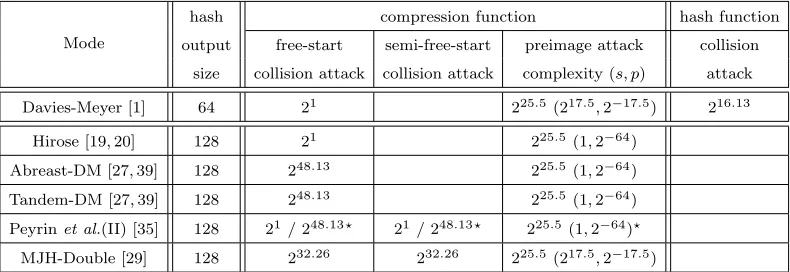
We depict in Table 1 our results for the block cipher to compression function modes considered in this article when instantiated with IDEA. We implemented all attacks of reasonable complexities and provide in Appendix C the collision/preimage examples obtained.
Table 1. Summary of results for block cipher to compression function modes when instantiated withIDEA(we did not include MDC-2 as it does not provide ideal collision resistance). The preimage complexity results findspreimages on average with a certain probabilityp, for a total average ofA=s·psolutions. The results for Peyrinet al.(II) construction, marked with a *, depend on the instance considered (see relevant parts of Sections 5, 6 and 7 for more details).
Mode
hash compression function hash function
output free-start semi-free-start preimage attack collision
size collision attack collision attack complexity (s, p) attack
Davies-Meyer [1] 64 21 225.5(217.5,2−17.5) 216.13 Hirose [19, 20] 128 21 225.5(1,2−64)
Abreast-DM [27, 39] 128 248.13 225.5(1,2−64) Tandem-DM [27, 39] 128 248.13 225.5(1,2−64) Peyrinet al.(II) [35] 128 21/ 248.13? 21 / 248.13? 225.5 (1,2−64)?
MJH-Double [29] 128 232.26 232.26 225.5(217.5,2−17.5)
Conclusion
when instantiated with the block cipher IDEA. Namely, we analyzed all known double-key schemes such as Davies-Meyer, Hirose, Abreast-DM, Tandem-DM, Peyrin et al. (II) and MJH-Double. While most of these constructions are conjectured or proved to be secure in the ideal cipher model, we showed that their security is very weak when instantiated with the block cipher IDEA, which remains considered as secure in the secret key model. In particular, we answer in the negative for the 20-year-old standing open question concerning the security of the Abreast-DM and Tandem-DM instantiated with IDEA. All our practical attacks have been implemented and they can work even for any number ofIDEArounds. Our results indicate that one has to be very careful when hashing with a block cipher that presents any weakness when the key is known or controlled by the attacker. Also, since we extensively use the presence of weak-keys for
IDEA, as a future work it would be interesting to look at the security of hash functions based on block ciphers for which some key sets are known to be weaker than others.
Acknowledgments
The authors would like to thank the anonymous referees for their helpful comments.
References
1. A. Menezes, P. van Oorschot, and S. Vanstone. CRC-Handbook of Applied Cryp-tography. CRC Press, 1996.
2. Ey¨up Serdar Ayaz and Ali Aydin Sel¸cuk. Improved DST Cryptanalysis of IDEA. In Eli Biham and Amr M. Youssef, editors,Selected Areas in Cryptography, volume 4356 ofLecture Notes in Computer Science, pages 1–14. Springer, 2006.
3. Eli Biham, Orr Dunkelman, and Nathan Keller. New Cryptanalytic Results on IDEA. In Lai and Chen [25], pages 412–427.
4. Eli Biham, Orr Dunkelman, and Nathan Keller. A New Attack on 6-Round IDEA. In Alex Biryukov, editor,FSE, volume 4593 ofLecture Notes in Computer Science, pages 211–224. Springer, 2007.
5. Eli Biham, Orr Dunkelman, Nathan Keller, and Adi Shamir. New Data-Efficient Attacks on Reduced-Round IDEA. Cryptology ePrint Archive, Report 2011/417, 2011.
6. Alex Biryukov, Jorge Nakahara Jr., Bart Preneel, and Joos Vandewalle. New Weak-Key Classes of IDEA. In Robert H. Deng, Sihan Qing, Feng Bao, and Jianying Zhou, editors,ICICS, volume 2513 ofLecture Notes in Computer Science, pages 315–326. Springer, 2002.
8. Gilles Brassard, editor.Advances in Cryptology - CRYPTO ’89, 9th Annual Inter-national Cryptology Conference, Santa Barbara, California, USA, August 20-24, 1989, Proceedings, volume 435 ofLNCS. Springer, 1990.
9. Donghoon Chang. Near-Collision Attack and Collision-Attack on Double Block Length Compression Functions based on the Block Cipher IDEA. Cryptology ePrint Archive, Report 2006/478, 2006. http://eprint.iacr.org/.
10. Joan Daemen, Ren´e Govaerts, and Joos Vandewalle. Weak Keys for IDEA. In Stinson [37], pages 224–231.
11. Joan Daemen and Vincent Rijmen. The Design of Rijndael: AES - The Advanced Encryption Standard. Springer, 2002.
12. Ivan Damg˚ard. A Design Principle for Hash Functions. In Brassard [8], pages 416–427.
13. H¨useyin Demirci, Ali Aydin Sel¸cuk, and Erkan T¨ure. A New Meet-in-the-Middle Attack on the IDEA Block Cipher. In Matsui and Zuccherato [32], pages 117–129. 14. Bert den Boer and Antoon Bosselaers. Collisions for the Compressin Function of
MD5. InEUROCRYPT, pages 293–304, 1993.
15. Hans Dobbertin. Cryptanalysis of MD5 compress. Presented at the rump session of EUROCRYPT 1996, 1996.
16. Ewan Fleischmann, Michael Gorski, and Stefan Lucks. On the Security of Tandem-DM. In Orr Dunkelman, editor,FSE, volume 5665 ofLecture Notes in Computer Science, pages 84–103. Springer, 2009.
17. Ewan Fleischmann, Michael Gorski, and Stefan Lucks. Security of Cyclic Double Block Length Hash Functions including Abreast-DM. Cryptology ePrint Archive, Report 2009/261, 2009. http://eprint.iacr.org/.
18. Philip Hawkes. Differential-Linear Weak Key Classes of IDEA. InEUROCRYPT, pages 112–126, 1998.
19. Shoichi Hirose. Provably Secure Double-Block-Length Hash Functions in a Black-Box Model. In Choonsik Park and Seongtaek Chee, editors,ICISC, volume 3506 ofLecture Notes in Computer Science, pages 330–342. Springer, 2004.
20. Shoichi Hirose. Some Plausible Constructions of Double-Block-Length Hash Func-tions. In Matthew J. B. Robshaw, editor,FSE, volume 4047 ofLecture Notes in Computer Science, pages 210–225. Springer, 2006.
21. John Kelsey, Bruce Schneier, and David Wagner. Key-Schedule Cryptoanalysis of IDEA, G-DES, GOST, SAFER, and Triple-DES. In Neal Koblitz, editor,
CRYPTO, volume 1109 of Lecture Notes in Computer Science, pages 237–251. Springer, 1996.
22. Dmitry Khovratovich, Gaetan Leurent, and Christian Rechberger. Narrow Bi-cliques: Cryptanalysis of Full IDEA. InEUROCRYPT, 2012, to appear.
23. Alexander Klimov and Adi Shamir. Cryptographic Applications of T-Functions. In Matsui and Zuccherato [32], pages 248–261.
24. Lars R. Knudsen and Vincent Rijmen. Known-Key Distinguishers for Some Block Ciphers. In Kaoru Kurosawa, editor,ASIACRYPT, volume 4833 ofLNCS, pages 315–324. Springer, 2007.
25. Xuejia Lai and Kefei Chen, editors. Advances in Cryptology - ASIACRYPT 2006, 12th International Conference on the Theory and Application of Cryptology and Information Security, Shanghai, China, December 3-7, 2006, Proceedings, volume 4284 ofLecture Notes in Computer Science. Springer, 2006.
27. Xuejia Lai and James L. Massey. Hash Function Based on Block Ciphers. In
EUROCRYPT, pages 55–70, 1992.
28. Jooyoung Lee and Daesung Kwon. The Security of Abreast-DM in the Ideal Cipher Model. Cryptology ePrint Archive, Report 2009/225, 2009.http://eprint.iacr. org/.
29. Jooyoung Lee and Martijn Stam. MJH: A Faster Alternative to MDC-2. In Aggelos Kiayias, editor,CT-RSA, volume 6558 ofLecture Notes in Computer Science, pages 213–236. Springer, 2011.
30. Jooyoung Lee, Martijn Stam, and John P. Steinberger. The Collision Security of Tandem-DM in the Ideal Cipher Model. In Phillip Rogaway, editor,CRYPTO, volume 6841 ofLecture Notes in Computer Science, pages 561–577. Springer, 2011. 31. Michael Luby and Charles Rackoff. How to Construct Pseudorandom Permutations
from Pseudorandom Functions. SIAM J. Comput., 17(2):373–386, 1988.
32. Mitsuru Matsui and Robert J. Zuccherato, editors.Selected Areas in Cryptography, 10th Annual International Workshop, SAC 2003, Ottawa, Canada, August 14-15, 2003, Revised Papers, volume 3006 ofLecture Notes in Computer Science. Springer, 2004.
33. Ralph C. Merkle. One Way Hash Functions and DES. In Brassard [8], pages 428–446.
34. Fr´ed´eric Muller and Thomas Peyrin. Cryptanalysis of T-Function-Based Hash Functions. In Min Surp Rhee and Byoungcheon Lee, editors,ICISC, volume 4296 ofLecture Notes in Computer Science, pages 267–285. Springer, 2006.
35. Thomas Peyrin, Henri Gilbert, Fr´ed´eric Muller, and Matthew J. B. Robshaw. Combining Compression Functions and Block Cipher-Based Hash Functions. In Lai and Chen [25], pages 315–331.
36. Bart Preneel, Ren´e Govaerts, and Joos Vandewalle. Hash Functions Based on Block Ciphers: A Synthetic Approach. In Stinson [37], pages 368–378.
37. Douglas R. Stinson, editor. Advances in Cryptology - CRYPTO ’93, 13th Annual International Cryptology Conference, Santa Barbara, California, USA, August 22-26, 1993, Proceedings, volume 773 ofLecture Notes in Computer Science. Springer, 1994.
38. Xiaoyun Wang and Hongbo Yu. How to Break MD5 and Other Hash Functions. In Ronald Cramer, editor, EUROCRYPT, volume 3494 of LNCS, pages 19–35. Springer, 2005.
39. Xuejia Lai. On the Design and Security of Block Ciphers. Hartung-Gorre Verlag, Konstanz, 1992.
A The IDEA subkeys
B Proof of difference preservation through multiplication
with a null subkey
We prove in this section that for randomly chosen values aand a0 with a⊕a0 =δ, the probability that the differenceδ is preserved after multi-plication by the null subkey is equal to 2−1.585. The condition we expect can be translated into the following equation
i-th round Z1(i) Z (i)
2 Z
(i)
3 Z
(i)
4 Z
(i)
5 Z
(i) 6
1 0-15 16-31 32-47 48-63 64-79 80-95
2 96-111 112-127 25-40 41-56 57-72 73-88 3 89-104 105-120 121-8 9-24 50-65 66-81
4 82-97 98-113 114-1 2-17 18-33 34-49
5 75-90 91-106 107-122 123-10 11-26 27-42 6 43-58 59-74 100-115 116-3 4-19 20-35 7 36-51 52-67 68-83 84-99 125-12 13-28 8 29-44 45-60 61-76 77-92 93-108 109-124
OT 22-37 38-53 54-69 70-85
Table 2.Key bits used for subkeysZj(i) in thei-th round ofIDEA
Since the operation is equivalent to a complement (or XOR with
0xffff) and an addition with value 2, we can rewrite
δ= ((a⊕0xffff) + 2)⊕((a0⊕0xffff) + 2) δ= ((a⊕0xffff) + 2)⊕((a⊕δ⊕0xffff) + 2)
δ= (b+ 2)⊕((b⊕δ) + 2)
δ⊕(b+ 2) = (b⊕δ) + 2
whereb=a⊕0xffff. One can check that the least significant bit condi-tion of this equacondi-tion is always fulfilled.
If the second least significant bit of b is 0 (probability 1/2), then (b+ 2) =b⊕2 and the equation is fulfilled if and only if the second least significant bit of (b⊕δ) is also 0 (probability 1/2). Overall, this situation happens with probability 1/4.
If the second least significant bit of bis 1 (probability 1/2), then we will have a carry propagating and we require the second least significant bit of (b⊕δ) to be also 1 (probability 1/2). If the third least significant bit ofbis 0 (probability 1/2), then (b+ 2) =b⊕6 and the equation is fulfilled if and only if the third least significant bit of (b⊕δ) is also 0 (probability 1/2). Overall, this situation happens with probability (1/4)2.
Continuing this reasoning over all the bits layers, we obtain that the success probability is equal to
14
X
i=1
C Collision and preimage examples
C.1 Free-start collision for Davies-Meyer mode
CVi:0x9efc 0x14ef 0x85d6 0xc557
CVi0 :0x1efc 0x94ef 0x05d6 0x4557
M =M0 :0
CVi+1=H(CVi, M) :0x7f11 0x83f1 0x7617 0x8af3
CVi+10 =H(CVi0, M0) :0x7f11 0x83f1 0x7617 0x8af3
C.2 Hash function collision for Davies-Meyer mode
We use as initial value the first 64 output bits of the SHA-2computation of the string “IDEA”:
SHA-2(”IDEA”) = ”9f8c7b26cde59ca3dacc74ec7afda737ac1d15aa5239206416f79019dbd7ec37”
IV:IV1=0x9f8c,IV2 =0x7b26,IV3=0xcde5,IV4 =0x9ca3
M1:0xdacc 0xdacc 0xdacc 0xdacc 0xdacc 0xdacc 0xcadc 0x0282
M10:0xdacc 0xdacc 0xdacc 0xdacc 0xdacc 0xdacc 0xcade 0x1a3f
CV1=H(IV, M1):0xb782 0x4583 0x83b6 0x0bef
CV10 =H(IV, M10):0x1ce2 0x8553 0xe656 0x4387
CV2=H(CV1,0):0xdffd 0x3ffd 0x8e7d 0x6e7d
CV20 =H(CV10,0): 0xdffd 0x3ffd 0x8e7d 0x6e7d
C.3 Free-start collision for Hirose mode
For Hirose mode, we used as constant c the first 64 output bits of the
SHA-2 computation of the string “IDEA”:
SHA-2(”IDEA”) = ”9f8c7b26cde59ca3dacc74ec7afda737ac1d15aa5239206416f79019dbd7ec37”
c:0x9f8c 0x7b26 0xcde5 0x9ca3
CV1i :0x93e8 0x4d86 0x45a5 0xa829
CV2i =CV20i :0
M =M0 :0
CV1i+1:0x2101 0x23c9 0xde42 0xdc96
CV10i+1:0x2101 0x23c9 0xde42 0xdc96
CV2i+1:0x0009 0x0401 0x3d38 0x3934
CV20i+1:0x0009 0x0401 0x3d38 0x3934
C.4 Preimage for Davies-Meyer mode
Since a random 64-bit challenge has preimage(s) with a probabilityp, we show the preimage of a challenge which we are sure at least one preimage exists (similar to a second-preimage search). In order to get the challenge, we use as input the first 64 output bits of theSHA-2 computation of the string “IDEA”, and provide one of the preimages found:
SHA-2(”IDEA”) = ”9f8c7b26cde59ca3dacc74ec7afda737ac1d15aa5239206416f79019dbd7ec37”
The challengeH(0x9f8c7b26cde59ca3,0) :0x20ad1fc924e61ba2
CVi+1=H(CVi, M) :0x20ad 0x1fc9 0x24e6 0x1ba2
M :0
CVi:0x1860 0x002e 0x2d82 0x0200
CViis one preimage out of 223.585forCVi+1, the search takes 225.486 IDEA
CVi+1 CVi
E M
Fig. 2.Davies-Meyer
f1 f2 f3 f4 f5
CV1i+1 CV2i+1 CV1i
M1
M2
CV1i
CV2i
M1 CV1i
CV2i
M2 CV1i
CV2i
M1 CV2i
M1
M2
Fig. 3.Peyrinet al.(II)
c
E
E
CV1i+1 CV1i
CV2i
M
CV2i+1
Fig. 4.Hirose
M
CV2i+1 CV2i
W E
CV1i+1
CV1i E
Fig. 5.Tandem-DM
CV1i
M
CV2i E CV2i+1
CV1i+1 E
Fig. 6.Abreast-DM
CV1i+1 E
CV2i
f
M2
CV1i E
M1
CV2i+1
·g