A Modular Framework for Multi-Factor
Authentication and Key Exchange
?Nils Fleischhacker1, Mark Manulis2, and Amir Azodi3 1
Saarland University, Germany
Surrey Centre for Cyber Security, University of Surrey, UK
Hasso Plattner Institute, Germany
Abstract. Multi-Factor Authentication (MFA), often coupled with Key Exchange (KE), offers very strong protection for secure communication and has been recommended by many major governmental and industrial bodies for use in highly sensitive applications. Over the past few years many companies started to offer various MFA services to their users and this trend is ongoing.
The MFAKE protocol framework presented in this paper offers`a la carte design of multi-factor au-thentication and key exchange protocols by mixing multipletypes and quantities of authentication factors in a secure way: MFAKE protocols designed using our framework can combine any subset of multiple low-entropy (one-time) passwords/PINs, high-entropy private/public keys, and biometric fac-tors. This combination is obtained in a modular way from efficient single-factor password-based, public key-based, and biometric-based authentication-only protocols that can be executed in concurrent ses-sions and bound to a single session of an unauthenticated key exchange protocol to guarantee forward secrecy.
The modular approach used in the framework is particularly attractive for MFAKE solutions that require backward compatibility with existing single-factor authentication solutions or where new fac-tors should be introduced gradually over some period of time. The framework is proven secure using the state-of-the art game-based security definitions where specifics of authentication factors such as dictionary attacks on passwords and imperfectness of the biometric matching processes are taken into account.
Keywords: two-factor, multi-factor authentication, tag-based authentication, key exchange, frame-work, modular design
1
Introduction
Authentication Factors An authentication factor is used to produce some evidence that an entity at the end of the communication channel is the one which it claims to be. Modern computer security knows different types of authentication factors, all of which are widely used in practice. Their standard classification considers three main groups (see e.g. [20]), characterized by the nature of provided evidence: knowledge, possession, and physical presence. The evidence of knowledge is typically offered by low-entropypasswords. These include memorizable (long-term) passwords or PINs, e.g. for login purposes and banking ATMs, and one-time passwords that are common to many online banking and e-commerce transactions. The evidence of possession corresponds to physical devices such as smart cards, tokens, or TPMs, equipped with long-term (high-entropy) secret keys and some cryptographic functionality. These devices have tamper-resistance to protect secret keys from exposure. The evidence of physical presence refers to uniquebiometric identifiers of human beings. These may include face profile, finger prints, iris images, or behavioral characteristics such as gait or voice, and are used in access control systems and many electronic passports.
?A shorter version of this paper appears in the proceedings of the 1st International Conference on Research in
A different approach might be needed for an attacker to compromise a particular factor, depending on its type and use. For instance, passwords are susceptible to social engineering (e.g. phishing) and dictionary attacks. Digital devices can be lost or stolen. Those offering tamper-resistance may nonetheless fall to reverse-engineering [21,22], side-channel attacks [19], and trojans (e.g. recent Sykipot Trojan attacks against smart cards). Biometric data can be obtained from a physical contact with the human or copied if available in a digital form. Since the number of personal biometrics that permit efficient use in security technologies is limited, their wide use across different application domains makes it even harder to keep those factors private.
Multi-Factor Authentication (with Key Exchange) The strength of Multi-Factor Authentication (MFA) is based on the assumption that if an entity has many authentication factors, regardless of their nature, then it is hard for the attacker to compromise them all. That is, by combining different factors within a single authentication process, MFA aims at higher assurance in comparison to single-factor schemes. MFA has found its way into practice4, most notable are combinations of long-term passwords with secret keys, possibly stored in tokens (e.g. Two-Factor SSH with USB sticks) or any of these with one-time passwords (e.g. OATH HOTP/TOTP, RSA SecurID, Google Authenticator). Many companies, e.g. Google, Facebook, Yahoo are now offering their users optional two-factor authentication mechanisms based on one-time pass-words. The increasing use of smart phones to access services and the recent progress by Apple and Samsung to equip smart phones with fingerprint readers is expected to further boost the practical deployment of the MFA technology. Since MFA is mostly used to authenticate a client/user to a remote server the authenti-cation of the client becomes its main security goal. The server-side authentiauthenti-cation in MFA protocols offers further protection and is typically performed without using multiple factors on the server side.
The concept of Multi-Factor Authenticated Key Exchange (MFAKE), formalized in [36], extends MFA with establishment of secure session keys. In addition to authentication goals it aims at key secrecy, usu-ally modeled in terms of (Bellare-Rogaway style) AKE-security [8,10,16]. Earlier MFAKE protocols focused mostly on two factors and were often unsuccessful: for instance, password-token combination from [34] was broken in [40] which itself was broken in [31], the scheme from [37] was cryptanalyzed in [39], and a biometric-token combination from [32] has fallen in [33]. Partially, these attacks were due to the missing modeling and analysis in those works.
A formal approach to MFAKE introduced in [36] was the first to account simultaneously for all three types of authentication factors. Most notable is their modeling of biometric factors. Unlike some previous single-factor biometric schemes, e.g. [18,12], that regarded biometrics as low- or high-entropy secrets, [36] drops biometric secrecy in favor of the liveness assumption (see also [15,14]) aiming at physical presence of a user. The protocol from [36] has recently been cryptanalysed in [26], who showed how an adversary that steals user’s password and impersonates the server can essentially compromise all other authentication factors of the client. The model in [36] didn’t consider server authentication and the only way to prevent the above attack against the protocol is to require mandatory authentication on the server side. The protocol would remain insecure if server authentication is left optional (as intended by the model) due to the way in which client messages bind different authentication factors together, as also exploited in [26].
MFAKE protocols may differ not only in nature of factors but also in their quantity. To this end, [38] introduced Multi-Factor Password AKE (MFPAKE), extending the PAKE setting [7], where arbitrary many low-entropy passwords (long-term and one-time) can be combined to authenticate the client. Their protocol further offers public-key based server-side authentication and supports verifier-based PAKE setting from [23,24].
4 MFA definitions and usage in practice are not consistent. For example, according to [1, Sec. 8.3], for two-factor
Generalized and Modular MFAKE Approach? Various problems in the design of secure MFAKE protocols, coupled with the fact that existing protocols differ in nature and quantity of deployed factors and that perception of MFA varies across products, standards, and research literature, motivates the need for a simpler and modular MFAKE approach.
Our goal is to build secure MFAKE protocols out of well-known and understood concepts behind existing single-factor solutions. We argue that in general this approach though not necessarily more efficient helps to avoid caveats, arising in the combination of factors and results in a cleaner, less error-prone protocol design. The generality of the approach can further be used to formally explain the relationships between MFAKE and single-factor authentication schemes, and its modularity is beneficial for an independent accommodation of other factors, e.g. for social authentication [13,17].
A general MFAKE protocol can be built from different types of single-factor AKE protocols that are then combined in a smart way into a secure MFAKE solution. The feasibility of this approach and its formal correctness is implied by our work. A direct combination of different black-box AKE schemes is sub-optimal since it would include some redundancy in the computations of forward-secure session keys. Therefore, our approach for a general MFAKE is to use single-factor authentication-only protocols (to avoid computation of multiple session keys) and derive one forward-secure session key at the end of the protocol.
1.1 Contributions and Organization
General MFAKE ModelWe introduce and model a general framework for (α, β, γ)-MFAKE, including its MFA-only version, building on the three-factor AKE model from [36]. In a standard client-server setting we admit arbitrary quantities and combinations of low-entropy passwords (long-term and one-time), high-entropy secret keys (possibly with corresponding public keys), and biometric factors (with explicit and implicit matching). We model dictionary attacks on passwords and also account for the imperfect matching process of biometric templates. When modeling biometrics we follow theliveness assumption of [36] and do not treat biometric distributions as secret. We discuss why this assumption is realistic from the practical point of view.
Remark 1. In Appendix A we further relate our (α, β, γ)-MFAKE framework to several existing authentica-tion models and protocols. By varying the parametersα,β, andγwe can show that many current single-factor and multi-factor settings can be seen as special cases of our general framework: (1,0,0)-MFAKE implies PAKE models from [7,23], (0,1,0)-MFAKE implies two-party AKE models from [8,10], (1,1,1)-MFAKE subsumes the three-factor client authentication approach from [36], while (α,0,0)-MFAKE is related to the MFPAKE protocol introduced in [38].
Modular (α, β, γ)-MFAKE Framework We give a simple generic (α, β, γ)-MFAKE protocol construc-tion, based on sub-protocols that can be instantiated from a wide range of existing, well-understood and efficient authentication-only schemes. More precisely we consider arbitrary many independent runs of ef-ficient authentication-only protocols that rely on passwords, secret keys, and biometrics and link them to a single independent session of an Unauthenticated Key Exchange (UKE) in a way that generically binds authentication and key establishment and results in an AKE-secure MFAKE protocol (with forward secrecy) that offers MFA for the client and strong (optional) authentication of the server.
To this end, we define a generalized notion oftag-based MFA, extending the preliminary concepts from [27] that considered the use of tags (auxiliary strings) in public key-based challenge-response scenarios. For all types of single-factor authentication-only protocols we demonstrate existence of efficient tag-based flavors and discuss their generic extensions with tags. We show how to use tags in an (α, β, γ)-MFAKE protocol to bind all independent (black-box) sub-protocols in a secure way. (In this way, for example, we avoid the type of problems identified in [26] for the protocol in [36].)
Organization. Generalized (α, β, γ)-MFAKE, its MFA-only version, and security goals are modeled in
2
Generalized MFAKE: Definitions and Security
Our definitions of generalized MFAKE extend the model from [36], which in turn builds on the models from [8,7].
2.1 System Model and Correctness
Participants, Sessions, and Authentication Factors An MFAKE protocol is executed between two participants: aclientC and aserver S. Several instances of any participant can exist at a time. This models multiple concurrent protocol sessions. An instance of participant U∈ {C, S}in sessionsis denoted as [U, s]. The session idsis the transcript of all messages sent and received by the instance, except for the very last protocol message. At the end of the protocol each instance either accepts or rejects.
By pid([U, s]) we denote partner identity with which [U, s] is interacting in the protocol session. Two instances [U, s] and [U0, s0] are said to bepartnered if and only ifpid([U, s]) = U0,pid([U0, s0]) = U, and their session ids formmatching conversations [8,10], denoted s=s0.
Each clientCmay have arbitrary types and quantities of authentication factors that it may use in multiple protocol sessions as detailed in the following.
Passwords A client C may hold an array of α passwords, denoted pwdC. Each password pwdC[i], i =
1, . . . , αis assumed to have low entropy, chosen from a dictionaryDpwd. Passwords can be used across multiple sessions, in which case they are considered to be long-term. We also allow for one-time passwords [3,35] that have been previously registered with the server. Our setting can be extended to deal with verifier-based password authentication, e.g. [24,9,29], where the server stores some non-trivial function of pwdC[i] for
better protection against server compromise attacks.
Client Secret Keys A client C may hold an array of β secret keys, denoted skC. Each secret key skC[i]∈KeySp,i= 1, . . . , βis assumed to have high entropy. In case of public key-based client authentication
there exists an array of corresponding public keys, denotedpkC, which is assumed to be known system-wide.
AnyskC[i] can be stored in a secure hardware token (e.g. in a smartcard or TPM), in which case its usage in
the protocol assumes client’s access to the corresponding device, i.e., our model doesn’t distinguish between hardware tokens and private keys of the client.
BiometricsFor each clientC there are γpublic biometric distributionsDistC,i,i= 1, . . . , γ. The process
of measuring some biometric (being it face, any particular finger, or iris) is comprehended as drawing a biometric template WC,i according toDistC,i. Upon the enrollment of the client an arrayWC containingγ
biometric templatesWC[i],i= 1, . . . , γ is created and will be used as a reference for the session-dependent
matching process on the server’s side. We do not need to require thatWC is stored in clear on the server’s
side. Our model admits the case, where the server stores some non-trivial transformation ofWC, e.g. using
secure sketches [18,12].
Functionality of biometric data matching is modeled through an algorithmBioMatch, which takes as input a candidate templateW∗ and a reference templateW, which may also be givenimplicitly in a transformed form, and outputs 1 indicating that W∗ matches W and 0 otherwise. For example, BioMatch can require that the Hamming distance betweenW and W∗ remains below some threshold, an approach used, e.g. in [12,36]. We also take into account that biometric measurements arenot perfect:
– For any client C,
PrhBioMatch(WC,i∗ ,WC[i]) = 1 |WC,i∗ ←DistC,i, i∈[1, γ]
i
≥1−falsenegi ,
where falsenegi is the probability with whichith biometric ofCis falsely rejected.
– For any two clients C0,C withC0 6=C,
PrhBioMatch(WC∗0,i,WC[i]) = 0| WC∗0,i←DistC0,i, i∈[1, γ]
i
≥1−falseposi ,
While false rejection is important for MFA correctness, false acceptance impacts the lower bounds of the protocol’s security.
Server Secret Key We assume that server S may have a high-entropy secret key skS with the
corre-sponding system-wide known public keypkS.
Generalized MFAKEWe define generalized MFAKE and its correctness property.
Definition 1 ((α, β, γ)-MFAKE). A multi-factor authenticated key exchange protocol(α, β, γ)-MFAKE(C, S) is a two-party protocol, executed between a client instance [C, s] with α passwords, β secret keys, andγ biometric templates and a server instance[S, s0]such that at the end of their interaction each instance either accepts or rejects. The correctness property of the protocol requires that for all κ∈N, if at the end of the
protocol session[C, s]accepts holding session keykC and[S, s]accepts holding session keykS, and[C, s]and
[S, s]are partnered, thenPr[kC =kS] = 1.
Inauthentication-onlyMFA protocols parties either reject or accept their communication partnerwithout computing any session keys. The following definition of client’s MFA towards the server accounts for imperfect biometric matching process, where servers may falsely reject clients.
Definition 2 ((α, β, γ)-MFA). A multi-factor authentication-only protocol (α, β, γ)-MFA is a two-party protocol, executed between a client instance[C, s]withαpasswords,β secret keys, andγbiometric templates and a server instance[S, s0]such that at the end of their interaction the server instance either acceptsCas its communication partner or rejects. Let ‘accC’ denote the event that[S, s]accepts the client. The correctness property of the (α, β, γ)-MFA protocol requires thatPr[accC]≥1−
γ
P
i=1
falsenegi .
Forserver-side authenticationthe multi-factor aspect is typically irrelevant, i.e., the client decides whether to accept the server based onpkS. The correctness property in this case is perfect.
2.2 Security Goals: AKE-Security and Mutual Authentication
MFAKE protocols must guarantee standard goals with respect to session key security and mutual authenti-cation against any probabilistic polynomial-time adversaryA. Due to asymmetry with regard to the use of multiple factors on the client side and typically one factor (secret key) on the server’s side, mutual authen-tication is dealt with separately for clients and servers.
Liveness Assumption for Biometrics We assume that biometric data is public and resort to liveness assumption [36] to ensure physical presence of a client. Liveness of a client C is modeled through a special biometric computation oracle BioComp([C, s], WA,i): depending on the state of [C, s] this oracle uses client’s
secret keysskC and passwordspwdC together with an input biometric templateWA,ithat must be chosen
according to some adversary-specified distributionDistA,i to perform the required computation step that
would otherwise be performed using a templateWC,i∗ chosen according to the distributionDistC,i. The crucial
condition here is thatDistA,imust significantly differ fromDistC,i such that Pr[BioMatch(WA,i,WC[i]) =
0] ≥1−falseposi for any WA,i ←R DistA,i. For simplicity, we assume that A queries BioComp only with
templates WA,i from the distributions DistA,i, 1≤i≤γ (alternative modeling ofBioComp would require
Ato specify some template generation algorithm with a suitable distributionDistA,i which will be invoked
within BioComp on each new query to pick WA,i). Liveness assumption requires that any new message m, whose computation depends on the ith biometric template of C, must be previously generated by the BioComp oracle, before an active adversary can make use of it. Using BioComp oracle A can test own biometric templates in client’s computations. Note that the liveness assumption allows for replay attacks on biometric-dependent messages, i.e.Acan consult theBioComporacle to obtain a new message in one session ofC and then replay it in another.
high-quality templates should be seen as a corruption of the client. This might be a valid argument in certain use cases, however, for the purpose of generality, it seems more appropriate to assume that biometric data is public and resort to the liveness assumption, when modeling security of biometric-based protocols. Since biometric data is used in many different domains (e.g. e-passports, personal computers, entry access systems, etc.) leakage of high-quality templates is not unlikely. In contrast to private keys, biometric characteristics are produced by nature and are bound to a specific person. From this perspective, their modeling via liveness assumption, aiming at user’sphysical presence seems to be more appropriate. Liveness assumption has also been in the focus of recent standardization initiatives, e.g. ISO/IEC WD 30107 Anti-Spoofing and Liveness Detection Techniques.
Client and Server CorruptionsAn active adversaryAmay corrupt authentication factors of a clientC through itsCorruptClient(C,type, i) oracle by indicating the type of the corrupted factor and its positioni in the array. Corrupted passwords and secret keys are revealed to A, whereas corrupted biometric factors imply thatAno longer needs to follow restrictions put forth by the liveness assumption on those factors.A
can ask multipleCorruptClientqueries for different factors of its choice. This models realistic scenarios, where different factors may require different attacks. Server corruptions are handled through the CorruptServer oracle, which responds withskS.
Adversarial Queries Our security definitions will be given in form of games with a PPT adversary A
that interacts with the instances through a set of oracles, as specified in the following. We assume that U,U0∈ {C, S}.
Invoke(U,U0) allows A to invoke a session at party U with party U0. If U is a client then U0 must be a server, and vice versa. In response, a new instance [U, s] withpid([U, s]) = U0 is established. [U, s] takes as input the authentication factors of U. If [U, s] is supposed to send a message first then this message is generated and given toA.
Send([U, s], m) allowsAto send messages to the protocol instances (e.g. by forwarding, modifying, or creating new messages). In general, the oracle processesmaccording to the state of [U, s] and eventually outputs the next message (if any) toA. However, if U =Sandmis such that it was not produced by an instance of C=pid([S, s]) but its computation was expected to involveith biometric of C, thenmis processed only if it was output byBioComp([C,·], WA,i) or ifApreviously queried CorruptClient(C,3, i).
BioComp([C, s], WA,i) outputs messagem(if any) computed based on the internal state of [C, s] usingskC, pwdC, and WA,i (fromDistA,ias explained above).
RevealSK([U, s]) givesAthe session key computed by [U, s] (if such key exists).
CorruptClient(C,type, i) allowsAto corrupt authentication factors ofC. Iftype= 1 thenAis givenpwdC[i];
iftype= 2 then it receivesskC[i]; if type= 3 thenAreceives nothing but the liveness assumption for
theith biometric ofC is dropped.
CorruptServer(S) givesAserver’s S secret keyskS.
Freshness The notion of freshness prevents A from using its oracles to attack the protocol in a trivial way. For instance, key secrecy and authentication goals will require that no protocol participant was fully corrupted during the protocol session: aclientC is fully corrupted if and only if all existing authentication factors ofC have been corrupted via correspondingCorruptClient(C,·,·) queries; aserverS is fully corrupted if and only if aCorruptServer(S) query has been asked. Our definition of freshness aims at server instances sinceAwill be required to break AKE-security for their session keys. This is not a limitation since protocol correctness guarantees that any accepted partnered client instance will compute the same key as the server instance. In protocols without server authentication A can impersonate the server and compute the same key as the client. An instance [S, s] that has accepted is said to befresh if all of the following holds:
– Upon acceptance of [S, s] neither the serverS nor the clientC=pid([S, s]) were fully corrupted.
Remark 3. Freshness conditions can be made more complicated to incorporate specialized goals such as security against key compromise impersonation (KCI) and corruptions of ephemeral secrets (cf. [30] and its variants). These goals however are factor-dependent. For instance, (α,0,0)-MFAKE protocols with shared passwords typically wouldn’t offer KCI-security (which by definition makes sense only in the public key setting). It also seems unlikely that (α,0,0)-MFAKE can tolerate leakage of ephemeral secrets (the only randomness used in the protocol) without enabling an offline dictionary attack. Our conditions thus offer a common security base for all (α, β, γ)-MFAKE flavors, without narrowing the possibility of extension towards more complex requirements.
Security of Session Keys Secrecy of session keys is modeled in terms of AKE-security in the Real-or-Random indistinguishability framework [4] where multiple Test queries that can be asked only to fresh instances [S, s]. Their answers depend on the value of bit b, which is fixed in the beginning of the game: if b = 1 thenA receives the real session key held by [S, s]; if b = 0 then Ais given a random key chosen uniformly from the set of all possible session keys. At the end of the gameAoutputs bitb0 aiming to guess b. LetSuccAAKE,(α,β,γ)-MFAKE(κ) denote the probability of the event b0 =b in a game played by Aagainst the AKE-security of (α, β, γ)-MFAKE. Let q denote the total number of invoked sessions. (α, β, γ)-MFAKE is AKE-secure, if for all PPT adversariesAthe following advantage is negligible inκ:
Adv(AKEα,β,γ)-MFAKE,A(κ) =
Succ
(α,β,γ)-MFAKE,A AKE (κ)−q
α
|Dpwd| +
γ
X
i=1
falseposi −1
2
.
AKE-security is relevant only for (α, β, γ)-MFAKE protocols from Definition 1. It doesn’t apply to (α, β, γ)-MFA protocols from Definition 2 that do not support key establishment.
Authentication RequirementsAn (α, β, γ)-MFAKE protocol must further provide authentication, which we treat separately for clients and servers. A protocol which satisfies both offersmutual authentication.
Client Authentication. Let A be an adversary against client authentication of (α, β, γ)-MFAKE that interacts with client and server instances using the aforementioned queries (whereby Test queries are ir-relevant). A breaks client authentication if there exists a server instance [S, s] that has accepted a client C =pid([S, s]), for which there exists no client instance that is partnered with [S, s], and neitherS norC were fully corrupted upon the acceptance of [S, s].
LetSucc(CAuthα,β,γ)-MFAKE,A(κ) denote the success probability in breaking client authentication. The protocol is CAuth-secure, if for all PPT adversariesAthe following advantage is negligible (inκ):
Adv(CAuthα,β,γ)-MFAKE,A(κ) =
Succ
(α,β,γ)-MFAKE,A CAuth (κ)−q
α
|Dpwd| +
γ
X
i=1
falseposi .
This definition of CAuth-security is directly applicable to (α, β, γ)-MFA protocols from Definition 2. The advantage ofAis denoted thenAdv(CAuthα,β,γ)-MFA,A(κ) and its success probability is subject to the same bounds asSucc(CAuthα,β,γ)-MFAKE,A(κ). For (α, β, γ)-MFA protocols CAuth-security is the main property.
Remark 4. The low entropy of passwords and non-perfect biometric matching impose a lower boundq(|Dα pwd|+
Pγ
i=1false pos
i ) on the success probability of a CAuth-adversary. This bound is not imposed on the success
probability with regard to server authentication as explained below.
Server Authentication.An adversaryAagainst server authentication of (α, β, γ)-MFAKEinteracts with
3
Modular Design of MFAKE Protocols
Our general (α, β, γ)-MFAKEprotocol is built in a modular way from sub-protocols for different authentica-tion factors, yet with some extensions and optimizaauthentica-tions. We start with the main building blocks.
3.1 Tag-based Authentication
Tag-based Authentication (TbA) [27] accounts for the use of auxiliary, possibly public, strings (tags) in authentication protocols. In TbA each party uses a tag, in addition to the authentication factor, and the protocol guarantees that if parties accept then their tags match. For instance, the server accepts some client in a session if and only if that client was alive during that session and used as input the same tag as the server. For public key-based challenge-response protocols, [27] gave a signature-based compiler with the TbA property. In our work we require a more general TbA notion that in addition to public keys encompasses passwords and biometrics as defined in the following.
Definition 3 (Tag-based MFA). A tag-based MFA protocol (α, β, γ)-tMFA is an(α, β, γ)-MFA protocol from Definition 2, where in addition the client instance[C, s]takes as input tagtC, the server instance[S, s]
takes as input tag tS, and iftC6=tS then both parties reject; otherwise, they accept as in the (α, β, γ)-MFA
protocol.
Tag-based CAuth-security: Let A be a PPT adversary against client authentication of (α, β, γ)-tMFA that interacts with the instances of C and S using the same oracles as for (α, β, γ)-MFA, except that theInvoke oracle is modified such that it receives tagtas an additional input fromA.Ais said to break CAuth-security of(α, β, γ)-tMFAif at the end of its interaction there exists a server instance[S, s]that was invoked with tag tS and has accepted a clientC=pid([S, s]), for which there exists no client instance that was invoked with tag tC =tS and is partnered with[S, s], and neitherS norC were fully corrupted upon the acceptance of[S, s].
The corresponding advantage ofA, denoted Adv(CAuthα,β,γ)-tMFA,A(κ), is then defined analog to the advantage in (α, β, γ)-MFA.
Ais allowed to test tags of its own choice, i.e. existence of a partnered client instance that was invoked with a tagtC6=tSleads to a successful attack. Definitions oftag-based server authenticationin (α, β, γ)-tMFAand
success probabilitySucc(SAuthα,β,γ)-tMFA,A(κ) are obtained by reversing the roles ofCandS, as for (α, β, γ)-MFA in Section 2.2.
3.2 Utilized Sub-Protocols and Their Examples
Our framework constructs (α, β, γ)-MFAKEin a modular way from simpler protocols that represent special cases of tag-based MFA. We first describe corresponding (non tag-based) protocols for authentication and provide some examples, including the discussion on how to extend those protocols with tags.
PwA: (Tag-based) Password-based Authentication Protocol The first sub-protocol is for password-based authentication, denotedPwA, in which only one party (in our case the client) authenticates itself to the other party (server). In our generalized MFA model the adversarial advantage against client authentication ofPwAbecomesAdvACAuth,PwA(κ) =AdvCAuthA,(1,0,0)-MFA(κ).
For instance, an AKE-secure PAKE protocol with key confirmation from client to server, which is proven secure in the model from [7] can be used asPwA. On the other hand, those PAKE protocols can be somewhat simplified since we do not requirePwAto provide session keys. The following is an example for the PAKE protocol from [6] when only client-side authentication with key confirmation is applied.
PwA example. Let (G, g, q) be a description of the cyclic group of prime order q with generator g that
together with two elementsV, W ∈Gand a hash functionH:{0,1}∗7→ {0,1}κbuild public parameters.
As-sume thatpwd∈Zqis shared betweenCandS. In aPwAsession, derived from [6],SsendsY∗=gyWpwdfor
pwd)).S checks whetherh=H(C, S, Y∗, X∗,(X∗/Vpwd)y, pwd) and accepts the client in this case. It is easy to see that client authentication of thisPwAfollows from the security of PAKE in [6].
Verifier-basedPwA.TheΩ-method introduced in [24,23] transforms any PAKE into a verifier-based (aka.
asymmetric or augmented) PAKE where passwords are stored on the server side in a blinded way using a random oracle H0, a symmetric encryption scheme (Gen,Enc,Dec), and an additional pair of signing keys (sk, pk), which are not treated as an authentication factor. For a given password pwd the server stores (H0(pwd),Enc
pwd(sk)). The Ω-method proceeds as follows. First a (symmetric) PAKE session is executed
using H0(pwd) as a password on both sides, resulting in an intermediate PAKE keyk. This key is used to derive two independent keysk0 and k00 and the client is givenEnck0(Encpwd(sk)).C decrypts sk and sends a signature on the entire protocol transcript. If this signature verifies usingpk the server accepts the client. The session key of verifier-based PAKE becomesk00. TheΩ-method can be applied to obtain verifier-based PwAfrom plain PAKE protocols, in which casek00 can be omitted.
Tag-based (verifier-based) PwA.In the symmetric case any PwA protocol can be transformed into a
tag-based tPwA as follows. Parties on input their tags t first compute HT(pwd, t) using a cryptographic
hash functionHT, which then serves as a password for the originalPwA. Since in Definition 3 the adversary
specifies tags upon invocation of an instance any successful CAuth-adversary againsttPwAcan either be used to break CAuth-security ofPwAor to find a collision forH, i.e.AdvtPwACAuth,A(κ)≤AdvPwACAuth,A(κ) +qHT(κ) inq protocol sessions. A similar trick can be applied to verified-basedPwAconstructed using the aforementioned Ω-method — instead ofH0(pwd) in the initial (symmetric)PwAsession parties would useH
T(H0(pwd), t).
Security of such verifier-based tPwA follows from the security of the underlying PwA, the Ω-method, and the collision-resistance ofHT.
PkA: (Tag-based) Public Key Authentication ProtocolThe second sub-protocol is a single-side au-thentication protocol in the public key setting, denoted PkA, with adversarial advantage against its client authentication defined asAdvACAuth,PkA(κ) =AdvCAuthA,(0,1,0)-MFA(κ).
Tag-based PkA. Examples of PkA include challenge-response protocols, where S sends a (high-entropy)
challengertoC, andCreplies with a function of its secret key, e.g. a signature. A generic extension of such PkA protocols with tags, denoted tPkA, uses a cryptographic hash function HT and follows immediately
from [27] — the challenge r received byC with tagtC is transformed intor0C =HT(r, tC), which is then
used to generated response toS where it is verified usingrS =HT(r, tS). As shown in [27] this conversion
is applicable to various classes ofPkAprotocols.
BiA: (Tag-based) Biometric-based Authentication Protocol The third sub-protocol is a biometric-based authentication protocol, denotedBiA, in whichC authenticates towardsS that holds some (possibly blinded) reference template ofC. In line with our model (and [36]) we work with public biometric factors and denote the adversarial advantage against client authentication ofBiA asAdvACAuth,BiA (κ) =AdvCAuthA,(0,0,1)-MFA(κ).
Tag-based BiA example. Let (G, g, q) be a cyclic group of sufficiently large prime order q.C and S first
execute an unauthenticated Diffie-Hellman key exchange inGby exchanginggx andgy. Consider two hash
functions H1,H2 :G7→ {0,1}κ. Let WC,i0 resp.WC,i denote the ith bit of the corresponding template. For
each biti the client computes hi =H1(gx, gy, gxy, WC,i0 , i) using its version of g
xy and sends the resulting
set{hi}i toS.S re-computes corresponding values using its version ofgxy and the reference templateWC,
and accepts the client if τ or more hash values from {hi}i match. Note that if liveness assumption is in
place then the adversary is prevented from sending anyhi that was not computed beforehand through the
BioComporacle. The tag-based CAuth-security of the protocol follows then directly from the classical CDH assumption in the random oracle model.
Definition 4 (Unauthenticated KE).An unauthenticated key exchange protocol, denotedUKE, is a two-party protocol executed between a client instance[C, s]and a server instance [S, s0]such that at the end both instances accept holding respective session keys kC andkS or reject. Let s=trC ands0 =trS be respective
communication transcripts of the two instances. AnUKE protocol is correct if their partnering, i.e. s=s0, implies equality of their session keys, i.e., kC=kS.
KE-security.Consider the following attack game against some correctUKEprotocol: A PPT adversaryA
receives as input the security parameter κ and can query the Transcript oracle which is parameterized with a random bit b fixed in the beginning of the game. On anith query the Transcriptoracle executes a protocol session between two new instances of C andS, and hands its communication transcript tri and a key ki to
A, where ki is real if b= 0 or randomly chosen (for each newTranscript query) if b= 1. At some point A
outputs bitb0. AnUKEprotocol is KE-secure if the following advantage is negligible in κfor allA:
AdvUKEKE,A=
Pr[b=b0]−1
2
.
UKEexample.The unauthenticated Diffie-Hellman key exchange protocol in a cyclic group (G, g, q), where C andS exchangegx andgy, respectively, and derive their session keys viaH(gx, gy, gxy) offers a
straight-forward KE-secureUKEscheme in the random oracle model under the CDH assumption.
3.3 Modular (α, β, γ)-MFAKE Protocol Framework
We now detail the modular design of a generalized (α, β, γ)-MFAKE protocol, which supports arbitrary combinations of authentication factors, both in type and quantity. In addition to the sub-protocols from the previous section, its construction utilizes four hash functionsHT,HC,HS,Hk :{0,1}∗ 7→ {0,1}κ, modeled
as random oracles that are used for the purpose of tag derivation, key confirmation, and key derivation.
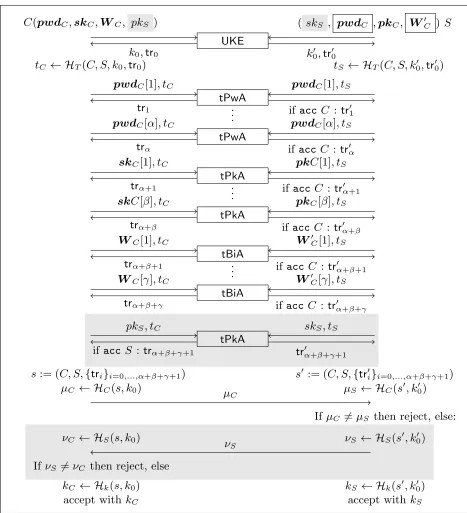
Protocol description. (α, β, γ)-MFAKEis built from four sub-protocols: UKE, tPwA, tPkA, and tBiA. The design is based on the following idea (see also Figure 1): first,C andS run one UKEsession resulting in unauthenticated session keysk0 for the client andk00 for the server, that are then used by both parties to derive tags (tCandtS) throughHT. Then, an appropriate tag-based sub-protocol is executed independently
for each authentication factor of the client.CandSthus executeαsessions oftPwA,βsessions oftPkA(with client-side authentication), andγ sessions of tBiA, possibly in parallel.S aborts the protocol and rejectsC if any of those sessions results in the rejection of the client. The server authentication is optional and is executed through a session oftPkA(with server-side authentication). After finishing all sub-protocolsCand Shold their so-far transcripts{tri}i=0,...,α+β+γ+1and{tr0i}i=0,...,α+β+γ+1, respectively, and proceed with the confirmation:Csends a hash value, computed with HC, on input its unauthenticated key material from the
UKEsession and session identifiers, which comprises its so-far transcripts and the identities of both parties. S verifies that this hash value is as expected. For the optional server authentication, S responds with its own hash value, computed usingHS on similar inputs as in the client’s case. Upon successful confirmation
parties accept with session keyskC resp.kS, derived usingHk.
Instantiations. Our general (α, β, γ)-MFAKE protocol can be instantiated using concrete sub-protocols
C
(
pwd
C,
sk
C,
W
C, pk
S)
(
sk
S,
pwd
C,
pk
C,
W
0C)
S
UKE
k
0,
tr
0k
00,
tr
00t
C← H
T(
C, S, k
0,
tr
0)t
S← H
T(
C, S, k
00,
tr
00)
tPwA
pwd
C[1]
, t
Ctr
1pwd
C[1]
, t
Sif
acc
C
:
tr
01.
.
.
tPwA
pwd
C[
α
]
, t
Ctr
αpwd
C[
α
]
, t
Sif
acc
C
:
tr
0αtPkA
sk
C[1]
, t
Ctr
α+1pk
C
[1]
, t
Sif
acc
C
:
tr
0α+1.
.
.
tPkA
sk
C
[
β
]
, t
Ctr
α+βpk
C[
β
]
, t
Sif
acc
C
:
tr
0α+βtBiA
W
C[1]
, t
Ctr
α+β+1W
0C[1]
, t
Sif
acc
C
:
tr
0α+β+1.
.
.
tBiA
W
C[
γ
]
, t
Ctr
α+β+γW
0C[
γ
]
, t
Sif
acc
C
:
tr
0α+β+γtPkA
pk
S, t
Cif
acc
S
:
tr
α+β+γ+1sk
S, t
Str
0α+β+γ+1s
:= (
C, S,
{
tr
i}
i=0,...,α+β+γ+1)s
0:= (
C, S,
{
tr
0i}
i=0,...,α+β+γ+1)
µ
C← H
C(
s, k
0)µ
µ
S← H
C(
s
0, k
00)
C
If
µ
C6
=
µ
Sthen reject, else:
ν
S← H
S(
s
0, k
00)
ν
C← H
S(
s, k
0)ν
S
If
ν
S6
=
ν
Cthen reject, else
k
S← H
k(
s
0, k
00)
accept with
k
Sk
C← H
k(
s, k
0)accept with
k
Call building blocks of (α, β, γ)-MFAKEcan be realized using existing efficient (single-factor) authentication solutions.
Performance optimizations. The only dependency amongst the different black-box runs of tag-based authentication sub-protocols is the input tag obtained after the UKE session. Therefore, all subsequent sub-protocol runs can be parallelized, resulting in three generic rounds (UKE, tag-based sub-protocols, and confirmation round). Of course, care should be taken to match client and server messages within each round, in order to account for the potential mismatch in the sending and delivery order of messages in parallel sub-protocol sessions. This can be done by pre-pending labels indicating that a message belongs to the ith session and using these labels to construct matching transcripts on both sides. Further optimizations may include interleaving of messages and using one random challenge ofSfor all β sessions oftPkAand another one for all γ sessions of tBiA, resulting in a three-pass protocol for MFA-based client authentication and five-pass protocol with further authentication of the server.
3.4 Security Analysis
The initial UKEexecution contributes to the forward secrecy of the session keys. In particular, successful key confirmation guarantees that the transcriptstr0andtr00and the unauthenticated keysk0 andk00 match. Independent runs of tag-based authentication-only protocols for each client’s factor ensure thatC was alive at least during that part of the protocol execution. This is because at least one of those factors must remain uncorrupted prior to the acceptance of the server and all sub-protocol transcripts are linked together in the key confirmation step. Sincetr0 andtr00are linked to the transcripts of all authentication-only sub-protocols the key confirmation step further guarantees thatCwas alive during theUKEsession and, hence, the secrecy of unauthenticated keysk0 andk00 follows from KE-security of theUKEprotocol. The secrecy of k0 and k00 carries over to the secrecy of the final session keyskC andkS due to the use of independent random oracles.
The optional server authentication follows the same reasoning as client authentication usingPkA sessions. This intuition is proven in Theorems 1 and 2.
Theorem 1. Our(α, β, γ)-MFAKEprotocol is AKE- and CAuth-secure, in the random oracle model, and
Adv(AKEα,β,γ)-MFAKE,A(κ) ≤ AdvUKEKE,B(κ) +α·AdvtPwACAuth,B(κ) +β·SucctPkACAuth,B(κ)
+
γ
X
i=1
AdvtBiAi,B
CAuth(κ) + (q 2
HT +q(qHC +qHK))·2 −κ,and
AdvCAuth(α,β,γ)-MFA,A(κ) = AdvAKE(α,β,γ)-MFAKE,A(κ)−q(qHk−1)·2 −κ.
Proof. We prove this theorem using a series of games that are written for the AKE-security. To the end of the proof we discuss the impact of game hops on the CAuth-security. We denote bySucc(AKE-α,β,γx)-MFAKE,A(κ) the success probability ofAin gameGx and define
∆x(κ) =|Succ
(α,β,γ)-MFAKE,A
AKE-x (κ)−Succ
(α,β,γ)-MFAKE,A AKE-(x−1) (κ)|.
G0 This is the original AKE-security game, where the simulator answers the queries of Aon behalf of the instances according to the specification of (α, β, γ)-MFAKE.
G1 In this game for all simulated server and client instances that have matching UKEtranscriptstr0=tr00 the correspondingUKEkeysk0andk00 are chosen at random such thatk0=k00holds. Otherwise,k0and k00 are computed as inG0.
the messages and keys of the UKEsub-protocol. Assume Ainvokes an instance of U ∈ {C, S}. If this instance is supposed to send the first message in theUKEsession thenBqueries itsTranscriptoracle and uses the first message of the obtained transcript as a response toA. IfAinvokes an instance for U06= U that is expected to send a message only after having received some incoming message thenB waits for the correspondingSendquery ofAand checks whether input message is amongst those output byBfrom some transcript that it holds and responds with the next response message from this transcript. If the input message is unexpected then Bruns UKEpart on behalf of this instance of U0 without consulting its oracle (and will thus be able to compute the UKEkey for that session). OnceUKEsession on behalf of some instance is finished Bhas always a key to continue its simulation, either from its ownUKErun or from a Transcript query. The way in whichB simulates UKEsessions ensures that the latter type of keys are used in sessions that involve instances with matchingUKEtranscripts. IfTranscriptreturns real keys then we are in G0; otherwise inG1. Hence,∆1(κ)≤AdvUKEKE,B(κ).
G2 In this game the simulator aborts if in the ith tPwAsession, for some i∈ {1, . . . , α}, a server instance [S, s0] with tag tS and (partial) transcript tr0i accepts client C but there exists no instance of C with
matching (partial) transcripttri andtC=tS, andpwd[i] is not corrupted.
Claim. ∆2(κ)≤α·Succ tPwA,B
CAuth(κ).Proof.We prove this with a hybrid argument using sub-gamesG upto(j)
2 ,
j = 0, . . . , α. Let tPwAi, i ∈ {1, . . . , α} denote the ith tPwA sub-protocol run. In G
upto(j)
2 all tPwAi,
1 ≤i≤j are handled as in G2 and all tPwAi, j < i≤αare handled as in G1. That is,G1 =G upto(0) 2 and G2 =G
upto(α)
2 . As before, we define∆ upto(j)
2 (κ) as the difference in A’s success probability in two consecutive gamesGupto(2 j−1)andG2upto(j). The difference between the two is thatGupto(2 j)may still abort even ifGupto(2 j−1)does not. AnyAthat can distinguish between the games must have successfully caused tPwAj to abort in G
upto(j)
2 , in which case an instance [S, s0] accepts C in tPwAj while no partnered
client instance with the same tag exists and noCorruptClient(C,0, j) was asked. SuchAcan be used to break CAuth-security oftPwA. The simulator can act as CAuth-adversaryBagainsttPwAby invoking new instances of the server in the tPwA game using tags of server instances that it simulates in the interaction with A. The simulator relays alltPwAj related queries ofAas its own queries in the tPwA
game and wins if A causes Gupto(2 j) to abort. Therefore∆upto2 (j)(κ)≤SucctPwACAuth,B(κ) and thus ∆2(κ) =
Pα
j=1∆ upto(j)
2 (κ)≤α·Succ tPwA,B CAuth(κ).
G3 In this game the simulator aborts if in theith client sidetPkAsession, for somei∈ {1, . . . , β}, a server instance [S, s0] with tagtS and (partial) transcripttr0α+iaccepts client Cbut there exists no instance of C with matching (partial) transcripttrα+i andtC =tS, and skC[i] is not corrupted.
Claim. ∆3(κ)≤β·Succ tPkA,B
CAuth(κ).Proof.We can use essentially the same hybrid argument as inG2, but fortPkAsessions, and thus build a sequence ofβ sub-games to show that the difference between any two consecutive sub-games can be upper-bounded bySucctPkACAuth,B(κ). This leads to∆3(κ) =P
β j=1∆
upto(j) 3 (κ)≤ β·SucctPkACAuth,B(κ).
G4 In this game the simulator aborts if in the ith tBiA session, for somei ∈ {1, . . . , γ}, a server instance [S, s0] with tagtS and (partial) transcripttrα0+β+iaccepts clientCbut there exists no instance ofCwith
matching (partial) transcripttrα+β+i andtC=tS, and theith biometric is not corrupted.
Claim. ∆4(κ)≤Pγ
i=1Succ tBiAi,B
CAuth(κ).Proof.We denote bytBiAi thetBiAprotocol operating on the ith
biometric. Again, using the hybrid argument as in G2, but for tBiA sessions, we can build a sequence of γ sub-games and upper-bound the difference between any two consecutive sub-gamesGupto(4 j−1) and G4upto(j) with SuccCAuthtBiAj,B(κ). The simulator can relay all tBiAj related queries of A as its own queries
in the tBiA game, including those related to the BioComp oracle since all biometric-dependent tBiA messages used in the (α, β, γ)-MFAKEprotocol remain identical to those of thetBiAprotocol. This leads to ∆4(κ) =P
γ j=1∆
upto(j) 4 (κ)≤
Pγ
Remark 5. If the simulation does not abort in this game then it is guaranteed that for each server in-stance [S, s0] that is entering the confirmation round with partial transcripts{tr0i}1≤i≤α+β+γ(comprising
executions of tPwA, PkA, and tBiA sub-protocols) and tag tS, and that has not disqualified itself as a
candidate for aTestquery (i.e. fulfills freshness conditions from Section 2.2), there exists a client instance [C, s] with partial transcripts {tri}1≤i≤α+β+γ such that there exists an indexi,1≤i≤α+β+γ with
tri=tr0i. Moreover, any such client instance holds tagtC=tS.
G5 In this game the simulation aborts if an instance [S, s0] enters the confirmation round with partial transcriptstr00and{tr0i}1≤i≤α+β+γ and there exists [C, s] with partial transcriptstr0and{tri}1≤i≤α+β+γ
such that for some indexi:tri=tr0i buttr06=tr00. Claim. ∆5(κ) ≤ q2
HT2−κ. Proof. G4 already ensures that if [S, s0] accepts in all authentication sub-protocols then there exists a client instance withtC=tS. The only difference between the two games is
that G5 may still abort even ifG4 does not. IfA can distinguish between the games thenAmust have successfully caused the simulator to abort in G5, in which case [S, s0] and [C, s] hold tags tS =tC but
tr06=tr00. We can thus output a collision forHT. SinceHT is a random oracle we get ∆5(κ)≤q2HT2−κ. Remark 6. G5 implies that any instance [S, s0] that was not disqualified as a candidate for a Testquery (upon entering the confirmation round) has a corresponding client instance [C, s] with the sameUKE transcript and at least one matching tag-based sub-protocol transcript.
G6 This game proceeds as G5, except that on behalf of an instance [S, s0] that is not disqualified as a candidate for a Test query the simulator computesµS ← H0C(s0) andkS ← HK0 (s0) using two private
random oracles H0
C and Hk0, and sets µC = µS and kC = kS for the corresponding [C, s] that has
matching UKEtranscript and at least one matching tag-based sub-protocol transcript.
Claim. ∆6(κ) ≤q(qHC +qHK)·2−κ. Considering that in the previous game, confirmation values and session keys of [S, s0] were derived through random oraclesHC andHk on input k00 (which is random as ensured by G1) and the transcript s0, anyAthat can distinguish between the games must ask at some point a query for HC or Hk containingk00 ands0 for any of theq invoked sessions as input. Therefore, ∆6(κ)≤q(qHC+qHk)·2
−κ.
G6 implies that if [S, s0] accepts and is not disqualified as a candidate for aTestquery thenkS is uniformly
distributed in the domain of session keys. Hence, the probability ofAto win inG6no longer depends on the key, i.e.Acan win inG6 only by guessing bitb (with probability 12).
Summarizing the probability differences across all games we obtain
Adv(AKEα,β,γ)-MFAKE,A(κ) =
Succ(AKEα,β,γ)-MFAKE,A(κ)−q α
|Dpwd|+
γ
X
i=1 falseposi
! −1 2 = 6 X i=1
∆i(κ) +
1 2 −q
α
|Dpwd| +
γ
X
i=1 falseposi
! −1 2 .
Taking into account that 6
X
i=1
∆i(κ)≤AdvKEUKE,B(κ) +α·Succ tPwA,B
CAuth(κ) +β·Succ tPkA,B CAuth(κ)
+
γ
X
i=1
SucctBiAi,B
CAuth(κ) + (q 2
HT +q(qHC+qHK))·2 −κ,
and that
AdvtPwACAuth,B(κ) =
SucctPwACAuth,B(κ)− q |Dpwd|
AdvtBiAi,B CAuth(κ) =
Succ
tBiAi,B
CAuth(κ)−q·false pos
i
we obtain
Adv(AKEα,β,γ)-MFAKE,A(κ)≤AdvUKEKE,B(κ) +α·AdvtPwACAuth,B(κ) +β·SucctPkACAuth,B(κ)
+
γ
X
i=1
AdvtBiAi,B
CAuth(κ) + (q 2
HT +q(qHC +qHK))·2−κ,
which is negligible by assumptions onUKE,tPwA, tPkA, andtBiA.
Proof forCAuth-security.With regard to client authentication, consider the above game sequence from the perspective of the CAuth-security game and success probabilitySucc(CAuthα,β,γ)-MFAKE,A(κ). Freshness conditions regarding server instances encompass the requirements that are relevant for the CAuth-game. Then, Remark 6 implies that in G5 for each server instance [S, s0] for which A could still win the game there exists a client instance [C, s] with the matching UKE transcript and at least one matching tag-based sub-protocol transcript. In G6,µC andµS are computed using private oracle, while for CAuth-security modifications of kC and kS are irrelevant. The probability difference to G5 is thus upper-bounded by q·qHC ·2−κ. Then, [S, s0] must have received µC =µS without having a partnered client instance. That is Amust have asked
aSend query containing a value that matches a uniformly distributedµS. This happens with probability at
mostq·2−κ for up toqinvoked server instances. We thus obtain the following CAuth-success
SuccCAuth(α,β,γ)-MFAKE,A(κ) =SuccAKE(α,β,γ)-MFAKE,A(κ)−q(qHk−1)·2 −κ−1
2. Taking into account that by definition
Adv(AKEα,β,γ)-MFAKE,A(κ) =
Succ(AKEα,β,γ)-MFAKE,A(κ)−q α
|Dpwd| +
γ
X
i=1 falseposi
! −1 2
we obtain a negligible CAuth-advantage
Adv(CAuthα,β,γ)-MFAKE,A(κ) =
Succ(CAuthα,β,γ)-MFAKE,A(κ)−q α
|Dpwd| +
γ
X
i=1 falseposi
! =
Succ(AKEα,β,γ)-MFAKE,A(κ)−q(qHk−1)·2−κ− 1 2
−q α
|Dpwd| +
γ
X
i=1 falseposi
! = Adv
(α,β,γ)-MFAKE,A
AKE (κ)−q(qHk−1)·2−κ
.
u t
Theorem 2. Our(α, β, γ)-MFAKEprotocol with server authentication isSAuth-secure in the random oracle model, and
SuccSAuth(α,β,γ)-MFAKE,A(κ)≤AdvUKEKE,B(κ) +SuccCAuthtPkA,B(κ) + (qHT2 +q(qHS+ 1))·2−κ.
Proof. This proof resembles in part the proof of Theorem 1 and proceeds in a series of similar games. We denote bySucc(SAuth-α,β,γ)-xMFAKE,A(κ) the success probability ofAin gameGx. For each gameGx, we define∆x(κ)
as the difference inA’s success probability when playing against the two consecutive gamesGx-1andGx, i.e., ∆x(κ) =|Succ
(α,β,γ)-MFAKE,A
SAuth-x (κ)−Succ
(α,β,γ)-MFAKE,A SAuth-(x−1) (κ)|.
G1 This game proceeds asG0, except that for all simulated server and client instances that have matching UKEtranscriptstr0=tr00the correspondingUKEkeysk0andk00 are chosen at random such thatk0=k00 holds. Otherwise, k0 andk00are computed as inG0.
Claim. ∆1(κ) ≤AdvKEUKE,B(κ). Proof. For client and server instances that do not share matching UKE transcripts both games are identical. AnyAthat can distinguish betweenG1andG0with non-negligible probability can be used to break the KE security from Definition 4. The description of theUKEadversary is exactly the same as in G1 from the proof of Theorem 1. Hence,∆1(κ)≤AdvUKEKE,B(κ), as claimed. G2 This game proceeds as G1, except that the simulator aborts if in the server-side tPkA session a client
instance [C, s] with tagtCand (partial) transcripttrα+β+γ+1accepts serverSbut there exists no instance ofS with matching (partial) transcript tr0α+β+γ+1and tagtS=tC, andskS is not corrupted.
Claim. ∆2(κ)≤Succ tPkA,B
CAuth(κ).Proof.As already described in gamesG2throughG4in proof of Theorem 1 if A can distinguish between the two games, it can be immediately used to break CAuth-security of tPkA. (In this game CAuth-security is understood as a security property of PkA in case where the authenticating party is the server S. Recall that PkA offers single-side authentication and was defined from the perspective of an authenticating client. In this game the authenticating party is S but the notion of CAuth-security remains as defined.) Hence,∆2(κ)≤SucctPkACAuth,B(κ), as claimed.
Remark 7. Note that if the simulation does not abort in G2 then it is guaranteed that for each client instance [C, s] that is entering the confirmation round with partial transcript trα+β+γ+1 and tag tC,
there exists a server instance [S, s0] with partial transcripttr0α+β+γ+1=trα+β+γ+1andtS =tCif neither C norS=pid([C, s]) has been fully corrupted.
G3 This game proceeds as G2, except that simulation aborts if an instance [C, s] enters the confirmation round with partial transcripts tr0andtrα+β+γ+1 and there exists [S, s0] with partial transcripts tr00 and tr0α+β+γ+1 such thattrα+β+γ+1 =tr0α+β+γ+1 but tr06=tr00.
Claim. ∆3(κ)≤q2
HT2−κ. Proof. G2 already ensures that if [C, s0] accepts in the server side tPkA sub-protocol then there exists a server instance with tS =tC. The only difference between the two games is
that G3 may still abort even ifG2 does not. IfA can distinguish between the games thenAmust have successfully caused the simulator to abort in G3, in which case [C, s] and [S, s0] hold tags tC =tS but
tr06=tr00. We can thus output a collision for HT. SinceHT is a random oracle we get∆3(κ)≤qH2T2 −κ,
as claimed.
G4 This game proceeds as G3, except that on behalf of an instance [C, s] for which neither C nor S = pid([C, s]) is fully corrupted the simulator computesνC← H0S(s
0) using a private random oracleH0
S, and
sets νS =νC for the corresponding [S, s0] that has matchingUKE transcript and matching server-side
tPkA sub-protocol transcript.
Claim. ∆4(κ)≤q·qHS·2−κ.Proof.Considering that in the previous game, confirmation values of [C, s] were derived through the random oracle HS on input k0 (which is random as ensured by G1) and the transcript s, any A that can distinguish between the games must ask at some point a query for HS
containing k0 and s for any of the q invoked sessions as input. Therefore, ∆4(κ) ≤ q·qHS ·2−κ, as claimed.
Assume that A wins in G4. Then, [C, s] must have received νS = νC without having a partnered server
instance. That is,Amust have asked a Sendquery containing a value that matches a uniformly distributed νC. This happens with probability at most q·2−κ for up toqinvoked client instances. We thus get
Succ(SAuthα,β,γ)-MFAKE,A(κ) = 4
X
i=1
∆i(κ) +q·2−κ
≤AdvUKEKE,B(κ) +SucctPkACAuth,B(κ) + (qHT2 +q(qHS+ 1))·2−κ, which is negligible by assumptions onUKEandtPkA.
4
Conclusion
The proposed framework for multi-factor authentication and key exchange protocols enables black-box con-structions from existing, better-understood single-factor authentication-only schemes. Our generic construc-tion of the (α, β, γ)-MFAKEprotocol avoids undesirable interactions amongst the different factors and bears optimization potential since messages of tag-based authentication sub-protocols can be interleaved or commu-nicated over different channels. Thanks to its modularity the framework can easily be extended in the future to accommodate other authentication factors, e.g. based on friend-of-friend or social authentication [13,17].
Acknowledgments
Nils Fleischhacker was supported by the German Federal Ministry of Education and Research (BMBF) through funding for the Center for IT-Security, Privacy, and Accountability (CISPA,www.cispa-security.org). Mark Manulis was supported by the German Research Foundation (DFG), project PRIMAKE (MA 4957).
References
1. PCI Data Security Standard, Ver.2. http://www.pcisecuritystandards.org/, 2010. 2. NIST Special Publication 800-63, Rev.1. http://csrc.nist.gov/publications/, 2011.
3. M. Abdalla, O. Chevassut, and D. Pointcheval. One-Time Verifier-Based Encrypted Key Exchange. InPKC 2005, volume 3386 ofLNCS, pages 47–64. Springer, 2005.
4. M. Abdalla, P.-A. Fouque, and D. Pointcheval. Password-Based Authenticated Key Exchange in the Three-Party Setting. InPublic Key Cryptography (PKC 2005), volume 3386 ofLNCS, pages 65–84. Springer, 2005.
5. M. Abdalla, P.-A. Fouque, and D. Pointcheval. Password-based authenticated key exchange in the three-party setting. InPKC 2005, volume 3386 ofLNCS, pages 65–84. Springer, 2005.
6. M. Abdalla and D. Pointcheval. Simple Password-Based Encrypted Key Exchange Protocols. InCT-RSA 2005, volume 3376 ofLNCS, pages 191–208. Springer, 2005.
7. M. Bellare, D. Pointcheval, and P. Rogaway. Authenticated Key Exchange Secure against Dictionary Attacks. InEUROCRYPT 2000, volume 1807 ofLNCS, pages 139–155. Springer, 2000.
8. M. Bellare and P. Rogaway. Entity Authentication and Key Distribution. InCRYPTO 1993, volume 773 of LNCS, pages 232–249. Springer, 1993.
9. F. Benhamouda and D. Pointcheval. Verifier-based password-authenticated key exchange: New models and constructions. Cryptology ePrint Archive, Report 2013/833, 2013. http://eprint.iacr.org/2013/833. 10. S. Blake-Wilson, D. Johnson, and A. Menezes. Key Agreement Protocols and Their Security Analysis. In6th
IMA International Conference on Cryptography and Coding, volume 1355 ofLNCS, pages 30–45. Springer, 1997. 11. X. Boyen. Reusable Cryptographic Fuzzy Extractors. InACM CCS 2004, pages 82–91. ACM, 2004.
12. X. Boyen, Y. Dodis, J. Katz, R. Ostrovsky, and A. Smith. Secure Remote Authentication Using Biometric Data. InEUROCRYPT 2005, volume 3494 ofLNCS, pages 147–163. Springer, 2005.
13. J. G. Brainard, A. Juels, R. L. Rivest, M. Szydlo, and M. Yung. Fourth-Factor Authentication: Somebody You Know. InACM CCS 2006, pages 168–178. ACM, 2006.
14. J. Bringer and H. Chabanne. An Authentication Protocol with Encrypted Biometric Data. InAFRICACRYPT 2008, volume 5023 ofLNCS, pages 109–124. Springer, 2008.
15. J. Bringer, H. Chabanne, M. Izabach`ene, D. Pointcheval, Q. Tang, and S. Zimmer. An Application of the Goldwasser-Micali Cryptosystem to Biometric Authentication. In ACISP 2007, volume 4586 of LNCS, pages 96–106. Springer, 2007.
16. R. Canetti and H. Krawczyk. Analysis of Key-Exchange Protocols and Their Use for Building Secure Channels. InEUROCRYPT 2001, volume 2045 ofLNCS, pages 453–474. Springer, 2001.
17. E. De Cristofaro, M. Manulis, and B. Poettering. Private Discovery of Common Social Contacts. International Journal of Information Security, 12(1):49–65, 2013.
18. Y. Dodis, L. Reyzin, and A. Smith. Fuzzy Extractors: How to Generate Strong Keys from Biometrics and Other Noisy Data. InEUROCRYPT 2004, volume 3027 ofLNCS, pages 523–540. Springer, 2004.
20. Federal Financial Institutions Examination Council. Authentication in an Internet Banking Environment, 2005.
http://www.ffiec.gov/pdf/authentication_guidance.pdf.
21. F. D. Garcia, G. de Koning Gans, R. Muijrers, P. van Rossum, R. Verdult, R. W. Schreur, and B. Jacobs. Dismantling MIFARE Classic. InESORICS 2008, volume 5283 of LNCS, pages 97–114. Springer, 2008. 22. F. D. Garcia, P. van Rossum, R. Verdult, and R. W. Schreur. Dismantling SecureMemory, CryptoMemory and
CryptoRF. InACM CCS 2010, pages 250–259. ACM, 2010.
23. C. Gentry, P. D. MacKenzie, and Z. Ramzan. Password authenticated key exchange using hidden smooth sub-groups. InACM CCS 2005, pages 299–309. ACM, 2005.
24. C. Gentry, P. D. MacKenzie, and Z. Ramzan. A Method for Making Password-Based Key Exchange Resilient to Server Compromise. InCRYPTO 2006, volume 4117 ofLNCS, pages 142–159. Springer, 2006.
25. F. Hao. On Robust Key Agreement Based on Public Key Authentication. InFinancial Cryptography and Data Security, volume 6052 ofLNCS, pages 383–390. Springer, 2010.
26. F. Hao and D. Clarke. Security Analysis of a Multi-factor Authenticated Key Exchange Protocol. InACNS, volume 7341 ofLNCS, pages 1–11. Springer, 2012.
27. T. Jager, F. Kohlar, S. Sch¨age, and J. Schwenk. Generic Compilers for Authenticated Key Exchange. In ASIACRYPT 2010, volume 6477 ofLNCS, pages 232–249. Springer, 2010.
28. J. Katz, R. Ostrovsky, and M. Yung. Forward Secrecy in Password-Only Key Exchange Protocols. InSCN 2002, volume 2576 ofLNCS, pages 29–44. Springer, 2002.
29. F. Kiefer and M. Manulis. Zero-Knowledge Password Policy Checks and Verifier-Based PAKE. InESORICS 2014, volume 8713 ofLNCS, pages 295–312. Springer, 2014.
30. B. A. LaMacchia, K. Lauter, and A. Mityagin. Stronger Security of Authenticated Key Exchange. InProvSec 2007, volume 4784 ofLNCS, pages 1–16, 2007.
31. Y. Lee, S. Kim, and D. Won. Enhancement of Two-Factor Authenticated Key Exchange Protocols in Public Wireless LANs. Computers & Electrical Engineering, 36(1):213–223, 2010.
32. C.-T. Li and M.-S. Hwang. An Efficient Biometrics-Based Remote User Authentication Scheme Using Smart Cards. Journal of Network and Computer Applications, 33(1):1–5, 2010.
33. X. Li, J.-W. Niu, J. Ma, W.-D. Wang, and C.-L. Liu. Cryptanalysis and Improvement of a Biometrics-Based Re-mote User Authentication Scheme Using Smart Cards.Journal of Network and Computer Applications, 34(1):73– 79, 2011.
34. Y. M. Park and S. K. Park. Two Factor Authenticated Key Exchange (TAKE) Protocol in Public Wireless LANs. IEICE Transactions on Communications, E87-B(5):1382–1385, 2004.
35. K. G. Paterson and D. Stebila. One-Time-Password-Authenticated Key Exchange. InACISP 2010, volume 6168 ofLNCS, pages 264–281. Springer, 2010.
36. D. Pointcheval and S. Zimmer. Multi-factor Authenticated Key Exchange. InACNS 2008, volume 5037 ofLNCS, pages 277–295. Springer, 2008.
37. R. Song. Advanced Smart Card Based Password Authentication Protocol. Computer Standards & Interfaces, 32(5–6):321–325, 2010.
38. D. Stebila, P. Udupi, and S. Chang. Multi-Factor Password-Authenticated Key Exchange. InEighth Australasian Information Security Conference (AISC 2010), volume 105, pages 56–66, 2010.
39. J. E. Tapiador, J. C. Hernandez-Castro, P. Peris-Lopez, and J. A. Clark. Cryptanalysis of Song’s Advanced Smart Card Based Password Authentication Protocol. arXiv.org, Cryptography and Security, 2011. http: //arxiv.org/abs/1111.2744v1.
40. X. Wang and W. Zhang. An Efficient and Secure Biometric Remote User Authentication Scheme Using Smart Cards. InPacific-Asia Workshop on Computational Intelligence and Industrial Application (PACIIA ’08), vol-ume 2, pages 913–917. IEEE, 2008.
A
Some Special Cases of (
α, β, γ
)-MFAKE
This section relates our (α, β, γ)-MFAKE model to some well-known authentication models. In particular, proven relationship between (1,0,0)-MFAKE and the PAKE model from [7] implies that any PAKE protocol proven secure in [7] can readily be used as an (1,0,0)-MFAKE in our generic solution; similarly, any 2-AKE protocol that satisfies the security definitions from [8], refined in [10] for the public-key setting, can readily be used as an (0,1,0)-MFAKE.