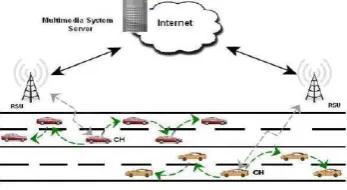
Improving Energy and Efficiency in cluster based
VANETs through AODV Protocol
Prerana Deshmukh
PG Department of Computer Science and Engineering, J.D.College of Engineering & Managment, RTMNU,
Maharashtra, India
Prof. Shrikant Sonekar
Associate Professor, Computer Science and Engineering, J.D.College of Engineering & Managment, RTMNU,
Maharashtra,India
Abstract: VANET is kind of ad hoc networks that implement between vehicles on a road. Due to high mobility, routing issues are more in VANET as compared to MANET. Thereby, in this paper we propose a modification on AODV as MANET routing protocol to make it adaptive for VANET and enhancing to minimize the energy consumption and improve efficiency. For any mobile node, there can be three mobility parameters: position, direction and speed. In our method, we have used direction as most important parameter to select next hop during a route discovery phase in location based approach. We propose a novel location based routing solution over VANETs to form lanes that are able to address vehicle passenger preferences and deliver content of their interest. We will improve the energy consumption by placing Road Side unit between two lanes.
Index Terms- VANET, Road side unit, Energy Efficiency.
INTRODUCTION
Vehicular Ad-Hoc Network (VANET) communication has recently become an increasingly popular research topic in the area of wireless networking as well as the automotive industries. VANET provides a platform for mobile vehicles wherein they can communicate, distribute data quickly, efficiently and more appropriately.
Vehicular Ad-Hoc Networks (VANETs) is a type of Mobile ad Hoc Networks (MANETs), equipped with vehicles communicating in wireless mode among each other and forming a network spontaneously while traveling along the road. Wireless transmission facilitate the vehicles to communicate without any telecommunication infrastructures such as the base stations or access points of wireless dedicated access networks, needed in the previous Intelligent Transportation Systems (ITS).
VANETs define two modes of communication, Vehicle to Vehicle (V2V) and Vehicle to Infrastructure (V2I). Many traditional wireless networks, vehicles are often moving very quickly, and may only remain in an AP radio coverage area for a relatively short period of time. Since multiple vehicles may be present in the AP coverage area, the question arises as to the order with which vehicles should be served. Energy efficient road-side access point scheduling is considered. A scheduler is designed that is capable of satisfying the communication requirements of the vehicles in the vicinity of the AP while minimizing the energy needed using AP power control. A novel user-oriented cluster-based solution for multimedia delivery over VANETs that is able to personalize multimedia content and its delivery based on the preferences of the passengers and their profiles two techniques are used cluster formation and cluster head selection. The cluster
formation algorithm aims to group vehicles based on vehicle characteristics and user interest in content. The cluster head selection algorithm makes sure that cluster head function is efficiently distributed among vehicles. There are many routing protocols for ad hoc networks .One of the most important of them is AODV. AODV is an on demand routing protocol. This protocol finds routes for a node only when it has data packet for transmission.
About AODV Routing Protocol
AODV is an on routing protocol. This protocol finds routes for a only when it has data packet for transmission. AODV routing consists of three phases:
Route discovery
Route discovery phase starts when a node wants to transmit data and has no route to destination. In this phase, source node broadcasts a Route Request Packet (RREQ) to its neighbor. Nodes that receive RREQ packets divide into three categories:
Receiver node is destination Node has a route to destination None of the above
In the two first situations, receiver unicast a Route Reply (RREP) packet to the route that received Route Request (RREQ) packet from it. The route that RREP packet traverses, selected as one of the main routes for source that has been sent RREQ packet.
Data transmission
It transmits data packets across selected route. Route maintenance
It is possible that a link is broken and results in route expiration.
The maintenance phase calls to repair broken or expired route so to find a new route to destination. Node whose link was broken, unicast a Route Error (RERR) packet to the source node. The Source node searches in its routing table if find another route to old destination select that route as new main route for data transmission, else rebroadcasts new RREQ packet.
Advantages of AODV
We can find more than one route for any pair of source and destination.
LITERATURE SURVEY We have read following papers on VANET:
According Omid Abedi, Mahmood Fathy, Jamshid Taghiloo in “Enhancing AODV Routing Protocol Using Mobility Parameters”[1] Direction and Position are most commonly used mobility parameter where Next Hop selection is preferred
Direction is most important as compared to Position. When a source node wants to send a packet to destination node, Routing protocol gets direction of source node and destination node Recognize intermediate node that can be participate in route between source and destination. Using Manhattan mobility model, nodes can move in three situations:
Source node and destination node move in same direction.
Source node and destination node move in opposite direction.
Source node and destination are orthogonal.
By S. Lee, W. Su, and M. Gerla, in “Ad hoc Wireless Multicast with Mobility Prediction” [3] A method that can be used for stable routing is mobility prediction. In that, by using mobility parameters such as node’s speed and node’s position, node’s movement can predict. Therefore, we can select routes that are more stable than other route.
W. Su,in “Motion Prediction in Mobile/Wireless Networks” states that working with same prediction, he stated that we can eliminate transmissions of control packets and thus, reduce routing overhead and will achieve stable routes.
According to M. Zapata and N. Asokan, In “Securing Ad-hoc Routing Protocols” [2] many improvements are made on this protocol. He proposed a new version of AODV (SAODV) that improves AODV security. The SAODV routing is used to protect the routing messages of the original AODV. SAODV uses digital signatures to authenticate non-mutable fields and hash chains to authenticate the hop-count field in both RREQ and RREP messages.Considering energy efficient road-side access point Scheduling referred paper propose a scheduler that is capable of satisfying the communication requirements of the vehicles in the vicinity of the AP while minimizing the energy needed using AP power control. [5]
A novel user-oriented cluster-based multimedia delivery solution over VANETs that is able to address vehicle passenger preferences and deliver multimedia content of their interest based on clustering approach is described in [6].
As per the above reference they conclude that AODV is one of the best ad hoc routing protocols with overall better performance in terms of three metrics: delivery ratio, routing overhead and path optimality. Hence we propose AODV is a good routing protocol for scenarios with high mobility using clustering technique and also conserve energy during transmission.
Problem Definition
The Existing system are working on the mobility parameter such as speed , direction, position etc. but consume more energy during data transmission so in the proposed system we are using the mobility parameter as distance between
node in a cluster and base station and try to minimize the energy consumption.
In proposed system Location based cluster mechanism and the cluster head selection will be used so as to improve the data discovery phase of AODV routing protocol. Minimizing energy needed for data transmission. Improving Energy efficiency in VANET using two tier data delivery mechanism.
RESEARCH METHODOLOGY
In Proposed Methodology we are working in following stages:
Network Formation
Specifying different modes of transmission Proposed Algorithm
Testing Results
Network Formation
Network will consist of nodes (mobile vehicles), Links (connecting nodes and RSU), Road side units and Server. Client server Architecture is used for network formation. Conditions for making Network will be Defined area for network, No fixed number of nodes are specified as the nodes are mobile, Options of Network (eg. Nodes, routing protocols, start and stop time of a network, life time of a network), Formations of node (with respective to X and Y axis), Operations on node (algorithm implementation, deciding to whom the packet should be delivered), Establishing the communication, Transmission of data packet, Analysis the transmission on different parameter (energy, delay, jitter) by graph plotting commands, Stopping the communication. Figure Fig.1 shows the network topology with 19 mobile nodes and node 0 as a (RSU).
Fig. 1 Network Topology Specifying modes of transmission
In Proposed Methodology we are incorporating Location based mechanism that is able to address vehicle passenger preferences and deliver content of their interest. The client server architecture includes A server in the back-end which stores the content and is able to retrieve the content based on preference and location information. A Roadside unit (RSU) RSU is a mediator for communication among Server and client and the vehicles as clients (nodes).
Based on the defined mobility parameters (distance and energy) for proposed technique, it will be decided whether to choose direct communication between two vehicles or through Road side Unit. Distance Threshold is defined as a standard value for comparison. Euclidean Distance method is used for calculating the distance between source and destination.
Euclidean Distance =
√ 1 2 1 2 Where s(x1, y1) and d(x2, y2)
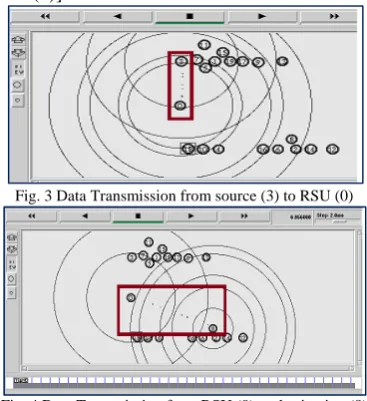
Calculated value is then compared with provided distance threshold and resulting value will then decide which mode of transmission need to be chosen. Following figures shows the snapshot of network topology wherein data delivery is initiated, vehicle 3 is sending a data packet to vehicle 8 via channel as Road side unit (Transmission - via channel) and vehicle 12 is sending a data packet to vehicle 14 by directly going through vehicle ( Transmission – directly through vehicle).Fig.3 and Fig.4 shows the transmission via channel from node 3 to node 8 tracing a path from (source (3)-RSU-destination(8)].
Fig. 3 Data Transmission from source (3) to RSU (0)
Fig. 4 Data Transmission from RSU (0) to destination (8) Fig.5, Fig.6 and Fig.7 indicates the second kind of transmission from source node 12 to destination node 14 by directly travelling to destination node as the calculated distance is less than threshold distance.
Fig. 5 Data Transmission from source (12) to destination (14)by directly moving towards it
Fig. 6 source (12) travelling towardes destination (14)
Fig. 7 source (12) reaches to destination (14)
In Proposed LB – VANET Algorithm
Whenever a node decides to send a data packet the most important parameter under consideration is distance between the source node and destination node and energy consumed during transmission Consider the following parameters:
Let the distance between source node and destination node be d .
Energy required for transmission of data packet from source node be Tr .
Energy required for reception of data packet from receiver node be Rr .
Energy required for receiving acknowledgement of data packet be Rac.
Energy required by RSU for finding route from routing table be Rrt.
Routing power be Pr .
Following Functions are defined: Distance (S-R), Distance (S-RSU-R, Energy (S-R), Energy (S-RSU-R). Whenever a data packet is originated in a network between any source and destination following functions is calculated. Depending on the calculated value it is decided whether to opt a direct path between source and destination or to have RSU as an intermediate node between source and destination.
Loop:
If Distance (S-R) < Distance (S-RSU-R) If Energy (S-R) < Energy (S-RSU-R)
Then select Distance (S-R) Else select Distance (S-RSU-R)
Generally for intra communication Distance (S-R) is used for sending data packet and for inter cluster communication Distance (S-RSU-R) is used.
To overcome different issues like congestion delay etc while sending data packet following overcomes can be done. Entire network can be divided into segments by RSUs which collects information on a particular area Distribution of area by RSU. RSU will help to decentralize processing of the traffic data, and prevent spreading of irrelevant data.
Merits of proposed algorithm:
energy is considered which will help to improve the efficiency of proposed methodology. Road side unit was not considered in Existing algorithm whereas in proposed algorithm it was considered which will overcome the issue of packet lost and delay.
Pseudo Code:
Distance (source node and destination node) . Energy required ( Tr ,Rr ,Rac,Rrt )
Routing power ( Pr ) Functions
Distance (S-R) Distance (S-RSU-R) Energy (S-R) Energy (S-RSU-R) Step 1
Calculate Distance (S-R) between Node A and B. Step 2
Calculate Distance (S-RSU-R) between Node A, B and RSU.
If Distance (S-R) < Distance (S-RSU-R) If Energy (S-R) < Energy (S-RSU-R) Then select Distance (S-R)
Else select Distance (S-RSU-R)
TESTING RESULTS
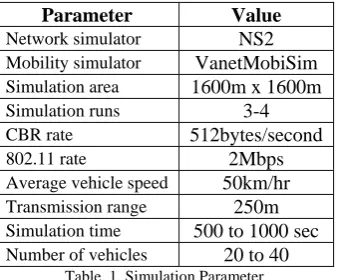
In this section, we evaluate the performance of the LB-VANET algorithm through simulation results. For evaluation, we compare data packet delivery with LB-VANET algorithm and without LB-LB-VANET algorithm considering different simulation parameters like energy, delay, throughput, jitter. The simulation experiments were conducted on NS2.34 [7] and IEEE 802.11 with a transmission rate of 2Mbps and a transmission range of 250m was used as the underlying MAC protocol. We used VanetMobiSim [8] to generate a 4 x 4 flat grid topology of a 1600m by 1600m area. All streets have two lanes and are bi-directional. Road side unit is placed in between the lanes for communication via channel. In each simulation run, we randomly selected two to three data packet delivery, using 512-byte constant bit rate (CBR), an UDP-based packet generation application. In the simulations, the number of vehicles considered is 20 to 40. The running time of each run is 500 to 1000 seconds. All simulation results are an average over 10 runs. Table 1 summarizes the parameters used in the simulations.
Parameter Value
Network simulator NS2
Mobility simulator VanetMobiSim
Simulation area 1600m x 1600m
Simulation runs 3-4
CBR rate 512bytes/second
802.11 rate 2Mbps
Average vehicle speed 50km/hr
Transmission range 250m
Simulation time 500 to 1000 sec
Number of vehicles 20 to 40
Table. 1. Simulation Parameter
Fig.8 and Fig.9 show the average packet delay and energy consumption with the LB-VANET algorithm and without
algorithm, respectively, along with comparison among two under different simulation runs. It is seen that the packet delivery ratio with applied algorithm is more as compared to data delivery with different cluster based algorithm. Packet delivery ratio
increases with the node density
increasing.
The LB-VANET algorithm can significantlyimprove the packet delivery ratio as compared with existing algorithm. The below figures shows the comparative results for simulation parameters such as delay, energy, throughput by plotting time on X axis and Parameters on Y axis.
Fig. 8 adelay Vs opt_adelay
Energy graph shows the comparison of energy consumed, concludes that energy consumption was lesser in data delivery with algorithm as compared to without algorithm hence resulting in a more efficient technique for data transmission.
Fig. 9 aenergy Vs opt_aenergy
Determining the efficiency of a network expressed as a data transfer rate of useful and non-redundant information basing on bandwidth and line congestion error correction is expressed as throughput. The average throughput graph for LB-VANET algorithm is shown in Fig. 10.
Fig. 10 athroughput Vs opt_athroughput
CONCLUSION
REFERENCES
[1] Omid Abedi, Mahmood Fathy, Jamshid Taghiloo “Enhancing AODV Routing Protocol Using Mobility Parameters” in Department of Computer engineering, Iran University of Science and Technology, Tehran, Iran 978-1-4244-1968-5/08/$25.00 ©2008 IEEE.
[2] M. Zapata and N. Asokan, “Securing Ad-hoc Routing Protocols,” in Proc. of ACM Workshop on Wireless Security (WiSe), Atlanta, GA, Sept. 2002.
[3] S. Lee, W. Su, and M. Gerla, “Ad hoc Wireless Multicast with Mobility Prediction”, Proceeding of IEEE ICCCN'99, Boston, MA, 1999, pp. 4-9.
[4] C. E. Perkins and E. M. Royer, “ Ad-hoc On-Demand Distance Vector Routing”, In Proceedings of the 2nd IEEE Workshop on Mobile Computing Systems and Applications, pages 90–100, New Orleans, LA, 1999.
[5] Abdulla A. Hammad, Ghada H. Badawy, Terence D. Todd, Amir A. Sayegh and Dongmei Zhao “Traffic Scheduling For Energy Sustainable Vehicular Infrastructure” Department of of Electrical and Computer Engineering McMaster University Hamilton, Ontario, CANADA 978-1-4244-5638-3/10/$26.00 ©2010 IEEE.
[6] Irina Tal and Gabriel-Miro Muntean “User-oriented Cluster-based
Solution for Multimedia Content Delivery over VANETs” in
Broadband Multimedia Systems and Broadcasting (BMSB), 2012 IEEE International Symposium on 27-29 June 2012 pp: 1 – 5. [7] NS-2, available at http://www.isi.edu/nsnam/ns/