Incremental Program Obfuscation
Sanjam Garg∗
University of California, Berkeley
Omkant Pandey
Stony Brook University, New York
Abstract
Recent advances in program obfuscation suggest that it is possible to create software that can provably safeguard secret information. However, software systems usually contain large executable code that is updated multiple times and sometimes very frequently. Freshly obfus-cating the program for every small update will lead to a considerable efficiency loss. Thus, an extremely desirable property for obfuscation algorithms isincrementality: small changes to the underlying program translate into small changes to the corresponding obfuscated program.
We initiate a thorough investigation ofincremental program obfuscation. We show that the strong simulation-based notions of program obfuscation, such as “virtual black-box” and “virtual grey-box” obfuscation, cannot be incremental (according to our efficiency requirements) even for very simple functions such as point functions. We then turn to the indistinguishability-based notions, and present two security definitions of varying strength — namely, a weak one and a strong one. To understand the overall strength of our definitions, we formulate the notion of incremental best-possible obfuscation and show that it is equivalent to our strong indistinguishability-based notion.
Finally, we present constructions for incremental program obfuscation satisfying both our security notions. We first give a construction achieving the weaker security notion based on the existence of general purpose indistinguishability obfuscation. Next, we present a generic trans-formation usingoblivious RAMto amplify security from weaker to stronger, while maintaining the incrementality property.
1
Introduction
Program obfuscation is the process of transforming a computer program into an “unintelligible” one while preserving its functionality. Barak et al. [BGI+12] formulated several notions for program obfuscation, and demonstrated that the strongest form of obfuscation, calledvirtual black-box(VBB) obfuscation, is impossible in general. The recent work of Garg et al. [GGH+13b] presents an obfuscation mechanism for general programs that achieves the notion of indistinguishability obfuscationbased on assumptions on multilinear maps [GGH13a]. Indistinguishability obfuscation, orIO, is a weaker form of obfuscation thanVBB; nevertheless, it results in best possible obfuscation [GR07].
The feasibility of general purpose obfuscation, in principle, allows the creation of software that can provably safeguard secret information, e.g., cryptographic keys, proprietary algorithms, and so
∗
on. A typical software, however, can be quite complex with millions of lines of executable code [IB]. Once installed, it may go through frequent updates, e.g., when new features are added or security vulnerabilities are discovered. If cryptographic obfuscation is used to protect the software, it must be possible to quickly update the obfuscatedsoftware when new updates become available. In particular, if the original program is large, the obfuscating it from scratch for every new update would be prohibitive. Furthermore, in various client-server settings, where the obfuscated software resides on a networked machine, transmitting the entire (updated) software would be a bottleneck. Ideally, the effort to update the obfuscated program should only be proportional to the changes made to the the original unobfuscated program.
These issues are not unique to program obfuscation and analogous problems have been consid-ered in several other settings. Bellare, Goldreich and Goldwasser [BGG94] introduced and developed the notion of incremental cryptography, first in the context of hashing and digital signatures. The idea is that, once we have signed a documentD, signing new versions ofDshould be rather quick. For example, if we only flip a single bit of D, we should be able to update the signature in time polynomial in log|D|(instead of|D|) and the security parameterλ. Incrementality is an attractive feature to have for many cryptographic primitive such as encryption, signatures, hash functions, and so on [BGG95, Mic97, Fis97a, BM97, BKY01, MPRS12].
If we want to obfuscate large programs that are frequently updated, then it is crucial to have in-crementalprogram obfuscation. Although, current program obfuscation methods are prohibitively slow for application to large programs. However as it becomes more efficient, it is clear that incrementality will be essential for deployment of obfuscation of large programs. This line of in-vestigation is particularly important because of its relevance to the deployment (as opposed to security) of obfuscated software.
1.1 Our Contributions
In this work, we initiate the study of incremental program obfuscation. Here we ask what is the right security definition for incremental program obfuscation and if it can be realized. In this work, we show that enhancing obfuscation with incrementality must come at the some degradation in security. In contrast on the positive side, we realize thebest possibleincremental obfuscation. More specifically, our incremental obfuscation method hides as much about the original program as any other incremental obfuscation of a given size. Our results are generic in the sense that starting with a general purpose obfuscation method for circuit, Turing Machines or RAM programs, we obtain general purpose incremental obfuscation for the same class of programs. Next we provide more details.
Modeling incremental obfuscation. We model an incremental obfuscation method by an ob-fuscation procedure and anUpdateprocedure. In this setting, a large programP is obfuscated and placed on a remote machine in the obfuscated formPe. Updatecan query any bit of the obfuscated program Pe. The input to Updateis a set S of indices, indicating which bits of P should be “up-dated.” For every index i ∈S, there is an associated update operation fi :{0,1} → {0,1} to be performed on the ith bit of P; the set of these operations is denoted byFS ={fi}i∈S. The output of Update consists of a set Se indicating the bits of Pe to be updated; for every i ∈ Se there is an associated bitbi indicating the updated value.
how bad Updatecan be when we just want to update one bit.1
An important observation is that theUpdatecannot be a public algorithm, since otherwise, one can “tamper” with the Pe and potentially recover the entire P. Therefore, Updatemust require a secret key, generated at the time of obfuscation ofP, to be able to make updates.
In this work, we require that the size of the updated obfuscated program should be the same as the fresh obfuscation of the new (updated) program. Further strengthening this requirement: we require that an updated obfuscation of a program should lookcomputationally indistinguishable from a freshly generated obfuscation of the new program. We actually achieve statistical indis-tinguishability, and refer to this property as pristine updates. These requirements are crucial for various applications.
Lower bound for incremental VBB and VGB obfuscation. We show that incrementality significantly interferes with the security an obfuscation method can offer. More specifically, we show that for the family of point functions, every incremental VBBobfuscation scheme must have incrementality ∆∈Ω(n/logn) wherenis the size of the point function program. In fact, our result holds also for the weaker notion ofvirtual grey box(VGB) obfuscation, introduced by Bitanksy and Canetti [BC10]. VGB obfuscation, like VBB, is a simulation-based notion of security but it allows the simulator to be unbounded; it only requires that the number of queries made by the simulator to the black-box program should be polynomial. This further strengthens our result.
Our lower bound proceeds by proving that every incremental VGB (and hence VBB) scheme must “leak” the Hamming distance between the obfuscated and updated programs. Therefore, no generic compiler can preserve obfuscation quality and provide low incrementality at the same time. Interestingly, our negative result holds even if only one update is made to the obfuscated point function. This is somewhat surprising since point-functions are inherently related to deterministic encryption [BS16] for which incremental schemes are known for single updates [MPRS12].
Positive results for indistinguishability obfuscation. Our lower bound motivates us to look more deeply into the definitions for incremental indistinguishability obfuscation, orIIO. We aim to obtain high flexibility in addition to as strong security as possible.
With this goal, we consider an obfuscated programPewhich is continually updated over time, by applying theUpdatealgorithm to the previous obfuscation. This results in a sequence of obfuscated programsP ,e Pe1, . . . ,PetwherePeiis obtained fromPei−1 usingUpdate. Since the adversary can view the entire sequence of obfuscated programs, this suggests the following natural definition: for every pair of programs (P0, P1) and every sequence of increments (or updates)I = (S1, . . . , St) of arbitrary polynomial size setsSiand for arbitrary polynomialt, the distributionsX0 := (Pe0,Pe01, . . . ,Pe0t) and
X1 := (Pe1,Pe01, . . . ,Pe1t) should be computationally indistinguishable provided that P0i and P1i are functionally equivalent for everyiwherePbi is the program corresponding toPebi for everyb∈ {0,1}. We use this definition as the default definition of IIO. We present an IIOscheme for the class of all circuits with incrementality poly(λ,log|P|), assuming the existence ofIOfor the same class.
1Another natural way to define incrementality is the running time ofUpdateforS, divided by|S|in the worst case,
taken over all (S, FS). For our constructions, the single bit measure obtains the same parameters for this alternative
Increment-privacy and “best possible” incremental obfuscation. TheIIOdefinition does not necessarily hide the sequence I of increments. Indeed, by looking at the sequence of updated programs, an adversary might be able to recover which bits were updated at each time step. For many application this could be a serious issue. For example, if Pe is updated to fix a security vulnerability in P, by looking at which bits were updated, a hacker might be able to discover the vulnerability; it can then exploit other machines where the program is still awaiting update.
Even more importantly, since IIOmay leak the sequence I, it is unlikely to achieve our desired “best possible” incremental obfuscation. We therefore consider a strengthened definition which hides the sequenceI, and call itincrement-privateIIO. More specifically, we consider two sequences
I0, I1 whereI0 is applied to Pe0 and I1 toPe1. As before, we require that the resulting obfuscation sequences should look indistinguishable provided that the underlying programs are functionally equivalent at every time step.
With the goal of realizing obfuscation satisfying this security notion, we show a transformation which converts any IIO scheme into increment-private IIO scheme without affecting its incremen-tality too much. Our transformation is obtained by combining IIO with oblivious RAM(ORAM) programs [GO96].
Finally, in an effort to better understand what is the strongest possible incremental obfuscation, we define the notion of best possible incremental obfuscation, or IBPO. For example, our lower bound forVGB/VBBobfuscations demonstrates that any incremental scheme must leak the size of incremental updates that take place. It is important to understand if this is all that is leaked. Our IBPO notion essentially captures all the information that can leak by an incremental obfuscation. Interestingly, we are able to show that increment-private IIO and IBPO are equivalent! That is, hiding the sequence suffices for best possible obfuscation. This is further evidence that increment-privateIIOis the right notion to target.
In all of our constructions we work with the sequential and non-adaptive model of updates — i.e., the updates are not adversarially chosen based on the previously provided obfuscations. In most settings for software updates, the updates are not adversarial since they come from the the software provider. The non-adaptive definition suffices for such applications. However, the adaptive definition might be desirable in other settings, for example if the adversary can influence the choice of updates, e.g., through insider attacks. We do not consider this notion in this work. Our results, however, easily extend to non-sequential setting which will be discussed towards the end.
Other applications. Besides being interesting in its own right, incremental obfuscation can be seen as a natural tool to enhance applications of obfuscation with incrementality properties. For example, one can very easily enhance the functional encryption scheme of Garg et al. [GGH+13b] in a way such that secret keys have incrementality properties. In functional encryption an encrypter can encrypt a messagemin such a way that a a secret keyskC, parameterized by the circuitC, can be used to learn C(m). Using our incremental obfuscation we can realize incremental functional encryption, where given a secret key forskC one can quickly provide new secret keys for incremental changes in C.
1.2 An Overview of Our Approach
construc-tion with ORAM to obtain increment-privacy without sacrificing incrementality. For concreteness, we view the program P as a boolean circuitC.
A common approach for obfuscating a general circuit C relies on the Naor-Yung “two-key paradigm” [NY90]: C is encrypted twice to get ciphertexts (e1, e2) which are then “hardwired”
into a low-depth circuit for which candidate obfuscation is known.
Suppose that we are given IOfor the class of all circuits. We will follow the two-key paradigm to obtain IIO. Specifically, we will obfuscate a special circuit C∗ using IO which will internally evaluate C. However, we cannot hardwire either C or the value (e1, e2) in C∗ since even if the
values (e1, e2) support incrementality, theIOmay not.
One option is to providee= (e1, e2) as an explicit input toC∗. C∗can obtainCby decrypting,
say e1, and evaluate it as required. If e1, e2 are bitwise encryptions of C, the scheme is also
incremental: changing any bit only requires changing the corresponding ciphertexts in e.
In order to make sure that the scheme is secure, C∗ must only accept “authorized” values of
e. This can be accomplished, for example, by signing eentirely after every update. C∗ will verify the signature on the updated e before performing the computation. This is indeed a promising approach, however, observe that now the signature must also be incremental since it would be a part of the obfuscation. Unfortunately, this is a big problem since incremental signatures are usually not injective. Consequently, there can exist multiples messages corresponding to the same signature; the existence of such messages is not quite compatible withIOtechniques.
Nevertheless, it is a promising approach and it is possible to make it work based on the existence of (public-coin) differing-inputs obfuscation (pc-dIO) [ABG+13, BCP14, IPS15]. Our goal is to obtain a feasibility result based on the existence ofIOalone, sincepc-dIO, due to its extractability flavor, is viewed as a very strong assumption [GGHW14, BP15b].
SSB hash and Merkle trees. A powerful technique to avoid the pc-dIO in many settings is thesomewhere statistically binding(SSB) hash technique based on Merkle trees. It was introduced by Hubaceck and Wichs [HW15], and is very similar in spirit to the positional accumulators of Koppula, Lewko, and Waters [KLW15].
At a high level, the approach considers hash functions which can be generated to be statistically binding at a chosen location. These functions are collisions-resistant, and functions generated for different locations are computationally indistinguishable. Such functions can be constructed from a variety of assumptions, including IO[HW15, KLW15, OPWW15].
Coming back to our construction, we will use the SSB hash functions based on Merkle trees presented in [HW15]. This hash has incrementality property, and consists of two values (h, T) where T is the Merkle tree and h is the root of T. Unfortunately, the SSB hash technique cannot be applied in a black-box manner to all settings. It has to be properly adapted to every setting.
We show how to apply this technique in our setting. More specifically, we take the following high level steps:
1. We encrypt the circuit twice, bit-by-bit, as before to obtain e = (e1, e2). We then apply a
quickly updatable SSB Hash to eto obtain (h, T). The valueh is then “signed.”
2. In fact, ordinary signatures are too rigid for our needs. Instead, we use non-interactive zero-knowledge (NIZK) proofs to give proofs that h does not have some special structure.
3. The full obfuscation will includeIOof a circuit C∗ which has a secret-keysk1 hardwired for
verify.
4. As new updates arrive, valuese, h, T are easily updated, as well as the proofs since they only depend onh and not e, T.
5. We then rely on the combined power of SSB-hash functions and NIZK proofs to design a sequence of hybrids such that the signatures exist only for the specified sequence in question. We further use NIZK proofs, SSB hash, and the power ofIOto slowly reach a point in hybrid experiments where there is exactly one value e∗ that will be accepted by the obfuscated program. At this point, we will able to encrypt the circuits from the other sequence—again, this step is performed one-by-one for each location in the sequence.
We note that executing this strategy is rather involved, and we heavily rely on manipulations via NIZK proofs to complete the security proof.
Increment-privacy via ORAM. To amplify security to increment-private IIO, we rely on two techniques: ORAM programs and the two-key paradigm [NY90]. In more detail, to obfuscate a circuitC, we first apply a statistically-secure ORAM scheme toC twice, to obtain two independent encodings ofC, sayC1∗, C2∗. Next we generate a circuitP that has (C1∗, C2∗), and secret information to decode one of them hardcoded in it. The program P, on input x, decodes one of the encoded circuits and outputs the evaluation of the decoded circuit on input x. Having defined P, we now obfuscate P using any IIOscheme (which only satisfies the weaker definition). The resulting obfuscation is ourincrement-private IIO.
At a high level, this works because incremental changes in C can be reduced to corresponding changes in the ORAM encodings of C, and hence the program P. However, since P is encoded using our IIO scheme, this preserves incrementality up to logarithmic factors. At the same time, the use of ORAM ensures the privacy of incremental updates.
We remark that, although the underlying ideas behind this transformation are simple, the proof is not as simple as one would hope for. In particular, to be able to successfully rely on the security of IIO, the obfuscated program needs a little more “guidance” to perform its task so that the hybrids will go through.
1.3 Related Work
Patchable Obfuscation. An interesting variant of IIO–called Patachable Obfuscation (PO)— was considered in [AJS17]. In PO, one aims to release a “short patch” which can update a previously obfuscated program. There are several fundamental differences between these two works. A crucial difference between IIO and PO is that in PO, the “patch” is allowed to take linear time (i.e., proportional to the size of the obfuscated program) even ifthe actual change is only a single bit in the underlying program. Indeed this is the case with the constructions of [AJS17]. In contrast,IIO requires that the time to update the obfuscated program must only depend on the time to update the plain, unobfuscated program. Our constructions achieve this form of efficiency. On the flip side, PO can maintain a short concise description of the patch even if the final change will be large; IIOdoes not require concise description and depends on the final change.
obfuscated code. Due this fundamental difference in problem formulation, the two works employ completely different methods. Our IIO constructions are obtained by relying only on standard, polynomially-hard assumptions but achieve only non-adaptive security. In contrast, the results of [AJS17] require the underlying primitives to be sub-exponentially secure but achieve adaptive security.
Finally, the stringent requirement on running time of updates in our work sheds light on the lower bounds for other notions of obfuscations such as VBB/VGB-obfuscation. We additionally develop the notion ofbest possible incremental obfuscation and develop generic tools using ORAM to achieve this notion. [AJS17] do not consider these issues or rely on ORAM techniques in any way. On the flip side, the method in [AJS17] can expand the input length of the obfuscated program which is not considered in our work.
Other related work. The concept of incremental cryptography was put forward by Bellare, Goldreich, and Goldwasser [BGG94], as a different type of efficiency measure for cryptographic schemes. They considered the case of hashing and signing, and presented discrete-logarithm based constructions for incremental collision-resistant hash functions and signatures, that support block replacement operation. Soon after, Bellare et al. [BGG95] also developed constructions for block insertion and deletion, and further issues such as tamper-proof updates, privacy of updates, and incrementality in symmetric encryption were also considered.
Subsequently, Fischlin [Fis97a] presented an incremental signature schemes supporting inser-tion/deletion of blocks, and tamper-proof updates, and proved a Ω(√n) lower bound in [Fis97b] on the signature size of schemes that support substitution and replacement operations (the bound can be improved to Ω(n) in certain special cases). The case of hashing was revisited by Bellare and Micciancio [BM97] who provided new constructions for the same based on discrete logarithms and lattices. Buonanno, Katz, and Yung [BKY01] considered the issue of incrementality in symmetric unforgeable encryption and suggested three modes of operations for AES achieving this notion.
Mironov, Pandey, Reingold, and Segev [MPRS12] study incrementality in the context of deter-ministic public-key encryption. They prove a similar lower bound on the incrementality of such schemes, and present constructions with optimal incrementality.
The task of constructing cryptographic primitives in the complexity class NC0 can be viewed as a dual of incremental cryptography where the focus is onoutput localityinstead of input locality. Applebaum, Ishai, and Kushilevitz [AIK06] resolved this question in the affirmative for public-key encryption, and argue impossibility of the same for constantinput locality [AIK06, Section C.1].
Barak et al. [BGI+12] formulated the notion of program obfuscation and proved strong negative results for VBB obfuscation. The connection between zero-knowledge and code obfuscation was first observed and studied by Hada [Had00]. VBB obfuscation for special classes of functions such as point functions were first considered by Wee [Wee05] (and Canetti [Can97]); subsequently, constructions for more functions were achieved such as proxy re-encryption, encrypted signatures, hyperplanes, conjunctions, and so on [LPS04, HRSV07, Had10, CRV10, BR13]. Goldwasser and Kalai extended the negative results forVBBobfuscation in the presence of auxiliary inputs [GK05] which were further extended by Bitansky et al. [BCC+14].
simulation based notion; it was further explored in [BCKP14].
The first positive result for indistinguishability obfuscation was first achieved in the break-through work of [GGH+13b], and further improved in [BGK+14]. In the idealized “generic en-codings” modelVBB-obfuscation for all circuits were presented in [CV13, BR14, BGK+14, AB15]. These results often involve a “bootstrapping step” which was improved by Applebaum [App14]. Further complexity-theoretic results appear in recent works of Barak et. al. [BBC+14] and Ko-margodski et al. [KMN+14]. Obfuscation in alternative models such as the hardware token model were considered in [GIS+10, BCG+11].
Sahai and Waters [SW14] developed powerful techniques for using indistinguishability obfusca-tion to construct several (old and new) cryptographic primitives. Since then,IOhas been success-fully applied to achieve several new results, e.g., [HSW14, BZ14, MO14, PPS15, CLP15, HW15, BP15a, BPW16, AS16]. The equivalence of IO and functional encryption [BSW11, O’N10] was recently established by Ananth and Jain [AJ15] and Bitanksy and Vaikuntanathan [BV15].
Differing input obfuscation (diO) was studied by Ananth et. al. [ABG+13] and Boyle et al. [BCP14], and subsequently used to construct obfuscation for Turing machines. After various im-plausibility results [GGHW14, BP15b], Ishai, Pandey, and Sahai put forward the improved notion of public-coin differing-inputs obfuscation and recovered several original applications ofdiO. Indis-tinguishability obfuscation for bounded-input Turing machines and RAM programs were presented in [BGL+15, CHJV15] and for bounded-space programs in [KLW15].
The notion of oblivious RAM programs was put forward by Goldreich and Ostrovsky [Gol87, Ost90, GO96]. Several improved constructions and variations of ORAM programs are now known [SCSL11, SvDS+13, LO13, CLP14, BCP16].
2
Definitions and Preliminaries
In this section we recall the definitions of some standard cryptographic schemes which will be used in our constructions. For concreteness, we adopt the family of polynomial-sized circuits are model of computation for describing programs. Our definitions, constructions, and results apply to Turing machines and RAM programs as well. We will bring up these models when appropriate.
From here on, unless specified otherwise, λalways denotes the security parameter. We assume familiarity with standard cryptographic primitives, specificallypublic-key encryption (PKE), non-interactive zero-knowledge proofs (NIZK, recalled in Section 2.4), perfectly binding commitments, and computational indistinguishability.
2.1 Indistinguishability Obfuscators
Definition 2.1 (Indistinguishability Obfuscator (IO)) A uniform PPT machine O is called an indistinguishability obfuscator for a circuit class {Cλ} if the following conditions are satisfied:
• Correctness: For all security parameters λ∈N, for allC ∈ Cλ, for all inputs x, we have that
Pr[Ce(x) =C(x) :Ce← O(λ, C)] = 1.
pairs of circuitsC0, C1 ∈ Cλ, we have that if C0(x) =C1(x) for all inputsx, then
Pr
D(O(λ, C0)) = 1
−Pr
D(O(λ, C1)) = 1
≤α(λ).
2.2 Somewhere Statistically Binding Hash
We recall the definition of somewhere statistically binding (SSB) hash from [HW15, OPWW15].
Definition 2.2 (SSB Hash) A somewhere statistically binding (SSB) hash consists of PPT algo-rithms (Gen, H) and a polynomial`(·,·) denoting the output length.
• hk ← Gen(1λ,1s, L, i): Takes as input a security parameter λ, a block-length s, an input-length L≤2λ and an index i∈[L] (in binary) and outputs a public hashing key hk. We let Σ ={0,1}sdenote the block alphabet. The output size is `=`(λ, s) and is independent of the input-length L.
• Hhk: ΣL→ {0,1}`: A deterministic poly-time algorithm that takes as inputx= (x[0], . . . , x[L− 1])∈ΣL and outputs Hhk(x)∈ {0,1}`.
We require the following properties:
Index Hiding: We consider the following game between an attackerAand a challenger:
• The attacker A(1λ) chooses parameters 1s, L and two indices i0, i1 ∈[L].
• The challenger chooses a bitb← {0,1} and sets hk←Gen(1λ,1s, L, i).
• The attacker Agets hk and outputs a bitb0. We require that for any PPT attacker A
we have that|Pr[b=b0]−12| ≤negl(λ) in the above game.
Somewhere Statistically Binding: We say that hk is statistically binding for an indexi∈[L] if there do not exist any valuesx, x0∈ΣLwherex[i]6=x0[i] such thatHhk(x) =Hhk(x0). We require that for any parameterss, L and any integer i∈[L] we have:
Pr[hk is statistically binding for index i : hk←Gen(1λ,1s, L, i)]≥1−negl(λ).
We say the hash is perfectly binding if the above probability is 1.
Merkle SSB Hash. For concreteness, we work with a specific instantiation of SSB Hash based on Merkle trees (and fully homomorphic encryption) given in [HW15]. The has values from this construction have the form (h, T) where T is the Merkle tree and h is the root of T. This con-struction has theincrementalityor “quick update” property: small changes to the underlying value only requirepoly(λ,logn) changes to (h, T) where nis the length of the string. Constructions with same properties can be based on a variety of assumptions includingIOalone [OPWW15, KLW15].
2.3 Oblivious RAM
Syntax. A Oblivious RAM scheme consists of two procedures (OData,OAccess) with syntax:
• (D∗, s) ← OData(1λ, D): Given a security parameter λ and memory D ∈ {0,1}m as input, ODataoutputs the encoded memory D∗ and the encoding keys.
• d←OAccessD∗(1λ, s, `, v): OAccesstakes as input the security parameterλand the encoding key s. Additionally, it takes as input a location `∈[m] and a valuev ∈ {⊥,0,1}. If v =⊥
then this procedure outputs d, the value stored at location ` in D. If v ∈ {0,1} the the procedure writes the value v to location ` inD. OAccesshas oracle access (read and write) toD∗ and changes made to it are preserved from one execution of OAccessto another.
Efficiency. We require that the run-time of OData should be m·polylog(m)·poly(λ), and the run-time of OAccessshould bepoly(λ)·polylog(m).
Correctness. Let `1, . . . , `t be locations accessed on memory D of size m and let v1, . . . , vt ∈
{0,1,⊥}. Then we require that on sequential executions of di = OAccessD ∗
(1λ, s, `i, vi) we have that for each i ∈ {1, . . . t} such that vi 6= ⊥ output di the correct and the latest value stored in location`i ofD.
Security. For security, we require that for any sequence of access locations`1, . . . , `tand`01, . . . , `0t, inD∈ {0,1}m, we have that:
MemAccess≈MemAccess0
where MemAccess and MemAccess0 correspond to the access pattern on D∗ during the sequential execution of the OAccessD∗ on input locations `1, . . . , `t and `01, . . . , `0t respectively and ≈denotes computational indistinguishability.
2.4 Non-Interactive Zero-Knowledge Proofs
We recall the definitions of non-interactive zero-knowledge proofs, taken verbatim from [GOS06]. LetRbe an efficiently computable binary relation. For pairs (x, w)∈Rwe callxthe statement and wthe witness. Let Lbe the language consisting of statements in R.
A non-interactive proof system [BFM88, FLS99, GOS06] for a relation R consists of a common reference string generation algorithm K, a prover P and a verifier V. We require that they all be probabilistic polynomial time algorithms, i.e., we are looking at efficient prover proofs. The common reference string generation algorithm produces a common reference stringσof length Ω(λ). The prover takes as input (σ, x, w) and produces a proof π. The verifier takes as input (σ, x, π) and outputs 1 if the proof is acceptable and 0 otherwise. We call (K, P, V) a non-interactive proof system forR if it has the completeness and statistical-soundness properties described below.
Perfect completeness. A proof system is complete if an honest prover with a valid witness can
convince an honest verifier. Formally we require that for all (x, w) ∈ R, for all σ ← K(1λ) and
π←P(σ, x, w) we have thatV(σ, x, π) = 1.
Statistical soundness. A proof system is sound if it is infeasible to convince an honest verifier
when the statement is false. For all (even unbounded) adversariesA we have
Pr h
σ ←K(1λ); (x, π)← A(σ) :V(σ, x, π) = 1 :x6∈L
i
Computational zero-knowledge [FLS99]. A proof system is computational zero-knowledge
if the proofs do not reveal any information about the witnesses to a bounded adversary. We say a non-interactive proof (K, P, V) is computational zero-knowledge if there exists a polynomial time simulator S = (S1,S2), such that for all non-uniform polynomial time adversaries A with oracle access to the prover or the simulator for queries (x, w) ∈ R. Simulator is not provided with the witnessw.
Prhσ←K(1λ) :AP(σ,·,·)(σ) = 1i≈Prh(σ, τ)← S1(1λ) :AS2(τ,·)(σ) = 1
i
.
3
Modeling Incremental Obfuscation
In this section, we provide the definitions for incremental program obfuscation. As noted before, for concreteness, we describe our definitions for circuits. The definitions for Turing machines (TM) and RAM programs are obtained by simply replacing circuits with TM/RAMs. We start by providing indistinguishability-based definitions. Let us first set up some notation.
There are four operations we can perform on a bit b: set(b) = 1,reset(b) = 0,flip(b) = 1−b and id(b) =b; denote byOP={set,reset,flip,id} the set of these operations. Anincremental changeto a string x of length nconsists of specifying an (ordered) subset S ⊆[n] of indices of x along with an (ordered) set of corresponding changes FS ={fi}i∈S (where fi ∈OP,∀i∈S). When we want to be explicit about FS, we denote the incremental change by (S, FS).
For a string x, FS(x) denotes the string x0 such that x0[i] = fi(x[i]) for every i ∈ S and
x0[i] = x[i] otherwise. A sequence I of many updates is an ordered sequence of updates I = ((S1, FS1), . . . ,(St, FSt)) When dealing with a sequence, we write FI(x) to denote the sequence of
strings (x1, . . . , xt) wherexj is defined recursively as xj :=FSj(x
j−1) for all j∈[t] and x0 =x.
IfCis a circuit, represented as a binary string,Iis a sequence oftupdates toC, andxis an input string, we writeFI(C)(x) to denote the sequence (C1(x), . . . , Ct(x)) where (C1, . . . , Ct)
def
= FI(C)
3.1 Incremental Indistinguishability Obfuscation
As discussed earlier, our first definition, called IIO, simply requires that for every sequence of updates I, if I produces two functionally equivalent circuit sequences, then the updated sequence of obfuscated circuits corresponding toIshould look indistinguishable. This is the weaker definition.
Definition 3.1 (Incremental Indistinguishability Obfuscator (IIO)) A pair of uniform PPT machines (O,Update) is called an incremental indistinguishability obfuscator for a circuit class
{Cλ} if the following conditions are satisfied:
• Syntax: Otakes as input a security parameterλand a circuitC∈ Cλ; it outputs an obfuscated circuit Ce and a secret keysk (for making updates). Updatetakes as input the secret-key sk, an incremental change (S, FS), and oracle access to Ce; it outputs an incremental change (S, Fe
e
S) for the circuit Ce.
Pr t ^ j=0 e
Cj(x) =Cj(x)
: (Ce
0, sk)← O(λ, C0)
(Ce1, . . . ,Cet)←Update
e
C0(sk, I)
= 1.
where UpdateCe0
(sk, I) denotes the (recursively computed) sequence (Ce1, . . . ,Cet) as follows:
for everyj ∈[t] define (Sej, F
e
Sj)←Update e
Cj−1
(sk, Sj) and then Cej =F
e
Sj
e
Cj−1
.
• Incrementality: There is a fixed polynomial poly(·,·), independent of the class Cλ, such that
the running time of UpdateCe
sk, {i}, F{i}
over all possible values of λ,C,e {i}, F{i}
, sk
is at most ∆(λ) =poly(λ,lg|Ce|). The incrementality of the scheme is defined to be∆(λ).
• Indistinguishability: For any (not necessarily uniform) PPT distinguisher D, there exists a negligible function α such that the following holds: For all security parameters λ∈N, for all pairs of circuits C0, C1∈ Cλ, for every polynomial tand for every sequence I of tupdates we have that if C0(x) =C1(x) and FI(C0)(x) =FI(C1)(x) for all inputs x, then
Pr
D(Expt(λ, C0, C1, I,0)) = 1
−PrD(Expt(λ, C0, C1, I,1)) = 1
≤α(λ).
where distributionExpt(λ, C0, C1, I, b)outputs as follows: sample(Ceb, sk)← O(λ, Cb), sample sequence(Ceb1, . . . ,Cebt)←UpdateCeb(sk, I), and output (I, C0, C1,Ceb,Ceb1, . . . ,Cebt).
The above definition does not necessarily hide the sequenceI from the adversary. Our next defini-tion, calledincrement-private IIOhides the sequence of updates as well. Informally, it states that if update sequences I0, I1 produce functionally equivalent circuit sequences, then the sequence of
updated obfuscations hides whetherI0 orI1 was used for making updates.
Definition 3.2 (Increment-private IIO) A pair of uniform PPT machines(O,Update) is called a sequence hiding incremental indistinguishability obfuscator for a circuit class {Cλ} if it satisfies thesyntax, correctnessandincrementalityproperties (as in definition 3.1) and the following sequence-hiding indistinguishability property:
• Increment-private indistinguishability: For any (not necessarily uniform) PPT distinguisher D, there exists a negligible function α such that the following holds: For all security parameters
λ∈N, for all pairs of circuits C0, C1∈ Cλ, for every polynomial tand for all pairs of update sequences I0, I1 of length t we have that if C0(x) = C1(x) and FI0(C0)(x) = FI1(C1)(x) for
all inputs x, then
Pr
D(Expt(λ, C0, C1, I0, I1,0)) = 1
−PrD(Expt(λ, C0, C1, I0, I1,1)) = 1
≤α(λ).
where distribution Expt(λ, C0, C1, I0, I1, b) outputs as follows: sample (Ceb, sk) ← O(λ, Cb), sample sequence (Ceb1, . . . ,Cebt)←UpdateCeb(sk, Ib), and output(I0, I1, C0, C1,Ceb,Ceb1, . . . ,Cebt).
Finally, we define the followingpristine updatesproperty which is desirable but not implied by above definitions: updated obfuscation of a circuit should be statistically close to its fresh obfuscation.
Definition 3.3 (Pristine updates) An incremental indistinguishability obfuscator (O,Update) for a circuit class{Cλ} haspristine updatesif there exists a negligible functionα such that ∀λ∈N, ∀C ∈ Cλ, and ∀(S, FS), the statistical distance between distributions {Ce : (C, ske )← O(λ, C)} and
{Ce0 : (C, ske )← O(λ, C),(S, Fe
e
S)←Update
e
C(sk,(S, F
S)),Ce0 =F
e
3.2 Incremental VGB and VBB Obfuscation
The simulation based definitions are defined analogously, but require the existence of a simulator.
Definition 3.4 (Incremental VGB/VBB Obfuscator) A pair of uniform PPT machines(O,Update) is called an incrementalVGBobfuscator for a circuit class{Cλ}if it satisfies thesyntax, correctness and incrementalityproperties (as in definition 3.1) and the following VGB security property:
For any (not necessarily uniform) PPT (single bit) adversary A, there exists a simulator S, a polynomialq, and a negligible functionα, such that the following holds: For all security parameters
λ ∈ N, for all circuits C ∈ Cλ, for every polynomial t and for every sequence I of t updates, we have that,
Pr
A(C,e Ce1, . . . ,Cet) = 1
−PrSC[q(λ)],FI(C)[q(λ)](1λ,1|C|) = 1
≤α(λ).
where(C, ske )← O(λ, C),(Ce1, . . . ,Cet)←UpdateCe(sk, I), and notationC[q(λ)](resp.,FI(C)[q(λ)]) represents at most q oracle calls to C (resp., every circuit in (C, FI(C))).
If S is polynomial time in λ, we say that (O,Update) is incremental VBBobfuscator for {Cλ}.
4
Our Construction
In this section, we present our basic construction which satisfies IIOnotion. Let:
• (G, E, D) be a PKE scheme for bits with ciphertext length`e,
• (Gen, H) be an SSB hash with alphabet Σ ={0,1}`e and output length `,
• O be anIOscheme for all circuits,
• (K, P, V) be a NIZK proof system for NP
• com be a non-interactive perfectly binding string commitment scheme
The component algorithms of ourIIOscheme (IncO,Update) are described in figures (1, 3).
Theorem 4.1 Scheme (IncO,Update) is an IIOscheme for all circuits.
Proof: It is easy to verify the correctness and incrementality of this scheme. It is also easy to see that the scheme satisfies the pristine updates property.
We show that it satisfies the indistinguishability property. Fix any two circuits (C0, C1), and
any sequenceI of any polynomial many incremental updates, saytupdates. We need to show that Expt(λ, C0, C1, I,0)≡cExpt(λ, C0, C1, I,0).
H1: Same as Expt(λ, C0, C1, I,0). For convenience, let us define C00 =C0 and C10=C1.
Recall that the output of this experiment is (I, C0
0, C10,Ce00,Ce01, . . . ,Ce0t) where Ce0i is of the form (ei, hi, Ti, ri, πhi,Pehk,σ,c1,c2,c3,sk1) and ei = (ei1, ei2) represents two (bitwise) encryptions of C0i under keyspk1 andpk2 respectively.
Algorithm IncO(1λ, C) proceeds as follows:
1. Sample (pk1, sk1)←K(1λ) and (pk2, sk2)←G(1λ).
2. Generatee= (e1, e2) wheree1, e2 arebit-wiseencryptions ofC, i.e.,e1= (e1,1, . . . , e1,|C|) and
e2 = (e2,1, . . . , e2,|C|) wheree1,i←E(pk1, C[i]), e2,i←E(pk2, C[i]), for everyi∈[|C|].
3. Samplehk←Gen(1λ,1`e,|e|,0) andσ ←K(1λ)
4. Generatec1←com(1`;ω1), c2 ←com(1`;ω2), c3 ←com(0`k1`;ω3)
5. Compute (h, T) =Hhk(e), where h is the root node of the (Merkle) treeT.
6. Choose a randomr and compute the proof πh ←P(σ,(h, r, c1, c2, c3), w) for relationR using
witness w= (1`,1`,0`k1`, ω1, ω2, ω3) where ((h, r, c1, c2, c3),(h0, u, t1kt2, ω1, ω2, ω3))∈R iff:
(a) c1=com(h0;ω1), c2 =com(u;ω2), c3=com(t1kt2;ω3), t1≤r ≤t2,and
(b) either h6=h0∧r 6=u or h=h0∧r =u
7. Compute obfuscation Pehk,σ,c1,c2,c3,sk1 ← O 1λ, Phk,σ,c1,c2,c3,sk1
where Phk,σ,c1,c2,c3,sk1 is
de-scribed in figure 2. The size of Phk,σ,c1,c2,c3,sk1 is padded to a valueQ defined later.
8. LetCe:=
e, h, T, r, πh,Pehk,σ,c1,c2,c3,sk1
anduk:= (pk1, hk, c1, c2, c3, σ, w); output (C, uke ).
Evaluation ofCe on inputx is obtained by evaluatingPehk,σ,c1,c2,c3,sk1 on input (e, r, πh, x).
Figure 1: Description of IncO
Circuit Phk,σ,c1,c2,c3,sk1 computes as follows on input (e, v, π, x):
1. Compute (h, T) =Hhk(e) and verify that V(σ,(h, v, c1, c2, c3), π) = 1.
Output ⊥if verification fails.
2. Otherwise, parseeas (e1, e2), compute C =D(sk1, e1), and output C(x).
Algorithm UpdateC,Ce
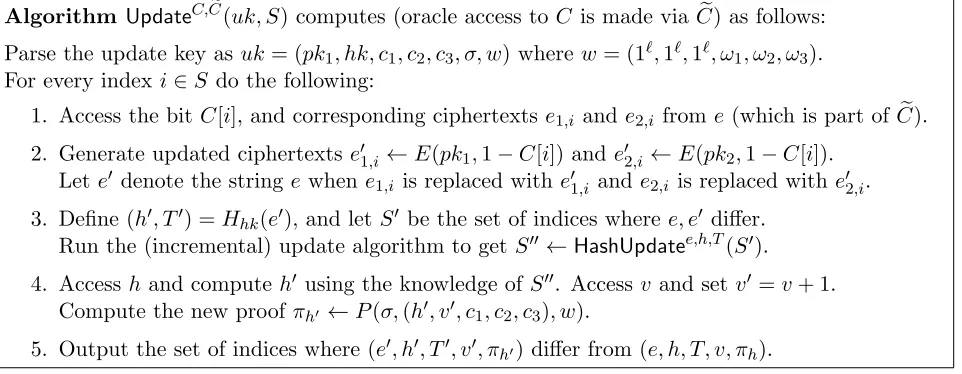
(uk, S) computes (oracle access toC is made viaCe) as follows:
Parse the update key asuk= (pk1, hk, c1, c2, c3, σ, w) wherew= (1`,1`,1`, ω1, ω2, ω3).
For every indexi∈S do the following:
1. Access the bitC[i], and corresponding ciphertextse1,i and e2,i from e(which is part of Ce).
2. Generate updated ciphertextse01,i←E(pk1,1−C[i]) ande02,i←E(pk2,1−C[i]).
Let e0 denote the stringe whene1,i is replaced with e10,i ande2,i is replaced with e02,i.
3. Define (h0, T0) =Hhk(e0), and let S0 be the set of indices wheree, e0 differ. Run the (incremental) update algorithm to get S00←HashUpdatee,h,T(S0).
4. Accessh and computeh0 using the knowledge of S00. Access v and setv0=v+ 1. Compute the new proof πh0 ←P(σ,(h0, v0, c1, c2, c3), w).
5. Output the set of indices where (e0, h0, T0, v0, πh0) differ from (e, h, T, v, πh).
Figure 3: Description of Update.
H2: This hybrid tests|r+t| ≤`(i.e.,r+t≤2`−1), and if so, it setsc3 to be a commitment to t1kt2
fort1 =r and t2=r+t, instead of 0`k1`, and continues as H2. If the test fails, it aborts.
The advantage in distinguishingH2 and H3 is at most δcom+t2−` where δcom is the distin-guishing advantage forcom. This is because of the following: valuer+t >2` for a randomly chosenr if and only ifr∈[2`−t,2`] which happens with probabilityt2−`; if the test succeeds, the hybrids differ only in commitment c3.
This hybrid ensures that there are no valid proofs other than thet+ 1 proofs that are given as part of the obfuscation and the updates.
H2.5: Same asH2except that the CRSσ and all NIZK proofs (πh1, . . . , πht) are now generated
nor-mally using the appropriate witness (instead of being simulated). Note that the hybrid indeed does have the appropriate witnesses to complete this step normally, and the distinguishing advantage fromH2 is at most tδnizk.
H3: This hybrid is identical to H2.5 except that it generates the components {ei2} by (bitwise) encrypting the sequence of circuits correspondingC1, namely{C1i}(instead of{C0i}) for every
i∈[t]. That is, for everi∈[t], it computesCe0i to be of the form (ei, hi, Ti, πhi,Pehk,σ,c1,c2,c3,sk1) as before where ei = (ei1, ei2) and ei1 is a bitwise encryption of C0i under pk1 obtained via
updates butei2 is a bitwise encryption ofC1i underpk2 (also obtained via updates).
The advantage in distinguishing H2.5 and H3 is at mostt· |C0| ·δpke whereδpke denotes the
advantage in breaking the security of PKE scheme. This claim is straightforward.
H4: Identical to H3 except that instead of obfuscating circuit Phk,σ,c1,c2,c3,sk1, it obfuscates the
following circuitP2hk,σ,c1,c2,c3,sk2
2, padded to the sizeQ:
Circuit P2hk,σ,c1,c2,c3,sk2(e, v, π, x):
1. Compute (h, T) =Hhk(e) and verify that V(σ,(h, v, c1, c2, c3), π) = 1.
Output⊥if verification fails.
2
2. Otherwise, parse eas (e1, e2), compute C=D(sk2, e2), and outputC(x).
Letδ4 denote the distinguishing advantage of any polynomial time distinguisher betweenH4
andH3. From lemma 4.1, δ4 ≤4t2|C0| ·(δssb+δnizk+δcom+δIO) where quantitiesδssb, δnizk,
andδIOdenote the distinguishing advantage for SSB hash, NIZK proofs, andIOrespectively.
H5: Same asH4 except that it generates ciphertextsei1 to now encrypt C1i (instead ofC0i)∀i∈[t].
That is, for every i ∈ [t], it computes Ce0i to be of the form (ei, hi, Ti, πhi,Pf2hk,σ,c1,c2,c3,sk2) whereei = (ei1, ei2) ande1i, ei2 are (bitwise) encryptions ofC1i underpk1, pk2 respectively. Note
that these encryptions are actually obtained via updates.
The distinguishing advantage betweenH5andH4is at mostt|C0|δpke. This is straightforward.
H6: Same as H5 except that it obfuscates circuit Phk,σ,c1,c2,c3,sk1 (which uses sk1 and decrypts
from e1, see figure 2) instead ofP2hk,σ,c1,c2,c3,sk2.
Letδ6 denote the distinguishing advantage betweenH6 and H5. We claim thatδ6≤4t2|C0| ·
(δssb+δnizk+δcom+δIO). The proof is identical to that of lemma 4.1 and omitted.
H7: Same as H6 but now c3 is switched back to a commitment of 0`k1` instead of t1kt2. Recall
thatt1 =r, t2 =r+t.
The distinguishing advantage between H7 and H6 is at most δcom+t2−` (as argued in H2).
Observe thatH7 is the same as experimentExpt(λ, C0, C1, I,1). The total distinguishing advantage
is thus bounded byO t2· |C0| · δpke+δnizk+δssb+δcom+ 2−`
which is negligible.
Lemma 4.1 δ4 ≤4t2|C0| ·(δssb+δnizk+δcom+δIO).
Proof: The lemma is proven by focusing on one of the t locations in the sequence at a time, and use the properties of SSB hash, to slowly reach a point where there is a unique value of e
corresponding to the hash value at this location. All values prior to this location will use sk2 and
e2, whereas those after it will usesk1, e1.
More precisely, we describe t hybrids G1, . . . ,Gt where hybrid Gj will use sk2 on inputs with
value v ifr ≤v < r+j, andsk1 ifr+j≤v≤r+t. Note that v is always in the range [r, r+t]
in this hybrid. To prove that Gj−1 and Gj are indistinguishable, we will design another 4 + 2|C0|
hybrids where we will first ensure the uniqueness of (j, hj) and then perform SSB hash translation to move toGj.
Formally, define G0 to be the same as H3, and for j ∈ [t] define hybrid Gj as follows: it is identical to Gj−1 except that it obfuscates the circuit Phk,σ,c1,c2,c3,r,sk1,sk2,j described in figure 4
(instead ofPhk,σ,c1,c2,c3,r,sk1,sk2,j−1).
3
Note thatr was chosen uniformly in step 6 of the construction and the size ofPhk,σ,c1,c2,c3,r,sk1,sk2,j
is padded to the valueQ before obfuscation.
Let εj denote the distinguishing advantage betweenGj and Gj−1. Observe thatGt is the same asH4 and δ4≤Pjεj. We now prove that εj ≤4t|C0| ·(δssb+δnizk+δcom+δIO).
Consider the following hybrids:
3Note that the only difference between these two circuits are valuesjandj−1, and this obfuscation is performed
Circuit Phk,σ,c1,c2,c3,r,sk1,sk2,j(e, v, π, x):
1. Compute (h, T) =Hhk(e) and verify that V(σ,(h, v, c1, c2, c3), π) = 1.
Output ⊥if verification fails.
2. Otherwise, parseeas (e1, e2) and computeC as follows:
If r≤v ≤r+j, set C=D(sk2, e2);
If r+j < v≤r+t, set C=D(sk1, e1).
3. OutputC(x).
Figure 4: Description ofPhk,σ,c1,c2,c3,sk1,j
Gj:1: Same as Gj−1 except that the CRS σ and all NIZK proofs are obtained from the simulator,
i.e., values (σ, πh1, . . . , πht) are sampled using the simulator. The distinguishing advantage
from Gj−1 is at mosttδnizk.
Gj:2: Same as Gj:1 except that commitments c1 and c2 are changed as follows. Let ej denote the
encryptions corresponding to the j-th update in the sequence, and let hj =Hhk(ej). Then,
c1 is set to be a commitment to hj and c2 a commitment to r+j: c1 = com(hj;ω1), c2 =
com(r+j;ω2). The distinguishing advantage fromGj:1 is at mostδcom.
Gj:3: Same asGj:2except that the CRSσ and all NIZK proofs (πh1, . . . , πht) are now generated
nor-mally using the appropriate witness (instead of being simulated). Note that the hybrid indeed does have the appropriate witnesses to complete this step normally, and the distinguishing advantage fromGj:2 is at mosttδnizk.
At this point, for location j, there exists only one value ofhj that can produce convincing proofs (from the soundness of NIZK). Next, we will use the SSB hash to reach a point where only the stringej will be accepted by the obfuscated circuit as the valid input corresponding to hashhj. We do this in a series of 2|C0|hybrids corresponding to the 2|C0|encryptions occurring inej = (ej1, e
j
2).
Formally, for every m = 1, . . . ,2|C0|, we define two hybrids Gjm:3:1,Gjm:3:2 below. Let e∗m denote the string which identical to ej in the first m blocks, each of length `
e, and 0 everywhere else. For convention, letG0:2
j:3 be the same as Gj:3. Then:
Gm:1
j:3 : Same as G
m−1:2
j:3 except that it makeshk to be binding at m, i.e., hk←Gen(1λ,1`e,|e|, m).
Gm:2
j:3 : Let us recall that we started with hybridGj−1which obfuscates the circuitPhk,σ,c1,c2,c3,sk1,sk2,j−1.
This hybrid proceeds just likeGm:1
j:3 except that it obfuscates the circuitP
m,e∗m
hk,σ,c1,c2,c3,sk1,sk2,j−1
described below.
Circuit Pm,e∗m
hk,σ,c1,c2,c3,sk1,sk2,j−1(e, v, π, x):
1. If the firstm blocks ofeand e∗m are not the same, output ⊥. 2. Otherwise outputPhk,σ,c1,c2,c3,sk1,sk2,j−1(e, v, π, x) (see figure 4).
The distinguishing advantage betweenGjm:3−1:2 andGm:1
j:3 is at mostδssb, and betweenGjm:3:1andGjm:3:2
Whenm= 2|C0|, the circuitPm,e
∗
m
hk,σ,c1,c2,c3,sk1,sk2,jaccepts onlye
∗
2|C0|=e
j as the input for location
j in the sequence and all other inputs are rejected. We can now safely change this program to use
sk2 to decryptej2 at locationj (instead ofe
j
1). More precisely, we consider the hybrid:
Gj:4 Same as G2
|C0|:2
j:3 except that it obfuscates a circuit which, in location j, decrypts from e
j
2.
More precisely, it obfuscates the following circuit:
Circuit Phk,σ,cej 1,c2,c3,sk1,sk2,j−1(e, v, π, x): 1. Ife6=ej, output ⊥.
2. Otherwise outputPhk,σ,c1,c2,c3,sk1,sk2,j(e, v, π, x) (see figure 4).
The distinguishing advantage from previous hybrid is at most δIO.
Our goal is now to get rid of the first condition, so that we switch back to only obfuscating
Phk,σ,c1,c2,c3,sk1,sk2,j. This is performed by simply reversing the steps in m hybrids. Furthermore,
we also reverse the changes made in the commitment in a sequence of 3 hybrids by considering the reverse of hybridsGj:3,Gj:2,Gj:1. The resulting hybrid would essentially be identical toGj. We omit these details.
The total distinguishing advantage betweenGj andGj−1is bounded by the sum of all advantages,
which is at most 4t|C0|(δcom+δnizk+δssb+δIO). This completes the proof.
Size Q: The value ofQ is defined to be the size of the programPhk,σ,cej
1,c2,c3,sk1,sk2,j−1 described
above (for any value of j, say j= 1).
Construction for Turing machines and RAM programs. As mentioned earlier, our con-structions are quite independent of the underlying model of computation. For example, to obtain construction for the class of bounded-input Turing machines, we use the same construction as in figure 1 except that the obfuscator O for circuits in (step 7) will now be an obfuscator for the class of bounded-input Turing machines since the program in figure 2 will now be a bounded-input Turing machine. Likewise, we also obtain constructions for RAM programs and unbounded-input Turing machines assuming the existence ofIOfor the same. This gives us the following theorem.
Theorem 4.2 If there exists indistinguishability obfuscation for a class of programs P = {Pλ} modeled as either boolean circuits, or (bounded/unbounded input) Turing machines, or RAM pro-grams, then there exists incremental indistinguishability obfuscation (IIO, definition 3.1) for P.
5
Amplifying Security to Increment-private
IIO
In this section, we present our (black-box) transformation which transform an IIO scheme (defi-nition 3.1) into an increment-private IIO scheme (definition 3.2). As before, for concreteness, we present our transformation for circuits, but it works for Turing machines and RAM programs as well. Our transformation preserves thepristine updatesproperty as well (definition 3.3).
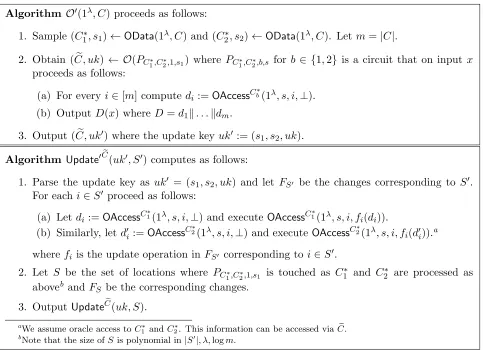
Algorithm O0(1λ, C) proceeds as follows:
1. Sample (C1∗, s1)←OData(1λ, C) and (C2∗, s2)←OData(1λ, C). Let m=|C|.
2. Obtain (C, uke ) ← O(PC∗
1,C
∗
2,1,s1) where PC
∗
1,C
∗
2,b,s for b ∈ {1,2} is a circuit that on input x
proceeds as follows:
(a) For every i∈[m] computedi :=OAccessC ∗
b(1λ, s, i,⊥).
(b) Output D(x) whereD=d1k. . .kdm.
3. Output (C, uke 0) where the update key uk0 := (s1, s2, uk).
Algorithm Update0Ce
(uk0, S0) computes as follows:
1. Parse the update key as uk0 = (s1, s2, uk) and let FS0 be the changes corresponding to S0. For each i∈S0 proceed as follows:
(a) Let di :=OAccessC ∗
1(1λ, s, i,⊥) and execute OAccessC
∗
1(1λ, s, i, fi(di)).
(b) Similarly, let d0i :=OAccessC2∗(1λ, s, i,⊥) and execute OAccessC∗2(1λ, s, i, fi(d0
i)).a
where fi is the update operation inFS0 corresponding to i∈S0.
2. Let S be the set of locations where PC1∗,C∗2,1,s1 is touched as C
∗
1 and C2∗ are processed as
aboveb and FS be the corresponding changes.
3. OutputUpdateCe
(uk, S).
aWe assume oracle access toC∗
1 andC
∗
2. This information can be accessed viaCe.
b
Note that the size of Sis polynomial in|S0|, λ,logm.
Figure 5: Description ofO0 and Update0.
givenIIOscheme. In addition to the encodings and secret information, the program is also provided with a bit bas well as some more information which tells the program which ORAM encoding to pick for evaluation. This is helpful in designing the hybrid experiments.
Our construction. Let (O,Update) be anIIOscheme for the class of all circuits. Let (OData,OAccess) be an oblivious RAM scheme as described in Section 2.3. Our new scheme consists of algorithms (O0,Update0) described in figure 5.4
Theorem 5.1 Scheme (O0,Update0) isincrement-private IIOfor all circuits (definition 3.2).
Proof: The correctness and the pristine updates property of our construction follows directly from the correctness and the pristine updates property of the underlyingIIOscheme. We argue the increment-private indistinguishability property of our construction.
We have to show that for any (not necessarily uniform) PPT distinguisher D, there exists a negligible function α such that the following holds: For all security parametersλ∈N, for all pairs
4We emphasize that even though our scheme uses ORAM, programP
C∗
1,C∗2,s,bin figure 5 is still only acircuitand
of circuits C0, C1∈ Cλ, for every polynomial tand for all pairs of update sequences I0, I1 of length
twe have that if C0(x) =C1(x) andFI0(C0)(x) =FI1(C1)(x) for all inputs x, then
Pr
D(Expt(λ, C0, C1, I0, I1,0)) = 1
−PrD(Expt(λ, C0, C1, I0, I1,1)) = 1
≤α(λ).
where distributionExpt(λ, C0, C1, I0, I1, b) outputs as follows: (1) Sample (C1∗, s1)←OData(1λ, Cb) and (C2∗, s2)←OData(1λ, Cb). (2) Sample (C, ske )← O(λ, PC∗
1,C
∗
2,1,s1) and the sequence (Ce
1, . . . ,
e
Ct)←
UpdateCe(sk, J), and output (I
0, I1, C0, C1,C,e Ce1, . . . ,Cet). Here J = (S1, . . . , St) is obtained from
Ib = (Sb,01, . . . Sb,t0 ) as follows (also described in figure 5). For each j∈ {1, . . . t}, setSb0 =Sb,j0 and proceed as follows.
1. FS0
b be the changes corresponding toS
0
b. For eachi∈S 0
b proceed as follows:
(a) Letdi:=OAccessC ∗
1(1λ, s, i,⊥) and executeOAccessC
∗
1(1λ, s, i, fi(di)).
(b) Similarly, letd0i:=OAccessC2∗(1λ, s, i,⊥) and executeOAccessC2∗(1λ, s, i, f
i(d0i)).
2. Let S be the set of locations where PC∗
1,C2∗,1,s1 is touched as C
∗
1 and C2∗ are processed as
above5 and FS be the corresponding changes.
3. OutputUpdateCe
(uk, S) as Sj.
To prove the claim, consider the following sequence of hybrids:
H1: This hybrid corresponds to the output of the experiment Expt(λ, C0, C1, I0, I1,0) as above.
H2: In this hybrid we change Step 1b in the experiment above. In particular we instead of changing stored value to fi(di) we always set it to zero. More formally, the procedure is changed as follows.
(a) FS0
b be the changes corresponding toS
0
b. For eachi∈S00 proceed as follows:
i. Let di :=OAccessC ∗
1(1λ, s, i,⊥) and execute OAccessC
∗
1(1λ, s, i, fi(di)).
ii. Similarly, letd0i :=OAccessC2∗(1λ, s, i,⊥) and execute OAccessC∗2(1λ, s, i,0).
(b) LetS be the set of locations wherePC∗
1,C2∗,1,s1 is touched asC
∗
1 andC2∗ are processed as
above andFS be the corresponding changes.
(c) OutputUpdateCe
(uk, S) as Sj.
Indistinguishability follows from the security of the IIO scheme. Here we use the property that any changes made toC2∗ do not affect the functionality of the programPC∗
1,C2∗,1,s1.
H3: In this hybrid we again change Step 1b in the experiment above. In particular, we make changes toC2∗ at locationsS10 instead ofS00. As inH1 we still set these locations to zero when the change is made. More formally:
(a) FS0
b be the changes corresponding toS
0
b. For eachi∈S00 and k∈S10 proceed as follows:
i. Let di :=OAccessC ∗
1(1λ, s, i,⊥) and execute OAccessC
∗
1(1λ, s, i, fi(di)).
5
ii. Similarly, letd0k :=OAccessC2∗(1λ, s,k,⊥) and execute OAccessC∗2(1λ, s,k,0).
(b) LetS be the set of locations wherePC∗
1,C2∗,1,s1 is touched asC
∗
1 andC2∗ are processed as
above andFS be the corresponding changes.
(c) OutputUpdateCe
(uk, S) as Sj.
Indistinguishability follows from the security of the oblivious RAM scheme (as in Section 2.3).
H4: In this hybrid we change how C2∗ is generated and the changes that are made while the increments are performed. More formally:
We generate (C2∗, s2) by executing OData(1λ,C1). Additionally the increments are not set using I1 instead of I0 as follows:
(a) FS0
b be the changes corresponding toS
0
b. For eachi∈S00 and k∈S10 proceed as follows:
i. Let di :=OAccessC ∗
1(1λ, s, i,⊥) and execute OAccessC
∗
1(1λ, s, i, fi(di)).
ii. Similarly, letd0k :=OAccessC2∗(1λ, s, k,⊥) and execute OAccessC
∗
2(1λ, s, k,fk(d0 k)).
(b) LetS be the set of locations wherePC∗
1,C2∗,1,s1 is touched asC
∗
1 andC2∗ are processed as
above andFS be the corresponding changes.
(c) OutputUpdateCe
(uk, S) as Sj.
Indistinguishability follows from the security of the IIO scheme. Here we use the property that any changes made toC2∗ do not affect the functionality of the programPC1∗,C2∗,1,s1.
H5: In this hybrid instead of outputting an obfuscation of PC∗
1,C2∗,1,s1 we output and obfuscation
of PC1∗,C2∗,2,s2.
Indistinguishability follows from the security of the IIO scheme. Here we use the property that for all x we have that C0(x) =C1(x) and FI0(C0)(x) =FI1(C1)(x). This in particular
implies thatPC∗
1,C2∗,1,s1(x) =PC1∗,C2∗,2,s2(x) andFJ(PC1∗,C2∗,1,s1)(x) =FJ(PC1∗,C2∗,2,s2)(x) where J = (S1, . . . St) as obtained in the previous hybrid.
Observe that at this point we can reverse the hybrids presented above and obtain the distribution Expt(λ, C0, C1, I0, I1,1). This proves our claim.
As before, this transformation is not specific to circuits. In particular, if (O,Update) is a scheme for Turing machines or RAM programs, then (O0,Update0) is increment-private IIO for the same model. Thus, our transformation, together with theorem 4.2, gives the following result.
Theorem 5.2 If there exists indistinguishability obfuscation for a class of programs P = {Pλ} modeled as either boolean circuits, or (bounded/unbounded input) Turing machines, or RAM pro-grams, then there exists increment-private indistinguishability obfuscation (definition 3.2) for P.
6
The Lower Bound
Point functions. LetIn={Ix}x∈{0,1}n denote the family of point functions for points in {0,1}n
VBB obfuscation schemes for In are known to exist [Wee05, Can97, BS16] under standard assumptions such as variants of one-way permutation or DDH. We show that even for a family as simple as In, incremental VBBobfuscation (corresponding to our efficiency requirements) does not exist. In fact, we rule this out even for VGB obfuscation, which is weaker than VBB; this strengthens our result.
More specifically, we show that the update algorithm of every incremental VGB obfuscation for In must change Ω(n/logn) bits for a large fraction of functions Ix ∈ In even if only one bit changes in x.
Theorem 6.1 Every VGB obfuscation scheme for In must have incrementality∆∈Ω(n/logn).
Proof: Let (O,Update) be a VGB obfuscation scheme for In with incrementality ∆. Let λ be the security parameter so that n =n(λ) ≥λ is a polynomial determining the length of points in
In, and ∆ is a function of λ.
The proof proceeds by showing that incrementality “leaks” Hamming distance between updated obfuscations, which, by definition, cannot be leaked by VGB obfuscation. Formally, define the following two distributions:
• D1 : Obtain obfuscations for programs Ix and Ix0 for a random x by obfuscating Ix and updating it for Ix0 where x, x0 differ in only one position, say first. I.e., samplex ← {0,1}n,
e
Ix ← O(Ix), Iex0 ←UpdateIex(1λ, uk,{1,flip}), and output (Iex,Iex0).
• D2 : Return obfuscations of two random points y1, y2 through update. I.e., sample y1, y2
uniformly, and obtain Iey1 ← O(Iy1). Let δ denote the set of locations where y1, y2 differ
corresponding to the functionflip. Then, obtainIey2 ←UpdateIey1(1λ, δ).
Next, define the following adversarial algorithm:
Algorithm A: on input two strings (Ie1,Ie2), A outputs 1 if the Hamming distance between Ie1,Ie2 is at most ∆; otherwiseA outputs 0.
By definition ofVGB security, there exists a simulatorS, a polynomialq, and a negligible function
α such thatS can simulate the output ofA (on any two obfuscated circuits) by making at mostq
queries to the corresponding circuits. Note that this simulatorS cannot distinguish the two cases above as it is only give oracle access to the programs.
Let us consider the output of Aon input (Iex,Iex0) sampled fromD1. Due to the incrementality of the scheme, these inputs differ in at most ∆ locations, and hence A outputs 1 with probability 1.
Next, consider the output of A on input (Iey1,Iey2) sampled from D2. We note that for any choice of randomness of the obfuscator the Hamming distance between Iey1,Iey2 cannot be less than than the Ω(n/logn). More formally, for a choice of random coins, the obfuscator is an injective function from 2n points to an obfuscation of m bits were m =nc for constant c. Then we claim that the two obfuscations (for randomy1 and y2) differ by at least Ω(n/logn) bits. If this was not
the case then we could encode the two random points x1, x2 ino(2n) bits which is impossible. In
particular, we could perform the encoding by giving x1 and the update of obfuscation fromx1 to
x2. If the hamming distance between the obfuscations of x1 and x2 ist=o(n/logn) then we have
that this change can be encoded in log mt
which is at most log((nc)t)< c.o(n/logn).logn < o(n). Therefore, we conclude that ∆∈Ω(n/logn).
7
Best Possible Incremental Obfuscation
Our lower bound on the incrementality ofVGB/VBBobfuscations demonstrates that any incremen-tal scheme must leak the size of incremenincremen-tal updates that take place. An interesting question is if this is all that is leaked. In particular, we investigate the possibility of realizing weaker simulation-based notions which allow for leakage of the size of the incremental updates.
However, a notion along these lines leaves a lot unexplained. For example, it is not clear if such an effort would yield a meaningful notion for general programs. Motivated by such issues and inspired by the notion of “best possible obfuscation” [GR07] for the single use setting, we define the notion of “best possible incremental obfuscation” orIBPO.
Definition 7.1 (Incremental Best Possible Obfuscator (IBPO)) A pair of uniform PPT ma-chines (O,Update) is called an incremental BPO obfuscator for a circuit class {Cλ} if it satisfies the syntax, correctness and incrementality properties (as in definition 3.1) and the following best possible obfuscation property:
For any (not necessarily uniform) PPT adversariesA, there exists a simulatorSand a negligible function α, such that the following holds: For all security parameters λ ∈ N, for all pairs of circuits C1, C2 ∈ Cλ (with |C1|=|C2|), for every polynomialt and for all pairs of update sequences
I0, I1 (with S0,i = S1,i for each i ∈ {1, . . . , t}) of length t we have that if C0(x) = C1(x) and
FI0(C0)(x) =FI1(C1)(x) for all inputs x, then
Pr
A(Ce0,Ce01, . . . ,Ce0t) = 1
−PrS(C1, I1) = 1
≤α(λ)
where (Ce0, sk)← O(λ, C0), and (Ce01, . . . ,Ce0t)←UpdateCe0(sk, I0).
Informally, this definition guarantees that any information that can be efficiently obtained from the obfuscation Ce0 along with the obfuscation increments Ce01, . . . ,Ce0t, can also be extracted efficiently (i.e., simulated) from any equivalent circuit of a similar size C1 and corresponding equivalent
updatesI1 of similar size. We now prove the following theorem.
Theorem 7.1 (O,Update) is incremental BPO obfuscator for a circuit class {Cλ} if and only if it isincrement-private IIOobfuscator for {Cλ}.
Proof Sketch: We need to prove that an IBPO scheme is also a increment-private IIOscheme and the other way around. We start with the first direction.
By the definition of best possible obfuscation we have that the distributions A(Ce0,Ce01, . . . ,Ce0t) and S(C1, I1) are close. Similarly the distributions A(Ce1,Ce11, . . . ,Ce1t) and S(C1, I1) are close. In the above expressions for b ∈ {0,1}, (Ceb, skb) ← O(λ, Cb), and (Ceb1, . . . ,Cebt) ← Update
e
Cb(sk
b, Ib). These two facts together imply that the distributions A(Ce0,Ce01, . . . ,Ce0t) and A(Ce1,Ce11, . . . ,Ce1t) are close, implying that (O,Update) is a increment-privateincremental indistinguishability obfuscator. Next we sketch the argument for the other direction. Our simulatorS on inputC1, I1 computes
(Ce1, sk1) ← O(λ, C1), and (Ce11, . . . ,Ce1t) ← Update
e
C1(sk
1, I1) and outputs (Ce1,Ce11, . . . ,Ce1t). The indistinguishability of this from obfuscation ofC0and obfuscation increments forI0follows directly