Textbook Non-Malleable Commitments
Vipul Goyal∗ Omkant Pandey† Silas Richelson‡
Abstract
We present a new non-malleable commitment protocol. Our protocol has the following features:
• The protocol has onlythree rounds of interaction. Pass (TCC 2013) showed an impossibility result for a two-round non-malleable commitment scheme w.r.t. a black-box reduction to any “standard" intractability reduction. Thus, this resolves the round complexity of non-malleable commitment at least w.r.t. black-box security reductions. Our construction is secure as per the standard notion of non-malleability w.r.t. commitment.
• Our protocol istruly efficient. In our basic protocol, the entire computation of the committer is domi-nated by just three invocations of a non-interactive statically binding commitment scheme, while, the re-ceiver computation (in the commitment stage) is limited to just sampling a random string. Unlike many previous works, we directly construct a protocol for large tags and hence avoid any non-malleability amplification steps.
• Our protocol makes black-box use of its underlying cryptographic primitives. Previously, the best known black-box construction of non-malleable commitments required a larger (constant) number of rounds. Our basic protocol secure against synchronizing adversaries is based on black-box use of any non-interactive statistically binding commitment (which, in turn, can be based on any one-to-one one-way function). Our extended protocol requires a mildly stronger assumption and more invocations of the underlying non-interactive commitment scheme.
• Our construction is public-coin and makes use of only black-box simulation. Prior to our work, no public-coin constant round non-malleable commitment schemes were known based on black-box simu-lation.
Our techniques departsignificantlyfrom the techniques used previously to construct non-malleable com-mitment schemes. As a main technical tool, we rely on non-malleable codes in the split state model. Our proofs of security are purely combinatorial in nature.
In addition, we also present a simple construction of constant round non-malleable commitments from any one-way function. While this result is not new, the main feature is its simplicity compared toanyprevious construction of non-malleable commitments (in any number of rounds). We believe the construction is simple enough to be covered in a graduate level course on cryptography. The construction uses non-malleable codes in the split state model in a black-box way.
∗
Microsoft Research, India. Email:[email protected].
†
University of California, Berkeley. Email:[email protected].
‡
1
Introduction
Man-in-the-middle (MIM) attacks are one of the most basic attacks in cryptography. The notion of non-malleable commitments was introduced in a seminal work of Dolev, Dwork and Naor [DDN91] as a countermeasure against such adversaries. Since their introduction, non-malleable commitments have proven to be capable of preventing MIM attacks in a variety of settings. Non-malleability lies at the heart of secure protocol composition, it allows for round-efficient secure multi-party computation and gives applications to areas as diverse as position based cryptography [CGMO09].
Acommitment schemeis a useful two party protocol which allows a committer,C, to send a representation of his messagev,Com(v;r)to a receiver,R, in such a way so that 1)Rlearns nothing aboutvuntilCchooses to open his commitment and 2)C is bound tov; he cannot openCom(v)to any valuev0 6=v. A commitment scheme isnon-malleableif for every messagev, no MIM adversary, intercepting a commitmentCom(v;r)and modifying it at will, is able to efficiently generate a commitmentCom(˜v; ˜r) to a related message ˜v. Interest in non-malleable commitments is motivated both by the central role that they play in securing protocols under composition [CLOS02, LPV09] and by the unfortunate reality that many widely used commitment schemes are actually highly malleable. Indeed, man-in-the-middle (MIM) attacks occur quite naturally when multiple concurrent executions of protocols are allowed, and can be quite devastating.
Since their conception, non-malleable commitment has been studied extensively, and, with increasing success in terms of characterizing its round complexity. The original construction of [DDN91] gave a protocol with log-arithmically many rounds. Barak [Bar02] gave a constant round construction based on non-black-box simulation (which was further improved by Pass and Rosen [PR05b]). More recently, constant round protocols for non-malleable commitment with black-box proofs of security were given by Goyal [Goy11] and Lin and Pass [LP11]. Other constructions include [PR05a, LP09, LPV08, PPV08, PW10, Wee10, GLOV12]. The current state of art is represented by the work of Goyal, Richelson, Rosen and Vald [GRRV14] whose scheme requires only four rounds of interaction. On the negative side, Pass [Pas13] showed that two-round non-malleable commitments cannot exists w.r.t. black-box proofs of security based on any “standard" intractability assumption. The lower bound of Pass holds even if the construction uses the underlying assumption in a non-black-box way. Thus, the main remaining open problem regarding the round complexity of non-malleable commitment is
Does there exist a protocol for non-malleable commitment with only three rounds of interaction?
In this work we present a three round protocol, thus giving a positive answer to the above question.
Zero-Knowldge: A Barrier to Three-Round Non-Malleable Commitment. Almost all previous schemes invoke some sort of proof of consistency. These are usually critical to the proofs of non-malleability, as without consistency one runs into a host of “selective⊥attacks” (where the MIM plays in such a way so that whether or not his commitment is valid, depends on the value inside the commitment he receives) which are difficult to rule out. Generally, zero-knowledge is used for this purpose. For example, the recent works of [GRRV14, BGR+15] use a three round “commit-and-prove” sigma protocol along with a GMW-style zero-knowledge proof of correctness [GMW87]. They then use the Feige-Shamir paradigm [FS90] in order to parallelize their protocol down to four rounds.
We also point out that also that zero-knowledge is usually the most computationally expensive component in protocols for non-malleable commitment. Indeed, all previous schemes for non-malleable commitment are considerably slower than their ordinary statically binding counterparts.
Our Contributions. We present a new construction of non-malleable commitment which has the following features:
• The protocol has only three roundsof interaction. Pass [Pas13] showed that two-round non-malleable commitments unfortunately cannot exists w.r.t. black-box proofs of security based on any “standard" intractability assumption. The lower bound of Pass holds even if the construction uses the underlying assumption in a non-black-box way. Thus, this resolves the round complexity of non-malleable commit-ments at least w.r.t. black-box security reductions. Our construction is secure as per the standard notion of non-malleability w.r.t. commitment.
• Our protocol is simple andtruly efficient. In our basic protocol, the entire computation of the committer is dominated by just three invocations of a non-interactive statically binding commitment scheme, while, the receiver computation (in the commitment stage) is limited to just sampling a random string. The decommitment stage is equally basic: the committer would send the openings of these commitments, while, the receiver would be required to check these openings for correctness and perform some simple computations. The protocol is easy to describe, the main complexity lies in the analysis rather than the construction.
In several previous works (including [GRRV14, BGR+15]), first a non-malleable commitment scheme for “small" tags is constructed. Then, a scheme for large tags is obtained using non-malleability amplification [DDN91, LP09]. This adds a significant multiplicative overhead to the computation of each party: the multiplicative overhead is typically related to the number of bits in the large tags. Unlike these previous works, our basic protocol works directly with large tags, and hence, we avoid any expensive amplification steps. Our basic protocol provides security only against synchronizing adversaries. Extension to non-synchronizing adversaries is addressed later, though still with a three round protocol.
• Our basic protocol is based on black-box use of any non-interactive statistically binding commitment scheme. Such schemes, in turn, can be based on any one-to-one, one-way function, or, at the cost of an extra initialization round, any one-way function. This protocol is secure against synchronizing adversaries. While this is sufficient for many applications such as secure multi-party computation, we also present a protocol secure against general (PPT) adversaries. Our extended protocol is based on black-box use of any non-interactive statistically binding commitment scheme whose hiding property holds against quasi-polynomial time adversaries. Such schemes, in turn, can be based on any quasi-quasi-polynomially secure one-to-one, one-way function. We note that previously, the best known black-box construction of non-malleable commitments required a larger constant number of rounds [GLOV12, KMO14]. Furthermore, the previous constructions, even though black-box, were significantly less efficient [GLOV12, LP12, KMO14, Kiy14]. For example, the construction of Goyal et al [GLOV12] used “MPC in the head techniques" of Ishai et. al [IKOS07].
• Our construction is coin and makes use of only black-box simulation. Prior to our work, no public-coin constant round non-malleable commitment schemes were known based on black-box simulation. The structure of our basic protocol is arguably “as basic as it can be": C sends a single commitment to some string, the receiver sends a random challenge, and, in the final round, sender sends another string (but doesn’t send any opening).
any one-way function. While such a construction is not new, the main feature is its simplicity over any previous construction: it has a simple “commit-and-prove” structure and can be be based on any split state non-malleable code (without any additional properties). The reduction makes a standard use of adaptive security, and may be of independent interest. We believe that this protocol is simple enough to be included in a graduate level textbook on cryptography or be taught in a graduate level cryptography course.
Starting Technical Idea. Our key technical tool will be non-malleable codes in the split-state model [DPW10, DKO13]. We will use these codes in conjunction with a techniques introduced by Goyal et. al. [GRRV14]. Non-malleable codes in the split-state model are codes whose codewords are pairs(L,R)∈ L × R, and the tampering function family is
Fsplit =
(f, g)f :L → L, g:R → R .
That is, one encodes a message by breaking it into two states, and is ensured that non-malleability holds as long as the adversary tampers each state separately. Several recent and exciting works [DKO13, ADL14, CZ14, ADKO15, CGL15] establish a connection between split-state non-malleable codes and various types of random-ness extractors. Thus, split-state non-malleable codes allow us to harrandom-ness deep theorems from the extensive randomness extraction literature and direct them towards the seemingly unrelated area of cryptographic non-malleability.
As a first attempt towards constructing non-malleable commitments, consider the protocol where the com-mitterCsimply commits separately toLandR? This does not work as the underlying commitment scheme may have some homomorphic properties allowing the MIM to maulLandR“jointly". Our starting idea is as follows. Let us focus our attention on synchronizing adversaries1. Cencodes the messagevasLandR, and, in the first round, sends a commitmentCom(L) toL. The receiver responds back with an acknowledgement message, at which pointCsendsRin the clear. This scheme does seem to have some non-malleability features. In the first round, the MIM must maulCom(L)into Com(˜L)without knowledge ofR, while in the final round, the MIM receivesRand must produceR˜ given onlyCom(L)(rather thanLitself). While this is indeed our starting point, this intuition turns out to be not sound (see Appendix for an “explicit" attack). Our basic protocol is quite simple and is given below.
• Committer’s Input:A valuevto commit to.
• 1. C → R: Cchooses(L,R)← Enc(v)whereLis viewed as a field element inZq;Calso drawsr ←Zq at random and sendsCom(L◦r)toRwhereComis a non-interactive, statistically binding commitment scheme.
• 2.R → C:Rchooses a randomα←Z∗qand sends it toC.
• 3.C → R:Csendsa=rα+LandRtoR.
• Decommitment:To decommit,Cdecommits to the commitment in1.
Intuitively,C commits to a polynomial-based 2-out-of-2 secret sharing of Lin the first round, and in the third round sends R along with one share. The same polynomial based commit-and-reveal mechanism is used in [GRRV14], but no non-malleable codes are used and so a zero-knowledge proof of consistency is needed.
To prove security of the above protocol, we must reduce any “successful" mauling attack to a mauling attack on the underlying non-malleable code. The adversary for the non-malleable codes (i.e., a split-state tampering function pair(f, g)) would have to run the left execution (with the MIM) using the givenLandRand extractL˜
andR˜ from the right execution. If MIM successfully mauls the commitment scheme, then the extracted˜LandR˜
would decode to˜vwhich is related to C’s committed valuev represented byLandR. This would presumably
1
contradict the security of the non-malleable code. However one must keep in mind that(f, g) must be split-state and so neither function is allowed to seeLandRat once. Hence, it cannot simply run our non-malleable commitment protocol, and extract the tampered˜LandR˜.
To complete the proof of security, we need to construct split-state (f, g) (which can use the MIM and the distinguisher for our protocol internally) so thatf outputsL˜using onlyLand likewisegoutputsR˜ using onlyR. Thereforef andgcannot complete the protocol execution with MIM to extract the tampered code (since each will be missing one ofLandR)! Thus, the idea of reducing the security of our construction to the security of non-malleable codes (in the split-state model) seems like a non-starter. This is the key technical challenge we encounter in our proof of non-malleability.
Our proof strategy, at a very high level is to havef(L)andg(R)execute independent interactions with MIM, and output˜LandR˜, respectively. This, however, leads toL˜andR˜ being extracted from two different protocol transcripts, and so there is no clear way to relate the extracted values back to MIM’s mauled commitment˜v. We then show that there exists a single protocol transcript (from the correct distribution) such that the left execution in that transcript is completed usingLandR, and the right usesL˜andR˜. Thus, if MIM is successful in mauling the commitment scheme, then(f, g)is split-state and succeeds in mauling the non-malleable code. A more precise technical overview is given later in this section.
We are not able to make the above argument go through based on standard split-state non-malleable codes. We need need the following additional properties described informally below. See Section 3 for a more precise description.
1. The code must be an augmented split-state non-malleable code [AAG+16]. This means that the distin-guisher for the non-malleable code is givenRas input, in addition to the tampered decoded message.
2. We need the code to beconditionally non-malleable. Intuitively, this means that non-malleability holds whenLis chosen randomly along with (and independently from) the tampering functions(f, g), andRis chosen randomly in the tampering experiment. This is in contrast to the usual security game where(f, g)
are fixed and then(L,R)are both drawn during the tampering experiment. We define this new property formally in Section 3.1.
3. The code must satisfy what we call thesimulatable right stateproperty. Roughly speaking, this means that given a randomL, the sets{R:Dec(L,R) =v}and{R:Dec(L,R) =v0}should be indistinguishable for allv, v0. See Section 3.2 for more details.
Our construction is based on the recent split state non-malleable code of Aggarwal et. al [ADL14]. It turns out that the code in [ADL14] already satisfies the first two of the above properties. We then present a modifica-tion to add the simulatable right state property. Note that the code of [ADL14] is purely informamodifica-tion theoretic, and, in comparison to cryptographic objects (such as commitments or one-way functions), very efficient. En-coding and deEn-coding simply requires sampling random vectors and taking their inner product, etc. To add the strong hiding property, we add a commitment and a symmetric encryption to the encoding and decoding proce-dures. Thus, our overall basic protocol has computation which is dominated by three invocations of a statistically binding commitment scheme (or rather two invocation of a statistically binding commitment and one symmetric encryption).
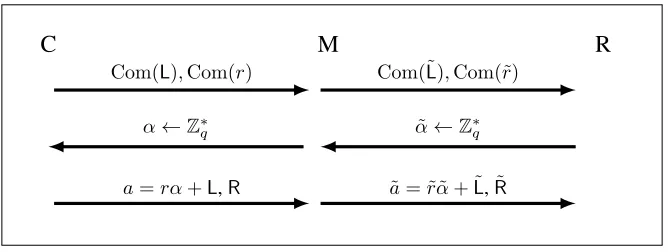
Overview of the Proof of Non-Malleability. Our protocol (under a man-in-the-middle attack) is given in Figure 1. For the time being, think of(L,R) ← Enc(v) whereL,R ∈ Zq,vis the value to whichC wishes to commit and(Enc,Dec) is a generic split-state non-malleable code. We will point out where each of the three above additional properties on(Enc,Dec)is needed. The first is easy to see. The distinguisher for non-malleable commitment gets the transcript (which contains R in the clear) as well as the decommitment v˜, so we need
C M R
Com(L),Com(r) Com(˜L),Com(˜r)
α←Z∗q α˜←Z∗q
a=rα+L,R ˜a= ˜rα˜+ ˜L,R˜
Figure 1: Protocol with Man-in-the-Middle
As mentioned above, we prove non-malleability by reducing any mauling attack to a tampering function(f, g)
which mauls the underlying code. This must be done carefully as on the one hand, we need to ensure thatf and
gtamperv correctly toM’s commitmentv˜, on the other hand,(f, g)must be split-state, and so cannot naïvely run MIM using bothLandR.
Both functions will obtain their output using the third message. They share a partial transcript consisting of the first two messages and the valuea. Though this information containsLand so it shouldn’t be given tog,Lis computationally hidden so we will be able to hybrid it away later. f(L) extracts˜Lby choosing a random value
R$ and sending (a,R$), receiving(˜a$,·); then it rewindsMand asks another random challengeβ˜on the right, it receivesβ on the left and sends(b,R$) whereb = (a−L) β/α
+L, and receives (˜b,·). It outputs˜L, the constant term on the line spanned by
( ˜α,˜a$),( ˜β,˜b) .g(R)also shares the random valueR$and so can compute
˜
a$. g(R)rewinds Mand sends (a,R) on the left and receives(˜a,R)˜ on the right. If ˜a = ˜a$,g(R) outputs R˜,
otherwise it outputs⊥.
Note that for(f, g)to succeed in extracting(˜L,R)˜ , it must be that the answer˜a$Mprovides when given the
randomR$is equal to thea˜he provides givenR. This will follow from the right state simulatability of(Enc,Dec).
Given this property, we can show that the chance thatManswers correctly (i.e., consistently with the linear map he committed to in the first round) givenR$ is about the same as the chance he answers correctly givenR. So
either both are incorrect with high probability, in which caseMis always committing to˜v=⊥and so cannot be mauling; or else botha˜$ and˜aare correct with non-negligible probability. In this case, we can show that(f, g)
succeed in extracting correct(˜L,R)˜ with non-negligible probability. One subtle point is that (f, g) are defined usingL. This means that even after we hybrid this dependence away, the mauling experiment for the resulting tampering functions will haveLfixed. This is why we need(Enc,Dec)to be conditionally non-malleable.
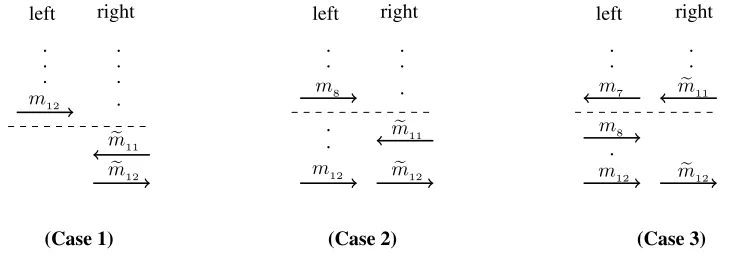
Extension to non-synchronizing adversaries. While in some applications, security against synchronizing ad-versaries is all one needs (e.g., constructing round efficient multi-party computation), in others, non-malleability against arbitrary schedulings is required. Our basic protocol only provides security against synchronizing ad-versaries, and actually is susceptible to selective bot attacks against general schedulings. Since our protocol has only three rounds, we can enumerate over all possible schedulings and check that the only other potentially prob-lematic scheduling is the sequential one where the left execution finishes entirely even before the right execution starts.
achieve this, we will use an extractable commitment scheme such that extraction requires two rewindings instead of just one. This is inspired by a technique from the constant round protocol of Lin and Pass [LP11]. Our final protocol requires significantly more invocations of the underlying commitment scheme, and requires this under-lying scheme to have hiding which holds against quasi-polynomial time adversaries. Very roughly, we use hiding against a quasi-polynomial time adversary because, to our knowledge, no construction of a 3-round extractable commitment scheme (which doesn’t suffer from either “over-extraction" or “under-extraction") is known to date. We stress, however, that it still only requires 3 rounds of interaction, and is much more efficient than all prior schemes in the literature. This protocol is described in Section 7.
A simple constant-round non-malleable commitment scheme from any one-way function. We now briefly discuss the ideas behind our simplest protocol. This protocol, and its proof, use only elementary techniques and are simple enough to be included in a graduate level course in cryptography.
The protocol has a simple “commit-and-prove” structure where commitments are executed using Naor’s commitment [Nao91]. Recall that Naor’s commitment uses a random stringρ sent by the receiver. Ifρ has a special form, then the commitment is “equivocal” and can be opened to both 0 and 1; otherwise it is statistically binding. Let us denote this commitment bycomρ. In out protocolρis obtained by simulatable coin-flipping. Informally, the protocol between the committerCand receiverRis as follows:
1. Sampleρwith coin-tossing: Ccommits to a random stringρ0 and sends it to the receiver — this can be done using standard 2-round Naor’s commitment.Rresponds with a random stringρ00.Csendsρ=ρ0⊕ρ00
toRand proves in (constant round) zero-knowledge thatρis indeed correct. Parseρ=ρ1kρ2kρ3.
2. Commit the first state: C encodes the message m (and identity id) using a standard split-state non-malleable code to obtain two states (L,R). It then commits to Lusing ρ1 as the first message of Naor:
c1=comρ1(L).
3. Start a proof of consistency. Before sending the second state,CandRstart a zero-knowledge proof-of-knowledge of “consistency” in which the statement to be proven is decided in the last step.
This is done by using the (standard) Feige-Shamir ZK protocol [FS89] which has constant rounds. Parties exchangeall but the lastmessage of this ZK protocol. Each commitment of this ZK protocol is imple-mented using a unique part ofρ2(as first message of Naor).
4. Send second state and finish the proof. C now just need to send the second stateRand prove that it is consistent with the value in c1. We do this slightly differently: C commits to Rusing the third part
ρ3, i.e.,c2 = comρ3(R)and proves that(c1, c2)are commitments to consistent states by sending the last
message of the proof. It thenopensc2toRby sending appropriate decommitment. Rsimply checks that
the opening ofc2 toRis valid and the proof verifies before accepting the commitment.
The proof crucially relies on the fact that Naor’s commitment is equivocal if ρ can be set appropriately. Specifically, we first “cheat” in the first step whereρ is set to be the special string which allows equivocation. This is done by using the simulator of zero-knowledge proof in the first step. For now, assume that the adversary is synchronous. This step ensures that there is no information about the states in the commitments or the proof transcripts.
We now construct split state functions by relying on the equivocality of Naor’s commitment. Specifically, our functions will share the same random tapeφand will be denoted by(fφ, gφ)for everyφ. They will both sample a transcript using random values for the states (instead of actualLandR) up to the point where last message is to be sent. At this point, they will output corrupted states differently, as follows.
The functionfφ, upon receivingL, will use the equivocality ofcomw.r.t. stringsρ1, ρ2, ρ3to find appropriate
randomness that is consistent withLand the transcript and construct a “honest committer” algorithm. It will then extracteLfrom this machine by rewinding in the proof-of-knowledge part. During rewidings, it suffices to use
The functiongφ, upon receivingR, will compute the last message of the proof just like functionfφ. However, it will openc2 to the correct valueRand feed it to MIM. If it receives a valid last message on the right with a
stateRe, it will output that state (and⊥) otherwise.
We remark that even though the transcripts and the commitments generated in the description of(fφ, gφ)are not binding, the proof ensures that the values output by them are distributed appropriately as long as correct states are given to them as input. The asynchronous adversary is handled using a simple scheduling argument (without relying on non-malleable code). We present the full protocol and proof in Section 8.
2
Preliminaries
We useλfor the security parameter andnegl(λ)orneglfor a function which tends to zero faster thanλ−kfor any constantk. We say that two probability distributionsXandYare computationally indistinguishable, and write
X≈cYif for all probabilistic polynomial time (PPT) distinguishersD,
Prx←X D(x) = 1
−Pry←Y D(y) = 1
=negl.
2.1 Cryptographic Building Blocks
Symmetric Key Encryption. A symmetric key encryption scheme is a tuple of algorithms(G,E,D): the key generation algorithmGtakes input1λ and outputs a private keyk; the encryption algorithmEtakes a keyk, a plaintext messagemsgand randomnessr as input and produces a ciphertextct = Ek(msg;r); and decryption takes a keykand a ciphertextctand outputsmsg=Dk(ct). We require
• Correctness: For any messagemsg, the process: k ← G(1λ), ct ← Ek(msg), msg0 = Dk(ct) outputs
msg0 =msgwith probability 1.
• Semantic Security:For any messagesmsg,msg0, we have
ct:k←G(1λ),ct←Ek(msg) ≈c
ct0:k←G(1λ),ct0 ←Ek(msg0) .
It is known how to construct symmetric key encryption schemes from any one-way function.
Commitment Schemes. A commitment scheme,hC,Riis a two-phase, two party protocol between a commit-terCand a receiverR. In the commit phase,C uses secret inputvand interacts withRwho uses no input. Let
z = Com(v;r)denoteR’s view after the commit phase. Let(w, v) = Decom(z, v, r) denoteR’s view after the decommit phase, whichReither accepts or rejects. We say thathC,Riis a statistically binding commitment scheme if the following properties hold:
• Correctness:If parties follow the protocol, thenR(z, w, v) = 1;
• Binding:With high probability overR’s randomness, there does not exist a(w0, v0)withv0 6=vsuch that
R(z, w0, v0) = 1;
• Hiding:For allv, v0,Com(v;r) r ≈c
Com(v0;r0) r0.
It is known how to construct a non-interactive, perfectly binding commitment scheme from any one-way permu-tation [Blu81]. Alternatively, any one-way function can be used to construct a two-round, statistically binding commitment scheme, where the binding property holds with high probability overR’s randomness [Nao91].
2.2 Non-malleable commitments
Non-malleable commitment is defined using the real/ideal paradigm. In the real interaction, there is a man-in-the-middle adversaryMinteracting with a committer,C, in the left session a receiverRin the right. We denote the various quantities associated with the right interaction as “tilde’d” versions of their left counterparts. So for example,Ccommits tovin the left interaction whileMcommits tov˜in the right. LetMIMv denote a random variable that describes(VIEW,v˜), consisting ofM’s view in the experiment and the valueMcommits to in the right interaction, given thatChas committed tovin the left interaction. The ideal interaction is the same, except thatC commits to an arbitrary fixed value, say 0, on the left. Let MIM0 be the random variable describing
(VIEW,v˜)in this interaction. We will use id-based commitment schemes and we forceMto use an identityid˜ on the right which is distinct fromidused on the left. We enforce this by stipulating thatMIMvandMIM0output
the special symbol⊥idwhenMhas used the same identity on the right which he has received on the left. This is analogous to the uninteresting case whenMis simply acting as a channel, forwarding messages fromCtoRand back. We letMIMv(y)andMIM0(y)be the distributions whereMgets a stringyas auxiliary input.
Definition 1(Non-Malleable Commitments). A commitment schemehC,Riisnon-malleableif for every PPT man-in-the-middle adversaryM, and for allv, we haveMIMv(y) y∈{0,1}∗ ≈c
MIM0(y) y∈{0,1}∗.
On the Presence of Identities. In the real world, nothing can be done to prevent a MIM from simply acting as a channel between C andR, forwarding messages back and forth. Therefore, the most basic definition of non-malleable commitment requires that the MIM cannot distinguish whether he is in the real or ideal world, even when he is given his committed value on the right, as long as he is doing something (anything) other than copying. [DDN91] noticed that this is equivalent to requiring every committer to have a public identity and forcing the MIM to use an identity which is distinct fromC’s. This observation has persisted ever since, so non-malleable commitment is usually defined with respect to identities. The equivalence is based on the following observation:Ccan choose his identity to be the public verification key for a signature and send a signature of the entire transcript in the last round. The security of the signature scheme then ensures that eitherMhas copiedC’s identity, in which case he cannot produce a valid signature unless he has copied every message as well, or he has used a distinct identity.
2.3 Non-Malleable Codes
Acoding schemeis a pair of functions(Enc,Dec)whereEnc :M → C andDec :C → Mfor a message space Mand codeword spaceC. It should be the case thatDec◦Enc(m) =mfor allm ∈ Mwith high probability over the randomness of Enc (it needn’t be the case that Enc is randomized at all, in which case correctness requiresDec◦Enc(m) =mwith probability 1). Historically, coding schemes are usually designed in order to be resilient to some form of tampering. In their important 2010 paper Dziembowski, Pietrzak and Wichs [DPW10] introduced non-malleable codes which are codes with strong security in the presence of tampering. Informally, for a familyF ⊂ {f :C → C}, we say that(Enc,Dec)is non-malleable with respect toF if for allf ∈ F, the tamper distribution Dec◦f◦Enc
(m)(over the randomness ofEnc) outputsm˜ which is either equal tomiff
copying or else is independent ofm. In this work we are interested in split-state non-malleable codes. Let(Enc,Dec)be a split state coding scheme soEnc:M → L × Rand let
Fsplit=
(f, g)f :L → L, g:R → R
be the set of split-state tampering functions.
Definition 2 (Tampering Distribution). Fix m ∈ M, (f, g) ∈ Fsplit. Thetampering distribution, denoted
Tm,f,gis: draw(L,R)←Enc(m), set(˜L,R) =˜ f(L), g(R)
and outputm˜ =Dec(˜L,R)˜ .
Definition 3(Simulatable Distribution). Let{Dm}m∈Mbe a family of distributions onMindexed bym. We say that{Dm}isε−simulatableif there exists a distributionSonM ∪ {same}such that∆(Dm,Sm)< εfor all
Definition 4(Split-State Non-Malleable Code). We say that(Enc,Dec)isε−non-malleable againstFsplitif for all(f, g)∈ Fsplit,{Tm,f,g}misε−simulatable.
The Non-Malleable Code of [ADL14]. The code of [ADL14] mapsm∈ Minto(L,R)whereL,R∈Zn p are random subject to the condition thathL,Ri ∈Hm⊂Zp(pis a prime much larger than|M|, and the{Hm}m∈M
are carefully chosen disjoint subsets ofZp). Non-malleability follows from an extensive analysis of the inner product function which makes heavy use of its properties as a randomness extractor. For any(f, g) ∈ Fsplit and
x ∈ Zp, the following random process is considered: choose L,R ∈ Zpn randomly such that hL,Ri = x, set
(˜L,R) =˜ f(L), g(R), and outputx˜=h˜L,R˜i. The main lemma of [ADL14] says thatx˜is either 1) independent ofx, or 2) of the formx˜=ax+bfor somea, b∈Zpwhich depend only on(f, g). Non-malleability in [ADL14] then follows from the design ofaffine evasive setsas the{Hm}m. This aspect of their construction is very elegant but as we will not need to change their{Hm}m, we do not discuss this portion further. The interested reader should see [ADL14] for more information. We note that the earlier work of [DKO13] used essentially the same outline in order to give a non-malleable code for one bit messages. Their construction is also very elegant and is much simpler: they useH0 ={0}andH1 =Zp− {0}.
2.4 Augmented Non-Malleable Codes
Very recently Aggarwal et al. [AAG+16] proved that the [ADL14] construction is non-malleable even when the tamper distribution outputsm˜ along with one of the states. Their proof looks at the randomized process: choose
L,R∈ Zn
p randomly such thathL,Ri =x, set(˜L,R) =˜ f(L), g(R)
and output(R,x˜)wherex˜ = h˜L,R˜i. The same randomness extraction properties of the inner product function used in [ADL14] show that even conditioned onR,x˜is either independent ofxor elsex˜=ax+bfora, b∈ Zp which depend only on(f, g). They call this stronger notion augmented non-malleability.
Definition 5(Augmented Tampering Distribution). Fixm∈ Mand(f, g)∈ Fsplit. Theaugmented tampering distribution, denotedVm,f,g is: draw(L,R) ← Enc(m), set (˜L,R) =˜ f(L), g(R)
and output(R,m˜) where
˜
m=Dec(˜L,R)˜ .
We use the letterVfor “view”: the output of the augmented tampering distribution will be basically what the MIM sees during a mauling attack on our non-malleable commitment scheme.
Definition 6(Augmented Simulatable Distribution). Let{Dm}m∈M be a family of distributions onR × M indexed bym, whereR is an arbitrary set. We say that {Dm} is ε−augmented simulatable if there exists a
distributionSonR ×(M ∪ {same})such that∆(Dm,Sm)< εfor allm, whereSm is the distribution onM
induced by drawing(R,m˜)←Sand outputting(R, m)ifm˜ =same,(R,m˜)if not.
Definition 7(Augmented Non-Malleable Code). We say that(Enc,Dec)isε−augmented non-malleableagainst
Fsplitif for all(f, g)∈ Fsplit,{Vm,f,g}misε−augmented simulatable.
Before moving on, we remark that the proof in [AAG+16] actually shows something slightly stronger. Let us think of the randomized process above as drawingL←Zn
p at random and then drawingR← {v∈Znp :hL,vi=
x}, computing(˜L,R)˜ and outputting(R,x˜). The analysis of [AAG+16] does not actually requireLto be uniform inZnp and works wheneverLhas sufficient min-entropy. In particular, givenn, p,M,{Hm}mas in[ADL14]and any sufficiently largeL ⊂Zn
p, define the coding scheme:
• EncL(m):chooseL← LandR←Znp randomly such thathL,Ri ∈Hm.
• Dec(L,R):ifhL,Ri ∈Hm, outputm, otherwise output⊥.
Claim 1. For all M, there exist n, p = poly(|M|, λ) such that for all L ⊂ Zn
p of size at least |L| ≥ pηn,
Moreover, the simulator for(EncL,Dec)is identical to the simulator for(Enc,Dec)except that it drawsL← L instead ofL← Zn
p. Claim 1 follows from the proof of the main theorem in [AAG+16]; as pointed out to us by Aggarwal in a personal communication [Agg].
3
New Constructions of Non-Malleable Codes
3.1 Conditional Augmented Non-Malleable Codes
Let(Enc,Dec) be a split-state code with codeword spaceL × R. In proving that our commitment scheme is non-malleable, we will need to choose a randomL∈ Land be ensured that the augmented tampering distribution is independent ofmeven conditioned onL. We define information theoretic and computational variants of these codes.
Definition 8(Conditional Augmented Tampering Distribution). Fixm∈ M,(f, g)∈ Fsplit, andL∈ L. The
conditional augmented tampering distribution,VL
m,f,g is: drawR←Enc(m|L) ={R
0 ∈ R:Dec(L,R0) = m},
set(˜L,R) =˜ f(L), g(R)and output(R,m˜)wherem˜ =Dec(˜L,R)˜ .
Definition 9(Conditional Augmented Simulatable Distribution). Let DLm m,L be a family of distributions on R × M indexed by m ∈ M and L ∈ L, where L and R are arbitrary sets. We say that DLm m,L is
ε−conditionally augmented simulatableif there exists a family of distributionsSL
LonR × M ∪ {same}
such that for all (computationally unbounded) distinguishersD,
PrL
∃m∈ Mst
Pr(R,m˜)←DLm D(R,m˜) = 1
−Pr(R,m˜)←SL
m D(R,m˜) = 1
> ε
< ε.
where the probability is overL ← Ldrawn uniformly and where SL
m draws(R,m˜) ← SLand outputs(R, m)
ifm˜ =same,(R,m˜)if not. We say{DLm}m,Liscomputationally conditionally augmented simulatableif for all
PPT distinguishersDand non-negligibleδ >0, there exist simulators
SL Lsuch that
PrL
∃m∈ Mst
Pr(R,m˜)←DLm D(R,m˜) = 1
−Pr(R,m˜)←SL
m D(R,m˜) = 1
> δ
=negl.
Definition 10(Conditional Augmented Non-Malleable Code). We say that(Enc,Dec)isε−conditionally aug-mented non-malleable (resp. computationally conditionally augaug-mented non-malleable) againstFsplit if for all
(f, g) ∈ Fsplit,
VLm,f,g m,L is ε−conditionally augmented simulatable (resp. computationally conditionally augmented simulatable).
We use a simple probability argument to show that the code from [ADL14] is conditionally augmented non-malleable. This is reminiscent of the way in which one argues that a sufficiently good two-source extractor is also a strong two-source extractor.
Claim 2. The code(Enc,Dec) of [ADL14] isε0−conditionally augmented non-malleable for some negligible quantityε0 >0.
Proof. Given (f, g) ∈ Fsplit, the simulatorSf,g guaranteed by the augmented non-malleability of(Enc,Dec) behaves as follows: drawL,R← Znp, set(˜L,R) =˜ f(L), g(R)
and output R,h˜L,R˜i
unlessh˜L,R˜i = hL,Ri, in which case output(R,same). We define the family{SLf,g}Lof simulators similarly: SLf,g drawsR ← Znp at random and outputs R,h˜L,R˜i
or(R,same)according to whetherh˜L,R˜iis distinct from or equal tohL,Ri. For a distinguisherD, let
LD
bad =
n
L∈Zn
p : ∃m∈ Mst
Pr D(V
L
m,f,g) = 1
−Pr D(SLm,f,g) = 1 > ε
whereε0 > ζ =p−(1−η)nfor1−η=clog−6pfor an absolute constantc >0. If|LD
bad|< ζpnthen we are done
so assume|LD
bad| ≥ ζpn. By Claim 1, the restricted code(Enc
LD
bad,Dec)is2−Ω(λ)−augmented non-malleable
with simulatorSL D bad
f,g identical to that for(Enc,Dec)except that the initial choices ofL,RareL← Lbad,R←Znp. However, this is a contradiction since by definition ofLD
bad,SLf,g does not simulate
VLm,f,g m.
3.2 Adding the Hiding Property
We will also need our non-malleable code to have a computational hiding property resembling semantic security in order to rule out selective⊥attacks. We formalize the property we need using a game between a challengerC and a PPT adversaryA, parametrized byN =poly(λ), a messagem∈ Mand a distributionDhidonR.
• CdrawsL← L,b← {0,1}, sendsR1, . . . ,RN toAwhereRi←Enc(m|L)ifb= 0;Ri← Dhidifb= 1.
• Aoutputsb0and wins ifb0 =b.
Definition 11(Codes with Simulatable State). We say that a split-state code(Enc,Dec)hassimulatable right stateif there is a distributionDhidonRsuch that for all PPTA,N =poly(λ), andm∈ M, the probability that
Awins the above game is at most1/2 +negl.
Hiding Game Variant. We will use another game parametrized by polynomials N, N0 = poly(λ). In this gameAsendsCtwo messagesm, m0 ∈ M,Cdraws a secretL← Land sendsAthe tuple R,{R1}, . . . ,{RN}
whereR ← Enc(m|L) and each set hasN0 elements. Moreover,Ri ← Enc(m0|L) for all Ri ∈ {Ri} and all
i= 1, . . . , N except for one randomi∗ for whichRi∗ ← Enc(m|L)for allRi∗ ∈ {Ri∗};Atries to guessi∗. If
(Enc,Dec)has simulatable right state then a PPT adversaryAcan guessi∗with probability at most1/N +negl.
Construction. Let (Enc0,Dec0) be an ε−conditional augmented non-malleable code. Let (G,E,D) be a
symmetric key encryption scheme, and let(Com,Decom)be a non-interactive, perfectly binding commitment scheme. The new coding scheme,(Enc,Dec)is defined as follows.
•Enc(m): Draw(L0,R0) ← Enc0(m),k← G(1λ),σ ← $, andc ← Ek(R0). Setz = Com(k, σ)and output
(L,R)whereL= L0,(k, σ)
,R= (c, z).
•Dec(L,R): If eitherL,R=⊥comoutput⊥com. Otherwise, parseL= L0,(k, σ)
andR= (c, z), check that
Decom(z) = (k, σ). If so setR0 =Dk(c), outputDec0(L0,R0); if not output⊥com.
Claim 3. (Enc,Dec)has simulatable right state.
Proof. Define three challengers C0, C1,C2 for the above hiding game, played with some fixedm ∈ M. Each
challenger drawsL= L0,(k, σ)
← Land fori= 1, . . . , N
• C0 setsRi= (ci, z)wherez= Com(k, σ)andci ←Ek(R0)for someR0withDec0(L0,R0) =m.
• C1 setsRi= (ci, z)wherez= Com(0)andci←Ek(R0).
• C2 setsRi= (ci, z)wherez= Com(0)andci←Ek0(0), wherek0 ←G(1λ).
Note thatC0draws eachRifromEnc(m|L), whereasC2drawsRifrom a distribution which is independent ofm andL; call this distributionDhid. Moreover,Acannot distinguish between his interaction withC0andC1by the
hiding ofCom. Likewise, he cannot distinguish between his interaction withC1andC2by semantic security.
Lemma 1. (Enc,Dec)is computationally conditionally augmented non-malleable against
Fsplitpoly =
(f, g)∈ Fsplit :f andgpolytime .
Proof Idea. Fix (f, g) ∈ Fsplitpoly. We describe a family of simulators for VLm,f,g m,L. SLf,g will be one of two distributions depending onL. The first simply drawsR← Dhid and outputs(R,⊥com). This will simulate
VLm,f,g mwheneverpL,mis small for allm∈ MwherepL,mis shorthand forPr(R,m˜)←VLm,f,g m˜ 6=⊥com
. In
other words, if(f, g)always tampers to⊥com, then non-malleability follows from right state simulatability. On the other hand, ifpL,mis large for allm∈ MthenVLm,f,gis identical toV
L0
m,f0,g0, a conditional augmented
tampering distribution of(Enc0,Dec0), for some tampering functions(f0, g0)∈ Fsplitwhich are related to(f, g).
In this case, we can useSL0
f0,g0 to constructS L
f,g.
The final piece of the proof involves ruling out selective bot attacks. We show that if the likelihood of(f, g)
tampering to ⊥com depends on the encoded message (i.e., if pL,m is significantly larger than pL,m0 for some
m, m0), then(f, g)can be used to win the above hiding game with non-negligible advantage. Sincef andgare polytime, eitherpL,mis small for allm, orpL,mis large for allmand so we are in one of the cases above.
The first point (whenpL,mis small for allm ∈ M) is relatively straightforward, but we expand a bit on the second and third points. The functions(f0, g0)are defined as follows.
• Random Choices:Drawk←G(1λ),σ←$,c$←E
k(0), setz= Com(k, σ), and(·,z˜$) =g(c$, z).
• f0(L0):Compute ˜L0,(˜k,˜σ)
=f L0,(k, σ)
. Output˜L0.
• g0(R0): Drawc← Ek(R0)and set(˜c,z˜) =g(c, z). Ifz˜6= ˜z$, output⊥com. Otherwise, use
superpolyno-mial time to break openz˜and recover the pair(˜k0,˜σ0). OutputR˜0 =D˜k0(˜c).
Remark. Note thatg0above does not run in polynomial time. It is possible to change the construction and get
the proof to work using polynomial time(f0, g0), however the proof would become longer and more difficult.
The main observation is that whenever(L, c$)are such thatDecom(˜z$) = (˜k,σ˜), the distributionsVLm,f,gand
VL0
m,f0,g0 are the same (up to encrypting the right state output byV L0
m,f0,g0). In this case, we can simulateV L
m,f,g usingSL0
f0,g0, so it suffices to show thatc
$exists such thatDecom(˜z$) = (˜k,σ˜). This follows from the semantic
security of(G,E,D)as(c$, z)andR= (c, z)←Enc(m|L)differ only in their encrypted values.
We prove the claim of the third point above, thatpL,mandpL,m0cannot differ very much, as it exhibbits a type
of argument which will be very useful to us in the rest of the paper.
The Hiding Machine. We mention here one technique which will be very useful to us moving forward. The cryptography we have inserted into the right side of our code gives us a way to rule out certain tampering behavior via reductions to computational security. We refer to such arguments as “the hiding machine”. At its core, the hiding machine is just a reduction to one of the hiding games above but there are many moving parts and so things often get quite complicated. Claim 4 below is a particularly simple example of the hiding machine in action and makes for a good first encounter. In general, the hiding machine is useful in ruling out various selective bot attacks.
Claim 4. For anym, m0 ∈ M,(f, g) ∈ Fsplitpolyand non-negligibleξ > 0we havePrL
h
pL,m−pL,m0 > ξ
i
= negl.
Proof. Fixm, m0 ∈ M,(f, g) ∈ Fsplitpolyand non-negligibleξ = ξ(λ) > 0. LetBADbe the set ofL ∈ Lsuch thatpL,m > ξ+pL,m0, and suppose for contradiction that there is a non-negligibleξ0 = ξ0(λ) > 0such that
PrL
L ∈ BAD
≥ ξ0. Fix N = 3/(ξξ0), N0 = Ω(λξ−2) and consider the PPT adversary A who plays the
(N, N0)−way hiding game for(Enc,Dec)against a challengerCas follows.
• Asendsm, m0 toCand receives R,{R1}, . . . ,{RN}
.
• Fori= 1, . . . , N,Asetspi = PrRi∈{Ri} z˜i= ˜z
and outputsi∗such thatpi∗is maximal.
Note that if the random secretL∈ Lchosen byCis inBADthenDecom(˜z) = (˜k,σ˜)with probability at least
ξ, wheref(L) = ˜L0,(˜k,σ˜)
. IfDecom(˜z) = (˜k,σ˜), then for eachiandRi ∈ {Ri},Dec(˜L,R˜i) 6=⊥comif and
only ifz˜i= ˜z. In this case,piapproximatespL,miwheremi=m
0ifi6=i∗ andm
i∗ =m. Therefore,
pi∗≥pL,m−ξ
3 >pL,m0 +ξ−
ξ
3 ≥pi+
ξ
3,
for alli6=i∗. We have used the Chernoff-Hoeffding bound, facilitated by our choice of largeN0. So we see that
Pr Awins≥Pr L∈BADPr Decom(˜z) = (˜k,σ˜)L∈BAD
(1−negl) =ξξ0−negl> 2 N,
and soAbreaks the right state simulatability of(Enc,Dec).
4
The Basic Protocol
The protocol is shown in Figure 2.
Setup:LetCombe a non-interactive, perfectly binding commitment scheme. Let(Enc,Dec)be a
computational, conditional, augmented non-malleable code. Fix a large primeq. Letid∈ {0,1}λbeC’s identity.
Commiter’s Private Input:v∈ MhC,Risynch to be committed to.
Commit Phase:
1. C → R:Setm=v◦idand draw(L,R)←Enc(m), whereL∈ L ⊂Zq. Choose randomr∈Zqand sendCom(L◦r)toR.
2. R → C:Send random challengeα∈Z∗q.
3. C → R:Send responsea=rα+L∈Zqand also sendR.
Decommit Phase:
1. C → R:Open the commitment sent in step 1. LetL0◦r0 ∈Zqbe the decommitted value.
Receiver’s Output:IfL0andr0do not satisfyr0α+L0 =athen output the special symbol⊥inc. Otherwise,
computem0=Dec(L0,R)and parsem0 =v0◦id0. Outputv0 ifid0 =id,⊥idif not.
Figure 2: Non-malleable commitment schemehC,Risynch.
Claim 5. hC,Risynchis a perfectly binding commitment scheme.
Proof Sketch. Perfect binding follows immediately from the perfect binding of Com. Computational hiding follows in a straightforward fashion from the hiding ofComand the well known fact that any split-state non-malleable code is also a 2-out-of-2 secret sharing scheme.
A Hiding Game ForhC,Risynch. Before proving Theorem 1, we specify a hiding game forhC,Risynch, anal-ogous to the hiding game for(Enc,Dec). Consider the following interaction between a challengerCand a PPT adversaryA.
• Partial Transcript:CchoosesL← L,r ←Zqand sendsComL= Com(L),Com(r)toA,Areturns
α∈Zqand receivesa=rα+LfromC.
• Message Choice:Achoosesm, m0∈ Mand sends them toC.
• Challenge Message: Cchoosesb← {0,1}and sends the pair(R0,R1)toAwhereRb ← Enc(m|L)and
R1−b←Enc(m0|L).
• Guess:Aoutputs a guessb0 ∈ {0,1}and wins ifb0 =b.
Just as for the hiding game of the code(Enc,Dec), we will usually use an (N, N0)−way variant of the above game, where the challenge message is R,{R1}, . . . ,{RN}
whereR ← Enc(m|L), each #{Ri} = N0, and alsoRi ← Enc(m0|L) for allRi ∈ {Ri}and all iexcept for a randomi∗, for whichRi∗ ← Enc(m|L)for all
Ri∗∈ {Ri∗}. In the(N, N0)−way variant,Awins if he guessesi∗.
Claim 6. IfComis computationally hiding and(Enc,Dec)has the hiding property then for all PPT adversaries
A, the probability thatA wins the above game (resp. its(N, N0)−way variant) is at most1/2 +negl(resp.
1/N +negl).
5
Proof of Non-Malleability (Theorem 1)
5.1 Notation
Transcripts. Suppose a PPT man-in-the-middle, M, participates in two protocol executions. We denote the transcript ofM’s view with the letterT. So
T= id,id˜,Com(L),Com(r),Com(˜L),Com(˜r),α, α, a,˜ R,˜a,R˜.
We writeComL forCom(L) andCom(r). NoteComL specifies a linear polynomialϕ(x) = rx+Lwhich Cuses to answer M’s queryα. We will usually write a transcriptTmore consicely as T = ComL,α, a,˜ R
, surpressingC’s identity id and the quantities which are outputs of M. Since without loss of generalityM is deterministic, these values uniquely define a full transcript.
Partial Transcripts. We also will find it useful to speak of partial transcripts, as this will let us isolate certain random choices made during the execution ofT. We useτ to denote the partial transcript whereC’s value R remains unspecified. We writeτ consicely asτ = (ComL,α, a˜ ). Note thatM’s third message is not specified
givenτ, howeverτ extends to a full transcriptTonceRis chosen. We write this full transcriptT(τ,R).
The DistributionMτm and DistinguisherDτ. Our goal is to use a MIM who breaks the non-malleability of hC,Risynch to violate the security of the code(Enc,Dec). In order to do this we make some notational changes which syntactically relateMto the code’s non-malleability game. By definition, ifMbreaks the non-malleability ofhC,Risynch then there existsv ∈ MhC,Ri
synch, a PPT distinguisherD, and non-negligibleδ =δ(λ) >0such
that
Pr(T,˜v)←MIMv D(T,v˜) = 1
−Pr(T,˜v)←MIM0 D(T,˜v) = 1
=δ. (1)
τ = ComL,α, a˜
, letMτmbe the distribution which drawsR←Enc(m|L)and outputs(R,m˜), wherem˜ isM’s encoded message inT(τ,R). LetDτ be the PPT distinguisher which on input(R,m˜), setsT =T(τ,R), parses
˜
m= ˜v◦id˜0 and outputsD(T,˜v). With these notational changes in place, (1) gives
Prτ
"
Pr(R,m˜)←Mτ m
Dτ R,m˜= 1
−Pr(R,m˜)←Mτ m0
Dτ R,m˜= 1
≥ δ
2
#
≥ δ
2. (2)
Note that sinceMis required to produce a commitment using a tagid˜ 6=id, when(R,m˜)is drawn fromMτm or
Mτm0, we will always havem /˜ ∈ {m, m0}.
Definition 12(Malleable Partial Transcripts). Form, m0∈ M, writeτ ∈MAULm,m0 if
Pr(R,m˜)←Mτm
Dτ R,m˜
= 1−Pr(R,m˜)←Mτ m0
Dτ R,m˜
= 1
≥δ/2.
So ifMbreaks the non-malleability ofhC,Risynch, there existm, m0 ∈ Msuch thatPrτ
τ ∈ MAULm,m0≥
δ/2.
5.2 Proof Overview
At this point, we go through the proof at a high level, in order to highlight the key ideas. As mentioned in the intro, our approach is to use an M who mauls hC,Risynch to construct polynomial time split state tampering
functions(f, g)∈ Fsplitpolywhich maul the code(Enc,Dec). In fact, we will construct an efficiently samplable dis-tributionDsplitonFsplitpolysuch that with non-negligible probability over(f, g)← Dsplit,(f, g)mauls(Enc,Dec).
We proceed in two steps. First, we useMto define an efficiently samplable distributionDMwhich outputs poly-time(f, g) which maul (Enc,Dec) but are not split-state. Then we show that DM is indistinguishable from a distributionDsplitonFsplitpoly.
The functions(f, g)output by DMshare a partial transcriptτ = ComL,α, a˜
andR$ ← Enc(m∗|L)for some arbitrary fixedm∗ ∈ M. This defines a full transcriptT= T(τ,R$), let˜a$ beM’s response in the third
message ofT. GivenL,fextracts a candidateL˜fromMby rewindingMand asking a new challengeβ˜, answering with(b,R$)on the left, wherebis computed usingLand the point(α, a)fromτ. Definingg(R)is simpler: it sends(a,R)toMreceiving(˜a,R)˜ , if˜a= ˜a$it outputsR˜, if not it outputs⊥inc.
Clearly, (f, g) are not split-state as the randomness(τ,R$) = ComL,α, a,˜ R$
shared by both functions depends onL. However,(τ,R$)only depends on information which computationally hidesL, and we show in
Section 5.5 that indeedDM ≈c Dsplit where(f, g)output byDsplit are defined using bogus randomness(τ,R$)
drawn from some distribution independent ofL.
It is much harder to show that with non-negligible probability,(f, g)← DMmauls(Enc,Dec). There are two
main issues, which correspond exactly to the two additional properties we need from our non-malleable code. The first is that the tampered value output by(f, g)can only be equal toM’s committed value ifM’s response
˜
a$ inT(τ,R$)is correct. For this, we use the right state simulatability of(Enc,Dec). Since the only difference
betweenR$ and the real right stateRis that(L,R$)is an encoding ofm∗ while(L,R)is an encoding ofm, we
can show thata˜$is correct with roughly the same probability that˜ais. This portion of our proof is in Section 5.3. We then find ourselves in one of two cases. Either the probability of correctness is large for both, or it is small for both in which caseMis always committing to⊥inc. In the second case, he is not mauling. In the first case we show that(f, g)outputM’s committed value with non-negligible probability that is independent of whether
Mis mauling or not. It follows that ifMmaulshC,Risynch with non-negligible probability, then (f, g)mauls (Enc,Dec)with related non-negligible probability. This part of our proof is in Section 5.4.
(˜L,R) =˜ f(L), g(R) and outputm˜ = Dec(˜L,R)˜ . This is in contrast to the usual security game for non-malleable codes where(f, g)are fixed and then(L,R)← Enc(m)are both drawn during the tampering experi-ment, and it explains our need for starting with(Enc,Dec)which are conditionally augmented non-malleable.
5.3 Ruling out Selective⊥incAttacks
Recall thatv˜=⊥incwhenM’s responsea˜is incorrect. In this section we use the shorthand
pτ,m= Pr(R,m˜)←Mτ
m v˜6=⊥inc
and we will prove that ifMis mauling then he is doing so by answering correctly. The main lemma of this section is the following.
Lemma 2. SupposeMbreaks the non-malleability ofhC,Risynch with non-negligible probabilityδ. Then there
existm, m0∈ Mand non-negligibleδ0 >0such that for allm∗∈ M
Prτ
"
τ ∈MAULm,m0 &pτ,m∗≥δ0 #
≥ δ
4 −negl.
Lemma 2 follows immediately from (2) and Claims 7 and 8 which rule out two separate types of mauling behav-ior.
Claim 7. For allm, m0∈ Mand non-negligibleξ >0we have:
Prτ
pτ,m−pτ,m0 > ξ
=negl.
Proof. We utilize the hiding machine. Fixm, m0 ∈ Mand non-negligibleξ >0. LetBADbe the set of partial transcriptsτ for whichpτ,m> ξ+pτ,m0 and suppose for contradiction that there is some non-negligibleξ0 >0
such that Pr τ ∈ BAD
≥ ξ0. Set N = 4/(ξξ0), N0 = Ω λξ−2
and consider the PPT adversary A who interacts withCin the(N, N0)−way hiding game forhC,Risynchas follows.
• AinstantiatesM. Upon receivingComLfromC, it plays the first two rounds ofhC,RisynchwithM, giving
inputComLand uniformα˜and receivingαin the second round of the left interaction.AsendsαtoCand
receivesa. This defines a partial transcriptτ = ComL,α, a˜
.
• Asends(m, m0)toCand receives challenge R,{R1}, . . . ,{RN}
. Aforwards(a,R)toMand receives
(˜a,R)˜ . This defines a full transcriptT=T(τ,R). Moreover, for alli= 1, . . . , N andRi ∈ {Ri},Asends
(a,Ri)toMand receives(˜ai,R˜i), defining transcripts{Ti}fori= 1, . . . , N, whereTi =T(τ,Ri).
• Acomputespi = PrRi∈{Ri} ˜ai = ˜a
, and outputsi∗such thatpi∗is maximal.
Note that ifτ ∈ BAD, thenM’s responsea˜inTis correct with probability at leastξ. Moreover, if˜ais correct thenv˜6=⊥incinTiif and only ifa˜i= ˜a. Therefore, conditioned onτ ∈BADanda˜being correct, we see that
pi∗ ≥pτ,m−ξ
3 >pτ,m0+ξ−
ξ
3 ≥pi+
ξ
3,
for alli6=i∗ with probability at least1−2−Ω(λ). We have used the Chernoff-Hoeffding bound, made possible by our choice of large enoughN0. We conclude that
Pr Awins ≥ξξ0(1−negl)> 2 N,
Claim 8. Letδ =δ(λ)>0be as the statement of Lemma 2. For allm, m0 ∈ M, we have:
Prτ
"
τ ∈MAULm,m0 &pτ,m< λ−2δ3 #
≤ δ
4.
Proof. This is another invocation of the hiding machine. Fix m, m0 ∈ M, let BAD0 be the partial transcripts
τ ∈MAULm,m0 such thatpτ,m < λ−2δ3, and suppose for contradiction thatPrττ ∈BAD0> δ/4. For almost
allτ ∈BAD0(in particular, for allτ ∈BAD0except for those for which Claim 7 does not hold), we have:
δ 2 ≤
Pr(R,m˜)←Mτ m
Dτ(R,m˜) = 1
−Pr(R,m˜)←Mτ m0
Dτ(R,m˜) = 1
≤
PrMτ m
Dτ(R,m˜) = 1 & ˜v =⊥inc−PrMτ m0
Dτ(R,m˜) = 1 & ˜v=⊥inc
+pτ,m+pτ,m0
<
PrMτ m
Dτ(R,⊥inc) = 1
v˜=⊥inc
−PrMτ m0
Dτ(R,⊥inc) = 1
˜v=⊥inc
+ 3λ−2δ3+negl.
Now, setN = 17/δ,N0 = Ω(λδ−2)and consider theAwho plays the hiding game againstCas follows.
• AinstantiatesMand obtains partial transcriptτ. Asendsm, m0, receives R,{R1}, . . . ,{RN}
, and sets Ti=T(τ,Ri), for allRi∈ {Ri}.
• Acomputespi = PrRi∈{Ri} D τ(R
i,⊥inc) = 1
and outputsi∗such thatpi∗is maximal.
Ifτ ∈ BAD0 then with probability at least 1/2, M will answer incorrectly in every Ti ∈ {Ti} for all i, and soM’s commitment in everyTi is to⊥inc. Conditioned on every commitment being to⊥inc, pi approximates
Pr(R,m˜)←Mτ mi D
τ(R,⊥inc) = 1
v˜=⊥inc
wheremi∗ =mandmi=m0 wheni6=i∗. In this case, we have by
Chernoff-Hoeffding,
pi∗ ≥Pr(R,m˜)←Mτ m
Dτ(R,⊥inc) = 1˜v=⊥inc
−δ
9 >Pr(R,m˜)←Mτm0
Dτ(R,⊥inc) = 1v˜=⊥inc
+2δ 9 ≥pi+
δ
9,
for alli6=i∗with probability1−2−Ω(λ). And soPr Awins≥ δ8 −negl> N2, which violates the security of the hiding game forhC,Risynch.
5.4 The DistributionDM
We now useMto define a polynomial time sampleable distribution,DM, which outputs a tampering function pair
(f, g), as follows.
• Random Choices:InstantiateMand play the first two rounds ofhC,Risynch, obtaining a partial transcript
τ = ComL,α, a˜
where a = ϕ(α) and ϕ(x) is the linear map specified by ComL. Draw R$ ←
Enc(m∗|L) for some arbitrary fixedm∗ ∈ Mand leta˜$ be M’s response in the full transcriptT(τ,R$).
Finally drawβ˜←Zq.
• fτ,R
$,β˜(L):Letϕ(x)be the unique linear function with constant termLandϕ(α) =a.
– rewindMback to the second message of the right interaction and askβ˜, receiveβ on the left;
– send(b,R$)whereb=ϕ(β)and receive(˜b,·)on the right; – output˜L, the constant term of the line spanned by
( ˜α,˜a$),( ˜β,˜b) .
• Output:(f, g) = (fτ,R
$,β˜, gτ,R$).
Notice(f, g)output byDMare not split-state as the randomness(τ,R$)shared by bothf andgdepends onL.
Nonetheless, we show in Section 5.5 below thatDM ≈cDsplit, a distribution onFsplitpoly. Combined with the next
lemma, this shows thathC,Risynchis non-malleable: anMwhich breaks the non-malleability ofhC,Risynchcan be used to construct a distributionDsplitonFsplitpolywhich breaks the security of the code(Enc,Dec).
Lemma 3. Letδ, δ0>0be as in the statement of Lemma 2. IfMbreaks the non-malleability ofhC,Rithen there existm, m0∈ Msuch that
PrL,(f,g)
"
Pr(R,m˜)←VL
m,f,g
Dτ(R,m˜) = 1−Pr(R,m˜)←VL
m0,f,g
Dτ(R,m˜)) = 1
> δ 2 #
> (δδ
0)3
256 −negl,
where the outer probability is overL← Land(f, g) = (fτ,R
$,β˜, gτ,R$)← DM, whereτ = (ComL,α, a˜ )
Proof Idea. The randomness needed in order to draw (f, g) ← DM consists of a random partial transcript
τ = ComL,α, a˜
, R$ ← Enc(m∗|L) andβ˜ ← Zq. Given these choices, the distributions VLm,f,g andMτm are very similar: both drawR← Enc(m|L)and output(R,m˜). We prove Lemma 3 by showing that whenver
τ,R$,β˜
is such thatM’s response ˜a$ is correct,VLm,f,g andMτm are actually identical for allm ∈ M. The proof then follows from the observation that˜a$is correct with non-negligible probability, which uses Lemma 2
and the right state simulatability of(Enc,Dec).
Proof of Lemma 3. For randomness(τ,R$) = ComL,α, rα˜ +L,R$
, say the “extraction event”, denotedEXT, occurs whenever˜a$is correct inT(τ,R$), and
Prβ˜
˜bcorrect inT ComL,β, rβ˜ +L,R
$
≥ (δδ
0)2
32 .
IfMmaulshC,Risynchthen there exist messagesm, m0∈ Msuch that
Prτ,R$ τ ∈MAULm,m0 &EXT
≥ δδ
0
4 −
δδ0
8 −negl=
δδ0
8 −negl,
using Lemma 2 and Bayes’ theorem. Ifa˜$ is correct theng(R)identifies whenMis committing to⊥inc on the right (˜ais correct if and only ifa˜= ˜a$), and so outputs the correctR˜. Moreover, if˜a$and˜bare correct thenf(L)
outputs the correct˜L. So we see that whenτ ∈MAULm,m0 andEXToccurs and˜bis correct (all of which happen
with probability at least(δδ0)3/256−negl), thenVLm,f,g ≡Mτmfor allm∈ Mand so sinceτ ∈MAULm,m0,
Pr Dτ(VLm,f,g) = 1−Pr Dτ(VLm0,f,g) = 1 > δ 2.
5.5 A Hybrid Argument to ProveDM≈cDsplit
Note that the distribution DM from the previous section does not output split state (f, g) as the randomness
(τ,R$) = Com(L),Com(r),α, a,˜ R$
shared betweenf andg depends in three ways on L: 1)τ contains a commitment to L, 2)a = rα+L, and 3) R$ ← Enc(m∗|L). We show in this section, however, that DM is
computationally indistinguishable from a polynomial time sampleable distributionDsplitonFsplitpoly. This, together with Lemma 3, completes the proof thathC,Risynchis non-malleable.
D0 = DM − This is the distribution defined above. It draws L ← L, a and also random partial transcript
D1− This distribution outputs functions(f1, g1)which behave exactly like(f0, g0)except that they are seeded
with(τ,R$) = Com(L),Com(r),α, a,˜ R$
, wherea←Zqis random instead of equal torα+L.
D2 − This outputs (f2, g2) which, again, differ from (f1, g1) only in their shared randomness. This time
(τ,R$) = Com(0),Com(r),α, a,˜ R$
, where a ∈ Zq is random. Now the only dependence on L is that
R$ ←Enc(m∗|L).
D3 =Dsplit− This outputs(f3, g3)which are the same as(f2, g2)except thatR$ ← Dhid, the distribution onR
guaranteed by the right state simulatability of(Enc,Dec). Since(τ,R$)no longer depends onL,(f3, g3)∈ Fsplitpoly.
Claim 9. D0 ≈cD1 ≈cD2≈cD3.
Proof. The first two indistinguishabilities follow from the hiding of Com. For the first, consider an adversary Awho interacts with a challengerCin the hiding game by choosingr0, r1 ∈Zq at random and sending(r0, r1)
toC, receiving a commitmentz = Com(rb)for a randomb ∈ {0,1}. ThenAdrawsL ← Landα˜ ← Zq at random and sends Com(L), z andα˜ toM (corresponding to the first message of the left interaction and the second message of the right interaction), receivingα as the second message on the left. Asetsa = r0α+L,
drawsR$ ←Enc(m$|L)and outputs Com(L), z,α, a,˜ R$
. Ifb= 0thenA’s output is distributed according to D0, while ifb= 1,A’s output is distributed likeD1. This proves thatD0 ≈cD1;D1 ≈c D2 follows even more
readily. Finally,D2 ≈cD3 follows from the hiding property of(Enc,Dec).
It follows from Lemma 3 and Claim 9 that ifMbreaks the non-malleability ofhC,Rithen there existm, m0 ∈ M and non-negligibleδ, δ0 >0such that
PrL,(f,g)
"
Pr(R,m˜)←VL
m,f,g
Dτ(R,m˜) = 1−Pr(R,m˜)←VL
m0,f,g
Dτ(R,m˜) = 1
> δ
2
#
> (δδ
0)3
256 −negl,
where the outer probability is overL← Land(f, g) ← Dsplit, drawn independently. This breaks the computa-tional condicomputa-tional augmented non-malleability of(Enc,Dec), thus completing our proof of Theorem 1.
6
Constructing Codes with Simulatable Right State (Proof of Lemma 1)
Lemma 1 (Restated). (Enc,Dec)is computationally conditionally augmented non-malleable against
Fsplitpoly =
(f, g)∈ Fsplit :f andgpolytime .
Fix(f, g) ∈ Fsplitpoly and non-negligible δ = δ(λ) > 0 (everyδ in this section refers to this choice). We must describe simulatorsSLf,g Lsuch that for all PPT distinguishersD,PrLEf,g
<2δ+λ−2δ4+negl, whereEf,g is the event
∃m∈ Mst
Pr(R,m˜)←VLm,f,g D(R,m˜) = 1
−Pr(R,m˜)←SL
m,f,g D(R,m˜) = 1
> δ.
We address the three points of the high level proof in Section 3.2 in reverse order. Recall, we already proved Claim 4. Just as in Section 3.2 we use the shorthandpL,mforPr(R,m˜)←VL
m,f,g m˜ 6=⊥com