Revisiting LEGOs: Optimizations, Analysis, and their Limit
Yan Huang and Ruiyu Zhu
Indiana University, Bloomington {yh33,zhu52}@indiana.edu
Abstract. The Cut-and-choose paradigm gives by far the most popular and efficient secure two-party computation protocols in the standard malicious model, able to offers bits of security with only s
copies of garbled circuits in the one-time execution scenario [33]. Nielsen, Orlandi et al. [48,13] have even proposed the seminal idea of LEGO-style cut-and-choose to further reduce the number of circuit copies to less thanswhile still keep constant round complexity. However, a substantial gap still exists between the theoretical idea of LEGO cut-and-choose and a practical implementation, e.g., [48] is not compatible with free-XOR and uses expensive asymmetric key operations for soldering, while [13] leaves the important building-block of soldering unspecified.
In this work, we introduceXOR-Homomorphic Interactive Hashand propose an efficient implemen-tation of this primitive by combining Reed-Solomon encoding andk-out-of-n oblivious transfers. We show how to apply this primitive to solve the performance-critical wire-soldering problem and propose a new LEGO-style cut-and-choose protocol. Comparing to previous LEGO-style protocols, ours only requires a single (as opposed to “a majority of”) correctly garbled gate in each bucket to guarantee security against malicious adversaries. Plus, through integrating Half-Gates garbling, we double the chance a “bad” gate being detected in the check stage (compared to MiniLEGO [13]). Our construction is more bandwidth-efficient than Lindell (CRYPTO, 2013) [33] either when the circuit sizeN is suffi-ciently large, or whenN is larger than a threshold solely determined by the ratio between the input and circuit sizes. E.g., we use less bandwidth for computing most linear and sub-linear functions.
Deploying a LEGO-style cut-and-choose protocol involves convoluted protocol parameter selection. To this end, we give a thorough analysis of the relations among all protocol parameters and propose efficient algorithms that automate the search for the optimal parameter configuration based on a re-quirement specification (i.e., the security parameterss, kand application parameterN) with provable accuracy.
Last, we formally prove a tight bound on the benefit of LEGO-style secure computation protocols, in the sense that the circuit duplication factorκhas to be larger than 2 and anyκ >2 is indeed achievable. This corrects a common mistake of claiming LEGO cut-and-choose can reduceκtoO(sk/logN) since 26∈O(sk/logN).
1
Introduction
Secure two-party computation was shown to be feasible in the 1980s [56,17]. Since then, significant efforts have been devoted toward making such protocols practical. Work in this direction was pioneered by Fair-play [40], which implemented Yao’s two-party computation, and followed by work that dramatically improves the software implementation [19,21,20,31,39,54], and work that significantly improves the performance of gar-bling [4,3,57,18]. All these work concerned the honest-but-curious model.
More desirable, of course, is to achieve security against malicious adversaries. While this is known to be feasible, in principle, using generic zero knowledge [17], a generic approach of this kind does not currently seem likely to result in efficient protocols even if specialized zero-knowledge proofs are used [26]. Indeed, the first technique explored for making efficient two-party computation protocols secure against active adversaries was thecut-and-choose paradigm. Alternative approaches to achieve active security in the two-party setting include the IPS compiler [25], which appears to have good asymptotic complexity [34] but seem challenging to implement in reality. Other approaches [47,12,11] have round complexity proportional to the depth of the circuit, exposing serious network latency issues in realistic deployment. Thus, in this work, we focus on protocols following the cut-and-choose paradigm.
any misbehavior is detected—and the remaining fraction are evaluated with the results being used to derive the final output. Cut-and-choose was first relatively naively used in Fairplay [40], which was later shown to be flawed [41,28].) A rigorous analysis of the cut-and-choose paradigm was first given by Lindell and Pinkas [35], followed by numerous others exploring variations of this technique and their application to (ever more) efficient secure two-party computation [55,48,50,36,52,32,22,33,2,23,37,38].
The critical question regarding the cut-and-choose approach is:how many garbled-circuit copies (namely, κ) are needed to ensure some desired security level? The value of κ has great impact on the efficiency of cut-and-choose protocols, especially as larger circuits are evaluated. Most cut-and-choose protocols’ com-putation/communication complexity is O(κ·k·N) +poly(nI, s, κ) where N is the circuit size, k is the
computational security parameter andnI is the input length. TypicallyN kand N s, so ifN nI,
minimizingκis obviously of key importance.
1.1 Prior Work
Notably, Lindell showed that, when circuit size is significantly greater than the input and output length of the target function, s bits of statistical security can be obtained with merelys copies of the circuits (i.e., κ=s). The key idea is to penalize cheating circuit generators, whose secret inputxwill be revealed to the honest evalutor, through running conventional actively-secure cut-and-choose protocols [35,36] per output bit. Alternatively, Huang et al. [22] proposed symmetric cut-and-choose that offers the same parallel cost (2s copies are generated in total, concurrently), but avoid using expensive conventional cut-and-choose to bootstrap.
Nielsen and Orlandi [48] proposed the seminal LEGO approach, which allows the evaluator to cut-and-choose individual gates and exploits the evaluator’s randomness in grouping garbled gates to thwart active attacks from the generator. This could reduce κ to values even less than s for most circuits! While their first proposal was based on garbling NAND gates and required expensive asymmetric-key operations for soldering, an improved version of this technique, MiniLEGO [13], is compatible with free-XOR technique and would use only symmetric-key operations. However, both work focused on demonstrating the asymptotic advantage, leaving the concrete analysis open to practitioners. In fact, it is not possible to derive a concrete measurement of improvement for MiniLEGO as the construction of some critical components, e.g., thessenc algorithm heavily used in wire soldering, remain unspecified.
More recently, researchers studied the amortized cost of securely computing a function f many times through cut-and-choose circuits across many executions [37,23,38]. The conclusion was that the amortizedκ for cut-and-choose can be reduced toO(s/logN) whereN is the number of executions. However, this result does not apply to a single execution of f, which fits to many practical scenarios where users want to run different computations with different peers in an ad hoc fashion. Thus, in the remainder of this paper, we restrict our attention to cut-and-choose protocols that target single execution scenarios.
Related to our work on XOR-Homomorphic Interactive Hash, [48,13,38,53] considered the problem of realizing XOR-homomorphic commitments. However, none of them satisfies the tight budget of practically useful LEGO-protocols, while we note that XOR-homomorphic commitments, which is a stronger primitive than XOR-homomorphic interactive hash, is not necessary for building secure LEGO-protocols.
In an independent and current work, Frederiksen et al. [14] made some similar exploration. Nevertheless, our work is distinct in that: (1) we formally prove the tight bound on the efficiency of any LEGO-protocols and identify a common mistake on some efficiency claims in prior work of LEGO-style protocols; (2) we introduce the notion of XOR-Homomorphic Interactive Hash to address the wire soldering problem, while they use XOR-Homomorphic Commitment and regular cryptographic hashes; (3) We present analytical and numerical security analysis and a highly efficient automated tool to optimize the protocol parameters with proved high accuracy.
1.2 Our Contribution
In fact, the savings have to be upper-bounded bys/2, wheresis the statistical security parameter. We give a rigorous proof (Section 6) that the benefit of LEGO-protocols istightly bounded at a duplication factor κ= 2, in the sense that any κ >2 (note κcan be decimals) is achievable if N is sufficiently large, while anyκ≤2 is impossible to attain however largeN is. Note that this result also applies to correct a similarly fallacious claim on the amortized performance of cut-and-choose [37].
This lower bound on the best achievable κ postulates a tight budget on handling each garbled gate in every LEGO-protocol that aims to outperform the most efficient non-LEGO secure computation protocol in practice. Using Lindell’s cheat-then-reveal protocol [33] (the most efficient construction whenN nI, N
k) as a baseline, a LEGO-protocol outperforming this baseline could afford at mosts·c(k)/2 on each garbled gate because κ >2 (where c(k) is the cost per boolean gate using [33]). For example, considering the cost of bandwidth, when s = 40, k = 128, c(k) = 256 bits (assuming Half-Gates [57] is used), any LEGO-like protocol that uses more than 40×256/2 = 5120 bits of bandwidth per garbled gate will not outperform [33] when N nI. No existing LEGO-protocols achieved such a tight budget. In fact, the state-of-the-art
LEGO-protocol [13] left its solution to “soldering”, the most performance-critical component, unspecified. In this work, we propose an efficient actively-secure two-party computation protocol in the Random Oracle Model (ROM) [6] that fully instantiates the idea of LEGO. It is the first construction that meets the aforementioned budget limit, and can actually outperform Lindell’s cheat-and-reveal protocol [33]. We show that a single (as opposed to “majority” required by MiniLEGO) correctly garbled gate in every bucket suffices to guarantee active-security (Section4.4, Lemma3). In addition, we show how to leverage the idea of Half-Gates [57] to improve the evaluator’s detection rate (from 1/4 in MiniLEGO) to 1/2 (Lemma4). The two enhancements alone can lead to substantial savings compared to MiniLEGO, e.g., 15% whenN = 10K and 25% whenN = 100K.
We introduce a new cryptographic primitive, called XOR-Homomorphic Interactive Hash, which played a paramount role in our LEGO-protocol construction but may be of independent interest as well. It is the primitive that enables efficient wire “soldering”. It also helps to relax the security requirement to “one good gate per bucket”. This is because the evaluator in our protocol will learn the generator’s global secret ∆ whenever two “valid” but different wire labels were found at any bucket, where the “validity” is determined by a label’s interactive hash.
An XOR-homomorphic interactive hash scheme involves two parties (a message holder and a hash re-ceiver) where the hash receiver does not learn any information beyond what can be (efficiently) inferred from the hash while the message holder does not learn the hash. It offers some sense of “hiding” (which is precisely defined in terms of the ideal functionalityFXorIHash, see Section3.1), in addition to the “binding” property that comes with traditional hashes. However, this security notion differs from the standard notion of cryptographic commitment in that it allows leaking partial information on the pre-image of the hash.
We provide an instantiation of FXorIHash, which is inspired by Reed-Solomon encoding [51] and makes black-box calls to a constant number ofk-out-of-noblivious transfers. The basic idea is to obliviously transfer k symbols (chosen by the hash receiver) out of then-symbol encoding of a message. If Reed-Solomon code is used, we can carefully choose n,k andσ (number of bits per symbol) to statistically hidethe pre-image to the hash receiver meanwhilestatistically bindthe pre-image to the hash sent to the receiver (because any change in the original message will be evident from one of thek symbols in the encoding watched by the receiver with overwhelming probability). We show how to efficiently identify the optimal parameters of the interactive hash scheme to mininize the overall bandwidth for the secure two-party computation protocol (Section5.1).
2
Notation and Building Blocks
We letH be a hash function that will be treated in the analysis as a random oracle. We use the standard definitions of secure two-party computation for active adversaries [16].
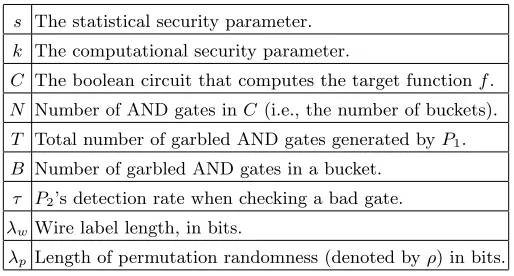
We use P1 to denote the circuit generator and P2 the circuit evaluator. In addition, we assume for simplicity that onlyP2will receivef(x, y), the output of the computation (overP1’s secret inputxandP2’s secret input y). We assume the original functionf can be computed by a circuitC consisting of N AND gates (whereas the rest are all XORs). To execute it securely, our protocol will generate a total number ofT garbled AND gates. We summarize in Figure1the variables used to describe our main secure computation protocol.
s The statistical security parameter.
k The computational security parameter.
C The boolean circuit that computes the target functionf.
N Number of AND gates inC (i.e., the number of buckets).
T Total number of garbled AND gates generated byP1.
B Number of garbled AND gates in a bucket.
τ P2’s detection rate when checking a bad gate.
λwWire label length, in bits.
λp Length of permutation randomness (denoted byρ) in bits.
Fig. 1: Variables in XOR-Homomorphic Verifiable Commitment Scheme
2.1 Oblivious Transfer
We make black-box use of 1-out-of-2 oblivious transfers (OT) to send wire labels corresponding to the evaluator’s input, andk-out-of-nOT in constructing the XOR-Homomorphic interactive hash. Ak-out-of-n oblivious transfer protocol takes nmessages m1, . . . , mn from the sender and a set of kindices i1, . . . , ik ∈
[1, n] from the receiver, and outputs thekmessagesmi1, . . . , mik to the receiver (but nothing else). Actively
secure 1-out-of-2 OT can be efficiently constructed [49,44] and extended [27,1] so that only a small number of expensive base OTs are needed. An actively securek-out-of-noblivious transfer protocol could be efficiently constructed from black-box use of 1-out-of-2 committed oblivious transfer (COT) protocols [29,15], or slightly more efficiently by combining committing OT [28] and committed OT. UC secure committed and committing 1-out-of-2 OTs could be efficiently instantiated from dual-mode cryptosystems [49]. Camenisch, Neven, and Shelat [8] proposed efficient and simulatable k-out-of-nOT in the Random Oracle Model.
2.2 Garbled Circuits
Following the formalism proposed by Bellare, Hoang, and Rogaway [4], a garbling scheme G is is 5-tuple (Gb,En,Ev,De, f) of algorithms, whereGbis an efficient randomizedgarblerthat, on input (1k, f), outputs
(F, e, d);Enis anencoderthat, on input (e, x), outputsX;Evis anevaluatorthat, on input (F, X), outputsY; Deis adecoderthat, on input (d, Y), outputsy. The correctness ofGrequires for every (F, e, d)←Gb(1k, f)
and everyx,De(d,Ev(F,En(e, x))) =f(x). LetΦbe a prefixed function modeling the acceptable information leak and “≈” symbolizescomputational indistinguishability.PrivacyofGimplies that there exists an efficient simulatorS such that for anyx∈ {0,1}nI,
ObliviousnessofG implies that there exists an efficient simulatorS such that
{(F, e, d)←Gb(1k, f), X←En(e, x) : (F, X)} ≈ {S(1k, Φ(f))}.
AuthenticityofG requires that for every efficient adversaryA= (A1,A2),
Pr
Y 6=Ev(F, X)andDe(d, Y)6=⊥) :
(f, x)← A1(1k),
(F, e, d)←Gb(1k, f), X←En(e, x),
Y ← A2(1k, F, X).
=negl(k),
wherenegl is a negligible function.
Our protocol, uses the Half-Gates garbling scheme recently proposed by Zahur, Rosulek, and Evans [57], which offers the simulation-based definition of privacy, obliviousness, and authenticity under acircular corre-lation robustnessassumption of the hash functionH. We summarize their AND gateGbandEvalgorithms, GenAND(Algorithm1) andEvlAND(Algorithm2), respectively, in the Appendix.
2.3 LEGO-Style Cut-and-Choose
Nielsen and Orlandi [48] proposed the seminal idea of LEGO, which enables the circuit evaluator to check individual garbled gates and randomly group evaluation gates to accomplish actively secure two-party com-putation. The first construction [48] was based on NANDs and require public key operations for soldering. Fredericksen et al. [13] improved the LEGO construction to work with free-XOR technique. The backbone of LEGO-style protocols are made of three basic components:
1. Generate.P1generates a total ofT garbled gates.
2. Evaluate. P2 randomly picks BN gates and groups them into N buckets, each of which will realize a gate in C. P2 evaluates every bucket by first translating the bucket’s input-wire labels to input-wire labels of each garbled gate in the bucket, then evaluating the garbled gates and finally translating the output-wire labels obtained from evaluating gates of the same bucket to the output-wire labels of the bucket for majority selection. (The wire label translation is also known aswire soldering.
3. Check. P2 checks the rest T −BN gates for their correctness, using per-gate secrets revealed by P1. Note that unlike the circuit checking of traditional cut-and-choose, every bad gates could be detected with probability less than 1.
Note that in [48], all garbled gates in the description above are NANDs, as NANDs alone isfunctional complete to realize arbitrary circuits; while with [13], all garbled gates are ANDs, which, combined with XORs, are also functional complete. Because XORs can be securely computed locally, no extra cut-and-choose is needed to ensureP1’s correct behavior on XORs.
3
XOR-Homomorphic Interactive Hash
3.1 Definition.
We introduce the notion of XOR-Homomorphic Interactive Hash, which is a pair of algorithms (Hash,Verify), whereHashinvolves two participants,P1andP2. Roughly speaking,Hashis an efficient two-party probabilis-tic algorithm that takes a messagemfromP1and outputs nothing toP1, butonlythe hash ofm(denoted as
hmi) toP2without revealing any extra information.Verifyis an efficient deterministic algorithm (executable by P2 alone) that takes a hash hmi and a message m0 as inputs, and outputs a bit b indicating whether m=m0 (but nothing beyond). Like conventional notion of hashing, we require|hmi|<|m| and that for any two distinct messages m1 and m2 from P1, their hashes received by P2 are distinct except for a negligible probability. In addition, the hashes need to be XOR-homomorphic, i.e.,hm1i ⊕ hm2i=hm1⊕m2i.
– Hash.Upon receiving(Hash, m)from the committerP1: if there is a recorded value (cid, m), generate a delayed output(Receipt,cid, hmi)toP2, wherehmidenotes the hash ofmand|hmi|<|m|; other-wise, pick a fresh numbercid, record (cid, m) and generate a delayed output(Receipt,cid, hmi)toP2.
– Verify. Upon receiving (Verify, cid1, . . . ,cidt, d) for any t ≥ 1 fromP2: if there are recorded values (cid1, m1), . . . ,(cidt, mt) (other-wise do nothing), setz= 1 ifm1⊕ · · · ⊕mt=d, andz= 0, otherwise; generate a delayed output(VerifyResult, z)toR.
Fig. 2: Ideal functionality of XOR-Homomorphic Interactive Hash.(“send a delayed outputxto partyP” signals a standard treatment of fairness: it means “send (x,P) to the adversay; whenreceivingokfrom the adversary, output
xtoP.”)
Like cryptographic commitments,FXorIHashalso offers certain “hiding” and “binding” properties: (1) Even after receivinghmi,P2learns nothing aboutmexcept for what can be efficiently inferred fromhmi; (2) Once
hmi is sent to P2, P1 (who does not know hmi) can’t claim hmi to be the hash of a different message m0. Due to these “limited” notions of hiding and binding, we borrow two expressions from the domain of commitments:
1. “P1 sends hmi to P2”refers to the action whereP1 andP2collaboratively runHashoverP1’s private inputmso thatP2learns hmi(but nothing else) while P1 learns nothing.
2. “P1 opens hmi to P2” refers to the action whereP1 reveals the pre-image mto P2, who then checks whether mis consistent with its claimed hashhmivia callingVerify(hmi, m).
Unlike traditional commitments, which fully hides the committed message to the receiver, an interactive hash allows leaking some information ofmto the receiver, yet preserve the remaining entropy (ifmis picked uniformly random, there has to be some entropy left since |hmi| <|m|). In addition, with an interactive hash scheme, the hashes are kept secret from the party (i.e.P1) who holds the pre-images, while the party (i.e.P2) who has the hash can efficiently query (by itself) whether a message is a pre-image of the hash.
3.2 Construction.
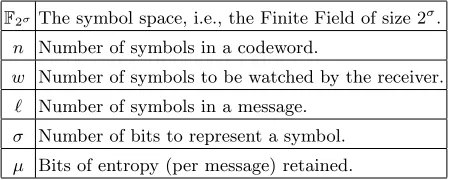
Inspired by Reed-Solomon code, we give a concrete implementation of XOR-homomorphic interactive hash scheme that leverages a black-box use of w-out-of-noblivious transfer protocols. IfP1’s input messages to Hashare sampled uniformly random, our construction perfectly hides |m| − |hmi|bits of information in m. Meanwhile, it guarantees statistical binding in thatP1can only claim a different messagem0 to be the pre-image ofhmiwith negligible probability. We summarize the variables relevant to describing the interactive hash protocol in Figure3.
F2σ The symbol space, i.e., the Finite Field of size 2σ. n Number of symbols in a codeword.
w Number of symbols to be watched by the receiver.
` Number of symbols in a message.
σ Number of bits to represent a symbol.
µ Bits of entropy (per message) retained.
Fig. 3: Variables in the construction of XOR-homomorphic interactive hash
message m using a Reed-Solomon code and then sends the n-symbols encoding to P2 using a w-out-of-n obliviously transfer. Intuitively, perfect hidingis guaranteed for uniform-randomly sampled messages ofP1, because even after observing w symbols of P2’s choice, there remains 2(`−w)σ possible pre-images equally likely mapping to hmi; statistical binding is ensured since ifP1 claims the hash with a different message m0, it will be detected byP2 with probability at least `−w1
n w
(since the encodings ofm andm0 will be identical at`−1 symbols at most whilewout of the nencoding symbols have been watched byP2).
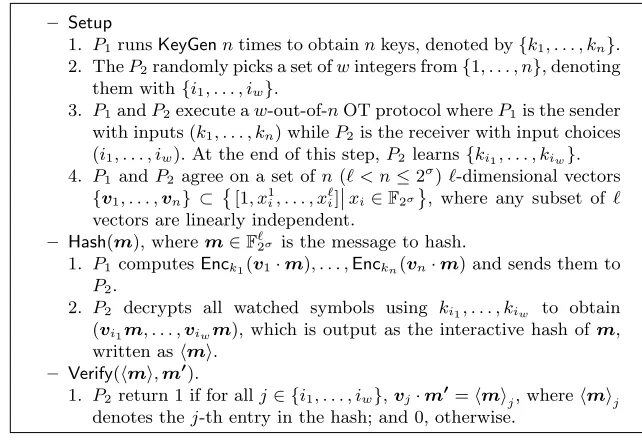
Our optimized instantiation of FXorIHash is detailed in Figure 4. We leverage a symmetric encryption scheme, (KeyGen,Enc,Dec), to limit the use of OT toSetupstage only. AsSetupneeds to run only once to prepareP1andP2 for all subsequent calls toHash andVerify, the overall cost of OT is well amortized.
– Setup
1. P1runsKeyGenntimes to obtainnkeys, denoted by{k1, . . . , kn}. 2. TheP2randomly picks a set ofwintegers from{1, . . . , n}, denoting
them with{i1, . . . , iw}.
3. P1andP2execute aw-out-of-nOT protocol whereP1is the sender with inputs (k1, . . . , kn) whileP2is the receiver with input choices (i1, . . . , iw). At the end of this step,P2 learns{ki1, . . . , kiw}.
4. P1 andP2 agree on a set ofn(` < n≤2σ)`-dimensional vectors {v1, . . . ,vn} ⊂ [1, x1i, . . . , x`i]
xi∈F2σ , where any subset of `
vectors are linearly independent.
– Hash(m), wherem∈F`2σ is the message to hash.
1. P1computesEnck1(v1·m), . . . ,Enckn(vn·m) and sends them to P2.
2. P2 decrypts all watched symbols using ki1, . . . , kiw to obtain
(vi1m, . . . ,viwm), which is output as the interactive hash ofm, written ashmi.
– Verify(hmi,m0).
1. P2return 1 if for allj∈ {i1, . . . , iw},vj·m0=hmij, wherehmij denotes thej-th entry in the hash; and 0, otherwise.
Fig. 4: Realize XOR-Homomorphic Interactive Hash
3.3 Proof of Security
It can be proved that the construction in Figure4realizesFXorIHashin the honest-but-curious model, though this is not much more useful than Lemma1in the security proof of our main protocol. (Thus, we leave the proof of the theorem to the full version of the paper.) Intuitively, the lemma suggests that (1) ifmis picked random, (`−w)σbits of entropy remains even if after hmiis sent; (2) anywsymbols is a valid hash; (3) a hashhmistatistically binds the sender to the messagem.
Lemma 1. Assumeσ-bit symbols. Letm be a uniform-randomly sampled`-symbol message andhmibe the w-symbol hash of m produced by the Hash algorithm of Figure 4. Let Hmin be the min-entropy function. Then
1. Hmin(m|hmi) = (`−w)σ. That is, in P2’s perspective, there is still (`−w)σ bits of entropy about m after P2 receiveshmi.
2. Any tuple ofw symbols can be regarded as an interactive hash of some messagem.
3. Once P2 receives hmi, P1, even with unbounded computation power, cannot open hmi to a different messagem0 with probability more than `−w1 n
w
.
4
The Protocol
4.1 High-Level Description
At the high level, the protocol proceeds in the following steps:
1. Generate garbled ANDs.P1generates a total ofT garbled AND gates using the Half-Gates garbling algorithm GenAND(but using elongated wire labels).
2. Commit and send garbled AND gates.P1commits and sends all garbled ANDs it generated toP2. 3. Evaluate.P2randomly picks a random stringJ and send it toP1. UsingJ as the source of randomness, P1 andP2 randomly selectBN ANDs and group them into N buckets, each of which will be used to compute an AND gate inC. For every bucket,
(a) P1 and P2 securely solder the B garbled ANDs using the XOR-homomorphic interactive hash. P2 delays its response to soldering failures to step5b.
(b) P2 evaluates allB garbled ANDs in the bucket. P2 locally evaluates all XORs in circuitC.
4. Check.P2 checks the rest (T−BN) garbled ANDs to verify their correctness (but delays its response to check-failures to step 5b).
5. Output determination.
(a) P1 “opens” the permutation randomness associated to the final output-wires so thatP2 knows how to interpret the final output-wire labels.
(b) If any failure occurred at the time of checking (step 4), soldering (step 3a), or opening (step 5a) above,P2 aborts. Otherwise,P2 translates the output-wire labels into plaintext bits.
Remark 1. Our protocol is distinguished from previous LEGO-style protocols in that it requires only one correctly generated garbled gate in each bucket. This is enabled by combining the free-XOR technique with our XOR-homomorphic hash: (1)P2can always learn, fromh∆iandhwpi(the hash of the 0-label permuted by a bitpassociated with every wire), whether a wire labelwit obtains in the evaluation stage is consistent with eitherhw0iorhw1iregardless of the value ofp; (2) wheneverP
2 learns bothw0andw1(via evaluating both good and bad gates in the same bucket), it can learn the global secret∆and further P1’s secret input x, except with negligible probability. We will formally prove this point as Lemma3.
Remark 2. Unlike MiniLEGO [13] where the detection rateτ= 1/4, we are able to increaseτto 1/2, through leveraging the Half-Gates garbling [57]. The intuition behind this idea is that a correctly garbled gate can be modeled as the solution to a linear system of four equations over three variables where all the coefficients are fixed by the six interactive hashes associated with the gate. Since any three of the four coefficients vectors are linearly independent (due to the hash function used in the Half-Gates garbling), ifP1 cheats so that one of the equations does not hold, there has to be at least another equation that is also not satisfied. That is, if the gate is bad, at least two out of four rows of the garbled table is corrupted. We will formally prove this observation as Lemma4.
Remark 3. We stress thatP2 should not complain in event of: (1) any bad gate found in the checking stage (step4); (2) XOR values not matching with their hashes in soldering (step3a); and (3) any pre-images not matching the hashes of the wire permutation randomness in step5a, until in the end (step5b). This prevents maliciousP1 from probing the watched symbols ofP2from observing P2’s responses.
4.2 Formal Specification
Fix a functionf that P1and P2 wish to compute over their respective inputsx, y (letnPI1 andn P2
I are the
bit length of xand y, respectively. Assume f is realized by a boolean circuit C. The protocol proceeds as follows.
(a) P1andP2execute theSetupstep of the XOR-homomorphic hash scheme, whereP1is the hash sender and P2 is the hash receiver.
(b) P1 randomly samples the global secret ∆ ← {0,1}λw (as is used in Half-Gates [57] to enable the
free-XOR technique [30]) and commit it toP2, who learnsh∆i.
1. Generate garbled ANDs. Fori ={1, . . . , T}, P1 runs the garbling algorithm GenAND(Figure 1) to createT garbled AND gates:
(wi,l0 , w0i,r, w0i,o, Ti,G, Ti,E)←GenAND(i, ∆)
wherew0
i,l, w0i,r, wi,o0 are the wire labels representing 0-values on the left input-wire, the right input wire,
and the output-wire, respectively, of thei-th garbled AND;Ti,Gis the single garbled row in the generator
half-gate andTi,E the single row in the evaluator half-gate.
2. Commit and send garbled AND gates.Fori={1, . . . , T},
(a) P1 samples ρi,l ← {0,1}λp, ρi,r ← {0,1}λp, ρi,o ← {0,1}λp, and computes w1
i,l := w0i,l⊕∆; w1i,r :=
w0
i,r⊕∆;wi,o1 :=wi,o0 ⊕∆.
(b) Letpi,l=ρi,l1 ⊕· · ·⊕ρ
i,l
λp(whereρ i,l
j denotes thej-th bit ofρi,l), whilepi,randpi,oare similarly derived
fromρi,r andρi,o, respectively.P1andP2 hashρi,l, wpi,l i,l ,ρ
i,r, wpi,r i,r ,ρ
i,o, wpi,o
i,o so thatP2learnshρ i,li,
hwpi,l i,l i,hρ
i,ri,hwpi,r i,r i,hρ
i,oi,hwpi,o
i,o i, respectively.
(c) P1 sendsTi,G, Ti,E toP2.
3. Evaluate.P2 randomly picks a random string J and send it to P1. Using J as a random source, BN garbled ANDs are selected and grouped intoN buckets.
P1andP2 follow an identical topological order to process the initial input-wires and every binary gate of the boolean circuitC. (NoteC only contains ANDs and XORs.)
(a) For every input-wireWi associated to P1’s private input bit xi:P1samplesρi← {0,1}λp and a wire
label w0i ← {0,1}λw (thus w1 i := w
0
i ⊕∆) and sends w xi
i and the hashes hρ ii, hwpi
i i to P2 (where
pi=ρi1⊕ · · · ⊕ρiλp).
(b) For every input-wireWi associated to P2’s private inputyi:
i. Wi is⊕-split intoswires Wi,1, . . . , Wi,s.
ii. P1 sampleswi,01← {0,1}λw, . . . , w0
i,s← {0,1}
λw and runs the interactive hashing withP2 so that
P2learnshw0i,1i, . . . ,hw0i,si.
iii. P2samplesyi,1← {0,1}, . . . , yi,s← {0,1}subject toyi,1⊕ · · · ⊕yi,s =yi.
iv. For every j ∈ {1, . . . , s}, P2 retrieves wyi,j
i,j from P1 through oblivious transfer, and verifies w yi,j i,j
againsthwyi,j
i,j i(note P2 can computehw
yi,j i,j i:=hw
0
i,ji ⊕yi,jh∆i). A verification failure at any j
results inP2’s delayed abort at step5. v. P2 setsw
yi i :=w
yi,1
i,1 ⊕ · · · ⊕w
yi,s
i,s andhw yi i i:=hw
yi,1
i,1 i ⊕ · · · ⊕ hw
yi,s
i,s i,hrii:=h0i.
(c) For every AND gate inC (recall thatP2 should have already obtained two wire labelswal, wbr, which represent the signalsa, bon the left and right input wires of the AND gate, and hasheshρli,hwpl
l iand
hρri,hwpr r i):
i. P2 selectsB garbled ANDs (solely determined by randomness rcc), g1, . . . , gB, from T − K and
notifiesP1 its choices.
ii. P1 samples ρo ← {0,1}λp and w0
o ← {0,1}λw and sends hashes hρoi and wopo to P2 (where
po =ρo1⊕ · · · ⊕ρoλp). P2 sets O to an empty set, and executes the following for i ∈ {1, . . . , B}
(note that wheneverP2 receives an incorrect preimage reuqired to verify a hash, it continues its execution until its delayed abort at step5),
A. Let pi,l = gi.pl, pi,r = gi.pr. P1 opens hρli ⊕ hρi,li, hρri ⊕ hρi,ri to P2 so that P2 learns pl⊕pi,l:=L1≤j≤λp(ρ
l j⊕ρ
i,l
j ) andpr⊕pi,r:=L1≤j≤λp(ρ r j⊕ρ
i,r j ).
B. Letwx
i,l=gi.wxl andw x
i,r =gi.wxr for any bitx,P1openshw
pl l i ⊕ hw
pi,l
i,l i ⊕((pl⊕pi,l)h∆i) and
hwpr r i ⊕ hw
pi,r
i,r i ⊕((pr⊕pi,r)h∆i)toP2so thatP2learnsdlanddr(wheredl=w0l ⊕w0i,l, dr=
w0
r⊕w0i,r), hence can compute wai,l:=w a
l ⊕dl andwbi,r:=wbi,r.
C. LetTi,G=gi.TG,Ti,E=gi.TE. IfP2 runswi,o:=EvlAND(wla, w b
D. P2 verifies wi,o against hw pi,o
i,o iand hw pi,o
i,o i ⊕ h∆i. If neither succeeds,P2 stops processing gi
and advances to processing gategi+1. E. Letpi,o=gi.po. P1 openspo⊕pi,otoP2. F. Letwi,o=gi.wo.P1openshwopoi ⊕ hw
pi,o
i,o i ⊕((po⊕pi,o)h∆i) toP2so thatP2learnsdi,o(note
di,o:=wo0⊕wi,o0 ), hence can computewo:=wi,o⊕di,o.
G. P2verifieswo againsthwopoiandhwopoi ⊕ h∆i. If either verification succeeds,P2addswo toO;
otherwise, continue evaluating the next garbled gate.
iii. If there exist two different labels wo andw0o in O. P2 computes∆∗ :=wo⊕w0o, and uses ∆∗ to
find outP1’s private inputsxand computesf(x, y).
iv. Otherwise, i.e.,Ocontains a single elementw,P2 setswo=w.
(d) For every XOR gate inC: since XOR is free,P1 does nothing whileP2 calculateswo:=wl⊕wr. At
the same time,P2 deriveshρoi:=hρli ⊕ hρriandhwpooi:=hw pl l i ⊕ hw
pr r i.
4. Check. P2 checks the correctness of the rest T−BN garbled ANDs. For every check-gate denoted by
hρli,hwpl l i,hρ
ri,hwpr
r i,hρoi,hwopoi, TG, TE
,
(a) P2 samplesa← {0,1}, b← {0,1}and sendsa, btoP1. (b) P1 openshρli,hρri,hρoitoP2. Letp
l=ρl1⊕ · · · ⊕ρlλp,pr=ρ r
1⊕ · · · ⊕ρrλp,po=ρ o
1⊕ · · · ⊕ρoλp,
i. P1openshw
pl
l i ⊕((a⊕pl)h∆i) toP2 so thatP2 learnswal.
ii. P1openshwprri ⊕((b⊕pr)h∆i) toP2 so thatP2 learnswbr.
iii. Letz=a∧b.P1 openshwpooi ⊕((z⊕po)h∆i) toP2so thatP2learns woz.
(c) P2 computeswo:=EvlAND(wal, w b
r, TG, TE). Ifwo=6 woz,P2 goes to step4d.
(d) If any failure is detected in step 4(b)ii and 4(b)iii, P2 keeps dummy-execution of the protocol as normal, until step5, when it aborts..
5. Output determination.If any incorrect garbled AND gates or incorrect hash preimages were found in steps4 and3above,P2aborts. IfP1’sf(x, y) was determined in step3(c)iii(from leakedP1’s secret ∆), P2 outputs f(x, y). Otherwise, (cheating was not observed byP2), for every final output-wire inC, P1 opens hρoi(the hash of the permutation bit on the final output-wire) toP
2 so thatP2 can find out the value represented by wo (recallwo is already either verified with hwopoior hwpooi ⊕ h∆i, thus once po is
known from openingρo,w
o can be translated to a plaintext bit).
4.3 Optimizations
Thwart selective-failure attacks, more efficiently.In order to preventP1 from probing P2’s inputy using inconsistent wire labels in OT and garbling, in step3b, every input-wire forP2’s input is split toswires (which are XOR-ed together), requiringnP2
I s1-out-of-2 oblivious transfers (wheren P2
I is the number of bits
iny andsis the statistical parameter). Lindell and Pinkas [35] suggested an optimization using a bundle of wires per circuit to reduce the cost down to max(4nP2
I ,8s). Shelat and Shen [53] proposed an optimization
based on Reed-Solomon code to reduce the cost to as low as 25% of Lindell and Pinkas’s already optimized construction.
Length preserving encryption.In the interactive hash scheme of Figure4, aHashrequiresncalls to the symmetric key encryption. To prevent ciphertext explotion and save bandwidth, the symmetric key secure encryption scheme can be replaced by a secure format-preserving encryption scheme [43,5,45].
4.4 Proof of Security
We first show that, for any security parameters, k and circuit sizeN, it is possible to configure the protocol parametersT, B, n, `, wsuch that ifP2will be able to correctly outputf(x, y) (except with probability 2−s)
if it does not abort in our protocol. We break the proof into the following two lemmas. For concrete values of s, k, N, we detail how to setup T, B, n, `, wto achieve the best performance while maintaining the security guarantee.
Lemma 3. If there is at least one correctly garbled gate in each bucket,P2 is able to outputf(x, y) except with negligible probability when executing the two-party computation protocol of Section4.2.
Lemma 4. Givenh∆iand any committed garbled AND, hρli,hwpl l i,hρ
ri,hwpr
r i,hρoi,hwopoi, TG, TE, where
pl=ρl1⊕. . .⊕ρlλp,pr=ρ r
1⊕. . .⊕ρrλp,po =ρ o
1⊕. . .⊕ρoλp. If any of the following is not satisfied (where
EvlANDis the Half-Gate AND gate evaluation algorithm, see Algorithm2), EvlAND(wl0, w0r, TG, TE) =wo0; EvlAND(w
0
l, w
1
r, TG, TE) =w0o;
EvlAND(wl1, w0r, TG, TE) =wo0; EvlAND(w
1
l, w
1
r, TG, TE) =w1o,
P2 will be able to detect this fact with probability at least 1/2 in step4.
Theorem 2. Under the assumptions outlined in Section2, and modelingH as a random oracle, the protocol in Section 4securely computesf in the presence of malicious adversaries.
Proof We analyze the protocol in a hybrid world where the parties have access to an ideal functionality for k-out-of-noblivious transfer. The standard composition theorem [9] implies security when the sub-routine are instantiated with a securek-out-of-nOT protocol.
For a corrupted P1, we construct a polynomial-time simulator S that interacts with the corrupted P1 using the protocol specified in Section4.2 asP2 with inputy= 0, except with the following changes:
1. In step 0a of Setup, instead of using a real w-out-of-n OT protocol, S and P1 use a trusted party (simulated by S) to accomplish the w-out-of-n OT so that S learns all the symbol-encryption keys k1, . . . , kn thatP1 has generated.
2. In step 3a of Evaluate, in addition to receiving hρii and hwpi
i i, S uses the symbol-encryption keys
learned above to find outρi,p
i, and w pi
i , which, combined with the correctly garbled gate wherew pi i is
used, allowsS to learnxifor all 1≤i≤nPI1.
3. In step5ofOutput determination, ifSdoes not abort, (instead of outputsf(x,0)),S sendsxto the trusted party and receive in return an outputz=f(x, y).
Now we show that ∀x, y,REALP1,P2(x, y)≈
IDEALT,S,P2(x, y) by examining the following two cases: 1. If P2 does abort in the real world execution, S will also abort in the ideal world execution because the
difference betweenS andP2does not affect their behavior of aborts.
2. IfP2 does not abort in the real world execution, assuming the parametersT, B, n, `, ware properly set, following Lemma 2 and Lemma 3, we know that P1 andP2 must be able to outputf(x, y) in the real world (except with probability less than 2−s. In this case,S in the ideal world execution will not abort
either, soS will send the extracted x(becauseS does not abort, thus except with probability less than 2−s, at least one correctly garbled gate is in every bucket andP
1 had revealed all expected pre-images and expected xors correctly, hence indeed able to extractx) to the trusted party soSandP2can output f(x, y) in the ideal world.
For a corrupted P2, we construct a polynomial-time simulator S that interacts with the corrupted P2 using the protocol specified in Section4.2 asP1 with inputx= 0, except with the following changes:
1. In step 0a of Setup, instead of using a real w-out-of-n OT protocol, S and P1 use a trusted party (simulated byS) to accomplish thew-out-of-nOT so thatS learns all positions of the watched symbols selected by P2.
2. In step 3b of Evaluate, instead of using a real 1-out-of-2 OT protocol, S and P1 use a trusted party (simulated byS) to accomplish the 1-out-of-2 OT so that S learns yi,1, . . . , yi,s, hence able to compute
P2’s effective inputyi:=yi,1⊕ · · · ⊕yi,s for all 1≤i≤nPI2.
3. In step5ofOutput determination, ifS does not abort,S sends they extracted above to the trusted party and receive in returnf(x, y). Leveraging the knowledge of all positions of P2’s watched symbols, for every output bitziwheref(x, y) differs fromf(0, y), letρbe the original permutation randomness on
the output-wire associated withzi ,S openshρitoρ0, which differs fromρin a single bit while matching
Now we show that ∀x, y,REALP1,P2(x, y)≈IDEALT,P1,S(x, y) by examining the following two cases: 1. IfP2does abort in the real world execution,S will also abort in the ideal world execution becauseP1is
honest so the only reason that an abort happens is thatP2decides to leaves the protocol while the deci-sion can only be made over transcripts that are computationally indistinguishable. This computational indistinguishability can be derived from the security of the garbled circuit protocol.
2. IfP2 does not abort in the real world execution, assuming the parametersT, B, n, `, ware properly set, following Lemma2and Lemma3, we know thatP1andP2will be able to outputf(x, y) in the real world (except with probability less than 2−s). In this case, theS runs in the ideal world will not abort either
(following the security of the garbling scheme), soS will be able to extractyand use it to obtainf(x, y) from the trusted party in the ideal world. Note that because S knows all w symbols of ρ’s encoding watched by P2 and ` > w(where`is the number of symbols inrho0), aρ0 that matcheshρibut differs from ρin a single bit can be efficiently calculated from solving a linear system ofw+ 1 equations. ut
5
Parameters and Analysis
Our protocol involves two flavors of cut-and-choose (one in the XOR-homomorphic interactive hash and the other for gate checking and evaluation) and many parameters. It involves novel approaches of analysis to figure out the best (in terms of efficiency) set of parameters subject to a concrete security guarantee. In this section, we propose a unique approach to efficiently automate the search for optimal parameter settings for every concrete security parameters (s, k).
Cost Metric.In this work, we focus on the cost of network bandwidth, which can be accurately calculated in our analysis. As faster hardware [3,32], new garbling mechanisms [18,3], and circuit parallelism [7,46,24,32] have been exploited to dramatically improve the speed of garbled circuit protocols, the high bandwidth cost of these protocols, especially in the malicious model, is increasingly prominent and widely recognized by the research community. In practice, bandwidth has been shown to be highly correlated with the time cost as a significant portion of the time is spent on data transmission and synchronization.
5.1 Optimal Parameters of the Interactive Hash
Here our goal is to determine the most bandwidth-efficient configuration of (σ, `, n, w) that achievess bits statistical security in binding and retains µ bits entropy per hashed message from the hash receiver. We model it as a non-linear optimization problem given in Figure5. We introduce constantsα, βto characterize the bandwidth cost in the main protocol associated with the parameters of the interactive hash scheme. We use α = 3, β = 3 when searching for the parameters of interactive hash used on wire permutation randomness because every garbled AND gate comes with 3 wires, each having a random string to encode the permutation bit (so 3nσ bits sent in Hashand 3`σ sent in “open” the XOR difference); whileα= 3, β= 5 when determining the parameters for hashing the wire labels (noteβ= 5 because the two garbled rows have to be extended to`σ bits each to enableP2to verify the output wire labels on its own.)
A naive brute-force search of all possible (σ, `, n, w) values can hardly solve the non-linear programming problem because, apparently, the value ranges of n and ` appear to be quite large, whereas there are no explicit upper-bounds forσand`.
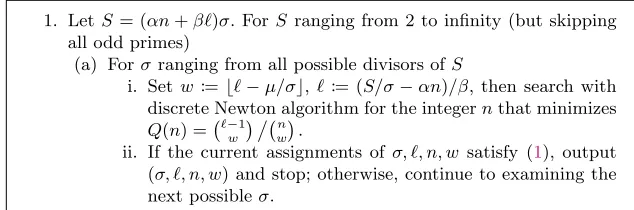
To this end, we identified a highly efficient solution through aggressive pruning (Figure 6). Our basic strategy is to scan through candidate S values from the bottom and return as soon as a viable (σ, `, n, w) is found. We had two key insights that helps to dramatically speedup our search: (1) Fixing S =S0 and σ=σ0, ifw:=b`−k/σ0ccan’t satisfy (1) then there cannot be a viable solution withσ=σ0that achieves S0 (which saves us from trying out all possiblewbut only one); (2) FixingS=S0, σ=σ0, w=w0, because `= (S0/σ0−αn)/β, `−w1 wn
is aconvexfunction ofnand its value is solely determined byn(which allows us to decide whether a viable solution of (σ0, w0, `, n) exists for S0 by evaluating `−w1 wn
Lets, µ, α, βbe fixed integer constants,S= (αn+β`)σ. minS
subject to:
`−1
w
! , n w !
≤2−s (1)
σ(`−w)≥µ (2)
2σ ≥n (3)
wheren, `, σ, ware all positive integers.
Fig. 5: The non-linear programming problem for optimizing the interactive hash’s parameters.((1) comes from part 2 of Lemma1, (2) is related to part 1 of Lemma1, (3) stems from the requirement on the encoding vectors (Figure4, Step4of theSetupstage).)
1. LetS = (αn+β`)σ. ForS ranging from 2 to infinity (but skipping all odd primes)
(a) Forσranging from all possible divisors ofS
i. Set w:=b`−µ/σc,`:= (S/σ−αn)/β, then search with discrete Newton algorithm for the integernthat minimizes
Q(n) = `−1 w
n w
.
ii. If the current assignments of σ, `, n, w satisfy (1), output (σ, `, n, w) and stop; otherwise, continue to examining the next possibleσ.
Fig. 6: Algorithm to find the bandiwidth-optimal parametersσ, `, n, wof XOR-homomorphic interactive hash for every requirement specifications, µ, α, β.
Lemma 5. Fixing S = S0 and σ = σ0, it takes only logarithmic number of steps to search in the one-dimensional space ofn, to decide whether a viable solution(σ, w, `, n)to the non-linear programming problem of Figure 5achievingS0 with σ=σ0.
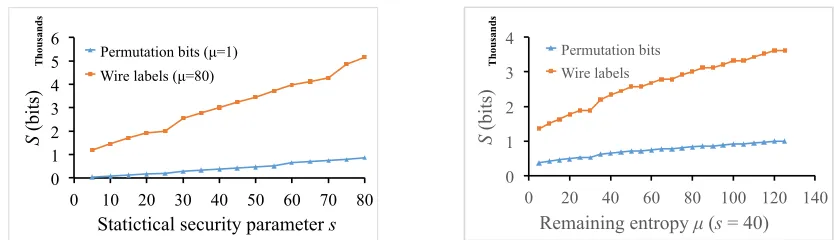
Leveraging this parameter optimization algorithm, we plot the influence of the security parameters s, k over the bandwidth cost related to XOR-homomorphic interactive hash in our secure two-party computation protocol in Figure7,
5.2 Fast Computation of Proverall(N, B, T , τ, b)
Computing the optimal parametersT, B based ons, k, N, τ is an even challenging non-linear programming problem. Our solution to that problem requires a highly efficient and accurate approach to compute the overall success probability ofP1. In this section, we describe our novel algorithm that computes Proverall(N, B, T, τ, b)
0 1 2 3 4 5 6
0 10 20 30 40 50 60 70 80
S
(bi
ts
)
Th
ou
san
d
s
Statictical security parameter s Permutation bits (µ=1)
Wire labels (µ=80)
0 1 2 3 4
0 20 40 60 80 100 120 140
S
(bi
ts
)
Th
ou
san
d
s
Remaining entropy µ (s = 40) Permutation bits
Wire labels
Fig. 7: Per gate bandwidth cost of XOR-homomorphic interactive hashes for two types of messages.(The cost is roughly linear in the security parametersand the amount of remaining entropyµ, except for a few periodic jumps due to increasedσ.)
Once the parameters N, B, T, τ, b are fixed, the exact probability of malicious P1’s attack success rate could be straightforwardly described as,
Proverall(N, B, T, τ, b) = b
X
i=0
Prc(N, B, T, τ, b, i)Pre(N, B, b−i)
Prc(N, B, T, τ, b, i) = (1−τ)i b i
T−b T−BN−i
T T−BN
(4)
Pre(N, B, b) =
b
B
BN B
+
b−1
X
i=0
Pre(N−1, B, b−i)· b B−i
BN−b i
BN B
(5)
Pre(N, B, b) = 0, ∀0≤b≤B
However, due to the large scale ofN, T values (e.g., N > 230) and stringent requirement on the precision, e.g. end results less than 240 ∼ 2−80 (determined by the statistical security parameter), it is infeasible to accurately compute Prc (which involves calculating large binomial coefficients) and Pre (which involves
exponential number of slow recursions) based on (4) and (5).
Thus, we propose novel approaches to compute Preand Prc, which naturally combines to yield a highly
efficient and accurate approximation for Proverall(N, B, T, τ, b). E.g., set s= 40, ifN = 50,000, the error in
our approximation of log Proverall(N, B, T, τ, b) (on any secure choice of (T, B) assumingT > BN + 0.05T)
is less than 1 bit, while it decreases asN increases (following Lemma6and Lemma 7).
Computing Pre(N, B, b) Our key idea is to usegenerating functionsto efficiently calculate Preas the ratio
between the count of garbled gate assignments resulting a failure (i.e., at least one bucket is filled withBbad gates) and the total count of garbled gate assignments. First, we can use functiong(x, y) = (1+x)B+(y−1)xB
to model the gate assignment process for a single bucket, wherexdenotes a gate is “bad” and 1 denotes a gate is “good” while the coefficient ofxiis the number of ways to assign ibad gates to a bucket. Note that
we explicitly introduce the coefficient y forxB to denote the event that “all B gates in a bucket are bad”.
Furthermore, we can useG(x, y) =g(x, y)N as the generating function to model the gate assignment process
on the whole circuit withN buckets: the coefficient (which is a polynomial in y, hence written as fi(y)) of
xiinG(x, y) denotes the number of assignments that usedibad gates in total. Let fi(y) =P∞j=0cjyj, then
fb(1) =P∞j=0cj is the total number of assignments withb bad gates used in the evaluation stage whereas
fb(1)−fb(0) =P∞j=1cj denotes the number of assignments that resulted at least one broken bucket. Hence,
Input:s, N,r0. Output:Tmin, BTmin
1. ChoosebuandBu.
(a) Computei0:=s+2 andbu:=−(s+1) .
log(r0
2 + 2 2/(1−r0)−i0/N)
(b) SetTmin:=∞andBu:=∞. 2. ForB ranging from 2 toBu,
(a) Precompute Pre(N, B, b) = 1−fb(0)/fb(1) for all integer b ∈ [B, bu].
(b) Find the smallest TB such that Proverall(N, B, TB, τ, b) < 2−s for all b ≤ bu. Note that such a TB exists for every B ≥ 2. Since Proverall(N, B, T, τ, b) is a monotonically decreasing func-tion of T, the search ofTB is highly efficient with a doubling-and-halving probe strategy.
(c) IfTmin > TB, then updateTmin :=TB,BTmin :=B, andB
u:= d(1−r0)TB/Ne.
3. OutputTmin, BTmin.
Fig. 8: Determine bucket size (B) and the total number of gates to garble (T).
Note that we can further dramatically reduce the cost of computing the coefficients of the polynomial G(x, y), by not distinguishing any termsyj1 andyj2 for anyj
1, j2≥1. Therefore, multiplying (u+vy) and (w+ty) yieldsuw+ (ut+vw+vt)y, keeping allcjs a linear formula ofy no matter how bigN andB are.
Computing Prc(N, B, T , τ, b, i) Recall that typicallyT, N are large whileb, iare far smaller thanN. So the dominating cost in computing Prc is due to calculating T−TBN−b−i
.
T T−BN
. Fortunately, we show that,
according to Lemma6, it can be accurately approximated by T−TBNiBN T−i
b−i
.
Lemma 6. Let T, B, N, b, ibe defined as above. Then
lim
N−>∞ T−b T−BN−i
T T−BN
=
T−BN
T
i BN
T−i
b−i
.
5.3 Parameters of Gate Checking and Bucketing
Here the goal is, for every statistical security requirementsand circuit sizeN, efficiently identify the smallest T that guaranteessbits of statistical security for a circuit ofN buckets. To ensure security, a naive solution requires, for a candidate (T, B) configuration, calculating Proverall for allbranging from 1 toT. In practice,
this works only for circuits of moderate size, e.g., under a million. WhenN is large, this does not work due to the daunting cost of computing (and memorizing) the coefficientsfj(y) in the generating functionG(x, y)
for alli≤T (as bis only loosely upper-bounded by T).
Thus, we consider a relaxed but practically meaningful problem for cases when N is large. Namely, assuming the check rater= (T−BN)/T > r0 for a positive constantr0, find the (T, B) pair with minimal T (except for an asymptotically diminishing error due to approximating Prc). Intuitively, strategies with low
check rate do not perform well as a maliciousP1 would exploit it by injecting more bad gates, increasing its probability of successful attacks. In practice, we can set r0 to however small positive values to attain stronger claims on the optimality of theT value output by the search.
bother to compute the coefficients ofxj in G(x, y) for allj > bu. We formally prove that a lower-bound of r implies a upper-bound ofb as Lemma7. Our algorithm finds the smallest T by enumerating all possible B values. Another useful observation, which enables to effectively prune our search space, is that a smaller viableTB we found on the way stipulates an upper-bound onB values we need to enumerate.
Using the efficient search algorithm above, we discovered the optimal T for a range of N, s settings. Figure9 depicts the the optimalκ=T /N with respect to differentN ands.
0 2 4 6 8 10 12 14 16
0 1 2 3 4 5 6 7 8 9 10 11
κ
Circuit Size N Thousands
s=30 s=40 s=50
0 2 4 6 8 10 12
0 10 20 30 40 50 60 70 80 90
κ
Statistical security parameter s
N=20000 N=10000 N=5000
Fig. 9: Optimalκwith respect to differentN andsvalues.(Whens= 40,κ= 6 is easily achievable for circuits with more than 6000 gates. Noteκincreases almost linearly with the statistical security parameters.)
Lemma 7. For anys, r0, τ >0, there existsN0 andbu such that ifT ≥BN/(1−r0), then
Proverall(N, B, T, τ, b)<2−s, ∀b > bu.
5.4 Compare to Existing Two-Party Computation Protocols
Since our protocol has constant rounds whereas NNOB [47] and SPDZ [12] requires linear number of rounds (theoretically in circuit depth but practically in circuit size because only a bounded number of gates can be held in memory) and a heavy-weighted preparation stage, ours performs better for large scale computation when the impact of network latency is taken into account.
Our protocol easily beats any existing cut-and-choose based two-party computation protocols (such as [35,52,36,53,42]) that requires 3s copies of circuits to achieve s-bit of statistical security on any not-too-small circuits (e.g., N ≥6000), because, says= 40, the bandwidth of using 120 copies of the circuit is equivalent to aκvalue of 120∗128∗2/4844 = 6.34, while as Figure9shows, we can achieveκ= 5.8 for any circuit of sizeN ≥6000.
Next, we consider The Lindell (CRYPTO, 2013)’s cheat-then-reveal protocol [33], the only protocol that achievess bits of security usings copies of circuits in the non-amortized execution scenario. We will show that our protocol can outperform theirs in terms of bandwidth cost either when thenP1
I /N ratio is large, or
whenN is sufficiently large.
First of all, we calculate the bandwidth cost of our protocol for (s= 40, k= 128) as follows:
1. Determine the optimal parameter settingn = 100, `= 46, w= 27, σ = 7 for hashing wire labels. That is, it costs nσ = 700 bits to hash a wire label and `σ= 322 bits to reveal a wire label (or an XOR of several wire labels).
2. Determine the optimal parameter settingn= 44, `= 19, w= 18, σ= 6 for hashing permutation bits. So it costs nσ= 264 bits to hash a permutation bit and `σ= 114 bits to reveal a permutation bit (or an XOR of several permutation bits).
3. Each row in the garbled table should have 322 bits since the wire labels are extended.
5. To evaluate a gate, the total bandwidth cost is 114×3 + 322×3 = 1308 because all three wires needs to be soldered once, each of which requires revealing an XOR of two permutation bits and an XOR of two wire labels.
6. LetnP1
I be the bit length ofx,P1needs to send a`σnPI1bits in Step3a; Letn P2
I be the bit length ofy, we
use lognP2
I +n P2
I +s+s·max
log(4nP2
I ),log(4s)
number of actively secure oblivious transfers (where efficient actively secure OT extension [27,1] can be used) in Step3bfollowing Shelat-Shen’s optimization on handling P2’s input [53].
Taking a conservative estimation, every garbled gate will cost no more than (700 + 264)×3 + (322 + 114)×3 + 322×2 = 4844 bits, no matter whether the gate is used for checking or evaluation. Note that Lindell (CRYPTO, 2013)’s protocol [33] will generate 128×2×40 = 10240 bits of traffic per gate (excluding the cost of the special handling of input and output wires). Since the same overhead allows us to implement 5120/4844 = 2.11 gates per bucket. Therefore, according to the results of Section6.2, settingκto any value between 2 and 2.11, our approach can outperform theirs whenN is sufficiently large.
When N is not sufficiently large, the cost of proper treatment of the initial input wires cannot be ignored. In this case, our protocol has significant advantage over the state-of-the-art actively secure two-party computation protocols, since ours requires only sending a `σ-bit message per bit of P1’s input x, whereas the state-of-the-art protocols spend significantly more bandwidth in the input consistency proofs. Let cours(nI) and cprev(nI) be the cost of handling the initial inputs in our work and a previous work,
respectively. LetcN,ours andcN,prevbe the per gate cost of our work and a previous work, respectively. Our protocol will outperform when
cours(nI) +cN,ours·N < cprev(nI) +cN,prev·N,
that is, whencN,ours< c(nI)/N+cN,prev wherec(nI) =cprev(nI)−cours(nI). BecausecN,prev is a constant solely determined by the security parameters whilecN,oursdecreases asN grows, for any fixedc(nI)/N, our
protocol will outperform traditional cut-and-choose protocols if N is larger than a threshold Nbreak−even. Figure10quantitatively depictsNbreak−even with respect toc(nI)/N. Our protocol uses less bandwidth for
all (c(nI)/N, N) configurations in the area above the curve.
1 10 100 1,000 10,000
0 50 100 150 200 250 300 350
Thousands
Fig. 10: QuantifyingNbreak−even with respect toc(nI)/N, the cost ratio of input handling and circuit size.
has clear advantage, e.g., c(nI)/N is 50K bits for computing the Hamming distance between two strings
((nP1
I =n P2
I =N/2), 101K bits for Integer comparison (n P1
I =n P2
I =N), and 3K bits for private AES cipher
(nP1
I = n P2
I = 128, N ≈ 10K). So, our protocol can easily outperform theirs for Hamming distance and
Integer comparison but will not be more bandwidth-efficient for computing private AES whenN ≤1010. In general, our scheme loses to Lindell (CRYPTO, 2013) for most super-linear algorithms (except for sufficiently largeN), whosec(nI)/N values are small.
Most recently, Arash-Mohassel-Pinkas-Riva [2] proposed a lightweight cheating-punishment technique based on Lindell’s and applied a bandwidth-saving technique that requires little more than 19 copies of garbled circuits being transmitted to obtain 40-bit security. Our protocol cannot outperform theirs in band-width but it would be an interesting and promising research to develop XOR-homomorphic interactive hash schemes that are more bandwidth-efficient to outperform theirs.
6
The Tight Bound on The Benefit
In LEGO-protocols,κ=T /N (could be a decimal). When the circuit sizeN approaches to infinity, (following the efficiency claim in LEGO-style protocols [13,48,14]) one may intuitively think κ goes to 0, as O(κ) = O(T /N) =O((skN/logN)·1/N) =O(sk/logN). However, this is not the case! We will show shortly that two is the tight bound of κ, i.e., κ≤2 can never be securely achieved by any LEGO-protocol; while any κ >2 can be achieved (at least with the protocol proposed in this paper) whenN is sufficiently large.
In the proof of this section, we generalize the bucket size B to decimal values, which suggests different buckets can have different (integer) size.
6.1 Any κ≤2 Is Impossible to Achieve
Let Proverall be the overall success rate ofP1attacking a LEGO-style protocol. Our goal is to show that any LEGO-style protocol will be insecure in an asymptotic sense. Namely, there exists a positive constantcand N0 such that Proverall > c holds for all circuit sizes larger than N0 (Theorem 3). We achieve this by first
restricting our attention to the insecurity of LEGO-style protocols withκ= 2 that use only size-1 and size-2 buckets (Lemma8), which can be proved through a sequence of mathematical relaxation (Lemma10,11,12) on the success probabilities of a malicious generator. Then we generalize the result of Lemma8 to schemes of arbitrary size buckets (Lemma9) and settings ofκ <2 (Theorem3).
Theorem 3. Ifκ≤2, there exist a constantc >0and an integerN0such thatProverall > cfor allN > N0.
Proof First, we will show a propositionPropthat ifκ= 2, there exist a constantc >0 and an integerN0 such that Proverall > cfor allN > N0. This can be derived directly through combining the facts of Lemma8
and Lemma9: it suffices to consider schemes involving only size-1 and size-2 buckets because, according to Lemma9, they work at least as good as any scheme with the same (T, N) but using other bucket sizes; while Lemma8 provesPropwith respect to using buckets of sizes 1 and 2.
Second, to generalizePropto κ <2, it suffices to see that comparing to the setting ofκ= 2, with the circuit size N being fixed, reducing κ leads to a smaller T, hence some garbled gates have to be dropped either in the verification stage, or in the evaluation stage, or both, all of which further undermine the overall security guarantee of the original cut-and-choose scheme. Therefore,Propalso holds for allκ <2. ut
Lemma 8. Assume only size-1 buckets and size-2 buckets are used. Let Proverall(N, x, b)be the probability
that a cheating P1, who generates b bad gates, successfully attacks a LEGO-style protocol that computes a circuit withN buckets, of whichxpercent is of size 2 and(1−x)percent is of size 1 (hencex∈[1/N,1−1/N]). If κ= 2, there exists a constantc >0 and an integerN0 such that Proverall(N, x, b)> c for allN > N0.
Lemma 10. Fix κ= 2and assume a total ofN buckets are used, of whichxpercent is of size 2 and(1−x) percent is of size 1. LetPrc(N, x, b)be the probability thatP1 survives the gate verification stage, generating
b bad gates. Then
Prc(N, x, b)≥
1 +x
2
b
1− (1−x)b
2
(1 +x)(2N−b)
.
Lemma 11. Assume a total of N buckets are used, of which xpercent is of size 2 and(1−x)percent is of size 1. Let Pre(N, x, b) be the probability of P1 successfully cheats in the evaluation stage, with b bad gates
selected for evaluation. Then
Pre(N, x, b)≥1−
2x
1 +x
b
Lemma 12. There exists a constant c > 0 and a constant N0 such that for all integer N > N0,∀x ∈
[N1,1− 1
N], there exists a positive integerb such that
1 +x
2
b
1− (1−x)b
2
(1 +x)(2N−b) 1− 2x 1 +x
b
> c
Last, we remark that our discussion above only concerns theasymptoticnotion of security. Therefore, the aforementioned theorem and proofs should not be interpreted as contradiction to the fact that a particular κ ≤ 2 could work with certain concrete security parameter settings, e.g., a κ ≤ 2 may be achievable for 3 bits of statistical security. However, we stress that any κ≤ 2 can never be achieved with more than 5 bits of statistical security, evidenced by pickingc2= 0.48, c3 = 0.13, c1 = 0.85, andN0 = 3 in the proof of Lemma12such thatc >0.05 while log 0.05−1≈4.32.
6.2 Any κ >2 Is Achievable
WhenN is sufficiently enough, LEGO-style protocols can indeed reduce the circuit duplication factorκto values arbitrarily close to 2. Our proof of this fact (Theorem4) is constructive, which essentially uses the protocol we will explain in Section4hence inherits its proof of security (see Section 4.4) except for a claim on the feasibility of upper-bounding a malicious generator’s probability of successful attacks, which we prove here as Lemma13. The proof is based on a simple cut-and-choose scheme where all buckets are of size 2 and T−2N gates are used for verification. The key idea is to show that, for a fixedκ >2 and a (however small) constant ε, we can find an integer N0 such that for all N > N0, a malicious generator’s successful attack probability is upper-bounded byε.
Theorem 4. For anyκ >2, statistical security parameter sand computational security parameterk, there exist an integer N0 and a LEGO-like two-party computation protocol ΠLEGOκ of circuit duplication factorκ
such that forΠκ
LEGO is actively-secure for all circuits of sizeN > N0.
Lemma 13. Assume that, to compute a boolean circuit of size N, P1 generates a total ofT garbled gates, T−2N of which are used for gate verification. Assume all buckets used in evaluation stage are of size 2. Let Proverall(N, b)be the probability that P1 succeeds in an attack by generatingb bad gates. For anyκ >2 and
any ε >0, there existsN0 such that
Proverall(N, b)< ε, (∀N > N0)
Lemma 14. Let Pre(N, b)be the probability that, conditioned on passing the verification stage,P1 succeeds
withb bad gates actually used in the evaluation stage. Then
1. For every fixedN,Pre(N, b)is strictlyincreasing with respect tob.
2. For anyb andε >0, there exists an N0 such thatPre(N, b)< ε.
Lemma 15. If T, N, b, i are non-negative integers such thatT >2N,T ≥b, andi≤b, then
T−b T−2N−i
T T−2N
≤
T−2N
T
i 2N
T−i
b−i
Acknowledgememnt
Yan Huang would like to thank Feng-Hao Liu for helpful discussions on some security proofs, and thank Jesper Nielsen for an initial chat that provoked this research topic. This work is supported by NSF award #1464113.
References
1. G. Asharov, Y. Lindell, T. Schneider, and M. Zohner. More efficient oblivious transfer extensions with security for malicious adversaries. Advances in Cryptology – EUROCRYPT, 2015.
2. A. Afshar, P. Mohassel, B. Pinkas, and B. Riva. Non-interactive secure computation based on cut-and-choose. Advances in Cryptology – EUROCRYPT, 2014.
3. M. Bellare, V. T. Hoang, S. Keelveedhi, and P. Rogaway. Efficient garbling from a fixed-key blockcipher. IEEE Symposium on Security and Privacy, 2013.
4. M. Bellare, V. T. Hoang, and P. Rogaway. Foundations of garbled circuits. 19th Conference on Computer and Communications Security, 2012.
5. M. Bellare, T. Ristenpart, P. Rogaway, and T. Stegers. Format-preserving encryption. SAC: 16th Annual International Workshop on Selected Areas in Cryptography, 2009.
6. M. Bellare and P. Rogaway. Random oracles are practical: A paradigm for designing efficient protocols. 1st Conference on Computer and Communications Security, 1993.
7. N. Buescher and S. Katzenbeisser. Faster secure computation through automatic parallelization. 24th USENIX Security Symposium, 2015.
8. J. Camenisch, G. Neven, and a. shelat. Simulatable adaptive oblivious transfer. Advances in Cryptology – EUROCRYPT, 2007.
9. R. Canetti. Security and composition of multiparty cryptographic protocols. Journal of Cryptology, 2000. 10. H. Chen and R. Cramer. Algebraic geometric secret sharing schemes and secure multi-party computations over
small fields. Advances in Cryptology – CRYPTO, 2006.
11. I. Damg˚ard, M. Keller, E. Larraia, C. Miles, and N. P. Smart. Implementing AES via an actively/covertly secure dishonest-majority MPC protocol. International Conference on Security in Communication Networks, 2012. 12. I. Damg˚ard, V. Pastro, N. P. Smart, and S. Zakarias. Multiparty computation from somewhat homomorphic
encryption. Advances in Cryptology – CRYPTO, 2012
13. T. K. Frederiksen, T. P. Jakobsen, J. Nielsen, P. S. Nordholt, and C. Orlandi. MiniLEGO: Efficient secure two-party computation from general assumptions. Advances in Cryptology – EUROCRYPT, 2013.
14. T. K. Frederiksen, T. P. Jakobsen, J. Nielsen, and R. Trifiletti. TinyLEGO: An interactive garbling scheme for maliciously secure two-party computation. ePrint Archive, 2015. http://eprint.iacr.org/2015/309.
15. J. A. Garay, P. MacKenzie, and K. Yang. Efficient and universally composable committed oblivious transfer and applications. Theory of Cryptography Conference, 2004.
16. O. Goldreich. Foundations of Cryptography: Basic Applications, volume 2. Cambridge University Press, Cam-bridge, UK, 2004.
17. O. Goldreich, S. Micali, and A. Wigderson. How to play any mental game or A completeness theorem for protocols with honest majority. ACM Symposium on Theory of Computing, 1987.
18. S. Gureron, Y. Lindell, A. Nof, and B. Pinkas. Fast garbling of circuits under standard assumptions.Conference on Computer and Communications Security, 2015.
19. W. Henecka, S. K¨ogl, A.-R. Sadeghi, T. Schneider, and I. Wehrenberg. TASTY: tool for automating secure two-party computations. Conference on Computer and Communications Security, 2010.
20. A. Holzer, M. Franz, S. Katzenbeisser, and H. Veith. Secure two-party computations in ANSI C. Conference on Computer and Communications Security, 2012.
21. Y. Huang, D. Evans, J. Katz, and L. Malka. Faster secure two-party computation using garbled circuits.USENIX Security Symposium, 2011.
22. Y. Huang, J. Katz, and D. Evans. Efficient secure two-party computation using symmetric cut-and-choose. Advances in Cryptology – CRYPTO, 2013.
23. Y. Huang, J. Katz, V. Kolesnikov, R. Kumaresan, and A. J. Malozemoff. Amortizing garbled circuits. Advances in Cryptology – CRYPTO, 2014.