Scalable Group Signatures with Revocation
Benoˆıt Libert1 ?, Thomas Peters1 ??, and Moti Yung2 1Universit´e catholique de Louvain, ICTEAM Institute (Belgium)
2
Google Inc. and Columbia University (USA)
Abstract. Group signatures are a central cryptographic primitive, simultaneously supporting accountability and anonymity. They allow users to anonymously sign messages on behalf of a group they are members of. The recent years saw the appearance of several constructions with security proofs in the standard model (i.e., without appealing to the random oracle heuristic). For a digital signature scheme to be adopted, an efficient revocation scheme (as in regular PKI) is absolutely necessary. Despite over a decade of extensive research, membership revocation remains a non-trivial problem in group signatures: all existing solutions are not truly scalable due to either high overhead (e.g., large group public key size), or limiting operational requirement (the need for all users to follow the system’s entire history). In the standard model, the situation is even worse as many existing solutions are not readily adaptable. To fill this gap and tackle this challenge, we describe a new revocation approach based, perhaps somewhat unexpectedly, on the Naor-Naor-Lotspiech framework which was introduced for a different problem (namely, that of broadcast encryption). Our mechanism yields efficient and scalable revocable group signatures in the standard model. In particular, the size of signatures and the verification cost are independent of the number of revocations and the maximal cardinality N of the group while other complexities are at most polylogarithmic in N. Moreover, the schemes are history-independent: unrevoked group members do not have to update their keys when a revocation occurs.
Keywords. Group signatures, revocation, standard model, efficiency.
1 Introduction
As suggested by Chaum and van Heyst in 1991 [32], group signatures allow members of a group to anonymously sign messages on behalf of a population group members managed by a group authority. Using some trapdoor information, a tracing authority must be able to “open” signatures and identify the signer. A complex problem in group signatures is the revocation of members whose signing capability should be disabled (either because they misbehaved or they intentionally leave the group).
1.1 Related Work
Group signatures without revocation.The first provably coalition-resistant scalable group signature was described by Ateniese, Camenisch, Joye and Tsudik in 2000 [7]. At that time, the security of group signatures was not totally understood and proper security definitions were given later on by Bellare, Micciancio and Warinschi [9] (BMW) whose model captures all the requirements of group signatures in three properties. In (a relaxation of) this model, Boneh, Boyen and Shacham [16] obtained a construction in the random oracle model [10] with signatures shorter than 200 bytes [13].
In the BMW model, the population of users is frozen after the setup phase beyond which no new member can be added. Dynamic group signatures were independently formalized by Kiayias and Yung [45] and Bellare-Shi-Zhang [11]. In these models, pairing-based schemes with relatively short signatures were put forth in [54, 33]. Ateniese et al.[6] also gave a construction without random oracles using interactive assumptions. In the BMW model [9], Boyen and Waters independently came up with a different standard model proposal [19] using more classical assumptions and they subsequently refined their scheme [21] to
?This author was supported by the Belgian Fund for Scientific Research (F.R.S.-F.N.R.S.) via a “Charg´e de recherches”
fellowship.
??
obtain size signatures. In the dynamic model [11], Groth [38] described a system with constant-size signatures without random oracles but this scheme was rather a feasibility result than an efficient construction. Later on, Groth gave [39] a fairly efficient realization – with signatures consisting of about 50 group elements – in the standard model with the strongest anonymity level.
Revocation. In group signatures, membership revocation has received much attention in the last decade [22, 8, 29, 18] since revocation is central to digital signature schemes. One simple solution is to generate a new group public key and deliver a new signing key to each unrevoked member. However, in large groups, it may be inconvenient to change the public key and send a new secret to signers after they joined the group. An alternative approach taken by Bresson and Stern [22] is to have the signer prove that his membership certificate does not appear in a public list or revoked certificates. Unfortunately, the signer’s workload and the size of signatures grow with the number of expelled users.
Song [55] presented an approach handling revocation in forward-secure group signatures. However, verification takes linear time in the number of excluded users.
Using accumulators1 [12], Camenisch and Lysyanskaya [29] proposed a method (notably followed by [60, 27]) to revoke users in the ACJT group signature [7] while keepingO(1) costs for signing and verifying. While elegant, this approach is history-dependent and requires users to keep track of all changes in the population of the group: at each modification of the accumulator value, unrevoked users need to update their membership certificates before signing new messages, which may require O(r) exponentiations – if r
is the number of revoked users – in the worst case.
Brickell [23] suggested the notion of verifier-local revocation group signatures, which was formalized by Boneh and Shacham [18] and further studied in [50, 61, 48]. In their systems, revocation messages are only sent to verifiers (making the signing algorithm independent of the number of revocations). The group manager maintains a revocation list (RL) which is used by verifiers to make sure that signatures were not generated by a revoked member. The RL contains a token for each revoked user and the verification algorithm has to verify signatures w.r.t. each token (a similar revocation mechanism is used in [24]). As a result, the verification cost is inevitably linear in the number of expelled users.
More recently, Nakanishi, Fuji, Hira and Funabiki [49] described a construction with constant com-plexities for signing/verifying and where group members never have to update their credentials. On the other hand, their proposal has the disadvantage of linear-size group public keys (in the maximal number
N of users), although a tweak allows reducing the size toO(N1/2).
In the context of anonymous credentials, Tsang et al. [58, 59] showed how to blacklist users without compromising their anonymity or involving a trusted third party. Their protocols either have linear prov-ing complexity in the number of revocations or rely on accumulators (which may be problematic for our purposes). Camenisch, Kohlweiss and Soriente [28] suggested to handle revocations by periodically up-dating users credentials in which a specific attribute indicates a validity period. While useful in certain applications of anonymous credentials, in group signatures, their technique would place quite a burden on the group manager who would have to generate updates for each unrevoked individual credential.
1.2 Our Contribution
For the time being and despite over a decade of research efforts, group signatures in the standard model have no revocation mechanism allowing for scalable (i.e., constant or polylogarithmic) verification time without dramatically degrading the efficiency in other metrics and without being history-dependent. In pairing-based group signatures, accumulator-based approaches are unlikely to result in solutions supporting very large groups. The reason is that, in known pairing-based accumulators [53, 27], public keys have lin-ear size in the maximal number of accumulated values (unless one sacrifices the constant size of proofs of
1
non-membership as in [5]), which would result in linear-size group public keys in straightforward implemen-tations. Recently [35], Fan et al.suggested a different way to use the accumulator of [27] and announced constant-size group public keys but their scheme still requires the group manager to publicizeO(N) values at each revocation. In a revocation mechanism along the lines of [29], Boneh, Boyen and Shacham [16] managed to avoid linear dependencies. However, their technique seems hard to combine2 with Groth-Sahai proofs [40] so as to work in the standard model, which is our goal. In addition, we would like to save unre-voked users from having to update their keys after each revocation. To this end, it seems possible to adapt the approach of Nakanishi et al. [49] in the standard model. However, merely replacing sigma-protocols by Groth-Sahai proofs in the scheme of [49] would result in group public keys of size O(N1/2) in the best case.
In this paper, we describe a novel and scalable revocation technique that interacts nicely with Groth-Sahai proofs and gives constructions in the standard model with O(1) verification cost and at most poly-logarithmic complexity in other metrics. Our approach bears similarities with the one of Nakanishi et al. [49] in that it does not require users to update their membership certificates at any time but, unlike [49], our group public key size is either O(logN) or constant. Like the scheme of [49], our main system uses revocation lists (RLs) of size O(r) – which is in line with certificate revocation lists of standard PKIs – and we emphasize that these arenotpart of the group public key: verifiers only need to know the number of the latest revocation epoch and they do not have to read RLs entirely.
To obtain our constructions, we turn to the area of broadcast encryption and build on the Subset Cover framework of Naor, Naor and Lotspiech [51] (NNL). In a nutshell, the idea is to use the NNL ciphertext as a revocation list and have non-revoked signers prove their ability to decrypt in order to convince verifiers that they are not revoked. In its public-key variant, due to Dodis and Fazio [34], the Subset Cover frame-work relies on hierarchical identity-based encryption (HIBE) [44, 37] and each NNL ciphertext consists of several HIBE encryptions. To anonymously sign a message, we let group members commit to the specific HIBE ciphertext that they can decrypt (which gives constant-size signatures since only one ciphertext is committed to), and provide a non-interactive proof that: (i) they hold a private key which decrypts the committed HIBE ciphertext. (ii) The latter belongs to the revocation list.
By applying this approach to the Subset Difference (SD) method [51], we obtain a scheme withO (1)-size signatures, O(logN)-size group public keys, membership certificates of sizeO(log3N) and revocation lists of size O(r). The Layered Subset Difference method [41] can be used in the same way to obtain membership certificates of size O(log2.5N) while retaining the same efficiency elsewhere. Using the Com-plete Subtree method, we also obtain a tradeoff with O(r·logN) revocation lists, log-size membership certificates and constant-size group public keys (comparisons among schemes are given in Section 4).
A natural question is whether our SD-based revocable group signatures can generically use any HIBE scheme. The answer is negative as the Boneh-Boyen-Goh (BBG) construction [15] is currently the only suitable candidate. For anonymity reasons, ciphertexts should be of constant size and our security proof requires the HIBE system to satisfy a new and non-standard security property which is met by [15]. As we will see, the proof can hardly rely on the standard security notion for HIBE schemes [37].
We note that the new revocation mechanism can find applications in contexts other than group signa-tures. For example, it seems that it can be used in the oblivious transfer with access control protocol of [26], which also uses the technique of Nakanishi et al. [49] to revoke credentials.
2
In the scheme of [16], signing keys consist of pairs (g1/(ω+s), s) ∈G×Zp, whereω∈ Zpis the private key of the group
manager, and the revocation mechanism relies on the availability of the exponent s ∈ Zp. In the standard model, the
Groth-Sahai techniques would require to turn the membership certificates into triples (g1/(ω+s), gs, us), for someu∈G(as
2 Background
2.1 Bilinear Maps and Complexity Assumptions
We use bilinear maps e: G×G → GT over groups of prime order p where e(g, h) 6= 1GT if and only if
g, h6= 1G. In these groups, we rely on hardness assumptions that are all falsifiable [52].
Definition 1 ([16]). The Decision Linear Problem (DLIN) in G, is to distinguish the distributions
(ga, gb, gac, gbd, gc+d) and (ga, gb, gac, gbd, gz), with a, b, c, d ←R Z∗p, z R
← Z∗p. The Decision Linear
As-sumption is the intractability of DLIN for any PPT distinguisher D.
Definition 2 ([13]). Theq-Strong Diffie-Hellman problem(q-SDH) inGis, given (g, ga, . . . , g(a
q)
), for some g←R G and a←R Zp, to find a pair (g1/(a+s), s)∈G×Zp.
Finally, we appeal to yet another “q-type” assumption introduced by Abeet al. [2].
Definition 3 ([2]). In a group G, the q-Simultaneous Flexible Pairing Problem (q-SFP) is, given
gz, hz, gr, hr, a, ˜a, b, ˜b∈G andq ∈poly(λ) tuples (zj, rj, sj, tj, uj, vj, wj)∈G7 such that
e(a,˜a) =e(gz, zj)·e(gr, rj)·e(sj, tj) and e(b,˜b) =e(hz, zj)·e(hr, uj)·e(vj, wj), (1)
to find a new tuple(z?, r?, s?, t?, u?, v?, w?)∈
G7 satisfying relation (1) and such that z? 6= 1G andz? 6=zj
for j ∈ {1, . . . , q}.
2.2 Groth-Sahai Proof Systems
In the following notations, for equal-dimension vectors or matrices A and B containing group elements,
AB stands for their entry-wise product.
In their instantiations based on the DLIN assumption, the Groth-Sahai (GS) techniques [40] make use of prime order groups and a common reference string comprising vectorsf~1, ~f2, ~f3∈G3, wheref~1 = (f1,1, g),
~
f2 = (1, f2, g) for somef1, f2 ∈G. To commit to an elementX∈G, one setsC~ = (1,1, X)f~1 r
f~2 s
f~3 t
withr, s, t←R Z∗p. When the CRS is configured to give perfectly sound proofs, we havef~3=f~1 ξ1
f~2 ξ2
where
ξ1, ξ2 ∈ Z∗p. Commitments C~ = (f r+ξ1t
1 , f s+ξ2t
2 , X·gr+s+t(ξ1+ξ2)) are then Boneh-Boyen-Shacham (BBS)
ciphertexts [16] that can be decrypted usingβ1= logg(f1),β2 = logg(f2). In the witness indistinguishability
(WI) setting, vectors f~1, ~f2, ~f3 are linearly independent and C~ is a perfectly hiding commitment. Under
the DLIN assumption, the two kinds of CRS are computationally indistinguishable. To commit to a scalarx∈Zp, one computesC~ =ϕ~xf~1
r f~2
s
, wherer, s←R Z∗p, using a CRS comprising vectors ϕ, ~~ f1, ~f2. In the soundness setting, ϕ, ~~ f1, ~f2 are linearly independent (typically ϕ~ = f~3(1,1, g)
where f~3 = f~1 ξ1
f~2 ξ2
) whereas, in the WI setting, choosing ϕ~ = f~1 ξ1
f~2 ξ2
gives a perfectly hiding commitment sinceC~ is always a BBS encryption of 1G, no matter which exponent x is committed to.
To prove that committed variables satisfy a set of relations, the prover computes one commitment per variable and one proof element (made of a constant number of group elements) per relation.
Such proofs are available for pairing-product equations, which are relations of the type
n
Y
i=1
e(Ai,Xi)· n
Y
i=1 ·
n
Y
j=1
e(Xi,Xj)aij =tT, (2)
for variables X1, . . . ,Xn ∈ G and constants tT ∈ GT, A1, . . . ,An ∈ G, aij ∈ Zp, for i, j∈ {1, . . . , n}.
Efficient proofs also exist for multi-exponentiation equations
m
Y
i=1 Ayi
i · n
Y
j=1 Xbj
j · m
Y
i=1 ·
n
Y
j=1 Xyiγij
for variables X1, . . . ,Xn ∈ G, y1, . . . , ym ∈ Zp and constants T,A1, . . . ,Am ∈ G, b1, . . . , bn ∈ Zp and
γij ∈G, for i∈ {1, . . . , m}, j ∈ {1, . . . , n}.
In pairing-product equations, proofs for quadratic equations require 9 group elements whereas linear equations (i.e., where aij = 0 for all i, j in equation (2)) only take 3 group elements each. Linear
multi-exponentiation equations of the type Qm
i=1A yi
i =T demand 2 group elements.
Multi-exponentiation equations admit zero-knowledge (NIZK) proofs at no additional cost. On a sim-ulated CRS (prepared for the WI setting), a trapdoor makes it is possible to simulate proofs without knowing witnesses and simulated proofs have the same distribution as real proofs. In contrast, pairing-product equations do not always have NIZK proofs. Fortunately, NIWI proofs will be sufficient here.
2.3 Structure-Preserving Signatures
Several applications (see [2, 3, 36, 31, 4] for examples) require to sign groups elements while preserving the feasibility of efficiently proving that a committed signature is valid for a committed group element.
In [2, 3], Abe, Haralambiev and Ohkubo showed how to conveniently signngroup elements at once using signatures consisting of O(1) group elements. Their scheme (which is referred to as the AHO signature in the paper) makes use of bilinear groups of prime order. In the context of symmetric pairings, the description below assumes public parameters pp= (G,GT), g
consisting of groups (G,GT) of order p >2λ, where
λ∈Nis a security parameter, with a bilinear map e:G×G→GT and a generatorg∈G.
Keygen(pp, n): given an upper bound n ∈N on the number of group elements that can be signed alto-gether, choose generatorsGr, Hr←R G. Pickγz, δz ←R Zp andγi, δi ←R Zp, fori= 1 ton. Then, compute
Gz = Gγrz, Hz = Hrδz and Gi = Gγri, Hi = Hrδi for each i ∈ {1, . . . , n}. Finally, choose exponents
αa, αb ←R Zp and defineA=e(Gr, gαa) andB =e(Hr, gαb). Set the public key as
pk= Gr, Hr, Gz, Hz, {Gi, Hi}ni=1, A, B
∈G2n+4×G2T
while the private key consists ofsk= αa, αb, γz, δz,{γi, δi}ni=1
.
Sign(sk,(M1, . . . , Mn)): to sign a vector (M1, . . . , Mn)∈Gnusing sk= (αa, αb, γz, δz,{γi, δi}ni=1), choose
ζ, ρ, τ, ν, ω←R
Zp and computeθ1=gζ as well as
θ2 =gρ−γzζ· n
Y
i=1
M−γi
i , θ3 =Gτr, θ4=g(αa−ρ)/τ,
θ5 =gν−δzζ· n
Y
i=1
M−δi
i , θ6=H ω
r, θ7=g(αb−ν)/ω,
The signature consists ofσ = (θ1, θ2, θ3, θ4, θ5, θ6, θ7).
Verify(pk, σ,(M1, . . . , Mn)): parseσ as (θ1, θ2, θ3, θ4, θ5, θ6, θ7)∈G7 and return 1 iff these equalities hold:
A=e(Gz, θ1)·e(Gr, θ2)·e(θ3, θ4)· n
Y
i=1
e(Gi, Mi), (4)
B =e(Hz, θ1)·e(Hr, θ5)·e(θ6, θ7)· n
Y
i=1
e(Hi, Mi). (5)
Abe et al. [2, 3] also showed that signatures can be publicly randomized to obtain a different sig-nature {θi0}7
i=1 ← ReRand(pk, σ) on (M1, . . . , Mn). After randomization, we have θ
0
1 = θ1 while {θ0i}7i=2
are uniformly distributed among the values satisfying the equalities e(Gr, θ02) ·e(θ30, θ40) = e(Gr, θ2) ·
e(θ3, θ4) and e(Hr, θ50)·e(θ06, θ07) = e(Hr, θ5)·e(θ6, θ7). Moreover, {θ0i}i∈{3,4,6,7} are statistically
indepen-dent of (M1, . . . , Mn) and the rest of the signature. This implies that, in anonymity-related protocols,
re-randomized {θi0}i∈{3,4,6,7} can be safely revealed as long as (M1, . . . , Mn) and {θi0}i∈{1,2,5} are given in
committed form.
In [4], Abe, Groth, Haralambiev and Ohkubo described a more efficient structure-preserving signature based on interactive assumptions. Here, we use the scheme of [2, 3] so as to rely on falsifiable assumptions.
2.4 The NNL Framework for Broadcast Encryption
The Subset Cover framework [51] considers secret-key broadcast encryption schemes withN = 2`registered
receivers. Each one of them is associated with a leaf of a complete binary treeT of height`and each tree node is assigned a secret key. IfN denotes the universe of users andR ⊂ N is the set of revoked receivers, the idea of the framework is to partition the set of non-revoked users into m disjoint subsets S1, . . . , Sm
such that N \R=S1∪. . .∪Sm. Depending on the way to partition N \Rand the distribution of keys to
users, different instantiations and tradeoffs are possible.
The Complete Subtree Method.In this technique, each subsetSi consists of the leaves of a complete
subtree rooted at some node xi ofT. Upon registration, each user obtains secret keys for all nodes on the
path connecting his leaf to the root of T (and thus O(`) keys overall). By doing so, users in N \R can decrypt the content if the latter is enciphered using symmetric keysK1, . . . , Kmcorresponding to the roots
of subtrees S1, . . . , Sm. As showed in [51], the CS partitioning method entails at most m ≤r·log(N/r)
subsets, where r =|R|. Each transmission requires to send O(r·logN) symmetric encryptions while, at each user, the storage complexity is O(logN).
As noted in [51, 34], a single-level identity-based encryption scheme allows implementing a public-key variant of the CS method. The master public key of the IBE scheme forms the public key of the broadcast encryption system, which allows for public keys of size O(1) (instead of O(N) in instantiations using ordinary public-key encryption). When users join the system, they obtainO(`) IBE private keys (in place of symmetric keys) associated with the “identities” of nodes on the path between their leaf and the root.
The Subset Difference Method.The SD method reduces the transmission cost toO(r) at the expense of increased storage requirements. For each node xj ∈ T, we call Txj the subtree rooted at xj. The set N \R is now divided into disjoint subsets Sk1,u1, . . . , Skm,um. For each i∈ {1, . . . , m}, the subset Ski,ui is
determined by a node xki and one of its descendants xui – which are called primaryand secondary roots
of Ski,ui, respectively – and it consists of the leaves of Txki that are not in Txui. Each user thus belongs
to much more generic subsets than in the CS method and this allows reducing the maximal number of subsets to m= 2r−1 (see [51] for a proof of this bound).
A more complex key distribution is necessary to avoid a prohibitive storage overhead. Each subset
Ski,ui is assigned a “proto-key” Pxki,xui that allows deriving the actual symmetric encryption key Kki,ui
forSki,ui and as well as proto-keysPxki,xul for any descendantxul ofxui. At the same time,Pxki,xul should
be hard to compute without a proto-key Pxki,xui for an ancestor xui of xul. The key distribution phase
then proceeds as follows. Let user i be assigned a leaf vi and let =x0, x1, . . . , x` =vi denote the path
from the root tovi. For each subtree Txj (withj ∈ {1, . . . , `}), ifcopathxj denotes the set of all siblings
of nodes on the path fromxj tovi, userimust obtain proto-keysPxj,wfor each nodew∈copathxj because
he belongs to the generic subset whose primary root isxj and whose secondary root isw. By storingO(`2)
proto-keys (i.e.,O(`) for each subtree Txj), users will be able to derive keys for all generic subsets they
In [34], Dodis and Fazio extended the SD method to the public-key setting using hierarchical identity-based encryption. In the tree, each nodew at depth≤`has a labelhwi which is defined by assigning the label εto the root (at depth 0). The left and right children of ware then labeled with hwi||0 and hwi||1, respectively. For each subset Ski,ui of N \R, the sender considers the primary and secondary roots xki,
xui and parses the label hxuiias hxkii||ui,`i,1. . . ui,`i,2, withui,j ∈ {0,1} for each j∈ {`i,1, . . . , `i,2}. Then, he computes a HIBE ciphertext for the hierarchical identity (hxkii, ui,`i,1, . . . , ui,`i,2) at level `i,2−`i,1+ 2. Upon registration, if=x0, . . . , x`=vi denotes the path from the root to his leafvi, for each subtreeTxj,
user i receives exactly one HIBE private key for eachw∈copathxj: namely, for each w∈copathxj, there exist `1, `2∈ {1, . . . , `} such thathwi=hxji||w`1. . . w`2 withwj ∈ {0,1}for allj ∈ {`1, . . . , `2} and useri obtains a HIBE private key for the hierarchical identity (hxji, w`1, . . . , w`2). By construction, this key will allow user i to decrypt any HIBE ciphertext encrypted for a subset whose primary root is xj and whose
secondary root is a descendant ofw. Overall, each user thus has to storeO(log2N) HIBE private keys.
2.5 Revocable Group Signatures
We consider group signature schemes that have their lifetime divided into revocation epochs at the begin-ning of which group managers update their revocation lists.
The syntax and the security model are similar to [49] but they build on those defined by Kiayias and Yung [45]. Like the Bellare-Shi-Zhang model [11], the latter assumes an interactive join protocol between the group manager and the prospective user. This protocol provides the user with a membership certificate and a membership secret. Such protocols may consist of several rounds of interaction.
Syntax. We denote by N ∈ poly(λ) the maximal number of group members. At the beginning of each revocation epoch t, the group manager publicizes an up-to-date revocation list RLt and we denote by Rt⊂ {1, . . . , N} the corresponding set of revoked users (we assume thatRt is part ofRLt). A revocable
group signature (R-GS) scheme consists of the following algorithms or protocols.
Setup(λ, N): given a security parameter λ ∈ N and a maximal number of group members N ∈ N, this algorithm (which is run by a trusted party) generates a group public key Y, the group manager’s private key SGM and the opening authority’s private key SOA. Keys SGM and SOA are given to the appropriate authority whileY is publicized. The algorithm also initializes a public stateStcomprising a set data structureStusers =∅ and a string data structureSttrans =.
Join: is an interactive protocol between the group manager GM and a userUi where the latter becomes a group member. The protocol involves two interactive Turing machinesJuser andJGMthat both take as inputY. The execution, denoted as [Juser(λ,Y),JGM(λ, St,Y,SGM)], terminates with userUi obtaining
a membership secret seci, that no one else knows, and a membership certificatecerti. If the protocol
successfully terminates, the group manager updates the public stateStby settingStusers :=Stusers∪{i}
as well asSttrans :=Sttrans||hi,transcriptii.
Revoke: is a (possibly randomized) algorithm allowing the GM to generate an updated revocation list
RLt for the new revocation epoch t. It takes as input a public key Y and a set Rt ⊂ Stusers that
identifies the users to be revoked. It outputs an updated revocation listRLt for epoch t.
Sign: given a revocation epochtwith its revocation listRLt, a membership certificatecerti, a membership
secretseci and a messageM, this algorithm outputs⊥ifi∈ Rt and a signatureσ otherwise.
Verify: given a signatureσ, a revocation epocht, the corresponding revocation listRLt, a messageM and
a group public keyY, this deterministic algorithm returns either 0 or 1.
Open: takes as input a messageM, a valid signatureσ w.r.t. Y for the indicated revocation epoch t, the opening authority’s private keySOA and the public stateSt. It outputsi∈Stusers∪ {⊥}, which is the
Each membership certificate contains a unique tag that identifies the user.
A R-GS scheme must satisfy three security notions defined in appendix A. The first one is called security against misidentification attacks. It requires that, even if the adversary can introduce and revoke users at will, it cannot produce a signature that traces outside the set of unrevoked adversarially-controlled users.
As in ordinary (i.e., non-revocable) group signatures, the notion of security against framing attacks mandates that, even if the whole system colludes against a user, that user will not bear responsibility for messages that he did not sign. Finally, the notion of anonymity is also defined (in the presence of a signature opening oracle) as in the models of [11, 45].
3 A Revocable Group Signature Based on the Subset Difference Method
As already mentioned, the idea is to turn the NNL global ciphertext into a revocation list in the group signature. Each group member is associated with a leaf of a binary tree of height ` and the outcome of the join protocol is the user obtaining a membership certificate that contains the same key material as in the public-key variant of the SD method (i.e., O(`2) HIBE private keys). To ensure traceability and non-frameability, these NNL private keys are linked to a group element X, that only the user knows the discrete logarithm of, by means of structure-preserving signatures.
At each revocation epocht, the group manager generates an up-to-date revocation listRLtconsisting
of O(r) HIBE ciphertexts, each of which is signed using a structure-preserving signature. When it comes to sign a message, the user Ui proves that he is not revoked by providing evidence that he is capable of
decrypting one of the HIBE ciphertexts inRLt. To this end,Ui commits to that HIBE ciphertextCl and
proves that he holds a key that decrypts Cl. To convince the verifier that Cl belongs to RLt, he proves
knowledge of a signature on the committed HIBE ciphertext Cl (this technique is borrowed from the set
membership and range proofs of [57, 25]). Of course, to preserve the anonymity of signers, we need a HIBE scheme with constant-size ciphertexts (otherwise, the length of the committed ciphertext could betray the signer’s location in the tree), which is why the Boneh-Boyen-Goh construction [15] is the ideal candidate. The scheme is made anonymous and non-frameable using the same techniques as Groth [39] in steps 4-6 of the signing algorithm. As for the security against misidentification attacks, we cannot prove it by relying on the standard collusion-resistance (captured by Definition 7 in appendix B.1) of the HIBE scheme. In the proof of Theorem 1, the problem appears in the treatment of forgeries that open to a revoked user: while this user cannot have obtained a private key that decrypts the committed HIBE ciphertext of the forgery (because he is revoked), unrevoked adversarially-controlled users can. To solve this problem, we need to rest on a non-standard security property (formalized by Definition 8 in appendix B.1) called “key-robustness”. This notion asks that, given a private key generated for some hierarchical identity using specific random coins, it be infeasible to compute the private key of a different identity for the same random coins and even knowingthemaster secret key of the HIBE scheme. While unusual, this property can be proved (by Lemma 1 in appendix B.2) under the standard Diffie-Hellman assumption for the BBG construction.
Perhaps surprisingly, even though we rely on the BBG HIBE, we do not need its underlying q-type assumption [15]. The reason is that the master secret key of the scheme is unnecessary here as its role is taken over by the private key of a structure-preserving signature. In the ordinary BBG system (recalled in appendix B.2), private keys contain components of the form (gα
2 ·F(ID)r, gr), for some r ∈ Zp, where
g2α is the master secret key and F(ID) is a function of the hierarchical identity. In the join protocol, the master key g2α disappears: the user obtains a private key of the form (F(ID)r, gr) and an AHO signature is used to bind the user’s membership public key X to gr. The latter can be thought of as a public key
is used to compute F(ID)r as well as a number of delegation components allowing to derive signatures for messages that ID is a prefix of (somewhat in the fashion of wildcard signatures [1][Section 6]).
3.1 Construction
As in Section 2.4,hxi denotes the label of nodex∈T and, for any sub-treeTxj rooted atxj and any leaf
vi of Txj,copathxj denotes the set of all siblings of nodes on the path fromxj tovi, not countingxj itself.
As is standard in group signatures, the description below assumes that, before joining the group, user
Ui chooses a long term key pair (usk[i],upk[i]) and registers it in some PKI.
Setup(λ, N): given a security parameterλ∈Nand the permitted number of usersN = 2`, 1. Choose bilinear groups (G,GT) of prime order p >2λ, with a generator g←R G.
2. Generate two key pairs (skAHO(0) , pk(0)AHO) and (sk(1)AHO, pkAHO(1) ) for the AHO signature in order to sign messages of two group elements. These key pairs consist of
pk(d)AHO=G(d)r , Hr(d), G(d)z =Gγ(zd)
r , Hz(d) =Hδ
(d)
z r , {G
(d) i =G
γi(d)
r , Hi(d) =Hδ
(d)
i
r }2i=1, A(d), B(d)
and skAHO(d) = α(d)a , αb(d), γz(d), δz(d),{γi(d), δi(d)}2i=1
, whered∈ {0,1}.
3. As a CRS for the NIWI proof system, select vectors f = (f~1, ~f2, ~f3) s.t. f~1 = (f1,1, g) ∈ G3,
~
f2 = (1, f2, g)∈G3, and f~3=f~1 ξ1
·f~2 ξ2
, withf1 =gβ1, f2=gβ2 ←R Gand β1, β2, ξ1, ξ2←R Z∗p.
4. Choose (U, V)←R G2 that, together with f
1, f2, g, will form a public encryption key.
5. Generate a master public keympkBBG for the Boneh-Boyen-Goh HIBE. Such a public key consists3 of mpkBBG = {hi}`i=0
, where`= log2(N), and no master secret key is needed. 6. Select an injective encoding4 function H : {0,1}≤` →
Z∗p and a strongly unforgeable one-time
signatureΣ= (G,S,V). 7. Set SGM:= sk(0)AHO, skAHO(1)
,SOA := β1, β2
as authorities’ private keys and the group public key is
Y :=g, pk(0)AHO, pk(1)AHO, mpkBBG, f, (U, V), H, Σ
.
Join(GM,Ui): the GM and the prospective userU
irun the following protocol [Juser(λ,Y),JGM(λ, St,Y,SGM)]: 1. Juser(λ,Y) picks x ←R Zp and computes X = gx which is sent to JGM(λ, St,Y,SGM). If the value
X already appears in some entrytranscriptj of the database Sttrans,JGM aborts and returns⊥ to
Juser.
2. JGM assigns toUi an available leaf vi of labelhvii=vi,1. . . vi,` ∈ {0,1}` in the tree T. Let x0 =,
x1, . . . ,x`−1,x`=vi be the path fromvi to the rootofT. Forj = 0 to`,JGMdoes the following. a. Consider the sub-treeTxj rooted at node xj. Letcopathxj be the co-path fromxj tovi.
b. For each nodew∈copathxj, sincexj is an ancestor of w,hxji is a prefix of hwi and we denote
byw`1. . . w`2 ∈ {0,1}
`2−`1+1, for some`
1 ≤`2 ≤`, the suffix ofhwi coming right after hxji.
3 As mentioned earlier, in comparison with the original HIBE scheme (recalled in appendix B.2) where mpk
BBG includes (g1=gα, g2) andmskBBG=gα2, the public elementsg1 andg2 have disappeared.
4
This encoding allows making sure that “identities” will be non-zero at each level. Since the set{0,1}≤`
is of cardinality P`
i=02
i
b.1 Choose a random r←R Zp and compute a HIBE private key
dw= (Dw,1, Dw,2, Kw,`2−`1+3, . . . , Kw,`) = h0·h
H(hxji)
1 ·h
H(w`1) 2 · · ·h
H(w`2) `2−`1+2
r
, gr, hr`2−`1+3, . . . , hr`
for the identity (H(hxji),H(w`1), . . . ,H(w`2))∈(Z
∗
p)`2−`1+2.
b.2 Usingsk(0)AHO, generate an AHO signature σw = (θw,1, . . . , θw,7) on (X, Dw,2) ∈G2 so as to bind the HIBE private keydw to the valueX that identifiesUi.
3. JGM sendshvii ∈ {0,1}`, and the HIBE private keys{{dw}w∈copathxj}`j=0 toJuser that verifies their
validity. If these keys are all well-formed,Juser acknowledges them by generating a digital signature
sigi = Signusk[i] X||{{dw}w∈copathxj}`j=0
and sends it back toJGM. 4. JGM checks that Verifyupk[i] X||{{dw}w∈copathxj}`j=0, sigi
= 1. If not JGM aborts. Otherwise, JGM returns the AHO signatures {{σw}w∈copathxj}`j=0 to Juser and stores the conversation transcript
transcripti = (X,{{dw, σw}w∈copathxj}`j=0, sigi) in the databaseSttrans.
5. Juser defines the membership certificatecerti ascerti= hvii,{{dw, σw}w∈copathxj}`j=0, X
, whereX
will serve as the tag that identifies Ui. The membership secretseci is defined to beseci =x.
Revoke(Y,SGM, t,Rt):
1. Parse SGMasSGM:= sk(0)AHO, sk(1)AHO.
2. Using the SD covering algorithm, find a cover of the unrevoked user set{1, . . . , N}\Rtas the union
of disjoint subsets of the formSk1,u1, . . . , Skm,um, withm≤2· |Rt| −1.
3. For i= 1 to m, do the following.
a. Consider Ski,ui as the difference between sub-trees rooted at an internal node xki and one
of its descendants xui. The label of xui can be written hxuii = hxkii||ui,`i,1. . . ui,`i,2 for some
`i,1 < `i,2 ≤`and where ui,κ ∈ {0,1} for each κ ∈ {`i,1, . . . , `i,2}. Then, compute an encoding
ofSki,ui as a group element
Ci=h0·h
H(hxkii)
1 ·h
H(ui,`i,1) 2 · · ·h
H(ui,`i,2) `i,2−`i,1+2.
Note thatCican be thought of as a de-randomized HIBE ciphertext for the hierarchical identity H(hxkii),H(ui,`i,1), . . . ,H(ui,`i,2)
∈(Z∗p)`i,2−`i,1+2.
b. To authenticate the HIBE ciphertext Ci and bind it to the revocation epoch t, use sk(1)AHO to
generate an AHO signature Θi = (Θi,1, . . . , Θi,7) ∈ G7 on the pair (Ci, gt) ∈ G2, where the epoch numbertis interpreted as an element of Zp.
Return the revocation data RLt which is defined to be
RLt=
t, Rt, {hxkii, hxuii, Ci, Θi= (Θi,1, . . . , Θi,7)
}mi=1 (6)
Sign(Y, t, RLt,certi,seci, M): return ⊥ if i ∈ Rt. Otherwise, to sign M ∈ {0,1}∗, generate a one-time
signature key pair (SK,VK) ← G(λ). Parse certi as hvii,{{(dw, σw)}w∈copathxj}`j=0, X
and seci as
x∈Zp. Then,Ui conducts the following steps.
1. Using RLt, determine the setSkl,ul, withl∈ {1, . . . , m}, that contains the leafvi (this subset must
xkl is an ancestor ofxul, we can write hxuli = hxkli||ul,`1. . . ul,`2, for some `1 < `2 ≤ ` and with
ul,κ∈ {0,1} for eachκ∈ {`1, . . . , `2}. The signerUi computes a HIBE decryption key of the form
(Dl,1, Dl,2) =
h0·h
H(hxkli)
1 ·h
H(ul,`1) 2 · · ·h
H(ul,`2) `2−`1+2
r , gr
. (7)
This is possible since, if we denote by hxk,li||ul,`1. . . ul,`01 the shortest prefix of hxuli that is not a
prefix ofhvii, the key material{dw}w∈copathxk
l
corresponding to the sub-tree rooted atxkl contains
a HIBE private key dw = (Dw,1, Dw,2, Kw,`01−`1+3, . . . , Kw,`) such that
dw =
h0·h
H(hxkli)
1 ·h
H(ul,`1) 2 · · ·h
H(ul,`0 1)
`01−`1+2
r
, gr, hr`0
1−`1+3, . . . , h
r `
,
which allows deriving a key of the form (7) for the samer ∈Zp (i.e.,Dl,2=Dw,2).
2. To prove his ability to “decrypt” Cl, Ui first re-randomizes Θl as {Θl,i0 }7i=1 ←ReRand(pk (1)
AHO, Θl).
Then, he computes a Groth-Sahai commitmentcomCltoClas well as commitments{comΘ0l,i}i∈{1,2,5}
to {Θl,i0 }i∈{1,2,5}. He generates a proof πCl that Cl is a certified HIBE ciphertext for epoch t:i.e.,
πCl provides evidence that
A(1)·e(Θl,30 , Θ0l,4)−1·e(G(1)2 , gt)−1 =e(G(1)z , Θl,10 )·e(G(1)r , Θl,20 )·e(G(1)1 , Cl), (8)
B(1)·e(Θl,60 , Θ0l,7)−1·e(H2(1), gt)−1 =e(Hz(1), Θl,10 )·e(Hr(1), Θ0l,5)·e(H1(1), Cl),
Then, Ui generates commitments {comDl,i} 2
i=1 to the HIBE key components {Dl,i}2i=1 derived at
step 1 and computes a proofπDl thate(Dl,1, g) =e(Cl, Dl,2). The latter is quadratic and requires 9
group elements. Since{Θ0l,i}i∈{3,4,6,7} are constants, equations (8) are linear and require 3 elements each. Hence, πCl andπDl take 15 elements altogether.
3. Letσl= (θl,1, . . . , θl,7) be the AHO signature on (X, Dl,2). Compute{θl,i0 }7i=1 ←ReRand(pk (0)
AHO, σl) and generate commitments {comθ0
l,i}i∈{1,2,5} to{θ
0
l,i}i∈{1,2,5} as well as a commitmentcomX toX.
Then, generate a proofπσl that committed variables satisfy the verification equations
A(0)·e(θl,30 , θ0l,4)−1=e(G(0)z , θ0l,1)·e(G(0)r , θl,20 )·e(G1(0), X)·e(G(0)2 , Dl,2),
B(0)·e(θl,60 , θ0l,7)−1=e(Hz(0), θl,1)·e(Hr(0), θ
0
l,5)·e(H (0)
1 , X)·e(H (0) 2 , Dl,2)
Since these equations are linear,πσl requires 6 group elements.
4. UsingVKas a tag (we assume that it is first hashed ontoZpin such a way that it can be interpreted
as a Zp element), compute a tag-based encryption [47] ofX by drawingz1, z2 ←R Zp and setting
(Ψ1, Ψ2, Ψ3, Ψ4, Ψ5) = f1z1, f z2
2 , X·gz1+z2,(gVK·U)z1,(gVK·V)z2
.
5. Generate a NIZK proof that comX = (1,1, X)·f~1 φX,1
·f~2 φX,2
·f~3 φX,3
and (Ψ1, Ψ2, Ψ3) are BBS
encryptions of the same value X. If we write f~3 = (f3,1, f3,2, f3,3), the Groth-Sahai commitment
comX can be written as (f φX,1
1 ·f φX,3
3,1 , f φX,2
2 ·f φX,3
3,2 , X·gφX,1+φX,2·f φX,3
3,3 ), so that we have
comX (Ψ1, Ψ2, Ψ3)−1= f1τ1 ·f τ3
3,1, f τ2
2 ·f τ3
3,2, g
τ1+τ2·fτ3
3,3
(9)
with τ1 = φX,1 −z1, τ2 = φX,2 −z2, τ3 = φX,3. The signer Ui commits to τ1, τ2, τ3 ∈ Zp (by
computingcomτj =ϕ~ τj·f~
1 φτj ,1
·f~2 φτj ,2
, forj ∈ {1,2,3}, using the vectorϕ~=f~3·(1,1, g) and random {φτj,1, φτj,2}
3
j=1), and generates proofs {πeq-com,j}3j=1 that τ1, τ2, τ3 satisfy the three relations (9).
6. Compute σVK = g1/(x+VK) and generate a commitment comσVK to σVK. Then, generate a NIWI proof that committed variables σVK and X satisfy e(σVK, X · gVK) = e(g, g). This relation is quadratic and requires a proof consisting of 9 group elements. We denote this proof by πσVK = (~πσVK,1, ~πσVK,2, ~πσVK,3).
7. Compute σots=S(SK,(M, RLt, Ψ1, Ψ2, Ψ3, Ψ4, Ψ5, Ω,com,Π)) whereΩ={Θl,i0 , θ0l,i}i∈{3,4,6,7} and
com= comCl,{comDl,i} 2
i=1, comX,{comΘ0l,i}i∈{1,2,5},{comθ0l,i}i∈{1,2,5},{comτi} 3
i=1, comσVK
Π= (πCl, πDl, πσl, πeq-com,1, πeq-com,2, πeq-com,3, πσVK)
Return the signature σ= VK, Ψ1, Ψ2, Ψ3, Ψ4, Ψ5, Ω,com,Π, σots
.
Verify(σ, M, t, RLt,Y): parse σ as above and do the following.
1. If V(VK,(M, RLt, Ψ1, Ψ2, Ψ3, Ψ4, Ψ5, Ω,com,Π), σots) = 0, return 0.
2. Return 0 if e(Ψ1, gVK·U)6=e(f1, Ψ4) or e(Ψ2, gVK·V)=6 e(f2, Ψ5).
3. Return 1 if all proofs properly verify. Otherwise, return 0.
Open(M, t, RLt, σ,SOA,Y, St): given SOA = (β1, β2), parse the signature σ as above and return ⊥ if Verify(σ, M, t, RLt,Y) = 0. Otherwise, compute ˜X=Ψ3·Ψ
−1/β1
1 ·Ψ
−1/β2
2 . In the databaseSttrans, find a recordhi,transcripti = (X,{{dw, σw}w∈copathxj}`j=0, sigi)i such that X = ˜X. If no such record exists
inSttrans, return⊥. Otherwise, returni.
From an efficiency point of view, for each i∈ {1. . . , m},RLt comprises 8 group elements plus the labels
of nodes that identify Ski,ui. IfλG denotes the bitlength of a group element, the number of bits of RLtis
thus bounded by 2· |Rt| ·(8·λG+ 2 logN)<2· |Rt| ·(9λG) bits (as logN < λG/2 since λ≤λG and N is polynomial). The size of revocation lists thus amounts to that of at most 18· |Rt|group elements.
Group members needO(log3N) group elements to store their membership certificate. As far as the size of signatures goes, com and Π require 42 and 36 group elements, respectively. If the one-time signature of [38] is used, σ consists of 96 group elements, which is less than twice the size of Groth’s signatures [39]. At the 128-bit security level, if each element has a representation of 512 bits, a signature takes 6 kB.
Verifying signatures takes constant time. The cost of each signature generation is dominated by at most`= logN exponentiations to derive a HIBE private key at step 1. However, this step only has to be executed once per revocation epoch, at the first signature of that epoch.
3.2 Security
Theorem 1 (Misidentification). The scheme is secure against misidentification attacks assuming that the q-SFP problem is hard forq = max(`2·qa, qr2), where qa andqr denote the maximal numbers of Qa-join queries and Qrevoke queries, respectively, and `= logN.
Proof. To mount a successful misidentification attack, the adversaryAmust output a non-trivial signature for which the opening algorithm fails to point to an unrevoked adversarially-controlled group member.
Letσ? = VK?, Ψ1?, Ψ2?, Ψ3?, Ψ4?, Ψ5?, Ω?,com?,Π?, σots? denote A’s forgery and parse com? as
com?=com?C,{com?Di}2i=1, com?X,{com?Θ0
i}i∈{1,2,5},{com ? θ0
i}i∈{1,2,5},{com ? τi}
3
i=1, com?σVK?
.
By hypothesis, it must be the case thatOpen(M?, t?, RLt?, σ?,SOA,Y, St)6∈Ua\Rt?, whereUadenotes the
set of adversarially-controlled users. Depending on extractable commitments com?X, com?C, {com?D
i} 2 i=1, {com?Θ0
i}i∈{1,2,5},{com ? θ0
- Type I forgeries are those for which com?C
l contains a group element C
? such that (C?, gt?
) was never signed when the latest revocation listRLt? was generated.
- Type II forgeriesare such thatcom?C contains a properly certified HIBE ciphertext for epocht? (say
C?=Cl?, for somel∈ {1, . . . , m}, whereC1?, . . . , Cm? are the HIBE ciphertexts of RLt?). However, the
execution ofOpenreveals a previously unseenX? or points some revoked useri∈Ua∩ Rt? althoughσ?
provides convincing evidence that the committed private key (D?1, D2?) allows decryptingCl? and that committed elements{θi?}7
i=1 form a valid signature on (X?, D?2). In this case, we have two situations:
a. The pair (X?, D?2) was not signed byJGMin any execution of Join. It means that either: (1) Open uncovers a value X? that does not appear anywhere in Sttrans. (2) The traced user i∈ Ua∩ Rt?
colluded with some unrevoked user j ∈Ua whose leaf is in S
kl,ul – which C ?
l is an encoding of –
and managed to forge an AHO signature so as to link his X? to an authorized key (D?1, D2?) for
Skl,ul.
b. The pair (X?, D2?) was signed by JGM at some execution of Join. At first, we would like to use the Type II.b adversary to break the standard selective semantic security of the HIBE system (cf. Definition 7 in appendix B). As it turns out, even if we were using the original BBG HIBE (with its master secret key), such a reduction would be unlikely to work because the set Skl,ul may contain
unrevoked users in Ua, so that A obtained private keys that do decrypt Cl?. Instead, we rely on the security property that we call “key-robustness” (defined in appendix B.1) and which relies on a weaker assumption than the standard security of the BBG HIBE. Observe that, when userijoined the group, he cannot have been issued the private key (D?1, D2?) (which is an authorized key for
Skl,ul) since he is revoked at epocht
?. However, since (X?, D?
2) was signed byJGM, userimust have obtained fromJGM a HIBE private key of the form (D1, D2?), whereD1 6=D?1, for an identity other
than the one encoded by Skl,ul. In this case, as will be showed in Lemma 2, the key-robustness
property is necessarily broken in the HIBE scheme.
It is easy to see that Type I and Type II.a forgeries imply a forger against the AHO signature scheme (the proof is straightforward and omitted).
Lemma 2 (in appendix C) demonstrates that a Type II.b attack necessarily contradicts the key-robustness property (formally defined in appendix B.1) of the Boneh-Boyen-Goh HIBE scheme and thus the Diffie-Hellman assumption, as established by Lemma 1 in appendix B.2.
Finally, one can readily check that an adversary cannot produce a signature σ? allowing to win the misidentification game without being one of the above kinds of forgeries. The result of the theorem follows
from the fact that the SFP assumption implies the CDH assumption. ut
The security against framing attacks and the anonymity property rely on the SDH and DLIN assump-tions, respectively, and the proofs are given in appendices D.1 and D.2.
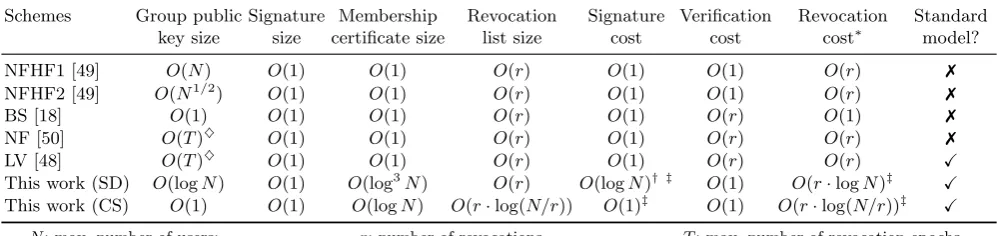
4 Efficiency Comparisons
This section discusses the comparative efficiency of known pairing-based revocable group signatures. We focus on revocation methods that are more efficient than generic revocation techniques: for example, we do not consider techniques (such as the one recalled in [19][Section 5.4]) consisting in privately sending new keys to all remaining users at each revocation. Also, we only consider schemes where group members are stateless and do not have to update their membership certificate every time a revocation occurs.
Table 1.Comparison between pairing-based revocable group signatures
Schemes Group public Signature Membership Revocation Signature Verification Revocation Standard
key size size certificate size list size cost cost cost∗ model?
NFHF1 [49] O(N) O(1) O(1) O(r) O(1) O(1) O(r) 7
NFHF2 [49] O(N1/2) O(1) O(1) O(r) O(1) O(1) O(r) 7
BS [18] O(1) O(1) O(1) O(r) O(1) O(r) O(1) 7
NF [50] O(T)♦ O(1) O(1) O(r) O(1) O(r) O(r) 7
LV [48] O(T)♦ O(1) O(1) O(r) O(1) O(r) O(r) X
This work (SD) O(logN) O(1) O(log3N) O(r) O(logN)† ‡ O(1) O(r·logN)‡ X This work (CS) O(1) O(1) O(logN) O(r·log(N/r)) O(1)‡ O(1) O(r·log(N/r))‡ X
N: max. number of users; r: number of revocations T: max. number of revocation epochs
∗The revocation cost refers to the complexity of generating an up-to-date revocation list.
♦These schemes can be modified to haveO(1)-size group public keys.
† This complexity is only involved at the first signature of each revocation epoch.
‡We only count arithmetic operations. In the signing algorithm, for example, we neglectO(log logN) combinatorial operations at the beginning of each epoch.
As we can see, our CS and SD-based constructions are not only the first revocable group signatures with constant verification time in the standard model. Among schemes where revocations do not entail updates in unrevoked users’ credentials, they are also the only solutions offeringO(1) verification cost and at most poly-logarithmic complexity in other metrics.
In applications where one can afford a logarithmic expansion factor in the size of revocation lists, the CS method seems preferable as it features compact (meaning logarithmic according to the terminology used in [9, 19]) membership certificates.
In situations where the size of the revocation list is to be minimized, the SD method should be preferred. Alternatively, the Layered Subset Difference approach (LSD) [41] provides an interesting tradeoff: at the expense of doubling the maximal size of revocation lists (which asymptotically remain of size O(r)), its basic variant allows reducing the size of membership certificates toO(log5/2N) as onlyO(log3/2N) HIBE private keys have to be stored.
Acknowledgements
We thank Damien Vergnaud, S´ebastien Canard, Roch Lescuyer and the anonymous reviewers for useful comments.
References
1. M. Abdalla, E. Kiltz, G. Neven. Generalized Key Delegation for Hierarchical Identity-Based Encryption. InESORICS’07,
LNCS4734, pp. 139–154. Springer, 2007.
2. M. Abe, K. Haralambiev, M. Ohkubo. Signing on Elements in Bilinear Groups for Modular Protocol Design. Cryptology ePrint Archive: Report 2010/133, 2010.
3. M. Abe, G. Fuchsbauer, J. Groth, K. Haralambiev, M. Ohkubo. Structure-Preserving Signatures and Commitments to Group Elements. InCrypto’10,LNCS6223, pp. 209–236, 2010.
4. M. Abe, J. Groth, K. Haralambiev, M. Ohkubo. Optimal Structure-Preserving Signatures in Asymmetric Bilinear Groups. InCrypto’11,LNCS6841, pp. 649–666, 2011.
5. T. Acar, L. Nguyen. Revocation for Delegatable Anonymous Credentials. InPKC’11,LNCS6571, pp. 423–440, 2011. 6. G. Ateniese, J. Camenisch, S. Hohenberger, B. de Medeiros. Practical group signatures without random oracles.
Cryp-tology ePrint Archive: Report 2005/385, 2005.
7. G. Ateniese, J. Camenisch, M. Joye, G. Tsudik. A practical and provably secure coalition-resistant group signature scheme. InCrypto’00,LNCS1880, pp. 255–270, 2000.
8. G. Ateniese, D. Song, G. Tsudik. Quasi-Efficient Revocation in Group Signatures. InFinancial Cryptography’02,LNCS
9. M. Bellare, D. Micciancio, B. Warinschi. Foundations of group signatures: Formal definitions, simplified requirements, and a construction based on general assumptions. InEurocrypt’03,LNCS2656, pp. 614–629, 2003.
10. M. Bellare, P. Rogaway. Random Oracles are Practical: A Paradigm for Designing Efficient Protocols. In 1st ACM Conference on Computer and Communications Security, pp. 62–73, ACM Press, 1993.
11. M. Bellare, H. Shi, C. Zhang. Foundations of group signatures: The case of dynamic groups. InCT-RSA’05,LNCS3376, pp. 136–153, 2005.
12. J. Benaloh, M. de Mare. One-Way Accumulators: A Decentralized Alternative to Digital Sinatures. InEurocrypt’93,
LNCS4948, pp. 274–285, 1993.
13. D. Boneh, X. Boyen. Short Signatures Without Random Oracles. InEurocrypt’04,LNCS3027, pp. 56–73. Springer-Verlag, 2004.
14. D. Boneh, X. Boyen. Efficient Selective-ID Secure Identity-Based Encryption Without Random Oracles. InEurocrypt’04,
LNCS3027, pp. 223–238, 2004.
15. D. Boneh, X. Boyen, E.-J. Goh. Hierarchical identity based encryption with constant size ciphertext. InEurocrypt’05,
LNCS3494, pp. 440–456, 2005.
16. D. Boneh, X. Boyen, H. Shacham. Short Group Signatures. InCrypto’04,LNCS3152, pp. 41–55. Springer, 2004. 17. D. Boneh, B. Lynn, H. Shacham. Short signatures from the Weil pairing. In Asiacrypt’01, LNCS2248, pp. 514–532.
Springer, 2001.
18. D. Boneh, H. Shacham. Group signatures with verifier-local revocation. InACM-CCS’04, pp. 168–177. ACM Press, 2004. 19. X. Boyen, B. Waters. Compact Group Signatures Without Random Oracles. InEurocrypt’06,LNCS4004, pp. 427–444,
Springer, 2006.
20. X. Boyen, B. Waters. Anonymous Hierarchical Identity-Based Encryption (Without Random Oracles). In Crypto’06,
LNCS4117, pp. 290–307, 2006.
21. X. Boyen, B. Waters. Full-Domain Subgroup Hiding and Constant-Size Group Signatures. InPKC’07,LNCS4450, pp. 1–15, 2007.
22. E. Bresson, J. Stern. Efficient Revocation in Group Signatures. InPKC’01,LNCS1992, pp. 190–206, 2001.
23. E. Brickell. An efficient protocol for anonymously providing assurance of the container of the private key. Submission to the Trusted Computing Group. April, 2003.
24. E. Brickell, J. Camenisch, L. Chen. Direct Anonymous Attestation. InACM-CCS’04, pp. 132–145, 2004.
25. J. Camenisch, R. Chaabouni, a. shelat. Efficient Protocols for Set Membership and Range Proofs. InAsiacrypt’08,LNCS
5350, pp. 234–252, Springer, 2008.
26. J. Camenisch, M. Dubovitskaya, G. Neven, G. Zaverucha. Oblivious Transfer with Hidden Access Control Policies. In
PKC’11,LNCS6571, pp. 192–209, 2011.
27. J. Camenisch, M. Kohlweiss, C. Soriente. An Accumulator Based on Bilinear Maps and Efficient Revocation for Anony-mous Credentials. InPKC’09,LNCS5443, pp. 481–500, 2009.
28. J. Camenisch, M. Kohlweiss, C. Soriente. Solving Revocation with Efficient Update of Anonymous Credentials. In
SCN’10,LNCS6280, pp. 454–471, 2010.
29. J. Camenisch, A. Lysyanskaya. Dynamic Accumulators and Application to Efficient Revocation of Anonymous Credentials. InCrypto’02,LNCS2442, pp. 61–76, Springer, 2002.
30. R. Canetti, S. Halevi, J. Katz. A Forward-Secure Public-Key Encryption Scheme. In Eurocrypt’03, LNCS 2656, pp. 254–271, 2003.
31. J. Cathalo, B. Libert, M. Yung. Group Encryption: Non-Interactive Realization in the Standard Model. InAsiacrypt’09,
LNCS5912, pp. 179–196, 2009.
32. D. Chaum, E. van Heyst. Group Signatures. InEurocrypt’91,LNCS547, pp. 257–265, Springer, 1991.
33. C. Delerabl´ee, D. Pointcheval. Dynamic Fully Anonymous Short Group Signatures. In Vietcrypt’06, LNCS4341, pp. 193–210, Springer, 2006.
34. Y. Dodis, N. Fazio. Public Key Broadcast Encryption for Stateless Receivers. InDigital Rights Management (DRM’02),
LNCS2696, pp. 61–80, 2002.
35. C.-I. Fan, R.-H. Hsu, M. Manulis. Group Signature with Constant Revocation Costs for Signers and Verifiers. In
Cryptology and Network Security (CANS 2011),LNCS7092, pp. 214–233, 2011.
36. G. Fuchsbauer. Automorphic Signatures in Bilinear Groups and an Application to Round-Optimal Blind Signatures. Cryptology ePrint Archive: Report 2009/320, 2009.
37. C. Gentry, A. Silverberg. Hierarchical ID-based cryptography. InAsiacrypt’02,LNCS2501, Springer, 2002.
38. J. Groth. Simulation-Sound NIZK Proofs for a Practical Language and Constant Size Group Signatures. InAsiacrypt’06,
LNCS4284, pp. 444–459, Springer, 2006.
39. J. Groth. Fully anonymous group signatures without random oracles. In Asiacrypt 2007, LNCS 4833, pp. 164–180. Springer, 2007.
40. J. Groth, A. Sahai. Efficient non-interactive proof systems for bilinear groups. InEurocrypt’08, LNCS 4965, pp. 415–432, 2008.
42. D. Hofheinz, T. Jager, E. Kiltz. Short Signatures From Weaker Assumptions. InAsiacrypt’11, LNCSseries, to appear, 2011.
43. D. Hofheinz, E. Kiltz. Programmable hash functions and their applications. InCrypto’08, LNCS5157, pp. 21–38, 2008. 44. J. Horwitz, B. Lynn. Toward hierarchical identity-based encryption. InEurocrypt’02,LNCS2332, Springer, 2002. 45. A. Kiayias, M. Yung. Secure scalable group signature with dynamic joins and separable authorities. International Journal
of Security and Networks (IJSN) Vol. 1, No. 1/2, pp. 24–45, 2006. Earlier version appeared as Cryptology ePrint Archive: Report 2004/076, 2004.
46. A. Kiayias, M. Yung. Group signatures with efficient concurrent join. InEurocrypt’05,LNCS3494, pp. 198–214, 2005. 47. E. Kiltz. Chosen-ciphertext security from tag-based encryption. InTCC’06,LNCS3876, pp. 581–600, 2006.
48. B. Libert, D. Vergnaud. Group Signatures with Verifier-Local Revocation and Backward Unlinkability in the Standard Model. InCANS’09,LNCS5888, pp. 498-517, 2009.
49. T. Nakanishi, H. Fujii, Y. Hira, N. Funabiki. Revocable Group Signature Schemes with Constant Costs for Signing and Verifying. InPKC’09,LNCS5443, pp. 463–480, 2009.
50. T. Nakanishi, N. Funabiki. Verifier-Local Revocation Group Signature Schemes with Backward Unlinkability from Bilinear Maps. InAsiacrypt’05,LNCS5443, pp. 533–548, 2009.
51. M. Naor, D. Naor, J. Lotspiech. Revocation and Tracing Schemes for Stateless Receivers. InCrypto’01,LNCS2139, pp. 41–62, 2001.
52. M. Naor. On Cryptographic Assumptions and Challenges. InCrypto’03,LNCS2729, pp. 96–109. Springer-Verlag, 2003. 53. L. Nguyen. Accumulators from Bilinear Pairings and Applications. InCT-RSA’05,LNCS3376, pp. 275–292, 2005. 54. L. Nguyen, R. Safavi-Naini. Efficient and Provably Secure Trapdoor-Free Group Signature Schemes from Bilinear Pairings.
InAsiacrypt’04,LNCS3329, pp. 372–386. Springer-Verlag, 2004.
55. D. Song. Practical forward secure group signature schemes. InACM-CCS’01, pp. 225–234, 2001.
56. V. Shoup. Lower bounds for discrete logarithms and related problems. InEurocrypt’97,LNCS1233, pp. 256–66, 1997. 57. I. Teranishi, K. Sako. k-Times Anonymous Authentication with a Constant Proving Cost. InPKC’06,LNCS3958, pp.
525–542, Springer, 2006.
58. P. Tsang, M.-Ho Au, A. Kapadia, S. Smith. Blacklistable anonymous credentials: blocking misbehaving users without TTPs. InACM-CCS’07, pp. 72–81, 2007.
59. P. Tsang, M.-Ho Au, A. Kapadia, S. Smith. PEREA: towards practical TTP-free revocation in anonymous authentication. InACM-CCS’08, pp. 333–344, 2008.
60. G. Tsudik, S. Xu. Accumulating Composites and Improved Group Signing. In Asiacrypt’03,LNCS2894, pp. 269–286, 2003.
61. S. Zhou, D. Lin. Shorter Verifier-Local Revocation Group Signatures from Bilinear Maps. InCANS’06,LNCS4301, pp. 126–143, Springer, 2006.
A Correctness and Security Definitions for Revocable Group Signatures
In the following, a public state St is saidvalid if it can be reached fromSt= (∅, ε) by a Turing machine having oracle access to JGM. Likewise, a state St0 is said to extend another state St if it can be reached from St.
Similarly to [45, 46], we will write certi Y seci to express that there exist coin tosses $ for JGM and Juser such that, for some valid public state St0, the execution of [Juser(λ,Y),JGM(λ, St0,Y,SGM)]($) provides Juser withhi,seci,certii.
Correctness. We say that a R-GS scheme is correct if:
1. In a valid stateSt, it holds that|Stusers|=|Sttrans|and no two entries ofSttranscan contain certificates
with the same tag.
2. If [Juser(λ,Y),JGM(λ, St,Y,SGM)] is honestly run by both parties andhi,certi,seciiis obtained byJuser, then it holds that certiY seci.
3. For each revocation epoch t and any hi,certi,secii such that certi Y seci, satisfying condition 2, if
i6∈ Rt, it holds thatVerify Sign(Y, t, RLt,certi,seci, M), M, t, RLt,Y
= 1.
4. For any hi,certi,secii resulting from the interaction [Juser(., .),JGM(., St, ., .)] for some valid state St, any revocation epochtsuch that i6∈ Rt, ifσ=Sign(Y, t, RLt,certi,seci, M), then
Security Model. As in [45], we formalize security properties via experiments where the adversary interacts with a stateful interfaceI that maintains the following variables:
- stateI: is a data structure representing the state of the interface as the adversary invokes oracles. It is
initialized asstateI = (St,Y,SGM,SOA)←Setup(λ, N). It comprises the (initially empty) setStusersof
group members and a databaseSttrans containing transcripts of join protocols. Finally,stateI includes
a countert(which is initialized to 0) indicating the number of user revocation queries so far. - n=|Stusers|< N is the current cardinality of the group.
- Sigs: is a database of signatures issued by the signing oracle. Each record is a triple (i, t, M, σ) indicating that messageM was signed by useriduring period t.
- Ua: is the set of users that are adversarially-controlled since their introduction in the system.
- Ub: is the set of honest users that were introduced by the adversary acting as a dishonest group manager. For such users, the adversary obtains the transcript of the join protocol but not the user’s membership secret.
When mounting attacks, adversaries will be granted access to the following oracles.
- Qpub,QkeyGM andQkeyOA: when these oracles are invoked, the interface looks upstateI and returns the
group public keyY, the GM’s private keySGMand the opening authority’s private keySOArespectively. - Qa-join: allows the adversary to introduce users under his control in the group. On behalf of the GM, the interface interacts with the malicious prospective user by runningJGM in the join protocol. If the protocol successfully terminates, the interface increments N, updates St by inserting the new user n
in setsStusers and Ua. It also sets Sttrans:=Sttrans||hn,transcriptni.
- Qb-join: allows the adversary, acting as a dishonest group manager, to introduce new group members of his choice. The interface starts an execution of [Juser,JGM] and runs Juser in interaction with the
JGM-executing adversary. If the protocol successfully completes, the interface increments n, adds user
ntoStusersandUband setsSttrans :=Sttrans||hn,transcriptni. It stores the membership certificatecertn
and the membership secretsecn in a privatepart ofstateI.
- Qsig: given a message M, an index i, the interface checks if the private area of stateI contains a
certificatecertiand a membership secretseci such thati6∈ Rt, wheretis the current revocation epoch.
If no such elements exist or ifi6∈Ub, it returns⊥. Otherwise, it generates a signatureσ on behalf of useri for epocht. It also sets Sigs←Sigs||(i, t, M, σ).
- Qopen: on input of a valid pair (M, σ) for some revocation epoch t, the interface runs the opening algorithm using the current state St. WhenS is a set of triples (M, σ, t), Q¬openS denotes the restricted oracle that applies the opening procedure to any triple (M, σ, t) but those in S.
- Qread and Qwrite: allow the adversary to read and write the content of stateI. When invoked, Qread outputs the wholestateI but the public/private keys and the private part ofstateI where membership
secrets are stored after Qb-join-queries. Queries Qwrite allow the adversary to modifystateI as long as
it does not remove or alter elements of Stusers, Sttrans or invalidate the public state St: for example,
the adversary can use it to create dummy users at will as long as it does not re-use already existing certificate tags.
- Qrevoke: is a user revocation oracle. On input of an index i such that i∈Stusers, the interface checks
ifi is in the appropriate user set (i.e., Ua or Ub depending on the considered security notion) and if
Sttrans contains a record hi,transcriptii such that i 6∈ Rt, where t is the current revocation epoch. If
not, it returns⊥. Otherwise, it incrementst, addsitoRtand generates an updated revocation listRLt
which is made available to the adversary. For simplicity, we assumed that the adversary only revokes one user per query to Qrevokebut the model easily extends to allow multiple revocations at once.
In a misidentification attack, the adversary is allowed to corrupt the opening authority via theQkeyOA oracle. He can also introduce corrupt users in the group via Qa-join-queries and revoke users at will using
Qrevoke. His goal is to produce a signature σ? that verifies w.r.t. RLt?, where t? denotes the current
revocation epoch (i.e., the number ofQrevoke-queries). It wins if the produced signature σ? does not open to any unrevoked adversarially-controlled.
Definition 4. A R-GS scheme is secure against misidentification attacks if, for any PPT adversary A
involved in the experiment hereafter, we have AdvmisA -id(λ) = Pr[ExptAmis-id(λ) = 1]∈negl(λ).
Experiment ExptmisA -id(λ)
stateI = (St,Y,SGM,SOA)←Setup(λ, N);
(M?, σ?)← A(Qpub, Qa-join, Qrevoke, Qread, QkeyOA); If Verify(σ?, M, t?, RLt?,Y) = 0 return 0;
i=Open(M?, t?, RLt?, σ?,SOA,Y, St0);
If (i6∈Ua\Rt?) return1;
Return 0;
This definition extends the usual definition [45] in that A is also successful if σ? verifies w.r.t.RLt? but
opens to an adversarially-controlled user that was revoked during the revocation epoch t?.
Framing attacks consider the situation where the whole system, including the group manager and the opening authority, conspires against some honest user. The adversary is allowed to corrupt the group managerandthe opening authority (usingQkeyGMandQkeyOA, respectively). He can also introduce honest group members (via Qb-join-queries), observe the system while these users generate signatures and create dummy users usingQwrite. In addition, before the possible corruption of the group manager, the adversary can revoke group members at any time by invoking the Qrevoke oracle. As a potentially corrupted group manager, Ais allowed to come up with his own revocation list RLt? at the end of the game. We assume
that anyone can publicly verify that RLt? is correctly formed (i.e., that it could be a legitimate output
of Revoke) so that the adversary does not come up with an ill-formed revocation list. For consistency, if
A chooses not to corrupt the GM, the produced revocation list RLt? must be the one determined by the
history of Qrevoke-queries. The adversary eventually aims at framing an uncorrupt group member.
Definition 5. A R-GS scheme is secure against framing attacks if, for any PPT adversary A, it holds that AdvfraA (λ) = Pr[ExptAfra(λ) = 1]∈negl(λ).
Experiment ExptfraA (λ)
stateI = (St,Y,SGM,SOA)←Setup(λ, N);
(M?, σ?, t?, RLt?)← A(Qpub, QkeyGM, QkeyOA, Qb-join, Qrevoke, Qsig, Qread, Qwrite);
If Verify(σ?, M?, t?, RLt?,Y) = 0 then return 0;
i=Open(M?, t?, RLt?, σ?,SOA,Y, St0);
If i6∈Ub return0; If V
j∈Ubs.t.j=i (j, t?, M?,∗)6∈Sigs
then return 1; Return 0;
Anonymity is defined via a game involving a 2-stage adversary. To give a proper definition, we need to define an special algorithm IsRevoked which, given a valid membership certificate/secret pair (cert,sec) and a revocation list RLt, allows efficiently deciding if (cert,sec) belongs to a revoked user for RLt. Such
an algorithm exists in our construction.
In the first stage of the game, called play stage, the adversary is allowed to modify stateI by making