RANGE CONDITION CLASSIFICATION 97
equipment and the plot sizes were felt to be of could cause great differences in suitability for adequate size to offset the variability of distribu- plantings and would likely invalidate replication
tion. of treatments.
The fact that the plants did not mature beyond the seedling stage was not felt to be critical (based on earlier unpublished work conducted at the study area). These trials gave the indication that stand establishment was accomplished over a period
of several years and that the precipitation received immediately before and during the growing sea- son would tend to influence whether or not the plants matured from seed during the first year.
A very probable source of variability was in- herent within the spoil itself. The extremes of pH and textures over short distances on the banks
LITERATURE CITED
GRANDT, A. F., AND A. L. LANG. 1958. Reclaiming Illinois strip coal land with legumes and grasses. University of Illinois Agr. Exp. Sta. Bull. 628. 64 p.
LUJAN, LEANDRO E. 1966. Revegetation of strip-mined areas in Southwestern Wyoming. M.S. thesis, University of Wyoming.
MAY, MORTON. 1967. Mine reclamation in the Western States. Mining Congress J. Aug., 1967.
ROGERS, NELSON F. 1951. Strip-mined lands of the West- ern Interior Coal Province. Missouri Agr. Exp. Sta. Res. Bull. 475. 55 p.
Range Condition Classif ication
Based on Regressions of
Herbage Yields on Summer
Stocking Rates’
J. L. LAUNCHBAUGHPasture Management Specialist, Fort Hays Branch, Kansas
Agricultural Experiment Station, Hays, Kansas
Highlight
Vegetation on a clay upland range site in the Kansas ‘20- to 24-inch precipitation zone was differentially stocked at three rates with yearling cattle for 20 summer grazing seasons. Applications of the currently accepted range condition classification system on yield data for the last 10 grazing seasons indicated need for improvements in classifying range condition for this site. With existing range condition classification concepts, it appeared im- possible either to reduce vegetation to poor condition or to maintain excellent range condition under summer grazing. Much of the difficulty was caused by herbaceous species not responding to grazing (decrease, increase, or invade) as classified in the condition guide. A modified range condi- tion classification system incorporating re-evaluated re- sponses of species to grazing was developed from yield regressions and compared with the existing system. The proposed method gave somewhat more consistent condition evaluations and better separation of test pastures into con- dition classes than the method currrently used.
A major U.S. system of range condition classifica- tion was introduced by Dyksterhuis (1949). Initial stages of development and ecological principles in-
1 Contribution No. 220, Fort Hays Branch, Kansas Agri- cultural Experiment Station, Hays, 67601. Paper pre- sented at the 21st Annual Meeting, American Society of Range Management, Albuquerque, N. M., February 12- 15, 1968. Received April 19, 1968; accepted for publica- tion July 1, 1968.
volved were further reviewed by Dyksterhuis (1952, 1958). The system is widely used in central U.S. to categorize ranges into excellent, good, fair, and poor condition, to recognize their productive capacity in relation to the potential for the site, and to help with management decisions for range improvement or to make full use of the highest condition class. The relative proportion of herba- ceous dominants in the highest and presumably most productive condition-climax; the responses of individual species to grazing; i.e., decreasers, increasers, and invaders; departures in herbage composition from the highest condition; and the assumption that condition will improve through plant succession, constitute the basis for the range condition classification concept.
Although in its conception the system recognized a direct relationship between range condition and herbage production, the relation was considered to be only general. The need was expressed, however, for quantitative data to show specific yield- condition relationships for each site under different kinds and seasons of livestock use. Current tech- nical range site descriptions give average herbage yields for range sites in excellent condition (U.S. Dept. Agr.-SCS, 1967a). The range condition guides recognize not only a forage production dif- ferential associated with condition class, but also a need to stock lighter to bring about range im- provement, by recommending lowest stocking rates for ranges in poor condition and highest stocking rates for ranges in excellent condition, (U.S. Dept. Agr.-SCS, 1967).
condition evaluations of the test pastures for the last 10 years of grazing, using the latest Kansas range condition guide for the site (U.S. Dept. Agr.- SCS, 1962). Although test pastures were differen- tiated into condition classes most years, inconsist- encies in the condition evaluations were significant.
This paper further evaluates species perform- ances on clay upland range under the grazing treatments cited above, and synthesizes a modified system of range condition classification based on yield responses of major herbage species to differ- ent intensities of summer grazing.
Resume of Grazing Study
Basal cover changes were recorded over 20 years for major grass species associated with three sum- mer stocking rates (Launchbaugh, 1967). Impor- tant basal cover and botanical composition shifts in response to intensity of use occurred during the first 10 years. Cover characteristics then became identifiable with the degree of summer use. Changes within treatment the next 10 years ap- peared to be caused more by weather variations than by grazing intensity. In terms of basal cover, western wheatgrass was inversely related to grazing pressure, buffalograss directly related, and blue grama was affected only slightly by grazing inten- sity.
Herbage yields of the various vegetation com- ponents were measured on caged plots the last 10 years of grazing. Since major cover changes al- ready had taken place, production data character- ized vegetation in different conditions rather than following annual step-by-step departures from one condition class to another.
Western wheatgrass and blue grama yielded the most herbage under light grazing, blue grama and buffalograss the most under moderate grazing, and buffalograss dominated under heavy grazing. An- nual grasses were most productive under light graz- ing, intermediate under moderate grazing, and least productive under heavy grazing. Downy and Japanese bromes were the important annuals in the moderately and lightly grazed pastures, while little barley was the most frequent annual grass on heavily grazed range.
Weeds were present in significant quantities when spring rainfall amounts were high and pro- duced higher yields on moderately and lightly
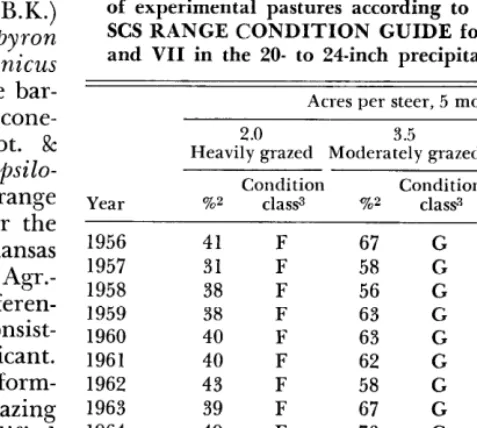
1956 1957 1958 1959 1960 1961 1962 1963 1964 1965
41 F 67 G 65 G
31 F 58 G 73 G 38 F 56 G 78 E
38 F 63 G 58 G 40 F 63 G 53 G 40 F 62 G 73 G 43 F 58 G 48 F
39 F 67 G 70 G
49 F 73 G 91 E
44 F 87 E 95 E -
Mean Z F 67 E Yi E
1 A summary of Table 7 from Launchbaugh, 1967, with revisions in percentages allowable in climax according to 1967 Range Con- dition Guide (U.S. Dept. Agr.-SCS, 1967).
2 Percent of climax vegetation.
s Condition Class: P =Poor (O-24); F= Fair (25-49); G =Good (50-74); E = E xcellent (75-100).
grazed ranges than on heavily grazed. Western rag- weed was the major weed species associated with light and moderate grazing, and upright prairie- coneflower was the most abundant weed under heavy grazing. All weeds were scarce during years of low spring rainfall.
Table 1 recapitulates the range condition classi- fication of the test pastures according to the exist- ing sys tern. Grazing treatments ranked in logical order in terms of condition class, but under light grazing condition varied greatly from year to year and ranged from fair to excellent. It seems un- likely that an excellent condition class would ever be maintained under light usage, because of weather controlled variability in western ragweed and west- ern wheatgrass abundance. It also appears impos- sible to reduce vegetation on this site to the poor condition class, because the so-called increasers, which make up a large part of the vegetation on both the highest and lowest condition ranges are so abundant. The composition would need to de- generate to almost pure buffalograss and annual invaders to qualify as poor condition. That pros- pect appears unlikely without feeding a supple- mental roughage to cause both severe trampling and destructive grazing.
Reactions of Species to Grazing.-Response of
RANGE CONDITION CLASSIFICATION 99
TOtal Yield
++;;
06 07 0.0 0.9 1.0 1.1 1.2 13 1.4 , 3 Western Summer Siockfng Rate (AUM/ACW) wheatgross
fi Uprlqht
&,70+260x ( Prolrlsconeflower
Summer Stockmq Rote (AUM/AW.Z)
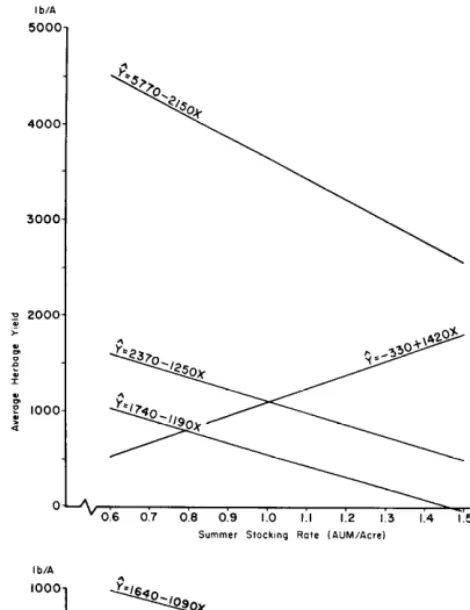
Regressions of total herbage and individual species yields on summer stocking rate (IO-year average). Significance of regression coefficients by the t-test: Total yield, t = 3.83**; Buffalograss, t = 3.93**; Blue grama, t = 5.57**; Western wheatgrass, t = 4.69*+; Upright prairieconeflower, t = 3.08*+; Little barley, t = 2.69”; Western ragweed, t = 3.67”” and Annual bromes, t = 4.43**.
grass, blue grama, western ragweed, and upright prairieconeflower, increasers; and all annual grasses, invaders on the clay upland range site (U.S. Dept. Agr.-SCS, 1967). Fig. 1 shows regressions of total herbage production and important species on sum- mer stocking rate. In each case tested there was a significant linear regression of herbage production on stocking rate. Thus, over a wide range of stock- ing rates major species on this site may be charac- terized as decreasers, increasers, and invaders ac- cording to their responses to grazing intensity. Accordingly, blue grama, western wheatgrass, west- ern ragweed, and the annual brome grasses re- sponded as decreasers; buffalograss was the only significant increaser, followed by upright prairie- coneflower. Little barley, although relatively un- important under any grazing intensity, might be considered an invader as only minute quantities of it would appear in the highest condition range. Several inconsistencies exist between these findings and prevailing assumptions-responses of blue grama, western ragweed, and annual brome grasses.
/- -\
/
-I., ., ., . 11 I. 1 I1 -\. .a
.2 .4 .6 .6 1.0 1.2 1.4 1.6 I.6
Animal Unit Months / Acre
FIG. 2. Percentage yield of buffalograss relative to the com- bined percentages of blue grama and western wheatgrass calculated from yield regressions on stocking rate.
Development of a Revised System
The above findings indicate that the condition classification system should be revised to be con- sistent with species responses to grazing on this range site. Yield composition data suggest a clas- sification system based on assumptions that: (1) yield regressions indicated species reaction to sum- mer grazing intensity; (2) the most reliable index to condition was relative yields of the three major perennial grasses, because their relationship ap- peared to be influenced more by grazing intensity than by weather differences; and (3) yields of other species, though associated with summer grazing in- tensity, depended highly on weather conditions.
The yield percentage of buffalograss relative to the combined percentages of blue grama and west- ern wheatgrass were plotted against stocking rate using yields calculated from regression (Fig. 2). Assuming linearity beyond data used in regressions, buffalograss would be replaced by blue grama and western wheatgrass at a light stocking rate of 0.25 animal unit month/acre. At the other extreme a heavy rate of 1.85 AUM/acre would result in 100yO buffalograss.
20-
O-
.4 .6
<
75-Y Animol Unit Months /Acre
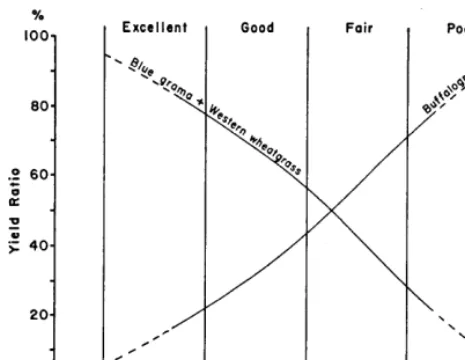
Fm. 3. Percentage yield ratio of buffalograss to blue grama plus western wheatgrass in range condition classes, assuming highest condition range would contain at least 5% buffalo- grass, and lowest condition, not over 95% buffalograss.
range of stocking rates been tested, the relation- ship between percentage buffalograss and stocking rate would not be linear at very high or very low stocking rates. Thus the lightest stocking rates would leave some buffalograss, which would in- crease but not take over completely under heavier stocking rates. Limits were arbitrarily set at 5 and 95%, respectively, and the familiar condition classes, excellent, good, fair, and poor were estab- lished by equal four-part division of the horizontal axis between these percentages of buffalograss (Fig. 3). The different condition ranges on this site would have yield ratios shown in Table 2. Figure 4 was prepared from this table and total herbage yield regression on stocking rate. It incorporates the relationships of percentage yield ratio, range condition, average herbage yield, relative yield, and summer stocking rate.
Application of System. -The system requires rel-
ative yields of buffalograss to total buffalograss, blue grama, and western wheatgrass. If, for exam- ple, buffalograss composes 40% of the total peren- nial grass growth, the condition class would be judged good, predicted average herbage yield would be approximately 3,600 lb/acre (approximately
Table 2. Yield ratio percentages of buffalograss to blue grama plus western wheatgrass for each condition class.
Range condition
class
Yield percentage
Blue grama plus Buffalograss to western wheatgrass
Excellent 5-22 78-95
Good 22-44 56-78
Fair 44-7 1 29-56
Poor 7 1-95 5-29
1,...,,.,.,,,,,,,!,,l,,,,,I
IO 20 30 40 50 60 70 00 90
YIELD RATIO OF BUFFALOGRASS TO BLUE GRAMA B WESTERN WHEATGRASS (%I
FIG. 4. Relationship of buffalograss yield ratio to range con- dition class, average total herbage yield, relative total herbagc production, and summer stocking rate. Broken-line arrows indicate relationship assuming buffalograss is 400/, of the perennial grass production on a clay upland range site in the Kansas ZO- to 24-inch precipitation zone.
73% of the potential production), and summer stocking rate to achieve and to maintain the condi- tion would be 1.0 AUM/acre.
Applying the system to individual year data of the previous study (Table 3), showed consistent condition class ratings, particularly for lightly grazed range. Divergence was greater in condition class ratings between lightly and heavily grazed ranges than with the existing system (Table l), and a poor condition class became a reality for the site. Condition classes deviated from the mean for the heavily and moderately grazed pastures twice each;
Table 3. Annual and mean range condition classification of experimental pastures according to modified range condition classification system shown in Fig. 4.
Year
2.0 3.5 5.0
Heavily grazed Moderately grazed Lightly grazed
Condition Condition Condition
%1 class2 %I class2 %1 class2
1956 1957 1958 1959 1960 1961 1962 1963 1964 1965 Mean
69 F
87 P
80 P
78 P
77 P
73 P
73 P
77 P
68 F
73 P
76 P
24 G 17 E
57 F 7 E
53 F 9 E
38 G 10 E
33 G 6 E
36 G 12 E
40 G 18 E
36 G 11 E
37 G 8 E
27 G 13 E
40 E 11 E
l Yield ratio of buffalograss to blue grama and western wheat- grass.
RANGE CONDITION CLASSIFICATION 101
however, no variations were greater than one con- an excellent condition class made up of 75 to 100% dition class. Most of the deviation in condition decreasers and allowable increasers. In addition, class within treatment appeared to result from certain decreasers are more persistent than others cover change interactions associated with drought under grazing. Blue grama did not disappear along and subsequent recovery. Drought may cause dif- with western wheatgrass at a heavy stocking rate. ferential cover reductions of buffalograss and blue If blue grama were treated as a decreaser in the orama and disproportionate recovery rates follow-
h present system, difficulties still arise in getting di-
ing drought (Albertson, 1937; Albertson et al., vergence in condition class ratings between lightly
1953). and heavily grazed ranges.
Discussion
Confirmed accuracy of this approach to range condition evaluation will require further testing, particularly on data not included in the regression analyses, from both previously sampled and simi- lar sites. Several points need further consideration. Stocking rates lighter and heavier than those used in calculating regressions need to be tested to ar- rive at actual improvement and deterioration limits under grazing. The extreme range of stocking rate- yield regression linearity is needed to verify or re- ject assumptions made on the limited projections beyond regressions. Also, if such a system has ad- vantages over present ones, the expense of long- term grazing research to obtain information even for major range sites must be reconciled.
Yield proportion of major herbaceous dominants relative to grazing intensity appears to be the most reliable index to range condition evaluation where increasers and certain decreasers persist under heavy grazing, and true invaders play only minor roles. Yield ratios should include only species in- fluenced most by grazing treatment and least by yearly weather differences.
LITERATURE CITED
Although the most widely accepted range condi- tion classification method has proved satisfactory in many situations, apparent failure to evaluate clay upland range vegetation may be attributed largely to the #g-razing reactions of blue grama and buffalograss. Blue grama decreased rather than in- creased with grazing. The major increaser, buffalo- grass, did not respond to grazing in the classical sense (increase, then decrease under heavy grazing); but, behaved like an invader under heavy grazing. A similar situation has been reported for Canadian Mixed Prairie where increasers are the main spe- cies in both climax and depleted ranges (Coupland et al., 1960).
When severely deteriorated vegetation is com- posed primarily of increasers with relatively few invaders; or if major decreasers persist in siqnifi- cant quantities under heavy grazing, the Dykster- huis system gives a very narrow spread between highest and lowest condition ratings. Treating cer- tain increasers as invaders does not solve the prob- lem, because their normal occurrence in high con- dition range minimizes the probability of having
ALBERTSON, F. W. 1937. Ecology of mixed prairie in west- central Kansas. Ecol. Monogr. 7:481-547.
ALBERTSON, F. W., A. RIEGEL, AND J. L. LAUNCHBAUCH. 1953. Effects of different intensities of clipping on short grasses in west-central Kansas. Ecology 34: l-20.
COUPLAND, R. T., N. A. SKOGLUND, AND A. J. HEARD. 1960.
Effects of grazing in the Canadian mixed prairie. Proc. 8th Int. Grassland Congr. 212-215.
DYKSTERHUIS, E. J. 1949. Condition and management of range land based on quantitative ecology. J. Range Manage. 2: 104-l 15.
DYKSTERHUIS, E. J. 1952. Determining the condition and trend of ranges (natural pastures). Proc. 6th Int. Grass- land Congr. 1322-1327.
DYKSTERHUIS, E. J. 1958. Ecological principles in range evaluation. Bot. Rev. 24:253-272.
LAUNCHBAUGH, J. L. 1967. Vegetation relationships as- sociated with intensity of summer grazing on a clay upland range site in the Kansas 20- to 24-inch precipita- tion zone. Kansas Agr. Exp. Sta. Tech. Bull. 154. 24 p. U. S. DEPT. AGR.-SCS. 1962. Range condition guide for areas V and VII in 20- to 24-inch precipitation zone. USDA-SCS Tech. Guide, Sect. II-E-I. Mimeo.
U. S. DEPT. AGR.-SCS. 1967. Guide for determining range condition class and suggested initial stocking rates for (Oberlin, Hays, Hill City, Ness City, Norton, Osborne, Phillipsburg, Stockton, Lacrosse, Russell, Hoxie, Smith Center and WaKeeney work units). Kansas (20-24”) precipitation zone. USDA-SCS Tech. Guide, Sect. II-E-l. TG Notice #40. mimeo.
U.S. DEPT. AGR.-SCS. 1967a. Kansas technical range site description. Clay upland-CU (20-24” P.Z.) USDA-SCS Tech.*Guide, Sect. H-E-2. mimeo.
Spec;u/ists
in Quality N AT I V E G
R A
S S E S
Wheatgrasses l Bluestems l Gramas l Switchgrasses l Lovegrasses l Buffalo l and Many Others
We grow, harvest, process these seeds Native Grasses Hawested in ten States Yo;; Inquiries -