ISSN: 2574 -1241
A Comparative Study of TransE and TransH Algorithms
in Spatial Address Representation Learning
DOI: 10.26717/BJSTR.2020.26.004427
Xin Wang
1, Weihong Li
1* and Haoxin Tong
2 1School of Geography, South China Normal University, China2R & D Department , Aerospace Finest (Guangdong) Information Technology Co. Ltd., China
*Corresponding author: Weihong Li, School of Geography, South China Normal University, Guangzhou 510631, China
Introduction
The continuous generalization of geographic information has become an important feature of the new geographic information era [1,2]. With the extensive application of location big data, mas-sive location big data such as address is generated, and address data is generalized geographic data. The composition of address data includes text description and location description, namely semantic address information and spatial address information. It has become a hot research problem in the development of geo-graphic information science and technology to research the fusion of the two based on the knowledge graph technology and dig out more valuable information in the address. Traditional address en-tity representation methods can be divided into two categories, one is the numeral based longitude and latitude location method, the other is the text to represent the geographical entity, this pa-per discusses the text representation method with more research
significance. Address entity text representation is actually geoc -oding problems, in this information age, how to address entity
accurately is the computer to understand and calculate, it is crucial to the problem, a large number of scholars to research, geograph-ic entity not only contains rgeograph-ich semantgeograph-ic information, however, its contains spatial information is often neglected, easy to cause the address entity semantic similarity space distance is not close and similar semantic space distance is not similar, therefore, the com-bination of semantic information and spatial information will help to solve this problem, providing a new method for geographic in-formation mining.
In 2012, Google first proposed the concept of knowledge graph
[3], and took it as the knowledge brain of Google search engine, fun-damentally solving the problem of semantic search. The purpose of knowledge graph is to describe the various entities that exist in the real world and concepts, as well as the relationship between them, the huge amounts of information into knowledge stored in this way, widely used in semantic search, intelligent q&a, the realization of personalized recommendation, and other functions, such as social Received: March 13, 2020
Published: April 07, 2020
Citation: Xin Wang, Weihong Li, Haoxin
Tong. A Comparative Study of TransE and TransH Algorithms in Spatial Address
Representation Learning. Biomed J Sci & Tech Res 26(5)-2020. BJSTR. MS.ID.004427.
Keywords: Geographic Knowledge Graph;
Spatial Address Data; Knowledge Based Representation Learning; Trans E; Trans H
ARTICLE INFO Abstract
Geographic knowledge graph is the extension of knowledge graph in geography. As
the basic data of geographic data, spatial address contains rich spatial information and
semantic information. It is a simplified geographic knowledge graph. In this paper, we
integrate geographic knowledge into spatial addresses, study how to combine spatial information with semantic information by knowledge representation learning. The
spatial address data set is trained on the TransE and TransH, two classical translation models, and a comparative study is conducted through triple classification and distance
estimation between vectors. The research proves the TransH model is obviously
superior to the TransE model in the task of modeling complex relationships. This study
networking and e-commerce but also extremely important in the
field of commercial value [4]. With the rapid development of satel -lite remote sensing and sensor technology, a large number of loca-tion based geographic data access to and use by people, knowledge graph technology in geographical community to get the favour of a large number of scholars, geographical scholars began efforts of knowledge graph in the geographical science, discusses the applica-tion of geographic knowledge graph building and [5], the construc-tion of corpus [6-8], geographic entities and relaconstruc-tionship extracconstruc-tion [9,10], the implementation of “geography data, information, knowl-edge, wisdom” intelligent into [11], using knowledge enhancement technique can build intelligent interactive virtual geographic en-vironment [12] service framework, Knowledge representation of trajectory data containing time and space is carried out by means of knowledge nesting technology, People’s Daily habits are mined [13], and deep recursive neural network is used to carry out the dis-ambiguation task of geographical entities on social media data [14].
The extensive application of knowledge graph technology has accelerated the transformation of mass geographic data to geo-graphic information, and also extended the new thinking of geo-sci-ence research for geographers. However, knowledge graph is a structured semantic network in essence, which is used to represent the interconnections between knowledge and construct the rela-tionship network between entities, so as to carry out the relevant calculation of knowledge. In this process, knowledge representa-tion is a key step in the construcrepresenta-tion and applicarepresenta-tion of knowledge graph [15]. Knowledge representation of learning [16] the purpose lies in the knowledge base entities and relationships in the dense with a low dimensional vector, said in a low dimensional space the closer the distance between the object vector represents the higher semantic similarity, and the farther the distance between the ob-ject vector represents the lower the semantic similarity, the repre-sentation of knowledge learning to computing the semantic links between the entities and relationships, to quantify the semantics of the close degree between objects, so as to improve the accura-cy of low frequenaccura-cy object [17-22]. Basic geographic data has the great effect of space vehicle and the stock of knowledge [11], along with the expansion of knowledge graph technology in geography, geographic data knowledge role has been greatly enhanced, but ig-nores the geographical space vector function of the nature of the elements of the most elements such as geographical spatial dis-tribution and time evolution process and regional characteristics, such as how to geographic data of spatial relation and the semantic relationship between fusion, has become the geographical knowl-edge graph is a big problem.
As an important part of geographical data, address data not
only provides geographical entity location attribute in space, but also provides hierarchical association of geographical entity seman-tically. Constructing address knowledge graph can solve the prob-lem of semantic relation and spatial relation fusion of geographic knowledge graph. Two similar geographic entities at the semantic
level does not represent the distance in space is also similar, such as south China normal university and east China normal university, but there are 1400km away, and two geographical entities on the space distance of close nor its similar at the semantic level, such as
Bainaohui computer city and third affiliated hospital of zhongshan
university are less than one hundred meters, but literally has noth-ing to do, therefore, when donoth-ing the representation of geographical entity study, the relationship between entities should not be limit-ed to the semantic relationship, a large number of spatial relations [23-29] should also be taken into account, the two should be
mutu-al fusion can make up for a lack of their own. At present, there are
few reports on the integration of the spatial relationship and se-mantic relationship of geographical entities in expressive learning.
This study takes geographic knowledge graph as an example, we will conduct research on the construction of address knowledge graph that fuse spatial and semantic relationships. It focuses on the learning problems of knowledge graph, and compares the spatial
address data sets in the two classic translation models, TransE and TransH. Use the methods of triple classification and distance eval
-uation between vectors to perform quantitative analysis and find
the representation learning model that is most suitable for spatial addresses. By selecting test samples and calculating entity text
sim-ilarity, linear distance and vector distance respectively, it is verified
that the address entity can effectively solve the problem of semantic space inconsistency of address entity after being transformed into spatial vector by the representation learning method. This research will help to more accurately construct the knowledge graph of ad-dresses, and provide a reference for the representation learning of geographic knowledge graph. Provide new research ideas for the
research of geographic information science in the field of knowl -edge graph.
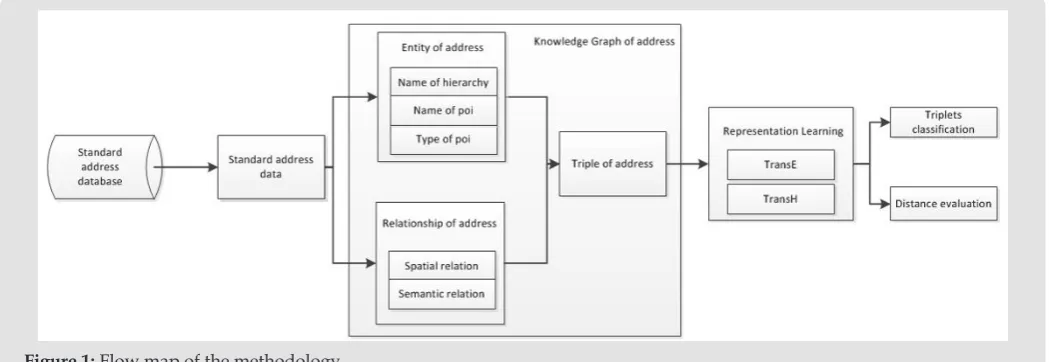
Research Methods
In this study, the constructed spatial address knowledge graph is used to establish a spatial address triple data set. The entities include address hierarchy see Table 1 for details name, informa-tion point name and informainforma-tion point type, and the relainforma-tionship includes semantic relationship (address dependency relationship, attribute relationship) and spatial relationship (spatial distance).
TransE and TransH, the classical models of learning, were used to
train the address data set, and the advantages and disadvantages of
the two models were evaluated by triple classification and distance.
Table 1: Address hierarchy.
Number The Original Address Address Hierarchy
1 Shi pai street, tianhe district, guangzhou city, guangdong province
Province-city-district-street
2 Tianyu village, linhe street, tianhe district, guangzhou city city-district-street-village
3 zhongshan street, guangzhou city, South China normal university, guangdong province
Address Hierarchy
According to the 2009 China national standardization manage -ment committee issued digital urban geographic information pub-lic platform name/address encoding rules, combined with the actu-al address name, place name, street name, Chinese address roughly
divided into administrative areas, community name, door (floor) address and sign things such as a category five addresses(based
on BiLSTM - CRF Chinese level address participle), name of experi-mental data selection point of interest as a geographic entity name, the street road, street, lane and land use types at all levels as an entity relationship between said.
Spatial Address Triple
Traditional hot said alone cannot apply to massive knowledge representation, RDF proposed a simple binary relation model to represent the semantic relationships between things, namely us-ing a triple set way of describus-ing thus-ings and relationships, gradu-ally of three yuan for the basic unit of knowledge representation in knowledge graph, the entities and relationship are expressed as RDF triples data form (head entities, relationships, end entity) or down (h, r, t). In this paper, RDF data description method is used,
as shown in Table 2. Address triples are expressed as (geographical
entity name, spatial relationship/semantic relationship, hierarchi-cal entity name). The address hierarchy is divided into four levels, which are residential village committee, street, lane, land type and
information point. According to the Euclidean distance between
the two information point is less than 50m as the adjacent rules, divided according to the longitude and latitude of each information point information point adjacent relations, resulting from the pro-cessing in this paper, the use of space address triples. Semantically, space address triples can be said in the knowledge base address entity hierarchy semantic relationship, can also be as entities with the attribute value; From the point of space, space address triples can be represented by neighboring relations address entity on the
space distance and topology relations, also can use blackboard to ask address, such as the southeast northwest the orientation of the relationship between entities, can well completion knowledge graph on the geographical spatial knowledge representation meth-od. Through the above space address triples can build knowledge graph.
Table 2: Address triple.
The Original Address Address Triple
East railway station, -Tianyu village,Linhe
streel
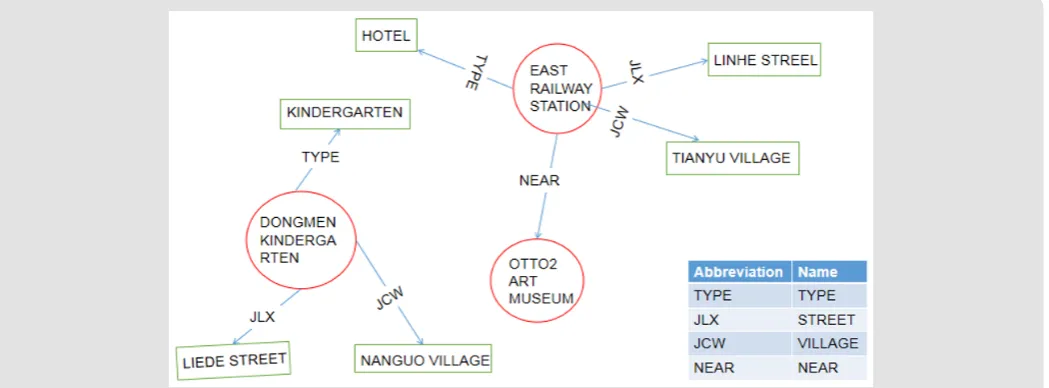
(East railway station,Type,Hotel) (East railway station,Jcw,Tianyu village)
(East railway station,Jlx,Linhe street) (East railway station,Near,Ott2 art museum)
TransE Model
Bordes et al. First proposed the TransE model in 2013. Based
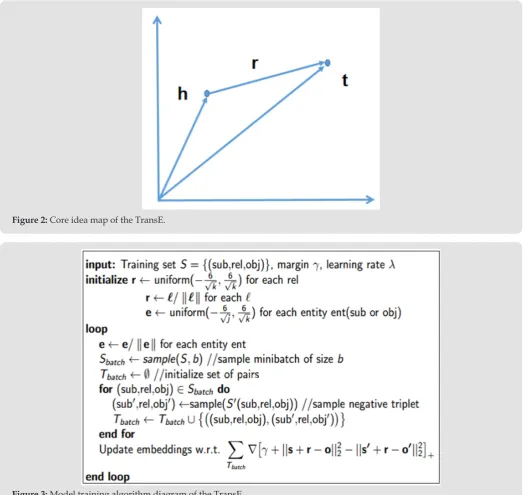
on the distributed vector representation of entities and relation-ships, consider the relationship r in each triple instance (head, re-lation, tail) as a translation from the head entity h to the tail entity t, by continuously adjusting h, r, and t, Make (h + r) as equal to t as possible to achieve the purpose of learning. The core idea is shown in Figures 1 & 2, that is, when (h, r, t) is true, there should be h + r
≈ t. Based on the core idea of the TransE model, we imagine that
for a correct real triple, there exists (h + r) between the embedding
of the entity and the relationship, which is infinitely close to t, and
the wrong negative triple should exist (h + r) away t, so a scoring
function is defined for the triple in the experiment, that is, the ra -tionality is measured by the L1 or L2 distance of the difference be-tween the vector of the head entity h and the relationship r and the
vector of the tail entity t. The score function of TransE is As shown
in formula (3-1), for a correct triple, the lower the score, the better, and for a wrong triple, the higher the score, the better. Train the model to distinguish between positive and negative samples. From this, we can get the hinge-based hinge loss function as shown in formula (3-2).
( )
1 2,
r L
L
f h t
=
h r t
+ −
(3-1)∑ ∑
∈ ∈ +
−
+
=
S t r
h h rt S r r
t
h
f
t
h
f
L
) , ,
( ( ', , )' '
)]'
,'
(
)
,
(
[
γ
(3-2)
among them
[ ]
x+Indicates that x is greater than 0 and theorig-inal value, and less than 0 is 0.
γ
Represents the hyperparameter margin used to distinguish positive and negative triples, this article takes 1;S
Represents the set of positive triples,S
'Represents theset of negative triples where the head or tail entities are randomly
replaced. The TransE model training algorithm is shown in Figure
3.
Figure 2: Core idea map of the TransE.
Figure 3: Model training algorithm diagram of the TransE.
TransH Model
The TransE model, as the originator of the translation model,
has the advantages of fewer parameters and low computational complexity.However, it has defects in handling non-one-to-one
rela-tionships, so subsequent scholars have improved the TransE mod -el and even proposed it in 2014. TransH mod-el proposed by Wang
Z and other scholars [20]. In order to solve the problem that the model needs to assign different relationship vectors when dealing
with different relationships, TransH defines a hyperplane for each
the hyperplane along the normal vector w and translated on the hyperplane. The core idea is shown in Figure 4, where The scoring function is shown in formula (3-3).
2 1
||
)
(
)
(
||
)
,
(
L L r T r r
T r
r
h
t
h
w
hw
r
t
w
tw
f
=
−
+
−
−
(3-3)Different from the construction of TransE negative triples,
TransH uses Bernoulli negative sampling to construct negative tri-ples. In actual cases, the head and tail entities corresponding to the relationship are imbalanced, that is, there is a non-one-to-one Rela-tionship, so it is not reasonable to use random negative sampling to replace head and tail entities. Therefore, a negative sampling meth-od based on probability is designed in TransH: if the relationship is
one-to-many, the head entity is replaced with a larger probability, and if the relationship is many-to-one, the tail entity is replaced with a larger probability. First, the average number of tail entities for each head entity needs to be counted in all triples, recorded as
tph
, The average number of head entities per tail entity, recorded as hpt, Define a Bernoulli distribution with sampling parametersas shown in formula (3-4). During training, we will use P X
(
=1)
To construct negative triples by replacing the head entity with the probability of x, and construct negative triples by replacing the tail entity with the probability of P X
(
=0)
.hpt tph
tph X
P X
P
+ − = = − =
=0) 1 ( 1) 1
( (3-4)
Figure 4: Core idea map of the TransH.
Experiments and Discussion
Experimental Data
The research area selected Tianhe District, Guangzhou, with a total of 118,807 POI information points. Data including address name (semantic address) and address the latitude and longitude (address space), in accordance with the address hierarchy, from the
smallest administrative unit in the village, the hierarchical struc-ture of the minimum network unit street road lane to address data partitioning entities and semantic relations, with 50m apart design are neighboring spatial relations, the resulting article 1658378 tri-ples, addresses the knowledge graph construction see Figure 5, the processed data and relevant training data as shown in Tables 3 & 4.
Table 3: Data Scale.
Type Entity Relationship
street village poi rel street rel village rel near
number 40 206 118,807 118,807 118,807 1,183,155
Table 4: Show of Data.
Name of address Latitude and longitude Village Street Type
East railway station 113.332623,23.151036 TIANYU village LINHE street Hotel DONGMEN kindergarten 113.351873,23.118637 NANGUO village LIEDE street Kindergarten
OTT2 art museum 113.337562,23.150034 TIANYU village LINHE street Museum
Experimental Design
The triples are input according to the data format required by
TransE and TransH, and the training rate is 0.01 according to the
stochastic gradient descent, with a margin of 1, a batch of 5000, and
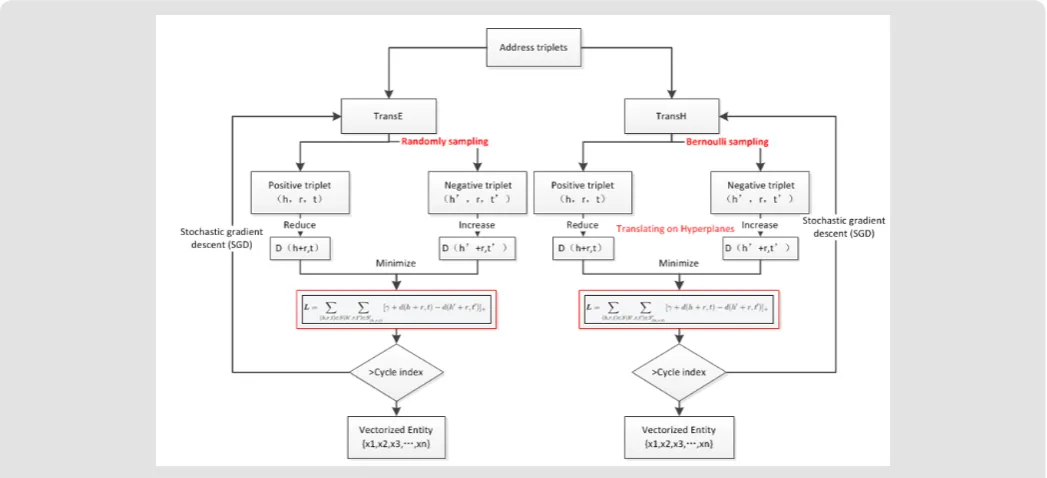
a dimension k of 128. The number of iterations is limited to 2000 for training, and the loss is reduced from 20 to 0.1, the training
pro-cess is shown in Figure 6, and the models of TransE and TransH are obtained, based on which triple classification and distance evalua -tion are performed.
Figure 6: Model training flow map of TransE and TransH.
Experimental Methods
The goal of this research are extracted from knowledge base
ad-dress space adad-dress triples data sets, respectively using TransE and
TransH training, get entities to quantify, respectively, according to the distance between the entities vector to compare the two models address the merits of the triple data set in the space, by selecting test samples respectively space distance, entity semantic similari-ty computing entities and entisimilari-ty vector, the distance between the
experiments are verified through the comparison and analysis to
solve with the problem of spatial relations and semantics relations. 1) TransE Model Experiment and Partial Code Imple-mentation
In this experiment, the serialized entities, relationships and
training samples were firstly read in memory. During the training,
loss of positive and negative triples were calculated for each epoch,
each batch and each sample, and model embedding was updated
through stochastic gradient descent to generate model files. The python code of the calculation diagram of TransE in Tensorflow is
as follows:
def build_graph_TransE(self):
self.headEntityVector=tf.placeholder(tf.int32,[None],name=”
-headEntityVector”)
self.tailEntityVector=tf.placeholder(tf.int32,[None],name=”tai
-lEntityVector”)
self.relationVector=tf.placeholder(tf.int32,[None],name=”rela
-tionVector”)
self.tailEntityVectorWithCorruptedTriplet=tf.placeholder(tf.in
-t32,[None],name=”tailEntityVectorWithCorruptedTriplet”) headEntityVector_embedding=tf.nn.embedding_lookup(self. embedding,self.headEntityVector)
tailEntityVector_embedding=tf.nn.embedding_lookup(self.em
-bedding,self.tailEntityVector)
relationVector_embedding=tf.nn.embedding_lokup(self.em
-bedding,self.relationVector)
headEntityVectorWithCorruptedTriplet_embedding=tf.nn.em
-bedding_lokup(self.embedding,self.headEntityVectorWithCor -ruptedTriplet)
tailEntityVectorWithCorruptedTriplet_embedding=tf.nn.em
-bedding_lokup(self.embedding,self.tailEntityVectorWithCor -ruptedTriplet)
headtailrel=tf.subtract(tf.add(headEntityVector_embed
-ding,relationVector_embedding),tailEntityVector_embedding) headtail_corrupted=tf.subtract(tf.add(headEntityVectorWith
-CorruptedTriplet_embedding,relationVector_embedding),tai
-lEntityVectorWithCorruptedTriplet_embedding)
headtailrel_square_sum=tf.reduce_sum(tf.pow(headtail -rel,2),1)
headtailrel_corrupted_square_sum=tf.reduce_sum(tf.pow( -headtailrel_corrupted,2),1)
headtailrel_loss=tf.subtract(headtailrel_square_sum,headtail -rel_corrupted_square_sum)
loss=tf.add(headtailrel_loss,self.ones) loss_max=tf.nn.relu(loss)
loss_v=tf.reduce_mean(loss_max) optimizer=tf.train.AdamOptimizer(0.01) train_op=optimizer.minimize(loss_v)
returnatrain_op,loss_v,headEntityVector_embedding,tailEnti
-tyVector_embedding,headEntityVectorWithCorruptedTriplet_em
-bedding,tailEntityVectorWithCorruptedTriplet_embedding,rela
-tionVector_embedding
2) TransH Model Experiment and Code Implementation
The algorithm calculation process of TransE and TransH is sim -ilar, except that in the model training process, a plane embedded vector w needs to be designed. When calculating positive and nega-tive triples of different samples, the head and tail entity vectors pro-jected on the plane w are used to calculate the loss, and Bernoulli sampling method is required for the design of negative triples. The
python code of the calculation diagram of TransH in Tensorflow is
as follows:
def build_graph_TransE(self):
_w=tf.get_variable(name=“w”, shape=[128,1] , dtype=tf.float32) w=tf.nn.l2_normalize(_w , name=“L2_normalize_w”)
self.headEntityVector=tf.placeholder(tf.int32,[None],name=”
-headEntityVector”)
self.tailEntityVector=tf.placeholder(tf.int32,[None],name=”tai
-lEntityVector”)
self.relationVector=tf.placeholder(tf.int32,[None],name=”rela
-tionVector”)
self.ones=tf.placeholder(tf.float32,[None],name=”one”) self.headEntityVectorWithCorruptedTriplet=tf.placeholder(tf. int32,[None],name=”headEntityVectorWithCorruptedTriplet”) self.tailEntityVectorWithCorruptedTriplet=tf.placeholder(tf.in
-t32,[None],name=”tailEntityVectorWithCorruptedTriplet”) headEntityVector_embedding=tf.nn.embedding_lookup(self. embedding,self.headEntityVector)
tailEntityVector_embedding=tf.nn.embedding_lookup(self.em
-bedding,self.tailEntityVector)
relationVector_embedding=tf.nn.embedding_lokup(self.em
-bedding,self.relationVector)
headEntityVectorWithCorruptedTriplet_embedding=tf.nn.em
-bedding_lokup(self.embedding,self.headEntityVectorWithCor -ruptedTriplet)
tailEntityVectorWithCorruptedTriplet_embedding=tf.nn.em
-bedding_lokup(self.embedding,self.tailEntityVectorWithCor -ruptedTriplet)
headEntityVector_embedding_w=tf.matmul(tf.matmul(head
-EntityVector_embedding,w),tf.transpose(w))
tailEntityVector_embedding_w=tf.matmul(tf.matmul(tailEnti
-tyVector_embedding,w),tf.transpose(w))
headEntityVectorWithCorruptedTriplet_embedding_w=tf.mat
-mul(tf.matmul(headEntityVectorWithCorruptedTriplet_em -bedding,w),tf.transpose(w))
tailEntityVectorWithCorruptedTriplet_embedding_w=tf.mat
-mul(tf.matmul(tailEntityVectorWithCorruptedTriplet_embed -ding,w),tf.transpose(w))
headtailrel=tf.subtract(tf.add(headEntityVector_embed
-ding-headEntityVector_embedding_w,relationVector_embed
-ding),tailEntityVector_embedding-tailEntityVector_embed -ding_w)
headtail_corrupted=tf.subtract(tf.add(headEntityVectorWith
-CorruptedTriplet_embedding-headEntityVectorWithCorrupt
-tyVectorWithCorruptedTriplet_embedding-,tailEntityVector -WithCorruptedTriplet_embedding_w)
headtailrel_square_sum=tf.reduce_sum(tf.pow(headtail -rel,2),1)
headtailrel_corrupted_square_sum=tf.reduce_sum(tf.pow( -headtailrel_corrupted,2),1)
headtailrel_loss=tf.subtract(headtailrel_square_sum,headtail -rel_corrupted_square_sum)
loss=tf.add(headtailrel_loss,self.ones) loss_max=tf.nn.relu(loss)
loss_v=tf.reduce_mean(loss_max) optimizer=tf.train.AdamOptimizer(0.01) train_op=optimizer.minimize(loss_v)
returnatrain_op,loss_v,headEntityVector_embedding,tailEnti
-tyVector_embedding,headEntityVectorWithCorruptedTriplet_em
-bedding,tailEntityVectorWithCorruptedTriplet_embedding,rela
-tionVector_embedding
3) The Python Code for Constructing TransE’s Negative Triples is as Follows:
def getCorruptedTriplet(self,triplet):
i=uniform(-1,1)
if i<0: while True:
entityTemp = sample(self.entityList,1)[0]
if(entityTemp,triplet[1],triplet[2]) not in self.filter:
break
corruptedTriplet = (entityTemp,triplet[1],triplet[2])
else: while True:
entityTemp = sample(self.entityList,1)[0] if(triplet[0],entityTemp,triple[2]) not in self.filter:
break
corruptedTriplet = (triplet[0],entityTemp,triplet[2])
return corruptedTriplet
4) The Python Code for Constructing TransH’s Negative Triples is as Follows:
def getCorruptedTriplet(self,triplet):
i=uniform(0,31)
if i<13: while True:
entityTemp = sample(self.entityList,1)[0]
if(entityTemp,triplet[1],triplet[2]) not in self.filter:
break
corruptedTriplet = (entityTemp,triplet[1],triplet[2])
else: while True:
entityTemp = sample(self.entityList,1)[0] if(triplet[0],entityTemp,triple[2]) not in self.filter:
break
corruptedTriplet = (triplet[0],entityTemp,triplet[2])
return corruptedTriplet
Compare the advantages and disadvantages of the two; Because the data set selected in this experiment is a spatial address trip-let, it cannot be inferred from the existing knowledge.For example, the a and b addresses are in a proximity relationship, and the b and c addresses are in a proximity relationship. Prove that a and c addresses are also adjacent, so this experiment does not choose link prediction and text relationship fact extraction as evaluation methods. Considering that in addition to semantic relationships, it also includes spatial distance relationships, so we choose triple
classification and distance between vectors. Evaluation as a model
evaluation method.
Triple classification
Triple classification refers to determining whether a given tri -ple (h, r, t) belongs to the correct tri-ple, which is essentially a binary
classification task. For example, given a triple (East railway station,
Near, Otto2 art museum), to determine whether the triple is correct by calculating whether the distance between the head entity vector plus the relationship vector and the tail entity vector is less than the threshold (the threshold size is determined by the validation set). By randomly selecting 1,000 triples to Construct the test data set
and get the classification accuracy of TransE and TransH, as shown
in Table 5. It is found that TransH (88.5%) is indeed better than
TransE (71.7%) in terms of triple classification accuracy. There are
many non-one-to-one relationships in the set.Therefore, TransH, which introduces hyperplane projection, performs better in the
tri-ple classification task of Chinese address data sets, indicating that
Table 5: Accuracy of triplets classification.
Model TransE TransH
Accuracy of triplets classification 71.7% 88.5%
Distance evaluation
Distance evaluation refers to the calculation of the distance be-tween the head entity vector plus the relationship vector and the tail entity vector in different models of the positive trigram and the negative trigram in different models, and according to the mech-anism trained by the translation model (i.e., reducing the positive triad The distance between h + r and t in the group and the distance between h + r and t in the negative triad are increased) to
evalu-ate the model’s pros and cons. The verification set of positive and
negative triples was constructed by 1:1 relationship, and the vector
distances in TransE and TransH were calculated, respectively. The
results are shown in Table 6.TransH can be found in cases of triples
(0.525) model is superior to the vector distance TransE (0.531), but in a negative example triples TransE on the vector distance (1.388)
is superior to TransH (1.379), the difference of the two data point of
view, TransE(0.857) is slightly better than TransH (0.854), showed that TransE and TransH two models in a single triples vector dis -tance between training situation is similar, and do not have too big discrepancy, however, Select the same three address entities to dis-play the results, as shown in Figures 7 & 8.
Table 6: Distance between triple vector.
Model TransE TransH
Distance of positive triple vector(h+r-t) 0.531 0.525 Distance of negetion triple vector(h’+r-t’) 1.388 1.379 Difference of positive and negative 0.857 0.854
Figure 7: Entity distance map of the TransE.
In the algorithm model, both TransE and TransH, the distance
between two entities with a relationship is indeed much closer than the distance between two entities without a relationship, For
exam-ple, (East railway station, Otto2 art museum, 0.545 / 0.533) is much smaller than (East railway station, Dongmen kindergarten, 1.414 /
1.335) .However, it can be found from Figure 8 that in the TransH algorithm model, the neighbors describing the spatial distance are described. The distance between the relationship vector entities is better than other vector entity distances describing semantic
rela-tionships.For example, the (East railway station, Dongmen kinder -garten, 1.335) without adjacent relations is greater than the (Hotel,
Kindergarten, 1.235), (East railway station, Kindergarten, 1.141),
(Otto2 art museum, Nanguo village, 1.173), (Otto2 art museum,
Lie-de street, 1.224), while the neighboring relationship (East railway station, Otto2 art museum, 0.533) is less than (East railway station,
Hotel, 0.613), (Otto2 art museum, Tianyu village, 0.552), etc., but
this situation is not obvious in the TransE algorithm model, such as the existence of proximity (East railway station, Otto2 art muse
-um, 0.545) less than (East railway station, Linhe street, 0.613), but
greater than (Otto2 art museum, Tianyu village, 0.513), it can be
speculated that TransH is more focused on complexity than TransE.
Modeling the relationship, it can be found from Tables 1 & 2 that the number of neighboring relationships in the address triples data set is much larger than several other semantic relationships. The spa-tial relationship is more complex than the semantic relationship, so it performs better in the TransH algorithm model.
The Experimental Summary
It can be seen from the results of the above triple classification
and vector distance evaluation that the TransH model is superior to
the TransE model, so the training results of the TransH model are
selected as the quantitative standard to evaluate the inconsisten-cies in the semantic and spatial similarity of traditional ical entities to be solved in this study. Two groups of six geograph-ical entities were selected, (Taipingyang computer city, Bainaohui
computer city, Yidong computer city) and (Huoju building, Renfeng building, Modeng store), replace with A, B, C, D, E, F, by latitude and longitude respectively calculate the linear distance of A and B,L (AB) is 0.1km, L (AC) is 0.2km, L (DE) is 0.2km, L (DF) is 0.5 km,
entities vector is obtained by TransH training respectively calculate
the distance between A and B of the vector,V (AB) is 1.131, V (AC) is 0.551, V (DE) is 1.312,V (DF) is 0.571, according to the geographical
entity semantic similarity computation, considering the geographic
entity for short text, so choose relatively simple and efficient cosine
similarity calculation method, to calculate the semantic similarity
of A and B, S (AB) is 0.67, S (AC) is 0.58, S (DE) is 0.5, S (DF) is zero, thus it can be seen that the V (AC) is less than V (AB), on the basis of
fully consider the semantic and the spatial relationship, the TransH
model considers the A is more similar than the C, Although L (AB) on the space distance is less than L (AC), but A and C belong to day
henan street, B belongs to huashi street, semantic relationship of
similar degree higher than similar degree in the spatial relations, conforms to the characteristics of semantic similarity space
dis-tance don’t close, V (DF) is less than V (DE), on the basis of fully con -sider the semantic and the spatial relationship, TransH model think D entities and F more similar to the entity, though on the semantic
relation S (DE) is greater than the S (DF), D, E, F belong to huashi street, but L (DF) is less than L (DE), the closer distance, There will
also be more similar proximity around geographical entities, so it can be assumed that D is more similar to F, conforms to the
charac-teristics of near space distance but not similar semantic. Above all,
in the process of entity training, the model of representation learn-ing combines the semantic relationship and spatial relationship of entities, which can solve the problem that the semantic and spatial inconsistency may exist when geographical entities represent geo-graphical objects.
Conclusion
Based on the research of the TransE and TransH models, this
paper collects the spatial address data of Tianhe District and ex-tracts the spatial address triples. Based on the characteristics of the spatial address data set containing both semantic relationships and spatial relationships, the semantics of the spatial address triples are designed. The introduction of spatial and spatial relationships and spatial relationships makes up for the traditional method of calculating the similarity of two address entities based on address semantic relationships only, ignoring the shortcomings of seman-tically similar addresses that are not necessarily close in spatial
distance.Through the TransE and TransH models, respectively Perform training, perform triple classification on the data set, and
evaluate the distance between vectors, verify the knowledge rep-resentation learning capabilities of the two translation models on
the spatial address data set, and confirm that TransH is performing
in the spatial address triple data set. When representing learning tasks of complex (non-one-to-one) relationship triples, the learning
effect is better than TransE.
It can effectively solve the difficulties of TransE’s modeling of
complex relationships such as one-to-many, many-to-one, and ma-ny-to-many.TransH not only weighs and balances The complexity of the model and the ability to express the model are also designed, and Bernoulli sampling is also designed to better conform to the average entity at the head and tail of the data set. The method of constructing negative triples with inconsistent number character-istics makes the training of the model more reasonable and effec-tive. The combination of semantic relationship and spatial relation-ship can solve the problem of semantic and spatial inconsistency in the representation of geographical entities. The introduction of spatial relationships in the data set will also greatly enrich the com-plex relationships in the geographic knowledge graph and dig out
more valuable geographic information. At the same time, the use
in Chinese datasets, and also help us better perform text semantic research on Chinese texts, and facilitate the transformation of re-search results.
References
1. Li Deren, Shao Zhenfeng (2009) On the New Era of Geographic Information [J]. Chinese Science (Series F: Information Science) 06: 3-11. 2. Gong Jianya, Wang Guoliang (2013) From Digital City to Smart City: New
Challenges Facing Geographic Information Technology [j]. Geomatics for Surveying and Mapping 38(2): 1-6.
3. Pujara J, Miao H, Getoor L, William Cohen (2013) Knowledge Graph Identification[C].International Semantic Web Conference. Springer Berlin Heidelberg. pp. 542-557.
4. Huang Hengqi, Yu Juan, Liao Xiao, Review of Knowledge Graph Research [J]. Journal of Computer System Applications 28 (6).
5. Jiang Bingchuan, Wan Gang, Xu Jian (2018) Large-scale geographic knowledge map construction of multi-source heterogeneous data [J]. Journal of Surveying and Mapping 8: 1051-1061.
6. Zhang Chunju, Zhang Xueying, Wang Shu (2016) Temporal and Spatial Information Labeling of Events in Chinese Texts [J]. Journal of Chinese Information Processing 30(3): 213-222.
7. Zhang Xueying, Zhang Chunju, Zhu Shaonan (2012) Geospatial Relation Annotation of Chinese Texts [j]. Journal of Surveying and Mapping 03: 156-162.
8. Wang Jibu, Lu Feng, Wu Sheng (2018) Construction method of geographic entity relation corpus based on automatic back-marking [J]. Journal of Geo-Information Science 20(131): 5-13.
9. Gao Jialiang, Yu Li, Qiu Peiyuan (2019) An Open Relation Filtering Method for Geographic Entities Based on General Knowledge Base [J]. Journal of Geo-Information Science 21(9).
10. Lu Feng, Yu Li, Peng Peng, A Keyword Extraction Method and Device Containing Geographic Entity Relations [J]. Journal of Geo-Information Science.
11. Chen Jun, Liu Wanzeng, Wu Hao (2019) Basic problems and research directions of basic geographic knowledge services [J]. Journal of Wuhan University (Information Science Edition) 44(01): 41-50.
12. Jiang Bingchuan, Tan Liheng, Ren Yan, Li Feng (2019) Intelligent Interaction with Virtual Geographical Environments Based on Geographic Knowledge Graph. ISPRS International Journal of Geo-Information 8(10): 428.
13. Qian Tieyun, Liu Bei, Hung Nguyen, Yin Hongzhi (2019) Spatiotemporal Representation Learning for Translation-Based POI Recommendation. ACM Transactions on Information Systems 37(2): 1-24.
14. Zuheros C, Tabik S, Valdivia A (2019) Deep recurrent neural network for geographical entities disambiguation on social media data. Knowledge-Based Systems 173: 117-127.
15. Li Yongfang Research on Knowledge Graph Oriented Representation Learning [d].
16. Bengio Y, Courville A, Vincent P (2013) Representation Learning: A Review and New Perspectives. IEEE Transactions on Pattern Analysis and Machine Intelligence 35(8): 1798-1828.
17. Jiang Tianwen, Qin Bing, Liu Ting (2018) Open Domain Chinese Knowledge Reasoning Based on Representation Learning. Journal of Chinese Information Processing 32(3): 34-41.
18. Bordes A, Glorot X, Weston J, Yoshua Bengio (2014) A semantic matching energy function for learning with multi-relational data. Machine Learning 94(2): 233-259.
19. Socher R, Chen D, Manning CD, Andrew Y Ng (2013) Reasoning With Neural Tensor Networks for Knowledge Base Completion. International Conference on Neural Information Processing Systems. Curran Associates Inc.
20. Wang Z, Zhang J, Feng J, Zheng Chen (2014) Knowledge Graph Embedding by Translating on Hyperplanes. Twenty-eighth Aaai Conference on Artificial Intelligence. AAAI Press.
21. Lin H, Liu Y, Wang W, YinliangYue, ZhengLin (2017) Learning Entity and Relation Embeddings for Knowledge Resolution. Procedia Computer Science 108: 345-354.
22. Minervini P, Fanizzi N, D’Amato C, Floriana Esposito (2015) Scalable Learning of Entity and Predicate Embeddings for Knowledge Graph Completion. 2015 IEEE 14th International Conference on Machine Learning and Applications (ICMLA). IEEE.
23. Peiyuan Qiu, Jialiang Gao, Li Yu, Feng Lu (2019) Knowledge Embedding with Geospatial Distance Restriction for Geographic Knowledge Graph Completion [J]. International Journal of Geo-Information 8(6): 254. 24. Tan Z, Zhao X, Fang Y, Weidong Xiao (2018) GTrans: Generic Knowledge
Graph Embedding via Multi-State Entities and Dynamic Relation Spaces. IEEE Access 6: 8232-8244.
25. Zhang Zhao, Ji Jianmin, Chen Xiaoping (2019) Adversarial negative sample generation for knowledge representation learning. Journal of Computer Applications.
26. Wang Baokui, Wu Lin, Hu Xiaofeng, He Xiaoyuan (2019) Knowledge Representation of Joint Combat Situations Based on Knowledge Graph [j] .Journal of System Simulation 31(11): 2228-2237.
27. Jin Jin (2018) Research on knowledge graph representation learning based on deep learning and entity description [d] .Beijing Jiaotong University.
28. Winston PH (2017) On Computing Machinery and Intelligence. Philosophical Explorations of the Legacy of Alan Turing. Springer International Publishing.
29. Cheng b, li w h, tong h x (2019) bilstm-crf based hierarchical address segmentation in Chinese [J]. Journal of geosciences 21(8): 1143-1151.
Submission Link: https://biomedres.us/submit-manuscript.php
Assets of Publishing with us
• Global archiving of articles
• Immediate, unrestricted online access • Rigorous Peer Review Process • Authors Retain Copyrights
• Unique DOI for all articles
https://biomedres.us/ This work is licensed under Creative
Commons Attribution 4.0 License