An Unsupervised Multi-Document Summarization Framework
Based on Neural Document Model
Shulei Ma Zhi-Hong Deng∗
Key Laboratory of Machine Perception (Ministry of Education) School of Electronics Engineering and Computer Science
Peking University, Beijing 100871, China
[email protected], zhdeng@cis,pku.edu.cn [email protected]
Yunlun Yang
Abstract
In the age of information exploding, multi-document summarization is attracting particular atten-tion for the ability to help people get the main ideas in a short time. Tradiatten-tional extractive meth-ods simply treat the document set as a group of sentences while ignoring the global semantics of the documents. Meanwhile, neural document model is effective on representing the semantic content of documents in low-dimensional vectors. In this paper, we propose a document-level reconstruction framework namedDocRebuild, which reconstructs the documents with summary sentences through a neural document model and selects summary sentences to minimize the re-construction error. We also apply two strategies, sentence filtering and beamsearch, to improve the performance of our method. Experimental results on the benchmark datasets DUC 2006 and DUC 2007 show thatDocRebuildis effective and outperforms the state-of-the-art unsupervised algorithms.
1 Introduction
Multi-document summarization aims at capturing the important information of a set of documents related to the same topic and presenting it in a brief, representative, and pertinent summary. Most existing re-searches focus on extraction-based methods, in which sentences are selected from the original document set.
Typically, two kinds of unsupervised models are used for sentence selection. One is based on sentence ranking, which uses methods such as clustering (Lin and Hovy, 2002; Radev et al., 2004), PageRank (Erkan and Radev, 2004; Mihalcea and Tarau, 2005) and topic modeling (Harabagiu and Lacatusu, 2005; Wang et al., 2008), to rank the sentences. Considering that top-ranked sentences tend to convey much redundant information, additional strategies are usually applied to reduce redundancy when selecting sentences. This kind of methods usually need to weigh between relevance and redundancy, which may be hard to balance.
The other is based on sparse reconstruction (He et al., 2012; Liu et al., 2015; Yao et al., 2015), which selects a sparse subset of the sentences that can linearly reconstruct all the sentences in the original document set. This kind of methods has a good motivation but also weaknesses in their hypothesises. First, reconstructing single sentences may lose the global information of documents; Second, there are more reasonable ways than linear combination in reconstruction.
Commonly, in the above methods the document set is treated as a set of sentences and all the operations are carried out on the sentence set, losing the global information of documents. Meanwhile, neural document model (Le and Mikolov, 2014; Li et al., 2015; Lin et al., 2015) is an emerging technique which has made significant progress in capturing semantic information of documents by projecting the text into the low-dimensional continuous distributed representation. It has been applied to natural language processing tasks such as sentiment classification (Tang et al., 2015).
∗Zhi-Hong Deng is the corresponding author.
This work is licenced under a Creative Commons Attribution 4.0 International License. License details: http:// creativecommons.org/licenses/by/4.0/
In this paper, we address the aforementioned problems of existing methods and propose a document-level reconstruction framework based on neural document model, named DocRebuild, for multi-document summarization.
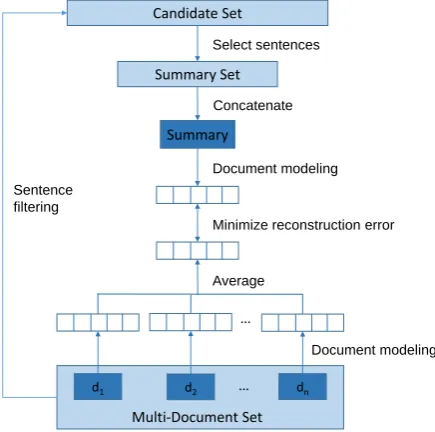
Intuitively, a good summary is supposed to reconstruct the main content of the multi-document set. In our model, we first introduce neural document model to represent the content of each document and use averaging to obtain the main content of the document set. The main content is reconstructed by concatenating the summary sentences into a sequence and feeding the summary sequence into the document model. Hence the multi-document summarization is converted into an optimization problem via taking the reconstruction error as the objective function. Summary sentences are selected to minimize this error. Furthermore, two strategies are addressed in selecting sentence to yield a better performance. First, irrelevant sentences are filtered and only a subset of related sentences is reserved as candidate set. Second, a beamsearch algorithm is applied to get a better solution in sentence selection stage.
Our contributions can be concluded as follows:
• We introduce neural document model into multi-document summarization task. As far as we know, no such works have been presented before.
• We propose a document-level reconstruction frameworkDocRebuild, and further adopt two effec-tive strategies to improve the performance of our method.
• The experimental results on two benchmark DUC data sets show that our method outperforms the state-of-the-art unsupervised approaches.
2 Related Work
Multi-document summarization has received widespread attention in recent years. Most existing multi-document systems use extraction-based methods, in which sentences are directly selected from the orig-inal document set.
The majority of these methods use the idea of sentence-ranking, assigning salient scores to sentences of the original document set and choosing the top sentences to form the summary. Typical methods are the centroid-based methods (Lin and Hovy, 2002; Radev et al., 2004), which score sentences basing on features such as cluster centroids, sentence position and TF-IDF. Besides, graph based models (Erkan and Radev, 2004; Mihalcea and Tarau, 2005) first measure the sentence similarity then use ranking al-gorithm such as PageRank on the similarity graph to estimate the importance of different sentences. Topics in documents are also discovered to be an effective feature for sentence ranking (Hardy et al., 2002; Harabagiu and Lacatusu, 2005; Wang et al., 2008). Maximum Marginal Relevance (MMR) (Gold-stein et al., 1999) is widely used for greedily selecting sentences while considering the tradeoff between relevance and redundancy.
However, it is usually hard to get a good balance between relevance and redundancy. Recently, a cou-ple of works have employed the idea of data reconstruction in the summarization task. DSDR (He et al., 2012) reconstructs each sentence in the document set by a non-negative linear combination of summary sentences then minimizes the reconstruction error. MDS-Sparse (Liu et al., 2015) introduces the diver-sity constraint and proposes a two-level sparse representation model to reconstruct the sentences in the document set. SpOpt (Yao et al., 2015) follows the sparse representation framework while simultaneous-ly doing sentence selection and compression by adjusting reconstruction coefficients and compression coefficients alternately in optimization.
However, few such researches have been reported on document level in multi-document summarization task.
3 Proposed Framework
We propose our framework DocRebuild in this section. The neural document model is introduced in Section 3.1, the objective function is formulated in Section 3.2, and summary sentences are selected with two effective strategies as shown in Section 3.3. Figure 1 illustrates the framework ofDocRebuild.
d1 d2 dn
Select sentences
… … Candidate Set
Multi-Document Set Summary Set
Average
Document modeling
Document modeling
Summary
Concatenate
Sentence filtering
[image:3.595.189.407.187.403.2]Minimize reconstruction error
Figure 1: The framework ofDocRebuild. Light blue boxes represent the sets of documents or sentences, deep blue boxes represent the document or summary sequences. Document modeling process projects document or summary sequences into real-valued vectors as represented by the bars.
3.1 Neural Document Model
Neural document model aims to represent the semantic content of a document with low-dimensional vector representation. As the basis of our framework, it is the key to a good performance. Here we focus on the unsupervised methods and exploit two kinds of unsupervised document models, named Bag-of-Words(BoW) model and Paragraph Vector(PV) model respectively, in our task.
In the BoW model, we simply use the bag-of-words of the document without considering the original order or relationships between neighboring words. Word embedding(Mikolov et al., 2013) has been proven of great significance in most natural language processing tasks in recent years. So we represent each word by its corresponding word embedding and the document is represented as the weighted average of all the words in the document.
Since BoW model is likely to lose the semantic information hidden in the order and composition of words, we introduce a more complex model which takes word order into consideration. PV (Le and Mikolov, 2014) is an unsupervised framework that learns distributed representations for sentences and documents. Compared with other hierarchical document models (Li et al., 2015; Lin et al., 2015) built upon sentences, PV handles texts with various length in a common way, making it possible to measure sentences, short summaries and long documents in the same semantic space.
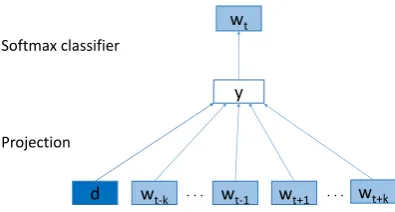
Figure 2 illustrates the framework of PV model. In this model, every document is mapped to a unique vector, as a column in matrixD ∈ Rn×l and every word is mapped to a unique vector, as a column in
matrixW ∈ Rm×l. n, m, lrepresent document set size, vocabulary size and dimensionality of vector,
d wt-k . . . wt-1 wt+1 . . . wt+k y
wt
[image:4.595.199.397.63.169.2]Projection Softmax classifier
Figure 2: The framework of PV model
It employs a similar idea as the one in Mikolov et al. (2013), to predict the next word given many contexts sampled from the document. More precisely, given a documentdconsisting of a sequence of wordsw1, w2, . . . , wT and the fixed window sizekof context, the objective of PV model is to maximize
the log-likelihood,
L=XT
t=1
logP(wt|wt−k:wt+k, d) (1)
Note that wt−k : wt+k represents the word sequence from wt−k to wt+k except wt. The probability
P(wt|wt−k:wt+k, d)is defined using the softmax,
P(wt|wt−k:wt+k, d) = e ywt
Pm
i=1eywi (2)
y∈Rmrepresents un-normalized log probability for all the possible words in vocabulary, computed as,
y=Uh(wt−k :wt+k, d) +b (3)
whereU ∈ Rm×l, b ∈ Rm are the parameters of softmax classifier andh stands for the averaging of
document vector and word vectors extracted fromDandW.
During training, parametersD, W, U, bare randomly initialized and then updated to maximize equa-tion (1) using stochastic gradient descent via backpropagaequa-tion. Once the model is trained, it can further be employed in predicting representations of the documents not included in the training set.
At inference stage, a new document is fed into the PV model to do the same prediction task as the training documents. But this time only the document vectordis randomly initialized while other pa-rametersW, U, bare fixed. Then we update the document vectordto maximize equation (1) by gradient descent as well. After convergence,dis taken as the corresponding document vector.
3.2 Objective Function
We denote themulti-document setasD={d1, d2, . . . , dn}. All the documents inDare processed into
a group of sentences, defined as thecandidate setand denoted asC ={s1, s2, . . . , sm}. The sentences
selected fromSform thesummary set, denoted asS ={s∗
1, s∗2, . . . , s∗l}, whereS ⊂Cand|S| |C|.
Note that all the elements in the above sets are sequences of words. Letθdenote the required summary length, our task is to select the optimal subset of candidate setCthat composes summary shorter thanθ. We consider the multi-document summarization task as a data reconstruction problem. We assume that a good multi-document summary is supposed to reconstruct the main content of the document set. Therefore we focus on two issues: (1) how to represent the main content of the document set, and (2) how to use the summary set to reconstruct the main content. In this work, both issues are resolved by document modeling.
0.4 0.3 0.2 0.1 0.0 0.1 0.2 0.3 0.4 0.4
[image:5.595.185.396.67.231.2]0.3 0.2 0.1 0.0 0.1 0.2 0.3 0.4
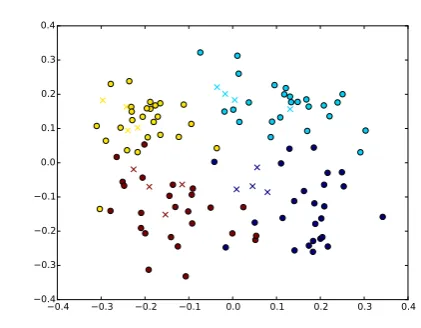
Figure 3: Visualization of document vectors and summary vectors. Documents are represented by circles and summaries are represented by crosses.
summaries, and we find that the centre of summary vectors are close to the centre of document vectors in the same color, implying the effectiveness of averaging.
Hence in our model, each document in the document set is mapped into a vector through document model, then the document vectors are averaged to represent the main content. As for the summary set, all the sentences inSare sequentially concatenated into a sequenceS∗ as the corresponding summary.
Then the summary sequence S∗ can be seen as a short document and fed into the document model
to reconstruct the main content. Naturally, reconstruction error is applied as objective function and measured by distance between the summary vector and the main content vector. Summary set S is adjusted to minimize the reconstruction error.
Provided that the document modeling process is represented byDM, it takes a document or summay xas input and obtains the semantical vector representation ofx, denoted asDM(x). Our reconstruction model is formalized as follows:
min
S⊂C kDM(S ∗)− 1
n
n
X
i=1
DM(di)k22 (4)
s.t. len(S∗)≤θ
Where S∗ denotes the corresponding summary sequence of summary setS and len(S∗) denotes the
length of the summary sequence.
Our formulation is similar to the intuition behind He et al. (2012), but differs from it mainly in two aspects: first, we directly reconstruct the original document set on document level; second, we introduce neural document model to represent and reconstruct documents with the summary sentences.
In addition, multi documents are usually considered to bring the redundancy problem in previous works. Contrarily, multiple documents benefit our method by helping represent documents reliably and capture the main content unbiasedly.
3.3 Sentence Selection
Our task is essentially to find the optimal subset of sentences that minimize equation (4) with length constraints, which can be seen as a generalization of knapsack problem and is NP-hard as explained in Lin and Bilmes (2011). The simple approximate approach is to select sentences sequentially from the candidate set with a greedy algorithm. Here we introduce two strategies in sentence selection stage to guarantee both efficiency and effectiveness.
summarization systems are suitable for this task. In the experiments, we utilize the baseline methods to rank the sentences first and reserve a subset of top-ranked sentences as candidate. Our method then selects summary sentences from the filtered candidate set.
Algorithm 1BeamSearch
Require: Candidate setC, multi-document setD, document modelDM, beam sizek, summary length thresholdθ
Ensure: A listLkincluding top-k summary sets 1: Lk, Lold, Lnew←∅
2: S←∅and appendStoLold 3: whileLoldis not emptydo 4: foreach sentencesinCdo
5: foreach summary setS inLolddo 6: ifs /∈Sthen
7: Snew ←S∪s
8: iflen(Snew∗ )< θthen
9: δ← kDM(Snew∗ )−n1Pni=1DM(di)k22
10: ifSnewcan’t further extendthen
11: UpdateLkto reserve the top-k final summary sets with lossδ
12: else
13: UpdateLnewto reserve the top-k promising summary sets with lossδ
14: end if
15: end if
16: end if
17: end for
18: end for
19: Lold←Lnew 20: Lnew ←∅ 21: end while
22: return Lk
BeamSearch Algorithm Beamsearch algorithm can be seen as the extension to greedy algorithm, which traverses the entire candidate setCwhile limiting itself tokpotential sentences at each selection step. This is similar to the algorithm used for sentence decoding in neural machine translation tasks (Bahdanau et al., 2014; Sutskever et al., 2014) except that the search space in neural machine translation is the vocabulary of words.
As shown in Algorithm 1, a listLkis maintained to store top-k final summaries and two listsLold, Lnew
are used to store the top-k promising summaries at each iteration. The algorithm iterates on the candidate setCover and over to select sentences until the required summary length is satisfied. At each iteration, all the sentences in the candidate set are added to the current promising summaries inLoldto calculate
the reconstruction error. The new summary sets within the length restriction are reserved. The reserved summary sets that have no room for adding new sentences are used to updateLk, while the rest are used
to update Lnew. At last, the top summary set in Lk is chosen and the sentences in it are concatenated
sequentially as result.
4 Experiments
4.1 Experimental Setup
Data Set The document understanding conference (DUC)1was the main forum providing benchmarks for researchers working on document summarization. We employ DUC 2006 and DUC 2007, the bench-mark datasets in multi-document summarization task, for evaluation. DUC 2006 and DUC 2007 contain 50 and 45 document sets respectively. Each document set has 25 news articles for summarization and 4 human-written summaries as ground truth. The length of a result summary is limited to 250 words.
Evaluation Metric We use ROUGE toolkit (Lin, 2004) as our evaluation metric, which is adopted by DUC for automatic summarization evaluation. ROUGE measures summary quality by counting over-lapping units such as the n-gram, word sequences and word pairs between the candidate summary (pro-duced by algorithms) and the reference summary (pro(pro-duced by humans). Here we report the average F-measures of ROUGE-1, ROUGE-2 and ROUGE-SU42, which are based on uni-gram match, bi-gram match, and unigram plus skip-bigram match with maximum skip distance of 4 between the candidate summary and the reference summary, respectively.
Document Model Training DUC datasets are of small scale, making it hard to train a neural network. For BoW model, we simply use the word vectors pre-trained on GoogleNews3 to infer the document vectors. For PV model, we employ the Thomson Reuters Text Research Collection (TRC2) in Reuters Corpora (Lewis et al., 2004) to train the PV model first, then fine-tune it on the documents in DUC2006 and DUC2007 datasets to learn more precise representation. The entire training set contains 215 million tokens, 1.3 million word types and 1.8 million documents. The python package gensim4 is used for training PV model and the parameters are set to default.
Compared Methods Since we focus on unsupervised extractive summarization task in this work, we compare our modelDocRebuild with several unsupervised extraction-based algorithms. As the same reason as He et al. (2012), we don’t compare with supervised methods (Toutanova et al., 2007; Haghighi and Vanderwende, 2009; C¸elikyilmaz and Hakkani-T¨ur, 2010; Lin and Bilmes, 2011) on DUC2006 and DUC2007 here.
1. Randomrandomly selects sentences from the original document set.
2. Lead(Wasson, 1998) sorts the documents chronologically and selects the leading sentences one by one.
3. DSDR(He et al., 2012) reconstructs all the sentences in the document set by linearly combining summary sentences and selects sentences to minimize reconstruction error with sparse coding. 4. SpOpt(Yao et al., 2015) uses a sparse representation model simultaneously selecting sentences and
doing sentence compression, subject to the diversity constraint.
Among these methods, Random and Lead are weaker baselines, DSDR is the original reconstruction method, and SpOpt is a state-of-the-art summarization method which considers sentence compression at the same time. Note that we re-implement the above methods5to filter sentences and generate candidate sets for our method. Then we construct our reconstruction model on each candidate set. We use term BoW(*) to denote the versions with BoW model and term PV(*) for those with PV model.
4.2 Experimental Result
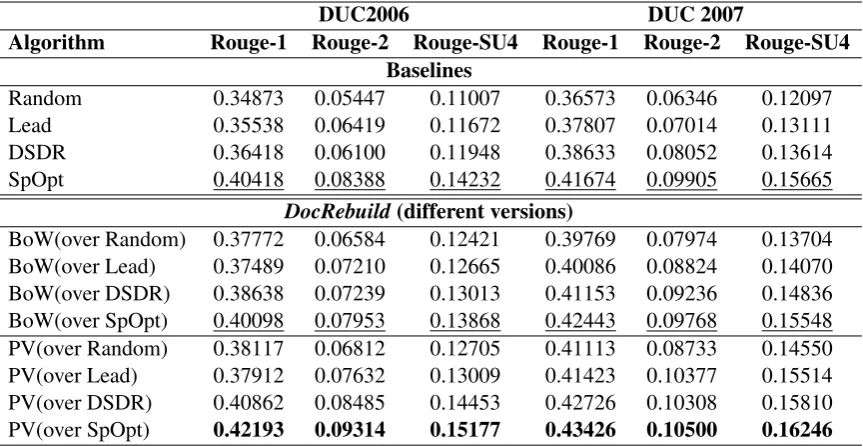
Overall Performance Table 1 shows the system comparison results on the two datasets. The param-eters of DocRebuild are set as follows: the dimensionality of document model is 300 for both BoW model and PV model, the candidate sentences are the top 10% sentences6, and the beamsize is set to
1http://duc.nist.org
2ROUGE version 1.5.5 with options: -a -n 2 -x -m -2 4 -u -c 95 -r 1000 -f A -p 0.5 -t 0 -d -l 250 3https://code.google.com/p/word2vec/
4http://radimrehurek.com/gensim/index.html
5Here we used the source code of SpOpt but failed to completely reproduce its results, which may be caused by document
preprocessing and parameter setting.
DUC2006 DUC 2007
Algorithm Rouge-1 Rouge-2 Rouge-SU4 Rouge-1 Rouge-2 Rouge-SU4
Baselines
Random 0.34873 0.05447 0.11007 0.36573 0.06346 0.12097
Lead 0.35538 0.06419 0.11672 0.37807 0.07014 0.13111
DSDR 0.36418 0.06100 0.11948 0.38633 0.08052 0.13614
SpOpt 0.40418 0.08388 0.14232 0.41674 0.09905 0.15665
DocRebuild(different versions)
[image:8.595.84.516.62.285.2]BoW(over Random) 0.37772 0.06584 0.12421 0.39769 0.07974 0.13704 BoW(over Lead) 0.37489 0.07210 0.12665 0.40086 0.08824 0.14070 BoW(over DSDR) 0.38638 0.07239 0.13013 0.41153 0.09236 0.14836 BoW(over SpOpt) 0.40098 0.07953 0.13868 0.42443 0.09768 0.15548 PV(over Random) 0.38117 0.06812 0.12705 0.41113 0.08733 0.14550 PV(over Lead) 0.37912 0.07632 0.13009 0.41423 0.10377 0.15514 PV(over DSDR) 0.40862 0.08485 0.14453 0.42726 0.10308 0.15810 PV(over SpOpt) 0.42193 0.09314 0.15177 0.43426 0.10500 0.16246
Table 1: Average F-measure performance on DUC2006 and DUC2007.
10 (parameters are tuned in the DUC2005). Among all the systems, Random and Lead unsurprisingly show the poorest performance, for they don’t consider any semantic information. DSDR performs better by introducing reconstruction framework. SpOpt improves the performance by employing diversity con-straint and doing sentence compression. DocRebuildobtains a significant7improvement on most of the corresponding baselines. Both PV(over DSDR) and PV(over SpOpt) outperform all the baselines and PV(over SpOpt) achieves the best performance. The result demonstrates the rationality of document-level reconstruction and the effectiveness of neural document model.
Besides, among all the versions of DocRebuild, PV model performs much better than BoW model, and the gap is more obvious on DUC2006 than on DUC2007. One possible reason is that PV model takes word order into consideration and this advantage is more apparent in the case of long documents (maximal length of documents is 5407 words in DUC2006 while 2663 words in DUC2007). It also can be observed that Rouge-1 score improves more obviously than Rouge-2 and Rouge-SU4 scores. This implicates our document models are more adept at handling words than n-grams since both document models do the prediction task on word-level.
Algorithm Rouge-1 Rouge-2 Rouge-SU4
None 0.39048 0.07421 0.13383
+Sentence filtering 0.41576 0.08896 0.14847 +Beamsearch 0.42193 0.09314 0.15177
Table 2: Performance with different strategies on DUC2006.
Analysis on Sentence Selection Strategies We further discuss the separate influence of two sentence selection strategies with PV(over SpOpt) version on DUC2006. As shown in Table 2, None stands for greedily selecting sentences from all the sentences in the document set, sentence filtering and beam-search are added sequentially. We can see that sentence filtering has impressive effect on improving our method. This demonstrates that sentence filtering is necessary for making document model work well as document model may be weak in modeling noisy sentences with rare words or in bad format. In addition, beamsearch further improves the performance by considering more possible combination of sentences. The above results indicate these two strategies both work well.
5 Conclusion and Future Work
In this paper, we introduced neural document model into multi-document summarization task and pro-posed a document-level reconstruction framework namedDocRebuild. In this framework, we represent and reconstruct the main content of documents with summary sentences on neural document model and take the reconstruction error as objective. To obtain the summary, we use sentence filtering to generate a candidate set and select the summary sentences from the candidate set via beamsearch algorithm. The experiment results show thatDocRebuildoutperforms the state-of-the-art unsupervised algorithms and shows great potential in summarizing multiple documents. In future work, it would be of great interests to extend our model by two ways: (1) trying more complex neural networks to model the documents, and (2) designing new algorithm to improve sentence selection.
Acknowledgements
This work is partially supported by the National High Technology Research and Development Program of China (Grant No. 2015AA015403) and the National Natural Science Foundation of China (Grant No. 61170091). We would also like to thank the anonymous reviewers for their helpful comments.
References
Dzmitry Bahdanau, Kyunghyun Cho, and Yoshua Bengio. 2014. Neural machine translation by jointly learning to align and translate. CoRR, abs/1409.0473.
Asli C¸elikyilmaz and Dilek Hakkani-T¨ur. 2010. A hybrid hierarchical model for multi-document summarization. InACL 2010, Proceedings of the 48th Annual Meeting of the Association for Computational Linguistics, July 11-16, 2010, Uppsala, Sweden, pages 815–824.
G¨unes Erkan and Dragomir R. Radev. 2004. Lexpagerank: Prestige in multi-document text summarization. In
Proceedings of EMNLP, pages 365–371.
Jade Goldstein, Mark Kantrowitz, Vibhu Mittal, and Jaime Carbonell. 1999. Summarizing text documents: Sen-tence selection and evaluation metrics. InProceedings of ACM SIGIR-1999, pages 121–128.
Aria Haghighi and Lucy Vanderwende. 2009. Exploring content models for multi-document summarization. In
Human Language Technologies: Conference of the North American Chapter of the Association of Computa-tional Linguistics, Proceedings, May 31 - June 5, 2009, Boulder, Colorado, USA, pages 362–370.
Sanda Harabagiu and Finley Lacatusu. 2005. Topic themes for multi-document summarization. InProceedings of SIGIR, pages 202–209.
Hilda Hardy, Nobuyuki Shimizu, Tomek Strzalkowski, Liu Ting, Xinyang Zhang, and G.Bowden Wise. 2002. Cross-document summarization by concept classification. InProceedings of SIGIR-02, pages 121–128. Zhanying He, Chun Chen, Jiajun Bu, Can Wang, Lijun Zhang, Deng Cai, and Xiaofei He. 2012. Document
summarization based on data reconstruction. InProceedings of AAAI.
Quoc V. Le and Tomas Mikolov. 2014. Distributed representations of sentences and documents. InProceedings of ICML, pages 1188–1196.
David D. Lewis, Yiming Yang, Tony G. Rose, and Fan Li. 2004. RCV1: A new benchmark collection for text categorization research.Journal of Machine Learning Research, 5:361–397.
Jiwei Li, Minh-Thang Luong, and Dan Jurafsky. 2015. A hierarchical neural autoencoder for paragraphs and documents. InProceedings of ACL, pages 1106–1115.
Hui Lin and Jeff A. Bilmes. 2011. A class of submodular functions for document summarization. InProceedings of ACL-HLT, pages 510–520.
Chin-Yew Lin and Eduard H. Hovy. 2002. From single to multi-document summarization. InProceedings of ACL, pages 457–464.
Chin-Yew Lin. 2004. Rouge: A package for automatic evaluation of summaries. InProceedings of the ACL-04 Workshop, pages 74–81.
He Liu, Hongliang Yu, and Zhi-Hong Deng. 2015. Multi-document summarization based on two-level sparse representation model. InProceedings of AAAI, pages 196–202.
Rada Mihalcea and Paul Tarau. 2005. A language independent algorithm for single and multiple document summarization. InProceedings of IJCNLP.
Tomas Mikolov, Ilya Sutskever, Kai Chen, Gregory S. Corrado, and Jeffrey Dean. 2013. Distributed representa-tions of words and phrases and their compositionality. InProceedings of NIPS, pages 3111–3119.
Dragomir R. Radev, Hongyan Jing, Magorzata Sty, and Daniel Tam. 2004. Centroid-based summarization of multiple documents. Inf. Process. Manage., 40(6):919–938.
Ilya Sutskever, Oriol Vinyals, and Quoc V. Le. 2014. Sequence to sequence learning with neural networks. In
Advances in Neural Information Processing Systems, page 31043112.
Duyu Tang, Bing Qin, and Ting Liu. 2015. Document modeling with gated recurrent neural network for sentiment classification. InProceedings of EMNLP, page 14221432.
Kristina Toutanova, Chris Brockett, Michael Gamon, Jagadeesh Jagarlamudi, Hisami Suzuki, and Lucy Vander-wende. 2007. The pythy summarization system: Microsoft research at duc 2007. Proceedings of DUC-2007. Dingding Wang, Tao Li, Shenghuo Zhu, and Chris Ding. 2008. Multi-document summarization via sentence-level
semantic analysis and symmetric matrix factorization. InProceedings of SIGIR, pages 307–314. ACM. Mark Wasson. 1998. Using leading text for news summaries: Evaluation results and implications for commercial
summarization applications. InProceedings of COLING-ACL, pages 1364–1368.