VISUALIZING CLASS DIAGRAM USING
OrientDB DATA-STORE
Sawinder Kaur
Karamjit Kaur
CSED, Thapar Univesity
CSED, Thapar University
Patiala (Punjab), India
Patiala (Punjab), India
[email protected]
[email protected]
Abstract— Relational databases are providing storage for several decades now. The term NoSQL broadly covers all non-relational databases that provide scalable and schema-less model. NoSQL databases are used by major organizations operating in the era of Web 2.0. Different categories of NoSQL databases are key-value pair, document, column-oriented and graph databases which enable programmers to visualize the data closer to the format used in their application. In this paper, class diagram has been merged with OrientDB through Java API to visualize the class diagram as OrientDB graph. OrientDB is the only database which supports both graph and document database, also provides support for both inheritance and polymorphism.
Keywords- OrientDB, NoSQL, Class Diagram.
I. INTRODUCTION
NoSQL is a next generation [6] database which addresses these properties: non-relational, non-ACID[12], distributed, open-sourceand horizontally scalable , schema-less. The original intention has beenmodern web-scale databases. Rise of NoSQL [15] databases are challenging the dominance of relational databases (dominated the software industry for longer period). There is an impedance mismatch between the relational data structures and the in-memory data structures. A NoSQL database allows developers to develop without having to convert in-memory structures to relational
structures.
Key-value is the simple NoSQL data stores to use from an API perspective. User can get the value for a key, put the value for a key or delete a key from the data store. The value is just stored without knowing what is stored inside. Key-value stores always use primary-key and use a hash table where a pointer points to a particular item of data. Key-based lookups results in lesser query execution time since values can be anything like objects, hashes etc. resulting in flexible and schema-less model appropriate for today’s unstructured data, hence gives a great performance and can be easily scaled. Key-value databases are Riak(Basho) [8], Redis(VMware) [8], Amazon DynamoDB [5], and Couchbase [15]. To update part of a value or query the database, this method is not ideal.
Documents are the prime concept in document databases. The database stores and retrieves documents which can be XML, JSON, BSON etc. These documents are self-describing and form hierarchical tree data structures which can consist of maps, collections, and scalar values. For example one could search for all documents in which “City” is “Patiala” that would deliver a result set containing all documents connected with any “3 Storey Office” that is in that particular city. Apache CouchDB[9] and MongoDB [15] are popular examples of a document store. CouchDB uses JSON to store data, JavaScripts its query language
structured data. MongoDB has typical applications in content management systems, mobiles, gaming and archiving. Document style databases are schema-less so it makes addition of fields easy to JSON without defining changes first.
In Column-oriented/Wide-table data stores,data is stored in cells grouped in columns of data rather than as rows of data. Columns are logically grouped into column families. Column families hold inside a virtually unlimited number of columns that can be created at runtime or the definition of the schema. Read and write is performed using columns rather than rows. In comparison, most relational DBMS reserve data in rows, the benefit of storing data in columns is fast search, access and data aggregation [7]. Relational databases store a single row as a continuous disk entry. Different rows are stored in different regions on disk whereas Columnar databases store all the cells corresponding to a column as a continuous disk entry making the search and access faster. For example: To query the titles from a bunch of a million articles will be a heedful task while using relational databases as it will go over each location to get item titles. On other side, with just one disk access, title of all the items can be attained. Popular open source column-oriented databases are Hypertable [8], HBase [15] and Cassandra [15]. Hypertable and HBase are derivatives of BigTable where as Cassandra takes its features from both BigTable and Dynamo.
OrientDB(Document+Graph) - OrientDB is a 2nd Generation Distributed Graph Database [10] and the first Multi-Model Open Source NoSQL DBMS that carries together the power of graphs and the flexibility of documents into one scalable high-performance [13] operational database. First generation Graph Databases lack the features that Big Data demands: multi-master replication[6], sharding[6] and more flexibility for modern complex use cases. OrientDB is incredibly fast as can store 220,000 records per second [10] on common hardware. Even for a Document based database, the relationships are handled as in Graph Databases with direct connections within records. You can traverse parts of or entire trees and graphs of records within few milliseconds. OrientDB supports schema-less, schema-full and schema-mixed modes [10], has a strong security profiling system based on roles and users, supports SQL amongst the query languages. Being a document database one can store any document on a vertex, being a graph database one can introduce new edges and properties. It allows schemas to be introduced at runtime.
Class diagram with OrientDB helps to store the state of the system. Almost for every system a domain model (or logical information model) is framed which describes what information the system must maintain. The state of the art for shaping such models is to build an object-oriented class diagram, typically in UML. This model represents classes with their properties and associations among classes. With most databases there is some impedance mismatch when mapping the canonical model as in Relational model there is no support for inheritance, polymorphism and relationships have to be mapped into keys. In graph databases there is also no support for polymorphism, inheritance and complex properties introduces new vertices. A document database also does not provide support for polymorphism and provides very limited support for relationships. In OrientDB the mapping eliminates all impedance mismatch as object becomes a vertex, complex properties are handled by documents, provides explicit support for relationships, inheritance and polymorphism.
II. MOTIVATION
To create a graph that contains a class diagram using the Java API OrientDB so that it becomes easy to analyse how the class diagram is depicted
in graph database. It helps
to easily understand how the classes are related to
each other, how polymorphism is used. OrientDB
graph is easily extensible and this can be achieved
by adding information about methods or by
purporting the meta-data. In this manner
information can be managed about annotated
methods and released revisions.
Projects need some extent of run-time configuration where user could configure the rules of the data structures stored and hence complexity increases. If a relational database is used behind any application then high complexity is seen between joins to retrieve the data. A schema-free document database could simplify complexity problem. OrientDB allows schemas to be introduced at runtime and provide record level security which means any record or class can be altered to extend any other - including vertices and edges in the graph.
To measure the performance based on response time of the retrieved data using JAVA API OrientDB.
III. NoSQL DATA-STORES
NoSQL referred to (not only SQL) or (non relational [3])
database which provides a mechanism
for storage and retrieval of data modelled different from the tabular relations used in relational databases. They have existed since the late 1960s, but did not obtain the NoSQL signature until its popularity in the early twenty-first century
when Web 2.0 companies such
as Facebook, Google and Amazon.com [15]. NoSQL databases are widely used in Bigdata, real-time web [2] applications and also supports SQL like query languages.
A. DOCUMENT-ORIENTED DATA MODEL OR DOCUMENT STORE
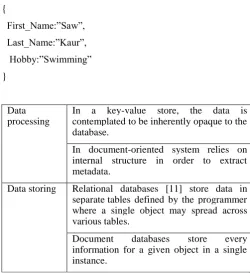
Is designed for storing, retrieving, and managing document-oriented information also called as semi-structured data [3]. The popularity of the term document-oriented database has grown [1] with the help of the term NoSQL itself. XML databases [4] are a subclass of document-oriented databases. Document-document-oriented databases are intrinsically a subclass of the key-value store [4], another NoSQL database concept. Example the following document is encoded in JSON.
{ First_Name:”Saw”, Last_Name:”Kaur”, Hobby:”Swimming” } Data processing
In a key-value store, the data is contemplated to be inherently opaque to the database.
In document-oriented system relies on internal structure in order to extract metadata.
Data storing Relational databases [11] store data in separate tables defined by the programmer where a single object may spread across various tables.
Document databases store every information for a given object in a single instance.
TABLE 1: Comparison of document-oriented and relational database.
B. KEY-VALUE STORE OR DATABASE
Is designed for storing, retrieving, and managing associative arrays, data structure. Dictionaries (data structures) contain a collection of objects or records, which have many different fields within them, each containing data. These records are stored and fetched using a key that uniquely distinguishes the record, and is used to quickly find the data within the database.
KEY VALUE
K1 XXX,ZZ
K2 SSS,5647,8
K3 BBB,10/04/2016
K4 AAA,CCC
K5 AAAA,BBBB
Fig. 1.Key-Valued Database
Data Structure
RDB pre-defines the data structure [11] in the database as a series of tables containing fields with well defined data types.
Key-value systems treat data as a single opaque collection which have distinct fields for every record.
Memory Optional values are represented by placeholders in RDB
Key-value stores often use far less memory as optimal values are not represented in it.
TABLE 2:Comparison of key-valued and relational database
C. GRAPH-BASED DATA MODEL
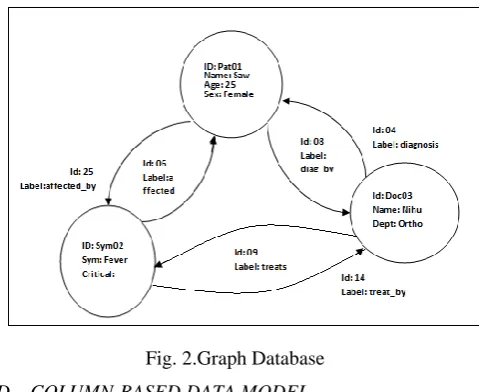
It uses graph structures for semantic queries with nodes, edges and properties are used to represent and store the data. A key concept of the system is the graph which directly relates data items in the store.
Fig. 2.Graph Database
D. COLUMN-BASED DATA MODEL
A column of a distributed data store is a NoSQL object of the lowest level in a key space. It is a tuple which has three elements [6] Unique name to refer the column, Value to tell
Fig. 3.Column Database
E. DOCUMENT AND GRAPH DATABASE
OrientDB can be used in multiple ways as it can be used as document database, graph database giving competition to MongoDB [15] and Neo4J [8][15]and also can be used as an Object-Oriented Database. For better performance Database integration is required which implies the integration [17] and aggregation of data from dif databases within or outside the organization and using the integrated data in many real time applications. New technology like cloud computing[14], Bigdata [2] came into existence, there is a need of sharing the resources and need to achieve consistency also. There are different platforms, different query languages, different data models[16], different dependencies among databases and applications so integration has become a capsule to solve this problem.
IV. OrientDB
OrientDB [10] as a document database can store documents. OrientDB can take an arbitrary document, a JSON document and can store it. After it has been stored one can query it using path expressions. If only document databases are used then it does not supports inheritance and provides no support for relationships.
OrientDB as a graph database which implement the relationships as first class citizens called edges and edges connect vertices. A vertex, in graph databases, is a simple cluster of name-value pairs. In OrientDB each document in document database acts as a vertex in graph database. If only graph databases are used then it does not supports inheritance, polymorphism. Complex properties introduces new vertices even if not required, hence no individuality. In OrientDB, mapping the two databases eliminates all impedance mismatch.
V. CLASS DIAGRAM
Fig. 4. Class diagram of case study
V1. ANALYSING CLASS DIAGRAM USING ORIENTDB
Fig. 7. Time required to retrieve and update the data
Fig. 5. Flowchart to represent class diagram in OrientDB
Fig. 6. Class Diagram in form of Graph
Vll. PERFORMANCE ANALYSIS
TABLE 3: Hardware Environment
TABLE 4: Software Environment
VIII. CONCLUSION
NoSQL is a complementary product for handling issues of scalability, complexity and performance. Non-relational databases provide many enhancements over traditional relational databases [11] such as increased scaling across commodity servers or cloud instances, non-adherence to rigid schema for inserting data and hence ease in capturing of different type data without many changes at schema level.
In this paper, we discussed about NoSQL databases and OrientDB which together provides better features by using both document and graph databases. Class diagram is very popular among application developers, but the concept together with non-relational databases is yet to come. To the
classes. Due to limit on length, only two classes of NoSQL Databases: Document-oriented and Graph-based databases together have been covered in this paper. A case-study have been explained and considered to illustrate the way of Class diagram. With the help of five queries data relationship between classes have been depicted through graph in OrientDB and their performance have been noted down.
REFERENCES
[1]DB-Engines Ranking per database model category [Online]. Available: http://dbengines. com/en/ranking_categories
[2]C Snijders, U Matza, UD Reips (2012). "'Big Data: Big gaps of knowledge in the field of Internet". International Journal of Internet Science 7: 1–5
[3]Leavitt, Neal."Will NoSQL Databases Live Up to Their Promise?".IEEE, 2010
[4]Grolinger, K. Higashino, W. A. Tiwari, A. Capretz, M. A. M. (2013). "Data management in cloud environments: NoSQL and NewSQL data stores" Springer, 2014.
[5]"Amazon helped start the “NoSQL” movement [Online]. Available: http://www.wired.com/2012/01/amazon-dynamodb/
[6]NoSQL DEFINITION: Next Generation Databases mostly addressing some of the points: being non-relational, distributed, open-source and horizontally scalable[Online]. Available: http://nosql-database.org/
[7]Chaker Nakhli. "Cassandra’s data model cheat sheet: Data model
elements: Column"[Online]. Available:https://en.wikipedia.org/wiki/
Column_(data_store)
[8]O Hajoui, R Dehbi, M Talea - Journal of Theoretical 2015 – “Advanced comparative study of the most promising NoSQL and NewSQL databases with a multi-criteria analysis method “
[9]Renzo Angles and Claudio Gutierrez. “Survey of graph database
models”. ACM Computing Surveys (CSUR), 40(1):1, 2008.
[10]Claudio Tesoriero. “Getting Started with OrientDB”. Packt Publishing Ltd, 2013.
[11]RDBMS dominate the database market, but NoSQL systems are catching up". [Online]DB-Engines.com, 2013
[12]Bogdan Tudorica, Cristian Bucur, “A comparison between several NoSQL databases with comments and notes”, RoEduNet International
Conference 10th Edition, IEEE 2011: Networking in Education and
Research, Chengdu, pp. 474-479.
[13]Y Li, S Manoharan “A performance comparison
of SQL and NoSQL database” IEEE, 2013