Registration-Based Encryption:
Removing Private-Key Generator from IBE
Sanjam Garg∗ Mohammad Hajiabadi† Mohammad Mahmoody‡ Ahmadreza Rahimi§
September 26, 2018
Abstract
In this work, we introduce the notion ofregistration-based encryption (RBE for short) with the goal of removing the trust parties need to place in the private-key generator in an IBE scheme. In an RBE scheme, users sample their own public and secret keys. There will also be a “key curator” whose job is only to aggregate the public keys of all the registered users and update the “short” public parameter whenever a new user joins the system. Encryption can still be performed to a particular recipient using the recipient’s identity and any public parameters released subsequent to the recipient’s registration. Decryption requires some auxiliary informa-tion connecting users’ public (and secret) keys to the public parameters. Because of this, as the public parameters get updated, a decryptor may need to obtain “a few” additional auxiliary information for decryption. More formally, if n is the total number of identities and κis the security parameter, we require the following.
• Efficiency requirements: (1) A decryptor only needs to obtain updated auxiliary infor-mation for decryption at mostO(logn) times in its lifetime, (2) each of these updates are computed by the key curator in time poly(κ,logn), and (3) the key curator updates the public parameter upon the registration of a new party in time poly(κ,logn). Properties (2) and (3) require the key curator to haverandom access to its data.
• Compactness requirements: (1) Public parameters are always at most poly(κ,logn) bits, and (2) the total size of updates a user ever needs for decryption is poly(κ,logn) bits. We present feasibility results for constructions of RBE based on indistinguishably obfusca-tion. We further provide constructions ofweakly efficient RBE, in which the registration step is done in poly(κ, n), based on CDH, Factoring or LWE assumptions. Note that registration is done only once per identity, and the more frequent operation of generating updates for a user, which can happen more times, still runs in time poly(κ,logn). We leave open the problem of obtaining standard RBE (with poly(κ,logn) registration time) from standard assumptions.
∗
[email protected] Berkeley. Research supported in part from DARPA/ARL SAFEWARE Award W911NF15C0210, AFOSR Award FA9550-15-1-0274, AFOSR YIP Award, DARPA and SPAWAR under contract N66001-15-C-4065, a Hellman Award and research grants by the Okawa Foundation, Visa Inc., and Center for Long-Term Cybersecurity (CLTC, UC Berkeley). The views expressed are those of the author and do not reflect the official policy or position of the funding agencies.
†
[email protected] Berkeley and University of Virginia. Supported by NSF award CCF-1350939 and AFOSR Award FA9550-15-1-0274.
‡
[email protected] University of Virginia. Supported by NSF CAREER award CCF-1350939, and two University of Virginia’s SEAS Research Innovation Awards.
§
Contents
1 Introduction 3
1.1 Technical Overview . . . 5
2 Preliminaries 8 3 Formal Definition of Registration-Based Encryption 9 4 IO-Based Construction of RBE 14 4.1 Proofs of Completeness, Compactness and Efficiency . . . 15
4.2 Proof of Security . . . 16
4.2.1 Simple Case of One User . . . 16
4.2.2 General Case of Multiple Users . . . 19
1
Introduction
Public-key encryption [DH76, RSA78,GM82] allows Alice to send Bob private messages without any a-priori shared secrets. However, before Alice can send any messages to Bob, she must obtain Bob’s public key. Enabling Alice to obtain Bob’s public key often requires additional public-key infrastructure and in some cases complex certification authorities; consequently, making implemen-tation of public-key encryption rather cumbersome.
With the goal of simplifying key-management in public-key encryption, Shamir [Sha84] intro-duced the notion of identity based encryption (IBE). An IBE scheme allows Alice to encrypt her messages to Bob knowing just the identity of Bob and some additional system public parameters. In this setup, Bob can then decrypt Alice’s ciphertexts using an identity-specific secret key that he obtains from the private key generator (PKG). In their celebrated work, Boneh and Franklin [BF01] provided the first construction of IBE using bilinear maps. A long line of subsequent research has provided many other constructions of IBE based on a variety of assumptions [Coc01,DG17]. IBE serves as the basis of several real-world systems (e.g., in systems by Voltage security) to simplify key-management.
Despite its significant advantages, one important limitation of IBE schemes is the so-called key-escrow problem. Namely, in an IBE scheme a PKG can generate the identity-specific secret key for any identity. This allows the PKG to arbitrarily decrypt messages that are intended for specific recipients. While in certain applications it is reasonable to place trust in a PKG, doing so is not always acceptable. This limitation of IBE often attracts significant criticism and restricts applicability in certain scenarios. In words of Rogaway [Rog15],
“But this convenience is enabled by a radical change in the trust model: Bob’s secret key is no longer self-selected. It is issued by a trusted authority. That authority knows everyone’s secret key in the system. IBE embeds key-escrow indeed a form of key-escrow where a single entity implicitly holds all secret keyseven ones that haven’t yet been issued. [...] Descriptions of IBE don’t usually emphasize the change in trust model. And the key-issuing authority seems never to be named anything like that: it’s just the PKG, for Private Key Generator. This sounds more innocuous than it is, and more like an algorithm than an entity.”
With the goal of enhancing the applicability of IBE, prior works suggested ways for reducing the level of trust that parties need to place in the PKG. Boneh and Franklin [BF01] suggested the use of multiple PKGs, instead of just one, with the goal of making the trust de-centralized. This idea was further explored in subsequent work (e.g., see [CHSS02,PS08,KG10]). In a different approach, Goyal [Goy07], later followed by Goyal et al. [GLSW08], studied the notion of accountable IBE, which allows users to get their decryption keys from the PKG using a secure key generation protocol. Such schemes provide safeguard against a malicious PKG who might distribute the identity-specific secret key for a particular user to unauthorized parties, as by doing so it risks the possibility of being caught in the future. Another approach to the key escrow problem, studied in [CCV04,
None of the above approaches, however, resolve the key-escrow problem entirely, as the PKG (or a collection of several of them) can still decrypt all ciphertexts in the system. Indeed even a trusted PKG may not be able to protect ciphertexts against a subpoena requesting decryption keys. This state of affairs leads us to the main question of this work:
Can we entirely remove PKG from IBE schemes?
A new primitive: registration-based encryption (RBE). In this work, we pursue a new approach to constructing IBE schemes by introducing a new notion which we callregistration-based encryption, and which does not suffer from the key-escrow problem. Recall that in traditional IBE schemes, the PKG plays an active role in maintaining the cryptographic secrets corresponding to the public parameters of the system, leading to the key-escrow problem. Deviating from this approach, in our RBE we replace the PKG with a much weaker entity that we call a key curator. A key curator does not possess any cryptographic secrets and just plays the role ofaggregating the public keys of the users.
In more detail, in an RBE scheme each user samples its own public key and secret key and provides its identity and the chosen public key to the key curator.1 The key curator is now tasked with the goal of curating this new user’s public key in the public parameters. Towards this, the key curator updates the public parameters and publicizes the new public parameters. Thus, unlike traditional IBE schemes, the public parameters in an RBE scheme evolve as new users register in the system. For example, letpp0,pp1, . . . ,ppnbe the different instances of the public parameters in the system, whereppiis the public parameter afteriusers have registered in the system. Just like an IBE scheme, we require that the size of the public parameter is always small: |ppi| ≤poly(κ,logn) fori≤n, where κ is the security parameter andn is the number of users in the system.
In an RBE scheme, decryption by a user is performed using its secret key and some auxiliary information that connects its public key with system’s public parameters. Note that as new users join the system and public parameters are updated, an update to the auxiliary information connect-ing a user’s public key to the new public parameters is necessary.2 However, it would be prohibitive to update each user’s auxiliary information (needed for decryption) after each single registration. Thus, we require that the effect of registration by new users on the previously registered users is minimal. In particular, we require that a registered user needs to query the key curator for auxiliary information connecting its public key to the public parameters at mostO(logn) times in its lifetime where nis the total number of registered users. Additionally, we require that the total size of the auxiliary information provided by the key curator needed for any decryption is at most poly(κ,logn) for security parameterκ.
Our results. We consider two variants of RBE schemes based on the efficiency of the registration and give constructions for both of them. In particular, we construct (standard) RBE using indis-tinguishabiltiy obfuscation, and we construct a “weakly efficient” variant of this primitive based on more standard assumptions.
• RBE based on IO: First, we construct (standard) RBE schemes in which the running time of key curator for every new user registration is poly(κ,logn) for security parameter κ assuming the key curator has random access to its auxiliary information. Other than the desired efficiency
1
The key curator will need to verify the identity of the user requesting the registration as it is done by certification authorities in public-key infrastructure.
2
itself, one motivation for such minimization in curator’s complexity is that since the work done in each user registration is small, it is then more reasonable to distribute the key curator’s job between the users themselves, removing the need of a dedicated key curator entirely. In such a system, a new user will only need to do a “small” amount of public computation to update the public parameters at the time of joining the system. Moreover, any previously registered user could obtain its updated auxiliary information needed for decryption from the public ledger as well. We obtain a feasibility result for this notion based on somewhere statistically binding hash functions [HW15] and indistinguishably obfuscation [BGI+01,GGH+13].
• RBE with weakly-efficient registration: Second, we consider a setting where the key curator is allowed to be “weakly efficient”; i.e., the running time of key curator for updating the public parameters as a single new user registers can poly(κ, n). We call such RBE schemes weakly effi-cient and obtain a construction of weakly-effieffi-cient RBE based on any hash garbling scheme. The notion of hash garbling and its construction has been implicit in prior works [CDG+17, DG17,
DG17, DGHM18,BLSV18], and it was shown there that hash garbling can be realized based on CDH, Factoring or LWE assumptions. In this work, we give a formal definition of this primitive (Definition5.1) and use it to construct RBE.
We leave open constructing RBE with poly(κ,logn) registration based on standard assumptions.
Communication cost of RBE compared with PKE and IBE. We view RBE as a hybrid between PKE and traditional IBE. PKE schemes are communication heavy for encryptors. In other words, each encryptor must obtain the public keys of each recipient that it sends encrypted messages to. In contrast, IBE schemes remove the need for the communication by the encryptors — specifically, encryptors no longer need to recover the public key of each user separately. However, the decryptor must still obtain its identity-specific secret key via communication with the PKG. Note that since this communication with PKG is only done once, the communication cost of an IBE is much smaller than the communication cost of a PKE. However, this efficiency comes at the cost of the key-escrow problem. Our RBE achieves, in large parts, the communication benefits of IBE without the key-escrow problem. More specifically, in an RBE, the encryptors do not need to recover the public key of each recipient individually. Additionally, a decryptor only needs to interact with the key curator to obtain the relevant updates at most logn times in total.
IBE was originally proposed with the goal of simplifying key management in IBE, yet the problem of key-escrow has prevented it from serving as a substitute for PKE — specifically, its applicability remains limited to specialized settings where trust is not a problem. We believe that efficient variants of our RBE constructions could indeed provide an alternative for PKE while also simplifying key management as IBE does.
1.1 Technical Overview
Our IO based solution is inspired by prior works on using witness encryption [GGSW13], if we interpret the decryption key (i.e., the secret key together with the required auxiliary updates) as a witness that enables decryption. Additionally, both our IO-based and the hash obfuscation based solutions (and in particular their tree-based hashing of the public keys) use ideas developed recently in the context of laconic OT [CDG+17] and IBE from the CDH assumption [DG17]. In both of these settings, our contribution is in formalizing the subtle aspects of RBE and then realizing RBE schemes (as mentioned above) using these ideas.
High level description of our IO-based construction of RBE. A natural first try for the solution would be for the curator to just Merkle hash together the public keys of all the users in the system (along with their corresponding identities). Here encryption could be performed by an obfuscation of the following program P[h,m], with the Merkle hash root h and the encrypted message m hardwired. Given input (pk,id,pth), the program P[h,m] outputs an encryption of m
under the public key pk only if pth is a “Merkle opening” (i.e., the right leaf to root path with siblings) for (pk,id) as a pair of sibling leaves in the Merkle hash tree with rooth, and it outputs⊥
otherwise. Decryption can proceed naturally with the right Merkle opening as auxiliary information that the key curator needs to provide for decryption. The main issue with this solution is that the Merkle hash roothchanges with every new user registering in the system. Our idea for solving this problem is to maintainmultiple Merkle hash trees such that any individual user is affected only a bounded number of times. Below, we explain this idea in more detail.
• Public parameters and auxiliary information. At a high level, in our construction, after n
parties have registered, the key curator holds an auxiliary information auxn of the following form:
it consists ofη full binary Merkle trees, Tree1, . . . ,Treeη with corresponding depthsd1 >· · ·>dη
and number of leaves 2d1, . . . ,2dη. The public parameter would be the set of the labels of theroots
of these trees. Every leaf in either of these trees is either an identity id or its public key pk as the sibling of the leafid, and every registered identityidappears exactly once as a leaf. Thus, half of the leaves of these trees contain the strings encoding the registered identities, and for each leaf id, the sibling leaf contains the public keypkofid. So, if there arenpeople registered so far in the system, then the total number of leaves in the trees is equal to 2n. Since we stated that d1 >· · ·>dη, it
means that the number of these treesη is at most log(n), simply because (d1, . . . , dη) would be the
binary representation of number 2n. This point implies that the public parameter is indeed short.
• What is needed for decryption. Even though in general it is more natural to describe encryp-tion first, in our case it is easier to describe the informaencryp-tion that is needed for decrypencryp-tion. Each identityid will hold is own secret key sk which will be necessary for decryption, but it would need more information for doing so. Indeed, ifTreeis the tree hold by the curator that contains (sibling leaves) (id,pk) in its leaves, then the identity id needs to know the “Merkle opening” of (id,pk) to the root of Treein order to do any decryption. Since the length of this path is at most the depth of Tree, which is at most log(n), the total size of the decryption keydk (which includes sk and the knowledge of such opening to the root of Tree) is at mostκ·log(n). This makesdk compact.
correspondingsk to the registeredpk, nobody other than id can decrypt the message m encrypted that way. When there are multiple trees Tree1, . . . ,Treeη held by the key curator, the ciphertext
includes η obfuscations, one for everyTreei.
• How to register. When a new partyid joins to register, we first create a single treeTree for that party, withid,pk as its only leaves. But creating too many trees naively increases the length of the public parameter. So, to handle this issue we “merge” the trees every now and then. In particular, upon any registration, so long as there are any two trees Tree1,Tree2 of the same size
held by the key curator, it “merges” them by simply hashing their rootsrt1,rt2 into a new rootrt.
This way, the key curator keeps the invariance property (stated above) that the trees are always full binary trees of different sizes. After doing any such merge, the key curator sends the the generated update of the form (rt1,rt,rt2) to all of the identities that are in either of the trees Tree1,Tree2.
That is because, the identities inTree1 would now need to knowrt2 and the identities inTree2 now
need the labelrt1 in order to decrypt what is encrypted for them. Alternatively, if the key curator
is passive and does not send updates, the users who are in the merged tree Tree would need to pull their updates whenever they have a ciphertext that they cannot decrypt, realizing that their auxiliary information is outdated.
To prove security of the above construction, collision-resistance of the used hash function is not enough, and we rely onsomewhere statistically binding hash functions [HW15] (see Definition2.3).
Weakly-efficient construction based on standard assumptions. In order to replace the use of obfuscation in the above construction, we build on the techniques by Cho, D¨ottling, Garg, Gupta, Miao, and Polychroniadou [CDG+17] and D¨ottling and Garg [DG17]. We abstract their idea of
using hash encryption and garbled circuits as a new primitive that we callhash garbling. Use of this abstraction simplifies exposition. A hash garbling scheme consists of algorithms (Hash,HG,HInp).3 Hash function is a function from {0,1}` to {0,1}κ. HG takes as input a secret state stt and an
arbitrary program P and outputs P. HInp takes as input a secret statee stt and a valuey∈ {0,1}κ and outputsey. Correctness and security require thatCe,ey, xcan be used to compute C(x), but also that they reveal nothing else about C.
Our construction of RBE from standard assumption is very similar to the IO-based construction except that we replace the use of IO with the less powerful primitive hash garbling. The key challenge in making this switch comes from the fact that hash garbling, unlike IO, cannot process the entire root to leaf Merkle opening in one shot. Thus, our construction needs to provide a sequence of hash garblings that traverse the root to leaf path step by step. Therefore, as the tree is being traversed, the hash garblings need to identify whether to go left or to go right. Note that this decision must be taken without any knowledge of what identities are included in the leaves of the left sub-tree and what identities are included in the leaves of the right sub-tree. We resolve this challenge by modifying the Merkle tree in two ways:
1. We ensure that the identities in the leave of any tree are always sorted.
2. In addition to the hashes of its two children, in the computation of the Merkle hash, we also hash the information about the largest identity that is present any leaf of the left subtree at any node. (The latter information allows us to traverse down a Merkle tree using it as a binary search tree.)
Using these enhancements over the simple Merkle trees, we can indeed substitute IO with the less powerful primitive of hash garbling, which in turn can be obtained from more standard assumptions. On the down side, this new construction needs to sort the identities for every registration, and in particular the registration cannot run in sublinear time poly(κ,logn). We refer the reader Section5
for more details on this construction.
2
Preliminaries
Notation. For a probabilistic algorithmA, by A(x)→ y, we denote the randomized process of runningAon inputxand obtaining the outputy. We use PPT to denote a probabilistic polynomial-time algorithms, where running polynomial-time is polynomial over the length of their main input (not the random seed). For randomized algorithmsA1, A2, . . ., by PrA1,A2,...[E] we denote the probability of
eventEwhen the randomness is over the algorithmsA1, A2, . . . as well. For deterministic algorithms A1, A2, byA1≡A2, we denote that they have the same input-output functionality; namely, for all x (of the right length, if A1, A2 are circuits), A1(x) = A2(x). For distribution ensembles Xn, Yn,
by Xn ≈c Yn we mean that they are indistinguishable against poly(n)-time algorithms. By x||y we denote the concatenation of the strings x, y. By negl(κ) we denote some function that is negligible in input κ; namely for all k, negl(κ)≤O(1/κk). Un denotes the uniform distribution over{0,1}n.
For algorithmA, byAB we denote an oracle access byAto oracleB. ByA[B]we denoteAaccessing oracle B with read and and write operations. So, if A writes y at location x, reading a query x
next time will returny.
Definition 2.1 (Public key encryption). A public key encryption scheme consists of three PPT algorithms (G,E,D) as follows.
• G(1κ) →(pk,sk): This algorithm takes a security parameter 1κ as input and outputs a pair
of public keypk secret keysk. Without loss of generality we assume that|pk|=|sk|=κ.
• E(pk,m)→ct: takes a messagem and a public keypk as input and outputs a ciphertextct.
• D(sk,ct)→m: takes a ciphertextct and a secret key skas inputs and outputs a message m.
The completeness and security properties are defined as follows.
• Completeness. The PKE scheme is complete if for every message m:
Pr
G,E,D[D(sk,E(pk,m)) =m: (sk,pk)←G] = 1.
• Semantic Security. Any PPT Adv wins the following game with probability 12+ negl(κ):
– The challenger generates (pk,sk)←G(1κ) and sendspk toAdv. – The challenger chooses a random bitband sends c←E(pk, b) to Adv. – Adv outputsb0 and wins ifb=b0.
Definition 2.2 (Indistinguishability obfuscation). A uniform PPT algorithm Obf is called an indistinguishability obfuscator for a circuit class {Cκ}κ∈N (where each Cκ is a set indexed by a
• Completeness. For all security parameters κ ∈ N and all circuits C ∈ Cκ, we obtain an obfuscation with the same function:
Pr
Obf[C
0 ≡C : C0= Obf(1κ,C)] = 1.
• Security. For any PPT distinguisher D, there exists a negligible function negl(·) such that for all κ ∈N, for all pairs of functionally equivalent circuits C1 ≡ C2 from the same family
C1,C2 ∈ Cκ,
Pr
Obf[D(1
κ,Obf(1κ,C
1)) = 1)]− Pr Obf[D(1
κ,Obf(1κ,C
2)) = 1)]
≤negl(κ).
The next definition is a special case of the definition of somewhere statistically binding (SSB) hash functions introduced by Hubacek and Wichs [HW15] for the blockwise setting. Here we only use two-input blocks.
Definition 2.3 (SSB hash functions [HW15]). Asomewhere statistically binding hash system con-sists of two polynomial time algorithms HGen,Hash.
• HGen(1κ, b)→hk. This algorithm takes the security parameterκand an index bitb∈ {0,1}, and outputs a hash keyhk.
• Hash(hk, x) → y. This is a deterministic algorithm that takes as input x = (x0, x1) ∈ {0,1}κ× {0,1}κ and outputs y ∈ {0,1}κ.
We require the following properties for an SSB hashing scheme:
• Index hiding. No poly(κ)-time adversary can distinguish betweenhk0andhk1 by more than
negl(κ), wherehkb ←HGen(1κ, b) for b∈ {0,1}.
• Somewhere statistically binding. We say that hk is statistically binding for index i ∈ {0,1}, if there do not exist two values (x0, x1),(x00, x10)∈ {0,1}`× {0,1}` such that xi 6= x0i
and Hash(hk, x) = Hash(hk, x0). We require that for both i∈ {0,1},
Pr
HGen[hk is statistically binding for i:hk←HGen(1
κ, i)]≥1−negl(κ).
3
Formal Definition of Registration-Based Encryption
In this section, we formalize the new notion of RBE. After defining the “default” version of RBE, we define weakened forms of this primitive with a specific relaxation in the efficiency requirements. The goal of this relaxation is to base the (relaxed) RBE on more standard assumptions.
We start by defining the syntax of the default notion of RBE. We will then discuss the required compactness, completeness, and security properties.
• Generating common random string. Some of the subroutines below will need a common random string crs, which could be sampled publicly using some public randomness beacon.
crs of length poly(κ) is sampled at the beginning, for the security parameterκ.
• Key generation. Gen(1κ) → (pk,sk): The randomized algorithm Gen takes as input the security parameter 1κ and outputs a pair of public/secret keys (pk,sk). Note that these are only public and secret keys, not the encryption ordecryption keys. The key generation algorithm is run by any honest party locally who wants to register itself into the system.
• Registration. Reg[aux](crs,pp,id,pk) → pp0: The deterministic4 algorithm Reg takes as input the common random sting crs, current public parameter pp, a registering identity id
and a public keypk(supposedly for the identityid), and it outputspp0 as the updated public parameters. The Reg algorithm usesread and write oracle access toauxwhich will be updated intoaux0during the process of registration.5 (The system is initialized with public parameters
ppand auxiliary information auxset to ⊥.)
• Encryption. Enc(crs,pp,id,m) → ct: The randomized algorithm Enc takes as input the common random sting crs, a public parameter pp, a recipient identity id and a plaintext message mand outputs a ciphertext ct.
• Update. Updaux(pp,id) → u: The deterministic algorithm Upd takes as input the current information pp stored at the KC and an identity id, has read only oracle access to aux and generates an update information u that can help id to decrypt its messages.6
• Decryption. Dec(sk,u,ct): The deterministic decryption algorithm Dec takes as input a secret key sk, an update information u, and a ciphertext ct, and it outputs a message m ∈ {0,1}∗ or in {⊥,GetUpd}. The special symbol ⊥ indicates a syntax error, while GetUpd
indicates that more recent update information (than u) might be needed for decryption.
Remark 3.2 (Key curator is transparent). We emphasize that in the definition above the KC has no secret state. In fact, the registration and update operations are bothdeterministic. This makes KC’s job fully auditable. Even the generation of the crs (that is done before KC takes control of the server’s information) only needs common random strings (as opposed to a common reference string), so that can be generated using public randomness beacon as well.
We will now first describe thecompleteness,compactness,efficiency properties (under the com-pleteness definition) and then we will describe the security properties. Both definitions are based on a security game that involves an “adversary” that tries to break the security, completeness, com-pactness, or efficiency properties by controlling how the identities (including the target/challenge identity) are registered and when the encryptions and decryptions happen.
4In our constructions, the algorithms Reg,Upd and Reg are deterministic, and this feature makes our KC trans-parent (see Remark3.2), so we keep the default definition based on deterministic version of these subroutines.
5
This is the step that needs the identity of the registeringidto be verified. This verification step is similar to IBE and its details are outside scope of this work.
6
Definition 3.3 (Completeness, compactness, and efficiency of RBE). For any interactive compu-tationally unbounded adversaryAdvthat still has a limited poly(κ) round complexity, consider the following game CompAdv(κ) betweenAdvand a challenger Chal.
1. Initialization. Chalsets pp = ⊥, aux =⊥, u = ⊥, D= ∅, id∗ = ⊥, t = 0, crs ← Upoly(κ)
and sends the sampledcrs toAdv.
2. Till Adv continues (which is at most poly(κ) steps), proceed as follows. At every iteration,
Adv chooses exactly one of the actions below to be performed.
(a) Registering new (non-target) identity. Advsends someid6∈ DandpktoChal. Chal
registers (id,pk) by letting pp:= Reg[aux](crs,pp,id,pk) and D:=D ∪ {id}.
(b) Registering the target identity. Ifid∗was chosen byAdvalready (i.e.,id∗ 6=⊥), skip this step. Otherwise, Adv sends some id∗ 6∈ D to Chal. Chal then samples (pk∗,sk∗) ←
Gen(1κ), updates pp:= Reg[aux](crs,pp,id∗,pk∗),D:=D ∪ {id∗}, and sends pk∗ toAdv. (c) Encrypting for the target identity. Ifid∗=⊥then skip this step. Otherwise, Chal
sets t =t+ 1, then Adv sends some mt ∈ {0,1}∗ to Chal who then sets m0t := mt and
sends back a corresponding ciphertext ctt←Enc(crs,pp,id∗,mt) to Adv.
(d) Decryption by target identity. Adv sends a j ∈ [t] to Chal. Chal then lets m0j = Dec(sk∗,u,ctj). If m0j =GetUpd, then Chal obtains the update u= Updaux(pp,id
∗
) and then letsm0j = Dec(sk∗,u,ctj).
3. The adversary Advwins the game if there is some j∈[t] for which m0j 6=mj.
Letn=|D|be the number of identities registered till a specific moment. We require the following properties to hold for any Adv (as specified above) and for all the moments (and so for all the values ofD and n=|D| as well) during the gameCompAdv(κ).
• Completeness. Pr[Adv wins inCompAdv(κ)] = negl(κ).
• Compactness of public parameters and updates. |pp|,|u|are both ≤poly(κ,logn).
• Efficiency of runtime of registration and update. The running time of each invocation of Reg and Upd algorithms is at most poly(κ,logn). (This implies the compactness property.)
• Efficiency of the number of updates. Thetotal number of invocations of Upd for identity
id∗ in Step2d of the gameCompAdv(κ) is at most O(logn) for everynduring CompAdv(κ).
Remark 3.4(Other definitions based on quantifying compactness and efficiency parameters). Even though Definition 3.3 requires compactness and efficiency requirements using function c(κ, n) ≤
poly(κ,logn), one can consider a more general definition that uses different (e.g., sublinear) func-tions to obtain various versions of RBE. In general, one can consider (c1, . . . , c5)-RBE schemes
where ci’s are functions of (κ, n), and that functionsc1, c2 describe the compactness requirements
(of public-key and updates), and functionsc3, c4, c5 describe the efficiency requirements.
Definition 3.5(WE-RBE). Aregistration weakly efficient RBE (or WE-RBE for short) is defined similarly to Definition 3.3, where the specified poly(κ,logn) runtime efficiency of the registration algorithm is not required anymore, but instead we require the registration time to be poly(κ, n).
Remark 3.6 (Denial of service attacks using fake ciphertexts). A class of malicious adversaries that are not captured by Definition3.3can potentially launch a “denial of service” attack against the efficiency of the decryption procedure as follows. Specifically, such malicious completeness adversary (that can also be seen as a form of “environment”) can cause an honest user to request too many updates by continually providing it with fake ciphertexts that seem to require an update for decryption. Here, we propose a generic approach for dealing with this issue. We can generalize the RBE primitive and allow the KC to have a secret state. This will take away the appealing transparency feature of the KC, but it will instead allow the KC to sign the public parameters, and those signed public parameters can then be included in the ciphertexts. Doing this will allow the decryption algorithm to detect fake ciphertexts that (maliciously) indicate that the population has grown beyond the last update, and that new update is needed for recent decryptions.
Security. For security, we require that no PPT adversary should be able to distinguish between encryptions of two messages (of equal lengths) made to a user who has registered honestly into the system, even if the adversary colludes and obtains the secret keys of all the other users. This is formalized by the adversary specifying a challenge identity and distinguishing between encryptions made to that identity. In order to prevent the adversary from winning trivially, we require that the adversary does not know any secret key for a public key registered for the challenge identity.
We present the formal definition only for the case of bit encryption, but any scheme achieving this level of security can be extended to arbitrary length messages using independent bit-by-bit encryption and a standard hybrid argument.
Definition 3.7 (Security of RBE). For any interactive PPT adversary Adv, consider the following gameSecAdv(κ) betweenAdvand a challengerChal. (Steps that are different from the completeness
definition are denoted with purple stars (??). Specifically, Steps 2c and 2d from Definition 3.3are replaced by Step 3below. Additionally, Step 3 from Definition3.3 is replaced by Step4below.)
1. Initialization. Chalsets pp =⊥, aux =⊥, D =∅, id∗ = ⊥, crs← Upoly(κ) and sends the
sampled crstoAdv.
2. Till Adv continues (which is at most poly(κ) steps), proceed as follows. At every iteration,
Adv chooses exactly one of the actions below to be performed.
(a) Registering new (non-target) identity. Advsends someid6∈ DandpktoChal. Chal
registers (id,pk) by letting pp:= Reg[aux](crs,pp,id,pk) and D:=D ∪ {id}.
(b) Registering the target identity. Ifid∗was chosen byAdvalready (i.e.,id∗ 6=⊥), skip this step. Otherwise, Adv sends some id∗ 6∈ D to Chal. Chal then samples (pk∗,sk∗) ←
Gen(1κ), updates pp:= Reg[aux](crs,pp,id∗,pk∗),D:=D ∪ {id∗}, and sends pk∗ toAdv. 3. (??)Encrypting for the target identity. If noid∗was chosen byAdvbefore (i.e.,id∗ =⊥)
thenAdvfirst sends someid∗6∈ DtoChal. Next,Chalgeneratesct←Enc(crs,pp,id∗, b), where
b← {0,1} is a random bit, letsD=D ∪ {id∗}, and sends cttoAdv. 4. (??) The adversaryAdv outputs a bitb0 and wins the game ifb=b0.
Equivalence to other definitions. One might consider a seemingly stronger security definition in which the adversary chooses its challenge identity from a set of previously chosen identities for which it does not know the keys. However, since the adversary can guess its own selection with probability 1/poly(κ), that definition becomes equivalent to Definition 3.7above. Another seem-ingly stronger definition would allow the adversary to register even more identities after receiving the challenge ciphertext (and before answering the challenge), however this is again an equivalent definition as the information distributed in this extra step is simulatable by the adversary and thus not helpful to her.
Choosing a registered or an unregistered identity. Here we note a subtle aspect of Defi-nition 3.7. If the adversary chooses Step 2b, it means that it is attacking a target identity that is registered in the system. Otherwise, the adversary shall choose the target identify in Step3, which means that the attacked target identity is not even registered in the system. In both cases, we require that the adversary has negligible advantage in guessing the encrypted bit.
Why not giving update oracle to adversary? In Definition 3.7, we did not provide explicit oracle access to Upd subroutine for the adversary. The reason is that the adversary receives thecrs, chooses the identities and receives the public keys. Moreover, KC is deterministic, has no secret state, and all the inputs it receives in maintaining the auxiliary information iscrs, identities, and the public-keys. Therefore, throughout the attack, the adversary knows the exact state of (pp,aux) hold by the key curator, and thus it can run the update operation itself. However, if one considers a KC with a secret state (perhaps for the goal of signing the public parameters as discussed in Remark3.6) then the corresponding security definition shall give the adversary oracle access to the update subroutine.
Remark 3.8 (Unauthorized registration of an identity). A malicious KC K∗, not following the protocol as modeled in the security game of Definition 3.7 can generate a pair of keys (pk,sk) on its own and register pk on behalf of an identity id. By that, K∗ can read messages that are subsequently encrypted to the identityid. Here we describe two approaches to tackle this problem.
1. Bootstrapping public-key directories. RBE schemes could be launched with respect to an external public-key directory D. Namely, only public-keys in D could be registered for matching identities. This way, a malicious key curatorK∗ can only register theactual public keys of the identities, and thus it is not able to decrypt the messages encrypted to them. Moreover, by also including (public) verification keys of the signatures by the identities in the public-key directory D, we can even preventK∗ from successfully registering any identities in the RBE scheme without having their permission (even by using their real public keys) as follows. Whenever the public parameter pp is updated, a signature ofpp by the registering identity is added to the public auxiliary aux. This way, a public auditor can detect a fake registration.
4
IO-Based Construction of RBE
In this section we present a formal construction of (efficient) RBE based on indistinguishability obfuscation and SSB hash functions (see Section2for formal definitions of the standard primitives used). We first describe the construction along the line of Definition 3.1 and then will prove its completeness, compactness, and security based on Definitions 3.3 and 3.7. We will then describe minor modifications that make the construction efficient according to Definition 3.5 (basically by not producing the updates in the registration).
Notation on binary trees. In our construction below, Treeis always afull binary tree (with 2i
leaves for some i), where the label of each node in Tree is calculated as the “hash” of its left and right children. We define the size of a tree Tree as the number of itsleaves, denoted by size(Tree) (so if size(Tree) =s, the total number of nodes will be 2s−1), and we denote the root of Treeas
rt(Tree), and we use d(Tree) to refer to the depth of Tree. Since we assume that Tree is always a full tree, we always have 2d(Tree) = size(d(Tree)). When it is clear from the context, we use rt and
d to denote the root and the depth ofTree.
Simplifying assumption on lengths. We note that without loss of generality, we can assume that public keys, secret keys and identities are all of the length security parameterκ.
Construction 4.1(RBE from IO and SSB Hashing). We will use an IO scheme (Obf,Eval) and a SSB hash function system (Hash,HGen) and a PKE scheme (G,E,D). Using them, we show how to implement the subroutines of RBE according to Definition 3.1.
• Stp(1κ)→(pp0,aux0). This algorithm outputspp0 = (hk1, . . . ,hkκ) where eachhki is sampled
from HGen(1κ,0) and aux=
∅ is empty.
• Reg[aux](ppn,id,pk)→ppn+1. This algorithm works as follows:
1. Parseaux:= ((Tree1, . . . ,Treeη),(id1, . . . ,idn)) where the trees have corresponding depths
d1 >d2· · ·>dη, and (id1, . . . ,idn) is the order by which the current identities have
reg-istered.7
2. Parseppn as a sequence ((hk1, . . . ,hkκ),(rt1,d1), . . . ,(rtη,dη)) where rti ∈ {0,1}κ
repre-sents the root ofTreei, and di represents the depth ofTreei.
3. Create new tree Treeη+1 with leaves id,pk and set its root asrtη+1 := Hash(hk1,id||pk)
and thus its depth would bedη+1 = 1.
4. LetT ={Tree1, . . . ,Treeη+1}. (We will keep changingT in steps below.)
5. While there are two different trees TreeL,TreeR ∈ T of the same depth d, same size s= 2d(as our trees are always full binary trees), and rootsrtL,rtR, do the following.
(a) Let Treebe a new tree of depth d+ 1 that containsTreeL as its left subtree, TreeR
as its right subtree, andrt= Hash(hkd+1,rtL||rtR) as its root.
6. LetT := (Tree1, . . . ,Treeζ) be the final set of trees with depths d01 >· · ·>d0ζ and roots
rt01, . . . ,rt0ζ. Setppn+1 andaux as follows:
ppn+1 := ((hk1, . . . ,hkκ),(rt01,d01), . . . ,(rt0ζ,d0ζ)) and
aux:= (T,(id1, . . . ,idn,idn+1=id)).
• Enc(pp,id,m) → ct: First parse pp := ((hk1, . . . ,hkκ),(rt1,d1), . . . ,(rtη,dη)). Generate
pro-grams P1, . . . ,Pη where each program Pi works as follows:
Hardwired values: rti,di,(hk1, . . . ,hkdi),m,id,r(the randomness)
Input: pth
1. Parsepth:= [(h00,h10),(h01,h11, b1). . . ,(h0di−1,h
1
di−1, bdi−1),rt].
2. Ifrti6=rt, then output ⊥.
3. Ifid6=h00, then output ⊥. 4. Ifrt= Hash(hkdi,h
0 di−1||h
1
di−1) and h
bj
j = Hash(hkj,h0j−1||h1j−1) forall j∈[di−1], then
output E(h10,m;r) by using h10 as the public key and r as the randomness, otherwise output ⊥.
Then, output ct:= (pp,Obf(P1), . . . ,Obf(Pη)) where Obf is IO obfuscation.
• Updaux(pp,id) → u: Letting aux := (Tree1, . . . ,Treeζ) and letting i be the index of the tree
that holdsid, return the whole Merkle opening of the path that leads toidin Treei.
• Dec(sk,u,ct) → m: Parse ct = (pp,P1, . . . ,Pη). Form mi = Decsk(Pi(u)) for each program
Pi. Output the firstmi 6=⊥.
Theorem 4.2. The RBE of Construction 4.1 satisfies the compactness, completeness properties according to Definition 3.3 and security according to Definition3.7.
In the rest of this section, we prove Theorem4.2. Along the way, we describe the modifications that are needed to Construction 4.1to make it efficient according to Definition3.5.
4.1 Proofs of Completeness, Compactness and Efficiency
Completeness is straightforward. Below we sketch why compactness holds.
Compactness of public parameters and updates. The public parameter’s format is of the formpp= ((hk1, . . .hkκ),(rt1,d1), . . .(rtη,dη)) whererti∈ {0,1}κ. Also, the identities are of length κ, so the depth of each tree is at most κ bits. It only remains to show that the number of trees at any moment is at most log(n). This is because the trees are full binary trees (of size 2di) and
the size of the trees are always different (otherwise, the registration step keeps merging them). Therefore, η ≤ log(n), and so the length of the ppn will be at most O(κ2 +κ·log(n)). In fact, we can optimize this length to be at most O(κ·log(n)) by only generating the hash keys when needed (i.e., when the registered population reaches 2k, we will generate hkk and put it in the
Efficiency of runtime of registration and update. The efficiency of registration follows from the fact that the total number of merges is at most logn. The efficiency of update runtime can also be easily guaranteed by using an appropriate data structure that maps a given identity to the leafs containing it in each tree (e.g., we can use a Trie data structure for this purpose to get such list in minimal time over the input length).
All other measures of efficiency either follows trivially, or by the log(n) upperbound on the number of merges.
4.2 Proof of Security
We now prove the security of Construction 4.1. We start by giving intuition about the security proof for a simple case. We will then give a detailed proof for the general case.
4.2.1 Simple Case of One User
Consider the case in which only one user has registered, and that the adversary wants to distinguish between encryptions of m∈ {0,1} made to that user. Let id∗ be the identity of the user who has registered, and let (pk∗,sk∗) ← G(1κ) be the pair of public/secret keys that the challenger Chal
produced at the time of registration as per Definition 3.7. Since we have only one user, the public parameter is pp := Hash(hk,id∗||pk∗), where hk ← HGen(1κ,0). Recall that w.l.o.g., we have |id∗|=|pk∗|=|pp|=κ.
An encryption of a bitm∈ {0,1}to identityid∗is an IO obfuscation of the circuit P in Figure1.
Hardwired: m∈ {0,1},id∗,pp,hk and randomnessr
Input: (id,pk)
1. If Hash(hk,id||pk)6=pp, then output ⊥ and end.
2. Ifid6=id∗, then output ⊥and end.
3. Output E(pk,m;r) and end.
Figure 1: Circuit P used for encryption ofmto identity id∗
Theorem 4.3 (Security). For any id∗ we have
Obf(P[0,id∗,pp,hk,r])≈c Obf(P[1,id∗,pp,hk,r]), (1)
for (pk∗,sk∗)←G(1κ), hk←HGen(1κ,0), pp:= Hash(hk,id∗||pk∗), r← {0,1}∗.
Roadmap for the proof of Theorem 4.3. We first alter the circuit P to obtain a circuit P1,
which works similarly except that P1checks whether or not its given input path is exactly (id∗,pk∗)
(i.e., the already registered identity along with its public key); if not, P1 will return⊥, even if the
two leaves (id,pk) correctly hashe to pp. If yes, P1 will encrypt the hardwired bit m under the
Equipped with this new circuit P1, first in Lemma 4.4 we show that under P1 we may switch
the underlying hardwired plaintext bitmfrom 0 to 1 while keeping the obfuscations of the resulting circuits indistinguishable. Then, in Lemma4.5we will show that for any fixed plaintext bitm, the obfuscations of P and P1 are indistinguishable. Lemmas4.4 and4.5 together imply Theorem4.3.
We start by defining the circuit P1, which is a modified version of P.
Hardwired: m∈ {0,1},id∗,pk∗,pp,hk and randomnessr
Input: (id,pk)
1. If (id,pk)6= (id∗,pk∗), then output⊥and end. 2. Output E(pk,m;r) and end.
Figure 2: Circuit P1
We now formally show that under P1 we may switch the underlying plaintext bit while keeping
their obfuscations indistinguishable.
Lemma 4.4. For any id∗ andhk we have
Obf(P1[0,id∗,pk∗,pp,hk,r]) c
≈Obf(P1[1,id∗,pk∗,pp,hk,r]), (2)
where (pk∗,sk∗)←G(1κ), r← {0,1}∗ andpp:= Hash(hk,id∗||pk∗).
Proof. Fix id∗ and hk. We slightly change the circuit P1 into a circuit P2, so that the circuit P2,
instead of getting m,pk∗ and rhardwired into itself, it gets the resulting ciphertext c∗ hardwired, and it will return this ciphertext if the check inside the program holds. This new circuit P2 is
defined in Figure3.
Notice that for all fixed m∈ {0,1},id∗,pk∗,rand pp:= Hash(hk,id∗||pk∗),
Obf(P1[m,id∗,pk∗,pp,hk,r]) c
≈Obf(P2[id∗,pp,hk,c∗]), (3)
where c∗ := E(pk∗,m;r). The reason behind Equation 3 is that the underlying two circuits are functionally equivalent, and so their obfuscations must be computationally indistinguishable by the property of IO.
We now show that under P2 we may switch the hardwired ciphertext from an encryption of
zero to one, by relying on semantic security of the PKE. Formally,
Obf(P2[id∗,pp,hk,c∗0]) c
≈Obf(P2[id∗,pp,hk,c∗1]), (4)
Hardwired: id∗,pp,hk and c∗
Input: (id,pk)
1. If (id,pk)6= (id∗,pk∗), then output⊥and end.
2. Outputc∗ and end.
Figure 3: Circuit P2
We now show that for any fixed plaintext m∈ {0,1}, the obfuscations of the two circuits P and P1 are computationally indistinguishable.
Lemma 4.5. For fixed m∈ {0,1},id∗ ∈ {0,1}κ,pk∗ ∈ {0,1}κ and randomness r, it holds that
Obf(P[m,id∗,pp,hk,r])≈c Obf(P1[m,id∗,pk∗,pp,hk,r]), (5)
where hk←HGen(1κ,0) and pp:= Hash(hk,id∗||pk∗).
Proof. Let a hash keyhk1be sampled as follows: hk1 ←HGen(1κ,1). We show that Equation5will
hold ifhk is replaced withhk1. This will complete our proof because by the index hiding property
of (HGen,Hash) we knowhk≈c hk1. Thus, it only remains to prove
Obf(P[m,id∗,pk∗,pp,hk1,r]) c
≈Obf(P1[m,id∗,pk∗,pp,hk1,r]), (6)
where hk1 ← HGen(1κ,1) and pp := Hash(hk1,id∗||pk∗). To prove Equation 6 we claim that the
underlying two circuits are functionally equivalent; namely,
P[m,id∗,pk∗,pp,hk1,r]≡P1[m,id∗,pk∗,pp,hk1,r]. (7)
Note that by security definition of IO, Equation 7 implies Equation 6, and thus we just need to prove Equation7. To prove equivalence of the circuits, assume to the contrary that there exists an input (id,pk) for which we have P(id,pk)6= P1(id,pk). (Here for better readability we dropped the
hardwired values.) By simple inspection, we can see that we have P(id,pk) 6= P1(id,pk) iff all the
following conditions hold:
1. Hash(hk1,(id,pk)) =pp; and
2. id=id∗; and
3. pk6=pk∗.
This, however, is a contradiction. By the somewhere statistical binding property of (HGen,Hash) and by the fact that hk1 ← HGen(1κ,1), Conditions 1 and 2 imply pk = pk∗, a contradiction to
4.2.2 General Case of Multiple Users
We will prove our security for the case in which at the time of encryption, we only have one tree (of any arbitrary depth). This is without loss of generality for the following reason. Recall that for encryption, if we have m roots, we obfuscate a circuit individually for each root. Suppose at the time of encryption, we havemtrees with respective rootsrt1, . . . ,rtm. Then, between the two main
hybrids which correspond to an encryption of zero and an encryption of one, we may consider m
intermediate hybrids, where under theith hybrid we encrypt 0 under the roots{rt1, . . . ,rti}and we
encrypt 1 under the roots{rti+1, . . . ,rtm}. Thus, using a hybrid argument, the result will follow.
Roadmap of the security proof. We will define four hybrids, where the first hybrid corresponds to an encryption of bit 0 and the last hybrid corresponds to an encryption of bit 1. We will prove that the views of the adversary in each of the two adjacent hybrids are computationally indistinguishable.
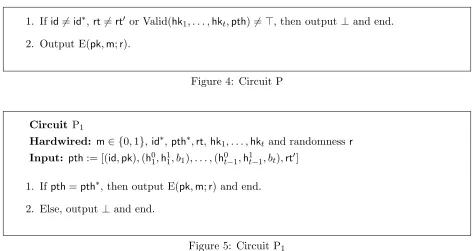
High-level proof sketch. Let Tree be the underlying tree at the time of encryption. An en-cryption of a bit mto an identity id corresponds to an IO obfuscation of a circuit P, which takes as input a path, and which will release an encryption of m under a public key given as a leaf of the path, if the given path is “valid.” As a hybrid, we will consider a circuit P1, which does all
the checks that are already performed by P, but which also does the following: if the given path is not present in the tree, then P1 will return ⊥, even if the path is valid. We will show that
for any fixed bit m, if we encrypt m by obfuscating either the circuit P or P1, the result will be
indistinguishable. We will make use of the somewhere statistical binding and index hiding of the underlying hash function in order to prove this. Now under an obfuscation of P1, one may easily
switch the hardwired plaintext bit. The reason is that since under P1, a given input path to the
circuit must be present in the tree, and since the challenge identityid∗ is registered only once (say under a public key pk), one may consider a related circuit which, instead of hardwiring a plaintext bitm, it hardwires into itself an encryption c←E(pk,m). The rest follows by semantic security of the PKE scheme.
We now go over the formal proof. We start by defining some notation.
Notation. Consider a path pth := [(id,pk),(h01,h11, b1), . . . ,(h0t−1,ht1−1, bt−1),rt] where rt is the
root and id andpk are the two leaves and b1, . . . , bt−1 ∈ {left,right}. For a treeTree of deptht, we
writepth⊆Treeifpthis a valid path inTreein the usual sense. The procedure Valid(hk1, . . . ,hkt,pth)
checks if the given path is a ‘valid path’ according to the given hash keyshk1, . . . ,hktthen it output >, otherwise outputs ⊥. For a path pth and interger i we write Last(pth, i) to refer to the last i
node “elements” inpth. Note that we do not consider the left-or-right bits as part of this counting. For example, letting pthbe as above,
Last(pth,5) = ((h0t−2,h1t−1, bt−2),(h0t−1,h1t−1, bt−1),rt).
We also extend the notation⊆given above to define Last(pth, i)⊆Treein the straightforward way.
Hardwired: m∈ {0,1},id∗,rt,hk1, . . . ,hkt and randomnessr
1. Ifid6=id∗,rt6=rt0 or Valid(hk1, . . . ,hkt,pth)6=>, then output ⊥and end.
2. Output E(pk,m;r).
Figure 4: Circuit P
Circuit P1
Hardwired: m∈ {0,1},id∗,pth∗,rt,hk1, . . . ,hkt and randomnessr
Input: pth:= [(id,pk),(h01,h11, b1), . . . ,(h0t−1,h1t−1, bt),rt0]
1. Ifpth=pth∗, then output E(pk,m;r) and end.
2. Else, output ⊥and end.
Figure 5: Circuit P1
Notation used in hybrids. We will write id∗ ←Adv(hk1, . . . ,hkκ) to mean that the adversary
Adv receivespp:= (hk1, . . . ,hkκ) as input, interacts with the challenger Chalas per Definition 3.7
and outputs id∗ as the challenge identity.
• Hybrid H1: Encrypt m= 0 using P. The ciphertext ct given to the adversary is formed
as follows.
1. Forj∈[κ] sample hkj ←HGen(1κ,0).
2. id∗ ←Adv(hk1, . . . ,hkκ).
3. ct ← Obf(P[0,id∗,rt,hk1, . . . ,hkt, r]), where rt is the root of the tree, t is the depth of
the tree, andr← {0,1}∗.
• Hybrid H2: Encryptm= 0 usingP1. The ciphertextctgiven to the adversary is formed
as follows.
1. Forj∈[κ] sample hkj ←HGen(1κ,0).
2. id∗ ←AdvRegsel,Regsmp(hk
1, . . . ,hkκ).
3. ct←Obf(P1[0,id∗,pth∗,rt,hk1, . . . ,hkt, r]), wherepth∗ is the path in the tree leading to
the challenge node, rtis the root ofpth∗,tis the depth of the tree, andr← {0,1}∗. • Hybrid H3: Encrypt m= 1 using P1. The ciphertextct given to the adversary is formed
as follows.
1. Forj∈[κ] sample hkj ←HGen(1κ,0).
3. ct←Obf(P1[1,id∗,pth∗,rt,hk1, . . . ,hkt, r]), wherepth∗ is the path in the tree leading to
the challenge node, rtis the root ofpth∗,tis the depth of the tree, andr← {0,1}∗. • Hybrid H4: Encrypt m= 1 using P. The ciphertext ct given to the adversary is formed
as follows.
1. Forj∈[κ] sample hkj ←HGen(1κ,0).
2. id∗ ←Adv(hk1, . . . ,hkκ).
3. ct←Obf(P[1,id∗,rt,hk1, . . . ,hkt, r]), wherertis the root of the underlying tree,tis the
depth of the tree, andr← {0,1}∗.
Notation. We usecthHii to denote the value of the ciphertext ctin Hybrid Hi.
Lemma 4.6. We have,
1. cthH1i≈c cthH2i,
2. cthH3i≈c cthH4i.
Proof. We will prove Part 1, and the proof for Part 2will be exactly the same.
Recall that in hybrid H1 we encryptm= 0 by obfuscating P and that in hybridH2 we encrypt
m= 0 by obfuscating P1. Lett be the depth of the tree at the time of encryption.
We will define intermediate hybrids P2,i fori∈[2t+ 1], and we will show P≡P2,1, P1 ≡P2,2t+1
and for all i∈[2t], Obf[P2,i] c
≈Obf[P2,i+1]. These circuit programs are given in Figure 6.
Informally, the program P2,i works as follows: it checks whether its given path is “correct” and
whether, in addition, the lastielements of the path are in accordance with the challenge pathpth∗
that was hardwired into the program. For example, ifi= 5, then the root of the path and the two levels below it (five nodes in total) should match the corresponding nodes in the challenge path
pth∗. If both these conditions hold, then P2,iwill encrypt the hardwired plaintext bit (m= 0) using
the public key provided in the corresponding leave of the path. We will now define a Hybrid H2,i below, which uses program P2,i.
• Hybrid H2,i: Encrypt m= 0 using P2,i. The given ciphertext ctis as:
1. Forj∈[κ] sample hkj ←HGen(1κ,0).
2. id∗ ←Adv(hk1, . . . ,hkκ).
3. ct ← Obf(P2,i[0,id∗,pth∗,rt,hk1, . . . ,hkt, r]), where pth∗ is the challnege path in the
system, rtis the root ofpth∗,tis the depth of the tree, andr ← {0,1}∗.
First, by inspection we can see thatcthH1i c
≈cthH2,1iandcthH2i c
≈cthH2,2t+1i. This is because
the underlying two circuits P and P2,1 are functionally equivalent. Same holds for P1 and P2,2t+1.
Thus, for any fixed w∈[2t] we just need to prove
cthH2,wi≈c cthH02,wi≈c cthH02,w+1i≈c cthH2,w+1i. (9) This will establish Equation 8.
Informally, the hybrids H02,w and H02,w+1 are defined similarly to H2,w and H2,w+1, except that
one of the many hash keys is now sampled in a different way, in order to make some binding property happen.
For z∈ {w, w+ 1}, the hybridH02,z is defined as follows.
• Hybrid H02,z for z∈ {w, w+ 1}. The given ciphertextct is formed as follows.
1. Letq :=t− bw2c −1 Intuitively,q denotes the level index in the tree for which we want to use a different hash key. For alli∈[κ]\ {q}: sample hk0i ←HGen(1κ,0). Sample
hk0q ←HGen(1κ, v), wherev:= (w+ 1) mod 2.
2. id∗1 ←Adv(hk01, . . . ,hk0κ).
3. ct ← Obf(P2,i[0,id∗1,pth∗1,rt1,hk01, . . . ,hk0t, r]), where pth∗1 is the challnege path in the
system, rt1 is the root ofpth∗ and r← {0,1}∗.
Toward proving Equation 9, first note that by the index hiding property of (HGen,Hash) we have cthH2,wi
c
≈cthH02,wi andcthH2,w+1i c
≈cthH02,w+1i. Thus, it remains to prove
cthH02,wi≈c cthH02,w+1i. (10) To prove Equation 10, we claim that the underlying two programs are equivalent,
P2,w[0,id∗1,pth ∗
1,rt1,hk01, ..,hk 0
t, r] = P2,w+1[0,id∗1,pth ∗
1,rt1,hk01, ..,hk 0
t, r]. (11)
By IO security, Equation 11 implies Equation10, and thus we just need to prove Equation 11. To prove equivalence of the two circuits in Equation 11, assume to the contrary that there exists an input pth for which we have P2,w(pth) 6= P2,w+1(pth). (Here for better readability we dropped
the hardwired values.) By simple inspection we can see that we have P2,w(pth) 6= P2,w+1(pth) iff
all the following conditions hold:
1. Valid(hk01, . . . ,hk0t,pth) =>; and 2. Last(pth, w)⊆pth∗1; and
3. Last(pth, w+ 1)6⊆pth∗1.
This, however, is a contradiction because by the somewhere statistical binding property of (KGen,Hash) and by the way in which we have sampledhk0q, Conditions1 and 2 contradict Condition3.
Description of Circuit P2,i.
Hardwired: m∈ {0,1},id∗,pth∗,rt,hk1, . . . ,hkt and randomnessr
1. Ifid6=id∗ orrt6=rt0 or Valid(hk1, . . . ,hkt,pth)6=>, then output ⊥and end.
2. If Last(pth, i)⊆pth∗, then output E(pk,m;r) and end. 3. Otherwise, output ⊥and end.
Figure 6: Circuit P2,i fori∈[`]
Lemma 4.7. cthH2i c
≈cthH3i.
Proof. The proof is similar to the proof of Lemma 4.4.
5
Basing Weakly-Efficient RBE on Standard Assumptions
In this section, we describe our construction of RBE based onhash garbling and is inspired by our IO based construction from previous section. This notion and its construction has been implicit in prior works [CDG+17,DG17], and it was shown [DG17,DGHM18,BLSV18] that hash garbling can be realized based on CDH, Factoring or LWE assumptions. Specifically, implicit in these prior works are constructions of hash garbling based on hash encryption and garbled circuits. Below, we abstract out this notion and use it in our work directly. This abstract primitive significantly simplifies exposition.
Definition 5.1 (Hash garbling). A hash garbling scheme consists of four PPT algorithms HGen, Hash, HG, and HInp, defined as follows.
• HGen(1κ,1`) → hk. This algorithm takes the security parameter κ and an output length
parameter 1` for`≤poly(κ), and outputs a hash key hk. (HGen runs in poly(κ) time.)
• Hash(hk, x) =y. This takeshk and x∈ {0,1}` and outputs y∈ {0,1}κ.
• HG(hk,C,stt) → C. This algorithm takes a hash keye hk, a circuit C, and a secret state
stt∈ {0,1}κ as input and outputs a circuit
e C.
• HInp(hk, y,stt) → ey. This algorithm takes a hash key hk, a value y ∈ {0,1}κ, and a secret
statestt as input and outputsye.
We require the following properties for a hash garbling scheme:
• Correctness. For all κ, `, hk ← HGen(1κ,1`), circuit C, input x ∈ {0,1}`, stt ∈ {0,1}κ,
e
C←HG(hk,C,stt) andye←HInp(hk,Hash(hk, x),stt), then C(e e
y, x) = C(x).
• Security. There exists a PPT simulatorSimsuch that for allκ, `(recall that`is polynomial inκ) and PPT (in κ) A we have that
(hk, x,C,e ye)
c
≈(hk, x,Sim(hk, x,1|C|,C(x))),
where hk ← HGen(1κ,1`), (C, x) ← A(hk), stt ← {0,1}κ,
e
C ← HG(hk,C,stt) and ye ←
Notation on binary trees. Just like the IO construction, in our construction below,Tree is a full binary tree where the label of each node in Tree is calculated as the hash of its left and right children and, now additionally, with an an extra identity. Looking ahead, this identity will be the largest identity among the users registered in the left child. (Such information is useful if one wants to a binary search of an identity over this tree.) Just as in the IO-based construction, we define the size of a treeTreeas the number of itsleaves, denoted by size(Tree), and we denote the root of
Tree asrt(Tree), and used(Tree) to refer to the depth ofTree. Again, when Treeis clear from the context, we usertand d to denote the root and the depth ofTree.
Before describing the construction, recall that without loss of generality, we can assume that public keys, secret keys, and identities, are all of length security parameter κ.
Comparison with Construction 4.1 using signs (=) and (??). To help the reader familiar with Construction4.1, we have denoted the steps that are identical to Construction4.1by (=) and the steps that are significantlydifferent by (??). Other steps are close but not identical.
Construction 5.2 (Construction of RBE from hash garbling). We will use a hash garbling scheme (HGen,Hash,HG,HInp) and a public key encryption scheme (G,E,D). Using them we show how to implement the subroutines of RBE according to Definition 3.1.
• Stp(1κ)→(pp0), where pp0=hk is sampled from HGen(1κ,13κ).
• Reg[aux](ppn,id,pk)→ppn+1. This algorithm works as follows:
1. (=) Parseauxn:= ({Tree1, . . . ,Treeη}),(id1, . . . ,idn)) where the trees have corresponding
depths d1 >d2· · ·>dη, and (id1, . . . ,idn) is the order the identities registered.8
2. Parseppnas a sequence (hk,(rt1,d1), . . . ,(rtη,dη)) whererti ∈ {0,1}κrepresents the root
of treeTreei and di represents the depth ofTreei.
3. Create a new treeTreeη+1with leavesid,pkand set its root asrtη+1←Hash(hk,id||pk||0κ)
and thus its depth would bedη+1 = 1.
4. (=) LetT ={Tree1, . . . ,Treeη+1}. (We will keep changing T in step below.)
5. While there are two different treesTreeL,TreeR∈ T of the same depthdand sizes= 2d
(recall that our trees are always full binary trees).
(a) Obtain newTreeof depthd+ 1 by merging the two treesTreeLandTreeRas follows.
(b) (??) Let id1. . .idn0 and pk1. . .pkn0 be the identities and public keys of n0 users in both treesTreeL and TreeR combined insorted order according to identities.
(c) For each i∈[n0], leth0,i:= Hash(hk,idi||pki||0κ).
(d) (??) Next for each j∈ {1, . . .logn0} andk∈ {0, . . . ,(n0/2j)−1}, let
hj,k = Hash(hk, hj−1,2k||hj−1,2k+1||id[j, k])
where id[j, k] is the largest identity in the left child (which is the node with label
hj−1,2k); namelyid[j, k] =id(2k+1)·2j−1. This completes the description of Tree.
(e) (=) Remove both ofTreeL,TreeR fromT and addTree toT instead. 8
6. Let T = {Tree1, . . . ,Treeζ} where d01 > · · · > d0ζ is their corresponding depth and
rt01, . . . ,rt0ζ is their corresponding roots. Set ppn+1,auxn+1 as
auxn+1 = (T,(id1, . . . ,idn,idn+1 =id)),ppn+1= (hk,(rt01,d01), . . . ,(rt0ζ,d0ζ)).
• Enc(pp,id,m)→ct:
1. Parsepp:= (hk,(rt1,d1), . . . ,(rtη,dη)).
2. For each i∈ {1, . . . η} and j ∈ {1, . . . ,di}, sample stti,j ← {0,1}κ and generate Pei,j ← HG(hk,Pi,j,stti,j), where Pi,j is explained below.
3. For eachi∈[η] obtain yei,1←HInp(hk,rti,stti,1).
4. Output the ciphertextct= (pp,{Pei,j}i,j,{yi,e 1}i). The program Pi,j works as follows:
Hardwired values: rti,di,hk,m,id,r,stti,j+1 (where stti,di+1 =⊥)
Input: a||b||id∗
1. Ifid∗= 0κ9 and a=idthen output E(b,m;r). 2. Ifid∗= 0κ and a6=idthen output ⊥.
3. Ifid>id∗ then output HInp(hk, b,stti,j+1), else output HInp(hk, a,stti,j+1).
• Updaux(pp,id)→u: If idis a leaf in a tree of aux, sayTree, return thewhole Merkle opening
pthof leafid and its sibling pk to the rootrt(Tree). Otherwise, return⊥.
• Dec(sk,u,ct)→m: Parsect= (pp,{Pei,j}i,j,{yei,1}i) andu:= (z1. . . zd
i∗). Leti
∗ be the index
of the tree that holds the corresponding identity.10 Decryption proceeds as follows:
1. Forj={1. . .di∗−1}do – eyi∗,j+1=Pei∗,j(yie∗,j, zj).
2. Letct:=Pei∗,d
i∗(yei∗,di∗, zdi∗).
3. Output D(sk,ct).
Theorem 5.3. The RBE of Construction 5.2 satisfies the compactness, completeness (Defini-tion 3.3), and security (Definition 3.7) properties.
In the rest of this section, we prove Theorem5.3. The completeness and compactness properties are proved similar to those of Construction 4.1. We can again verify that over the course of the system’s execution, the tree that holds a user id, will not be merged with other trees more than logn times. (Each merge increases the depth of the tree by one, and the depth cannot bypass logn.) We may use this fact to conclude all the efficiency features for the RBE scheme.
In the rest of this section, we focus on proving security.
9Without loss of generality we assume that no user is assigned the identity 0κ.
10
5.1 Proof of Security
Similar to our presentation of the proof of Construction 4.1, here also we first start by giving the proof for the case in which onlyone user has registered. We will then present the general proof.
Hardwired: rt,hk,m∈ {0,1},id0,rand stt
Input: (id,pk,id∗)
1. Ifid∗6= 0κ orid6=id0, then output ⊥and end.
2. Output E(pk,m;r) and end.
Figure 7: Circuit P used for encryption ofm to identityid0
Theorem 5.4 (Security). For any identity id0 we have
(HG(hk,P0,stt),HInp(hk,rt,stt)) c
≈(HG(hk,P1,stt),HInp(hk,rt,stt)) (12)
where hk ← HGen(1κ,13κ), stt ← {0,1}κ, (pk,sk) ← G(1κ), rt := Hash(hk,(id0,pk,0κ)) and for
m∈ {0,1} the circuit programPm is defined as
Pm:= P[rt,hk,m,id0,r,stt]. (13)
Proof. For m∈ {0,1} let ctm denote the challenge ciphertext, namely
ctm:= (HG(hk,P0,stt),HInp(hk,rt,stt)), (14)
where all the variables are sampled as in the theorem. We need to show ct0 c
≈ct1. By simulation
security of the hash garbling scheme, for bothm∈ {0,1} we have
ctm c
≈Sim(hk,(id0,pk,0κ),1|Pm|,E(pk,m;r)). (15)
By semantic security of the underlying public-key encryption scheme we have
Sim(hk,(id0,pk,0κ),1|P0|,E(pk,0;r))≈c Sim(hk,(id0,pk,0κ),1|P1|,E(pk,1;r)), (16)
and so we obtain ct0 c ≈ct1.
Proof for the general case. As in the proof in Section 4.2.2we may assume that at the time of encryption we have only one tree. The proof for the case of multiple trees is the same.
Proof. Suppose at the time of encryption the underlying tree with rootrthas depthd. In the sequel we shall write Pj forj ∈[d] to refer to the circuit program P1,j described in our RBE construction.
That is,
P1 ≡P1,1[rt,d,hk,m,id,r,stt1,2], (17)
and for j >1