ClinicoEconomics and Outcomes Research
Dove
press
O R I G I N A L R E S E A R C H
Open Access Full Text Article
open access to scientific and medical research
Early introduction of a semi-elemental formula
may be cost saving compared to a polymeric
formula among critically ill patients requiring
enteral nutrition: a cohort cost–consequence
model
Alistair S Curry1
Shkun Chadda1
Aurélie Danel2
Douglas L Nguyen3
1Health Economics, SIRIUS Market
Access, London UK; 2Market Access,
Nestlé Health Science, Vevey, Switzerland; 3University of
California-Irvine Department of Medicine, Orange, CA, USA
Objectives: Gastrointestinal (GI) intolerance is associated with adverse outcomes in critically ill patients receiving enteral nutrition (EN). The objective of this analysis is to quantify the cost of GI intolerance and the cost implications of starting with semi-elemental EN in intensive care units (ICUs).
Study design: A US-based cost–consequence model was developed to compare the costs for patients with and without GI intolerance and the costs with semi-elemental or standard EN while varying the proportion of GI intolerance cases avoided.
Materials and methods: ICU data on GI intolerance prevalence and outcomes in patients receiving EN were derived from an observational study. ICU stay costs were obtained from literature and the costs of EN from US customers’ price lists. The model was used to conduct a threshold analysis, which calculated the minimum number of cases of GI intolerance that would have to be avoided to make the initial use of semi-elemental formula cost saving for the cohort.
Results: Out of 100 patients receiving EN, 31 had GI intolerance requiring a median ICU stay of 14.4 days versus 11.3 days for each patient without GI intolerance. The model calculated that semi-elemental formula was cost saving versus standard formula when only three cases of GI intolerance were prevented per 100 patients (7% of GI intolerance cases avoided).
Conclusion: In the US setting, the model predicts that initial use of semi-elemental instead of standard EN can result in cost savings through the reduction in length of ICU stay if >7% of GI intolerance cases are avoided.
Keywords: intensive care unit, enteral nutrition, semi-elemental formula, gastrointestinal intolerance, costs
Plain language summary
The economic impact of gastrointestinal intolerance and use of semi-elemental nutri-tion in the ICU has not previously been modeled to the authors’ knowledge. A model was developed to analyze the costs of using semi-elemental versus polymeric enteral nutrition in an intensive care unit (ICU) cohort in the USA.
The model shows the following:
• The costs associated with gastrointestinal intolerance in the ICU in terms of length of stay constitute a high burden in the US health care system.
Correspondence: Alistair S Curry 58 St Kilda Road, London W13 9DE, UK Tel +44 203 657 2534
Email [email protected]
Journal name: ClinicoEconomics and Outcomes Research Article Designation: ORIGINAL RESEARCH
Year: 2018 Volume: 10
Running head verso: Curry et al
Running head recto: Modeled cost savings with semi-elemental nutrition in critical care DOI: http://dx.doi.org/10.2147/CEOR.S155312
ClinicoEconomics and Outcomes Research downloaded from https://www.dovepress.com/ by 118.70.13.36 on 21-Aug-2020
For personal use only.
Dovepress
Curry et al
• Preventing gastrointestinal intolerance by initial use of semi-elemental instead of polymeric formula could lead to potential cost savings by reducing ICU length of stay.
Introduction
Inadequate nutritional intake can adversely affect the clinical course in critically ill patients. Specialized nutritional sup-port, given either parenterally or enterally, is often required to improve patient outcomes and reduce morbidity and mortality. The 2016 American Society for Parenteral and Enteral Nutrition (ASPEN)/Society of Critical Care Medi-cine (SCCM) Nutrition Support Guidelines for Critically Ill Adults recommend first the use of early enteral nutrition (EN) because of data demonstrating the improvement in patient outcomes such as reduction in infectious complications, in the length of mechanical ventilation, and in the overall length of hospital stay.1 Second, EN is preferred over the early use
of parenteral nutrition because of earlier return of normal gut function and reduction in health care costs.1 In the intensive
care unit (ICU) setting, Peake et al reported that ~40% of patients required EN support.2
Gastrointestinal (GI) intolerance, characterized by upper (e.g., nausea, vomiting) or lower GI symptoms (e.g., diar-rhea), poses a significant problem in patients admitted to ICUs and often limits the ability to achieve adequate daily protein and caloric intake. Feed intolerance often arises from impaired gastroduodenal motility and nutrient absorption.3
Depending on the underlying medical condition, the defini-tion of feeding intolerance, and the nutridefini-tional support, GI intolerance can be frequent in the ICU. A study showed that 36% of enterally fed patients had an incident of diarrhea during the ICU stay.4 Delayed gastric emptying and
intra-abdominal hypertension are other common GI symptoms in ICU patients, reported in 60%5 and 27% of patients,
respectively.6 A multinational study concluded that >40% of
patients had GI symptoms during the first week of ICU stay.7
GI intolerance in the ICU increases the risk of malnutrition and the ability to tolerate routine EN support, which has been associated with poor patient outcomes including an increased length of stay (LOS), longer days on mechanical ventilation, and higher mortality rates.3
The ASPEN/SCCM guidelines note that “no clear benefit to patient outcome has been shown in the literature for the routine use of specialty formulas in a general ICU setting” (expert consensus) and that “small peptide formulations should be used in the patient with persistent diarrhea, with suspected malabsorption or lack of response to fiber” (expert consensus).1 The European Society for Parenteral and Enteral
Nutrition guidelines also note that the clinical trial evidence for the impact of semi-elemental EN versus standard EN in ICU patients is contradictory with two trials showing a reduction in diarrhea, one showing an increase in diarrhea, and one trial showing no difference. The European Society for Parenteral and Enteral Nutrition guidelines conclude that “As no clear cut advantage of peptide-based formulae has been demonstrated in these studies and taking into account the higher price, we concluded that the use of peptide-based formulas should not be recommended (Grade C).”8
Though a standard polymeric formula (containing whole proteins and mainly long chain type of triglycerides) used as first-line EN may be adequate in a variety of clinical settings, a more specialized semi-elemental formula, containing pep-tides and mostly medium chain type of triglycerides, may still offer clinical benefits for some high-risk, critically ill patients.
Alexander et al summarized the nutritional and health benefits of semi-elemental formulas in various nutritionally high-risk populations, including those with Crohn’s dis-ease, short bowel syndrome, acute and chronic pancreatitis, cerebral palsy, cystic fibrosis, cerebrovascular accidents, immunocompromised patients, and ICU patients.9 An adult
ICU population may contain patients with these conditions at the time of admission to the ICU. They reported that a 100% whey semi-elemental formula would lead to fewer cases of GI intolerance than a standard formula because the enzymatically hydrolyzed whey protein helps facilitate gas-tric emptying and reduces the risk for reflux and aspiration, although the comparative data specific to adult ICU patients did not demonstrate improved GI tolerance. In addition, semi-elemental formulas may improve the fat absorption and help promote better GI tolerance because of their high proportion of medium-chain triglycerides as a percentage of the total fat content.10 Semi-elemental EN has been
demon-strated to have a benefit in upper GI intolerance symptoms in children with development delay switched from standard EN in a retrospective study.11 However, the evidence for
upper GI intolerance in adult ICU patients is contradictory. In one trial conducted in acutely injured adult patients in the ICU the prevalence of elevated gastric residuals was similar between semi-elemental EN and standard EN.12 Conversely,
a retrospective study in abdominal surgery patients showed that the average maximum gastric residual volume (GRV) of patients receiving semi-elemental EN during their ICU stays was significantly lower than that of patients receiving standard EN.13
Given the improved outcomes in critically ill patients receiving enteral feeding, and the higher acquisition costs
ClinicoEconomics and Outcomes Research downloaded from https://www.dovepress.com/ by 118.70.13.36 on 21-Aug-2020
Dovepress Modeled cost savings with semi-elemental nutrition in critical care
of semi-elemental formulas compared with standard formulas, we have developed an ICU cohort simulation cost– consequence model. The model explores the cost and consequences of assuming different proportions of GI intoler-ance cases avoided by early introduction of a semi-elemental formula rather than a standard formula.
Materials and methods
Model specifications
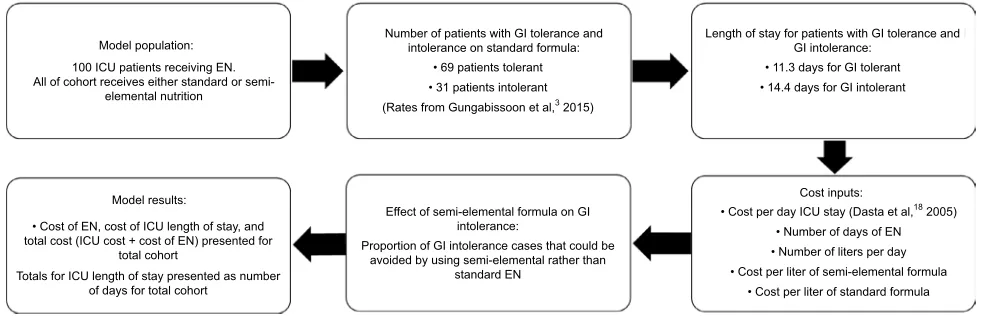
We developed a US-based cost–consequence model in Microsoft Excel to compare the total ICU costs for patients with and without GI intolerance who are receiving EN in the ICU, and to quantify the economic impact of early utilization of a semi-elemental formula instead of a standard formula. Using a standard formula as the comparator is a conservative approach because it represents the EN standard of care of most ICU patients. The time frame is short term as it assesses the costs during the ICU stay. The overview of the model is summarized in Figure 1.
Defining the incidence of GI intolerance and impact
on length of ICU stay
A comprehensive literature review (PubMed, MEDLINE, and the Cochrane Library between 2005 and 2015) was performed to identify the incidence and the economic burden of GI intol-erance among critically ill patients. Published data are limited in this field. The most robust publication on this topic was a multicenter, international study by Gungabissoon et al, which was used as the foundation of the cost–consequence model.3
In a retrospective analysis of the 2009 International Nutri-tion Survey of 167 ICUs from 21 countries,14 Gungabissoon
et al reported an incidence of 30.5% of adult ICU patients developing GI intolerance that required interruption of EN feeding.3 The analysis included patients on mechanical
ventilation for at least 48 hours requiring at least 72 hours stay in the ICU setting. The 1,888 patients indexed in the study were composed of the following diagnostic categories: respiratory (31%), neurologic (16%), trauma (13%), sepsis (11%), cardiovascular medical (8%), cardiovascular surgical (5%), GI surgical (5%), GI medical (3%), and other (8%). Feed intolerance was defined as one or more of large GRV, abdominal distension, vomiting/emesis, significant diarrhea, or subjective discomfort requiring interruption of EN. The median time to intolerance from initiation of enteral feeding (on average after 34.9 hours) was 3 days (range 1–12 days). Feed intolerance was associated with a reduction in the quan-tity of nutrients delivered, fewer ventilator-free days, longer ICU stay, and increased mortality (Table 1).
The large study conducted by Gungabissoon et al3 was
prompted by previous studies that had reported the relation-ships between feed intolerance and mortality, pneumonia, and length of ICU stay, but were based on small cohorts in a limited number of centers.6,15
In the model, it was assumed that, for every 100 ICU patients receiving EN, 31 will develop GI intolerance and 69 will remain GI tolerant based on Gungabissoon et al find-ings.3 Themean length of ICU stay in the model was 14.4
days for patients with GI intolerance and 11.3 days for those who were GI tolerant.3
Improved tolerance with semi-elemental formula versus standard formula
No controlled trial or observational data in the literature reported an estimate of the number of cases of GI intoler-ance that could be avoided in an adult population by using a semi-elemental EN formula compared to a standard formula in a general ICU setting. However, some studies were identi-fied but were not used as base case estimates in the model
Figure 1 Model outline.
Abbreviations: EN, enteral nutrition; GI, gastrointestinal; ICU, intensive care unit. Model population:
100 ICU patients receiving EN. All of cohort receives either standard or
semi-elemental nutrition
Number of patients with GI tolerance and intolerance on standard formula:
• 69 patients tolerant • 31 patients intolerant
(Rates from Gungabissoon et al,3 2015)
Effect of semi-elemental formula on GI intolerance:
Proportion of GI intolerance cases that could be avoided by using semi-elemental rather than
standard EN
Length of stay for patients with GI tolerance and GI intolerance:
• 11.3 days for GI tolerant • 14.4 days for GI intolerant
Cost inputs:
• Cost per day ICU stay (Dasta et al,18 2005) • Number of days of EN • Number of liters per day • Cost per liter of semi-elemental formula
• Cost per liter of standard formula
Model results:
• Cost of EN, cost of ICU length of stay, and total cost (ICU cost + cost of EN) presented for
total cohort
Totals for ICU length of stay presented as number of days for total cohort
ClinicoEconomics and Outcomes Research downloaded from https://www.dovepress.com/ by 118.70.13.36 on 21-Aug-2020
Dovepress
Curry et al
because they were for diarrhea outcomes only,16 contained a
high protein rather than standard EN for comparison,17 and
retrospectively collected data for intra-abdominal patients only.13 The model allows the user to vary the proportion of
GI intolerance cases avoided and calculates the threshold number of GI cases avoided for the semi-elemental formula to be cost saving versus the standard formula.
Economic data
The estimated cost of ICU stay was $4,714 per day, based on the value of $3,500 reported by Dasta et al inflated to 2016 values using the US Consumer Price Index.18 Dasta
et al calculated the cost per day of ICU stay by multiplying daily hospital charges by hospital-specific cost-to-charge ratios, as it was a multicenter study. This cost represents an average ICU stay cost, as Dasta et al performed their analysis on data from trauma, surgical, and medical ICUs. In the model, it was assumed that patients received 1.5 L of standard or semi-elemental formula for 8 days based on the average duration found in the Gungabissoon et al study.3 At a
cost per liter of $10.17 for the standard formula (Isosource®;
Nestlé Health Science) and $36.67 for the semi-elemental formula (Peptamen®; Nestlé Health Science), this equates to
the costs of $122.04 and $440.04, respectively, per episode of EN (publicly available 2016 customer list prices).
Sensitivity analysis
We conducted one-way sensitivity analyses to examine the impact of variation in single parameters on the results. We assessed the results if 1) GI intolerance resulted in only one additional day in ICU; 2) the incidence of GI intolerance was reduced from 31% to 22% based on the lowest incidence observed in the Gungabissoon et al study (Latin America region);3 3) the LOS was reduced from 14.4 to 7 days for
GI-tolerant cases (and from 11.3 to 5.5 days for GI-intolerant cases); and 4) the cost per ICU day was decreased by 20% from $4,714 to $3,771.
Results
Cost of GI intolerance
Based on a population of 100 patients entering the model, 31 of whom are expected to develop GI intolerance, the total length of ICU stay is 1,226.1 days, compared to the total length of ICU stay of 1,130.0 days in patients without GI intolerance. Therefore, GI intolerance accounts for 96.1 additional days in the ICU (3.1 additional days per GI-intolerant patient), resulting in an additional cost of $453,015 for the cohort.
Economic impact of initial use of a
semi-elemental formula
Using the model, we calculated for the 100-patient cohort that a semi-elemental formula would start to be cost saving compared with a standard formula when only 7.0% of GI-intolerant cases (3/31, rounded up to the nearest whole case) are avoided by using semi-elemental EN in all patients and with the base case estimate of 3.1 additional days in the ICU per intolerant patient applied. The ICU and EN cost implica-tions are detailed in Table 2.
Sensitivity analysis
We ran sensitivity analyses by varying single inputs as pre-viously described. For each of the scenarios, we calculated what would be the minimum efficacy for the semi-elemental formula to be cost saving versus the standard formula. The efficacy, defined as the proportion of GI cases avoided by using the semi-elemental formula rather than standard EN, varied from 3.5% to 21.8% (Table 3).
Discussion
ICU care expends a large proportion of hospital resources, despite a relatively low proportion of beds allocated to caring for critically ill patients. Prolonged ICU stays, often char-acterized as ICU admissions beyond 7–15 days, have been
Table 1 Comparison of outcomes between enteral feeding intolerant and tolerant patients
Outcome Tolerant (n=1,312) Intolerant (n=576) p-value
% Calories adequate (mean) 64.3±23.6 55.6±23 <0.0001
% Protein adequate (mean) 63.7±24.4 55.6±23.9 <0.0001
Ventilator-free days (median) 11.2 (0, 21.3) 2.5 (0, 18.8) <0.0001
ICU stay (median days) 11.3 (7.5, 20.1) 14.4 (9.1, 24) <0.0001
60-day mortality, % 26.2 30.8 0.04
Time to discharge alive from hospital (median days) 20.5 (12.9, 30.6) 23.8 (15.5, 35.1) 0.0001
Notes: Means are presented with SD. Interquartile range in parentheses presented for median values. Adapted from Gungabissoon U, Hacquoil K, Bains C, et al. Prevalence,
risk factors, clinical consequences, and treatment of enteral feed intolerance during critical illness. JPEN J Parenter Enteral Nutr. 2015;39(4):441–448, with permission from
John Wiley and Sons.3
Abbreviation: ICU, intensive care unit.
ClinicoEconomics and Outcomes Research downloaded from https://www.dovepress.com/ by 118.70.13.36 on 21-Aug-2020
Dovepress Modeled cost savings with semi-elemental nutrition in critical care
shown to be associated with high mortality rates and con-sume significant health care resources.19,20–22 Beyond initial
hospitalization, prolonged ICU stays are associated with an increased risk for hospital readmission, death within 30 days of hospital discharge, and long-term physical disability on discharge.23–25 There are several ICU quality measures that
have been implemented to reduce the length of ICU stays and the potential complications associated with long-term mechanical ventilation in the ICU. Particularly, the 2016 ASPEN/SCCM Nutrition Support Guidelines for Critically Ill Adults recommends early EN because of significant clinical data demonstrating that early EN improves patient outcomes through a reduction in infectious complications, length of mechanical ventilation, and overall length of hospital stay.1
Although the clinical benefit of EN is well acknowledged, Gungabissoon et al reported that approximately one-third of critically ill patients developed GI intolerance which was associated with more frequent interruptions in enteral feed-ings and a reduction in delivery of daily protein and caloric requirements.3 Despite adjusting for patient characteristics
and disease severity, GI intolerance was an independent risk factor for prolonged ICU stay and resulted in a significantly higher 60-day mortality rate (30.8% versus 26.2%; p=0.04). Tirlapur et al recently found that diarrhea was associated with increased ICU stay and mortality after controlling for demographic and clinical characteristics, which provide further evidence of the association between GI intolerance and negative clinical outcomes in the ICU.26
There is a limited and conflicting evidence base regard-ing the additional benefit of semi-elemental formula in ICU patients. As seen in some populations outside the ICU, these patients, representing a heterogeneous population (condi-tion, severity, and therapeutic procedures), could still benefit from a semi-elemental formula compared with use of other formulas because the hydrolyzed protein and modified fat components are more readily absorbed, and the formula may be better tolerated than the standard formula9 or elemental
formula.27 Semi-elemental formula is approximately three
times more expensive than standard formula; so, it is impor-tant to demonstrate that the additional expenditure will realize an improved outcome for the patient and an efficient use of resources.
We describe a cost–consequence model for an ICU cohort to estimate the potential savings with the initial use of a semi-elemental formula and to explore how many cases of GI intolerance would need to be avoided for the semi-elemental formula to be cost saving versus the standard formula. Three small studies of semi-elemental formula versus standard for-mula assessing adult patients in the ICU were identified, but none were prospective randomized trials assessing a range of GI intolerance outcomes for semi-elemental EN versus standard EN in a broad population of ICU patients. Jakob et al conducted a study on 89 adult ICU patients (medical and surgical).16 The proportion of patients experiencing diarrhea
during their ICU stay was lower in the semi-elemental group (64% versus the standard formula group [70%]) but was not statistically significant (risk ratio 0.91 [95% CI 0.68–1.22,
p=0.65]). There were 0 days where feeding was interrupted because of diarrhea in the semi-elemental group and 2 days in the standard formula group (p=0.28). Liu et al studied 72 patients who recently underwent intra-abdominal surgery and received EN.13 This retrospective trial found that the mean
LOS in the ICU for the semi-elemental formula group was shorter than that for the standard formula group (6.2±0.8 versus 6.8±1.5 days). This study also demonstrated that the prevalence of suspended feeding due to high GRV resulted in a relative risk reduction of 30% in the semi-elemental formula group compared to the standard formula group. Additionally, the prevalence of diarrhea was 33% lower in the semi-elemental formula group. In a study conducted by Seres and Ippolito on 49 adult ICU patients (medical, surgi-cal, cardiothoracic), the authors reported a 30% relative risk reduction of abdominal distension in the semi-elemental group versus the high protein polymeric formula group and
Table 2 Costs (US$) of managing the total ICU cohort, assuming that use of semi-elemental formula avoids 7% of GI intolerance (three cases)
Cost component Standard enteral
nutritiona
Semi-elemental enteral nutritionb
ICU stay cost (total cohort of 100 patients) 5,779,835 5,748,035
Enteral nutrition cost (100% of patients given formula) 12,204 44,004
Total cost (ICU stay + enteral nutrition) 5,792,039 5,792,039
Difference in total cost for 100 patients receiving semi-elemental formula versus standard enteral formula
0
Notes:aAssumes all patients receive the standard formula and 31 develop GI intolerance. bAssumes all patients receive the semi-elemental formula and 28 of the cohort
develop GI intolerance.
Abbreviations: GI, gastrointestinal; ICU, intensive care unit.
ClinicoEconomics and Outcomes Research downloaded from https://www.dovepress.com/ by 118.70.13.36 on 21-Aug-2020
Dovepress
Curry et al
a 40% reduction in the number of days with GI events (4.29 versus 7.13 days, p=0.0489).17 These results suggest that the
proportion of GI intolerance cases avoided with the semi-elemental formula is likely to be greater than the efficacy threshold calculated as being cost saving in the base case analysis (7.0%) or in the sensitivity analysis (3.5%–21.8%). Based on the published clinical data, if receiving the semi-elemental rather than standard formula leads to 30% of cases of GI intolerance (10 cases) avoided, then it would reduce the ICU stay by 28.8 days, representing a saving of $135,905 in the ICU cost of stay. The total savings for the cohort would be $104,105 lower for the semi-elemental formula cohort when the costs of EN are added to the ICU stay cost.
From the costs set out in Table 1, the relatively low cost of formula feed compared to the overall daily cost of an ICU stay can be observed. Thus, an intervention that reduces the length of ICU stay has the potential to realize significant cost savings. Gungabissoon et al reported that GI intoler-ance increased the median duration of ICU stay from 11.3 to 14.4 days.3 Therefore, the higher cost of the semi-elemental
compared with the standard formula is readily offset by the reduced incidence of GI intolerance and its associated ICU costs. Additionally, the Gungabissoon study reported that 50% of patients developed feeding intolerance between days 1 and 3 after EN initiation.3 This finding further supports
the initial use of the semi-elemental formula as a prudent strategy across the heterogeneous population of ICU patients for whom it is difficult to predict upfront if they are suscep-tible to develop digestive and absorption problems, because an overall cost saving is still observed in our model when three cases of GI intolerance are avoided for a cohort of 100 patients. Patient status (e.g., injury severity score, multiple organ dysfunction score), general conditions (e.g., abdominal surgery), and GI function (e.g., acute gastrointestinal injury grade), as well as biochemical indexes and treatment mea-sures, should be considered as they represent potential risk factors for feeding intolerance.28
There are several limitations to our study. First, no specific clinical trial data are available in the literature to estimate the proportion of GI intolerance cases that could be avoided by using semi-elemental nutrition versus standard nutrition in a diverse ICU population across the range of GI intoler-ance outcomes, as one trial was a retrospective analysis in patients with recent intra-abdominal surgery only,13 one
trial considered diarrhea outcomes only,16 and the other trial
compared a semi-elemental to a high-protein formula and not a standard polymeric formula.17 Therefore, the model
explored the threshold proportion of GI intolerance cases
Table 3
Results of sensitivity analysis varying model inputs
Sensitivity analysis parameters GI intolerance leads to one additional ICU day (instead of 3.1 days) ICU cost per day decreased by 20% GI intolerance incidence is 22% (instead of 31%) ICU total LOS for GI-intolerant cases reduced to 7 days (instead of 14.4 days) – LOS for GI-tolerant cases was 5.5 days instead of 11.3
days. EN feeding reduced
from 8 to 4 days
Standard EN Semi- elemental EN Standard EN Semi- elemental EN Standard EN Semi- elemental EN Standard EN Semi- elemental EN
Semi-elemental efficacy
−
21.8% (7/31 cases avoided)
a
−
8.8% (3/31 cases avoided)
a
−
9.9% (3/22 cases avoided)
a
−
3.5% (2/31 cases avoided)
a
ICU stay cost $ (for the cohort)
5,472,954
5,441,154
4,623,868
4,592,068
5,648,315
5,616,515
2,811,901
2,780,101
EN cost $ (100% of cohort given formula)
12,204
44,004
12,204
44,004
12,204
44,004
6,102
22,002
Note:
aRounded up to the nearest whole number of cases.
Abbreviations:
EN, enteral nutrition; GI, gastrointestinal; ICU, intensive care unit; LOS, length of stay.
ClinicoEconomics and Outcomes Research downloaded from https://www.dovepress.com/ by 118.70.13.36 on 21-Aug-2020
Dovepress Modeled cost savings with semi-elemental nutrition in critical care
avoided, which resulted in cost savings with semi-elemental formula versus standard formula in the model. It should be noted that not all patients in the ICU setting will require a semi-elemental formula to avoid GI intolerance, as the inci-dence of GI intolerance varies depending on various factors including the underlying condition for admission. However, it can be difficult to predict GI intolerance a priori on ICU admission. Therefore, this model indicates that feeding the whole ICU cohort of 100 patients with a semi-elemental formula would be cost saving if three cases of GI intoler-ance are avoided. Second, this analysis only considers costs incurred within the ICU setting, and any further hospital cost savings outside of the ICU have not been assessed. Additional benefits of shortening ICU stays, such as improvement of long-term functional status, reduction in long-term mortal-ity, and reduction in risk for hospital readmissions, have not been captured. Pendharkar et al reported that feeding intolerance in patients with acute pancreatitis was associated with poorer health-related quality of life (HRQoL).29 It is,
therefore, important to consider the overall consequences of GI intolerance on these broader factors: HRQoL, hospital readmission rates, time to recovery, and long-term outcomes alongside short-term ICU costs.
A randomized trial including a broad range of patients using enteral feeding in the ICU and assessing the impact of semi-elemental formula versus standard formula on LOS, recovery time outside the hospital, HRQoL, mortality, and overall treatment costs is required to enable the cost- effectiveness of semi-elemental nutrition to be more fully assessed. Assuming the proportion of patients with feed intolerance is 31% in ICU patients receiving standard EN and 28% in patients receiving semi-elemental nutrition, a trial of semi-elemental EN versus standard EN would require a sample size of n=3,627 per arm to achieve 80% power to detect this difference with a significance level of 5%. This represents the modeled simulation of a 7% reduction in feed intolerance in order for semi-elemental EN to be cost saving. A 25% reduction in feed intolerance (31% versus 23%) would require a sample size of n=482 per arm to achieve 80% power to detect this difference with a significance level of 5%.
To conclude, in theory, semi-elemental EN may be more easily digested, although there is no randomized clinical trial evidence to indicate this in the critically ill across the full range of GI intolerance outcomes. This analysis has been based on the best level of evidence currently available in the literature, but it is a modeled simulation only. Several guidelines recommend considering semi-elemental EN in particular cases, but clinicians may be reluctant to trial a
semi-elemental EN due to the higher cost. This model shows that use of semi-elemental EN in 100 patients in the ICU would be cost saving versus standard polymeric EN if it led to 7% fewer feeding interruptions due to GI intolerance, which extrapolates to 6.75 fewer days LOS in the ICU. Further large randomized controlled trials are required to confirm whether semi-elemental EN can reduce GI intolerance-related feeding interruptions versus standard polymeric EN across the typical range of patients presenting in the ICU.
Acknowledgments
The development of the cost–consequence model described in this manuscript by SIRIUS Market Access was funded by Nestle S.A. Nestlé is a manufacturer of semi-elemental and polymeric enteral nutrition formulas.
Disclosure
The authors report no conflicts of interest in this work.
References
1. McClave SA, Taylor BE, Martindale RG, et al; Society of Critical Care Medicine; American Society for Parenteral and Enteral Nutrition. Guidelines for the provision and assessment of nutrition support therapy in the adult critically III patient: Society of Critical Care Medicine (SCCM) and American Society for Parenteral and Enteral Nutrition (A.S.P.E.N.). JPEN J Parenter Enteral Nutr. 2016;40(2):159–211. 2. Peake SL, Chapman MJ, Davies AR, et al; George Institute for Global
Health; Australian and New Zealand Intensive Care Society Clinical Trials Group. Enteral nutrition in Australian and New Zealand intensive care units: a point-prevalence study of prescription practices. Crit Care Resusc. 2012;14(2):148–153.
3. Gungabissoon U, Hacquoil K, Bains C, et al. Prevalence, risk factors, clinical consequences, and treatment of enteral feed intolerance during critical illness. JPEN J Parenter Enteral Nutr. 2015;39(4):441–448. 4. Ferrie S, East V. Managing diarrhoea in intensive care. Aust Crit Care.
2007;20(1):7–13.
5. Nguyen NQ, Ng MP, Chapman M, Fraser RJ, Holloway RH. The impact of admission diagnosis on gastric emptying in critically ill patients. Crit Care. 2007;11(1):R16.
6. Reintam A, Parm P, Kitus R, Starkopf J, Kern H. Gastrointestinal failure score in critically ill patients: a prospective observational study. Crit Care. 2008;12(4):R90.
7. Reintam Blaser A, Poeze M, Malbrain ML, Bjorck M, Oudemans-van Straaten HM, Starkopf J; Gastro-Intestinal Failure Trial Group. Gastrointestinal symptoms during the first week of intensive care are associated with poor outcome: a prospective multicentre study. Intensive Care Med. 2013;39(5):899–909.
8. Kreymann KG, Berger MM, Deutz NE, et al; ESPEN (European Society for Parenteral and Enteral Nutrition). ESPEN guidelines on enteral nutrition: intensive care. Clin Nutr. 2006;25(2):210–223.
9. Alexander DD, Bylsma LC, Elkayam L, Nguyen DL. Nutritional and health benefits of semi-elemental diets: a comprehensive summary of the literature. World J Gastrointest Pharmacol Ther. 2016;7(2):306–319. 10. Hegazi RA, Wischmeyer PE. Clinical review: optimizing enteral nutri-tion for critically ill patients – a simple data-driven formula. Crit Care.
2011;15(6):234.
11. Minor G, Ochoa JB, Storm H, Periman S. Formula switch leads to enteral feeding tolerance improvements in children with developmental delays.
Glob Pediatr Health. 2016;3:2333794X16681887.
ClinicoEconomics and Outcomes Research downloaded from https://www.dovepress.com/ by 118.70.13.36 on 21-Aug-2020
Dovepress
Curry et al
ClinicoEconomics and Outcomes Research
Publish your work in this journal
Submit your manuscript here: https://www.dovepress.com/clinicoeconomics-and-outcomes-research-journal
ClinicoEconomics and Outcomes Research is an international, peer-reviewed open-access journal focusing on health technology assess-ment, pharmacoeconomics and outcomes research in the areas of diagnosis, medical devices, and clinical, surgical and pharmacological intervention. The economic impact of health policy and health systems
organization also constitute important areas of coverage. The manu-script management system is completely online and includes a very quick and fair peer-review system, which is all easy to use. Visit http://www.dovepress.com/testimonials.php to read real quotes from published authors.
Dove
press
12. Mowatt-Larssen CA, Brown RO, Wojtysiak SL, Kudsk KA. Comparison of tolerance and nutritional outcome between a peptide and a standard enteral formula in critically ill, hypoalbuminemic patients. JPEN J Parenter Enteral Nutr. 1992;16(1):20–24.
13. Liu MY, Tang HC, Hu SH, Chang SJ. Peptide-based enteral formula improves tolerance and clinical outcomes in abdominal surgery patients relative to a whole protein enteral formula. World J Gastrointest Surg.
2016;8(10):700–705.
14. Alberda C, Gramlich L, Jones N, et al. The relationship between nutri-tional intake and clinical outcomes in critically ill patients: results of an international multicenter observational study. Intensive Care Med.
2009;35(10):1728–1737.
15. Mentec H, Dupont H, Bocchetti M, Cani P, Ponche F, Bleichner G. Upper digestive intolerance during enteral nutrition in critically ill patients: frequency, risk factors, and complications. Crit Care Med.
2001;29(10):1955–1961.
16. Jakob SM, Butikofer L, Berger D, Coslovsky M, Takala J. A randomized controlled pilot study to evaluate the effect of an enteral formulation designed to improve gastrointestinal tolerance in the critically ill patient-the SPIRIT trial. Crit Care. 2017;21(1):140.
17. Seres DS, Ippolito PR. Pilot study evaluating the efficacy, tolerance and safety of a peptide-based enteral formula versus a high protein enteral formula in multiple ICU settings (medical, surgical, cardiothoracic).
Clin Nutr. 2017;36(3):706–709.
18. Dasta JF, McLaughlin TP, Mody SH, Piech CT. Daily cost of an intensive care unit day: the contribution of mechanical ventilation. Crit Care Med.
2005;33(6):1266–1271.
19. Becker GJ, Strauch GO, Saranchak HJ. Outcome and cost of prolonged stay in the surgical intensive care unit. Arch Surg. 1984;119(11): 1338–1342.
20. Fakhry SM, Kercher KW, Rutledge R. Survival, quality of life, and charges in critically III surgical patients requiring prolonged ICU stays.
J Trauma. 1996;41(6):999–1007.
21. Heyland DK, Konopad E, Noseworthy TW, Johnston R, Gafni A. Is it “worthwhile” to continue treating patients with a prolonged stay (>14 days) in the ICU? An economic evaluation. Chest. 1998;114(1):192–198. 22. Lipsett PA, Swoboda SM, Dickerson J, et al. Survival and func-tional outcome after prolonged intensive care unit stay. Ann Surg.
2000;231(2):262–268.
23. Delle Karth G, Meyer B, Bauer S, Nikfardjam M, Heinz G. Outcome and functional capacity after prolonged intensive care unit stay. Wien Klin Wochenschr. 2006;118(13–14):390–396.
24. Carden GP, Graham JW, McLennan S, Celi LA. Long-term outcome of long stay ICU and HDU patients in a New Zealand hospital. Crit Care Shock. 2008;11(1):26–34.
25. Chelluri L, Im KA, Belle SH, et al. Long-term mortality and qual-ity of life after prolonged mechanical ventilation. Crit Care Med.
2004;32(1):61–69.
26. Tirlapur N, Puthucheary ZA, Cooper JA, et al. Diarrhoea in the criti-cally ill is common, associated with poor outcome, and rarely due to Clostridium difficile. Sci Rep. 2016;6:24691.
27. Makola D. Elemental and semi-elemental formulas: are they superior to polymeric formulas? Pract Gastroenterol. 2005;34:59–72. 28. Xu L, Wang T, Chen T, Yang WQ, Liang ZP, Zhu JC. Identification of
risk factors for enteral feeding intolerance screening in critically ill patients. Saudi Med J. 2017;38(8):816–825.
29. Pendharkar SA, Asrani V, Das SL, et al. Association between oral feed-ing intolerance and quality of life in acute pancreatitis: a prospective cohort study. Nutrition. 2015;31(11–12):1379–1384.
ClinicoEconomics and Outcomes Research downloaded from https://www.dovepress.com/ by 118.70.13.36 on 21-Aug-2020