Available Online atwww.ijcsmc.com
International Journal of Computer Science and Mobile Computing
A Monthly Journal of Computer Science and Information Technology
ISSN 2320–088X
IJCSMC, Vol. 3, Issue. 6, June 2014, pg.208 – 214
RESEARCH ARTICLE
IDS IMPLEMENTATION IN
A PRIVATE CLOUD
Mr. Ashish Kumbhare, Mr. Manoj Chaudhari
Department of Computer Science & Engineering Priyadarshini Bhagwati College of Engineering, Nagpur Email: [email protected], [email protected]
Abstract- Cloud computing is rising field because of its performance, high availability, least cost and many others. Besides this companies are required there business from cloud computing because the dread of data leakage. Due lack of proper security control policy and weakness in protect which lead to many vulnerability in cloud computing. This thesis has been written to focus on the problem of data leakage and proposes a framework works in two phases. First phase which is known as Threats in cloud computing. In this phase we launch the attacks on the cloud server and analyze the impact of the attacks on server side. The name of the attacks which is launch on the cloud server is known as DDoS, ICMP and Malware attacks. Second phase is Data Security in which Data arrangement is done by client before storing the data.
Index Terms— Cloud Computing, DDoS, Private Cloud, Public Cloud, Community Cloud
I. INTRODUCTION
Everyone has a different definition of cloud computing, so the task of defining cloud computing is not so easy and simple. Fundamentally everyone with an interest in Information technology has an individual.
The key to considerate common explanations of the term cloud computing is to examine the variety of attributes of typical cloud solutions. It does not mean that each cloud characteristic is necessary to cloud computing or even that there is essentially any which qualifies a given approach as appropriate the cloud example. As their own, the cloud solutions are neither compulsory not enough fundamentals to the motion of cloud computing. But usually the more of these characteristics apply the additional possible others will agree to take it as a cloud solution. The definition of cloud computing is based on five different attributes which includes: shared resources, substantial scalability, resistance, pay as you go, and self-provisioning of properties. All these attributes of cloud computing are further explained as given below—
Shared Resources: it is also called multi tenancy. It accepts devoted resources like computing facilities dedicated to a single user or owner, cloud computing is based on a business model in which resources are shared with multiple users use the same resources at the network level, host level, and application level at the same time.
Massive Scalability: Although enterprises could have hundreds or thousands of systems, cloud computing offers the ability to scale to tens of thousands of systems, as well as the facility to tremendously scale bandwidth and storage space.
Elasticity: Users will quickly increase and decrease their computing resources as needed, as well as release resources for other customs when they are no longer required.
Pay as you go: This enables the users to pay for only the resources they actually use and for only the time they need the services.
Self-provisioning of Resources: This will enables the users for self-provision resources, like additional systems for processing capability, software, storage and network resources.
II. DEPLOYMENT MODELS
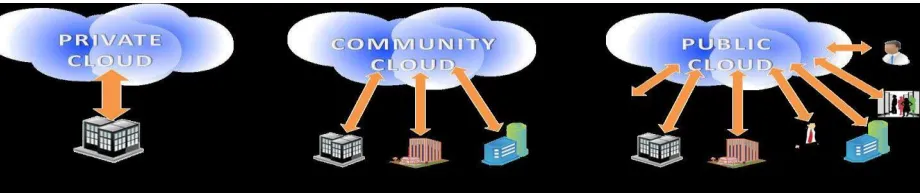
Figure 1 - Deployment Models In Cloud Computing
A. Public Cloud
Public clouds (or external clouds) describe cloud computing in the traditional mainstream sense, whereby resources are dynamically provisioned on a fine-grained, self-service basis over the internet, via web applications or web services, from an offsite, third party provider who shares resources and bills on a fine grained at the basis of utility computing [9].
Benefits of a Public Cloud: The Public clouds allow users to share data as well as store it as per their individual proficiencies. They can decide themselves what to and what not to share with their prospective customers. Public clouds agree to scaling up or down at whatever ability that is necessary by the enterprise.
B. Private Cloud
The Private clouds and internal clouds are rapports used to define and offerings that contend with cloud calculating on private complexes. These are typically virtualization computerization products claim to convey some benefits of cloud computing deprived of the drawbacks, take advantage of on data security, corporate governance, and reliability concerns. Enterprises mostly buy, build and manage them then as such, do not advantage from minor upfront investment costs and less hands-on management [10].
Benefits of a Private Cloud: The main benefits of private cloud are speed. Implementing a service through a self-service intersection point and automating the distribution of those offerings, can increase the rapidity of delivery automatically. A private cloud by itself has unique abilities such as automation, and some form of resource pooling with virtualization which will decrease costs but these can be done without building a complete and comprehensive private cloud.
C. Community Cloud
attendant with using a general public cloud that had not addressed such concerns in its SLA [12].
Benefits of a Community Cloud: In most circumstances in the community cloud the standard condition to be permitted to be a part of a security construction. This is done for the reason that all community members must be vacant to meet certain security obligation standards which in turn would ensure data security independence amongst community members. This will guarantee that the community cloud is secure and hard to get gain access to the community cloud by the attackers.
III. SECURING A PRIVATE CLOUD
In the cloud computing mechanism, a private cloud can work for many sets of internal users. There are various user groups will often activate against sets of information that need to be remote from each other. When there is no commercial need for making data from one group available to another, the set apart cloud must make compulsory meeting. Similarly, the set apart or private cloud must continue whatever indifference labels or levels. This can easily make difficulties the design and operation of storage, exchange cards and other shared resources. In cloud when operating a private cloud, there would be some security issues that also must be considered a side the network security. These are carry out make sure a secure private cloud consist of the following and these are ways to best look after a private cloud from interruption and data loss.
A. Antimalware In Cloud
The utilization and updating of anti-malware software must be important within a virtualized environment. Wherever virus-prone operating systems are used for virtual servers in a method that creates them subject to viruses, antivirus solutions have a duty to be used. This had better be made part of the pattern VM images before a VM is instantiated [22].
B. Interruption And Anomaly Detection
To deploy the network interruption and irregularity detection systems for cloud should be completely considered. Although these are in general not deployed throughout an enterprise but they are more common for data center organization [20]. The downcast side of such detection System is that like anti-virus systems, they necessitate numerous cares and feeding.
C. Data Backup And Storage
D. Location Of Data
Even though the locality of the data center may not be well thought-out while installing an internal cloud, a quantity of considerations is essential to be made [13]. The position of the data center and data will be administered by laws just as if the data were touched by a third party, former during the changeover to a private cloud.
E. Data Retention
The retaining time for assured data will also need to be well thought-out. An association of the data centre into cloud construction may also have led to the adjustment of the data storage government in place definitely SAN environment [11].
IV. PRIVATE CLOUD IMPLEMENTATION
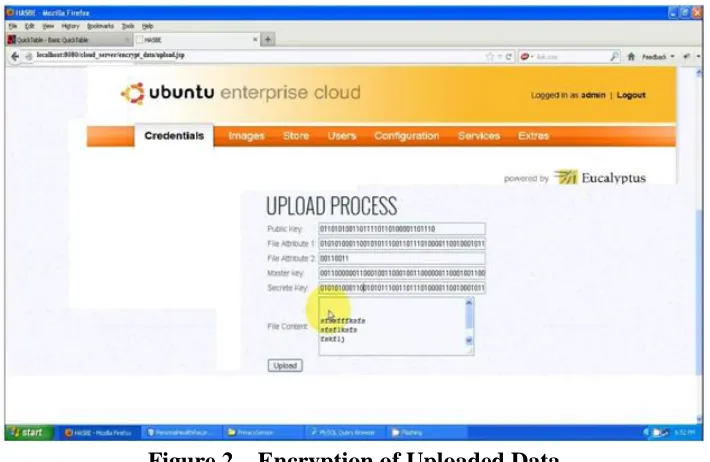
To provide the security for data in cloud, we use Java. We provide the security to the information or data, which is uploaded by any user in cloud to stored . We develop a Java program to encrypt the information or data, which is uploaded by any user in cloud to stored. We show the process of providing the security to the information, in the below figures. First user login in to the cloud by feeding appropriate credentials. User uploads the information in cloud by using “Browse” button and “Upload” button. Before finally upload the information; we confirmed that the uploaded information or data are in encrypted form. To upload successfully information or data in cloud, click “Upload” button.
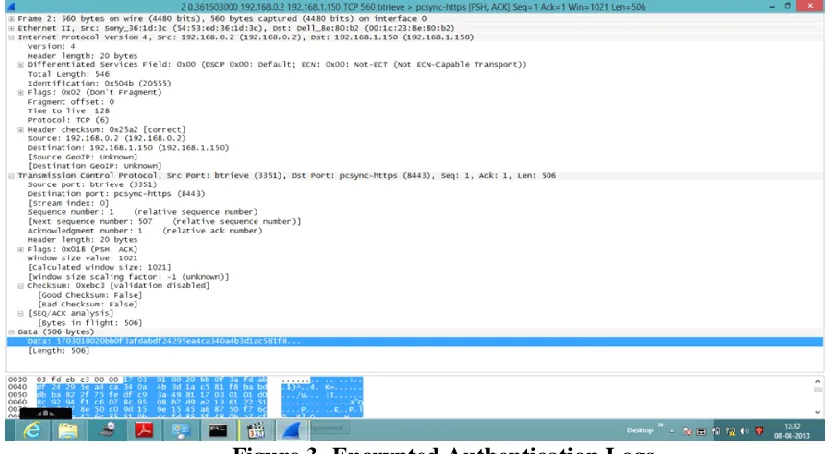
Figure 3- Encrypted Authentication Logs
Wireshark capture the packets of information or data, which is transmit from client side to server side in the cloud environment. In the above diagram captured packets of information or data are highlighted.
V. RESULT AND CONCLUSION
Carry out a private cloud using Ubuntu which is open source software, has been shown in this paper that it is conceivable to link regular desktop computers which lack virtualization capabilities to form clusters founded on Ubuntu Enterprise Cloud, using Eucalyptus as the organization software to build a private cloud. Putting in place was fairly easy and following the steps in this proposition would allow a beginner to install an open source cloud but at hand there were be problems with logging encountered with Eucalyptus.
This paper provide the result that is a fully functional private cloud with possibilities of Infrastructure as a facility which is the communicating Ubuntu Enterprise Cloud interface which is recycled to install images of operating systems and examination the full functionality of the cloud.
REFERENCES
[1] Antonpoulos, N. and Gilliam, L. (2010) Cloud Computing: Principles, Systems and Applications. London:
Springer-Verlag London Limited.
[2] Vaquero et al., (2009) Technology Policy Institute.
http://www.techpolicyinstitute.org/files %20architectural_and_policy_implications.pdf (accessed December, 2012).
[3] CloudBackground(2011): http://epic.org/privacy/cloudcomputing/#Background (Oct. 2012)
[4] Cloud computing (2012) http://epic.org/privacy/cloudcomputing/#Background (Nov. 2012).
[5] Cloud Evolution: http://jameskaskade.com/?p=344 (Accessed December 2012).
[6] Emeneker, W.et al, (2006) ―Dynamic‖. Virtu Springer-Verlag LNCS 4331, pp. 440-451.
[7] Cloud Business (2011):
October, 2012).
[8] Cloud Computing Architecture:
http://upload.wikimedia.org/wikipedia/commons /3/3c/Cloud_computing_layers.png (Accessed December 2012).
[9] Dell Systems (2009): http://www.dell.com/downloads/global/solutions/public/articles
/flying-cloud-navigator-platform-infrastructure-private-community.pdf (accessed November, 2012).
[10] Zoran Pantic (2011) Private Cloud Building: http://www.academia.edu/1910578 /Tutorial_ (Accessed
December, 2012).
[11] Plexibus (2011) Configuring Amazon Images: http://blogs.plexibus.com/2010/05/26/
eucalyptus-configuring-your-private-cloud-to-resemble-amazon-ec2/(September 2012).
[12] Community Cloud Computing (2009): http://arxiv.org/pdf/0907.2485.pdf(November 2012).
[13] Hybrid cloud computing (2009): A New Era. http://www.ijcst.com/vol22/2 /sujayR.pdf
[14] Delivery Model Types SPI: http://upload.wikimedia.org/wikipedia/commons/b/b5 /Cloud_computing.svg
(Accessed December 2012).
[15] Good read (2006) G.K Chesterton:
http://www.goodreads.com/quotes/55643-there-are-no-rules-of-architecture-for-a-castle-in (accessed December, 2012).
[16] Storage as a service (2009) Ruth et al: http://citeseerx.ist.psu.edu/viewdoc/summary? doi=10.1.1.134.2457
(accessed January, 2013).
[17] Cloud computing implementations (2012): http://www.networkcomputing.com
/other/idc-cloud-computing-implementations-to-double-by-2012.php?type=article ( December 2012).
[18] SAAS End User Applications: http://www.bigfootretail.com/90-of-ecommerce-on-saas/ .
[19] Securing the cloud (2011) http://my.safaribooksonline.com/book/-/9781597495929
/chapter-2dot-cloud-computing-architecture/40 (accessed December, 2012).
[20] Cloud computing (2011): http://en.wikipedia.org/wiki/Cloud_computing(November, 2012).
[21] Cloud security (2012):
http://my.safaribooksonline.com/book/-/9781597495929/chapter-7dot-security-criteria-building-an-internal-cloud/207(accessed December, 2012).