Available Online atwww.ijcsmc.com
International Journal of Computer Science and Mobile Computing
A Monthly Journal of Computer Science and Information Technology
ISSN 2320–088X
IJCSMC, Vol. 4, Issue. 5, May 2015, pg.994 – 1001
RESEARCH ARTICLE
Maximum Degree of Centrality for Cluster
Head Selection and Data Security in WSN
Rajesh Kumar N
, M.TECH (CNE) NHCE, VTU UNIVERSITY Karnataka, India Email: [email protected]Padma Priya
, Asst Prof VTU UNIVERSITY Karnataka, India Email: [email protected]Abstract— Wireless Sensor Networks (WSNs) present a new generation of real-time embedded systems for a wide variety of applications. However WSNs have limited computation, energy, and memory resources. One of the approaches to minimize the energy consumption is to allow only some nodes in a cluster of sensor nodes, called cluster- heads, to communicate with the base station. Appropriate cluster-head election can drastically reduce the energy consumption and enhance the lifetime of the network. In this thesis, a fuzzy logic approach to cluster-head election is proposed based on three descriptors - energy, concentration and centrality. After modeling the energy consumption for the WSN, we applied the algorithm to check for the quality of the network by measuring the time it takes for the first node to die in the cluster. We compare our algorithm with Low Energy Adaptive Clustering Hierarchy (LEACH), a previously proposed technique, by adjusting the cluster-head selection probabilities.
Index Terms— Cluster head selection; intra cluster head selection; cluster Maximum degree centrality; energy efficiency; fuzzy logistics; fuzzy inference
1. Introduction
In wireless sensor networks (WSNs) energy efficiency and scalability are the prime factors in the design of the system. Further, due to small sized sensor nodes, they have limited computing, bandwidth and communicating capabilities. All these characteristics require efficient management of the network topology, self-configuration and robustness for the purpose of balancing the load and for the network lifetime prolongation [1] [2].
to their respective CH. We have also proposed a new clustering algorithm by adopting both cluster optimal degree centrality and expected residual energy as selection parameters for defining fitness of a node to become a CH. The simulation results have shown that the proposed clustering method has resulted in enhanced network lifetime and individual cluster characteristics. This paper is structured as follows. Section II presents related work. Section III presents the system assumptions of our work. In section IV, we have derived the clustering parameters and their respective calculations. In section V the detailed operation of the proposed work is presented. Finally we proposed an algorithm for CH selection process. In section VI simulation results are presented and effectiveness of our work is evaluated. Conclusions are given in section VII.
2. RELATEDWORK
Clustering of sensor nodes has already been widely used in wireless sensor networks. Although the clustering can improve QoS in wireless sensor networks, it has some inherent problems. The main problem is that the energy consumption is uneven between CHs and other member nodes. In order to overcome this problem, most of the research focuses mainly on rotation of CHs. The first major approach towards rotation of CHs is LEACH protocol [3]. LEACH uses probabilistic model to select CHs and to rotate CHs periodically. LEACH being a pure probabilistic model, some CHs may lie in each other's communication range or may be the edge nodes of WSNs that leads to inefficient clustering. Also, energy of nodes is not considered in LEACH for the election of CH, which may result in selecting nodes with insufficient residual energy as cluster heads. Failure of these nodes can lead to partitions and inappropriate/incomplete results for the respective cycle. Fuzzy logic, due to its comparatively less computational burden and less processing demands, has also been widely used in WSNs for clustering purpose [4-8]. In most of the fuzzy clustering algorithms fuzzy rule based system is opted to make selections using different clustering parameters to elect CHs. Gupta et. al. in [4] has presented a centralized fuzzy logic based CH selection mechanism. In this method [4] Base station has to collect three fuzzy variables (concentration, energy and centrality) from all sensor nodes. Based upon the collected information election of a CH is done. This approach is a centralized one and thus the method does not present a realistic image and is unsuitable for large scale WSNs. Overheads and control communication resulted from centralized method would be very high and unsuitable for energy constrained WSNs. Further, the simulation resulted in selection of one CH per round and the work is silent about centrality calculations. In [5], author has proposed a fuzzy logic based approach (CHEF: Cluster Head Election mechanism using Fuzzy logic). This method proposed is a localized election mechanism using two fuzzy variables (residual energy and local distance). In this paper, node degree is not taken as a selection parameter; hence for nodes having equal residual energy, a node with less number of neighbor nodes has more chances to become CH and hence may result in inefficient clustering. CHEATS proposed in [6] considers the distance of a node from base station and remaining energy of a node as CH selection parameter. In [7], Anno et al. has proposed different fuzzy variables that include the residual energy, distance from cluster centroid, node degree, and network traffic. LEACH-ERE [8] is also a fuzzy logic based CH selection criteria. In LEACH-ERE, the expected residual energy (ERE) is proposed to act as a fuzzy variable during CH selection process. ERE is predicted by using the expected energy consumption (EEC). Where EEC is calculated via using an off-line trained neural network model. The proposed approach has adopted the LEACH protocol architecture but with a modification to the energy predication based on the ERE. EECS [9] is an Energy Efficient Clustering Scheme in wireless sensor networks. During CH election phase, a constant number of candidate nodes are elected and compete for cluster heads according to the nodes' residual energy. The candidate nodes send out a broadcast message containing its residual energy within a predefined radio range. If candidate finds a candidate with more residual energy, it will give up in the competition. Otherwise it will become CH. In the cluster formation phase, based upon distance cost from the node to the CH and distance cost from the CH to the base station, member nodes decide which CH to join. Method proposed in [10], takes distance from the sink (base station) to each node as well as the residual energy of each node as the selection criterion of cluster-head election. Energy-Efficient Cluster Head Selection (NECHS) [20] is a mechanism based on fuzzy rule based method where number of neighbor nodes and remaining energy are the input variables of fuzzy system. Most of the fuzzy based clustering algorithms stated above are based on LEACH and taken residual energy and some local parameters while electing CHs. In the method proposed by us apart from energy metric and local parameters, we have taken optimal node degree centrality for calculating fitness of a node to become CH. In this way, our proposed algorithm has led to enhanced coverage of sensor nodes by CHs. Also the proposed algorithm has led to decrease excessive load handling problems of CHs during local intra cluster communications.
3. SYSTEM ASSUMPTIONS
4. PROPOSED CLUSTERING APPROACH
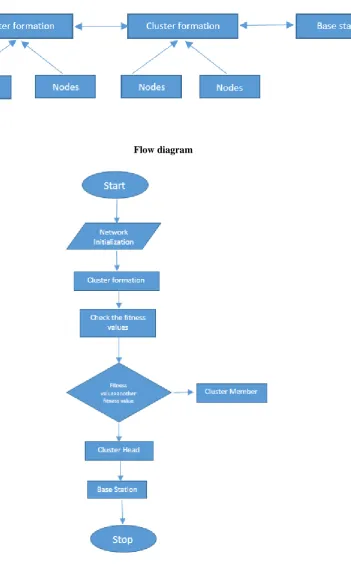
Architecture
Flow diagram
A. Clustering Algorithm In the proposed clustering algorithm, during set up phase each node generates a random number. If this random number is less than a pre-defined threshold, those particular nodes become candidates for current CH selection round. All other nodes switch to sleep mode for a duration equivalent to that of electing final CHs. The candidate nodes calculate the fitness to become CH by using fuzzy logic. The inputs for fuzzy inference are ERE and cluster optimal degree closeness centrality (CODC). After calculating Fitness, the candidate nodes broadcast candidate message containing Fitness value. Candidate nodes which fall in communication range of each other, receive these messages and the candidate node having high value of fitness becomes final CH. By this time, member nodes become active and Final CHs broadcast their id to all nodes present in their neighborhood. Member nodes join CHs from which they have minimum distance. After the steady phase, the process repeats itself until network become nonfunctional. The proposed clustering algorithm is as follows:
Input:
Nt, �: a communication network N at time t with L links
s : a sensor node
V: {v I v is s neighbor node which is CH candidate}
No: {c I neighbor nodes ofs ,for a (s,c» Uopt
T: a fitness value to become a CH candidate
R: the number of rounds after which a node again becomes eligible for CH competition
r: number oftimes a node does not serve as CH
Output:
CH(s): the cluster head ofthe node s
Fit (s): a fitness ofthe node s to be a CH
ClusterHead(s): true ifCH(s)=s
Network Initialization:
1. ClusterHeads(s) = false;
2. r(s) +-R Main: 1* for every setup round *1
3. if (r(s) < R)
4. ClusterHead(s) +- false;
5. T+-0;
6. r(s) = r(s)+ I;
7. else T+-Popt ;
8. end if
10. if (rand(s)(O, I) < T)
11. CH(s) +- s;
12. Fitness (s) +- fuzzy logic [ERE , CODq
13. Broadcast (fit(s), id); II cluster head Candidate-Message 14. On receiving Candidate-Messages from CH candidates;
15. for each v in V
16. if (fit(s) < fit(v) )
17. CH(s) +-v;
18. ClusterHead(s) +- false;
19. else ClusterHead(s) +- true;
22. if (ClusterHead(s) = true)
23. broadcast (fin-CH-Message, V)
24. r(s) +-0
25. end if
B. Fuzzy System Model The proposed method has taken advantage of fuzzy inference system to calculate Fitness value for a candidate CH node. Fuzzy inference system consists of a fuzzifier, fuzzy rules, fuzzy inference engine and a defuzzifier. In the proposed Fitness computation is accomplished by using predefined fuzzy "if-then" mapping rules. These fuzzy if-then mapping rules are shown in Table I.
We have used Mamdani Method (Zimmermann, 2001), as fuzzy inference technique, because it is the most frequently used fuzzy inference technique (Gupta et aI., 2005). The fitness value of each candidate CH will change according to the current value of ERE and cluster optimal degree closeness centrality. The fuzzy set that describes the input variable of ERE is shown in Fig 1. The linguistic variables for this fuzzy set are Low, Medium and High and Very high. We have selected a trapezoidal membership function for Low and Very high due to nature of our present study. On the other hand, the membership function of Medium and High is triangular membership function. The second fuzzy input variable is cluster optimal degree centrality of the candidate CH node. The fuzzy set which describes this input variable is illustrated in Fig. 2. Low, Optimal and Very high are the linguistic variables of this fuzzy set. Low and Very high linguistic variables have a trapezoidal membership function while Optimal variable has a triangular membership function.
The fuzzy output variable for our method is the Fitness of the candidate CH. Fuzzy set for Fitness variable is shown in Fig. 3. For fitness of a candidate CH we have defined 4 linguistic variables which are Low, Mediwn, High, and Very high. Very high variable have a trapezoidal membership function. The remaining linguistic variables Low, Medium and High are represented by using triangular membership functions. To obtain a crisp Fitness value, we perform de-fuzzification using COA (Center of Area) method. Unlike [8], in order to minimize the computation at a sensor node the numbers of rules are optimally selected. VI. PERFORMANCE EVALUATION AND SIMULATION In this section, the performance analysis of our proposed method using clustering parameters ERE and fuzzy optimal degree closeness centrality is presented. The analysis includes the comparison of the proposed algorithm against LEACH, CHEF, and LEACH-ERE. Simulation results have shown that our proposed approach presents enhanced performance.
Fig 1:FND and HNA metrics of performance
Fig 2:Number of Alive nodes
3) Energy consumption of cluster heads It is the average energy consumed for the data transmission and reception by CHs for randomly selected round. 100 rounds of simulations are sampled and amount of total energy spent by CHs during each round is depicted in figure 6. It is clearly indicated from the figure that energy consumed by CHs in our proposed method, CHEF and LEACH-ERE is less than that in LEACH. This is because of the reason that LEACH has not considered local selection parameters.
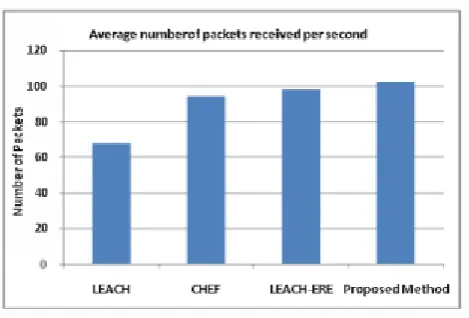
Fig 4:Throughput
5. CONCLUSION AND FUTURE WORK
In this paper, we have proposed a new method of clustering based upon cluster optimal degree centrality and expected residual energy. The proposed method has been compared with LEACH, CHEF and LEACH-ERE and shows better results in terms of network lifetime, individual cluster qualities and intra-cluster communication. A further direction of this work will be to apply the proposed technique for multi-hop routing and can also be extended for optimal placement of sink as well as relay nodes.
REFERENCES
[1] I.F. Akyildiz, w. Su, Y. Sankarasubramaniam, E. Cayirci, A survey on sensor networks, IEEE Communications Magazine 40 (8) (2002) 104112
[2] 1.Yick, B.Mukherjee, D.Ghosal, Wireless sensor network survey, Computer Networks journal 52 (2008) 2292- 2330
[3] W. Heinzelman, A. Chandrakasan, H. Balakrishnan, Energy-efficient communication protocol for wireless sensor networks, in: proceeding of the Hawaii International Conference System Sciences, Hawaii, January 2000.
[4] I. Gupta, D. Riordan, and S. Sampalli, "Cluster-head election using fuzzy logic for wireless sensor networks, " in Proc. Annu. Conf. Commun. Netw. Services Res., 2005, pp. 255-260.
[5] J. Kim, S. Park, Y. Han, and T. Chung, "CHEF: Cluster head election mechanism using fuzzy logic in wireless sensor networks, " in Proc. Int. Conf. Adv. Commun. Technol., Feb. 2008, pp. 654-659.
[6] A. Pires, C. Silva, E. Cerqueira, D. Monteiro, and R. V. Jr, "CHEATS: A Cluster-Head Election Algorithm for WSN Using a Takagi-Sugeno Fuzzy System, " 2011.
[7] 1. Anno, L. Barolli, A. Durresi, F. Xhafa, and A. Koyama, "Performance evaluation of two fuzzy-based cluster head selection systems for wireless sensor networks, " Mobile Inform. Syst., vol. 4, no. 4, pp. 297312, 2008.
[8] 1.-shyan Lee, S. Member, and W.-liang Cheng, "Fuzzy-Logic-Based Clustering Approach for Energy Predication, " IEEE Sensors Journal, vol. 12, no. 9, 2012, pp. 2891-2897.
[9] Chengfa Li, Mao Ye, Guihai Chen, and Jie Wu. "An energy-efficient unequal clustering mechanism for wireless sensor networks." In Mobile Adhoc and Sensor Systems Conference, 2005. IEEE International Conference on, pp. 535-540, IEEE, 2005.
[10] Young-Ju Han" Jung-Ho Eom, Seon-Ho Park, and Tai-Myoung Chung. "Energy-efficient distance based clustering routing scheme for long-term lifetime of multi-hop wireless sensor networks." In Managing Next Generation Networks and Services, pp. 543-546. Springer Berlin Heidelberg, 2007.
[11] Freeman, L.c. Freeman, Centrality in social networks: conceptual clarification. Social Networks, 1( 1978), 215-239.
[12] P. Bonacich, Power and centrality: a family of measures. American Journal of Sociology 92 (1987) ,1170-1182.
[13] S.P. Borgatti, Centrality and network flow. Social Networks 27 (1) (2005), 55-71.
[15] A. Okabe, B. Boots, K. Sugihara and S. N. Chiu, "Spatial Tessellations: Concepts and Applications of Voronoi Diagrams ", 2nd edition, John Wiley and Sons Ltd.
[16] T.S. Rappaport (1998) 'Wireless Communications: Principles and Practice', 2nd ed. Englewood Cliffs, NJ: Prentice-Hall, pp. 107-108.
[17] Holger Karl, Andreas Willig. Protocols and Architectures for Wireless Sensor Networks John Wiley & Sons, pp 36-44, 2005.
[18] UCBILBNLlViNT Network Simulator: NS-2. (2000) [Online]. Available:http://www.isi.edu/nsnamlnsl
[19] M.J. Handy, M. Haase and D. Timmermann, "Low energy adaptive clustering hierarchy with deterministic cluster-head selection ", Proc. into Workshop Mobile Wireless Communication Networks, 2002, pp. 368372.