Encrypted Data
Qingji Zheng†, Xiangxue Li‡, and Aytac Azgin†
† Huawei Research Center, Santa Clara, CA, USA, 95050 †{qingji.zheng, aytac.azgin}@huawei.com
‡ Dept. of Computer Science & Technology, East China Normal University, China ‡[email protected]
Abstract. Keyword search on encrypted data enables one to search key-word ciphertexts without compromising keykey-word security. We further in-vestigate this problem and propose a novel variant, dubbedcertificateless keyword search on encrypted data(CLKS).CLKSnot only supports
key-word search on encrypted data, but also brings promising features due to the certificateless cryptography. In contrast to the certificated-based keyword search,CLKSrequires no validation on the trustworthy of the public key before encrypting keywords; in contrast to the identity-based keyword search,CLKSprevents the key issuer (e.g., key generator
cen-ter) from penetrating any information on keyword ciphertexts by lever-aging the capability of accessing all data users’ (partial) private keys. Specifically, we rigorously define the syntax and security definitions for
CLKS, and present the construction that is provably secure in the
stan-dard model under the Decisional Linear assumption. We implemented the proposedCLKSscheme and evaluated its performance. To the best of our knowledge, this is the first attempt to integrate certificateless cryptography with keyword search on encrypted data.
Keywords: keyword search, certificateless cryptography
1
Introduction
key based keyword search, certificate-based keyword search1and identity-based (or attribute-based) keyword search2. Comparing with symmetric key based key-word search, the last two kinds of keykey-word search are more flexible and promising because they do not require any key sharing between the data owner and the target user who the data will be shared with.
For certificate-based keyword search, when the data owner wants to share the data with a target user, he will encrypt the data with the target user’s public key. Note that before this operation, the data owner needs to validate the certificate which binds the target user’s identity and the corresponding public key in order to assure that the public key is really associated with the target user, which needs to rely on some trust/certificate management system such as PKI. In addition, the data owner might need to conduct costly certificate chain verification (until finding a certificate authority he trusts) for certificate validation. In order to mitigate this downside, identity-based (attribute-based) keyword search [31, 34, 28] is introduced where the public key is exactly the same as the target user’s identity (attributes) and therefore there is no need to validate the correctness of the public key. Despite its benefits, identity-based (attribute-based) keyword search suffers from the key escrow problem that the key generation authority has full access to all data users’ private keys.
Contribution. We propose certificateless keyword search on encrypted data
(CLKS), which preserves the merits of identity-based keyword search (e.g., no
certificate management and validation) without inherent key escrow problem. To be specific, we follow the basic principle underlying the certificateless cryptog-raphy: treating the user’s identity as part of the public key and letting the user’ private key consisting of two components, one generated by the key generation center and the other chosen by the user. Thus, CLKSallows users to put less
trust on the key generation center. We summarize our contribution as follows and compare three kinds of keyword search solutions in Table 1:
– We first integrate the certificateless cryptography with keyword search on encrypted data. We formalize the notion for CLKS, and rigorously define
its security properties.
– We present aCLKSscheme that is provably secure in the standard model
under the Decisional Linear assumption. Similar to other certificateless prim-itives, the proposed certificateless keyword search scheme leverages the iden-tity as user’s partial public key and eliminates the key escrow problem. We implemented the proposed scheme and conducted the performance evalua-tion on real data to show its feasibility.
Organization.Section 2 describes the related work. Section 3 presents crypto-graphic assumptions and primitives. Section 4 presents the system and threat
1 Certificate-based keyword search means keyword search on encrypted data in
tradi-tional public key setting, where users generate the public/private by themselves and the certificate is used to bind the user identity and the public key.
2 Attribute-based keyword search can be treated as the generalized version of
Table 1. Comparison of three kinds of keyword search primitives that are involved with the public/private keys.
Type of keyword search Who generates user’s private key Required trust Model/Infrastructure Certificate-based User Certificate binds the user identity and public key Identity(attribute)-based Third party authority Fully trusted third party authority Certificateless (our paper) User and third party authority Honest-but-curious third party authority
model, and Section 5 formalizes the syntax and security definitions. Section 6 presents the main construction Section 7 presents the performance.
2
Related Work
We briefly review the relevant techniques on keyword search on encrypted data, which are separated into three categories as follows:
Symmetric key based keyword search.It allows the data owner to encrypt keywords and the corresponding data, and outsource keyword ciphertexts and data ciphertexts to the remote server. Only the data owner, or someone with the symmetric key, can generate the search token in order to ask the cloud to conduct search on keyword ciphertexts. [27] proposed the first symmetric key based keyword search scheme. Many variants, e.g., [17, 12, 14, 22, 23, 11, 8] have been proposed with various features, for example, improved security [14], dynamic support [22], UC security [23], verifiability [11] and multi-user sharing [21]. The main advantage of the symmetric key based keyword search is its high efficiency since it does not involve any costly public key operations (e.g. exponentiation, pairing). In the data sharing scenario, however, the technique requires the data owner and the target user (or remote server) sharing some common secret [21].
Certificate-based keyword search.For certificate-based keyword search, the data owner encrypts keywords and data with the public key of the target user, so that the target user can use his own private key to generate the search token and then conduct the search on keyword ciphertexts. Many solutions, e.g., [5, 4, 7, 1, 9, 10, 30, 26, 29], have been proposed after [6] initiated the first study. While certificate-based keyword search is more flexible compared with symmetric key based keyword search, it requires the data owner validating the target user’s public key before encrypting keywords. The trust and certificate management infrastructure, e.g., PKI, has been introduced to facilitate the validation process.
or attributes. While it mitigates the certificate management issue, it indeed in-troduces another issue – key escrow problem, since the key generation authority can access all users’ private keys.
3
Preliminaries
Letx←R X denote selecting an elementxfrom the setX uniformly at random. LetI be the user universe where each user is associated to a unique identityid. Let (e, p, g, G, GT)←BMP(1ℓ) be the function that generates a bilinear map e : G×G → GT by taking as input a security parameter ℓ, such that p is
an ℓ-bit prime, G and GT are two cyclic groups of prime order p and g is a
random generator of groupG. The bilinear mapeshould satisfy (i)∀a, b∈Zp, e(ga, gb) =e(g, g)ab; (ii)e(g, g)6= 1 and (iii)ecan be computed efficiently.
We assume that the identities are distinctn-bit numbers. LetH1:{0,1}n→
G, H2 : {0,1}∗ → Z∗p, where H1 is a function mapping id to an element in G (defined as in section 6) andH2is modeled as a collision-resistant hash function.
Decisional Linear (DL) AssumptionLet (e, p, g, G, GT)←BMP(1ℓ). Given g, h, f, Q ←R G and gr2, hr1, wherer
1, r2
R
← Z∗p are unknown, the DL
assump-tion states that any probabilistic polynomial-time algorithm A can determine whether Q=fr1+r2 or not at most with a negligible advantage with respect to
the security parameterℓ, where the “advantage” is defined as
AdvDL(ℓ) =|Pr[A(g, h, f, gr2, hr1, fr1+r2) = 1]−Pr[A(g, h, f, gr2, hr1, Q) = 1]|.
4
System and Threat Model
Application example.For illustrating the model visually, we consider the ap-plication of sharing Electronic Health Record (EHRs): The health service vendor (e.g., software infrastructure) acts as key generation center, and patients can be the data owners of EHRs, and will share EHRs with professionals for treatment purpose. When the user (either patients or professionals) registers the system, he will be assigned with a partial private key with respect to his unique identity and can generate the private/public key. To share EHRs with a professional, the patient can use that professional’s public key (requiring no validation of the public key) to encrypt the indexed keywords (e.g. age, name, DOB etc.) and store the encrypted keywords and the associated encrypted EHRs in the storage system. The professional then generates the tokens based on keywords together with his own private key, and asks the storage system to return the encrypted EHRs having matched keywords. We can see that the benefit is that the vendor cannot leverage its knowledge on partial private keys to learn extra information from the encrypted index, and the patients require no validation on public key.
Cloud
Keygenerationcenter Dataowner Targetuser keywordciphertexts
datafileciphertexts
searchtoken Sharepublicparametersforsystementitiesandissuepartialprivatekeysforusers
Fig. 1.The system model where the certificateless keyword search scheme can operate.
Threat model Similar to the threat model in the certificateless setting, we assume that the KGC cannot be fully trusted. That is, the KGC follows the protocol specification honestly but might attempt to use the information he obtained to penetrate more information. We assume that the users might be malicious, meaning that the users might pretend to be some target user and distribute the fake public key (i.e., the public key is different from that published by the target user) on behalf of the target user in order to learn information about the target user’s ciphertexts. We assume that the cloud server is honest-but-curious, meaning that it will honestly execute the pre-defined protocols, but attempt to learn as much private information as possible. In addition, we assume that theKGCand the users cannot collude together.
5
Definitions
Definition 1. A CLKS scheme is associated with the keyword space M and
the identity space I and defined by seven algorithms as follows:
– Setup(1ℓ): This algorithm, run by theKGC, takes as input a security
parame-terℓand returns the system parameterparamand master keymk. Theparam
is made publicly known andmk is kept private. For simplicity, we implicitly
– Gen-Partial-Private-Key(mk,id): This algorithm, run by the KGC, takes as
inputmk and the userid, and generates a partial private key pskid, which is
sent to the user via a secure channel.
– Gen-Private-Key(pskid): This algorithm, run by the user, takes as inputpskid,
and returns a complete private keyskid, which is kept private.
– Gen-Public-Key(skid,pskid): This algorithm, run by the user, takes as input
theskid andpskid, and returns a public keypkid.
– Enc(pkid,id,kw): This algorithm, run by any user, takes as input the the
target user’s public keypkid, identityid and the keyword kw, and returns a
ciphertextcph.
– Gen-Token(skid,kw): This algorithm, run by the userid, takes as input the
skid and the keyword kw, and returns a search token token.
– Match(token,cph): This algorithm, run by the cloud server (or entities
hold-ing keyword ciphertexts), takes as input the search tokentokenand a
cipher-textcph, and returns 1 if token andcph correspond to the same identity id
and the same keyword. Otherwise, it returns 0.
Correctness.We say that aCLKSscheme is correct if, for allid∈ I,mkoutput
by the Setup, skid output by the Gen-Private-Key, and pkid output by the
Gen-Public-Key, the following always holds:∀kw∈ M,cph←Enc(pkid,id,kw),token←
Gen-Token(skid,kw) : 1←Match(token,cph)
Security.Intuitively, the adversary model againstCLKSconsists of two kinds of
adversaries similar to that of certificateless encryptions [13]: Type 1 adversary models the outsider, who is allowed to manipulate users’ public key without accessing the KGC’s master keymk; and Type 2 adversary models the insider, who can acquire the KGC’s master keymk without manipulating users’ public keys.
To be specific, we capture the two security requirements against the two adversaries via the following games. Let A be Type 1 adversary (Game A) or Type 2 adversary (Game B). The security games are played betweenAand the challenger, who maintains two lists:
– TokenList: It stores the tuple [id,kw], meaning that the search token with respect to the keywordkwfor the user idhas been queried byA.
– UserInfoList: It stores the tuple [id, pskid, skid, pkid, P1, P2,P3], where the boolean valueP1= 1 means that Ahas acquiredpskid and P1= 0 not, the boolean valueP2 = 1 means that Ahas acquired skid and P2 = 0 not, and the boolean valueP3= 1 means thatAhas replacedid’s public keypkid and
P3= 0 not.
Game A
Setup:The challenger runsSetup(1ℓ) to initialize the system parameterparam
and the master key mk. The challenger sends param to A, and sets two lists
TokenListand UserInfoListempty.
– Gen-Partial-Private-Key[id]: Given the userid fromA, if pskid inUserInfoList is not null, then the challenger returnspskid. Otherwise, the challenger runs
Gen-Partial-Private-Key(mk,id) to getpskid, adds [id,pskid, ⋆, ⋆,1,0,0] toUserInfoList where⋆means null, and returnspskid toA.
– Gen-Private-Key[id]: Given the useridfromA, the oracle works as follows: • Ifskid inUserInfoListis not null, then the challenger retrievesskid. • Else ifpskidinUserInfoListis not null, then the challenger retrievespskid,
runsskid ←Gen-Private-Key(pskid) and addsskid to theUserInfoList.
• Otherwise, the challenger runs pskid ← Gen-Partial-Private-Key(mk, id) andskid ←Gen-Private-Key(pskid), and adds (id,pskid,skid) toUserInfoList. The challenger updatesP1= 1 andP2= 1 inUserInfoListwith respect toid and returnsskid to A.
– Gen-Public-Key[id]: Given the useridfrom A, the oracle works as follows: • Ifpkid inUserInfoListis not null, then the challenger retrievespkid. • Else if skid in UserInfoList is not null, then retrieve skid, the challenger
runs pkid ←Gen-Public-Key(skid) and adds pkid to the UserInfoList with respect toid.
• Else ifpskidinUserInfoListis not null , then the challenger retrievespskid, runs skid ←Gen-Private-Key(pskid) andpkid ←Gen-Public-Key(skid,pskid) and addsskid,pkid to theUserInfoListwith respect toid.
• Otherwise, the challenger runs pskid ← Gen-Partial-Private-Key(mk,id),
skid ←Gen-Private-Key(pskid) andpkid ←Gen-Public-Key(skid,pskid), and adds (id,pskid,skid,pkid,0,0,0) toUserInfoList.
The challenger returnspkid toA.
– Replace-Public-Key[id,pk] : Given the user idand the replaced public keypk
fromA(assume thatpkidhas been generated before), the challenger updates
pkid inUserInfoListwithpk, and setsP3= 1 with respect toid.
– Gen-Token[id,kw] : Given the userid and the keywordkwfrom A, the chal-lenger retrievesskid fromUserInfoList, runsGen-Token(skid,kw) to gettoken. The challenger adds [id,kw] to theTokenListand returnstoken toA.
Challenge Phase:Apresents two keywords of the same length,kw0andkw1, and the user id∗. Let [id∗, pskid∗,skid∗,pkid∗,P1, P2, P3] be the tuple stored in
UserInfoList, we require that
– P1= 0 andP2= 0, meaning thatpskid∗ andskid∗ are not acquired byA.
– Both (id∗,kw0) and (id∗,kw1) are not stored inTokenList.
Note thatP3 can be either 0 or 1, meaning thatid∗’s public key can be replaced or not. The challenger picks λ← {R 0,1}, runscph∗ ←Enc(pkid∗,id∗,kwλ), and
returnscph∗ toA.
Phase 2:Acontinues to query the oracles as in Phase 1, while following these restrictions:
– Acannot queryGen-Partial-Private-Key[id∗] orGen-Private-Key[id∗].
Guess:Aoutputs a bitλ∗. We sayAwins the game ifλ∗=λ.
Definition 2. A CLKSscheme achieves ciphertext indistinguishability against
Type 1 adversary if for any probabilistic polynomial time algorithm A, it wins
the above security game with a negligible advantage at most with respect to the
security parameter ℓ, where the “advantage” is defined as |Pr[λ=λ∗]−1
2|.
Game B
Setup:The challenger runsSetup(1ℓ) to initialize the system parameterparam
and the master keymk. The challenger sendsparamandmktoA, and initializes the empty listsTokenListandUserInfoList.
Phase 1:Ais allowed to query the following oracles in polynomial many times. We use the bracket [·] to indicate the input to the oracle fromA.
– Gen-Partial-Private-Key[id]: Given the userid fromA, if pskid inUserInfoList is not null, then the challenger returnspskid. Otherwise, the challenger runs
Gen-Partial-Private-Key(mk,id) to getpskid, adds [id,pskid, ⋆, ⋆,1,0,0] toUserInfoList where⋆means null, and returnspskid toA.
– Gen-Private-Key[id]: Given the useridfromA, the oracle works as follows: • Ifskid inUserInfoListis not null with respect toid, then retrieveskid. • Otherwise, run pskid ← Gen-Partial-Private-Key(mk, id) and skid ←
Gen-Private-Key(pskid), and add (id,pskid,skid) to UserInfoList.
The challenger updatesP1= 1 and P2= 1 inUserInfoListwith respect toid and returnspskid,skid to A.
– Gen-Public-Key[id]: Given the useridfrom A, the oracle works as follows: • Ifpkid inUserInfoListis not null with respect toid, then retrievepkid. • Else, the challenger runspskid ←Gen-Partial-Private-Key(mk,id),skid ←
Gen-Private-Key(pskid) and pkid ← Gen-Public-Key(skid,pskid), and add (id,
pskid,skid,pkid) to UserInfoList.
The challenger updatesP1= 1 inUserInfoListand returnspskid,pkid to A.
– Gen-Token[id,kw] : Given the userid and the keywordkwfrom A, the chal-lenger retrievesskid fromUserInfoList, runsGen-Token(skid,kw) to gettoken. The challenger adds [id,kw] to theTokenListand returnstoken toA.
Challenge Phase:Apresents two keywords of the same length,kw0andkw1, and the user id∗. Let [id∗, pskid∗,skid∗,pkid∗,P1, P2, P3] be the tuple stored in
UserInfoList, we require that
– P2= 0, meaning thatskid∗ is not acquired byA.
– Both (id∗,kw0) and (id∗,kw1) are not stored inTokenList.
The challenger picks λ← {R 0,1}, runscph∗ ←Enc(pkid∗,id∗, kwλ), and returns
cph∗ toA.
Phase 2: A continues to query the oracles as in Phase 1, while following the below restrictions:
– Acannot queryGen-Token[id∗,kw0] or Gen-Token[id∗,kw1].
Guess:Aoutputs a bitλ∗. We sayAwins the game ifλ∗=λ.
Definition 3. A CLKSscheme achieves ciphertext indistinguishability against
Type 2 adversary if for any probabilistic polynomial time algorithm A, it wins
the above security game with a negligible advantage at most with respect to the
security parameter ℓ, where the “advantage” is defined as |Pr[λ=λ∗]−1
2|.
6
Main construction
High level ideaMotivated by the DL assumption, we encrypt the keywordkw
as follows: Leta, b, cbe the private key (a, b, c←R Z∗
p) andga, gb, gcbe the public
key, and set the keyword ciphertext as
W1=gcr1, W2=ga(r1+r2)gbH2( kw)r1
, W3=gr2,
where H2:{0,1}∗→Z∗p is a collision resistant hash function. According to the
DL assumption, the keywordkw is perfectly hidden. Note that gb in the term gbH2(kw)r1 is to facilitate the security proof.
If one knows the termgac, then he can generate the search token with respect
to any keywordkw′: Selects←R Z∗p (sis to preserve the secrecy ofg
ac) and set
V1=gacs, V2=gcs, V3=gasgbH2(
kw′)s .
If kw = kw′, then the respective keyword ciphertext and search token should match:
e(W2, V2) =e(W1, V3)e(W3, V1).
This is because
e(W2, V2) =e(g, g)acs(r1+r2)e(g, g)bcsr1H2(kw),
e(W1, V3) =e(g, g)acsr1e(g, g)bcsr1H2( kw′)
e(W3, V1) =e(g, g)acsr2,
On the other hand, we observe that the adversary can only acquire either
KGC’s master key (w.r.t Type 1 adversary) or the user’s secret values (w.r.t Type 2 adversary with replaced public key), rather than both. This observation motivates use to expand the private key setting, such that KGChas the private keya, b, cand public keyga, gb, gc, and the user has the private keya′, c′(a′, c′←R Z∗
p) and public keyga ′
, gc′
. Therefore, the keyword ciphertext is constructed:
W1=g(c+c
′)r
1, W
2=g(a+a
′)(r
1+r2)gbH2(kw)r1, W
is associated to the userid. To this end, only knowing eithera, cora′, c′ cannot infer any information about the ciphertext.
In order to generate search token, the userid, holdinga′, c′, needs to acquire the termgac. We achieve it based on the idea how the secret key was distributed
in attribute-based encryption, where user idis treated as an attribute. That is,
KGCgenerates the partial private key for the useridas
sk1=gt1 and sk2=gacH1(id)t1 wheret1
R
←Z∗
p.
Our construction We now show theCLKSconstruction as follows.
– Setup(1ℓ): The KGC runs (e, p, g, G, G
T) ← BMP(1ℓ) to generate the
bi-linear map e : G×G → GT. Let a, b, c R
← Z∗p so that it has ga, gb, gc.
Let id be an n-bit number such that id = id1id2. . .idn. It selects vectors
(u, u1, . . . , un) R
←Gn+1 and defines the hash functionH
1(id) =uQnj=1u idj
j .
Let H2 : {0,1}∗ → Z∗p be a collision-resistant hash function and set the
system parameterparam= (e, G, GT,p, g, ga,gb, gc, u, u1,. . . , un,H1, H2).
– Gen-Partial-Private-Key(mk,id): Given the userid,KGCproceeds as follows: • It selectst1
R
←Z∗
p and setssk1=gt1,sk2=gacH1(id)t1.
• The partial private key is set to pskid = (sk1,sk2), which is sent to the useridvia a secure channel.
– Gen-Private-Key(pskid): Given pskid, the user selects a′, c′ ←R Z∗
p and sets
skid= (a′, c′,sk1,sk2).
– Gen-Public-Key(skid): Givenskid, the user sets its public key aspk= (pk1,pk2) = (ga′
, gc′
).
– Enc(pkid,id,kw): The user encrypts the keywordkwand returns a ciphertext
cphby selectingr1, r2
R
←Z∗p and settingcph= (W1, W2, W3, W4) where
W1=g(c+c
′)r1
, W2=g(a+a
′)(r1+r2)
gbH2(kw)r1, W
3=gr2, W4=H1(id)r2.
– Gen-Token(skid,kw): The userid generates a search tokentokenby selecting
s←R Z∗
p and settingtoken= (V1, V2, V3, V4) where
V1=sks1=gt1s, V2= (gac
′ ga′c
ga′c′
)s
sks2=g(a+a
′)(c+c′)s
H1(id)t1s,
V3=g(c+c
′)s
, V4=g(a+a
′)s
gbH2(kw)s.
– Match(token,cph): This algorithm returns 1 ife(W2, V3) = ee((W3,V2W4,V1))e(W1, V4). Otherwise, return 0.
Correctness.The correctness can be verified as follows:
Because e(W3, V2)
e(W4, V1) =e(g
r2, g(a+a′)(c+c′)s
H1(id)t1s)
e(H1(id)r2, gt1s)
=e(g, g)(a+a′)(c+c′)sr2 ,
and e(W1, V4) =e(g(c+c
′)r1
, g(a+a′)s
gbH2(kw)s) =e(g, g)(c+c′)r1s(a+a′+bH2(kw)),
then e(W3, V2)
e(W4, V1)
e(W1, V4) =e(g, g)(a+a
′)(c+c′)s(r1+r2)
e(g, g)b2H2(kw)r1s.
e(W2, V3) =e(g(a+a
′)(r1+r2)
Remark. Given a search token, the attacker can launch the off-line keyword guessing attack (aka. predicate privacy [25]) because he can utilize the public information (e.g., public key) to test whether the given search token corresponds to some keyword. Such attack is inherent for certificate-based keyword search, identity-based (attribute-based) keyword search and our proposedCLKS. Some
research efforts has been made to prevent such attack. For example, [24, 19, 31] considered the approaches where the search token can be transmitted over the public channel (i.e., search token indistinguishability) but the user needs to share some secret with the remote server, which cannot completely solve the off-line keyword guessing attack because the remote server can still launch this attack.
The security of our proposed scheme can be assured by the following theo-rems, which proofs are shown in the Appendix.
Theorem 1. SupposeA is the Type 1 adversary making at most ξeppk queries
to oracleGen-Partial-Private-Keyandξprk queries to oracleGen-Private-Key. Let
AdvH2 be the advantage of A breaking the collision-resistant hash function H2
(i.e., AdvH2 = Pr[(H2(kw1) =H2(kw2))∩(kw16=kw2)|kw1,kw2∈ {0,1}∗]) and
AdvDL(ℓ)be the advantage ofAbreaking the DL assumption. Then the advantage
of Type 1 adversary breaking the ciphertext indistinguishability is
AdvType 1≤AdvH2+ 2(ξprk+ξeppk)(n+ 1)AdvDL(ℓ)
Theorem 2. Suppose A is the Type 2 adversary making at most ξprk queries
to oracleGen-Private-Keyandξtk queries to oracleGen-Token. LetAdvH2 be the
advantage of A breaking the collision-resistant hash functionH2 andAdvDL(ℓ)
be the advantage of Abreaking the DL assumption. Then the advantage of Type
2 adversary breaking the ciphertext indistinguishability is
AdvType 2≤AdvH2+ 2ξprkξtk(n+ 1)AdvDL(ℓ)
7
Performance Evaluation
We implemented theCLKSscheme in Java using the Java Pairing Based
Cryp-tography Library [15]. In our implementation, we instantiated the bilinear map with Type A pairing (ℓ= 512) offering a level of security equivalent to 1024-bit Discrete Logarithm security. To process the keywords and the identities (both are strings), we used the SHA-1 to hash them into the 128-bit data, which are then transformed to the elements inZ∗p andGrespectively.
To evaluate the feasibility of theCLKSin practice, we conducted the
is a a Linux running desktop with Intel Core i7-2600 3.4GHz CPU and 4GB RAM to simulate the cloud server that runs the algorithmMatch.
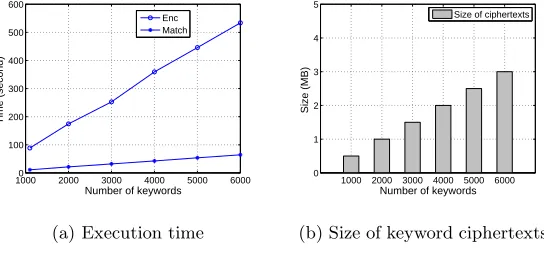
We ran six experiments using different number of keywords varying from 1000 to 6000 with step 1000. We repeated each experiment 5 times to determine the average execution time. Figure 2(a) compares the execution time for encrypt-ing all keywords (on the user machine) and for findencrypt-ing the matched keyword ciphertexts with a given search token (on the server machine).
From Figure 2(a) we see that encrypting entire keywords are more costly than finding the matched keyword ciphertexts. Fortunately, encrypting entire keywords will be executed only once, while finding matched ciphertext needs to be executed once per search request. Figure 2(b) shows the size of keyword ciphertexts that are serialized to the disk. We can see that the size of keyword ciphertexts is linear to the number of keywords.
10000 2000 3000 4000 5000 6000 100
200 300 400 500 600
Number of keywords
Time (second)
Enc Match
(a) Execution time
1000 2000 3000 4000 5000 6000 0
1 2 3 4 5
Number of keywords
Size (MB)
Size of ciphertexts
(b) Size of keyword ciphertexts
Fig. 2.Performance of CLKS. Note that we set that it needs to runMatchalgorithm
on half of the entire keyword ciphertexts to find a matched keyword ciphertext.
8
Conclusion
We have proposed a novel variant of keyword search – certificateless keyword search(CLKS), supporting keyword search on encrypted data while enjoying the
benefits from certificateless cryptography. We presented a concrete construction, and proved its security under the DL assumption in the standard model.
References
properties, relation to anonymous ibe, and extensions. J. Cryptol., 21(3):350–391, 2008.
2. S. S. Al-Riyami and K. G. Paterson. Certificateless public key cryptography. In Advances in Cryptology - ASIACRYPT 2003, Taipei, Taiwan, 2003, pages 452–473, 2003.
3. J. Baek, R. Safavi-Naini, and W. Susilo. Certificateless public key encryption without pairing. InInformation Security, 8th International Conference, ISC 2005, Singapore, Sept. 20-23, 2005, pages 134–148, 2005.
4. J. Baek, R. Safavi-Naini, and W. Susilo. Public key encryption with keyword search revisited. In Computational Science and Its Applications - ICCSA 2008, International Conference, Perugia, Italy, 2008, Part I, pages 1249–1259, 2008. 5. F. Bao, R. H. Deng, X. Ding, and Y. Yang. Private query on encrypted data in
multi-user settings. InISPEC 2008, Sydney, Australia, 2008, pages 71–85, 2008. 6. D. Boneh, G. D. Crescenzo, R. Ostrovsky, and G. Persiano. Public key encryption
with keyword search. InAdvances in Cryptology - EUROCRYPT 2004, Interlaken, Switzerland, 2004, pages 506–522, 2004.
7. D. Boneh and B. Waters. Conjunctive, subset, and range queries on encrypted data. InTCC 2007, Amsterdam, The Netherlands, 2007, pages 535–554, 2007. 8. C. B¨osch, A. Peter, B. Leenders, H. W. Lim, Q. Tang, H. Wang, P. H. Hartel, and
W. Jonker. Distributed searchable symmetric encryption. In2014 Twelfth Annual International Conference on Privacy, Security and Trust, Toronto, ON, Canada, 2014, pages 330–337, 2014.
9. J. Camenisch, M. Kohlweiss, A. Rial, and C. Sheedy. Blind and anonymous identity-based encryption and authorised private searches on public key encrypted data. In Public Key Cryptography - PKC 2009, Irvine, CA, USA, 2009, pages 196–214, 2009.
10. N. Cao, C. Wang, M. Li, K. Ren, and W. Lou. Privacy-preserving multi-keyword ranked search over encrypted cloud data. IEEE Trans. Parallel Distrib. Syst., 25(1):222–233, 2014.
11. Q. Chai and G. Gong. Verifiable symmetric searchable encryption for semi-honest-but-curious cloud servers. InICC 2012, Ottawa, ON, Canada, 2012, pages 917–922, 2012.
12. Y. Chang and M. Mitzenmacher. Privacy preserving keyword searches on remote encrypted data. InACNS 2005, New York, NY, USA, 2005, pages 442–455, 2005. 13. Y.-C. Chen, R. Tso, W. Susilo, X. Huang, and G. Horng. Certificateless signa-tures: Structural extensions of security models and new provably secure schemes. Cryptology ePrint Archive, Report 2013/193, 2013. http://eprint.iacr.org/. 14. R. Curtmola, J. A. Garay, S. Kamara, and R. Ostrovsky. Searchable symmetric
encryption: improved definitions and efficient constructions. InCCS 2006, Alexan-dria, VA, USA, 2006, pages 79–88, 2006.
15. A. De Caro and V. Iovino. jpbc: Java pairing based cryptography. InProceedings of the 16th IEEE Symposium on Computers and Communications, ISCC 2011, pages 850–855, Kerkyra, Corfu, Greece, 2011.
16. A. W. Dent. A note on game-hopping proofs. Cryptology ePrint Archive, Report 2006/260, 2006. http://eprint.iacr.org/.
17. E. Goh. Secure indexes. IACR Cryptology ePrint Archive, 2003:216, 2003. 18. J. Homer, S. Zhang, X. Ou, D. Schmidt, Y. Du, S. R. Rajagopalan, and A.
Sing-hal. Aggregating vulnerability metrics in enterprise networks using attack graphs. Journal of Computer Security, 21(4):561–597, 2013.
20. H. Huang, S. Zhang, X. Ou, A. Prakash, and K. A. Sakallah. Distilling critical attack graph surface iteratively through minimum-cost SAT solving. In ACSAC 2011, Orlando, FL, USA, 2011, pages 31–40, 2011.
21. S. Jarecki, C. S. Jutla, H. Krawczyk, M. Rosu, and M. Steiner. Outsourced sym-metric private information retrieval. In CCS’13, Berlin, Germany, 2013, pages 875–888, 2013.
22. S. Kamara, C. Papamanthou, and T. Roeder. Dynamic searchable symmetric encryption. InCCS’12, Raleigh, NC, USA, 2012, pages 965–976, 2012.
23. K. Kurosawa and Y. Ohtaki. Uc-secure searchable symmetric encryption. In Fi-nancial Cryptography and Data Security - 16th International Conference, FC 2012, Kralendijk, Bonaire, 2012, Revised Selected Papers, pages 285–298, 2012.
24. H. S. Rhee, J. H. Park, W. Susilo, and D. H. Lee. Trapdoor security in a searchable public-key encryption scheme with a designated tester. Journal of Systems and Software, 83(5):763–771, 2010.
25. E. Shen, E. Shi, and B. Waters. Predicate privacy in encryption systems. InTCC 2009, San Francisco, CA, USA, 2009, pages 457–473, 2009.
26. J. Shi, J. Lai, Y. Li, R. H. Deng, and J. Weng. Authorized keyword search on en-crypted data. InComputer Security - ESORICS 2014 - 19th European Symposium on Research in Computer Security, Wroclaw, Poland, 2014. Part I, pages 419–435, 2014.
27. D. X. Song, D. Wagner, and A. Perrig. Practical techniques for searches on en-crypted data. In2000 IEEE Symposium on Security and Privacy, Berkeley, Cali-fornia, USA, 2000, pages 44–55, 2000.
28. W. Sun, S. Yu, W. Lou, Y. T. Hou, and H. Li. Protecting your right: Attribute-based keyword search with fine-grained owner-enforced search authorization in the cloud. In2014 IEEE Conference on Computer Communikations, INFOCOM 2014, Toronto, Canada, 2014, pages 226–234, 2014.
29. Q. Tang and X. Chen. Towards asymmetric searchable encryption with message recovery and flexible search authorization. In8th ACM Symposium on Information, Computer and Communications Security, ASIA CCS ’13, Hangzhou, China, 2013, pages 253–264, 2013.
30. C. Wang, N. Cao, K. Ren, and W. Lou. Enabling secure and efficient ranked keyword search over outsourced cloud data. IEEE Trans. Parallel Distrib. Syst., 23(8):1467–1479, 2012.
31. T.-Y. Wu, T.-T. Tsai, and Y.-M. Tseng. Efficient searchable id-based encryption with a designated server. volume 69, pages 391–402. Springer Paris, 2014. 32. L. Xu, X. Wu, and X. Zhang. CL-PRE: a certificateless proxy re-encryption scheme
for secure data sharing with public cloud. InASIACCS ’12, Seoul, Korea, 2012, pages 87–88, 2012.
33. S. Zhang, X. Zhang, and X. Ou. After we knew it: empirical study and modeling of cost-effectiveness of exploiting prevalent known vulnerabilities across iaas cloud. In,ASIA CCS ’14, Kyoto, Japan - June 03 - 06, 2014, pages 317–328, 2014. 34. Q. Zheng, S. Xu, and G. Ateniese. VABKS: verifiable attribute-based keyword
search over outsourced encrypted data. In 2014 IEEE Conference on Computer Communikations, INFOCOM 2014, Toronto, Canada, April 27 - May 2, 2014, pages 522–530, 2014.
9
Appendix: Theorems and Their Security Proof
9.1 Proof of Theorem 1
Proof. We prove this theorem with the game hopping technique [16]: Let Si
denote the event of A winning the game i and Advi be the advantage of A.
Suppose gamei+ 1 proceeds the same as gameiexcept for the case that game
i+ 1 will halt and output a random bit when a pre-defined event Evhappens. IfEvis detectable (i.e., Pr[Ev] is non-negligible) andEvis independent fromSi,
then
Pr[Si+1] = Pr[Si+1|Ev] Pr[Ev] + Pr[Si+1|¬Ev] Pr[¬Ev]
=1
2Pr[Ev] + Pr[Si+1|¬Ev] Pr[¬Ev] =1
2(1−Pr[¬Ev]) + Pr[Si] Pr[¬Ev]
Therefore, |Pr[Si+1]−1
2|= Pr[¬Ev]|Pr[Si]− 1 2|
Advi+1= Pr[¬Ev]Advi
Game 1: In this game,Aproceeds with the steps as defined in Game A. That is, the challengerB generates the master key, public parameter and users’ partial private key. In addition, B can answer the queries oracleGen-Token for search tokens. Let (id∗,pkid∗) be the user identity and public key in the challenger phase
and letW∗= (W∗
1, W2∗, W3∗, W4∗) be the ciphertext returned toA.
Game 2: In this game,Aproceeds with the steps as defined in Game 1 except that
H2 is set to be a perfect collision-resistant hash function. Therefore, Pr[S2] = Pr[S1]−AdvH2 andAdv2=Adv1−AdvH2.
Game 3: In this game, B plays the game the same as Game 2 except for the generation of the public parameter:
– B selectsa, b, c ←R Z∗
p. It also selects κu ∈ {0, . . . , n} (note that id is n-bit
number) andτu∈ {0, . . . , p} such thatτu(n+ 1)< p.
– Bselectsx′
u R
←Zτu and the vector (xu1, . . . , xun) wherexuj∈Zτu,1≤j≤n.
– Bselectsy′
u R
←Zp and the vector (yu1, . . . , yun) whereyuj R
←Zp,1≤j≤n.
– The public parameters are set as
u= (ga)x′
u−κuτugy′u
uj= (ga)xujgyuj for 1≤j≤n
We can see that the generation process did not change the distribution of the public parameter. Therefore, Pr[S3] = Pr[S2] andAdv3=Adv2.
– Bdefines two functions for the inputid=id1. . .idn:
Ju(id) =x′u−κuτu+ n
X
j=1
idjxuj
Ku(id) =y′u+ n
X
j=1
idjyuj
– At the guess phase,Bthen checks that whether Ju(id∗) = 0. IfJu(id∗)6= 0,
thenB halts and outputs λ′ ← {R 0,1} as A’s guess. Otherwise, B proceeds the same as Game 3.
Since (x′
u, xu1, . . . , xun) are unknown to A, Pr[Ju(id∗) = 0 mod p] = τu(n1+1).
Therefore,Adv4= Adv3
τu(n+1).
Game 5: In this game, B plays the game the same as Game 4 except for the guess phase (Ev5):Bchecks the oracle queries to see whether one of the following happens,
– Ju(id) = 0 for some id that was queried to partial private key oracle
Gen-Partial-Private-Key.
– Ju(id) = 0 for someidthat was queried to private key oracleGen-Private-Key.
If Ev5 happens, thenB halts and outputs λ′
R
← {0,1} as A’s guess. Since Ev5 might be not independent of Game 4 (note thatJu(id∗) = 0 in Game 4), we will
estimate the lower bound of Pr[¬Ev5].
Pr[¬Ev5] = Pr[(∩id∈ΩJu(id)6= 0)
^
(∩id∈Ω′Ju(id)6= 0)]
= 1−Pr[(∪id∈ΩJu(id)6= 0)
_
(∪id∈Ω′Ju(id)6= 0)]
≥1− X id∈Ω
Pr[Ju(id)6= 0]−
X
id∈Ω′
Pr[Ju(id)6= 0]
= 1−ξeppk+ξprk
τu
where Ω is the set ofid queried to the oracleGen-Partial-Private-Key, Ω′ is the set of id queried to the oracle Gen-Private-Key, ξeppk is the number of oracle
queries to Gen-Partial-Private-Key and ξprk is the number of oracle queries to
Gen-Private-Key.
Therefore, if we setτu= 2(ξprk+ξeppk), then Pr[¬Ev5]≥ 12. Hence,Adv5≥ 1
2Adv4.
Game 6: In this game,B plays the game the same as Game 5 except for taking
ga, gb, gc as public key, where a, b, c are unknown to B. B proceeds with the
– Gen-Partial-Private-Key[id]: Givenid, ifJu(id) = 0, thenBaborts (simulated
by Game 5). Otherwise, it pickst′ 1
R
←Z∗
pand sets
sk1= (gb)
−1
Ju(id)gt′1 and sk
2= (gb)
−Ku(id)
Ju(id) H
1(id)t
′ 1
Note thatsk1,sk2are valid components for the partial private key because:
H1(id) =gaJu(id)gKu(id)
sk1=gt
′ 1−Juc(id)
sk2= (gc)
−Ku(id)
Ju(id) H
1(id)t
′ 1
=gac(gaJu(id)gKu(id))Ju−(cid)(gaJu(id)gKu(id))t′1
=gacH
1(id)t
′ 1−Juc(id)
by implicitly settingt1=t′1−Juc(id).
We can see that the distributions of the master key, public keys and the partial private key are identical to that of Game 5. Therefore,Adv6=Adv5. Game 7: In this game, B plays the game the same as Game 6 except for the challenge phase.
Given (pkid∗ = (pk∗1,pk∗2),id∗,kw0,kw1) fromA, ifJu(id∗)6= 0, thenBaborts
(simulated by Game 4). Otherwise,B picksλ← {R 0,1}, selectsr1, r2
R
←Z∗
p and
set cph= (W∗
1, W2∗, W3∗, W4∗) where
W∗
1 = (gcpk∗1)r1,
W2∗= (g
a
pk∗2)r1+r2gbH2(kwλ)r1,
W∗
3 =gr2,
W∗
4 =gKu( id∗)r2
because Ju(id∗) = 0
We can see thatAdv7=Adv6because the distribution of the challenge ciphertext did not change.
Game 8: In this game, B plays the game the same as Game 7 except for the challenge ciphertext generation. Given a DL instance (g, h, f, gr2, hr1, Q),cph=
(W∗
1, W2∗, W3∗, W4∗) is set, where
W1∗=h
r1,
W∗
2 =QhH2( kwλ)r1,
W3∗=g
r2 ,
W∗
4 =gKu( id∗)r2
.
by implicitly settinggb =h, gc=h/pk∗
distinguishing Decisional Linear problem. Then |Pr[S7]−Pr[S8]| ≤ AdvDL(ℓ).
Moreover, as in Game 8,kwλ is hidden perfectly, so Pr[S8] = 12. This completes the simulation and has the following inequalities
Adv1=Adv2+AdvH2
Adv2=Adv3
Adv3=τu(n+ 1)Adv4
Adv4≤2Adv5
Adv5=Adv6=Adv7≤AdvDL(ℓ)
Therefore,
Adv1≤AdvH2+ 2(ξprk+ξeppk)(n+ 1)AdvDL(ℓ)
9.2 Proof of Theorem 2
The proof for this theorem uses similar technologies as in Theorem 1, hence we skip it here. Note that A will not query the oracle Gen-Partial-Private-Key