Western University Western University
Scholarship@Western
Scholarship@Western
Electronic Thesis and Dissertation Repository
August 2012
Security on Medical Wireless Sensor Networks
Security on Medical Wireless Sensor Networks
Eric D. Southern Supervisor
Dr. Abdelkader Ouda
The University of Western Ontario Joint Supervisor Dr. Abdallah Shami
The University of Western Ontario
Graduate Program in Electrical and Computer Engineering
A thesis submitted in partial fulfillment of the requirements for the degree in Master of Engineering Science
© Eric D. Southern 2012
Follow this and additional works at: https://ir.lib.uwo.ca/etd
Part of the Software Engineering Commons, and the Systems and Communications Commons
Recommended Citation Recommended Citation
Southern, Eric D., "Security on Medical Wireless Sensor Networks" (2012). Electronic Thesis and Dissertation Repository. 685.
https://ir.lib.uwo.ca/etd/685
This Dissertation/Thesis is brought to you for free and open access by Scholarship@Western. It has been accepted for inclusion in Electronic Thesis and Dissertation Repository by an authorized administrator of
SECURITY ON MEDICAL WIRELESS SENSOR
NETWORKS: AUTHENTICATION, INTEGRITY, AND
PROTECTION
(Spine title: Security on Medical Wireless Sensor Networks) (Thesis format: Monograph)
by
Eric Duncan Southern
Graduate Program in Electrical and Computer Engineering
A thesis submitted in partial fulfillment of the requirements for the degree of
Masters of Engineering Science
The School of Graduate and Postdoctoral Studies The University of Western Ontario
London, Ontario, Canada
THE UNIVERSITY OF WESTERN ONTARIO
THE SCHOOL OF GRADUATE AND POSTDOCTORAL STUDIES
CERTIFICATE OF EXAMINATION
Supervisors Examination Board
Dr. Abdelkader Ouda Dr. Sylvia Osborn
Dr. Abdallah Shami Dr. Luiz Fernando Capretz
Dr. Raveendra K. Rao
The thesis by
Eric Duncan Southern
entitled
Security on Medical Wireless Sensor Networks: Authentication, Integrity and Protection
is accepted in partial fulfillment of the requirements for the degree of Masters of Engineering Science
__________________________ _______________________________
Abstract
Wireless technology is fast becoming a very important tool for all aspects of
communication. An area that lacks a strong implementation for wireless communication is
the medical field. Wireless systems could be used by clinicians to be better able to
diagnose and monitor patients. The reason behind the lack of adoption in healthcare is due
to the need to meet the legislated and perceived requirements of security and privacy when
dealing with clinical information. The current methods of wireless authentication are
investigated and an existing issue in mobile networks is described and solved with two
novel solutions; one solution within GSM and the other within UMTS. Strong
authentication protocols are developed based on the existing wireless protocols, while
using minimal messages and symmetric operations to limit resource utilization to meet the
needs of the healthcare environment. To ensure the quality of the protocol a BAN
(Burrows-Abadi-Needham logic) analysis is performed which verifies that the desired
goals of the protocols are appropriately met within the results analysis. The developed
security protocol is shown to be secure, uses minimal messages to maintain efficiency and
meets the legal requirements to be used in medical wireless sensor networks.
Keywords: Medical Wireless Sensor Networks, Authentication, Integrity, Key
Dedication
This thesis is dedicated to my father who encouraged an understanding and passion
for computers early in my life. I also dedicate this thesis to my mother who has given me
support throughout every step of my educational career. Finally I dedicate this thesis to my
son, Isaac, who with his every breath makes me achieve more and be more so that I can
Acknowledgments
This thesis has been made possible with the guidance and help of several important
individuals who in one way or another contributed and extended their valuable insight and
assistance in the completion of this work.
Foremost of those contributors is Prof. Ouda who has helped me through every step
of my career as a student here at UWO. He has given me invaluable insight into many
areas of study relating to software engineering and has greatly enriched both my Bachelors
and my Masters.
I would like to thank Prof. Shami for his assistance and guidance in helping to
finalize my work and for his clarity in analyzing my submissions to greatly increase the
quality of my output.
Many thanks go out to all of the educators in my life that have had a significant
impact on my desire to extend my knowledge and continue learning throughout my life,
including but not limited to, Madam Heidi, Mrs. Armstrong, Mr. Hamilton, Mr. Morrison,
Mr. Goldberg, Mr. Lafontaine, Mrs. Stillman, Prof. Frost, Prof. M. Capretz and Prof. L.
Glossary
3G - 3rd Generation of Mobile Telecommunications
3GPP - 3rd Generation Partnership Project
4G - 4th Generation of Mobile Telecommunications
AES - Advanced Encryption Standard
AK – Anonymity Key
AKA - Authentication and Key Agreement
AMF – Authentication Management Field
AMPS - Advanced Mobile Phone System
AP - Access Point
AS – Access Stratum
ASME - Access Security Management Entity
AUC – Authentication Center
AUTN – Authentication Token
AV - Authentication Vector
BS - Base Station
CBC - Cipher Block Chaining
CFB - Cipher Feedback
CK - Ciphering Key
CRC - Cyclic Redundancy Check
CTR - Counter
ECC - Elliptic Curve Cryptography
EKE – Encrypted Key Exchange
EPS – Evolved Packet System
FIPPA - Freedom of Information and Protection of Privacy Act
GSM - Global System for Mobile Communications
GTK - Group Temporal Key
HAAA - Home Authentication, Authorization and Accounting Server
HIPAA - Health Insurance Portability and Accountability Act
HMAC - Hash-based Message Authentication Code
IK - Integrity Key
IMSI - International Mobile Subscriber Identity
ISP - Internet Service Provider
ITU - International Telecommunication Union
IV - Initialization vector
KDC – Key Distribution Center
KDF - Key Derivation Function
KEK - Key Encryption Key
LTE - Long Term Evolution
MIC - Message Integrity Check
MME – Mobile Management Entity
MSN - Medical Sensor Network
MWSN - Medical Wireless Sensor Network
OFB - Output Feedback
PDA - Personal Digital Assistant
PHI - Protected Health Information
PHIPA - Personal Health Information Protection Act
PIPEDA - Personal Information Protection and Electronic Documents Act
PKC - Public-key Cryptography
POTS - Plain Old Telephone Service
PTK - Pairwise Transient Key
RAND - Random Challenge
RRC – Radio Resource Control
SHA - Secure Hash Algorithm
SIM - Subscriber Identity Module
TKIP - Temporal Key Integrity Protocol
UE - User Equipment
UMTS - Universal Mobile Telecommunications System
USIM - Universal Subscriber Identity Module
WEP - Wired Equivalent Privacy
WPA - Wi-Fi Protected Access
WPA2 - Wi-Fi Protected Access 2
WSN - Wireless Sensor Network
Table of Contents
ABSTRACT...III
DEDICATION... IV
ACKNOWLEDGMENTS ... V
GLOSSARY... VI
TABLE OF CONTENTS ... IX
LIST OF FIGURES ... XI
LIST OF TABLES ... XII
CHAPTER 1 ... 1
Introduction... 1
1.1 Hypothesis... 2
1.2 Methodology ... 3
1.3 Contribution ... 3
1.4 Thesis Outline ... 4
CHAPTER 2 ... 5
Background ... 5
2.1 Legislated Requirements... 6
2.1.1 Health Insurance Portability and Accountability Act (HIPAA) ... 6
2.1.2 Personal Information Protection and Electronic Documents Act (PIPEDA) and Other Relevant Laws... 8
2.2 Medical Wireless Sensor Networks (MWSN)... 9
2.2.1 Body Sensor Networks ... 10
2.2.2 Environmental Sensor Networks ... 12
2.3 Authentication in Sensor Networks ... 12
2.3.1 Authentication of Sensor Nodes ... 14
2.3.2 Authentication of Sink Nodes ... 14
2.4 Key Agreement in Sensor Networks... 15
2.5 Encryption and Integrity in Sensor Networks... 16
CHAPTER 3 ... 18
Wireless Authentication and Key Agreement ... 18
3.1 Evolution in Wireless Communications ... 21
3.2.1 SIM-based Authentication Mechanism... 25
3.2.2 USIM-based Authentication Mechanism... 28
3.3 Authentication in Stationary Wireless Networks... 35
3.3.1 Wired Equivalent Privacy ... 36
3.3.2 Wi-Fi Protected Access (WPA) ... 38
3.3.3 Wi-Fi Protected Access 2 (WPA2) ... 39
3.4 Legacy Integration of SIM with USIM... 41
3.4.1 GSM Mobile Device with UMTS Network... 43
3.4.2 UMTS Mobile Device with GSM BTS ... 44
3.4.3 UMTS Mobile Device with GSM BTS and MSC ... 46
3.5 Proposed Solution to Problem of GSM Integration in UMTS... 47
3.5.1 Proposed Modification to GSM ... 48
3.5.2 Proposed Modification to UMTS... 50
3.6 Summary ... 53
CHAPTER 4 ... 56
Authentication for Medical Wireless Sensor Networks ... 56
4.1 Scenario: Patient Monitoring after Surgery ... 56
4.1.1 Smart Control Node Authentication ... 60
4.1.2 Cryptographic Hash Functions ... 64
4.1.3 Sensor Node Authentication ... 65
4.2 Formal Protocol Analysis ... 67
4.2.1 BAN analysis of the Smart Control Node Authentication... 70
4.2.2 BAN analysis of Sensor Node Authentication... 76
4.3 Summary ... 82
CHAPTER 5 ... 84
Patient Privacy ... 84
5.1 Location Privacy ... 87
5.1.1 Mist Protocol... 87
5.1.2 The Onion Protocol (TOR) ... 90
5.2 Identification Privacy... 91
5.3 Information Privacy ... 92
CHAPTER 6 ... 95
Concluding Remarks and Future Work ... 95
6.1 Future Work ... 97
BIBLIOGRAPHY ... 98
List of Figures
Figure 3.1: GSM Authentication Protocol... 26
Figure 3.2: UMTS Authentication Protocol. ... 29
Figure 3.3: EPS-AKA Authentication. ... 31
Figure 3.4: EPS-AKA Key Derivation. ... 33
Figure 3.5: EAP-AKA Authentication... 34
Figure 3.6: WEP Authentication Protocol. ... 37
Figure 3.7: WPA authentication against the access point... 38
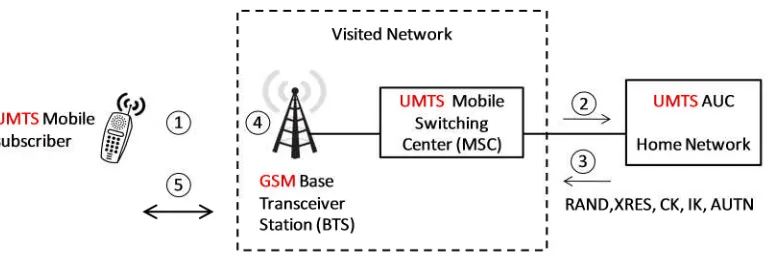
Figure 3.8: The GSM Mobile subscriber is authenticated via a UMTS BTS, which is connected to a UMTS MSC... 44
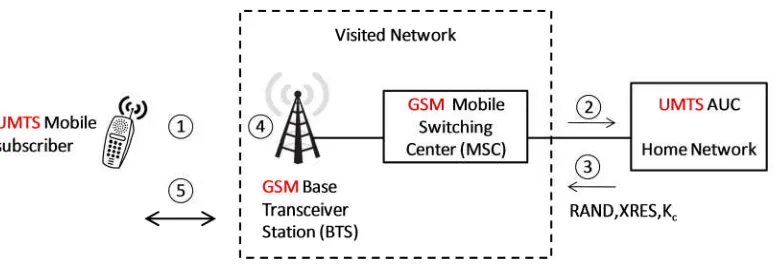
Figure 3.9: The UMTS Mobile subscriber is authenticated via a GSM BTS, which is connected to a UMTS MSC... 45
Figure 3.10: The UMTS Mobile subscriber is authenticated via a GSM BTS, which is connected to a GSM MSC. ... 47
Figure 3.11: Proposed modification to GSM Protocol. ... 49
Figure 3.12: Request/Response to retrieve newCKandIK. ... 51
Figure 4.1: Initial authentication of smart control node to do patient agreement and sensor attachment. ... 61
Figure 4.2: Authentication of smart control node while collecting patient telemetry... 64
Figure 4.3: Hash Function used to create authentication values... 65
Figure 4.4: Sensor node initial authentication. ... 66
Figure 4.5: Sensor node re-authentication. ... 67
Figure 5.1: Registration in MIST protocol. ... 88
List of tables
Number Page
Table 5-1: Types of clinical data stored in clinical systems. 85
Chapter 1
I
NTRODUCTION
Technological innovations for communication and computing have been advancing at
an accelerated pace. The ability to co-ordinate and communicate between many devices by
using wireless communication has had a major impact in many areas of life. One area that
has seen slow advancement is medical care. There are many concerns about the security
and integrity of the information created and stored in the systems that are being developed
to help meet the needs of clinicians and patients. Patient privacy and safety are of major
concern when applying many of the new innovations in wireless communication to the
problems faced by the medical community. The general public is concerned about how
their medical information is stored, transmitted and cared for. Clinicians are concerned
Chapter 1: Introduction
perceived issues of applying wireless technology to monitor patients, it is worthwhile to
investigate existing security issues in wireless networks as well as how those issues have
been resolved. By applying the experience gained from wireless deployments it will be
possible to address the concerns and requirements of clinical systems, to ensure the safety
of patients and staff.
Before wireless technology can be applied to the clinical environment, which will
bring many benefits and advantages to clinical care, the security issues need to be
addressed. The ability to remotely track patient information will allow clinicians a more
robust picture of patient health. The extended time that patient information can be gathered
will increase the understanding of the results of medical treatments and allow for stronger
refinement of those treatments to create better results overall or tailored treatments for each
patient. The technology will afford clinicians the ability to understand if a patient is in
stable or in declining health over a long period of time.
1.1
Hypothesis
This thesis will investigate the needs of wireless communication in a healthcare
setting and attempt to develop a protocol that will meet the needs of the legislation. The
protocol will also need to use a minimum number of messages to achieve its desired goals
of mutual authentication and key agreement. The protocol will avoid public key
authentication to limit resource utilization and therefore it will require the use of symmetric
operations or hashing. The protocol will need to be shown to be secure while achieving the
Chapter 1: Introduction
1.2
Methodology
To achieve the desired authentication protocol, different steps will be taken. First an
investigation of current protocols will be completed focusing on protocols that are already
in use in real world wireless communications. The protocols will be analyzed for their
strengths and weaknesses as well as addressing those weaknesses. A protocol will then be
developed that will meet the needs of the healthcare environment. The developed protocol
will then be analyzed with existing theoretical analysis tools. Once the protocol has been
successfully analyzed and shown that it meets the desired goals, we can be certain that it
has met the stated hypothesis.
1.3
Contribution
This thesis proposes two different solutions to the issues brought about by the
integration of the UMTS and GSM protocols. One solution focuses on minimal changes to
the GSM protocol by modifying the key used for encryption with the use of a cryptographic
hashing algorithm. The second solution to the problems brought about by the integration is
a modification of the UMTS protocol and the integration equations to protect the
communications. This thesis also proposes a new secure authentication protocol to be used
in medical wireless sensor networks. The protocol has a minimum number of messages to
ensure efficiency and to limit the resources needed for communication. The protocol
avoids public key cryptography to reduce the resources required for authentication by using
Chapter 1: Introduction
protocol is also found to be secure using BAN analysis to be certain it meets the desired
authentication goals.
1.4
Thesis Outline
The remainder of this thesis is organized as follows. Chapter 2 provides a broad
background on many of the requirements, implications, and needs of medical wireless
sensor networks (M-WSN) as well as information pertaining to security of wireless
communication. In Chapter 3 we discuss authentication in existing 802.11 and mobile
networks and the issues faced by those networks as they have adapted to new security
challenges. A scenario on how an M-WSN would be used is discussed as well as how the
authentication of the system is achieved and a formal verification that the authentication
achieves the desired results are in Chapter 4. Chapter 5 discusses other privacy concerns
and how they may be addressed. Chapter 6 concludes this thesis and offers future research
Chapter 2
B
ACKGROUND
Technology has become a required tool for informed medical care. To address the
concerns of how to properly apply our technological toolset to the medical problem space
we need to properly meet the legislated needs of the countries in which the system would
be deployed and address the privacy concerns of the patients and clinicians that will be
gathering and using the information. This will help to develop acceptable systems that will
meet the legislated needs of the organizations wishing to pursue the application of this
technology with respect to medical care. It will also help to address the concerns of
patients regarding the handling and control of their confidential information. With both the
legislated requirements and the patient concerns addressed, it will lead to adoption of the
Chapter 2:Background
We will also be investigating the existing frameworks of sensor networks to
understand how they handle the security concerns of each type of sensor deployment while
working within the limited resources available on sensor nodes.
2.1
Legislated Requirements
Privacy of medical information is a very important requirement as the information
has a large potential for abuse. To address the issue of privacy and security the United
States, Canada and many other countries have developed legislative requirements on how
the data can be handled by the organizations that need access to the information. Many
different organizations need information related to MSNs that are deployed with patients.
The clinicians, pharmacies and health care providers each need some, if not all, of the
telemetry that is received from the sensors. Insurance providers need to know which MSN
has been deployed with what sensor types and what billable actions have been taken with
the system. Researchers need a variety of information collected to be able to conduct
research and increase knowledge and positive outcomes of clinical care. Public health
organizations may need information collected to understand if there is a public health issue
in an area. The part of the requirements this thesis is concerned with are the regulations
that most countries have in their legislation relating to how the information can be
transmitted to ensure that there is limited opportunity for eavesdropping or modification of
the information.
2.1.1 Health Insurance Portability and Accountability Act (HIPAA)
The United States passed legislation dealing with patient information that requires the
Chapter 2:Background
identifiers for providers, health insurance plans, and employers. HIPAA [1] required the
Secretary of the U.S. Department of Health and Human Services (HHS) to develop
regulations protecting the privacy and security of certain health information. There are two
rules that are the foundation of the legislation, the Privacy Rule and the Security Rule. The
Privacy Rule provides federal protections for personal health information held by covered
entities and gives patients an array of rights with respect to that information while still
permitting the disclosure of personal health information needed for patient care and other
important purposes.
The patient has rights related to the health information collected and can request to
see a copy of the health records. Patients can have corrections added to their health
information, receive a notice that tells them how their information is used and shared,
decide whether to give permission before information can be used or shared for certain
purposes and get a report on when and why the health information was shared. The entities
covered under the law must teach the people who work for them how patient information
may or may not be used and shared and they must take appropriate and reasonable steps to
keep your health information secure.
The Security Rule establishes national standards for protecting the integrity,
confidentiality and availability of electronic protected health information (e-PHI). The
requirements state that entities must ensure the confidentiality, integrity and availability of
all e-PHI they create, receive, maintain, or transmit. They must identify and protect against
reasonably anticipated threats to the security or integrity of the information. They must
Chapter 2:Background
ensure compliance by their workforce. The technical safeguards that are required are
Access Control, Audit Controls, Integrity Controls and Transmission Security.
2.1.2 Personal Information Protection and Electronic Documents Act (PIPEDA)
and Other Relevant Laws
Canada passed legislation that governs how organizations collect, use and disclose
personal information in the course of business. Unlike the American legislation, PIPEDA
[2] applies to all organizations that have access to personal information for commercial
purposes. This requirement makes hospitals exempt from many of the regulations but
physicians’ commercial activities and private practice is covered under the law. Private
group homes are also covered under PIPEDA and need to meet the requirements. There
are laws that apply to hospitals and other primary care facilities on a provincial basis such
as the Personal Health Information Protection Act (PHIPA) [3] and the Freedom of
Information and Protection of Privacy Act (FIPPA) [4] in Ontario. PIPEDA requires that
all organizations receive consent for collection of information, except in a few specific
limited circumstances. The information can only be used or disclosed for the purposes for
which consent has been given. Even with consent, the collection, use and disclosure must
be limited to purposes that a reasonable person would consider appropriate under the
circumstances. The law also requires that individuals have a right to see the personal
information and the ability to correct any inaccuracies. The acts that relate to hospitals in
the different provinces have many of the same requirements as stated in PIPEDA.
PIPEDA and the other laws generally require that safeguards be put in place to
Chapter 2:Background
any unauthorized access, disclosure, copying, use or modification. The information must
be protected regardless of the format in which it is held.
2.2
Medical Wireless Sensor Networks (MWSN)
Wireless Sensor Networks will have a very large impact on many aspects of society
from military applications to common household appliances. The application of WSN to
the field of medicine will have widespread consequences in the gathering of medical
information and giving a more robust picture of patient health. Sensor networks can give
real-time information and telemetry to the clinicians that require the information to
properly respond to medical situations and emergencies. A MWSN can track many
different aspects of the patient including movement inside their home, their temperature
and other bio-medical information such as oxygen saturation. The telemetry will help
reduce costs for healthcare facilities by allowing patients to be remotely monitored instead
of being in a facility for observation. There are a few different frameworks based on the
Telos Mote[5] and Mica[6] Sensors. These frameworks generally use TinyOS [7] to
efficiently manage and utilize their resources with many different deployment strategies to
meet the differing needs of modern healthcare. Along with sensor information, there is a
very real possibility of medication being delivered in minute doses to patients based on
information gathered from medical sensor networks. The delivery of the medication would
be controlled by wireless communication. When the information gathered from an MWSN
reaches this level of integration with the medical care of patients, it is imperative that all
communication be very secure with high integrity and availability so that no mistakes can
Chapter 2:Background
when needed. The types of sensor networks gathering the medical telemetry that can be
used in the healthcare problem space are body sensor networks that are affixed to the
patient or implanted inside the body and environmental sensor networks that gather
information from the environment and are not physically connected to the patient and are
usually stationary. We describe both types of sensor networks in the next two sections.
2.2.1 Body Sensor Networks
The sensors are applied directly to the body and monitor patient vital signs. The
sensors will gather the information from the body and send it to clinicians for
understanding and monitoring. The CodeBlue framework presented by V. Shnayder, et al.
[8] shows a decentralized integrated MWSN for use in a clinical setting that will allow
clinicians to query patient sensors to send vital information. The telemetry devices they
use to collect data include a pulse oximeter, two-lead electrocardiogram, and a specialized
motion-analysis sensor. They have built routing protocols to allow a clinician device to be
able to query and receive data from these sensors while at a remote location in the medical
facility. The CodeBlue framework lacks security and data protection. B.Sarikaya, et al. [9]
integrate electroencephalography (EEG) sensors into the CodeBlue framework.
There are other frameworks that have encryption and integrity but lack authentication
or key agreement such as Kumar, et al. [10] who have built a sensor system for monitoring
patients; their example monitors Electrocardiograph (ECG) information. To ensure
confidentiality of the data, they have used the Ping-Pong [11] encryption algorithm with
the Ping-Pong MAC to ensure integrity. They proceed to develop a framework in [12]
Chapter 2:Background
information to be presented to clinicians in a human usable format. Waluyo, et al. [13]
have developed a centralized framework that has a personal digital assistant (PDA) or other
powerful computing device as a sensor gateway. They have built the functionality for data
collection as well as command and control within their network which is built on TinyOS
on the sensors with a Java framework on the PDA. They have applied the SkipJack [14]
encryption algorithm to their communication to ensure confidentiality. There is no method
of Authentication and Key Agreement (AKA) as they have a single pre-distributed key for
all devices.
A home network for health monitoring is proposed by Singh, et al. [15] which relies
on stationary cameras, a PDA, body sensors, and home health controller system. This will
then send the clinical information over the internet to a medical center. They use an
Encrypted Key Exchange (EKE) [16] protocol for key distribution as well as a Key
Distribution Center (KDC) to limit the impact of losing the PDA as a core device in the
network. When establishing keys between body sensors the EKE uses user secure
environmental values (SEV) such as Inter-Pulse-Interval (IPI) or Heart Rate Variance
(HRV). Diffie-Hellman based EKE (DH-EKE) described in their work is used to establish
a session key, SEV is used as the Encryption in EKE. They show how this uses fewer
resources than Elliptic Curve Cryptography (ECC). PDA authentication uses KDC with a
multiple server protocol (each of the cameras). The user enters a password into the PDA.
This password is used as the encryption in the DH-EKE to authenticate the PDA against the
Chapter 2:Background
allowing the PDA to authenticate the body sensor. As long as a minimum number of
cameras return the proper values then the PDA is authenticated against the body sensor.
2.2.2 Environmental Sensor Networks
Environmental sensors are placed within an environment to track information on the
patient and the environment which gives a holistic view of all conditions that the patient
may experience. An example is the stationary cameras previously mentioned in a home
network for health monitoring proposed by Singh, et al. [15]. Some sensors already exist
in the home such as carbon dioxide and carbon monoxide sensors. Sensors can be added to
the bed to monitor movement of bedridden patients to give information that would help
clinicians reduce the occurrence of bedsores. Infrared and other types of sensors can be
used in the environment to monitor patient bio-metric data without needing physical
contact with the patient.
2.3
Authentication in Sensor Networks
Authentication schemes in sensor networks always need to consider the limited
resources of the nodes that will need to authenticate themselves against the system. Sensor
nodes have limited power, limited processing, and limited memory. When considering any
protocols within this framework it is essential to reduce the overhead and processing to
increase the life of the sensor while ensuring security. There are many different methods
used to achieve secure authentication and key agreement. Symmetric key cryptography or
the more resource intensive asymmetric-key cryptography such as ECC, and RSA can all
be used to authenticate to a network. Authentication is an important aspect of MWSNs due
Chapter 2:Background
Authentication allows the patient to be certain that the network they connect to is the
appropriate network and it allows the clinical systems/clinician to be certain of which
patient is connecting to their system. Mutual authentication is also a very important factor
in billing for medical services rendered by the sensor network (eg. monitoring,
medications).
Collaborative Bloom Filters are used by B. Tong, et al. [17] to achieve authentication
for devices that wish to connect to the sensor network in conjunction with a Merkle hash
tree and ECC. When a node is added to the network it presents and authenticates itself to
the other 1-hop nodes in the sensor network giving each of those nodes a share of its
private key. If the node misbehaves then the 1-hop nodes can collaboratively use the
information to discern the private key of the misbehaving node to add to the revocation list.
M. Kim, et al. [18] present an adaptive mechanism that first relies on symmetric key
authentication that as the node behaves properly it will eventually gain enough information
to use a public key for authentication. This method relies on a shared common symmetric
key for all nodes and it may be possible to discern the private key of the node if other nodes
are compromised.
ECC is used as one of the two factors of authentication in Malasri, et al. [19]. The
second tier of authentication is by using biometric data such as a fingerprint reader or a
finger vein reader. The two factors allow for a more secure system compared to a single
factor of authentication. They also propose that the data collected by the sensor be checked
against the previous data as a method of ensuring the patient is the appropriate patient. If
Chapter 2:Background
with this method of biometric authentication is that some patients will not present
themselves at the healthcare facility in a desired biometric state required for the
initialization of the biometric data. This will result in either alerts happening when the
patient is no longer experiencing the undesired biometric state or with no alert going off
when they are experiencing an undesired state.
Ren, et al. [20] use Public Key Cryptography (PKC) as they state that it is no longer
impractical for WSNs. Broadcast authentication is used in their WSNs under the multiuser
scenario by designing PKC based solutions with minimized computational and
communication costs. Their approach allows for the following security actions - user
authentication (illegitimate users will be excluded from injecting bogus messages), user
revocation (sensor nodes can deal with user revocations), and authenticity of any message
broadcast by a user should be able to be verified by every receiving node.
2.3.1 Authentication of Sensor Nodes
The sensor nodes will authenticate against each other or to a sink node. Sensor nodes
generally have the least resources of any device in the network. In many different sensor
networks the nodes will perform authentication against each other and to the network. The
nodes will also try to detect attacks on the system when routing information through other
nodes to a sink node for collection and possible transmission to the desired recipients.
Most sensor networks have many nodes all of the same type to achieve the desired task
such as intrusion detection into an area for military purposes. In a MWSN most of the
sensors are specialized to be able to collect the appropriate information from the patient.
Chapter 2:Background
These types of nodes are generally more powerful, can be a laptop or PDA, with
greater resources and communicate the sensor information back to a more central system.
The authentication of sensor nodes to the sink node will usually be less powerful than the
authentication of the sink to the central system.
2.4
Key Agreement in Sensor Networks
Key agreement is required in a secure network to allow devices to begin to
communicate securely and with integrity. Du, et al. [21] describe a methodology for an
asymmetric pre-distribution key management scheme in a Heterogeneous sensor network.
Their design has pre-distributed key pools to the sensors that allows for high probability of
key agreement between sensor nodes. The nodes can therefore authenticate against each
other by use of the pre-distributed keys. Camtepe, et al. [22] also propose a probabilistic
key distribution methodology to increase the likely-hood that two sensors will be able to
authenticate each other and proceed to communicate securely.
The proposed security framework for wireless medical sensor networks in Morchon,
et al. [23] relies on cryptographic keying material, a lightweight digital certificate linked to
the keying material and a security policy. This system is used to enable distributed key
agreement by means of the multidimensional secure key establishment scheme and
cryptographically enforced access control. Each node has keying material related to the
main security domain as well as other keying material related to each of the sub-domains to
which it has access. The design allows for quick and easy agreement between the medical
devices such as a PDA and the sensors on the type of access allowed by matching the
Chapter 2:Background
2.5
Encryption and Integrity in Sensor Networks
The limited resources in sensor networks require the design of the security to be
limited. To achieve confidentiality, Malasri, et al. [19] use the RC5 [24] encryption
algorithm and to achieve integrity in their communication they use the SHA-1 [25]
algorithm. Waluyo, et al. [13] use the SkipJack encryption algorithm to secure the
information sent in their framework from passive eavesdropping. They do not have any
integrity algorithms to ensure the quality of the communication and they do not have any
protections against active attacks. The single key used on all devices will allow one
compromised device to have full access to all information on their MWSN. The Ping-Pong
and Ping-Pong-MAC algorithms used by Kumar, et al. [10] meet both of these
requirements of confidentiality and integrity allowing the sensor to use similar algorithms
to reduce the overhead in both of these operations. There are many tools used in security to
achieve these goals such as stream ciphers, block ciphers and cryptographic hash functions.
Due to the limited resources available to sensor nodes it may be appropriate to use
stream ciphers to secure the communication between nodes since they generally use less
overhead and can easily be implemented in hardware. Ping-Pong, RC4, A5/1 and A5/2 are
stream ciphers that are used to protect communication. RC4 is the algorithm used in WEP
and it is also in active use by many websites such as Gmail, Amazon, and RBC. A5/1 and
A5/2 are encryption algorithms used in GSM communication but these algorithms have
serious flaws.
Block Ciphers generally require more resources than stream ciphers but there are
Chapter 2:Background
symmetric encryption research and they provide many different modes of securing the
information that have been accepted by the National Institute of Standards and Technology
[26]. One mode of operation is Cipher Block Chaining (CBC) which reduces the chance of
using a dictionary attack on the cipher text as each input block is XORed against the
previous block of cipher text. Other modes of operation that are very useful and allow the
block cipher to act as a stream cipher are Cipher Feedback (CFB), Output Feedback (OFB)
and Counter (CTR). Counter mode has the added advantage of being able to be decrypted
in parallel. Due to the increased complexity of block ciphers most cannot be easily
implemented in hardware but the AES block cipher is able to be implemented in hardware.
Hash functions have many applications in security and allow for simple methods of
ensuring integrity. Cryptographic hash functions take an input message and create a
pseudorandom output message digest that is easy to compute given the message but it is
infeasible to generate a message given the hash digest. It is also infeasible to modify a
message without changing the hash or to find two different messages with the same hash.
These properties make hashing a useful tool for integrity and for deriving pseudorandom
Chapter 3
W
IRELESS
A
UTHENTICATION AND
K
EY
A
GREEMENT
Wireless communications have revolutionized the way the world communicates. An
important process used to secure that communication is authentication. Authentication is
the process of determining whether someone or something is, in fact, who or what it is
declared to be. The traditional method of authentication in computing is the
challenge-response mechanism. There is a shared secret between the two parties that is used in an
algorithm so that one party asks a question as a challenge and the other party must reply
with a correct answer as a response. For any wireless communication to be secure there
needs to be some type of authentication and key exchange to create that security. As flaws
Chapter 3: Wireless Authentication and Key Agreement
required to meet those security issues. When creating new algorithms and systems it is
possible that the existing equipment may not be able to implement the new protocols,
which means that integration may be required to transition from the old security protocols
to the new more secure protocols.
Using a wireless medium for communication means that any attacker has full access
to everything sent over the air and can use that information to attack, modify, and
eavesdrop or any other activity if the information is not properly secured. Stationary
wireless networks were created without a strong need to integrate protocols and have
simply developed slightly more secure protocols to protect old equipment. New protocols
in stationary wireless networks are implemented without integration as a requirement.
Mobile network security is constantly evolving and adapting to meet the needs of
users and network operators. Mobile wireless networks have the requirement of allowing
old equipment to use the entire network, as it is advantageous to allow new mobile
equipment to connect to old networking equipment to increase coverage areas and for old
equipment to be able to connect to new towers for roaming and billing. This requirement
for mobile networks means that integration is required. Mobile networks originally had no
security which proved to be a deployment nightmare that was attacked constantly and the
providers were defrauded of millions of dollars. To address the security issues in mobile
networks, the subscriber identity module (SIM) authentication protocols [27] were
developed to secure the resources of the network providers. The original SIM security
framework developed in Global System for Mobile Communications (GSM) networks had
Chapter 3: Wireless Authentication and Key Agreement
the algorithms used to secure the communication. The evolution of authentication in
mobile networks to address the problems in the SIM framework brought about the creation
of the universal subscriber identity module (USIM) protocols which are used in Universal
Mobile Telecommunications System (UMTS), Long Term Evolution (LTE) and
Worldwide Interoperability for Microwave Access (WiMAX) to secure the network from
the SIM framework security issues. The integration of those two SIM and USIM
frameworks brought forward the major weaknesses first found in the SIM framework.
This chapter discusses authentication in mobile wireless networks as well as the
needs of those networks to interoperate and the security issues brought about by that
integration. This will include a description of the authentication and key agreement (AKA)
protocols of the legacy SIM based 2G GSM networks, and the modern USIM based 3G
UMTS networks, 4G LTE networks and WiMAX networks. The authentication protocols
in the new generations of mobile wireless networks are designed to interoperate (not
replace) the existing protocols as the infrastructure for the existing system is deployed
nationally and is very expensive to replace requiring time, effort and expense. Therefore
the integration of the different protocols to allow this interoperation gives the mobile
operators the ability to upgrade their networks while still maintaining coverage for their
customers. The protocols and methods used for the integration of the legacy systems into
the modern AKA systems will be discussed. We explore simple and effective solutions to
reduce the possible attacks on the USIM protocols due to the above integration. First we
propose a subtle modification to the SIM based GSM security protocols as a stand-alone
Chapter 3: Wireless Authentication and Key Agreement
as a second solution. When considering authentication in an M-WSN we need to
investigate the common methods of wireless authentication that have already been
deployed and therefore have undergone a large amount of scrutiny and have been able to
withstand many different vectors of attack.
It is worth mentioning that the integration of the old (flawed) security protocols is not
always the right option. For instance, the new authentication protocol described by IEEE
802.11i to protect stationary wireless networks replaced (did not interoperate with) the
legacy Wired Equivalent Privacy (WEP) due to the problems found in the earlier
algorithms and protocols. Southern, et al. [28] compared the differences between the
interoperation solution in mobile networks and the replacement solution employed in
stationary wireless networks.
3.1
Evolution in Wireless Communications
Wireless communication allows for easy connectivity of devices without the
expensive requirements of laying a physical network. One of the main difficulties in
deploying wireless networks is the ability to secure information and resources on a medium
that by its very nature broadcasts all information. A key aspect of securing wireless
communication is the authentication protocol used to allow access to the network. The two
major types of wireless networks are the stationary networks generally defined by the IEEE
802.11 standards and the mobile networks defined as 2G, 3G and 4G networks. As
security requirements have changed, the protocols for authentication have adapted with
those changes. Both of these network types have faced significant security problems that
Chapter 3: Wireless Authentication and Key Agreement
algorithms. When creating the new more powerful algorithms and protocols the older
hardware cannot implement them due to the more strenuous requirements.
The demands on mobile communication and networks have been constantly
increasing. Originally the need was simply to have a phone system that could meet most of
the requirements of the standard plain old telephone service (POTS) in most homes. The
original first generation (1G) systems, such as the advanced mobile phone system (AMPS),
were analog cellular networks which met this need without considering the inherent issues
that arise due to using a wireless medium as opposed to a wired one. Security was a major
issue that was not properly addressed when developing the 1G systems and therefore the
phones were susceptible to cloning. This was due to the phones broadcasting their identities
without encryption or integrity when phone calls are placed. Attackers could then take this
information and apply it to their own phone to then use it to connect to the provider
network allowing them to call anywhere without having a legitimate account with the
provider. The cloning defrauded many providers of large amounts of money while
inappropriately making unauthorized use of their resources. Securing resources against
inappropriate use is one of the many benefits and requirements of security in mobile
wireless communication.
The second generation of mobile communications (2G) strove to solve the phone
cloning issue and while meeting the expanding requirements of consumers with GSM/2G
networks. GSM networks also addressed some of the issues with using a wireless medium
when sending information. The new network authenticates the user against the network in a
Chapter 3: Wireless Authentication and Key Agreement
well as ensuring that the network resources are not accessed inappropriately. This made
phone cloning a much more difficult proposition for attackers to inappropriately make use
of provider networks, while allowing providers to be much more certain that their resources
were not being fraudulently used by unauthorized devices. The problem with GSM
networks was that they did not appropriately protect the user from many other types of
attacks, such as the false base station attack that would allow an attacker to listen in or
modify the communication from the GSM user. The false base station attack and other
security issues in GSM networks were attempted to be resolved by providers with the third
generation of mobile communication (3G).
3G mobile communications allowed for much better use of the spectrum available
allowing much “smarter” devices to be on the network. Even though the cloning issue was
mostly resolved with the GSM networks there were other security issues that needed to be
addressed in universal mobile telecommunications systems (UMTS) networks. To address
these new issues the 3rd generation used mutual-authentication between the mobile device
and the provider network. The UMTS networks also have much higher speeds for IP
communication to allow for users to make extensive use of the network resources.
The next generation of mobile communication will make even further use of the
available spectrum and increase the ability of smart devices to do much more robust
communication with media and other applications. The authentication in the fourth
generation (4G) is still going to be the same authentication protocols as the USIM 3G to
Chapter 3: Wireless Authentication and Key Agreement
networks will allow wider bandwidths, higher efficiency and a fully IP network for all
communication.
GSM networks had by far the largest installed base of users with over 3 billion GSM
devices in use around the world [29]. This large market of devices has made it a business
requirement of all providers to allow for the legacy GSM system to be integrated into new
systems to ensure that these users can use the network resources and be billed appropriately
for that usage. The interoperation of legacy systems needs to be executed with the utmost
care to ensure that issues in the legacy system do not manifest themselves in the new
integrated system. There are many security concerns when integrating legacy systems and
the evolution of those systems to handle new requirements. The authentication done in the
GSM network was maintained in the new UMTS networks to allow these devices to
connect. This integration allows some of the security issues in GSM networks to be
exploited in the new network.
3.2
Authentication in Mobile Wireless Networks
When authenticating against a mobile wireless network the mobile equipment needs
to be able to send from one base station to another without a loss of communication or
interruption to an active connection. The requirement to roam without interruption forced
the development of a network that would allow a user to be able to authenticate to and use
all parts of the network seamlessly. A major difficulty faced by mobile networks is the
ability for a user to roam from one network operator to another network operator which
allows mobile network providers to bill foreign users and systems. This support limits the
Chapter 3: Wireless Authentication and Key Agreement
networks also tend to be built out nationally, a very large investment, which needs to be
leveraged as long as possible to have connectivity for all users. Some users are also likely
to keep a functioning phone for a much longer time than a functioning laptop. GSM
phones will operate as a worthwhile and functioning phone for more than a decade which
to many users that means there is no reason to upgrade their device.
3.2.1 SIM-based Authentication Mechanism
Mobile service providers needed to secure their networks from attack and
misappropriation of networking resources. In the attempt to achieve the goals set out in
GSM of protecting access to mobile services and to protect any relevant item from being
disclosed on the radio path [30], the GSM security protocols were developed. There are
many technical constraints that needed to be addressed when adding security to mobile
communication. When authenticating against a mobile wireless network the mobile
equipment needs to be able to send from one base station to another without a loss of
communication or interruption to an active connection. The requirement to roam without
interruption was a major factor in development of mobile networks that would allow a user
to be able to authenticate to and use all parts of the network seamlessly. The authentication
protocol deployed to address these problem was the SIM based GSM protocol.
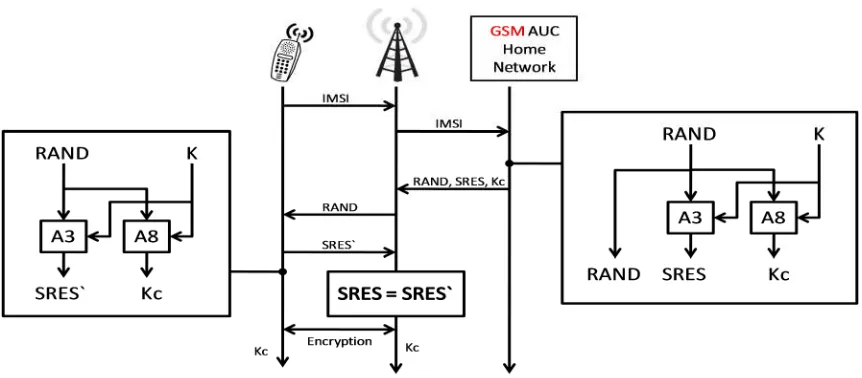
The authentication in GSM is a one-way authentication algorithm to authenticate the
mobile device to the service provider network. As shown in Figure 3.1 the algorithm uses
a secret key K that is shared between the GSM home network and the mobile device. The
mobile device identifies itself to the network by sending its international mobile subscriber
Chapter 3: Wireless Authentication and Key Agreement
the device. Based on the IMSI the home network recognizes the corresponding keyK that
is used along with a random challenge (RAND) to generate a session keyKc =A8(RAND,
K) and the expected response to the challenge SRES=A3(RAND,K), where A8 and A3 are
two hashing functions. The home network sends the authentication vector (RAND, SRES,
Kc) to the BS who will retain SRES andKcand sends the RAND to the mobile device as a
challenge. Using the shared secret key K along with the received RAND the mobile
generates the response SRES' and generates the same session key Kc. The mobile device
responds to the BS with the SRES which the BS then matches against the SRES to verify
the identity of the mobile device. This authentication in GSM gave the service providers
the ability to address the issue of cell phone cloning by issuing a challenge to the device
that would appropriately be responded to with the SRES'. GSM also added encryption
using the keyKcto the channel to allow the confidentiality on the information transmitted
across the air interface.
Chapter 3: Wireless Authentication and Key Agreement
Even with all of these new security enhancements to wireless communication, there
are many problems with the authentication and security in GSM. The encryption and
hashing algorithms were developed in secret design, in violation of Kerckhoff’s principle
[31]. It says a cryptosystem should be secure even if everything about the system, except
the key, is public knowledge, which led to the system being less secure than if they had
used known algorithms that had been vetted by cryptographers not involved in the design.
In addition, the stream cipher A5 is used for encrypting the communication channels. The
adopted A5/1 encryption algorithm in GSM can be broken in real time [32] and the A5/2
algorithm is easily broken in seconds [33] meaning that the intent to keep communication
of the customer on the network private is no longer truly provided by the protocol. The
GSM framework does allow providers to choose different algorithms for both the hashing
and encryption but due to the established base and weaknesses in the protocol this is not
entirely feasible for the encryption protocol (hashing protocols can be set specifically for
each device at the discretion of the provider). The XRES and other values are also limited
by their length as required in the GSM protocol.
The authentication protocol has many flaws that allow for denial of service, and false
base station attacks since the subscriber does not authenticate the network. Note that, GSM
uses one-way authentication. A false base station attack is visible due to the mobile device
not authenticating the network. The false base station attack is a classic man-in-the-middle
attack that generally passes most of the communication from the handset to the tower but
will modify some of the transactions to attack the network. These attacks have a method
Chapter 3: Wireless Authentication and Key Agreement
device to not use encryption for communication which allows the attacker to listen to the
conversation and possibly inject information into the channel. Again, the fact that GSM
protocol authenticates only the phone and leaves the network unauthenticated allows for
these base station attacks to neutralize any increase in the quality of the encryption
algorithms since the devices will support the older implemented algorithms and no
encryption. The insecurity brought about by the protocol allows these attacks to
compromise the confidentiality and integrity of the user communication with the network.
3.2.2 USIM-based Authentication Mechanism
3.2.2.1 UMTS-AKA Authentication Protocol
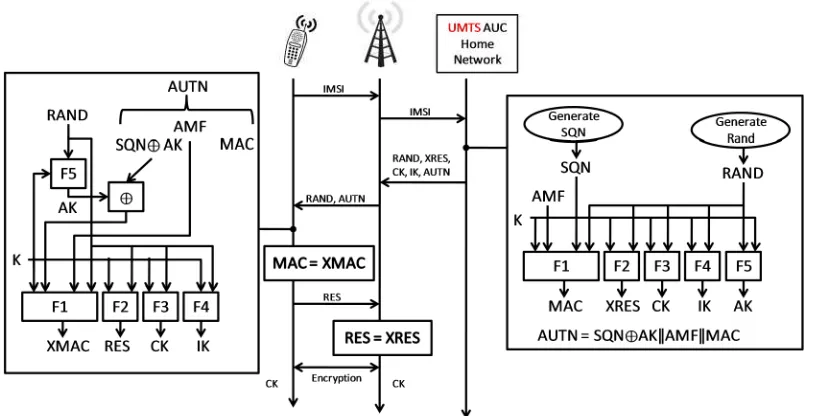
UMTS networks have mutual authentication in which the mobile device is
authenticated to the network as well as the network authenticating the phone as shown in
Figure 3.2. This mutual authentication allows the device to discern whether or not the
network they are connecting to is a legitimate network. The authentication protocol also
makes use of integrity to ensure that the communication is not modified when selecting
algorithms for encryption and integrity. The authentication protocol follows many of the
same network steps in the GSM protocol with some important changes. The authentication
token AUTN as well as the integrity key (IK) are sent from the home network. The AUTN
token along with the RAND are then sent to the mobile device which processes the RAND
with the key to verify the AUTN token by validating the MAC section of the token sent
from the network against the XMAC created by using the key, sequence, authentication
Chapter 3: Wireless Authentication and Key Agreement
The mobile equipment also does a validation of the sequence to ensure that it is within the
desired range. This verification allows the mobile device to trust the connection to the
network.
Figure 3.2: UMTS Authentication Protocol.
The algorithms are at the discretion of the providers but generally the Kasumi [34]
algorithm is used for both integrity and encryption with an option of no encryption. The
UMTS protocol does not allow the system to operate without integrity, which in
conjunction with the authentication allows the mobile device and network to have a
reasonable expectation that there has been no modification of the communication. This
method of authentication with integrity limits many attacks in a purely UMTS network.
The Kasumi algorithm is a modified MISTY1 algorithm that was chosen for its suitability
for implementation in hardware. The algorithm has some weaknesses but is not susceptible
Chapter 3: Wireless Authentication and Key Agreement
still developing the standards for 4G mobile communications but the authentication
protocols are the same as those of the UMTS network [36].
3.2.2.2 EPS AKA, LTE Authentication Protocol
LTE networks were developed to meet the growing mobile data usage of users. The
new network moved voice off of a circuit switched network to a packet switched IP based
VoIP protocol. There is better utilization of the bandwidth and increased speed and
capacity available for providers to meet the constantly growing needs of their users.
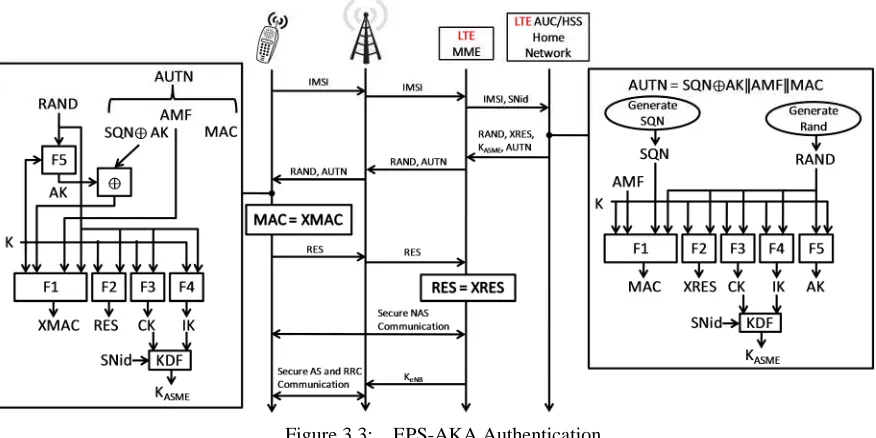
LTE networks have expanded the authentication key agreement used in UMTS. The
beginning of the protocol is identical with the IMSI request being forwarded by the base
station to the authentication center (AuC) as can be seen in Figure 3.3. The changes begin
with the evolved packet system (EPS) authentication vector (AV) which has RAND,
AUTN, XRES, and KASMEwhich is the access security management entity (ASME) instead
of CK and IK. The CK and IK values in the USIM along with the serving network’s
identity are the input into a key derivation function (KDF) to generate KASME. Then the
similarities to the UMTS protocol continue with the user equipment (UE) validating the
MAC and then responding with the RES for the network to complete the authentication
procedure by comparing it with XRES. The major change in EPS is that the KASMEis used
to generate keys in a key hierarchy. Keys are generated for three different traffic types: the
Chapter 3: Wireless Authentication and Key Agreement
Figure 3.3: EPS-AKA Authentication.
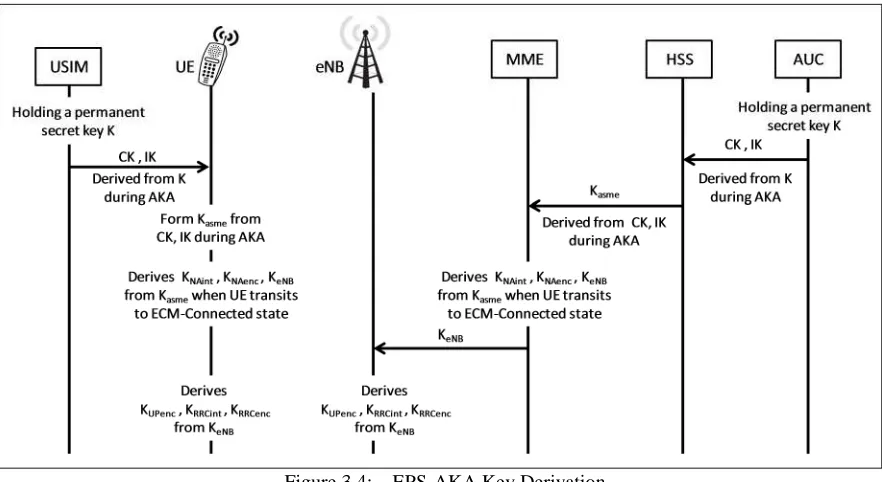
The Key Agreement within the EPS-AKA protocol allows for 6 different keys to be
generated as shown in Figure 3.4 which shows the different equipment that will be used to
derive each key, as follows.
Kis a 128-bit secret key stored permanently in USIM and AuC.
CK andIK are a pair of 128-bit keys derived in AuC and USIM during the
AKA process.
KASME is a 256-bit intermediate key derived in the home subscriber server
(HSS) and UE from CK and IK, during the AKA process. KASME is then
forwarded to MME as a part in the EPS AV along with RAND, XRES and
AUTN.
KeNB, KNASint, KNASenc, are 256-bit Intermediate Keys derived in MME and UE
as well from KASMEwhen UE transits to EPS Connection Management ECM
Chapter 3: Wireless Authentication and Key Agreement
during eNB handover. KeNB is then forwarded to the eNB. KNASint is an
integrity key for protection of NAS data derived in MME and UE. KNASencis
an encryption key for protection of NAS data derived in MME and UE.
KUPenc, KRRCint and KRRCenc are 256-bit keys derived from KeNB in eNB and
UE. KUPencis an encryption key for protection of user data derived in eNB and
UE. KRRCint is an integrity key for protection of user data derived in eNB and
UE. KRRCenc is also an encryption key for protection of RRC data derived in
eNB and UE.
Therefore, these keys are all based off of the pre-shared keyK. They follow the same
processes in UMTS as is evident in Figure 3.3 which are used to generate the different keys
and values required for the key agreement and authentication. The difference arises when
the keysCKandIKas well as the serving network identity (SNid) are used as input into a
key derivation function KDF generating KASMEwhich is then used to generate all the other
Chapter 3: Wireless Authentication and Key Agreement
Figure 3.4: EPS-AKA Key Derivation.
The authentication and key agreement in EPS-AKA has identical steps for mutual
authentication as UMTS only the key agreement and which devices perform the key
generation steps differ.
3.2.2.3 EPS AKA, LTE Authentication Protocol
Worldwide Interoperability for Microwave Access (WiMAX) is an IP based, wireless
broadband access technology that provides performance similar to 802.11/Wi-Fi networks
with the coverage and quality of service (QOS) of cellular networks. In a fixed wireless
configuration it can replace the telephone company's copper wire networks, the cable TV's
coaxial cable infrastructure while offering Internet service provider (ISP) services. In its
mobile variant, WiMAX has the potential to replace cellular networks. It is an IEEE
standard designated 802.16-2004 (fixed wireless applications) and 802.16e-2005 (mobile
Chapter 3: Wireless Authentication and Key Agreement
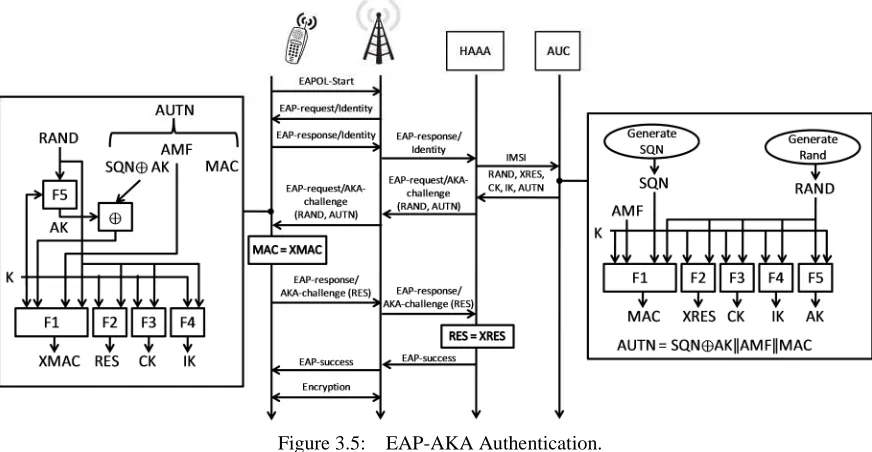
Figure 3.5: EAP-AKA Authentication.
To allow connections to WiMAX by current USIM cellular devices an extensible
authentication protocol method for UMTS Authentication and Key Agreement or for short
EAP-AKA was developed to integrate the UMTS-AKA algorithm into the extensible
authentication protocol (EAP) framework as seen in Figure 3.5. The start of the protocol
requires the UE to initiate the connection with the access point (AP) by sending an
EAPOL-Start message. The AP will then respond with the EAPOL-request/identity
message. The remainder of the protocol is very similar to the UMTS-AKA algorithm but
with the elements wrapped in their equivalent EAP message types. Therefore the UE will
respond to the EAPOL-request/identity message with an EAPOL-response/identity which
contains the IMSI of the USIM. The IMSI will be sent from the AP to the home
authentication, authorization and accounting server (HAAA) which will control all future
communication with the UE through the AP. The HAAA will then forward the IMSI to the
Chapter 3: Wireless Authentication and Key Agreement
The AuC will send the authentication vector ofCK,IK, RAND, XRES, and AUTN to the
HAAA. The HAAA will then send an EAP-request/AKA-challenge containing the RAND,
AUTN, and MAC to the UE. The UE will verify the MAC and respond to the HAAA with
the RES in an EAP-response/AKA-challenge message which is then to be validated by the
HAAA. The HAAA will then respond with an EAP-success message.
The EAP framework adds some extra overhead to the UMTS-AKA protocol with the
addition of the EAP standard messages that complete the requirements of the EAP
framework but the overall protocol uses the same messages and mutual authentication
requirements.
3.3
Authentication in Stationary Wireless Networks
To understand the security environment in mobile wireless networks it is worthwhile
to review the security in stationary networks since both types of networks have undergone
a phase of broken security and a migration of equipment from the less secure to more
secure environments. Stationary wireless networks allow user equipment to connect to a
network without the need of a physical wire. This allows for more user mobility and to
create a network quickly and in environments where it is difficult or expensive to deploy
physical networks. Generally, there is no need in these types of networks to manage the
mobility of the user from one network access point to another as the connection does not
need to be maintained if a user roams from one network area to another. The main
difference for stationary networks is that the wireless users generally have modern or more
powerful equipment that connects to the network and the network operator will generally
Chapter 3: Wireless Authentication and Key Agreement
have the same need to make their network allow access to old devices. Another major
consideration in the evolution of security in stationary networks is that the equipment
manufacturers were in control of the development and migration of the security framework
and therefore did not have a strong vested interest in maintaining older hardware and would
prefer to sell the new hardware that meets the new standard.
3.3.1 Wired Equivalent Privacy
The first type of security devised for wireless communication in the 802.11 standard
is WEP. The algorithm relies on a shared Key (WEP key) of 40 bits or 104 bits as well as
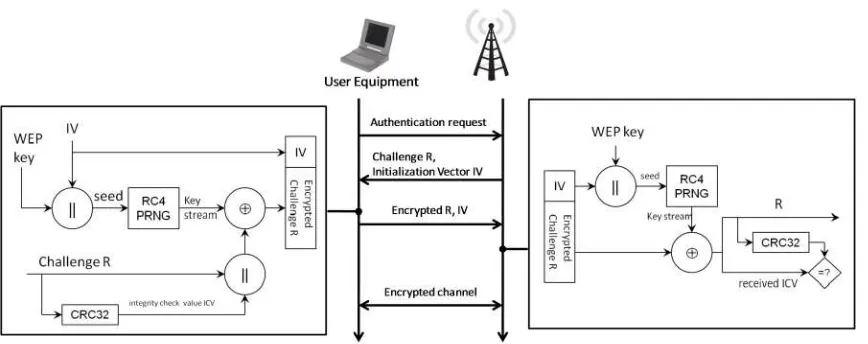
an Initialization Vector (IV) of 24 bits. As can be seen in Figure 3.6, WEP authentication
process starts when a user equipment UE requests to associate with the access point AP,
where UE must authenticate itself to the AP. Based on this request, AP sends a challenge
nonce R (random number) to the UE, and waits for the response. The UE then encrypts the
challenge R using a stream symmetric cipher RC4 as follows.
The challenge R is first checksummed using CRC32 that is added to R to
form the data payload.
Then the UE creates a 24-bit random initialization vector (IV).
The IV and the WEP key are used as a seed to generate RC4 key stream K.
The ciphertext is produced by XORing the key stream K with the data
payload.
UE then transmits the ciphertext and the IV to the AP as its response. The AP uses
Chapter 3: Wireless Authentication and Key Agreement
checksum. If a match is found, the authentication declared successful and the association is
formed.
Figure 3.6: WEP Authentication Protocol.
Note that the cryptosystem used in WEP is a stream symmetric cipher RC4, and the
key that encrypts the data is the same key that will be used for decryption to recover the
data.
Scott Fluhrer, et al. [37] describe in their work titled "Weaknesses in the Key
Scheduling Algorithm of RC4”, a number of weakness in the WEP protocol. The flaws are
related the way RC4 was implemented. They have mentioned that WEP can be cracked if
enough traffic can be intercepted. This is because there are only 16 million possible IV’s
(24-bit), so after intercepting enough packets, there are sure to be repeats in the IV’s. When
IVs repeat, the RC4 key stream can be easily discovered and hence a known-plaintext
attack can be utilized to recover the plaintext without the need for the WEP key. The end
result is that WEP has suffered from key management problems, implementation errors,
Chapter 3: Wireless Authentication and Key Agreement
3.3.2 Wi-Fi Protected Access (WPA)
The major flaws in WEP made it necessary for the Wi-Fi Alliance to create a stronger
protocol to increase the security of wireless networks without replacing the legacy
hardware. There was a rush to create a more secure wireless network and therefore WPA
was developed as a pre-standard 802.11i protocol that would be able to be loaded as an
update to most WEP firmware and would improve the security of existing wireless
networks until the 802.11i protocol could be ratified. WPA has the endorsement of the
Temporal Key Integrity Protocol (TKIP) and Message Integrity Check (MIC) by the Wi-Fi
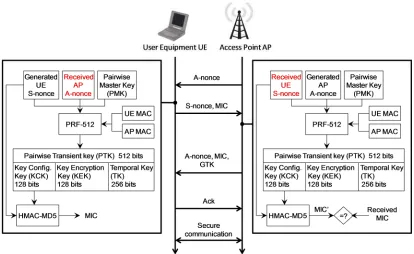
Alliance. Authentication under WPA is completely different than that in WEP as shown in
Figure 3.7.