TABLE OF CONTENTS
Abstract ... 3
Abbreviations ... 4
Market trend/ Challenges ... 5
Solution ... 7 Best Practices ... 11 Common Issues ... 12 Conclusion... 13 Reference ... 14 Author Info ... 14
Abstract
Every system has a reliability goal that needs to be achieved. Reliability allocations are used to set the goals for various sub-system or functional blocks such that the overall sub-system level reliability can be achieved in an effective way. There are various methodologies that exist to provide guidelines on the allocation techniques, which are more theoretical. The allocation technique described here ensures that the allocation is done rationally with consideration of factors such as complexity, state of art and duty cycle of the functional group or sub-system. This approach was experimented in one of the HCL Project and found the approach to be more pragmatic than compared to the other allocation techniques.
Abbreviations
Sl. No. Acronyms (Page No.) Full form
1 AGREE (5) Advisory Group
on Reliability of Electronic Equipment 2 C (8,9,10) Complexity 3 Co (8,9,10) Cost of Reliability Enhancement 4 Cr (8,9,10) Criticality 5 D (10,11,12) Duty Cycle 6 R (7,10) Reliability 7 Rt (7) Target Reliability
8 S (8,9,10) State of the art
9 Z (8,9,10) Proportionality
Factor
Market trend/ Challenges
Generally, as mentioned in the abstract, there are several methods to do a reliability allocation. These methods are selected based on the information available about the system on its application.
1. Equal Apportionment
The simplest method of all for allocating reliability is to distribute the target reliability equally among all sub-systems. For example, if the target reliability for a system is 0.95 and it has got 3 sub-systems, then the uniform allocation of reliability to all the components may require each component to have a reliability of 0.984. While this is the easy method of allocating the reliability, it is not always the best method of allocation. The weakness of this method is that subsystem goals are not assigned in accordance with the degree of difficulty associated with realization of allocated target reliability.
2. ARINC
The ARINC method assumes that failure rates of the subsystems are known. These rates can be obtained from either existing failure data or failure rate prediction standards. This method reduces subsystem failure rates by equal percentages such that the failure rate goal is reached. The rationale behind the ARINC method is that it requires equal effort to reduce failure rates by an equal percentage of failure rates. Even if the effort to reduce the failure rate increases non-linearly with the percentage of failure rate, it leads to the minimum overall effort needed to achieve the failure rate goal.
3. AGREE
This method takes into consideration subsystem complexity, mission time, and importance. Equal effective failure consequences are allocated to all elements. Failure rate allocation of a subsystem is proportional to its complexity. Failure rate allocation of a subsystem is inversely proportional to its mission time. Failure rate allocation of a subsystem is inversely proportional to its importance. When the importance of all elements is the same, the AGREE method allocates equal effective failure rates for all elements.
4. Feasibility of Objectives
This method was developed primarily to allocate the reliability of non-repairable mechanical-electrical systems. Subsystem allocation factors are computed as a function of numerical ratings of system intricacy, state of the art, performance time, and environmental conditions. On the basis of their experience, design engineers estimate and assign ratings on scales from 1 to 10.
Challenges
The four methods described earlier are available for the reliability engineer to do the reliability allocation. The result of allocation varies based on the method used and is always debatable. The choice and the subjectiveness in the method selection results in variation of allocated targets and hence leads to situations where the sub systems / modules are over / under budgeted with respect to reliability. Even the most sought Feasibility of objectyive methodology focus on only four important factors and misses out other factors which could have a sever impact on module / subsystem reliability.
If the reliability allocation result is very stiff / easy, it has different impacts on the product design . The stiff target could puts pressure on the designers in selection of COTS items, material, process and increase the cost while the easy target means the design is not sufficiently challenged and is putting extra allocation on complex sub systems.
The challenge stated above opens a area of research to devise a new technique which can be tailored each time based on the product application and product knowledge. This will help to minimize the subjectiveness and helps to consider each / every possible factor which influence the reliability of the module / sub system.
Solution
In the theoretical approach of most sought feasibility of objective methodology, only four factors such as Intricacy, State of Art, Operating time and Environment were considered, but in our approach, we have considered cost and criticality factors which play a vital role in product development and product safety. This approach is defined as “Modified Feasibility of Objectives” reliability allocation technique and can be tailored with additional factors to refine the allocation depending on the product and its application. Approach
As we are now aware, Reliability allocation is the process of allocation of system reliability target to sub-system or functional groups according to rational factors so that the target reliability requirement or goal into subsystem and component requirements or goals. The balancing act of allocation is done as per the below process:
Identification of all the functions associated with the system.
Grouping of system units according to its function which should be traceable to system function
Identification of applicable rational factors that should be considered for apportionment
Assignment of relative grades to each functional group under respective factor considered for apportionment.
Allocation of apportioned reliability to each functional group with weightage factor.
Rational Factors Considered
The relationship between apportioned reliability of ith functional group (Ri) and target reliability (Rt) is defined with weightage factor
(ωi)
R i = (Rt) ω
i
Also weightage factor (ωi) can be expressed with proportionality factor (Zi)
ωi = Zi/ ΣZi
Proportionality factor (Zi) in turn bears relationship with various rational factors considered for apportionment. In following paragraph such relationships has been defined considering the factors mentioned. The factors can be increased / decreased based on product and its application.
Reliability Allocation is the Delicate Art of Balancing the Budget
Complexity (C)
Higher the complexity of functional group, more difficult it would be to attain the target reliability. Therefore the functional group having relatively higher complexity should be allocated lower reliability target. The following guidelines have been adhered to arrive at the relative grade for complexity
- Multiple functional relationships with the other groups
- Architectural complexity with higher number of components
Criticality (Cr)
Functionally critical sub-systems should be allocated higher reliability target and thus Zi is proportional to criticality. The following guidelines have been adhered to arrive at the relative grade for Criticality
- The failure effect of the functional group on system
- Frequency of failure State of Art (S)
It is expected that state-of-art system should have higher reliability. The functional group with high novelty should be apportioned higher reliability target. Relative consideration of novelty of technology used is considered to arrive at the relative grade for Start of Art Cost (Co)
Higher the reliability enhancement cost, lower should be the apportioned target. This relationship defines the practical approach towards attaining higher reliability targets.
Duty Cycle (D)
The functional groups with higher duty cycles should be apportioned higher reliability target. It provides assurance under continuous operation of functional group the desired level of reliability is
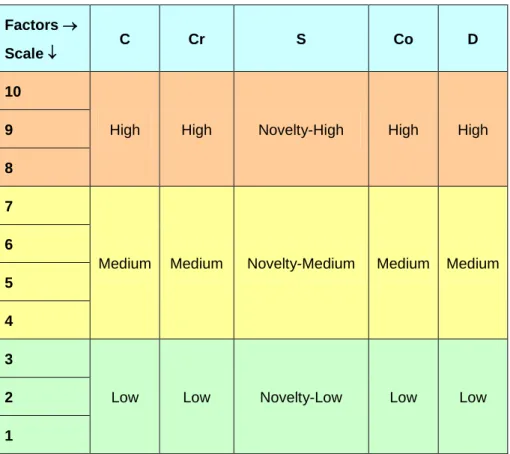
Table 1 provides the guidelines for selecting a relative grade factor
Table 1 – Guideline on selection of relative grade factor
Factors
Scale C Cr S Co D
10
High High Novelty-High High High 9
8 7
Medium Medium Novelty-Medium Medium Medium 6
5 4 3
Low Low Novelty-Low Low Low
2 1
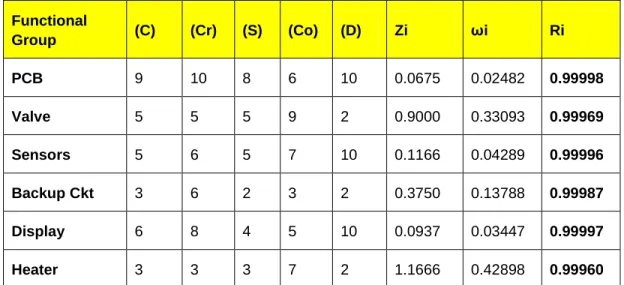
Table 2 shows the reliability apportionment done for a project (Indigo - Life Science), where the system reliability requirement was 0.99907 for its 10 hr operation.
Table 2 – Guideline on selection of relative grade factor Functional
Group (C) (Cr) (S) (Co) (D) Zi ωi Ri
PCB 9 10 8 6 10 0.0675 0.02482 0.99998 Valve 5 5 5 9 2 0.9000 0.33093 0.99969 Sensors 5 6 5 7 10 0.1166 0.04289 0.99996 Backup Ckt 3 6 2 3 2 0.3750 0.13788 0.99987 Display 6 8 4 5 10 0.0937 0.03447 0.99997 Heater 3 3 3 7 2 1.1666 0.42898 0.99960
Best Practices
However the industry and the reliability practitioners are still aligned to the feasibility of objective methodology against other methgods mentiuoned, the successful use of the proposed allocation method provides a unique approach to consider the cost, criticality and other factors of the product for reliability allocation. This approach has helped the design engineers to focus on improving the reliability of the functional group with consideration of Cost constraint and the Safety of the product in the project refered in the paper.
The proposed methodology was successfully used for different projects.
The process of allocation of relative grades should to be carried out as a team exercise, comprising of experienced members from the each of the functional group identified.
Step with care and great tact And remember that Life‟s a Great Balancing Act Just never forget to be dexterous and deft
And never mix up your right foot with your left.
- Dr. Suess, Oh, the places You‟ll Go.
Common Issues
The major challenge in the propsed solution is the subjectivity in selecting the factors and then rating them as per the method proposed. This subjectiveness varies with the experience of the reliability practitioner. For example, it may be possible for different practitioners to select different factors (apart from the factors suggested here) and they can grade them differently based on the individual / team knowledge. However despite this challenge, this method deemed to be best suited to address the challenges for doing the reliability allocation.
Common Issues are not so common
Commom Issues are not SO Common
Conclusion
Reliability Allocation is always a tricky task which needs “balancing act” to allocate reliability targets to the components or sub-system and also ensure that the reliability requirements are met as a system, without compromising on performance or cost or safety of the product.
Reliability allocation by “Modified Feasibility of Objectives” method helps us to perform this “balancing act” in a pragmatic approach rather than a theoretical approach. This methodology can be applied to any system which needs reliability allocation to be performed for its sub-systems or functional groups.
Further studies can be performed to eliminate the subjectivity in selecting the relative grade factor.
The authors also suggests the allocation exercise to be rationally planned and implemented so that it will be feasible to meet overall system reliability target. Apart from the proposed top down approach of reliability allocation, one can try the non conventional bottoms up approach of reliability allocation where reliability data for similar components exits and can be best used for this exercise. Conclusions are most of times
Reference
[1] Reliability Resources in www.relex.com [2] Reliability Allocation Report – Indigo
[3] Paper by Prof K.B.Mishra on Reliability Allocation Technique. [4] Reliability and Six Sigma By Dinesh Kumar, U. Dinesh Kumar
Author Info
Prateeck Biswas: Mr. Biswas is a reliability
consultant and has been working in the field of reliability and quality for more than 25 years, including about 20 years with aviation industries. He is heading reliability engineering practice in HCLT for last 5 years. He holds his post-graduate degree from Indian Institute of Technology (IIT), Bombay in Reliability Engineering. He has been associated with the leading aviation industries of the country like Indian Airlines, Hindustan Aeronautics Limited and Aeronautical Development Agency (ADA). He has worked as a senior reliability professional and a led team of engineers to carry out R&S analysis on civil and military development aircraft projects during his association with ADA. His work on aircraft system safety assessment and lessons learnt in R&S during development of aircraft has been published in Annual Reliability and Maintainability Symposium (RAMS), a renowned international journal in the field of relibility. His work on measurement uncertainty has also been published in international journal. He has worked extensively to propagate reliability concepts to practicing engineers at But it's not just a game of
finding literary references. - Dan Simmons
Arunkumar S: Mr. Arunkumar is a reliability practitioner and has been working in the field of reliability and quality for more than 12 years He holds his engineering in electrical and electronics. He is a Certified Reliability Engineer and a Certified Quality Engineer from American Society of Quality. He is also a Certified Green Belt.
He has been associated with HCL Technologies Ltd from last 4 years and has worked on various aerospace, hitech & life sciences programs on Reliability planning, Reliability testing, Project Planning, Co-ordination, Data Analysis and System Safety. and has good exposure to various standards and tools used in reliability engineering. Prior to HCL technologies, he has served as reliability practioner in Honeywell.
Abhay Waghmare: Mr. Abhay Waghmare is a
reliability practitioner and has been working in the field of reliability and design for more than 10 years. He holds his post graduate degree in Production Engineering from REC Allahabad and his bachelors in Mechanical Engineering from Nagpur University. He is a Certified Reliability Engineer from American Society of Quality. He has undergone the two semester course in Reliability Engineering & Testing under Prof. Dimitri from Univeristy of Arizona. He is also a Certified Green Belt from GE. He has been associated with HCL Technologies Ltd from last 5 years and has worked on various aerospace, hitech & life sciences programs on Reliability planning, Reliability testing, Project Planning, Co-ordination, Data Analysis and System Safety. and has good exposure to various standards and tools used in reliability engineering. Prior to HCL technologies, he has served as reliability practioner in GE India.
Hello, I’m from HCL’s Engineering and R&D Services. We enable technology led organizations to go to market with innovative products & solutions. We partner with our customers in building world class products & creating the associated solution delivery ecosystem to help build market leadership. Right now, 14500+ of us are developing engineering products, solutions and platforms across Aerospace and Defense, Automotive, Consumer Electronics, Industrial Manufacturing, Medical Devices, Networking & Telecom, Office Automation, Semiconductor, Servers & Storage for our customers.
For more details contact [email protected]
Follow us on twitter http://twitter.com/hclers and our blog http://ers.hclblogs.com/
Visit our website http://www.hcltech.com/engineering-services/
About HCL
About HCL Technologies
HCL Technologies is a leading global IT services company, working with clients in the areas that impact and redefine the core of their businesses. Since its inception into the global landscape after its IPO in 1999, HCL focuses on „transformational outsourcing‟, underlined by innovation and value creation, and offers integrated portfolio of services including software-led IT solutions, remote infrastructure management, engineering and R&D services and BPO. HCL leverages its extensive global offshore infrastructure and network of offices in 26 countries to provide holistic, multi-service delivery in key industry verticals including Financial Services, Manufacturing, Consumer Services, Public Services and Healthcare. HCL takes pride in its philosophy of „Employee First‟ which empowers our 72,267 transformers to create a real value for the customers. HCL Technologies, along with its subsidiaries, had consolidated revenues of US$ 3.1 billion (Rs. 14,101 crores), as on 31st December 2010 (on LTM basis). For more information, please visit
www.hcltech.com