Int. J. Food System Dynamics 9 (1), 2018, 101-111
DOI:http://dx.doi.org/10.18461/ijfsd.v9i1.917Semantic Interoperability for Data Analysis in the Food
Supply Chain
Jack Verhoosel
1, Michael van Bekkum
1, and Tim Verwaart
2 1TNO, Department of Data Science, Kampweg 5, Soesterberg, The Netherlands2Wageningen Research, Alexanderplein 15, The Hague, The Netherlands [email protected]; [email protected]; [email protected] Received October 2017, accepted December 2017, available online January 2018
ABSTRACT
Food supply chains consist of many links and operate on a global scale with many stakeholders involved from farm to fork. Each stakeholder maintains data about food products that they handle, but this data is not transparently available to all stakeholders in the chain and trust in data sharing is low. In addition, there are various other data sources that contain interesting data for stakeholders in the food chain, such as import/export transactions, production (forecast) data, parcel crop information, local weather predictions and social media streams. To improve their production, growers and traders are very interested in trends in the market and activities in supply and demand. To make all stakeholders in the food chain benefit from these data sources and to share data more transparently, the Dutch horticulture and food domain is developing the HortiCube platform via which various data sources are made accessible to application developers using a secure, linked data application interface. This paper describes the design and engineering of the semantic approach to enable interoperability between data sources. This includes (1) a high-level design of the HortiCube, (2) the metadata ontology used for describing the contents of the data sources in the HortiCube, (3) the common horticulture model used to achieve semantic alignment between data sources in the HortiCube, (4) a test application for a specific product case and (5) a discussion of our results and future work on this topic. The main contribution of our research is the generic solution and ontology design to the semantic challenges that arise when different data sources are combined to answer analysis questions for the user.
Keywords: Semantic alignment, ontologies, classifications mapping, data analysis, horticulture
1
Context, problem and approach
Food supply chains consist of many links and operate on a global scale with many stakeholders involved from farm to fork. Each stakeholder maintains data about food products that they handle, but this data is not transparently available to all stakeholders in the chain and trust in data sharing is low. In addition, there are various other data sources that contain interesting data for stakeholders in the food chain, such as import/export transactions, production (forecast) data, parcel crop information, local weather predictions and social media streams.
To improve their production, growers and traders are very interested in where their products eventually end up at consumers in various countries and what the consumer’s wishes and trends are. Growers also want to guide their supply based on the potential short-term demand for specific food products. However, growers have a very limited view of what the consumers want, because sharing of data across the entire supply chain is not common. Finally, most of the interesting data sources mentioned above are not
accessible on-line for continuous, real-time usage and automated consumption by growers and other stakeholders in the chain. This makes an environment that shares data for automated consumption by IT systems, a necessity.
Combining data sources allows for (big) data analysis, pattern searching and thus better decision-making on when to produce what quantities of which food products. These data sources can be made easily accessible via a semantic web-based mechanism in which secure, linked data principles are applied. To achieve this, the Dutch horticulture and food domain is developing the HortiCube platform via which various data sources are made available to application developers using a generic linked data application interface as first described in Verhoosel (2016).
In the remainder of this paper we will focus on the design and engineering of the semantic approach to enable interoperability between data sources. Subsequent sections will describe (1) a high-level design of the HortiCube, (2) the metadata ontology used for describing the contents of the data sources in the HortiCube, (3) the common horticulture model used to achieve semantic alignment between data sources in the HortiCube, (4) a test application for a specific product case and (5) a discussion of our results and future work on this topic. The main contribution of our research is the generic solution and ontology design to the semantic challenges that arise when different data sources are combined to answer analysis questions for the user.
2
The HortiCube platform
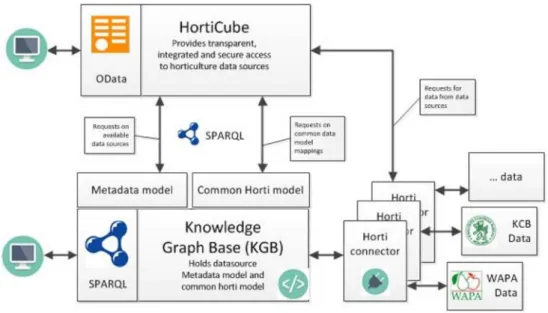
The HortiCube platform provides an application programming interface (API) that is based on the Open Data Protocol (OData). Via this interface, application developers can request from the HortiCube (1) what data sources it has available, (2) which type of data these data sources contain and (3) the data (values) from these data sources.
Figure 1. The HortiCube platform high-level architecture.
The HortiCube enables automated access to a variety of data sources. Via a HortiConnector component, structured transaction-oriented data sources are incorporated, such as production, stock and import/export data from stakeholders but also open data on for instance weather conditions. These data sources are made accessible via linked data web-based mechanisms. In addition, the platform incorporates security mechanisms to ensure that each stakeholder that has added a data source remains in control of who gets access to the stakeholders’ data. Furthermore, anonymization and aggregation rules are applied to data to ensure the privacy of the specific stakeholders when applicable.
At first, the HortiCube focuses on data sources that contain or are closely related to market information. Using this information, the stakeholders in the food supply chain can enhance their market orientation and information-based supply planning. In addition, by combining data sources, the HortiCube allows for applications of big data analysis, pattern searching and thus better decision-making on when to produce what quantities of which food products.
The metadata about data sources is stored in a Knowledge Graph Base (KGB) using linked data technology based on the Resource Description Framework (RDF)*. A metadata ontology is defined in OWL† to
represent these metadata concepts and their relations. The KGB is stored in an Apache Jena Fuseki‡
triplestore that is accessible via a SPARQL§ interface that can be used to query the KGB for its datasets.
The metadata ontology is described in more detail in section 4.
When combining data from different sources, semantics becomes an important aspect of the platform because the meaning of similar terms in different data sources needs to be aligned. A specific challenge in this context is the alignment of the semantics of food product identification, because different product coding lists and levels of product aggregation are in use along the supply chain. The Horticube platform incorporates a Common Horticultural Model (CHM) for mapping between these product-coding schemes. This CHM is designed using the same semantic web technologies as for the metadata ontology and made available in the KGB via a SPARQL interface. The CHM is described in more detail in section 5.
As a result, the HortiCube can offer a uniform interface with standard terms and classifications to application developers. Applications developed on top of the HortiCube use the semantically rich, linked data interface to access the data in the platform and support decision-making. This should give a boost to applications that make use of and combine market data and should minimize investment for individual stakeholders doing so.
3
Related work on agricultural ontologies
In agriculture, several efforts have been made to develop ontologies for the domain. Rehman (2015) gives a brief overview. AGROVOC and the Advanced Ontology Service (AOS) project was proposed by the Food and Agriculture Organization of the United Nations (FAO) for the development of agricultural ontologies based on their multilingual thesaurus as described by Soergel (2004). AGROVOC is a multilingual agricultural thesaurus and contains over 32,000 concepts in 27 languages. It comes close to an ontology and is the largest available agricultural thesaurus that is still being maintained. Smaller and older examples of ontologies are the PLANTS ontology (Goumopoulos 2004), OntoCrop (Maliappis 2009), Crop-Pest Ontology (Beck 2005), Irrigation Ontology (Cornejo 2005), AgriOnto (Xie 2008), ONTAgri (Rehman 2011). In (Roussey 2013) and (Amarger 2014) a small crop production ontology is described as well as an approach to use ontology design patterns for combining different ontologies into one. Most of these ontologies are either out-of-date, not maintained anymore, only partly available or simply not covering the specific domain that we have in scope. Therefore, we developed our own common horticultural model (CHM) to support the integration of data on horticultural production, stocks, trade, and consumption.
4
Knowledge graph base and metadata ontology
The KGB provides metadata on data sources made accessible via the HortiCube platform. This means that it provides data on the data that is available in the data sources: how these data sets are structured in terms of their concepts, how the data can be accessed, the conditions of use, etc. An important feature of the metadata model and the HortiCube platform is its ability to provide information on classifications available to express the data. Classifications are lists and classes of entities, such as countries and product codes. Different data sources often express the same concept in different classifications terms: a country code for the country Netherlands can e.g. be expressed according to the standard ISO-3166 (NL) or a numeric (local) variety that deploys 4-digit values (0003).
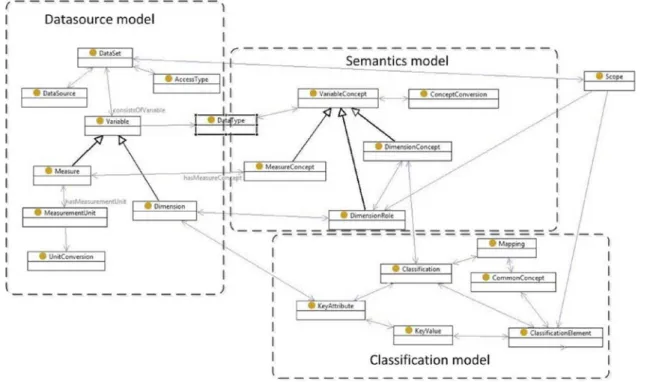
The general structure of the metadata model is depicted in figure 2. In this metadata model, we can discern three distinct parts:
1. The data source model – this part describes the structure of the data source, the concepts used to describe its data and its accessibility model.
2. The semantics model – this part provides a general framework for aligning concept definitions in different data sets.
3. The classifications model – this part describes the classifications in terms of its elements and the mapping between classifications.
In subsequent paragraphs, we will provide more detail on each of these parts of the model.
* https://www.w3.org/RDF/
† https://www.w3.org/OWL/
‡ https://jena.apache.org/documentation/fuseki2/index.html § http://www.w3.org/TR/sparql11-query/
Figure 2. Knowledge Base Graph (KGB) metadata model.
4.1 Datasource model
The DataSet concept refers to the various data sets that are made available via the HortiCube platform. A
DataSet provides reference to one or more DataSources, which is the location(s) (usually URI) where the
dataset is available. An example of a DataSet is the World Apple and Pear Association (WAPA) data set by data supplier WAPA at http://www.wapa-association.org/. The associated AccessType for a DataSet is a reference to the technical description for accessing the data. The DataSet defines the relations between
its Variables. The Variables in a data set are the key concepts in the data, e.g. Apple, Pear, Country or
production in case of the WAP data set. These concepts are the semantics (labels) of the data in the
DataSet. There are two distinct types of Variables we can discern, Measures and Dimensions. A Measure is a numerical variable, that can be expressed in terms of measurement units, e.g. Production in metric tons. This is the key information in the data set. A Dimension provides context and qualification to the
Measures. Examples of Dimensions in the WAPA data set are Country (of production), Year (of
4.2 Semantic model
The semantics model defines a model that allows alignment between the Variable concepts in various data sets. Whereas each data set may be expressed in terms of data set specific Variables, the
VariableConcept in the metadata model strives to align these. These VariableConcepts are linked to
ontologies (or vocabularies) that further define them. An example of a model for VariableConcepts is described in the next section on the Common Horticultural Model. Each of the types of Variable concepts in a data set (Measure and Dimension), is linked to an MeasureConcept and DimensionConcept as aligning representation types respectively. A MeasureConcept is directly related to a Measure: The Measure
Production in a data set can be directly linked to a Measure Concept. A DimensionRole qualifies the
Dimension concept by allowing the DimensionConcept to take on different roles in the same data set. An example is the ‘country’ concept that can play the ‘role’ of both ‘country of origin’ and ‘destination country’ in a data set, while both can be linked to the DimensionConcept ‘Country’.
4.3 Classification model
The essence of the classification part of the metadata ontology is that it allows the HortiCube to output data according to different classifications. Since classifications are lists and classes of entities such as countries and product codes, we need to be able to express lists (hierarchies) of elements and mappings between those lists. The Classification concept is the central element here, referring to a named classification and consisting of ClassificationElements. The ClassificationElements can be part of a hierarchical list, with subclasses of more specific elements. An example is the classification of ‘Apples’ in the GPC (Global Product Classification**), that are a specific subclass of the class ‘Pome Fruits’, which is in turn subclass of the class ‘Food’, etc. Via so-called keys we can link these ClassificationElements to the
Dimension concept in the data set. An example is the classification for Alpha-2 country codes, as provided
by the ISO-3166 standard. Its ClassificationElements are the various countries (Netherlands, UK, Germany)
with associated country codes (NL, GB, DE) defined by KeyValues. These country codes can be used to provide classification on the Dimension ‘Country’ in a particular data set, both when it is used as ‘country
of origin’ and as ‘destination country’. The Mapping concept links two different Classifications by means of (directional) hasMappingFrom and hasMappingTo relations. Mappings consist of CommonConcepts as the concepts that link the classification elements.
5
Common horticultural model
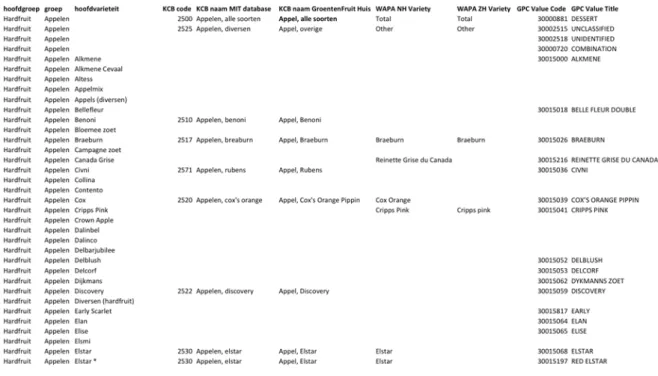
As decribed in section 2, the HortiCube integrates various data sources that use their own specific product classification. Apart from the generic Global Product Classification (GPC) product coding of GS1, there are various local and sectorial product-coding schemes in use. See figure 3 that shows a tabular form of the mapping between product classifications of apples. As is apparent from the figure, the product classifications differ in names, codes as well as languages used. The WAPA product classification is in English and uses the variety names only, while the KCB is in Dutch and uses code-numbers as well as names. The GPC is in English, uses different code-numbers and different names for some varieties.
Figure 3. Example in tabular form of a mapping between product classifications of apples.
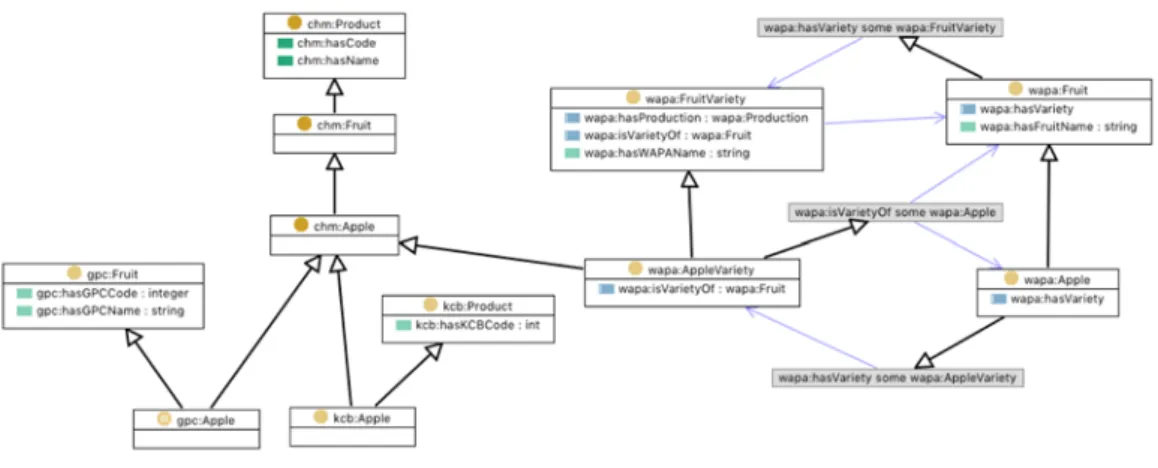
To make a mapping between these product classifications, we designed an ontology for each data source that represents the data in the data source. In the figure below, a snapshot of the WAPA ontology is visualised. It represents that production data that is maintained by WAPA on apples and pears.
A similar ontology was developed for the KCB data sources that describes the export data of various products from The Netherlands to other countries around the world, amongst them also apples and pears. Finally, we developed a small GPC ontology that referred to the ontology provided by GS1 for the GPC
varieties as OWL classes or OWL individuals. When apple varieties are represented as OWL classes, being subclasses of the class Apple, each Apple variety, such as Boskoop or Elstar, would become an OWL class. An instantiation of such a model with individual apples would be populated with every specific apple that is identified in some way. This is not a realistic model of the real world, because specific apples are not identified individually, but only by its variety name or number. Therefore, we chose to represent apple varieties as OWL individuals. The same reasoning holds for pears. In figure 4, a snapshot is presented of the WAPA apple individuals and KCB apple individuals.
Figure 4. WAPA and KCB individuals.
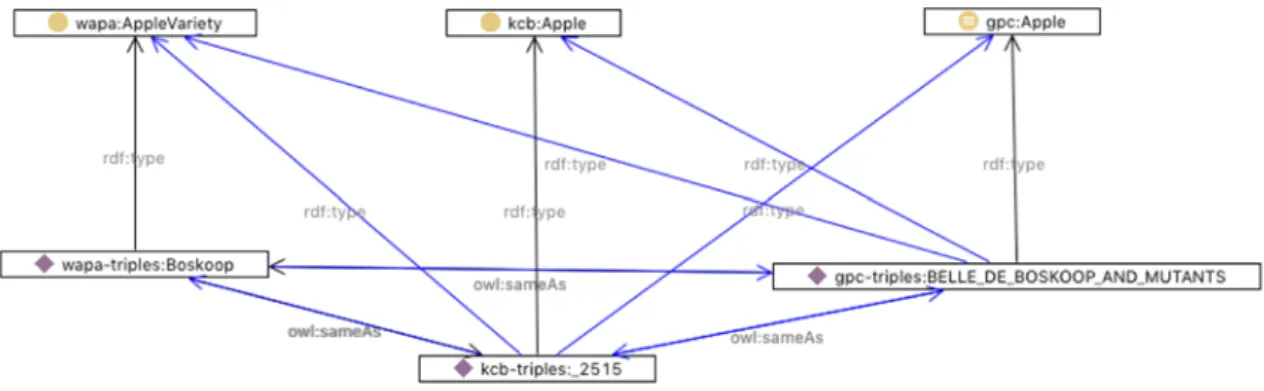
Again, it is obvious that the product classifications of WAPA and KCB differ in terms of names and numbers that individually identify the apple varieties. Thus, the next challenge to be tackled is how to make the mapping between the apple classifications in ontologies of different data sources. To solve that, we chose to apply the OWL property owl:sameAs that links an individual to another individual. Such an owl:sameAs statement indicates that two URI references actually refer to the same thing: the individuals have the same "identity". Note that we abstracted from the actual individual apples as they are not being identified as such, but only as an apple variety.
Figure 5. Mapping between WAPA and KCB varieties
In figure 5, a snapshot is given of the mapping between the individuals of the one of the apple varieties using the owl:sameAs property. As can be seen, the individuals WAPA:Boskoop, KCB:2515 and
GPC:BELLE_DE_BOSKOOP_AND_MUTANTS refer to the same apple variety. When querying for one of the
individuals of this variety also the other individuals can be returned using this mapping.
The mapping between different product classifications is one of the pillars of a larger Common Horticultural Model that supports the integration of data on horticultural production, stocks, trade, consumption and other market information data sources that are of interest to stakeholders in the sector.
Figure 6. The Common Horticultural Model (CHM).
One of the goals of the CHM is to enable answering of analysis questions on the combination of the information of the data sources in the HortiCube. One of these questions is for instance “What was the
production of Elstar in 2009 in The Netherlands?” or “Which country has the largest increase in apple/pear
production and export over the last year?”.
The CHM includes concepts like Product, Country, Export, Production, Stock and so on. In addition, the CHM covers the most important relationships between these concepts. The CHM then functions as the “semantic interface” to the users of the information that is maintained in the HortiCube. The users can be growers and traders or other stakeholders around the farm and the chain towards the customer and they want to express their analysis questions in terms of the common concepts in the CHM. See figure 6 with an excerpt of the concepts in the CHM and the relations with the WAPA data source.
The CHM can be queried using the SPARQL language to answer the analysis question posed above. Based on the mapping in the CHM to the individual data sources that correct data can be collected and returned to the user. For this, we have designed a demo-application that is described in the next section.
6
Demonstration application
We developed a specific application for the HortiCube to test the functionality of the KGB and the CHM model with its mapping between product classifications of apples and pears. We have made HortiConnectors with linked-data SPARQL interfaces based on ontologies for four important data sources for the apple/pear sector:
1. Apple/pear yearly production forecast figures per variety per EU country. This is a WAPA source that was transformed from CSV format to RDF using the LODRefine tool and the WAPA ontology. This dataset is made available via our Apache Jena Fuseki triplestore.
2. Apple/pear monthly stock per variety per EU country. This is also a WAPA source that was transformed to RDF and made available in the same way as the WAPA production dataset.
3. Accumulated export transactions of vegetables/fruit from The Netherlands abroad. This is a KCB source that was transformed to RDF using the KCB ontology and made available via our triplestore.
4. Import/export between countries in the EU of apples/pears from the UN Comtrade†† source. For
this source, we made use of an external API that is being provided by the UN. The HortiConnector to that dataset consists of a Python script that provides a restricted set of questions on the Comtrade data source via its API.
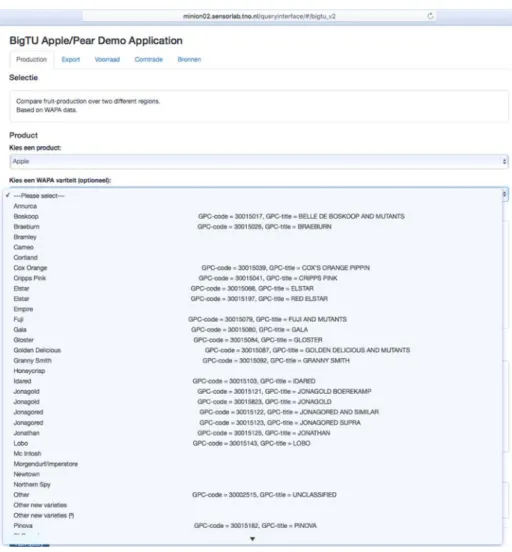
The demonstration application combines the data in these four datasets via the CHM and enables growers and traders of apples/pears to get insight in the production, stock and import/export data. Thereby, the application uses the mapping in the CHM between the apple/pear product coding schemes used in WAPA, KCB and GPC to align the specific apple/pear identifications towards the user. For instance, the user has the possibility to select one or more apple varieties from a list that combines the WAPA and GPC
classifications. See figure 7 for a snapshot of this interface. It shows the WAPA name, the GPC code and GPC title per apple variety and the various tabs that the user can select to get information on production, stock and import/export.
Figure 7. Demo application interface.
Using this selection tab, the user can choose a subset of apple varieties, a period of one or more years and two locations of one or more countries and compare the production, export and stock data for these parameters. Thereby, the user gets answers to the questions posed before: “What was the production of Elstar in 2009 in The Netherlands?” or “Which country has the largest increase in apple/pear production
and export over the last year?”. Thereby, insight is gained in trends in apple/pear growing and production
per country and what are the consequences for the export distribution to other countries. Based on this insight, growers and traders can make decisions on where to target for new markets or where to put extra effort in marketing of their products.
7
Conclusion and future work
The HortiCube platform allows transparent access to a variety of data sources, allowing developers to combine data from these sources to gain new insights and perform data analysis on a heterogeneous set of data. The generic approach presented in this paper employs the notion of common semantics to both describe the data sources themselves (KGB) and to describe the domain they refer to (CHM).
The metadata ontology encompasses both the description of the data source in terms of its own semantics as well as, a general framework for aligning concept definitions in different data sets and a means to describe classifications in terms of its elements and the mapping between classifications.
The CHM ontology provides a semantic model that supports the integration of data on horticultural production, stocks, trade, consumption and other market information data sources in the domain.
The main contribution of our research is the generic solution and ontology design to the semantic challenges that arise when different data sources are combined to answer analysis questions for the user. Our approach to ease the access to market information for SMEs in the sector is based on the following principles:
• Offering a standard API for querying a broad variety of data sources
• Describing variables and scopes of available data sets
• Linking the available variable definitions in data sets to concepts in ontologies
• Describing and applying classification mappings and unit conversions, linked to the variable concepts
• Providing metadata as Linked Open Data
This approach has proven feasible to realize a first demonstration application that combines data sources that are made accessible via LOD principles as well as external data sources that are being accessed via an API. We learned that mapping of product coding is a laborious activity that needs human support. When product varieties of a classification are modelled as individuals in an ontology instantiation, the owl:sameAs property turns out to be an easy OWL construct to represent the mapping between product codings. Once this is done, it can be reused many times for alignment of various data sources.
Future work on the HortiCube includes:
• Extending the CHM model to represent more and other data sources. The CHM ontology was very much designed with extensibility in mind and should be adapted as new data sources are included in the platform. Other domains will feature new generic concepts that need to be included in the model.
• Integrating the HortiCube component with the KGB and horticonnectors to extend the linked data (SPARQL) APIs of the platform to the standard OData API format. Functionality that performs aggregated data lookup, classification transformations and answers questions on generic data source features will be part of this component.
• Safeguarding privacy and security of access to the data disclosed by the platform. Since stakeholders will likely want their data to be accessible to a limited set of trusted partners, safety measures need to be integrated into the platform to regulate data access.
References
Amarger F., Chanet J-P., Haemmerle O., Hernandez N., and Roussey C. (2014) ‘SKOS Sources Transformations for Ontology Engineering: Agronomical Taxonomy Use case’, in 2014 Proceedings of Metadata and Semantics Research Conference (MTSR 2014), Karlsruhe, Germany, Springer, Communications in Computer and Information Science, Volume 478: 314-328
Beck H.W., Kim S., and Hagan D. (2005) ‘A Crop-Pest Ontology for Extension Publications’, in 2005 EFITA/WCCA Joint Congress on IT in Agriculture, Vila Real, Portugal : 1169-1176.
Cornejo C, Beck H.W., Haman D.Z., and Zazueta F.S. (2005) ‘Development and Application of an Irrigation Ontology’, in Joint conference, 5th Conference of the European Federation for Information Technology in Agriculture, Food and Environment, 3rd World Congress of Computers in Agriculture and Natural Resources, Vila Real, Portugal.
Goumopoulos C, Christopoulou E, Drossos N, and Kameas A. (2004) ‘The Plants system: enabling mixed societies of communicating plants and artefacts’, Ambient Intelligence p: 184-195.
Maliappis M.T., (2009) ‘Using Agricultural Ontologies’, Metadata and Semantics p: 493-498.
Rehman A.U., Shaikh Z.A. (2011) ‘ONTAgri: Scalable Service Oriented Agriculture Ontology for Precision Farming’, in 2011 International Conference on Agricultural and Biosystems Engineering (ICABE 2011).
Advances in Biomedical Engineering : 411-413.
Rehman A.U. (2015). ‘Smart Agriculture: An Approach Towards Better Agriculture Management’, OMICS group eBooks,
Soergel D, Lauser B, Liang A, Fisseha F, and Keizer J. (2004) ‘Reengineering Thesauri for New Applications: the AGROVOC Example’. Journal of Digital Information,4: 1-23.
Verhoosel J.P.C., Bekkum van M., and Verwaart, T. (2016) ‘HortiCube: a Platform for Transparent, Trusted Data Sharing in the Food Supply Chain’,
http://centmapress.ilb.uni-bonn.de/ojs/index.php/proceedings/-article/view/1642, Proceedings of the Food System Dynamics Conference, Igls, Austria.
Xie N., Wang W, Yang Y. (2008) ‘Ontology-based Agricultural Knowledge Acquisition and Application’. Computer and Computing Technologies in Agriculture, 1: 349-357.