Space product
assurance
Software product assurance
ECSS Secretariat
ESA-ESTEC
Requirements & Standards Division
Noordwijk, The Netherlands
Foreword
This Standard is one of the series of ECSS Standards intended to be applied together for the management, engineering and product assurance in space projects and applications. ECSS is a cooperative effort of the European Space Agency, national space agencies and European industry associations for the purpose of developing and maintaining common standards. Requirements in this Standard are defined in terms of what shall be accomplished, rather than in terms of how to organize and perform the necessary work. This allows existing organizational structures and methods to be applied where they are effective, and for the structures and methods to evolve as necessary without rewriting the standards.
This Standard has been prepared by the ECSS‐Q‐ST‐80C Working Group, reviewed by the ECSS Executive Secretariat and approved by the ECSS Technical Authority.
Disclaimer
ECSS does not provide any warranty whatsoever, whether expressed, implied, or statutory, including, but not limited to, any warranty of merchantability or fitness for a particular purpose or any warranty that the contents of the item are error‐free. In no respect shall ECSS incur any liability for any damages, including, but not limited to, direct, indirect, special, or consequential damages arising out of, resulting from, or in any way connected to the use of this Standard, whether or not based upon warranty, business agreement, tort, or otherwise; whether or not injury was sustained by persons or property or otherwise; and whether or not loss was sustained from, or arose out of, the results of, the item, or any services that may be provided by ECSS.
Published by: ESA Requirements and Standards Division ESTEC, P.O. Box 299,
2200 AG Noordwijk
The Netherlands
Change log
ECSS‐Q‐80A 19 April 1996
First issue
ECSS‐Q‐80B 10 October 2003
Second issue
ECSS‐Q‐ST‐80C 6 March 2009
Third issue
Main changes with respect to previous version are:
• definition of software criticality categories and tailoring of the Standard based on those;
• improvement of requirements on re‐use of software, software safety and dependability and software process assessment and improvement;
• streamlining of requirements to make the Standard more suitable for direct use in business agreements.
Table of contents
Change log ...3
1 Scope...8
2 Normative references ...9
3 Terms, definitions and abbreviated terms...10
3.1 Terms for other standards ... 10
3.2 Terms specific to the present standard ... 10
3.3 Abbreviated terms ... 16
4 Space system software product assurance principles ...18
4.1 Introduction... 18
4.2 Organization of this Standard ... 19
4.3 Tailoring of this Standard ... 21
5 Software product assurance programme implementation ...22
5.1 Organization and responsibility ... 22
5.1.1 Organization ... 22
5.1.2 Responsibility and authority... 22
5.1.3 Resources ... 23
5.1.4 Software product assurance manager/engineer... 23
5.1.5 Training... 23
5.2 Software product assurance programme management ... 24
5.2.1 Software product assurance planning and control ... 24
5.2.2 Software product assurance reporting... 25
5.2.3 Audits... 26
5.2.4 Alerts ... 26
5.2.5 Software problems... 26
5.2.6 Nonconformances ... 27
5.2.7 Quality requirements and quality models ... 27
5.3 Risk management and critical item control... 28
5.3.2 Critical item control ... 28
5.4 Supplier selection and control ... 28
5.4.1 Supplier selection ... 28
5.4.2 Supplier requirements ... 29
5.4.3 Supplier monitoring... 29
5.4.4 Criticality classification... 30
5.5 Procurement ... 30
5.5.1 Procurement documents ... 30
5.5.2 Review of procured software component list... 30
5.5.3 Procurement details... 30
5.5.4 Identification ... 30
5.5.5 Inspection ... 30
5.5.6 Exportability ... 31
5.6 Tools and supporting environment ... 31
5.6.1 Methods and tools ... 31
5.6.2 Development environment selection ... 31
5.7 Assessment and improvement process... 32
5.7.1 Process assessment ... 32
5.7.2 Assessment process ... 33
5.7.3 Process improvement... 34
6 Software process assurance ...35
6.1 Software development life cycle ... 35
6.1.1 Life cycle definition ... 35
6.1.2 Process quality objectives ... 35
6.1.3 Life cycle definition review... 35
6.1.4 Life cycle resources... 35
6.1.5 Software validation process schedule ... 36
6.2 Requirements applicable to all software engineering processes... 36
6.2.1 Documentation of processes ... 36
6.2.2 Software dependability and safety... 37
6.2.3 Handling of critical software... 39
6.2.4 Software configuration management... 41
6.2.5 Process metrics ... 43
6.2.6 Verification... 44
6.2.7 Reuse of existing software ... 47
6.3 Requirements applicable to individual software engineering processes or
activities... 51
6.3.1 Software related system requirements process ... 51
6.3.2 Software requirements analysis ... 51
6.3.3 Software architectural design and design of software items ... 53
6.3.4 Coding ... 54
6.3.5 Testing and validation... 55
6.3.6 Software delivery and acceptance... 60
6.3.7 Operations ... 61
6.3.8 Maintenance ... 62
7 Software product quality assurance ...64
7.1 Product quality objectives and metrication ... 64
7.1.1 Deriving of requirements ... 64
7.1.2 Quantitative definition of quality requirements... 64
7.1.3 Assurance activities for product quality requirements ... 64
7.1.4 Product metrics... 64
7.1.5 Basic metrics ... 65
7.1.6 Reporting of metrics ... 65
7.1.7 Numerical accuracy ... 65
7.1.8 Analysis of software maturity... 66
7.2 Product quality requirements... 66
7.2.1 Requirements baseline and technical specification... 66
7.2.2 Design and related documentation... 67
7.2.3 Test and validation documentation... 67
7.3 Software intended for reuse ... 68
7.3.1 Customer requirements ... 68
7.3.2 Separate documentation ... 68
7.3.3 Self-contained information... 68
7.3.4 Requirements for intended reuse ... 68
7.3.5 Configuration management for intended reuse ... 68
7.3.6 Testing on different platforms ... 69
7.3.7 Certificate of conformance... 69
7.4 Standard ground hardware and services for operational system ... 69
7.4.1 Hardware procurement... 69
7.4.2 Service procurement ... 69
7.4.3 Constraints ... 70
7.4.5 Maintenance ... 70
7.5 Firmware ... 70
7.5.1 Device programming ... 70
7.5.2 Marking... 71
7.5.3 Calibration ... 71
Annex A (informative) Software documentation...72
Annex B (normative) Software product assurance plan (SPAP) - DRD ...78
Annex C (normative) Software product assurance milestone report
(SPAMR) - DRD ...85
Annex D (normative) Tailoring of this Standard based on software
criticality ...88
D.1 Software criticality categories ... 88
D.2 Applicability matrix... 88
Annex E (informative) List of requirements with built-in tailoring
capability...99
Annex F (informative) Document organization and content at each
milestone ...100
F.1 Introduction... 100
F.2 ECSS-Q-ST-80 Expected Output at SRR ... 100
F.3 ECSS-Q-ST-80 Expected Output at PDR ... 102
F.4 ECSS-Q-ST-80 Expected Output at CDR ... 106
F.5 ECSS-Q-ST-80 Expected Output at QR... 108
F.6 ECSS-Q-ST-80 Expected Output at AR ... 109
F.7 ECSS-Q-ST-80 Expected Output not associated with any specific milestone review ... 111
Bibliography...113
Figures
Figure 4-1: Software related processes in ECSS Standards ... 19Figure 4-2: Structure of this Standard ... 20
Figure A-1 : Overview of software documents ... 72
Tables
Table A-1 : ECSS-E-ST-40 and ECSS-Q-ST-80 Document requirements list (DRL) ... 73Table B-1 : SPAP traceability to ECSS-E-ST-40 and ECSS-Q-ST-80 clauses... 78
Table C-1 : SPAP traceability to ECSS-E-ST-40 and ECSS-Q-ST-80 clauses ... 85
Table D-1 : Software criticality categories ... 88
1
Scope
This Standard defines a set of software product assurance requirements to be used for the development and maintenance of software for space systems. Space systems include manned and unmanned spacecraft, launchers, payloads, experiments and their associated ground equipment and facilities. Software includes the software component of firmware.
This Standard also applies to the development or reuse of non‐deliverable software which affects the quality of the deliverable product or service provided by a space system, if the service is implemented by software.
ECSS‐Q‐ST‐80 interfaces with space engineering and management, which are addressed in the Engineering (‐E) and Management (‐M) branches of the ECSS System, and explains how they relate to the software product assurance processes.
This standard may be tailored for the specific characteristic and constrains of a space project in conformance with ECSS‐S‐ST‐00.
Tailoring of this Standard to a specific business agreement or project, when software product assurance requirements are prepared, is also addressed in clause 4.3.
2
Normative references
The following normative documents contain provisions which, through reference in this text, constitute provisions of this ECSS Standard. For dated references, subsequent amendments to, or revision of any of these publications do not apply, However, parties to agreements based on this ECSS Standard are encouraged to investigate the possibility of applying the more recent editions of the normative documents indicated below. For undated references, the latest edition of the publication referred to applies.
ECSS‐S‐ST‐00‐01 ECSS system — Glossary of terms ECSS‐E‐ST‐40 Space engineering — Software general
requirements
ECSS‐Q‐ST‐10 Space product assurance – Product assurance management
ECSS‐Q‐ST‐10‐04 Space product assurance – Critical‐item control ECSS‐Q‐ST‐10‐09 Space product assurance – Nonconformance
control system
ECSS‐Q‐ST‐20 Space product assurance – Quality assurance ECSS‐Q‐ST‐30 Space product assurance – Dependability ECSS‐Q‐ST‐40 Space product assurance – Safety
ECSS‐M‐ST‐10 Space project management – Project planning and implementation
ECSS‐M‐ST‐10‐01 Space project management –Organization and conduct of reviews
ECSS‐M‐ST‐40 Space project management – Configuration and information management
ECSS‐M‐ST‐80 Space project management – Risk management ISO/IEC 15504 Part 2:2003 Software engineering ‐ Process assessment –
Part 2: Performing an assessment ‐ First Edition
3
Terms, definitions and abbreviated terms
3.1
Terms for other standards
For the purpose of this Standard, the terms and definitions from ECSS‐ST‐00‐01 apply in particular for the term:
acceptance test software product
NOTE The terms and definitions are common for the ECSS‐E‐ST‐40 and ECSS‐Q‐ST‐80 Standards.
3.2
Terms specific to the present standard
3.2.1 automatic code generation
generation of source code with a tool from a model
3.2.2 code coverage
percentage of the software that has been executed (covered) by the test suite
3.2.3 competent assessor
person who has demonstrated the necessary skills, competencies and experience to lead a process assessment in conformance with ISO/IEC 15504
NOTE Adapted from ISO/IEC 15504:1998, Part 9.
3.2.4 condition
boolean expression not containing boolean operators
3.2.5 configurable code
code (source code or executable code) that can be tailored by setting values of parameters
NOTE This definition covers in particular classes of configurable code obtained by the following configuration means:
• configuration based on the use of a compilation directive;
• configuration based on the use of a link directive;
• configuration performed through a parameter defined in a configuration file;
• configuration performed through data defined in a database with impact on the actually executable parts of the software (e.g. parameters defining branch structures that result in the non‐execution of existing parts of the code).
3.2.6 COTS, OTS, MOTS software
for the purpose of this Standard, commercial‐off‐the‐shelf, off‐the‐shelf and modified‐off‐the‐shelf software for which evidence of use is available
3.2.7 critical software
software of criticality category A, B or C
NOTE See ECSS‐Q‐ST‐80C Table D‐1 – Software criticality categories.
3.2.8 deactivated code
code that, although incorporated through correct design and coding, is intended to execute in certain software product configurations only, or in none of them
[adapted from RTCA/DO‐178B]
3.2.9 decision
boolean expression composed of conditions and zero or more boolean operators that are used in a control construct.
NOTE 1 For example: “if...then ...else” or the “case” statement are control construct.
NOTE 2 A decision without a boolean operator is a condition.
NOTE 3 If a condition appears more than once in a decision, each occurrence is a distinct condition.
3.2.10 decision coverage
measure of the part of the program within which every point of entry and exit is invoked at least once and every decision has taken “true” and “false” values at least once.
NOTE Decision coverage includes, by definition, statement coverage.
3.2.11 existing software
any software developed outside the business agreement to which this Standard is applicable, including software from previous developments provided by the
supplier, software from previous developments provided by the customer, COTS, OTS and MOTS software, freeware and open source software
3.2.12 integration testing
testing in which software components, hardware components, or both are combined and tested to evaluate the interaction between them
[IEEE 610.12:1990]
3.2.13 logical model
implementation‐independent model of software items used to analyse and document software requirements
3.2.14 margin philosophy
rationale for margins allocated to the performance parameters and computer resources of a development, and the way to manage these margins during the execution of the project
3.2.15 metric
defined measurement method and the measurement scale
NOTE 1 Metrics can be internal or external, and direct or indirect.
NOTE 2 Metrics include methods for categorising qualitative data.
[ISO/IEC 9126‐1:2001]
3.2.16 migration
porting of a software product to a new environment
3.2.17 mission products
products and services delivered by the space system
NOTE For example: Communications services, science data.
3.2.18 modified condition and decision coverage
measure of the part of the program within which every point of entry and exit has been invoked at least once, every decision in the program has taken “true” and “false” values at least once, and each condition in a decision has been shown to independently affect that decision’s outcome
NOTE A condition is shown to independently affect a decision’s outcome by varying that condition while holding fixed all other possible conditions.
3.2.19 operational
for the purpose of this Standard, related to the software operation NOTE It is not related to the spacecraft operation.
3.2.20 portability (a quality characteristic)
capability of software to be transferred from one environment to another
3.2.21 quality characteristics (software)
set of attributes of a software product by which its quality is described and evaluated
NOTE A software quality characteristic can have multiple levels of sub‐characteristics.
3.2.22 quality model (software)
set of characteristics and the relationships between them which provide the basis for specifying quality requirements and evaluating quality
[ISO/IEC 9126‐1:2001]
3.2.23 real-time
pertaining to a system or mode of operation in which computation is performed during the actual time that an external process occurs, in order that the computation results can be used to control, monitor, or respond in a timely manner to the external process
[IEEE 610.12:1990]
3.2.24 regression testing (software)
selective retesting of a system or component to verify that modifications have not caused unintended effects and that the system or component still complies with its specified requirements
[IEEE 610.12:1990]
3.2.25 reusability
degree to which a software unit or other work product can be used in more than one computer program or software system
[IEEE 610.12:1990]
3.2.26 singular input
input corresponding to a singularity of the function
3.2.27 software
see “software product” in ECSS‐S‐ST‐00‐01
3.2.28 software component
part of a software system
NOTE 1 Software component is used as a general term. NOTE 2 Components can be assembled and decomposed to
form new components. In the production activities, components are implemented as units, tasks or programs, any of which can be configuration items. This usage of the term is more general than
in ANSI/IEEE parlance, which defines a component as a “basic part of a system or program”; in this Standard, components are not always “basic” as they can be decomposed.
3.2.29 software intensive system
space system in which the dominant part of the constituents are software elements
NOTE In such systems, subsystems consist mainly of software. For this type of system, the majority of interfaces are software‐software interfaces.
3.2.30 software item
see “software product” in ECSS‐S‐ST‐00‐01
3.2.31 software observability
property of a system for which the values of status variables can be determined throughout observations of the output variables
3.2.32 software problem
condition of a software product that causes difficulty or uncertainty in the use of the software
[CMU/SEI‐92‐TR‐022]
3.2.33 software product assurance
totality of activities, standards, controls and procedures in the lifetime of a software product which establishes confidence that the delivered software product, or software affecting the quality of the delivered product, conforms to customer requirements
3.2.34 software unit
separately compilable piece of source code
NOTE In this Standard no distinction is made between a software unit and a database; both are covered by the same requirements.
3.2.35 statement coverage
measure of the part of the program within which every executable source code statement has been invoked at least once.
3.2.36 stress test
test that evaluates a system or software component at or beyond its required capabilities
3.2.37 test case
set of test inputs, execution conditions and expected results developed for a particular objective such as to exercise a particular program path or to verify compliance with a specified requirement
3.2.38 test design
documentation specifying the details of the test approach for a software feature or combination of software features and identifying associated tests
3.2.39 test procedure
detailed instructions for the set up, operation and evaluation of the results for a given test
3.2.40 test script
file containing a set of commands or instructions written in native format (computer or tool processable) in order to automate the execution of one or a combination of test procedures (and the associated evaluation of the results)
3.2.41 unit test
test of individual software unit
3.2.42 unreachable code
code that cannot be executed due to design or coding error
3.2.43 usability (a quality characteristic)
capability of the software to be understood, learned, used and liked by the user, when used under specified conditions
3.2.44 validation
<software> process to confirm that the requirements baseline functions and performances are correctly and completely implemented in the final product
3.2.45 verification
<software> process to confirm that adequate specifications and inputs exist for any activity, and that the outputs of the activities are correct and consistent with the specifications and input
3.2.46 walk-through
static analysis technique in which a designer or programmer leads members of the development team and other interested parties through a software product, and the participants ask questions and make comments about possible errors, violation of development standards, and other problems
3.3 Abbreviated
terms
For the purpose of this Standard and of ECSS‐E‐ST‐40, the abbreviated terms from ECSS‐S‐ST‐00‐01 and the following apply:
For the definition of DRD acronyms see Annex A.
NOTE The abbreviated terms are common for the ECSS‐E‐ST‐40 and ECSS‐Q‐ST‐80 Standards.
Abbreviation Meaning
AR acceptance review
NOTE The term SW‐AR can be used for clarity to denote ARs that solely involve software products.
CDR critical design review
NOTE The term SW‐CDR can be used for clarity to denote CDRs that solely involve software products.
CMMI capability maturity model integration COTS commercial‐off‐the‐shelf
CPU central processing unit DDF design definition file DDR detailed design review DJF design justification file
DRD document requirements definition
ECSS European Cooperation for Space Standardization eo expected output
GS ground segment
HMI human machine interface
HSIA hardware‐software interaction analysis
HW hardware
ICD interface control document
INTRSA international registration scheme for assessors
IRD interface requirements document
ISO International Organization for Standardization ISV independent software validation
ISVV independent software verification and validation MGT management file
MF maintenance file MOTS modified off‐the‐shelf
OBCP on‐board control procedure OP operational plan
ORR operational readiness review OTS off‐the‐shelf
PAF product assurance file PDR preliminary design review
NOTE The term SW‐PDR can be used for clarity to denote PDRs that solely involve software products.
PRR preliminary requirement review QR qualification review
NOTE The term SW‐QR can be used for clarity to denote QRs that solely involve software products.
RB requirements baseline
SCAMPI standard CMMI appraisal method for process
improvement
SDE software development environment SOS software operation support
SPA software product assurance
SPAMR software product assurance milestone report
SPAP software product assurance plan SPR software problem report
SRB software review board SRR system requirements review
NOTE The term SW‐SRR can be used for clarity to denote SRRs that solely involve software products.
SW software
SWE software engineering TRR test readiness review TS technical specification
4
Space system software product assurance
principles
4.1 Introduction
The objectives of software product assurance are to provide adequate confidence to the customer and to the supplier that the developed or procured/reused software satisfies its requirements throughout the system lifetime. In particular, that the software is developed to perform properly and safely in its operational environment, meeting the quality objectives agreed for the project.
This Standard contributes to these objectives by defining the software product assurance requirements to be met in a particular space project. These requirements deal with quality management and framework, life cycle activities and process definition and quality characteristics of products.
One of the fundamental principles of this Standard is the customer‐supplier relationship, assumed for all software developments. The organizational aspects of this are defined in ECSS‐M‐ST‐10. The customer is, in the general case, the procurer of two strongly associated products: the hardware and the software components of a system, subsystem, set, equipment or assembly. The concept of the customer‐supplier relationship is applied recursively, i.e. the customer can himself be a supplier to a higher level in the space system hierarchy.
The requirements of this Standard are applicable to the supplier, unless otherwise explicitly stated.
The supplier demonstrates compliance with the software product assurance requirements and provides the specified evidence of compliance.
To this end, the supplier specifies the software product assurance requirements for his/her suppliers, taking into account their responsibilities and the specific nature of their deliverables.
This Standard complements ECSS‐E‐ST‐40 “Space engineering — Software general requirements”, with product assurance aspects, integrated in the space system software engineering processes as defined in ECSS‐E‐ST‐40. Together the two standards specify all processes for space software development.
Figure 4‐1 schematically presents the different Software processes addressed by the set of the ECSS standards.
Life cycle processes Supporting life cycle processes
Acquisition
Supply
Documentation
Configuration management
Development
Operation
Maintenance
Quality assurance Verification
Validation Joint review
Audit
Problem resolution
Organizational life cycle processes
Management
Improvement
Infrastructure Training
Other ECSS ECSS-E-ST-40 ECSS-Q-ST-80
Details for SPA and/or SWE
Figure
4
‐
1:
Software
related
processes
in
ECSS
Standards
4.2
Organization of this Standard
This Standard is organized into three main parts:
• Software product assurance programme implementation
• Software process assurance
• Software product quality assurance.
The software documentation collecting the expected output of the ECSS‐E‐ST‐ 40 and ECSS‐Q‐ST‐80 requirements is summarized in Annex A.
Annex B and Annex C specify the DRDs (document requirements definitions) of the software product assurance documents (SPAP and SPAMR). The DRDs of other software engineering and management documents are included in ECSS‐E‐ST‐40 and ECSS‐M‐ST‐40.
In the preparation of this Standard the ISO/IEC 12207 standard has been used extensively, providing a common internationally recognized framework for the terminology and software life cycle processes description.
Software
product
assurance
programme
implementation
5.1
Organization
and
responsibility
5.5
Procurement
5.2
Software
product
assurance
programme
management
5.6
Tools
and
supporting
environment
5.3
Risk
management
and
critical
item
control
5.7
Assessment
and
improvement
process
5.4
Supplier
selection
and
control
Software
process
assurance
6.1
Software
development
life
cycle
6.2
Requirements
applicable
to
all
software
engineering
processes
6.3
Requirements
applicable
to
individual
software
engineering
processes
or
activities
Software
product
quality
assurance
7.1
Product
quality
objectives
and
metrication
7.2
Product
quality
requirements
7.3
Software
intended
for
reuse
7.4
Standard
ground
hardware
and
services
for
operational
system
7.5
Firmware
Figure
4
‐
2:
Structure
of
this
Standard
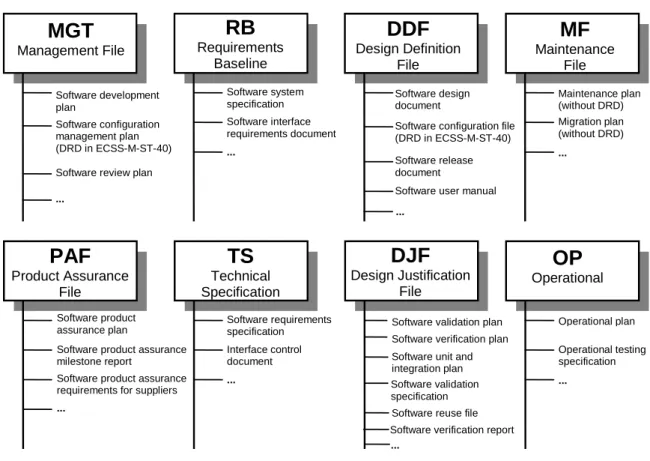
Each requirement of this Standard is identified by a hierarchical number, plus a letter if necessary (e.g. 5.3.1.5, bullet a). For each requirement, the associated output is given in the “Expected Output” section. When several outputs are expected, they are identified by a letter (e.g. “a”, “b”, etc.). With each output, the destination file of the output is indicated in brackets, together with the corresponding document DRD (after a comma) and review(s) (after a semicolon). For example: “[PAF, SPAP; SRR]” denotes an output contained in the Software Product Assurance Plan, part of the Product Assurance File, and required at SRR. When no DRD is defined for an Expected Output, and/or the Expected Output is not to be provided at any specific milestone review, then the corresponding sections of that Expected Output are replaced by dashes (e.g. “[PAF, ‐; ‐]”).
This standards details for the Software Product Assurance aspects some of the general requirements already addressed by the ECSS Management, Product Assurance and Quality Assurance standards.
4.3
Tailoring of this Standard
The general information and requirements for the selection and tailoring of applicable standards are defined in ECSS‐S‐ST‐00.
There are several drivers for tailoring, such as dependability and safety aspects, software development constraints, product quality objectives and business objectives.
Tailoring for dependability and safety aspects is based on the selection of requirements related to the verification, validation and levels of proofs demanded by the criticality of the software. Annex D contains a tailoring of this Standard based on software criticality.
Tailoring for software development constraints takes into account the special characteristics of the software being developed, and of the development environment. The type of software development (e.g. database or real‐time) and the target system (e.g. embedded processor, host system, programmable devices, or application‐specific integrated circuits) are also taken into account (see Annex S of ECSS‐E‐ST‐40). Specific requirements for verification, review and inspection are imposed, for example, when full validation on the target computer is not feasible or where performance goals are difficult to achieve. Tailoring for product quality and business objectives is done by selecting requirements on quality of the product as explained in clause 7 of this Standard based on the quality objectives for the product specified by the customer.
5
Software product assurance programme
implementation
5.1
Organization and responsibility
5.1.1 Organization
a. The supplier shall ensure that an organizational structure is defined for software development, and that individuals have defined tasks and responsibilities.
5.1.2
Responsibility and authority
5.1.2.1
a. The responsibility, the authority and the interrelation of personnel who manage, perform and verify work affecting software quality shall be defined and documented.
EXPECTED OUTPUT: Software product assurance plan [PAF, SPAP; SRR].
5.1.2.2
a. The responsibilities and the interfaces of each organisation, either external or internal, involved in a project shall be defined and documented.
EXPECTED OUTPUT: Software product assurance plan [PAF, SPAP; SRR].
5.1.2.3
a. The delegation of software product assurance tasks by a supplier to a lower level supplier shall be done in a documented and controlled way, with the supplier retaining the responsibility towards the customer.
EXPECTED OUTPUT: Software product assurance plan [PAF, SPAP; SRR].
5.1.3 Resources
5.1.3.1
a. The supplier shall provide adequate resources to perform the required software product assurance tasks.
EXPECTED OUTPUT: Software product assurance plan [PAF, SPAP; SRR].
5.1.3.2
a. Reviews and audits of processes and of products shall be carried out by personnel not directly involved in the work being performed.
5.1.4
Software product assurance
manager/engineer
5.1.4.1
a. The supplier shall identify the personnel responsible for software product assurance for the project (SW PA manager/engineer).
EXPECTED OUTPUT: Software product assurance plan [PAF, SPAP; SRR].
5.1.4.2
a. The software product assurance manager/engineer shall
1. report to the project manager (through the project product assurance manager, if any);
2. have organisational authority and independence to propose and maintain a software product assurance programme in accordance with the project software product assurance requirements;
3. have unimpeded access to higher management as necessary to fulfil his/her duties.
5.1.5 Training
5.1.5.1
a. The supplier shall review the project requirements to establish and make timely provision for acquiring or developing the resources and skills for the management and technical staff.
EXPECTED OUTPUT: Training plan [MGT, -; SRR].
5.1.5.2
a. The supplier shall maintain training records.
5.1.5.3
a. The supplier shall ensure that the right composition and categories of appropriately trained personnel are available for the planned activities and tasks in a timely manner.
5.1.5.4
a. The supplier shall determine the training subjects based on the specific tools, techniques, methodologies and computer resources to be used in the development and management of the software product.
NOTE Personnel can undergo training to acquire skills and knowledge relevant to the specific field with which the software is to deal.
5.2
Software product assurance programme management
5.2.1
Software product assurance planning and
control
5.2.1.1
a. The supplier shall develop a software product assurance plan in response to the software product assurance requirements in conformance with DRD in annex B.
b. The software product assurance plan shall be either a standalone document or a section of the supplier overall product assurance plan.
EXPECTED OUTPUT: Software product assurance plan [PAF, SPAP; SRR, PDR].
5.2.1.2
a. Any internal manuals, standards or procedures referred to by the software product assurance plan shall become an integral part of the supplier’s software product assurance programme.
5.2.1.3
a. The software product assurance plan shall be revisited and updated as needed at each milestone to ensure that the activities to be undertaken in the following phase are fully defined.
EXPECTED OUTPUT: Software product assurance plan [PAF, SPAP; CDR, QR, AR, ORR].
5.2.1.4
a. Before acceptance review, the supplier shall either supplement the software product assurance plan to specify the quality measures related
to the operations and maintenance processes, or issue a specific software product assurance plan.
EXPECTED OUTPUT: Software product assurance plan [PAF, SPAP; AR].
5.2.1.5
a. The supplier shall provide with the software product assurance plan a compliance matrix documenting conformance with the individual software product assurance requirements applicable for the project or business agreement.
EXPECTED OUTPUT: Software product assurance plan [PAF, SPAP; SRR, PDR].
b. For each software product assurance requirement, the compliance matrix shall provide a reference to the document where the expected output of that requirement is located.
NOTE For compliance with the required DRDs a general statement of compliance is acceptable.
EXPECTED OUTPUT: Software product assurance plan [PAF, SPAP; SRR, PDR].
5.2.2
Software product assurance reporting
5.2.2.1
a. The supplier shall report on a regular basis on the status of the software product assurance programme implementation, if appropriate as part of the overall product assurance reporting of the project.
EXPECTED OUTPUT: Software product assurance reports [PAF, -; -].
5.2.2.2
a. The software product assurance report shall include:
1. an assessment of the current quality of the product and processes, based on measured properties, with reference to the metrication as defined in the software product assurance plan;
2. verifications undertaken; 3. problems detected; 4. problems resolved.
EXPECTED OUTPUT: Software product assurance reports [PAF, -; -].
5.2.2.3
a. The supplier shall deliver at each milestone review a software product assurance milestone report, covering the software product assurance activities performed during the past project phases.
EXPECTED OUTPUT: Software product assurance milestone report [PAF, SPAMR; SRR, PDR, CDR, QR, AR, ORR].
5.2.3 Audits
a. For software audits, ECSS‐Q‐ST‐10 clause 5.2.3 shall apply.
EXPECTED OUTPUT: Audit plan and schedule [PAF, -; SRR].
5.2.4 Alerts
a. For software alerts, ECSS‐Q‐ST‐10 clause 5.2.9 shall apply.
EXPECTED OUTPUT: The following outputs are expected:
a. Preliminary alert information [PAF, -; -]; b. Alert information [PAF, -; -].
5.2.5 Software
problems
5.2.5.1
a. The supplier shall define and implement procedures for the logging, analysis and correction of all software problems encountered during software development.
EXPECTED OUTPUT: Software problem reporting procedures [PAF, -; PDR].
5.2.5.2
a. The software problem report shall contain the following information: 1. identification of the software item;
2. description of the problem; 3. recommended solution; 4. final disposition;
5. modifications implemented (e.g. documents, code, and tools); 6. tests re‐executed.
EXPECTED OUTPUT: Software problem reporting procedures [PAF, -; PDR].
5.2.5.3
a. The procedures for software problems shall define the interface with the nonconformance system (i.e. the circumstances under which a problem qualifies as a nonconformance).
EXPECTED OUTPUT: Software problem reporting procedures [PAF, -; PDR].
5.2.5.4
a. The supplier shall ensure the correct application of problem reporting procedures.
5.2.6 Nonconformances
5.2.6.1
a. For software nonconformance handling, ECSS‐Q‐ST‐10‐09 shall apply
EXPECTED OUTPUT: The following outputs are expected:
a. NCR SW procedure as part of the Software product assurance plan [PAF, SPAP; SRR]; b. Nonconformance reports [DJF, -; -].
b. When dealing with software nonconformance, the NRB shall include, at least, a representative from the software product assurance and the software engineering organizations.
EXPECTED OUTPUT: Identification of SW experts in NRB [MGT, -; SRR]
5.2.6.2
a. The software product assurance plan shall specify the point in the software life cycle from which the nonconformance procedures apply.
EXPECTED OUTPUT: Software product assurance plan [PAF, SPAP; SRR, PDR].
5.2.7
Quality requirements and quality models
5.2.7.1
a. Quality models shall be used to specify the software quality requirements.
EXPECTED OUTPUT: Software product assurance plan [PAF, SPAP; PDR].
5.2.7.2
a. The following characteristics shall be used to specify the quality model: 1. functionality;
2. reliability; 3. maintainability; 4. reusability;
5. suitability for safety; 6. security;
7. usability; 8. efficiency; 9. portability;
NOTE 1 Quality models are the basis for the identification of process metrics (see clause 6.2.5) and product metrics (see clause 7.1.4).
NOTE 2 quality models are also addressed by ISO/IEC 9126 or ECSS‐Q‐HB‐80‐04.
EXPECTED OUTPUT: Software product assurance plan [PAF, SPAP; PDR].
5.3
Risk management and critical item control
5.3.1 Risk
management
a. Risk management for software shall be performed by cross‐reference to the project risk policy, as specified in ECSS‐M‐ST‐80.
5.3.2
Critical item control
5.3.2.1
a. For critical item control, ECSS‐Q‐ST‐10‐04 shall apply.
5.3.2.2
a. The supplier shall identify the characteristics of the software items that qualify them for inclusion in the Critical Item List.
5.4
Supplier selection and control
5.4.1 Supplier
selection
5.4.1.1
a. For supplier selection ECSS‐Q‐ST‐20 clause 5.4.1 shall apply.
EXPECTED OUTPUT: The following outputs are expected:
a. Results of pre-award audits and assessments [PAF, -; -];
b. Records of procurement sources [PAF, -; -].
5.4.1.2
a. For the selection of suppliers of existing software, including software contained in OTS equipments and units, the expected output of clauses 6.2.7.2 to 6.2.7.6 shall be made available.
5.4.2 Supplier
requirements
5.4.2.1
a. The supplier shall establish software product assurance requirements for the next level suppliers, tailored to their role in the project, including a requirement to produce a software product assurance plan.
EXPECTED OUTPUT: Software product assurance requirements for suppliers [PAF, -; SRR].
5.4.2.2
a. The supplier shall provide the software product assurance requirements applicable to the next level suppliers for customer’s acceptance.
EXPECTED OUTPUT: Software product assurance requirements for suppliers [PAF, -; SRR].
5.4.3 Supplier
monitoring
5.4.3.1
a. The supplier shall monitor the next lower level suppliers’ conformance to the product assurance requirements.
5.4.3.2
a. The monitoring process shall include the review and approval of the next lower level suppliers’ product assurance plans, the continuous verification of processes and products, and the monitoring of the final validation of the product.
5.4.3.3
a. The supplier shall ensure that software development processes are defined and applied by the next lower level suppliers in conformance with the software product assurance requirements for suppliers.
EXPECTED OUTPUT: Next level suppliers’ software product assurance plan [PAF, SPAP; PDR].
5.4.3.4
a. The supplier shall provide the next lower level suppliers’ software product assurance plan for customer’s acceptance.
EXPECTED OUTPUT: Next level suppliers’ software product assurance plan [PAF, SPAP; PDR].
5.4.4 Criticality
classification
a. The supplier shall provide the lower level suppliers with the relevant results of the safety and dependability analyses performed at higher and his level (ref. clauses 6.2.2.1 and 6.2.2.2), including:
1. the criticality classification of the software products to be developed;
2. information about the failures that can be caused at higher level by the software products to be developed.
EXPECTED OUTPUT: Safety and dependability analyses results for lower level suppliers [RB, -; SRR].
5.5 Procurement
5.5.1 Procurement
documents
a. For procurement documents, ECSS‐Q‐ST‐20 clause 5.4.2 shall apply.
5.5.2
Review of procured software component list
a. The choice of procured software shall be described and submitted for customer review.
EXPECTED OUTPUT: Software development plan [MGT, SDP; SRR, PDR].
5.5.3 Procurement
details
a. For each of the software items the following data shall be provided: 1. ordering criteria
NOTE For example: versions, options and extensions. 2. receiving inspection criteria;
3. back‐up solutions if the product becomes unavailable;
4. contractual arrangements with the supplier for the development, maintenance and upgrades to new releases.
EXPECTED OUTPUT: Procurement data [MGT, -; SRR, PDR].
5.5.4 Identification
a. All the procured software shall be identified and registered by configuration management.
5.5.5 Inspection
a. The supplier shall subject the procured software to a planned receiving inspection, in accordance with ECSS‐Q‐ST‐20 clause 5.4.4, and the receiving inspection criteria as required by clause 5.5.3.
EXPECTED OUTPUT: Receiving inspection report [PAF, -; PDR, CDR, QR].
5.5.6 Exportability
a. Exportability constraints shall be identified.
5.6
Tools and supporting environment
5.6.1
Methods and tools
5.6.1.1
a. Methods and tools to be used for all the activities of the development cycle, (including requirements analysis, software specification, modelling, design, coding, validation, testing, configuration management, verification and product assurance) shall be identified by the supplier and agreed by the customer.
EXPECTED OUTPUT: Software product assurance plan [PAF, SPAP; SRR, PDR].
5.6.1.2
a. The choice of development methods and tools shall be justified by demonstrating through testing or documented assessment that:
1. the development team has appropriate experience or training to apply them,
2. the tools and methods are appropriate for the functional and operational characteristics of the product, and
3. the tools are available (in an appropriate hardware environment) throughout the development and maintenance lifetime of the product.
EXPECTED OUTPUT: Software product assurance milestone report [PAF, SPAMR; SRR, PDR].
5.6.1.3
a. The correct use of methods and tools shall be verified and reported.
EXPECTED OUTPUT: Software product assurance reports [PAF, -; -].
5.6.2
Development environment selection
5.6.2.1
a. The software development environment shall be selected according to the following criteria:
1. availability; 2. compatibility;
3. performance; 4. maintenance;
5. durability and technical consistency with the operational equipment;
6. the assessment of the product with respect to requirements, including the criticality category;
7. the available support documentation; 8. the acceptance and warranty conditions;
9. the conditions of installation, preparation, training and use;
10. the maintenance conditions, including the possibilities of evolutions;
11. copyright and intellectual property rights constraints; 12. dependence on one specific supplier.
EXPECTED OUTPUT: Software development plan [MGT, SDP; SRR, PDR].
5.6.2.2
a. The suitability of the software development environment shall be justified.
EXPECTED OUTPUT: Software development plan [MGT, SDP; SRR, PDR].
5.6.2.3
a. The availability of the software development environment to developers and other users shall be verified before the start of each development phase.
5.7
Assessment and improvement process
5.7.1 Process
assessment
a. The supplier shall monitor and control the effectiveness of the processes used during the development of the software, including the relevant processes corresponding to the services called from other organizational entities outside the project team.
NOTE The process assessment and improvement performed at organization level can be used to provide evidence of compliance for the project.
EXPECTED OUTPUT: Software process assessment records: Overall assessments and improvement programme plan [PAF, -; -].
5.7.2 Assessment
process
5.7.2.1
a. The process assessment model and method to be used when performing any software process assessment shall be documented.
EXPECTED OUTPUT: The following outputs are expected:
a. Software process assessment record: assessment model [PAF, -; -];
b. Software process assessment record: assessment method [PAF, -; -].
5.7.2.2
a. Assessments performed and process assessment models used shall be in conformance with ISO/IEC 15504 (Part 2).
EXPECTED OUTPUT: The following outputs are expected:
a. Software process assessment record: evidence of conformance of the process assessment model [PAF, -; -];
b. Software process assessment record: assessment method [PAF, -; -].
NOTE 1 The model and method documented in ECSS‐Q‐ HB‐80‐02 are conformant to ISO/IEC 15504 (Part 2). NOTE 2 Currently the CMMI model is not fully conformant to ISO/IEC 15504, however it can be used, provided that the SCAMPI A method is applied.
5.7.2.3
a. The process assessment model, the method, the assessment scope, the results and the assessors shall be verified as complying with the project requirements.
NOTE 1 Examples of assessment scopes are: organizational unit evaluated, and processes evaluated.
NOTE 2 ECSS‐Q‐HB‐80‐02 provides space specific process reference model and their indicators.
EXPECTED OUTPUT: Software process assessment record: Software process assessment recognition evidence [PAF, -; -].
5.7.2.4
a. Assessments, carried out in accordance with ECSS‐Q‐HB‐80‐02, shall be performed by a competent assessor, whereas the other assessment team members can be either competent assessor or provisional assessor.
NOTE 1 For other assessment schemes conformant to ISO/IEC 15504 (Part 2), assessors certified under INTRSA are competent assessors.
NOTE 2 When using CMMI/SCAMPI A, SEI authorized lead appraisers are competent assessors.
EXPECTED OUTPUT: Software process assessment record: competent assessor justification [PAF, -; -].
5.7.3 Process
improvement
5.7.3.1
a. The results of the assessment shall be used as feedback to improve as necessary the performed processes, to recommend changes in the direction of the project, and to determine technology advancement needs. b. The suppliers shall ensure that the results of previous assessments are
used in its project activity
EXPECTED OUTPUT: Software process assessment records: improvement plan [PAF, -; -].
5.7.3.2
a. The process improvement shall be conducted according to a documented process improvement process.
NOTE 1 For the definition of the process improvement process, see ECSS‐Q‐HB‐80‐02.
NOTE 2 For CMMI, the process improvement is described in the OPF (Organizational Process Focus) process area.
EXPECTED OUTPUT: Software process assessment records: improvement process [PAF, -; -].
5.7.3.3
a. Evidence of the improvement in performed processes or in project documentation shall be provided.
NOTE See ECSS‐Q‐HB‐80‐02.
EXPECTED OUTPUT: Software process assessment records: evidence of improvements [PAF, -; -].
6
Software process assurance
6.1
Software development life cycle
6.1.1
Life cycle definition
a. The software development life cycle shall be defined or referenced in the software product assurance plan.
b. The following characteristics of the software life cycle shall be defined: 1. phases;
2. input and output of each phase; 3. status of completion of phase output; 4. milestones;
5. dependencies; 6. responsibilities;
7. role of the customer at each milestone review, in conformance with ECSS‐M‐ST‐10 and ECSS‐M‐ST‐10‐01.
EXPECTED OUTPUT: Software product assurance plan [PAF, SPAP; SRR, PDR].
6.1.2
Process quality objectives
a. In the definition of the life cycle and associated milestones and documents, the quality objectives shall be used.
6.1.3
Life cycle definition review
a. The software life cycle shall be reviewed against the contractual software engineering and product assurance requirements.
6.1.4
Life cycle resources
a. The software life cycle shall be reviewed for suitability and for the availability of resources to implement it by all functions involved in its application.
6.1.5
Software validation process schedule
a. A milestone (SW TRR as defined in ECSS‐E‐ST‐40 clause 5.3.5.1) shall be scheduled immediately before the software validation process starts, to check that:
1. the software status is compatible with the commencement of validation activities;
2. the necessary resources, software product assurance plans, test and validation documentation, simulators or other technical means are available and ready for use.
EXPECTED OUTPUT: Software product assurance plan [PAF, SPAP; SRR, PDR].
6.2
Requirements applicable to all software engineering
processes
6.2.1
Documentation of processes
6.2.1.1
a. The following activities shall be covered either in software‐specific plans or in project general plans:
1. development;
2. specification, design and customer documents to be produced; 3. configuration and documentation management;
4. verification, testing and validation activities; 5. maintenance.
EXPECTED OUTPUT: Software project plans [MGT, MF, DJF].
6.2.1.2
a. All plans shall be finalized before the start of the related activities.
EXPECTED OUTPUT: Software project plans [MGT, MF, DJF].
6.2.1.3
a. All plans shall be updated for each milestone to reflect any changes during development.
EXPECTED OUTPUT: Software project plans [MGT, MF, DJF].
6.2.1.4
a. The software product assurance plan shall identify all plans to be produced and used, the relationship between them and the time‐scales for their preparation and update.
EXPECTED OUTPUT: Software product assurance plan [PAF, SPAP; SRR, PDR].
6.2.1.5
a. Each plan shall be reviewed against the relevant contractual requirements.
6.2.1.6
a. Procedures and project standards shall address all types of software products included in the project.
EXPECTED OUTPUT: Procedures and standards [PAF, -; PDR].
6.2.1.7
a. All procedures and project standards shall be finalized before starting the related activities.
EXPECTED OUTPUT: Procedures and standards [PAF, -; PDR].
6.2.1.8
a. Each procedure or standard shall be reviewed against the relevant plans and contractual requirements.
6.2.1.9
a. Before any activity is started, each procedure or standard for that activity shall be reviewed by all functions involved in its application, for suitability and for the availability of resources to implement it.
6.2.2
Software dependability and safety
6.2.2.1
a. For the system‐level analyses leading to the criticality classification of software products based on the severity of failures consequences, ECSS‐ Q‐ST‐40 Table 6‐1, and ECSS‐Q‐ST‐30 Table 5‐1, shall apply.
EXPECTED OUTPUT: Criticality classification of software products [PAF, -; SRR, PDR].
6.2.2.2
a. The supplier shall perform a software dependability and safety analysis of the software products, in accordance with the requirements of ECSS‐ Q‐ST‐30 and ECSS‐Q‐ST‐40 and using the results of system‐level safety and dependability analyses, in order to determine the criticality of the individual software components.
EXPECTED OUTPUT: Software dependability and safety analysis report [PAF, -; PDR].
6.2.2.3
a. The supplier shall identify the methods and techniques for the software dependability and safety analysis to be performed at technical specification and design level.
b. Methods and techniques for software dependability and safety analysis shall be agreed between the supplier and customer.
NOTE ECSS‐Q‐HB‐80‐03 provides indication on methods and techniques that can be applied such as:
• software failure modes, effects and criticality analysis (for the performing of this analysis, see also ECSS‐Q‐ST‐30‐02);
• software fault tree analysis;
• software common cause failure analysis.
EXPECTED OUTPUT: Criticality classification of software components [PAF, -; PDR].
6.2.2.4
a. Based on the results of the software criticality analysis, the supplier shall apply engineering measures to reduce the number of critical software components and mitigate the risks associated with the critical software (ref. clause 6.2.3).
6.2.2.5
a. The supplier shall report on the status of the implementation and verification of the SW dependability and safety analysis recommendations.
EXPECTED OUTPUT: Software dependability and safety analysis report [PAF, -; CDR, QR, AR].
6.2.2.6
a. The supplier shall update the software dependability and safety analysis at each software development milestone, to confirm the criticality category of software components.
EXPECTED OUTPUT: Software dependability and safety analysis report [PAF, -; CDR, QR, AR].
6.2.2.7
a. The supplier shall provide the results of the software dependability and safety analysis for integration into the system‐level dependability and safety analyses, addressing in particular:
1. additional failure modes identified at software design level; 2. recommendations for system‐level activities.