________________General Description
The MAX038 is a high-frequency, precision function generator producing accurate, high-frequency triangle, sawtooth, sine, square, and pulse waveforms with a minimum of external components. The output frequency can be controlled over a frequency range of 0.1Hz to 20MHz by an internal 2.5V bandgap voltage reference and an external resistor and capacitor. The duty cycle can be varied over a wide range by applying a ±2.3V control signal, facilitating pulse-width modula-tion and the generamodula-tion of sawtooth waveforms. Frequency modulation and frequency sweeping are achieved in the same way. The duty cycle and frequency controls are independent.Sine, square, or triangle waveforms can be selected at the output by setting the appropriate code at two TTL-compatible select pins. The output signal for all waveforms is a 2VP-Psignal that is symmetrical around ground. The low-impedance output can drive up to ±20mA.
The TTL-compatible SYNC output from the internal oscillator maintains a 50% duty cycle—regardless of the duty cycle of the other waveforms—to synchronize other devices in the system. The internal oscillator can be synchronized to an external TTL clock connected to PDI.
________________________Applications
Precision Function GeneratorsVoltage-Controlled Oscillators Frequency Modulators Pulse-Width Modulators Phase-Locked Loops Frequency Synthesizer
FSK Generator—Sine and Square Waves
____________________________Features
♦ 0.1Hz to 20MHz Operating Frequency Range ♦ Triangle, Sawtooth, Sine, Square, and PulseWaveforms
♦ Independent Frequency and Duty-Cycle Adjustments
♦ 350 to 1 Frequency Sweep Range ♦ 15% to 85% Variable Duty Cycle ♦ Low-Impedance Output Buffer: 0.1Ω ♦ Low 200ppm/°C Temperature Drift
_______________Ordering Information
MAX038
________________________________________________________________Maxim Integrated Products 1
20 19 18 17 16 15 14 13 12 11 1
2 3 4 5 6 7 8 9 10
V-OUT GND V+ A1
A0 GND REF
TOP VIEW
MAX038
DV+ DGND SYNC PDI FADJ
DADJ GND COSC
PDO GND IIN
GND
DIP/SO
___________________ Pin Configuration
For pricing, delivery, and ordering information, please contact Maxim/Dallas Direct! at
1-888-629-4642, or visit Maxim’s website at www.maxim-ic.com.
PART TEMP RANGE PIN-PACKAGE
MAX038CPP 0°C to +70°C 20 Plastic DIP
MAX038CWP 0°C to +70°C 20 SO
MAX038C/D 0°C to +70°C Dice
MAX038EPP* -40°C to +85°C 20 Plastic DIP MAX038EWP* -40°C to +85°C 20 SO *Contact factory prior to design.
MAX038
ABSOLUTE MAXIMUM RATINGS
ELECTRICAL CHARACTERISTICS
(Circuit of Figure 1, GND = DGND = 0V, V+ = DV+ = 5V, V- = -5V, VDADJ = VFADJ = VPDI = VPDO = 0V, CF= 100pF, RIN= 25kΩ, RL= 1kΩ, CL= 20pF, TA= TMINto TMAX, unless otherwise noted. Typical values are at TA= +25°C.)
Stresses beyond those listed under “Absolute Maximum Ratings” may cause permanent damage to the device. These are stress ratings only, and functional operation of the device at these or any other conditions beyond those indicated in the operational sections of the specifications is not implied. Exposure to absolute maximum rating conditions for extended periods may affect device reliability.
PARAMETER SYMBOL MIN TYP MAX UNITS
Frequency Temperature Coefficient
∆Fo/°C
200 ppm/°C
600
IIN Offset Voltage VIN ±1.0 ±2.0 mV
Frequency Programming
Current IIN 1.25 375 µA
(∆Fo/Fo)
∆V+ ±0.4 ±2.00
Frequency Power-Supply
Rejection (∆Fo/Fo)
∆V- ±0.2 ±1.00
%/V
Output Peak-to-Peak Symmetry VOUT ±4 mV
Maximum Operating Frequency Fo 20.0 40.0 MHz
2.50 750
Output Resistance ROUT 0.1 0.2 Ω
Output Short-Circuit Current IOUT 40 mA
Amplitude VOUT 1.9 2.0 2.1 VP-P
Rise Time tR 12 ns
Fall Time tF 12 ns
Duty Cycle dc 47 50 53 %
Amplitude VOUT 1.9 2.0 2.1 VP-P
Nonlinearity 0.5 %
Duty Cycle dc 47 50 53 %
CONDITIONS
VFADJ= -3V VFADJ= 0V VFADJ= -3V
V- = -5V, V+ = 4.75V to 5.25V V+ = 5V, V- = -4.75V to -5.25V
Short circuit to GND
10% to 90% 90% to 10%
VDADJ= 0V, dc = tON/t x 100% CF≤ 15pF, IIN = 500µA VFADJ= 0V
FO = 100kHz, 5% to 95% VDADJ= 0V (Note 1) V+ to GND ...-0.3V to +6V DV+ to DGND...-0.3V to +6V V- to GND ...+0.3V to -6V Pin Voltages
IIN, FADJ, DADJ, PDO ...(V- - 0.3V) to (V+ + 0.3V) COSC ...+0.3V to V-A0, A1, PDI, SYNC, REF...-0.3V to V+ GND to DGND ...±0.3V Maximum Current into Any Pin ...±50mA OUT, REF Short-Circuit Duration to GND, V+, V- ...30s
Continuous Power Dissipation (TA= +70°C)
Plastic DIP (derate 11.11mW/°C above +70°C) ...889mW SO (derate 10.00mW/°C above +70°C) ...800mW CERDIP (derate 11.11mW/°C above +70°C) ...889mW Operating Temperature Ranges
MAX038C_ _ ...0°C to +70°C MAX038E_ _ ...-40°C to +85°C Maximum Junction Temperature ...+150°C Storage Temperature Range ...-65°C to +150°C Lead Temperature (soldering, 10s) ...+300°C
Amplitude VOUT 1.9 2.0 2.1 VP-P
CF = 1000pF, FO = 100kHz
THD % Fo/°C
FREQUENCY CHARACTERISTICS
OUTPUT AMPLIFIER (applies to all waveforms)
SQUARE-WAVE OUTPUT (RL= 100Ω)
TRIANGLE-WAVE OUTPUT (RL= 100Ω)
SINE-WAVE OUTPUT (RL= 100Ω)
MAX038
_______________________________________________________________________________________ 3
ELECTRICAL CHARACTERISTICS (continued)
(Circuit of Figure 1, GND = DGND = 0V, V+ = DV+ = 5V, V- = -5V, VDADJ = VFADJ = VPDI = VPDO = 0V, CF = 100pF, RIN= 25kΩ, RL= 1kΩ, CL= 20pF, TA= TMINto TMAX, unless otherwise noted. Typical values are at TA= +25°C.)
Note 1:Guaranteed by duty-cycle test on square wave.
Note 2:VREFis independent of V-.
PARAMETER
DADJ Nonlinearity
SYMBOL MIN TYP MAX
dc/VFADJ 2 4
UNITS
%
Duty Cycle dcSYNC 50 %
Fall Time tF 10 ns
Rise Time tR 10 ns
Change in Output Frequency with DADJ
DADJ Input Current IDADJ 190 250 320 µA
DADJ Voltage Range VDADJ ±2.3 V
Fo/VDADJ ±2.5 ±8 %
Duty-Cycle Adjustment Range dc 15 85 %
Maximum DADJ Modulating
Frequency FDC 2 MHz
Output Low Voltage
FADJ Input Current IFADJ 190 250 320 µA
FADJ Voltage Range VFADJ ±2.4 V
Frequency Sweep Range
VOL 0.3 0.4 V
Fo ±70 %
FM Nonlinearity with FADJ Output High Voltage
Fo/VFADJ ±0.2 %
VOH 2.8 3.5 V
Change in Duty Cycle with FADJ dc/VFADJ ±2 %
Output Voltage VREF 2.48 2.50 2.52 V
CONDITIONS
-2V ≤ VDADJ ≤ +2V
90% to 10%, RL= 3kΩ, CL= 15pF 10% to 90%, RL= 3kΩ, CL= 15pF
-2V ≤ VDADJ ≤ +2V -2.3V ≤ VDADJ ≤ +2.3V ISINK= 3.2mA
-2.4V ≤ VFADJ ≤ +2.4V -2V ≤ VFADJ ≤ +2V ISOURCE= 400µA
-2V ≤ VFADJ ≤ +2V
IREF= 0
Temperature Coefficient VREF/°C 20 ppm/°C
0mA ≤IREF≤4mA (source) 1 2
Load Regulation VREF/IREF
-100µA ≤IREF≤0µA (sink) 1 4 mV/mA Line Regulation VREF/V+ 4.75V ≤V+ ≤5.25V (Note 2) 1 2 mV/V
Input Low Voltage VIL 0.8 V
Input High Voltage VIH 2.4 V
Input Current (A0, A1) IIL, IIH VA0, VA1= VIL, VIH ±5 µA Input Current (PDI) IIL, IIH VPDI= VIL, VIH ±25 µA
Positive Supply Voltage V+ 4.75 5.25 V
SYNC Supply Voltage DV+ 4.75 5.25 V
Negative Supply Voltage V- -4.75 -5.25 V
Positive Supply Current I+ 35 45 mA
SYNC Supply Current IDV+ 1 2 mA
Negative Supply Current I- 45 55 mA
Maximum FADJ Modulating
Frequency FF 2 MHz
SYNC OUTPUT
DUTY-CYCLE ADJUSTMENT (DADJ)
FREQUENCY ADJUSTMENT (FADJ)
VOLTAGE REFERENCE
LOGIC INPUTS (A0, A1, PDI)
MAX038
__________________________________________Typical Operating Characteristics
(Circuit of Figure 1, V+ = DV+ = 5V, V- = -5V, VDADJ= VFADJ= VPDI= VPDO= 0V, RL= 1kΩ, CL= 20pF, TA = +25°C, unless otherwise noted.)
0.1
1 100 1000
OUTPUT FREQUENCY vs. IIN CURRENT
10 100
MAX038-08
IIN CURRENT (µA)
OUTPUT FREQUENCY (Hz)
10 1
1k 10k 100k 1M 10M 100M
100µF 47µF 10µF 3.3µF 1µF 100nF 33nF 3.3nF 330pF 100pF 33pF
1.0
0
-3 2
NORMALIZED OUTPUT FREQUENCY vs. FADJ VOLTAGE
0.2 0.8
MAX038-09
VFADJ (V)
FOUT
NORMALIZED
0 0.4
-2 -1 1 0.6
3 1.2
1.4 1.6 1.8 2.0
IIN = 100µA, COSC = 1000pF
0.85
NORMALIZED OUTPUT FREQUENCY vs. DADJ VOLTAGE
0.90 1.10
MAX038-17
DADJ (V)
NORMALIZED OUTPUT FREQUENCY
1.00 0.95 1.05
IIN = 10µA
IIN = 25µA
IIN = 50µA
IIN = 100µA
IIN = 250µA
IIN = 500µA
2.0
-2.5
-2.0 -1.0 1.0 2.5
DUTY-CYCLE LINEARITY vs. DADJ VOLTAGE
-2.0 1.0
MAX038-18
DADJ(V)
DUTY-CYCLE LINEARITY ERROR (%)
0 1.5 0
-1.0 -1.5 -0.5 0.5 1.5
IIN = 10µA
IIN = 25µA
IIN = 50µA
IIN = 100µA IIN = 250µA
IIN = 500µA
60
0
-3 2
DUTY CYCLE vs. DADJ VOLTAGE
10 50
MAX038-16B
DADJ (V)
DUTY CYCLE (%)
0 30
20
-2 -1 1 40
70 80 90 100
3 IIN = 200µA
MAX038
_______________________________________________________________________________________ 5
SINE-WAVE OUTPUT (50Hz)
TOP: OUTPUT 50Hz = Fo
BOTTOM: SYNC IIN = 50µA
CF = 1µF
TRIANGLE-WAVE OUTPUT (50Hz)
TOP: OUTPUT 50Hz = Fo
BOTTOM: SYNC IIN = 50µA
CF = 1µF
SQUARE-WAVE OUTPUT (50Hz)
TOP: OUTPUT 50Hz = Fo
BOTTOM: SYNC IIN = 50µA
CF = 1µF
SINE-WAVE OUTPUT (20MHz)
IIN = 400µA
CF = 20pF
_____________________________Typical Operating Characteristics (continued)
(Circuit of Figure 1, V+ = DV+ = 5V, V- = -5V, VDADJ = VFADJ = VPDI = VPDO = 0V, RL = 1kΩ, CL = 20pF, TA = +25°C, unless otherwise noted.)
TRIANGLE-WAVE OUTPUT (20MHz)
IIN = 400µA
CF = 20pF
FREQUENCY (Hz) 1M 100k 10k 1k
100 10M
FREQUENCY (Hz) 1M 100k 10k 1k
100 10M
SINE WAVE THD vs. FREQUENCY
MAX038 toc01
FREQUENCY (Hz)
THD (%)
1M 100k 10k 1k 1 2 3 4 5 6 7
0
MAX038
_____________________________Typical Operating Characteristics (continued)
(Circuit of Figure 1, V+ = DV+ = 5V, V- = -5V, VDADJ= VFADJ= VPDI= VPDO= 0V, RL= 1kΩ, CL= 20pF, TA = +25°C, unless otherwise noted.)
FREQUENCY MODULATION USING FADJ
TOP: OUTPUT BOTTOM: FADJ
0.5V 0V -0.5V
FREQUENCY MODULATION USING IIN
TOP: OUTPUT BOTTOM: IIN
FREQUENCY MODULATION USING IIN
TOP: OUTPUT BOTTOM: IIN
PULSE-WIDTH MODULATION USING DADJ
TOP: SQUARE-WAVE OUT, 2VP-P
BOTTOM: VDADJ, -2V to +2.3V
+1V 0V -1V
+2V 0V -2V
SQUARE-WAVE OUTPUT (20MHz)
IIN = 400µA
MAX038
_______________________________________________________________________________________ 7
______________________________________________________________Pin Description
*The five GND pins are not internally connected. Connect all five GND pins to a quiet ground close to the device. A ground plane is recommended (see Layout Considerations).
0
-100
0 20 60 100
OUTPUT SPECTRUM, SINE WAVE
(Fo = 11.5MHz)
-80 -20
MAX038-12A
FREQUENCY (MHz)
ATTENUATION (dB)
40 80 -40
-60 -10 -30 -50 -70 -90
10 30 50 70 90 RIN = 15kΩ (VIN = 2.5V), CF = 20pF,
VDADJ = 40mV, VFADJ = -3V
0
-100
0 10 30 50
OUTPUT SPECTRUM, SINE WAVE
(Fo = 5.9kHz)
-80 -20
MAX038
12B
FREQUENCY (kHz)
ATTENUATION (dB)
20 40 -40
-60 -10 -30 -50 -70 -90
5 15 25 35 45 RIN = 51kΩ (VIN = 2.5V), CF = 0.01µF,
VDADJ = 50mV, VFADJ = 0V
_____________________________Typical Operating Characteristics (continued)
(Circuit of Figure 1, V+ = DV+ = 5V, V- = -5V, VDADJ= VFADJ= VPDI= VPDO= 0V, RL= 1kΩ, CL= 20pF, TA = +25°C, unless otherwise noted.)-5V supply input
V-20
Sine, square, or triangle output OUT
19
+5V supply input V+
17
Digital +5V supply input. Can be left open if SYNC is not used. DV+
16
Digital ground DGND
15
TTL/CMOS-compatible output, referenced between DGND and DV+. Permits the internal oscillator to be synchronized with an external signal. Leave open if unused.
SYNC 14
Current input for frequency control IIN
10
Phase detector output. Connect to GND if phase detector is not used. PDO
12
Phase detector reference clock input. Connect to GND if phase detector is not used. PDI
13
External capacitor connection COSC
5
Duty-cycle adjust input DADJ
7
Frequency adjust input FADJ
8
Waveform selection input; TTL/CMOS compatible A1
4
Waveform selection input; TTL/CMOS compatible A0
3
PIN
Ground* GND
2, 6, 9, 11, 18
2.50V bandgap voltage reference output REF
1
FUNCTION NAME
MAX038
_______________Detailed Description
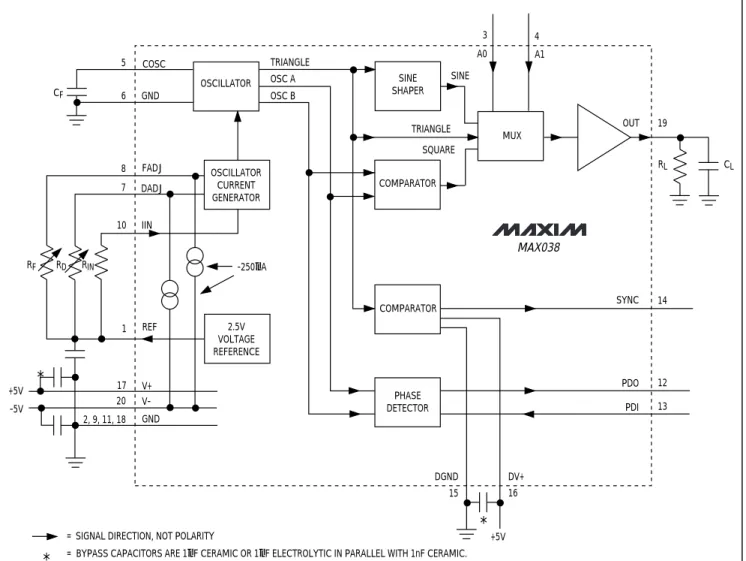
The MAX038 is a high-frequency function generator that produces low-distortion sine, triangle, sawtooth, or square (pulse) waveforms at frequencies from less than 1Hz to 20MHz or more, using a minimum of external components. Frequency and duty cycle can be inde-pendently controlled by programming the current, volt-age, or resistance. The desired output waveform is selected under logic control by setting the appropriate code at the A0 and A1 inputs. A SYNC output and phase detector are included to simplify designs requir-ing trackrequir-ing to an external signal source.
The MAX038 operates with ±5V ±5% power supplies. The basic oscillator is a relaxation type that operates by alternately charging and discharging a capacitor, CF,
with constant currents, simultaneously producing a tri-angle wave and a square wave (Figure 1). The charg-ing and dischargcharg-ing currents are controlled by the cur-rent flowing into IIN, and are modulated by the voltages applied to FADJ and DADJ. The current into IIN can be varied from 2µA to 750µA, producing more than two decades of frequency for any value of CF. Applying ±2.4V to FADJ changes the nominal frequency (with VFADJ= 0V) by ±70%; this procedure can be used for fine control.
Duty cycle (the percentage of time that the output wave-form is positive) can be controlled from 10% to 90% by applying ±2.3V to DADJ. This voltage changes the CF charging and discharging current ratio while maintaining nearly constant frequency.
MAX038
OSCILLATOR
OSCILLATOR CURRENT GENERATOR
2.5V VOLTAGE REFERENCE
OSC B OSC A TRIANGLE
SINE SHAPER
COMPARATOR
COMPARATOR
PHASE DETECTOR
MUX COSC
GND 5
6 CF
8 7
10 FADJ DADJ
IIN
REF 1
17 20 2, 9, 11, 18
V+ V-GND RF RD RIN
+5V -5V
-250µA
SINE
TRIANGLE SQUARE
A0 A1
OUT
SYNC
PDO PDI
19
14
12 13
RL CL
3 4
DGND DV+ 15 16
+5V
*
=SIGNAL DIRECTION, NOT POLARITY
= BYPASS CAPACITORS ARE 1µF CERAMIC OR 1µF ELECTROLYTIC IN PARALLEL WITH 1nF CERAMIC.
*
*
A stable 2.5V reference voltage, REF, allows simple determination of IIN, FADJ, or DADJ with fixed resistors, and permits adjustable operation when potentiometers are connected from each of these inputs to REF. FADJ and/or DADJ can be grounded, producing the nominal frequency with a 50% duty cycle.
The output frequency is inversely proportional to capacitor CF. CF values can be selected to produce frequencies above 20MHz.
A sine-shaping circuit converts the oscillator triangle wave into a low-distortion sine wave with constant amplitude. The triangle, square, and sine waves are input to a multiplexer. Two address lines, A0 and A1, control which of the three waveforms is selected. The output amplifier produces a constant 2VP-P amplitude (±1V), regardless of wave shape or frequency.
The triangle wave is also sent to a comparator that pro-duces a high-speed square-wave SYNC waveform that can be used to synchronize other oscillators. The SYNC circuit has separate power-supply leads and can be disabled.
Two other phase-quadrature square waves are gener-ated in the basic oscillator and sent to one side of an “exclusive-OR” phase detector. The other side of the phase-detector input (PDI) can be connected to an external oscillator. The phase-detector output (PDO) is a current source that can be connected directly to FADJ to synchronize the MAX038 with the external oscillator.
Waveform Selection The MAX038 can produce either sine, square, or trian-gle waveforms. The TTL/CMOS-logic address pins (A0 and A1) set the waveform, as shown below:
X = Don’t care.
Waveform switching can be done at any time, without regard to the phase of the output. Switching occurs within 0.3µs, but there may be a small transient in the output waveform that lasts 0.5µs.
Waveform Timing
Output Frequency
The output frequency is determined by the current injected into the IIN pin, the COSC capacitance (to ground), and the voltage on the FADJ pin. When
VFADJ= 0V, the fundamental output frequency (Fo) is given by the formula:
Fo(MHz) = IIN(µA) ÷ CF(pF) [1] The period (to) is:
to(µs) = CF(pF) ÷ IIN(µA) [2] where:
IIN= current injected into IIN (between 2µA and 750µA)
CF= capacitance connected to COSC and GND (20pF to >100µF).
For example:
0.5MHz = 100µA ÷ 200pF and
2µs = 200pF ÷ 100µA
Optimum performance is achieved with IIN between 10µA and 400µA, although linearity is good with IIN between 2µA and 750µA. Current levels outside of this range are not recommended. For fixed-frequency oper-ation, set IIN to approximately 100µA and select a suit-able capacitor value. This current produces the lowest temperature coefficient, and produces the lowest fre-quency shift when varying the duty cycle.
The capacitance can range from 20pF to more than 100µF, but stray circuit capacitance must be minimized by using short traces. Surround the COSC pin and the trace leading to it with a ground plane to minimize cou-pling of extraneous signals to this node. Oscillation above 20MHz is possible, but waveform distortion increases under these conditions. The low frequency limit is set by the leakage of the COSC capacitor and by the required accuracy of the output frequency. Lowest frequency operation with good accuracy is usu-ally achieved with 10µF or greater non-polarized capacitors.
An internal closed-loop amplifier forces IIN to virtual ground, with an input offset voltage less than ±2mV. IIN may be driven with either a current source (IIN), or a voltage (VIN) in series with a resistor (RIN). (A resistor between REF and IIN provides a convenient method of generating IIN: IIN = VREF/RIN.) When using a voltage in series with a resistor, the formula for the oscillator fre-quency is:
Fo(MHz) = VIN÷ [RINx CF(pF)] [3] and:
to(µs) = CF(pF) x RIN÷ VIN [4]
MAX038
_______________________________________________________________________________________ 9
A0 A1 WAVEFORM
X 1 Sine wave 0 0 Square wave 1 0 Triangle wave
MAX038
When the MAX038’s frequency is controlled by a volt-age source (VIN) in series with a fixed resistor (RIN), the output frequency is a direct function of VINas shown in the above equations. Varying VINmodulates the oscilla-tor frequency. For example, using a 10kΩ resistor for RIN and sweeping VIN from 20mV to 7.5V produces large frequency deviations (up to 375:1). Select RINso that IINstays within the 2µA to 750µA range. The band-width of the IIN control amplifier, which limits the modu-lating signal’s highest frequency, is typically 2MHz. IIN can be used as a summing point to add or subtract currents from several sources. This allows the output frequency to be a function of the sum of several vari-ables. As VINapproaches 0V, the IIN error increases due to the offset voltage of IIN.
Output frequency will be offset 1% from its final value for 10 seconds after power-up.
FADJ Input
The output frequency can be modulated by FADJ, which is intended principally for fine frequency control, usually inside phase-locked loops. Once the funda-mental, or center frequency (Fo) is set by IIN, it may be changed further by setting FADJ to a voltage other than 0V. This voltage can vary from -2.4V to +2.4V, causing the output frequency to vary from 1.7 to 0.30 times the value when FADJ is 0V (Fo ±70%). Voltages beyond ±2.4V can cause instability or cause the frequency change to reverse slope.
The voltage on FADJ required to cause the output to deviate from Foby Dx(expressed in %) is given by the formula:
VFADJ = -0.0343 x Dx [5]
where VFADJ, the voltage on FADJ, is between -2.4V and +2.4V.
Note:While IINis directly proportional to the fundamen-tal, or center frequency (Fo), VFADJis linearly related to % deviation from Fo. VFADJgoes to either side of 0V, corresponding to plus and minus deviation.
The voltage on FADJ for any frequency is given by the formula:
VFADJ= (Fo- Fx) ÷ (0.2915 x Fo) [6] where:
Fx= output frequency
Fo= frequency when VFADJ= 0V. Likewise, for period calculations:
VFADJ= 3.43 x (tx- to) ÷ tx [7] where:
tx = output period
to= period when VFADJ= 0V.
Conversely, if VFADJ is known, the frequency is given by:
Fx= Fox (1 - [0.2915 x VFADJ]) [8] and the period (tx) is:
tx= to÷ (1 - [0.2915 x VFADJ]) [9]
Programming FADJ FADJ has a 250µA constant current sink to V- that must be furnished by the voltage source. The source is usu-ally an op-amp output, and the temperature coefficient of the current sink becomes unimportant. For manual adjustment of the deviation, a variable resistor can be used to set VFADJ, but then the 250µA current sink’s temperature coefficient becomes significant. Since external resistors cannot match the internal tempera-ture-coefficient curve, using external resistors to pro-gram VFADJ is intended only for manual operation, when the operator can correct for any errors. This restriction does not apply when VFADJis a true voltage source.
A variable resistor, RF, connected between REF (+2.5V) and FADJ provides a convenient means of manually setting the frequency deviation. The resistance value (RF) is:
RF= (VREF- VFADJ) ÷ 250µA [10]
VREF and VFADJ are signed numbers, so use correct algebraic convention. For example, if VFADJ is -2.0V (+58.3% deviation), the formula becomes:
RF= (+2.5V - (-2.0V)) ÷ 250µA = (4.5V) ÷ 250µA
= 18kΩ
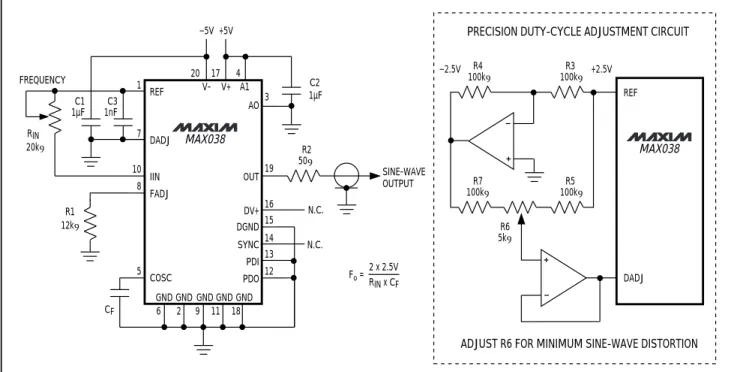
Disabling FADJ The FADJ circuit adds a small temperature coefficient to the output frequency. For critical open-loop applica-tions, it can be turned off by connecting FADJ to GND (not REF) through a 12kΩresistor (R1 in Figure 2). The -250µA current sink at FADJ causes -3V to be devel-oped across this resistor, producing two results. First, the FADJ circuit remains in its linear region, but discon-nects itself from the main oscillator, improving tempera-ture stability. Second, the oscillator frequency doubles. If FADJ is turned off in this manner, be sure to correct equations 1-4 and 6-9 above, and 12 and 14 below by doubling Foor halving to. Although this method doubles the normal output frequency, it does not double the upper frequency limit. Do not operate FADJ open cir-cuit or with voltages more negative than -3.5V. Doing so may cause transistor saturation inside the IC, lead-ing to unwanted changes in frequency and duty cycle.
With FADJ disabled, the output frequency can still be changed by modulating IIN.
Swept Frequency Operation
The output frequency can be swept by applying a vary-ing signal to IIN or FADJ. IIN has a wider range, slightly slower response, lower temperature coefficient, and requires a single polarity current source. FADJ may be used when the swept range is less than ±70% of the center frequency, and it is suitable for phase-locked loops and other low-deviation, high-accuracy closed-loop controls. It uses a sweeping voltage symmetrical about ground.
Connecting a resistive network between REF, the volt-age source, and FADJ or IIN is a convenient means of offsetting the sweep voltage.
Duty Cycle
The voltage on DADJ controls the waveform duty cycle (defined as the percentage of time that the output waveform is positive). Normally, VDADJ = 0V, and the duty cycle is 50% (Figure 2). Varying this voltage from +2.3V to -2.3V causes the output duty cycle to vary from 15% to 85%, about -15% per volt. Voltages beyond ±2.3V can shift the output frequency and/or cause instability.
DADJ can be used to reduce the sine-wave distortion. The unadjusted duty cycle (VDADJ= 0V) is 50% ±2%; any deviation from exactly 50% causes even order har-monics to be generated. By applying a small adjustable voltage (typically less than ±100mV) to VDADJ, exact symmetry can be attained and the distor-tion can be minimized (see Figure 2).
The voltage on DADJ needed to produce a specific duty cycle is given by the formula:
VDADJ= (50% - dc) x 0.0575 [11] or:
VDADJ= (0.5 - [tON÷ to]) x 5.75 [12] where:
VDADJ= DADJ voltage (observe the polarity) dc = duty cycle (in %)
tON= ON (positive) time to= waveform period.
Conversely, if VDADJis known, the duty cycle and ON time are given by:
dc = 50% - (VDADJx 17.4) [13] tON= tox (0.5 - [VDADJx 0.174]) [14]
MAX038
______________________________________________________________________________________ 11
MAX038
1µF
GND
COSC 12
AO
V-18 11 9 2 6
GND GND GND GND
5 8 10 7 1
13 14 15 16
N.C. 3
FADJ IIN DADJ REF
OUT
DV+ DGND SYNC PDI PDO V+ A1
4 17 20
–5V +5V
C2
1nF C3 1µF
C1
12kΩ
R1 20kΩ
RIN
FREQUENCY
50Ω R2
N.C.
CF
19 SINE-WAVE OUTPUT
2 x 2.5V RIN x CF
Fo =
MAX038
100kΩ R5
5kΩ R6 100kΩ
R7
100kR3Ω
100kR4Ω
DADJ REF +2.5V –2.5V
PRECISION DUTY-CYCLE ADJUSTMENT CIRCUIT
ADJUST R6 FOR MINIMUM SINE-WAVE DISTORTION
MAX038
Programming DADJ
DADJ is similar to FADJ; it has a 250µA constant cur-rent sink to V- that must be furnished by the voltage source. The source is usually an op-amp output, and the temperature coefficient of the current sink becomes unimportant. For manual adjustment of the duty cycle, a variable resistor can be used to set VDADJ, but then the 250µA current sink’s temperature coefficient becomes significant. Since external resistors cannot match the internal temperature-coefficient curve, using external resistors to program VDADJis intended only for manual operation, when the operator can correct for any errors. This restriction does not apply when VDADJ is a true voltage source.
A variable resistor, RD, connected between REF (+2.5V) and DADJ provides a convenient means of manually setting the duty cycle. The resistance value (RD) is:
RD= (VREF- VDADJ) ÷ 250µA [15]
Note that both VREFand VDADJare signed values, so observe correct algebraic convention. For example, if VDADJis -1.5V (23% duty cycle), the formula becomes:
RD= (+2.5V - (-1.5V)) ÷ 250µA = (4.0V) ÷ 250µA = 16kΩ
Varying the duty cycle in the range 15% to 85% has minimal effect on the output frequency—typically less than 2% when 25µA < IIN< 250µA. The DADJ circuit is wideband, and can be modulated at up to 2MHz (see photos, Typical Operating Characteristics).
Output The output amplitude is fixed at 2VP-P, symmetrical around ground, for all output waveforms. OUT has an output resistance of under 0.1Ω, and can drive ±20mA with up to a 50pF load. Isolate higher output capaci-tance from OUT with a resistor (typically 50Ω) or buffer amplifier.
Reference Voltage REF is a stable 2.50V bandgap voltage reference capa-ble of sourcing 4mA or sinking 100µA. It is principally used to furnish a stable current to IIN or to bias DADJ and FADJ. It can also be used for other applications external to the MAX038. Bypass REF with 100nF to min-imize noise.
Selecting Resistors and Capacitors The MAX038 produces a stable output frequency over time and temperature, but the capacitor and resistors that determine frequency can degrade performance if they are not carefully chosen. Resistors should be metal film, 1% or better. Capacitors should be chosen
for low temperature coefficient over the whole tempera-ture range. NPO ceramics are usually satisfactory. The voltage on COSC is a triangle wave that varies between 0V and -1V. Polarized capacitors are generally not recommended (because of their outrageous tem-perature dependence and leakage currents), but if they are used, the negative terminal should be connected to COSC and the positive terminal to GND. Large-value capacitors, necessary for very low frequencies, should be chosen with care, since potentially large leakage currents and high dielectric absorption can interfere with the orderly charge and discharge of CF. If possi-ble, for a given frequency, use lower IIN currents to reduce the size of the capacitor.
SYNC Output SYNC is a TTL/CMOS-compatible output that can be used to synchronize external circuits. The SYNC output is a square wave whose rising edge coincides with the output rising sine or triangle wave as it crosses through 0V. When the square wave is selected, the rising edge of SYNC occurs in the middle of the positive half of the output square wave, effectively 90° ahead of the output. The SYNC duty cycle is fixed at 50% and is indepen-dent of the DADJ control.
Because SYNC is a very-high-speed TTL output, the high-speed transient currents in DGND and DV+ can radiate energy into the output circuit, causing a narrow spike in the output waveform. (This spike is difficult to see with oscilloscopes having less than 100MHz band-width). The inductance and capacitance of IC sockets tend to amplify this effect, so sockets are not recom-mended when SYNC is on. SYNC is powered from sep-arate ground and supply pins (DGND and DV+), and it can be turned off by making DV+ open circuit. If syn-chronization of external circuits is not used, turning off SYNC by DV+ opening eliminates the spike.
Phase Detectors
Internal Phase Detector
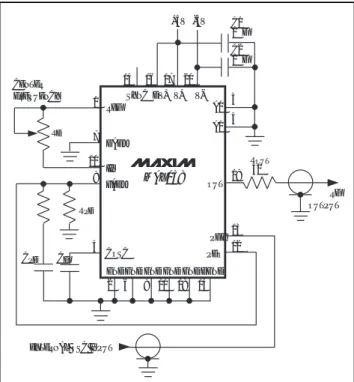
The MAX038 contains a TTL/CMOS phase detector that can be used in a phase-locked loop (PLL) to synchro-nize its output to an external signal (Figure 3). The external source is connected to the phase-detector input (PDI) and the phase-detector output is taken from PDO. PDO is the output of an exclusive-OR gate, and produces a rectangular current waveform at the MAX038 output frequency, even with PDI grounded. PDO is normally connected to FADJ and a resistor, RPD, and a capacitor CPD, to GND. RPDsets the gain of the phase detector, while the capacitor attenuates high-frequency components and forms a pole in the phase-locked loop filter.
PDO is a rectangular current-pulse train, alternating between 0µA and 500µA. It has a 50% duty cycle when the MAX038 output and PDI are in phase-quadrature (90° out of phase). The duty cycle approaches 100% as the phase difference approaches 180° and con-versely, approaches 0% as the phase difference approaches 0°. The gain of the phase detector (KD) can be expressed as:
KD= 0.318 x RPD(volts/radian) [16] where RPD= phase-detector gain-setting resistor. When the loop is in lock, the input signals to the phase detector are in approximate phase quadrature, the duty cycle is 50%, and the average current at PDO is 250µA (the current sink of FADJ). This current is divided between FADJ and RPD; 250µA always goes into FADJ and any difference current is developed across RPD, creating VFADJ (both polarities). For example, as the phase difference increases, PDO duty cycle increases, the average current increases, and the voltage on RPD (and VFADJ) becomes more positive. This in turn decreases the oscillator frequency, reducing the phase difference, thus maintaining phase lock. The higher RPD is, the greater VFADJ is for a given phase differ-ence; in other words, the greater the loop gain, the less the capture range. The current from PDO must also
charge CPD, so the rate at which VFADJchanges (the loop bandwidth) is inversely proportional to CPD. The phase error (deviation from phase quadrature) depends on the open-loop gain of the PLL and the ini-tial frequency deviation of the oscillator from the exter-nal sigexter-nal source. The oscillator conversion gain (Ko) is:
KO = ∆ωo ÷ ∆VFADJ [17] which, from equation [6] is:
KO= 3.43 x ωo(radians/sec) [18] The loop gain of the PLL system (KV) is:
KV= KDx KO [19]
where:
KD= detector gain KO= oscillator gain.
With a loop filter having a response F(s), the open-loop transfer function, T(s), is:
T(s) = KDx KOx F(s) ÷ s [20]
Using linear feedback analysis techniques, the closed-loop transfer characteristic, H(s), can be related to the open-loop transfer function as follows:
H(s) = T(s) ÷ [1+ T(s)] [21]
The transient performance and the frequency response of the PLL depends on the choice of the filter charac-teristic, F(s).
When the MAX038 internal phase detector is not used, PDI and PDO should be connected to GND.
External Phase Detectors
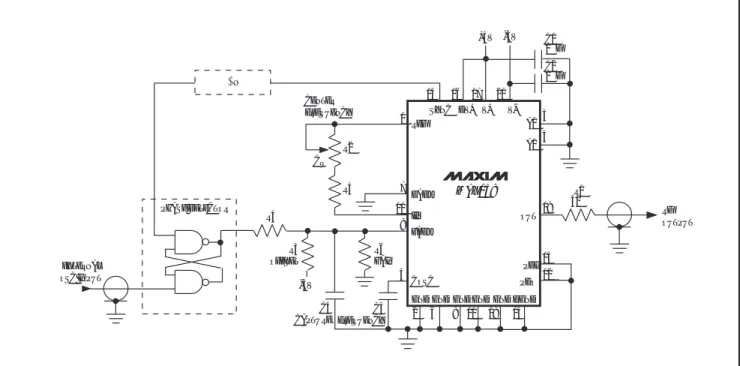
External phase detectors may be used instead of the internal phase detector. The external phase detector shown in Figure 4 duplicates the action of the MAX038’s internal phase detector, but the optional ÷N circuit can be placed between the SYNC output and the phase detector in applications requiring synchronizing to an exact multiple of the external oscillator. The resistor net-work consisting of R4, R5, and R6 sets the sync range, while capacitor C4 sets the capture range. Note that this type of phase detector (with or without the ÷N cir-cuit) locks onto harmonics of the external oscillator as well as the fundamental. With no external oscillator input, this circuit can be unpredictable, depending on the state of the external input DC level.
Figure 4 shows a frequency phase detector that locks onto only the fundamental of the external oscillator. With no external oscillator input, the output of the fre-quency phase detector is a positive DC voltage, and the oscillations are at the lowest frequency as set by R4, R5, and R6.
MAX038
______________________________________________________________________________________ 13
Figure 3. Phase-Locked Loop Using Internal Phase Detector
MAX038
GND
COSC 12
A0
V-18 11 9 2 6
GND GND 15
DGND GND GND
5 8 10 7 1
13 3
FADJ IIN DADJ REF
RD
OUT
PDI PDO V+ 17 DV+ 16 20
+5V -5V
C2 1µF C1 1µF
CENTER FREQUENCY
50Ω
ROUT
CF
RPD
CPD
19
RF OUTPUT A1 4
SYNC 14
MAX038
Figure 4. Phase-Locked Loop Using External Phase Detector
Figure 5. Phase-Locked Loop Using External Frequency Phase Detector
MAX038
GND
COSC 12
A0
V-18 11 9 2 6
GND GND 15 DGND GND GND
5 8 10 7 1
13 3
FADJ IIN DADJ REF R2
CW R3
OUT
PDI PDO V+ 17 DV+
16 20
+5V -5V
-5V
C2 1µF C1 1µF
CENTER FREQUENCY
50ΩR1
R6 GAIN R5
OFFSET R4 PHASE DETECTOR
EXTERNAL OSC INPUT
C4 CAPTURE
19 RF
OUTPUT A1 4
SYNC 14 ÷N
C3 FREQUENCY
MAX038
GND
COSC 12
A0
V-18 11 9 2 6
GND GND 15 DGND GND GND
5 8 10 7 1
13 3
FADJ IIN DADJ REF R2
CW R3
OUT
PDI PDO V+ 17 DV+
16 20
+5V -5V
-5V
C2 1µF C1 1µF
CENTER FREQUENCY
50R1Ω
R6 GAIN R5
OFFSET R4
C4 CAPTURE
19
RF OUTPUT A1 4
SYNC 14
÷N
C3 FREQUENCY EXTERNAL
OSC INPUT
MAX038
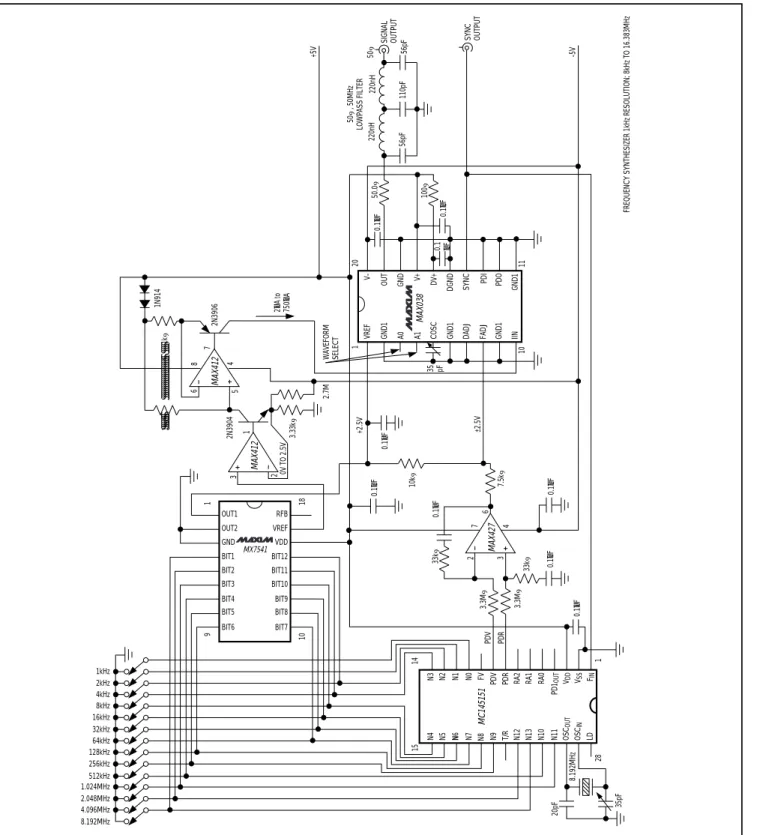
______________________________________________________________________________________ 15 N4 N3 N2 MC145151 N6 8.192MHz MAX427 N5 OUT1 OUT2 RFB VREF VDD GND1 MX7541N7 N8 N9 T/R N12 N13 N10 N11 OSC
OUT
OSC
IN
LD
N
N1 N0 FV
PDV PDR RA2 RA1 RA0
PD1
OUT VDD VSS FIN
35pF 20pF 15 14 28 1 GND BIT1 BIT2 BIT3 BIT4 BIT5 BIT6 BIT12 BIT11 BIT10 BIT9 BIT8 BIT7 MAX038
A0 A1 COSC GND1 DADJ FADJ OUT GND V+ DV+
DGND SYNC PDI PDO
VREF V-GND1 IIN GND1 3.3M Ω PDV PDR 3.3M Ω 33k Ω 0.1 µ F 0.1 µ F 33k Ω 0.1 µ F 0.1 µ F 7.5k Ω 10k Ω 2 3 7 4 6 0.1 µ F 0.1 µ F +2.5V ±2.5V 35 pF 10 11 0.1 µ F
0.1 µF
0.1 µ F 50.0 Ω 100 Ω 1 20 50 Ω , 50MHz LOWPASS FILTER 220nH 220nH 56pF 110pF 56pF 50
Ω SIGNAL OUTPUT SYNC OUTPUT
+5V -5V
9 10
1 18
3 2
1
0V TO 2.5V
2N3904 3.33k Ω 2.7M 1k Ω 1k Ω 5 6 8 4 7 2N3906 1N914 2 µ A to 750 µ A MAX412 MAX412 8.192MHz 4.096MHz 2.048MHz 1.024MHz 512kHz 256kHz 128kHz 64kHz 32kHz 16kHz 8kHz 4kHz 2kHz 1kHz WAVEFORM SELECT
FREQUENCY SYNTHESIZER 1kHz RESOLUTION; 8kHz TO 16.383MHz
MAX038
Layout Considerations Realizing the full performance of the MAX038 requires careful attention to power-supply bypassing and board layout. Use a low-impedance ground plane, and con-nect all five GND pins directly to it. Bypass V+ and V-directly to the ground plane with 1µF ceramic capaci-tors or 1µF tantalum capacicapaci-tors in parallel with 1nF ceramics. Keep capacitor leads short (especially with the 1nF ceramics) to minimize series inductance. If SYNC is used, DV+ must be connected to V+, DGND must be connected to the ground plane, and a second 1nF ceramic should be connected as close as possible between DV+ and DGND (pins 16 and 15). It is not necessary to use a separate supply or run separate traces to DV+. If SYNC is disabled, leave DV+ open. Do not open DGND.
Minimize the trace area around COSC (and the ground plane area under COSC) to reduce parasitic capaci-tance, and surround this trace with ground to prevent coupling with other signals. Take similar precautions with DADJ, FADJ, and IIN. Place CFso its connection to the ground plane is close to pin 6 (GND).
___________Applications Information
Frequency Synthesizer Figure 6 shows a frequency synthesizer that produces accurate and stable sine, square, or triangle waves with a frequency range of 8kHz to 16.383MHz in 1kHz incre-ments. A Motorola MC145151 provides the crystal-con-trolled oscillator, the ÷N circuit, and a high-speed phase detector. The manual switches set the output frequency; opening any switch increases the output frequency. Each switch controls both the ÷N output and an MX7541 12-bit DAC, whose output is converted to a cur-rent by using both halves of the MAX412 op amp. This current goes to the MAX038 IIN pin, setting its coarse frequency over a very wide range.
Fine frequency control (and phase lock) is achieved from the MC145151 phase detector through the differ-ential amplifier and lowpass filter, U5. The phase
detec-tor compares the ÷N output with the MAX038 SYNC output and sends differential phase information to U5. U5’s single-ended output is summed with an offset into the FADJ input. (Using the DAC and the IIN pin for coarse frequency control allows the FADJ pin to have very fine control with reasonably fast response to switch changes.)
A 50MHz, 50Ω lowpass filter in the output allows pas-sage of 16MHz square waves and triangle waves with reasonable fidelity, while stopping high-frequency noise generated by the ÷N circuit.
V+
PDI SYNC AO
DADJ
PDO FADJ
0.118" (2.997mm)
0.106" (2.692mm) A1
COSC
GND
IIN
GND GND
DGND DV+ GND
GND REF V- OUT
TRANSISTOR COUNT: 855
SUBSTRATE CONNECTED TO GND
___________________Chip Topography
Maxim cannot assume responsibility for use of any circuitry other than circuitry entirely embodied in a Maxim product. No circuit patent licenses are implied. Maxim reserves the right to change the circuitry and specifications without notice at any time.
16 ____________________Maxim Integrated Products, 120 San Gabriel Drive, Sunnyvale, CA 94086 408-737-7600
Package Information
For the latest package outline information, go to