Journal of Algebra Combinatorics Discrete Structures and Applications
A class of constacyclic codes containing formally
self-dual and isodual codes
Research Article
Manjit Singh
Abstract: In this paper, we investigate a class of constacyclic codes which contains isodual codes and formally self-dual codes. Further, we introduce a recursive approach to obtain the explicit factorization of
x2m`n−µ
k∈Fq[x], wheren, mare positive integers andµkis an element of order`kinFq. Moreover, we give many examples of interesting isodual and formally self-dual constacyclic codes.
2010 MSC:12E05, 94B05, 11T71
Keywords: Constacyclic codes, Weight distributions, Isodual codes, Formally self-dual codes
1.
Introduction
Let Fq be a finite field with q elements and n be a positive integer. An [n, k]q-linear code C is
a k-dimensional subspace of Fnq. Usually, elements of C are referred to as codewords. The Hamming
weight of a vector c ∈ Fn
q, denoted by wt(c), is the number of nonzero coordinate entries in c. The
Hamming distance between two vectors c andc0 in Fn
q is defined as d(c, c0) =wt(c−c0). The minimum
distance dH(C) of a code C is the smallest distance between distinct codewords of the code C, i.e.
dH(C) = min{d(c, c0) :c, c0 ∈C}. For a linear code C, the minimum distance d=dH(C)is the same as
the minimum weight of nonzero codewords ofC.
LetAidenote the number of codewords with Hamming weightiinC, where0≤i≤n. The sequence (A0, A1, . . . , An)is called the weight distribution of the codeC. A linear code possessing minimum weight
dhas no nonzero codeword of weight less thandexcept zero codeword, that is,Ai= 0for all1≤i≤d−1
and A0 = 1. The weight distribution is an important research object in coding theory. However, the
problem of determining the weight distribution of linear codes is, in general, notoriously difficult. There are extremely few linear codes for which the weight distribution is known (see for example [7], [11], [17], [18] and the references therein).
For an [n, k]q-linear codeC, the dual codeC⊥ is also a linear code of lengthnand dimensionn−k
over Fq. The codeC is self-orthogonal if C ⊆C⊥ and self-dual if C=C⊥. The length nof a self-dual
code is even and dimension is n/2. Further, if q is odd, then there is no self-dual cyclic code of length 2n over Fq and, if q is even, then there is a unique self-dual cyclic code of dimension2n−1 of length 2n
(see [16, Section 5]). Blackford [4] obtained the necessary and sufficient conditions for the existence of simple-root self-dual negacyclic codes. Bakshi and Raka [3] obtained all the self-dual negacyclic codes of length 2n over
Fpm, where pis an odd prime and integerm≥1. Dinh [8, Corollary 3.3] characterized all repeated-root self-dual negacyclic codes of length 2ps over
Fpm. Remarkably note that constacyclic codes, except negacyclic codes or binary cyclic codes, do not include an important class of codes, that is, self-dual codes, however these codes contain formally self-dual and isodual codes.
A linear codeC is called isodual ifCis equivalent to its dual code C⊥. A code Cis called formally self-dual (f.s.d.) code if C and C⊥ have the same weight distribution. Automatically, self-dual codes are isodual codes and isodual codes are formally self-dual codes. Huffman and Pless [9] studied formally self-dual binary codes, however little work is known about formally self-dual codes over non-binary fields. These codes are important due to their applications in lattices [2], designs [10], code based cryptography, particularly in determining a minimal access set [14] and coding theory [5].
In this paper, motivated by the numerous practical applications of isodual codes and formally self-dual codes, we investigate a class of isoself-dual and formally self-self-dual constacyclic codes which are permu-tation and monomially equivalent to each other. Further, we study the form of codewords, generator polynomials and the weight distribution of a class ofµk- irreducible constacyclic codes of length2`nover Fq, where`is odd prime such that`k|(q−1)andµk is an element of order`k inF∗q\ {1,−1}. This paper
also presents a recursive factorization ofx2m`n−µ
k∈Fq[x], where integerm≥1.
The structure of the paper is as follows: Some background of constacyclic codes, the necessary notation and some known results are to be used presented in Section 2. In Section 3, the explicit factorization ofx2`n−µ
koverFqis obtained. Further, we introduce a recursive factorization ofx2 m`n
−µk.
The form of codewords of all irreducible µk-constacyclic codes of length`n and 2`n are also obtained.
Moreover, the weight distributions of these codes are determined by simply observing the weight of each message word. In Section 4, we construct a family of isodual and hence formally self-dual codes of length 2`n overFq in a very special case. In the end of this section, we illustrate a class of isodual codes and
formally self-dual codes by means of some examples.
2.
Preliminaries
Throughout this paper Fq denotes a finite field with qelements, whereq is a power of a prime. For
a fixedµ∈F∗q, whereF∗q =Fq\ {0}, a linear codeCof lengthnoverFq is called aµ-constacyclic code if
(c1, c2, . . . , cn−1, µc0)∈C for each(c0, c1, c2, . . . , cn−1)∈C.
The code C is called cyclic if µ= 1 and negacyclic ifµ =−1. If gcd(n, q) = 1, aµ-constacyclic code of length n is called simple-root code; otherwise it is called repeated-root code. Identifying the vector (a0, a1, . . . , an−1) ∈ Fnq with the polynomial a0xn−1+a1xn−2+· · ·+an−1 ∈ Fq[x], a simple-root
µ-constacyclic code C can be represented as an ideal of the quotient ring Fq[x]/hxn−µi. Each ideal in Fq[x]/hxn−µiis of the form hg(x)i, where g(x)is a monic divisor of xn−µin Fq[x]. The polynomial
g(x) is known as the generator polynomial of the codeC. Aµ-constacyclic code C is called irreducible or minimal over Fq ifh(x) = (xn−µ)/g(x)is an irreducible polynomial over
Fq, where the polynomial
h(x) is known as the parity check polynomial of the code C. The structure of constacyclic codes have been extensively studied and can be found in [1,3,5–8, 11].
For any two vectorsa= (a1, a2, . . . , an)andb= (b1, b2, . . . , bn)inFnq, the (Euclidean) inner product
a·b= n
X
i=1
aibi∈Fq, whereai, bi∈Fq for each i= 1,2, . . . , n.
The two vectors a andbare said to be orthogonal if a·b= 0. The dual code of C, denoted byC⊥, is defined as
C⊥ ={b∈Fnq :a·b= 0 for alla∈C}.
For any polynomial f(x) = r
X
i=0
aixr−i, where a0 = 06 , overFq, the reciprocal polynomial of f(x),
denoted by f∗(x), is given by:
f∗(x) =xrf(x−1) = r
X
i=0
aixi.
For a µ-constacyclic [n, k]q-code C with parity check polynomial h(x) of degree k over Fq, the
generator polynomial of C⊥ is given byh∗(x)over
Fq. Note thath∗(x)dividesxn−µ−1over Fq if and
only if h(x)dividesxn−µoverFq.
Lemma 2.1. [8, Proposition 2.2] The dual ofµ-constacyclic code is a µ−1-constacyclic code.
Remark 2.2. The dual code C⊥ of a cyclic (negacyclic) codeC is a cyclic (negacyclic) code, however, from Lemma2.1, we notice that the dual code ofµ-constacyclic code is not aµ-constacyclic code for every
µ∈F∗
q\ {1,−1}.
Definition 2.3 (see [13]). Two (n, M)-codes, whereM is the size of the code, overFq are equivalent if one can be obtained from the other by a combination of operations of the following type:
(i) permutation of thendigits of the codewords;
(ii) multiplication of the symbols appearing in a fixed position by a nonzero scalar.
Lemma 2.4. [13, p.72] Equivalent linear codes have the same length, dimension and distance.
The following result contains a criterion on irreducible non-linear binomials overFq, which was given
by Serret in 1866.
Lemma 2.5. [12, Theorem 3.75] Let t ≥ 2 be an integer and a ∈ F∗q. Then the binomial xt−a is irreducible inFq[x]if and only if the following two conditions are satisfied:
(i) each prime factor oft divides the order eof ainF∗q, but does not divide (q−1)/e;
(ii) q≡1 (mod 4)if t≡0 (mod 4).
For this section and the rest of this work, we set the following notation: Let`be a prime such that gcd(`, q) = 1andv= max{k:`k|(q−1)}. Obviously,v= 0if and only if`
-(q−1). Letµkbe a primitive
`kth root of unity in
F∗q withµ0= 1.
For a fixed k, where1 ≤k≤v, we rephrase the factorization ofx`n−µ
k over Fq in the following
form:
Lemma 2.6. [6, Theorem 4.1(ii)] Letnbe a positive integer,gcd(q, `) = 1,r= min{n, v−k},1≤k≤v, andv≥2 if`= 2. Then the irreducible factorization of x`n
−µk is given by
x`n−µk= `r Y
i=1
(x`n−r −µk`k+i+1r ),
In particular, by taking`= 2in Lemma2.6, a factorization ofx2n−µ
k into the product of2rfactors
is given as follows:
Lemma 2.7. Let nbe a positive integer, qbe odd prime power,r= min{n, v−k}and1≤k≤v. Then a factorization of x2n−µk overFq is given by:
x2n−µk =
2r
Y
i=1
(x2n−r−µk2k+ir+1),
whereµk+r is an element of order2k+rin F∗q. Further, ifv≥2, the factorization is irreducible overFq, and if v= 1, the irreducible factorization ofx2n
−µv is given in Lemma [16, Lemma 2.6].
In order to give a detailed explanation of our examples, we consider the following notions and results given in [15].
Let Sq = {a2 : a ∈ F∗q} and Oq = {a ∈ F∗q : |a| is odd}, where |a| denotes the order of a ∈ F∗q.
Readily note thatOq andSq are subgroups of the multiplicative groupF∗q of the nonzero elements ofFq
satisfyingOq ⊆ Sq. Remarkably note thatq≡3 (mod 4)if and only ifOq=Sq.
Lemma 2.8. [15, Theorem 4.2] Letqandtbe odd primes such thatq= 2t+ 1. ThenSq is generated by 4.
Lemma 2.9. [15, Theorem 4.4] Letqandtbe odd primes such thatq= 4t+ 1. Then the following holds:
(i) Oq=hti={ti: 0≤i≤t−1}.
(ii) Sq =h4iandOq=h16iforq >13.
3.
A class of irreducible constacyclic codes
This section studies a class ofµk- irreducible constacyclic code overFq. The weight distribution of
this class of codes is followed by the form of codewords without putting much effort.
First of all, by using the same notation introduced in Lemma2.6, letCk,i denote aµk-constacyclic
[`n, `n−r]
q code with the parity check polynomialhk,i(x) =x` n−r
−µ`ki+1
k+r . Then the generator polynomial
gk,i(x)ofCk,i is given by:
gk,i(x) =
x`n−µk
x`n−r
−µ`kk+i+1r .
Theorem 3.1. Let nbe a positive integer, `be a prime such thatgcd(`, q) = 1,`k|(q−1)for1≤k≤v
andr= min{n, v−k}. Then the generator polynomial of Ck,i is given by:
gk,i(x) = `r−1
X
u=0
µ(k`+kir+1)ux`n−r(`r−u−1).
Further, if a= (a0, a1, . . . , a`n−r−1)∈F` n−r
q be any message word, then
Ck,i={(a,aµ` ki+1
k+r ,· · ·,aµ
(`ki+1)(`r−1)
k+r )}.
Proof. Letr= min{n, v−k} and1≤k≤v. Sinceµk=µ
(`ki+1)`r
k+r for1≤i≤` r, so
x`n−µk = (x` n−r
)`r−µ(k`+kir+1)`r = (x`n−r−µ`kk+i+1r ) `r−1
X
u=0
Therefore, the generator polynomial gk,i(x)of a µk-constacyclic[`n, `n−r]q codeCk,i is given by:
gk,i(x) =
x`n −µk
x`n−r
−µ`kk+i+1r =
`r−1 X
u=0
µ(` ki+1)u k+r x
`n−r(`r−u−1).
Leta= (a0, a1,· · · , a`n−r−1)∈F` n−r
q be any message word. Then the corresponding message polynomial
can be expressed as
a(x) = `n−r−1
X
j=0
ajx`
n−r−j−1 .
Therefore, the code polynomial of Ck,i is given as follows:
a(x)gk,i(x) =
`n−r−1
X
j=0
ajx`
n−r−j−1
`r−1
X
u=0
µ(k`+kri+1)ux`n−r(`r−u−1) !
= `r−1
X
u=0
µ(k`+kir+1)u
`n−r−1
X
j=0
ajx`
n−r−j−1
x
`n−r(`r−u−1)
= `r−1
X
u=0
`n−r−1 X
j=0
ajµ
(`ki+1)u k+r x
`n−r(`r−u)−j−1.
Further, the uth component of codeword(c∗0, c∗1,· · ·, c∗`r−1)is
c∗u= (a0µ (`ki+1)u k+r , a1µ
(`ki+1)u
k+r ,· · ·, a`n−r−1µ (`ki+1)u k+r ).
By using notation aθfor the vector (a0θ, a1θ,· · · , a`n−r−1θ), whereθ∈F∗q, the codeCk,i is given by:
Ck,i={(a,aµ` ki+1
k+r ,· · ·,aµ
(`ki+1)(`r−1)
k+r ) :a∈F `n−r q }.
This completes the proof.
Remark 3.2. By Lemma 2.5, x`n−r
−µ`kk+i+1r is an irreducible factor of x`n
−µk over Fq for every 1≤i≤`r provided thatv≥2 if `= 2. Let us consider the exceptional casev= 1 if `= 2. Then k= 1,
i= 1and hencegk,i= 1. Thus, the codeCk,i becomes the whole spaceF2 n
q , a trivial negacyclic code. For any n≥2,x2n+ 1is reducible over
Fq, where q≡3 (mod 4). Therefore, there are non-trivial negacyclic equivalent codes of length 2n. These negacyclic codes of length2n over
Fq and their weight distribution have been studied in [17, Theorem 4.6].
Lemma 3.3. For any1≤i, j≤`r,Ck,i is equivalent to Ck,j.
Proof. There are `r irreducible codes C
k,i for 1 ≤ i ≤ `r for each fixed k, where 1 ≤ k ≤ v and
r= min{n, v−k}. For every pair(i, j), where1≤i≤j ≤`r, there exists a uniquel =j−i (mod `r)
such that µ`kk+jr+1 = µlrµ `ki+1
k+r . Using the form of codewords of Ck,i and Ck,j given in Theorem 3.1, it
follows that Ck,j =µjr−iCk,i. Thus, the code Ck,j can be obtained form the code Ck,i by multiplying
µj−i
r and hence they are equivalent.
Theorem 3.4. By using the assumptions of Theorem 3.1, the weight distribution of µk-constacyclic [`n, `n−r]
q code Ck is
A`rj= `n−r
j
(q−1)j for 0≤j ≤`n−r.
Proof. Direct from Theorem3.1.
Keeping in mind the previous notation, we now present the following result, which will be important in order to study of isodual and formally self-dual constacyclic codes that we are interested in.
Theorem 3.5. Letq,`,randk be as before, and additionally, let` be odd. Then
x2`n−µk= `r Y
i=1
(x`n−r±θk`k+i+1r ),
where θk+r is an element of order `k+randθ2k=µk.
Proof. For each1≤k≤v, the order ofµk is`k. Clearly`k is odd andµ` k+1
k =µk. Letθk =µ
(`k+1)/2 k
for 1 ≤ k ≤ v. Then the order of θk is `k and θ2k = µk. It follows that x2` n
−µk = x2` k
−θk2 = (x`k−θk)(x`
k
+θk). By Lemma2.6, the factorization ofx` n
−θk overFq is given by:
x`n−θk = `r
Y
i=1
(x`n−r−θk`k+i+1r ).
By changing xto−xin the above factorization of x`n
−θk, we obtain the factorization ofx` n
+θk over Fq as follows:
x`n+θk = `r
Y
i=1
(x`n−r+θk`k+i+1r ).
This completes the proof.
Theorem 3.6. Let q,`,r,k `be as in Theorem3.5, and additionally, letmbe a positive integer. Then a recursive factorization of x2m`n
−µk overFq is given by
x2m`n−µk= `r
Y
i=1
(x2m−1`n−r±θ`kk+i+1r ),
where θk+r is an element of order `k+randθ2k=µk.
Proof. The required form of factorization follows directly by using the substitution x to x2m−1
in Theorem3.5. By Lemma2.5, binomialsx2m−1`n±θ`ki+1
k+r is reducible overFq if and only if∓θ `ki+1
k+r ∈ Sq,
where Sq is the set of all square elements in F∗q.
For each1≤k≤v, in view of Theorem3.5, there are2`rdistinct irreducible factors ofx2`n−µkover Fq. LetCk,i0 andCk,i00 beµk-constacyclic[2`n, `n−r]q codes such thatCk,i0 =hgk,i0 (x)iandCk,i00 =hgk,i00 (x)i,
where 1≤i≤`r,1≤k≤vand
g0k,i(x) = x
2`n−µ k
x`n−r
−θ`kk+i+1r =
x`n−θ k
x`n−r
−θ`kk+ir+1
(x`n+θk)
and
g00k,i(x) = x
2`n −µk
x`n−r
+θ`kk+i+1r =
x`n +θk
x`n−r
+θ`kk+ir+1
Theorem 3.7. Let ` be a prime. 1 ≤i ≤`r and1 ≤k ≤v. Then the generator polynomial g0 k,i(x)of
Ck,i0 is given by
g0k,i(x) = `r−1
X
u=0
θ(` ki+1)u k+r x
`n−r(`r−u−1)
(x`n+θk).
Further, if a∈F` n−r
q is any message word, then
Ck,i0 ={(a,aθk`k+ir+1,· · ·,aθk(`+kri+1)(2`r−1))}.
Proof. Using the argument of Theorem3.1, we obtain
x`n−θk = (x` n−r
−θ`kk+ir+1) `r−1
X
u=0
θ(k`+kri+1)ux`n−r(`r−u−1) .
It follows that
x2`n−µk = (x` n
−θk)(x` n
+θk)
= (x`n−r−θ`kk+ir+1) `r−1
X
u=0
θ(` ki+1)u k+r x
`n−r(`r−u−1)
x`n+θk
= (x`n−r−θ`kk+ir+1)
2`r−1
X
u=0
θ(k`+kri+1)ux`n−r(2`r−u−1) .
Thus the generator polynomial g0k,i(x)of a µk-constacyclic[2`n, `n−r]q code Ck,i0 is
g0k,i(x) = x
2`n−µ k
x`n−r
−θk`k+i+1r =
2`r−1
X
u=0
θ(k`+kri+1)ux`n−r(2`r−u−1).
Leta= (a0, a1,· · · , a`n−r−1)∈F` n−r
q be any message word. Then the corresponding message polynomial
can be expressed asa(x) = `n−r−1
X
j=0
ajx`
n−r−j−1
. It follows that the code polynomial ofCk,i0 is
a(x)gk,i0 (x) =
`n−r−1 X
j=0
ajx` n−r−j−1
2`r−1 X
u=0
θ(` ki+1)u k+r x
`n−r(2`r−u−1) !
= `r−1
X
u=0
θ(k`+kri+1)u
`n−r−1
X
j=0
ajx`
n−r−j−1
x
`n−r(2`r−u−1)
=
2`r−1
X
u=0
`n−r−1
X
j=0
ajθ
(`ki+1)u k+r x
`n−r(2`r−u)−j−1 .
Further, the uth component of codeword(c∗∗0 , c∗∗1 ,· · ·, c∗∗`r−1)is
c∗∗u = (a0θ (`ki+1)u k+r , a1θ
(`ki+1)u
k+r ,· · ·, a`n−r−1θ
(`ki+1)u k+r ).
If we denoteaθ= (a0θ, a1θ,· · ·, a`n−r−1θ)for someθ∈F∗q, thenc∗∗u =aθ
(`ki+1)u
k+r for each0≤u≤2` r−1.
C0
k,i ={(a,aθ `ki+1
k+r ,· · ·,aθ
(`ki+1)(2`r−1)
k+r ) :a∈F
`n−r q }.
This completes the proof.
Using the argument discussed in Lemma3.3, observe that codesCk,i0 andCk,i00 are equivalent to codes Ck,`0 r andCk,`00 r respectively. DenoteCk,`0 r byCk0, andCk,`00 r byCk00.
Theorem 3.8. With our notation and assumption,Ck0 is equivalent toCk00.
Proof. Letg0k(x)andg00k(x)be generator polynomials ofCk0 andCk00respectively. Now the equivalence of these codes is asserted by the following identity:
gk00(−x) = x
2`n −µk
−x`n−r +θk+r
=−
x2`n−µk
x`n−r −θk+r
=−g0
k(x).
Remark 3.9. For each fixed 1≤k≤v and r= min{n, v−k}, there are 2`r irreducible codesCk,i0 and
Ck,i00 for1≤i≤`r. By Theorem 3.8, these codes are equivalent to Ck0. By Lemma 2.4, since equivalent linear codes share the same weight distributions, so it is sufficient to determine the weight distribution of
Ck0, aµk-constacyclic code of length2`n with the parity check polynomialx` n−r
−θk+r.
Theorem 3.10. Let ` be a prime, r = min{n, v−k} and 1≤k ≤v. Then the weight distribution of
µk-constacyclic [2`n, `n−r]q code Ck0 is
A2`rj= `n−r
j
(q−1)j for 0≤j ≤`n−r.
Proof. From Theorem3.7, the explicit form of codewords ofCk0 is given by:
Ck0 ={(a,aθk+r,· · ·,aθ2` r−1
k+r ) :a∈F `n−r q }.
Now, the weight distribution ofCk0 follows directly by using the above form of the code.
In end of this section, we present two examples as follows.
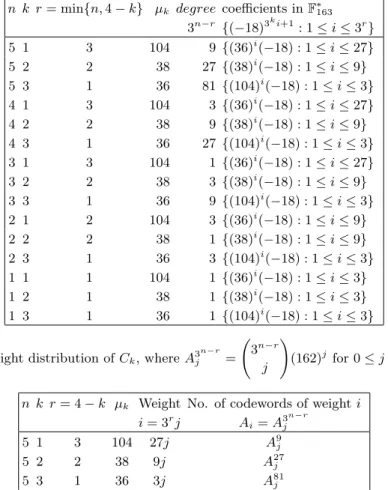
Example 3.11. With our notation, letq= 163,`= 3. Thenv= 4,1≤k≤3andr= min{n,4−k} ≥1. SinceSq(=Oq), a subgroup of order81, hasφ(3i) = 3i−1·2elements of order3ifor1≤i≤4, and4∈ Sq, so its order is either 9,27 or81. Using simple modular arithmetic, we obtain the order of4 is81. Thus one of the value of µ4 is4. Take µ4=−18 = 461,µ3 = 36 = 421,µ2= 38 = 463,µ1 = 104 = 427. It is
important to note that the choice ofµ4determinesµiuniquely as followsµ4−i=µ3 i
4 for0≤i≤3, however
if we choose µ1 first, then µ2 has more than one choices, for example if µ1 = 104, thenµ2 ∈ {40,38}.
By Lemma2.6, the factorization of x3n−µ
k is given by:
x3n−µk =
3r
Y
i=1
(x3n−r−µk3k+i+1r ).
In view of Table 1, the explicit factorization ofx81−38 overF163 is given by:
x81−38 = (x9+ 32)(x9+ 75)(x9+ 79)(x9+ 68)(x9−24) (x9+ 66)(x9+ 63)(x9−51)(x9+ 18).
Further, by Theorem 3.4, the weight distribution of 38-constacyclic [81,9,9]163 code C is
A9j=
9
j
Table 1. Parameters of the factorization x3n−µ
k;1≤k≤3
n k r= min{n,4−k} µk degree coefficients inF∗163
3n−r {(−18)3ki+1: 1≤i≤3r}
5 1 3 104 9 {(36)i(−18) : 1≤i≤27}
5 2 2 38 27 {(38)i(−18) : 1≤i≤9}
5 3 1 36 81 {(104)i(−18) : 1≤i≤3}
4 1 3 104 3 {(36)i(−18) : 1≤i≤27}
4 2 2 38 9 {(38)i(−18) : 1≤i≤9}
4 3 1 36 27 {(104)i(−18) : 1≤i≤3}
3 1 3 104 1 {(36)i(−18) : 1≤i≤27}
3 2 2 38 3 {(38)i(−18) : 1≤i≤9}
3 3 1 36 9 {(104)i(−18) : 1≤i≤3}
2 1 2 104 3 {(36)i(−18) : 1≤i≤9}
2 2 2 38 1 {(38)i(−18) : 1≤i≤9}
2 3 1 36 3 {(104)i(−18) : 1≤i≤3}
1 1 1 104 1 {(36)i(−18) : 1≤i≤3}
1 2 1 38 1 {(38)i(−18) : 1≤i≤3}
1 3 1 36 1 {(104)i(−18) : 1≤i≤3}
The weight distribution ofCk, whereA3 n−r
j =
3n−r j
!
(162)j for0≤j≤3n−r
n k r= 4−k µk Weight No. of codewords of weighti
i= 3rj A
i=A3 n−r j
5 1 3 104 27j A9
j
5 2 2 38 9j A27
j
5 3 1 36 3j A81j
4 1 3 104 27j A3j
4 2 2 38 9j A9j
4 3 1 36 3j A27
j
3 1 3 104 27j A1
j
3 2 2 38 9j A3
j
3 3 1 36 3j A9j
Table1provides the weight distributions of all irreducibleµk-constacyclic codes of length3n forn= 3,4,5 and1≤k≤3 overF163.
Example 3.12. With our notation, let q= 251, `= 5. Then v= 3and r= min{n,3−k}. The set of all square elements Sq contains125elements as follows: φ(125) = 100elements of order125,φ(25) = 20 elements of order 25, 4 elements of order5 and one element of order 1. Since4,9∈ Sq are of order 25 and 125 respectively. Take µ3 = 9, thereby µ2 =µ53 = 64 and µ52 =µ1 =−32 = 219. Now, µ2 = 64,
µ3= 9,θ2= 6413=−8 andθ3= 913= 88. By Theorem3.5, the factorization ofx2·5
n
−µk forn≥1 is given by:
x2·5n−µk =
5r Y
i=1
(x5n−r±θk5k+ir+1).
by:
x50−64 =
5
Y
i=1
(x5±8825i+1)
= (x5+ 96)(x5+ 55)(x5−60)(x5−3)(x5−88) (x5−96)(x5−55)(x5+ 60)(x5+ 3)(x5+ 88).
Also by Theorem 3.10, the weight distribution of 64-constacyclic [50,5,10]251 code is
A10j=
5
j
(250)j for 0≤j≤5.
Further, by Theorem 3.6, a reducible factorization of x100−64is given by:
x100−64 =
5
Y
i=1
(x10±8825i+1)
= (x10+ 96)(x10+ 55)(x10−60)(x10−3)(x10−88) (x10−96)(x10−55)(x10+ 60)(x10+ 3)(x10+ 88).
Since−1∈ S/ q and88∈ Sq, so there are5reducible binomials, for examplex10−88 = (x5−313)(x5+313) = (x5+ 29)(x5−29), and the remaining 5 are irreducible over
Fq. Moreover all binomials x10−8825i+1 for 1 ≤i ≤ 5 are reducible over Fq such asx10−8825i+1 = (x5−313(25i+1))(x5+ 313(25i+1)) = (x5+ 2925i+1)(x5−2925i+1)for1≤i≤5. This process can be carried forward for a reducible factorization of
x200−64from the explicit factorization of x100−64with 15irreducible factors over
Fq.
4.
Formally self-dual and isodual codes
A code is formally self-dual (f.s.d.) if the code and its dual have the same weight distribution. A code is isodual if it is equivalent to its dual. Since two equivalent codes have the same weight distribution, so the class of formally self-dual codes automatically contains the class of isodual codes, however, a formally self-dual code need not be isodual (see [9, p. 378]). In this section, we construct isodual and formally self-dual linear codes.
Theorem 4.1. Let` be an odd prime such that`|(q−1), but`2
-(q−1) andnbe a positive integer. Let
η be a primitive `th root of unity in F∗q. Then there exists an element θ =η(`+1)/2 ∈
F∗q of the order` such that x2`n−η= (x`n−θ)(x`n+θ). If C1=hx`
n
+θ)iandC2=hx`
n
−θ)i. ThenC1={(a, θa)} ,
C1⊥ ={(θa,−a)}, C2 ={(a,−θa) and C2⊥ ={(θa,a) where a= (a0, a1, . . . , a`n−1)∈F` n
q . Further, C1
andC2 are isodual codes, andCi,Ci⊥ fori= 1,2 are formally self-dual codes.
Proof. On substituting v = 1, r = 0, k = 1, η = µk+r = µ1 in Theorem 3.5, the factorization of
x2`n−µk reduces in the following form:
x2`n−η=x2`n−η`+1= (x`n−θ)(x`n+θ), whereθ=η(`+1)/2. Clearly the order ofθ∈
F∗q is`. Further, by Theorem3.7, we find the desired form of
C1 andC2. Furthermore, C1⊥ is aη−1-constacyclic code. Since x2`
n
−η−1= 1
η(θx
`n−1)(θx`n+ 1)and
C1 is generated byx`
n
+θ, soC1⊥=hθx`
n
−1i=hx`n
−θ−1i. SimilarlyC2⊥=hθx`
n
+ 1i=hx`n
+θ−1i. Obviously,C1,C2,C1⊥andC2⊥are all equivalent via a permutation of coordinates and multiplying certain
coordinates by constants. Since the relation of equivalence of codes is an equivalence relation, so C1 is
equivalent toC1⊥andC2is equivalent toC2⊥. This proves thatC1andC2are isodual codes. Further, by
Theorem 3.10, the weight distribution of Ci and its dualCi⊥ is A2j =
`
j
(q−1)j, where0≤j≤` for
Remark 4.2. In view of Theorem 3.5, θk ∈ F∗q presents one of the solution of the equation x2 = µk. Obviously, −θk is another solution of this equation. Since the order of θk is `k, then θk is a square element in F∗q. Note that −1 is a square in Fq if and only if 4|(q−1). In fact, the order of −θk is 2`k when q ≡3 (mod 4) and, `k whenq ≡1 (mod 4). From Theorem 3.6, a reducible factorization of
x4`n−µ
k overFq is given recursively as follows:
x4`n−µk= `r
Y
i=1
(x2`n−r±θk`k+i+1r ).
(i) If q ≡1 (mod 4), for each i, since±θ`ki+1
k+r is a square element of order `k+r, where r andk are as usual, and hence by applying Theorem 3.5, one has the explicit factorization of x2`n−r±θ`ki+1
k+r into the product of 2`r1 + 2`r1 irreducible factors over
Fq, where r1 = min{n−r, v−k}. In this
case whenq≡1 (mod 8), this process of factorization allows us to select the generator polynomials of isodual and formally self-dual codes of length 8`n and dimension 4`n over a finite field from the given factorization of x8`n−µ
k ∈Fq[x] (see Example4.6).
(ii) If q ≡ 3 (mod 4), then −1 ∈ S/ q, and one of the element ±θ` ki+1
k+r is a square element and hence either of the binomialx2`n−r±θ`ki+1
k+r can be expressed as a product of2`r1 irreducible factors over Fq, where r1 = min{n−r, v−k}. In this case, the generator polynomials of isodual codes and
formally self-dual codes are given by Theorem4.1.
4.1.
Worked examples
The following are examples of isodual codes and formally self-dual codes by means of Theorem4.1
and Theorem 3.6.
Example 4.3. For q = 13, we have ` = 3, v = 1, r = 0. By Lemma 2.9, the order of 3 is 3 modulo
13, it follows that µ1 = 3 θ1 = 9. By Lemma 2.5,x3−3 is an irreducible over F13. By Theorem 3.5,
x6−3 = (x3−9)(x3+ 9). Let
C1=hx3−9i={(a0, a1, a2,4a0,4a1,4a2) :a0, a1, a2∈F13}.
ThenC1⊥ is9-constacyclic code and is given by:
C1⊥=hx3+ 3i={(a
0, a1, a2,3a0,3a1,3a2) :a0, a1, a2∈F13}.
The weight distribution of C1 andC1⊥ isA2j =
3
j
(12)j for0≤j≤3. Thus the weight distribution of
this code is same as the weight of the codeC1. Denote byC2=hx3+ 9i,C3=hx3−3iandC4=hx3+ 3i.
Then these codes are formally self-dual codes, while pairs (C1, C4)and(C2, C3)are of isodual codes.
Moreover, using Theorem 3.6, we obtain
x12−3 = (x3−3)(x3+ 3)(x3−2)(x3+ 2).
Now, let C =h(x3+ 10)(x3+ 11)i, thenC⊥ =h(x3+ 4)(x3+ 6)i. Here C andC⊥ are respectively, a
3-constacyclic[12,6,3]13-code and a9-constacyclic[12,6,3]13-code. It is quite easy to see that these codes
are equivalent and hence C is isodual.
Example 4.4. Forq = 11, we obtain` = 5, v = 1, r = 0. By Lemma 2.8,µ1 ∈ h4i is an element of
order 5. All φ(5) = 4 elements of order 5 are given in {3,4,5,9}. Consider µ1 = 3. By Lemma 2.5,
x5−3 is irreducible andx10−3 is reducible overF11. Note thatx10−3 =x10−36= (x5−33)(x5+ 33) =
(x5−5)(x5+ 5). By Theorem 3.6, x20−3 = (x10−5)(x10+ 5). Since 42 = 5, so θ
1 = 4, x10−5 =
(x5−4)(x5+ 4)and hence x20−3 = (x5−4)(x5+ 4)(x10−6). LetC =hx5+ 5i={(a,5a) :a∈
Then C is a 3-constacyclic code of length 10 over F11 with the parity check polynomial x5−5. Then
C⊥=h5x5−1i=hx5+ 2i={(a,2a) :a∈
F511} is a 4-constacyclic code of length10overF11. SinceC⊥
is equivalent to C, soC is isodual and hence formally self-dual codes.
Example 4.5. For q= 29, we obtain `= 7, v= 1,r= 0. By Lemma 2.9, 7 is an element of order 7
modulo 29. Take µ1 = 7. By Lemma 2.5, x7−7 is irreducible and x14−7 is reducible over F29. Note
that x14−7 =x14−78= (x7−74)(x7+ 74) = (x7+ 6)(x7−6). LetC=hx7−6i={(a,−6a) :a∈
F729}.
Then C is a 7-constacyclic code of length 14 over F29 with the parity check polynomial x7+ 6. Then
C⊥ =h6x7+ 1i=hx7+ 5i={(a,5a) : a ∈
F729} is a 4-constacyclic code of length 14 over F29. Since
C⊥ = 4C and hence C is isodual and hence formally self-dual codes. By Theorem 3.6, x28 −7 =
(x14−6)(x14−23) = (x7±8)(x7±9) andx28−25 = (x14−5)(x14+ 5) = (x7±11)(x7±13). Now let
C1=h(x7−8)(x7+ 9)i,C1⊥ =h(x
7−11)(x7+ 13)i,C
2=h(x7−8)(x7−9)i,C2⊥=h(x
7−11)(x7−13)i,
C3=h(x7+ 8)(x7−9)i,C3⊥=h(x7+ 11)(x7−13)iandC4=h(x7+ 8)(x7+ 9)i,C4⊥ =h(x7+ 11)(x7+ 13)i
can be used for describing equivalent isodual and formally self-dual 23-constacyclic codes.
Example 4.6. Forq= 41, we obtain`= 5,v= 1,r= 0. Note that 16is an element of order5modulo
41. Take µ1 = 16, we haveµ−11 = 18. By Lemma2.5, x
5−16 is irreducible andx40−16is reducible
overF41. The factorization of x40−16 overF41 is given by
x40−16 = (x5±17)(x5±11)(x5±10)(x5±8).
Also
x40−18 = (x5±12)(x5±15)(x5±4)(x5±5).
Let C=hf1(x)f2(x)g1(x)g2(x)i, where fi(x) =x5−ηi andgi(x) =x5+ηi, whereηi∈ {8,10,11,17} and 1≤i≤2. Then C is a16-constacyclic code of length40overF41 and Then
C⊥=
x40−18
f1∗(x)f2∗(x)g∗1(x)g2∗(x)
is an 18-constacyclic code of length40overF41. This represents a class of isodual codes.
Acknowledgment: The author would like to sincerely thank the anonymous referees who gave many helpful comments and suggestions to create an improved version.
References
[1] N. Aydin, I. Siap, D. K. Ray–Chaudhuri, The structure of1–generator quasi–twisted codes and new linear codes, Des. Codes Cryptogr. 24(3) (2001) 313–326.
[2] C. Bachoc, T. A. Gulliver, M. Harada, Isodual codes over Z2k and isodual lattices, J. Algebra
Combin. 12(3) (2000) 223–240.
[3] G. K. Bakshi, M. Raka, A class of constacyclic codes over a finite field, Finite Field Appl. 18(2) (2012) 362–377.
[4] T. Blackford, Negacyclic duadic codes, Finite Fields Appl. 14(4) (2008) 930–943.
[5] T. Blackford, Isodual constacyclic codes, Finite Fields Appl. 24 (2013) 29–44.
[6] B. Chen, Y. Fan, L. Lin, H. Liu, Constacyclic codes over finite fields, Finite Fields Appl. 18(6) (2012) 1217–1231.
[7] H. Q. Dinh, C. Li, Q. Yue, Recent progress on weight distributions of cyclic codes over finite fields, J. Algebra Comb. Discrete Struct. Appl. 2(1) (2015) 39–63.
[8] H. Q. Dinh, Repeated–root constacyclic codes of length2ps, Finite Fields Appl. 18(1) (2012) 133–143.
[10] G. T. Kennedy, V. Pless, On designs and formally self–dual codes, Des. Codes Cryptogr. 4(1) (1994) 43–55.
[11] F. Li, Q. Yue, The primitive idempotents and weight distributions of irreducible constacyclic codes, Des. Codes Cryptogr. 86(4) (2018) 771–784.
[12] R. Lidl, H. Niederreiter, Introduction to Finite Fields and Their Applications, Cambridge University Press, 1986.
[13] S. Ling, C. Xing, Coding Theory: A First Course, Cambridge University Press, 2004.
[14] J. L. Massey, Minimal codewords and secret sharing, Proc. 6th Joint Swedish–Russian Workshop on Information Theory, Mölle, Sweden, (1993) 276–279.
[15] M. Singh, Some subgroups ofF∗q and explicit factors ofx2
nd
−1∈Fq[x], Transactions on
Combina-torics (2019) doi: 10.22108/TOC.2019.114742.1612.
[16] M. Singh, S. Batra, Some special cyclic codes of length2n, J. Algebra Appl. 16(1) (2017) 17 pages. [17] M. Singh, S. Batra, Weight distribution of a class of cyclic codes of length2n, J. Algebra Comb.
Discrete Appl. 6(1) (2018) 1–11.