ISSN: 2068 - 3537, E – ISSN (online) 2069 – 9476, ISSN – L = 2068 – 3537 Year XVII, No. 1, 2011, pp. 56-69
Permanency or Continuity?
A Relation between Innovation and Technological Development
J. Varga
János Varga
PhD Candidate in economics, Szent Istvan University, Gődőllő, Budapest, Hungary
"So much of what we call management consists in making it difficult for people to work.” Peter F. Drucker Abstract
The role of innovation is diversely estimated by enterprises. A group of them invest in this field as they have recognized the opportunities inherent in innovation. It is clear for such enterprises that continuous change and innovation may be one of the most important means to preserve competitiveness. Others solely wish to adapt to the continuously changing environment in order to retain their market position and avoid significant damages. Change is continuous and technological development has a crucial role in it. Dialectic of permanency and continuity, therefore, may result in a key factor for both the management and the entire enterprises.
Keywords: innovation, technology, competitiveness, enterprises
Innovation as a factor influencing competitiveness
definition of innovation. However, the notion of innovation would be unreasonably narrowed, if it were limited solely to the application of scientific achievements. For instance, entering a new market is deemed innovation for the enterprise, even if it is not related to new scientific achievements; moreover, new products are not even needed by the enterprise either. On the other hand, it is unquestionable that innovation is indeed, in many ways, linked to scientific-technical achievements. Relations between scientific organizations and enterprises are initiated bilaterally. Scientific organizations seek enterprises in order to utilize their achievements in practice, but enterprises may also turn to scientific organizations to scientifically support their innovation problems. Therefore, corporate leaders of innovation process often have multifaceted relations to science.
Figure 1: Ideas from outside the company Source: Csath, M – Versenyképesség-menedzsment
Technological development - the key to innovation
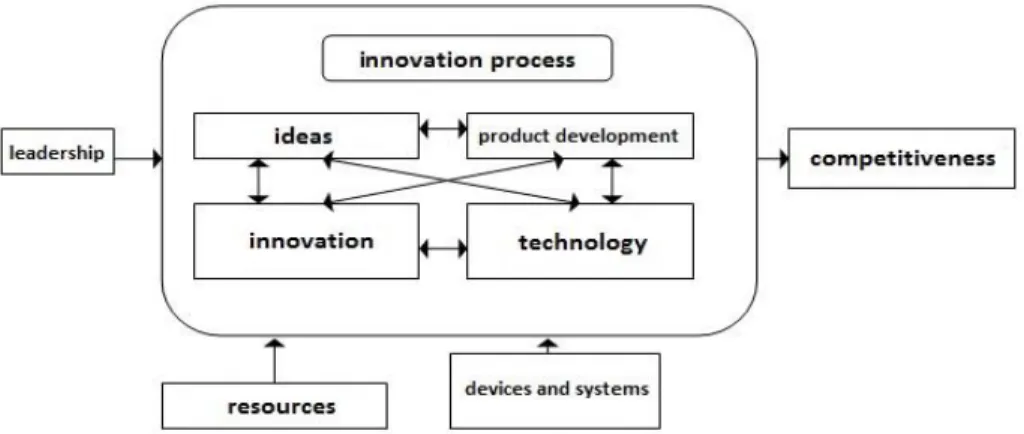
right and left brains. When it comes to successful innovations and discoveries the role of the unexpected is often argued. However Pasteur claims that ’in the field of observation, chance favors only the prepared mind’.Hungarian businesses inherited obsolete technology in every sector. Thus it is of high importance to give a good estimate of the current stage of our technological development, as well as our adaptation to new demands in the information society. According to studies based on corporate and national competitiveness, the employed technology and management play a key role in corporate efficiency. Porter [1990] claims that in order to preserve competitiveness innovation capacity is of high importance. Beside perfect quality and competitive prices early acquiring of the necessary knowledge for further technological or product development, earlier than other competitors, is important. New technology is one of the most important, if not the most important, source of competitiveness. Chiesa-Coughlan-Voss [1996] developed a comprehensive model to demonstrate the links between competitiveness and technical innovation processes (Figure 2). The model shows four core processes such as concept generation, product development, process innovation, and technology acquisition. Supporting these core processes are three enabling processes: the deployment of human and financial resources, the effective use of appropriate systems and tools, and senior management leadership and direction. The outcome from these core and enabling processes is performance in the marketplace.
Figure 2: Technological shift and corporate efficiency according to Chiesa-Coughlan-Voss
Nowadays technological innovation and technology management are strategic factors. Technology management is no longer a set of laboratory instruments and its management. Corporate R&D is responsible for the creation of new technology, information and solutions, as management is responsible for combining approaches to best enhance the acquisition, adaptation and maintenance of knowledge. The term of technology management is linked to technical innovations, and is to enhance corporate strategy. Technology management is a cross functional activity that uses technology to make the corporation successful and efficient [Pataki, 2005]. Cross functionality means that activities are beyond functional corporate boundaries. Technology management activities occur not only when it comes to innovation but strategy. Technology management linked to innovation is well-provided with a set of tools, such as technology scanning or road mapping that is essential for corporations that build on technological advancements. To another view, that takes macroeconomic factors of technology development and government preference into consideration. Technology management is an economic activity that focuses on technology development and distribution via corporate and governmental agencies [Inzelt, 1998].
Figure 3: Main field of implementation of technology management Source: Buzás, N: Innovációmenedzsment a gyakorlatban/own chart/
the governmental and non-profit sectors. To be able to meet human needs, the appropriate method and tools are essential. If any work is carried out, technology is employed – either recognizing i tor not. The role of technology and its relations to other corporate elements is illustrated in the figure of Leavitt [1964] and Vrakking [1993]. Technology is the core and vital element of corporate success. It is related to every other element, while having an effect on and effected by them, thus cannot be discussed separately.
Figure 4: Leavitt system model
Source: Buzás Norbert: Innovációmenedzsment a gyakorlatban/own chart/
Figure 5: Vrakking’s model on technology at corporate management Source: Buzás Norbert: Innovációmenedzsment a gyakorlatban/own chart/
Leavitt system model
[1964] Structu
re
Technolo gy
Purpose of analysis
My utmost objective is to prove that innovation processes are indeed principally generated by technological development. Permanency or continuity? It may result in a key issue for Hungarian enterprises as well, since without sufficient technological background Hungarian enterprises could not maintain their competitiveness either. How innovative are these firms? How much innovation awareness or search for innovation does incite innovation in enterprises? To what extent is innovative thinking represented by executives of enterprises? The results of the INNOTARS research program offer answers to these questions. Hungarian enterprises’ innovation activity is also mostly determined by technological development and spending on this ambit is also relevant. This observation is supported by the national research project which is purported to examine the factors affecting and accompanying innovation at Hungarian small and medium sized enterprises. During the research we collected data from the enterprises via questionnaire surveys and interviews. As technology is in constant change and one of the most significant challenges enterprises have to face is to operate in the constantly changing environment, thus, rapid technology sourcing may be the quickest response on the part of enterprises. Pursuant to the evolutionary or neo-Schumpeterian approach, capitalist economy constantly develops and selectively adapts new and better technologies; the enterprises, however, have distinct abilities to build or adapt new technologies and they further vary as to how they manage to profit from them [Nelson, 1991]. Grossman and Helpman [1991] considered directly technical evolution, knowledge accumulation and utilization as major underlying drivers of economic development. However, under Thirwall [2002] it is important to take a critical approach in respect of the new economic growth theories as they tend to neglect the importance of demand-side factors; it is however noteworthy that the issues of technical change and the flow of knowledge slowly become part of mainstream economics.
Figure 6: Impact of innovative thinking, creativity and search for innovation ***
and technological development on innovation processes of enterprises /own compilation/
Type of innovation Number of answers Proportion in percentage (814=100 %)
Product 158 19,41%
Technology 249 30,59%
Process 36 4,42%
Marketing 64 7,86%
Organization 83 10,20%
Other 54 6,63%
Schedule 1: Innovation types at the enterprises examined Source: INNOTARS research program1
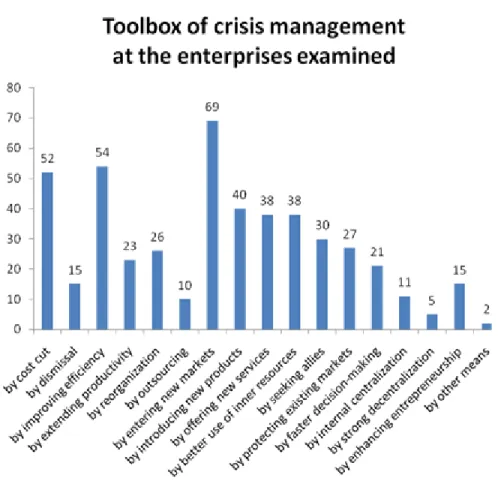
The results of Schedule 1 arise from the questionnaire survey of the research. In the questionnaire survey information was obtained from 814 enterprises throughout the whole country. It is to be noticed that at the majority of enterprises (249) technological innovation took place, which is followed by product innovation representing one fifth of the enterprises examined. Therefore, this dominant position of technological innovation cannot be questioned; nevertheless, it also logically raises the issue why it is the most determining innovation type with respect to enterprises. The explanation can be found in the interview survey of the research. In the research program 85 in-depth interviews were prepared with entrepreneurs. In these interviews we principally focused on understanding what the background of innovation processes is. One question related to the methodology of crisis management. It is noticeable from the survey that most enterprises tried to mitigate the impacts of the crisis by entering new markets. Moreover, the improvement of efficiency, cost cut, the introduction of new products and services also resulted in a decisive means of crisis management. However, all these may only be achieved by simultaneous technological development.
*** recognition of the importance of innovation by executives of companies, knowledge of the opportunities in innovation
1 Examination of the factors affecting and accompanying innovation in national small
Figure 7: Toolbox of crisis management at the enterprises examined Source: INNOTARS research program
Today In the future
quality 70 62
price 40 29
novelty 42 44
additional services 39 37
efficiency 46 44
cheapness 14 14
excellent process planning 37 32
Schedule 2: Key sources of competitiveness at the examined enterprises Source: INNOTARS research program2
Similar answers were by the enterprises in another section, where enterprises were asked which factors usually motivate/help technological innovation within an enterprise. Most frequent answers highlighted struggle to subsist, efficiency, quality and gaining competitive advantage as key factors. All these answers resemble the observations made above in the course of this analysis. A large number of the enterprises participating in the interview survey did not claim national or EU aids to finance innovation processes. Nevertheless, those who did, mostly claimed aids for building constructions, asset or machinery supply, other technological developments, trainings, development of the ISO system and job maintenance. The largest proportion is represented again by technological development. Technological development also ranked highest with respect to innovations not related to products and services. Information technology developments (e.g. new hardware and software supply) as well as other technological developments played an important role in such innovations. However, the management has to face certain problems arising upon the constant change. In addition to examining factors helping innovation, factors preventing innovation were also analyzed in the interview survey. In the vast majority of enterprises, risk aversion or fear of changes may prevent new innovation processes to be developed. The more changes an enterprise makes, the more resistance it may
2 Examination of the factors affecting and accompanying innovation in national small
probably face. Upon reviewing the results, the question can be answered whether it is rather permanency or continuity which enterprises need in their lives. Enterprises do not have an option in this respect. Continuity follows enterprises as far as they operate, since their economic environment is constantly changing, which is further enhanced by the accelerated technical technological development. However, permanency is necessary in ambits such as innovation, constant tracing of novelties or openness to novelties. Most enterprises cannot obviously create brand new technologies, thus, the majority may only take over or apply technological elements which are already available. Technological development may be regarded as continuity whilst adaptation to such development and constant innovation may result in as permanency in enterprises’ lives. Such enterprise development theories need to be applied which take into account both continuous operation (to improve short term efficiency) and non-continuous changes in order to provide better opportunities for long term improvement among changing circumstances. To achieve the first goal, the enterprise’s ongoing business activity is of importance, whilst innovation is highly topical when attaining the second objective. Simple and stable conditions, which allow specialization and facilitate planning, support short term efficiency. On the other hand, innovation requires and also leads to changes and wider scope of activities when inciting and forming new ideas. Flexibility and comprehensiveness are both required to establish favorable conditions also in the initial phase of the creative process, but also when discovering those new fields necessary to solve corporate problems. Efficiency and innovation are supplementary elements of the development of enterprises; however, solely one can prevail at a relevant moment. Permanency or continuity? Well, the one and only answer to this question is probably that both permanency and continuity are necessary for the successful operation of enterprises.
Bibliography
Borsi, B (2005) - Tudás, technológia és a magyar versenyképesség, PhD értekezés, Budapesti Műszaki- és Gazdaságtudományi Egyetem – Budapest
Buzás, N (2007) - Innovációmenedzsment a gyakorlatban, Akadémiai Kiadó, Budapest
Csath, M (2010) - Versenyképesség-menedzsment, Nemzeti Tankönyvkiadó, Budapest
Csath, M (2009) - A world in crisis? Does learning help to create future opportunities? – Development and Learning in Organizations: An international journal, Vol. 23. No. 6.
Dorogi, I, Rott, N (1985) - Az innovációs folyamat és irányítása, Műszaki Könyvkiadó, Budapest
Farkas, F (2004): Változásmenedzsment, KJK-Kerszöv Jogi és Üzleti Kiadó Kft., Budapest
Hirschmann, A (1958): The strategy of economic development. Yale University Press, New Haven, CT.
Kiss, J, Pandurics, A, Lapid, K (1997): Innováció és versenyképesség, Országos Műszaki Fejlesztési Bizottság, Budapest
Kiss, J (2004): A technológiai innováció szerepe a magyar vállalatok versenyképességében, Ph.D értekezés, Budapesti Corvinus Egyetem, Budapest
Landström, H (1998): Informal investors as enterpreneurs. Technovation 5
Nyström, H (1983): Kreativitás és innováció, Közgazdasági és Jogi Kiadó, Budapest
OECD (2004): Financing Innovative SME’s in a Global Economy. OECD, Paris
Perlaki, I (1981): Innováció és szervezés, Közgazdasági és Jogi Kiadó, Budapest
Porter, M, E (1990): The Competitive Advantage of Nations. The Free Press, New York
Szakály, D (2002): Innováció és technológiamenedzsment, Bíbor kiadó, Miskolc
Vágási, M, Piskóti, I, Buzás, N (2006): Innovációmarketing, Akadémiai Kiadó, Budapest
Varga, J (2010): Az innovációt befolyásoló és kísérő tényezők vizsgálata a hazai kis - és közepes vállalkozásokban, Az interjúk statisztikai értékelése, Budapest
Varga, J (2010): Kulcstényezők a versenyképesség növelésében: az innováció, konferencia kiadvány, Budapest