ORIGINAL RESEARCH ARTICLE
Challenges Related to the Structure of the Choice on Termination of
Pregnancy Services in Public Health Facilities in the Tshwane
District of Gauteng
DOI: 10.29063/ajrh2020/v24i1.11
Lillian Jabu Nkosi, Fhumulani Mavis Mulaudzi and Mmapheko Doriccah Peu
Department of Nursing Sciences, Faculty of Health Sciences, University of Pretoria
*For Correspondence: Email: [email protected]; Phone: (+27)72 603 1368
Abstract
In 1997 South Africa legalised termination of pregnancy services for all women living within the country. It is now more than a decade since Choice on Termination of Pregnancy (CTOP) services have been implemented however, the state of the infrastructure of CTOP services in public health facilities is a cause for concern. The assessment of the quality of CTOP services in public health facilities has been seriously neglected. The objectives of the study were to assess, determine and evaluate the challenges related to the quality of the infrastructure of CTOP services in public health facilities. A quantitative, non-experimental cross-sectional survey design was used. The population comprised of facility/quality managers, registered professional nurses and midwives. A universal sampling method was used.Data was collected from healthcare professionals who were involved in procuring CTOP services. The public health facilities were assessed in terms of space adequacy, provision of privacy, availability of ablution facilities, rest room as well as human and material resources using the Donabedian model. It was found that insufficient provision was made to the infrastructure of public health facilities to accommodate the high demand for CTOP services. Structural challenges remain a barrier in meeting the objectives of the CTOP services. There is evidence of significant differences between the facility/quality managers versus the professional nurses regarding their response to space provided for rendering CTOP services. The study recommends the revitalisation of the structure of CTOP services to improve the quality rendered. (Afr J Reprod Health 2020; 24[1]: 106-114).
Keywords: Challenges, structure, CTOP, public health facilities
Résumé
En 1997, l'Afrique du Sud a légalisé l'interruption des services de grossesse pour toutes les femmes qui habitent dans le pays. Cela fait maintenant plus d'une décennie que les services Les services du Choix à l'interruption de grossesse (CIG) ont été mis en œuvre, mais l'état de l'infrastructure des services du CIG dans les établissements de santé publics est préoccupant. L'évaluation de la qualité des services du CIG dans les formations sanitaires publiques a été sérieusement négligée. Les objectifs de l'étude étaient d'évaluer, de déterminer et d'évaluer les défis liés à la qualité de l'infrastructure des services du CIG dans les établissements de santé publics. Un plan d'enquête quantitatif et non expérimental a été utilisé. La population se composait de gestionnaires d'établissements / de qualité, d'infirmières professionnelles autorisées et de sages-femmes. Une méthode d'échantillonnage universelle a été utilisée. Les données ont été recueillies auprès de professionnels de la santé impliqués dans la fourniture de services du CIG. Les installations de santé publique ont été évaluées en termes d'adéquation de l'espace, de protection de la vie privée, de disponibilité des installations d'ablution, des toilettes et des ressources humaines et matérielles à l'aide du modèle donabédien. Il a été constaté que l'infrastructure insuffisante des établissements de santé publique n'était pas suffisamment adaptée pour répondre à la forte demande de services du CIG. Les défis structurels restent un obstacle à la réalisation des objectifs des services du CIG. Il existe des preuves de différences significatives entre les gestionnaires de l'établissement / la qualité et les infirmières professionnelles en ce qui concerne leur réponse à l'espace fourni pour la prestation des services du CIG. L'étude recommande la revitalisation de la structure des services du CIG pour améliorer la qualité rendue. (Afr J Reprod Health 2020; 24[1]: 106-114).
Introduction
In 1997 all women and girls (12 years and older) in South Africa were given the power of choice when their human rights to privacy and bodily autonomy was honoured by the promulgation of the Choice on the Termination of Pregnancy (CTOP) Act, 1996 (Act No. 92 of 1996) which legally allowed them to choose to terminate a pregnancy up to 12 weeks of gestation. With the promulgation of this Act, South Africa was viewed as one of the most progressive countries with respect to the protection of women and girls‘ human and reproductive rights. Although this Act as well as the amending Act, the Choice on Termination of Pregnancy Amendment Act, 2008 (Act No. 1 of 2008), remain a contentious issue among South African citizens. The Acts demonstrate South Africa‘s commitment to prioritise female independence and reproductive rights to reach Goal 5 of the Sustainable Development Goals (SDGs) to achieve gender equality and empower all women and girls by 2030. In our SDG Indicator Baseline Report 2017, we unequivocally state we will be steadfast in our vision to eradicate gender inequality and empower all women in South Africa1. We will take hands with the two hallmarks of female empowerment ‒ the Convention on the Elimination of All Forms of Discrimination Against Women (CEDAW) and the Beijing Platform for Action ‒ and together with the International Conferences on Population Development (ICPDs) we will take decisive steps to break the chains that bind all women to women to a societal attitude that objectifies them and thus short-sightedly nullifies their very humanness. Although an amending Act, the Choice on Termination of Pregnancy Amendment Act, 2008 (Act No. 1 of 2008) came into force on 18 February 2008, the ground-breaking CTOP Act of 1996 is viewed as the genesis of the promise made by the democratic government under the leadership of President Nelson Mandela that it was imperative for laws to start responding to the needs of the majority and protect the most vulnerable. Women and girls are among those who need their human rights respected, protected, and promoted. For the first time in the country‘s history women‘s health, and their reproductive
health, became an important issue on governmental, societal and community levels2.
When the CTOP Act of 1996 was implemented in 1997, several public health facilities were designated where safe, and legal CTOP services are provided, problems were almost immediately encountered with the resources and assistance in the facilities because they were not prepared to accommodate the influx of clients. The existing structure was very inadequate with no space to accommodate the new service and privacy was a problem as was proper equipment2-3. Despite the dilemma, the mandate was implemented due to the urgency to save women and girls‘ lives. The new CTOP Act, 2008 made substitutions to the CTOP Act of 1996 to maximise access to the provision of a safe and legal termination of pregnancy4. The environment has to be female-friendly, hygienic, and accessible. Registered nurses as well as registered midwives (who have additional training) are allowed to perform abortions up to the 12th week of pregnancy and facilities with a 24-hour maternity service do not need an MEC‘s approval to perform abortions in the first 12 weeks5 (Republic of South Africa, 2008) However, various serious shortcomings in health facilities where CTOP is procured have been carried over from the 1997 implementation of the first 1996 CTOP Act that still remain prevalent and unaddressed.
achieve MDG5 as well as to comply with the CTOP Amendment Act, 2008 some public health facilities, divided existing wards to create a little privacy in the space where CTOP services can be accommodated. Others incorporated the CTOP services into their family planning units9.
The objective of the study was to assess the quality of the current state of the structure in the designated public health facilities where CTOP is provided by using the Donabedian model of quality care. The Donabedian model uses three concepts to assess quality in healthcare facilities, namely structure, processes, and outcomes3. The structure refers to the environment in which healthcare is provided and includes human resources. The environment denotes the facility buildings and equipment for providing care while human resources are concerned with staffing ratios10. In this paper, the Donabedian model of quality care focused only on the structure of the public hospital areas where CTOP service is provided.
All enterprises or services depend on the availability of a basic infrastructure to become successful11. The state of the infrastructure influences how willing women are to access reproductive health and CTOP services as well as how they perceive the quality of care received. It is natural for women who receive a CTOP to wish for privacy and confidentiality because it does affect them emotionally. Privacy is a human right that must be afforded to all women in CTOP units12.
Lack of provision of privacy for CTOP clients due to inadequate space in the structure denies them the opportunity to freely discuss their reproductive needs with healthcare professionals13. The infrastructural challenges experienced in CTOP units interfere with history taking, assessment, and examination of CTOP clients. The poor state of the CTOP structure undermines women‘s rights to privacy14
. Inadequate space for CTOP services in public health facilities is also cited by Frederico, Michielsen, Arnaldo and Decat15 as a major deterring factor influencing abortion decision-making processes among women.
In addition to space, proper ventilation is important if health risks to staff and clients are to
be avoided as it can expose them to airborne diseases16. Further, a rest room is required for CTOP patients after the termination of pregnancy procedure, as they require observation and monitoring of their vital signs before being discharged13. However, clients are discharged prematurely due to the lack of rest room facilities. Rest room facilities are vital in a CTOP structure because it makes allowance for clients to be counselled about contraception methods to prevent future unwanted pregnancies. It is also clear that there are inadequate ablution facilities in CTOP clinics. The issue of ablution facilities emerges strongly since it is a requirement in any infrastructure17. However, it was not in the items asked in the current questionnaire. Inaccessibility of ablution facilities undermines the dignity of women. Crous, Haarhoff and Buckley18 state an ablution facility is a basic need. They further warn the lack of such facilities has significant negative effects on public health. The World Health Organization19 recommends for ablution facilities to be incorporated within the CTOP structure. The availability of appropriate equipment in CTOP units is crucial for improving the quality of termination of pregnancy services. A lack of equipment such as sonar machines to make a timely diagnosis for a client to have a CTOP (within the first 12 weeks of pregnancy) compromises quality care. The purpose of this article is to assess the challenges related to the structure of the choice on termination of pregnancy services in public health facilities in the Tshwane district of Gauteng province11.
Methods
health, education, business and government20. The survey was cross-sectional with data collected at one point in time21. Eight public health facilities in the district rendering choice CTOP services served as the study settings. These settings (community health centres and public hospitals) were purposively selected since they are designated to provide CTOP services. The CTOP health facilities are managed and run by professional nurses and midwives all registered with the South African Nursing Council (SANC). Twenty-nine respondents comprising 16 professional nurses, 8 health facility managers and 5 quality managers were recruited via a universal sampling method. The number of staff allocated to the CTOP units determined the small sample size (29).
The method used for data collection was a self-administered questionnaire containing open- and closed-ended questions relating to the quality of the CTOP structure in the public health facilities. Data to determine the suitability of the buildings to meet the required standard for the provision of these services was obtained. A pilot study verified the questionnaire would render relevant data and needed no changes or adjustments.
To be eligible for participation, the study required individuals to be working in public health facilities designated to provide CTOP services. All respondents met this requirement. The researcher personally handed the paper questionnaires to the respondents in the public health facilities from April 2015 to June 2015. The individuals were informed in writing of the purpose and scope of the study to allow them to make an informed decision to voluntarily participate or decline participation by not returning the questionnaire. Anonymity and confidentiality were guaranteed in that no names were requested on the questionnaire thus no completed questionnaire could be linked to any individual.
The questionnaire included items relating to the respondents‘ demographic data, the area where the CTOP unit was located, the space size, air conditioning, and ventilation. Further items included were privacy, the availability of rest rooms, and the availability of CTOP-specific equipment. The respondents were given two weeks to complete and return their questionnaires. The
researcher personally collected the completed questionnaires from the public health facilities after two weeks. Approval to conduct the study was obtained from all eight public health facilities. The data was captured on Excel spread sheet and analysed with the help of a statistician using the STATA software version 14. The results are presented as summarised statistics. Comparisons were undertaken using an independent t-test for comparing proportions to achieve the results. The results are presented in tables and percentages.
Results
Data analysis
Demographics
Age
The study sample consisted of 29 respondents comprising facility and quality managers, professional nurses, and midwives procuring CTOP services in public health facilities. Table 1 shows the demographic data age distribution of respondents ranging between 31 to 40 years (15%) and 51 years and above (85%). Most respondents (85.6%) held management positions. Female
respondents represented 85% and 15%
respondents were male. Ninety-two percent of the respondents in management were married and 7.7% were single.
Rendering CTOP services
The majority (85%) rendering CTOP services were 51 years and above. Fifteen per cent were between 31 and 40 years. All (100%) who rendered the CTOP services were female. Single respondents represented 43.8% and 37.5% were married. Respondents who had a live-in partner represented 12.5% and 6.3% were widows as indicated in Table 1.
Years of experience
It was indicated by 53.9% they had 10 years or
Table 1: Respondents‘ demographic data
Age in Years Scores (%)
Managers Professionals Probability 31 – 40
years
15.0 15.0 1.0
51 years and above
85.0 85.0 1.0
Gender
Male 15.4 0.0 0.07
Female 85.6 100 0.12
Marital Status
Single 7.7 43.8 0.07
Married 92.3 37.5 0.10 Live-in
Partner
0.0 12.5 0.30
Widow 0.0 6.3 0.47
Years of Experience
0 – 5 years 15.4 18.8 0.84 6 – 10 years 30.8 31.3 0.98 10 years and
above
53.9 50.0 0.85
management indicating they had less than five years‘ experience in the unit. Respondents who had 10 years or more experience in the field represented 50% followed by 31.3% with between 6 to 10 years‘ experience.
Respondents who had less than five years‘ experience of rendering CTOP services made up 18.8%. Forty-three per cent (43.8%) were single; 37.5% were married and 12.5% had a live-in partner. Only 6.3% of the respondents were widows.
From the results, we can deduce that both public health facilities and the CTOP services were managed by mature, skilled and experienced staff.
Responses to questionnaire
Structure
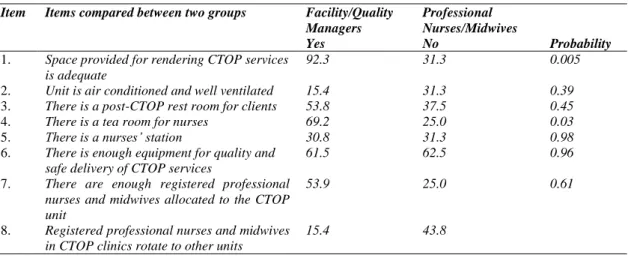
The results in Table 2 reflect responses to the question on the structure of CTOP services. The responses from management (facility/quality managers) are equal – 50% from management (facility/quality managers) indicate the structure does allow for the delivery of quality and safe CTOP services and 50% of the nurses (professional nurses/midwives) feel it does not allow for it. Of the nurses, 68.5% indicate the space provided for rendering CTOP services is
inadequate with 31.3% responding there is enough space.
Ventilation
A high 84.6% of managers responded the CTOP unit is not well-ventilated leaving 15% respondents from management feeling ventilation is not a problem. According to 68.5% of the nurses, the CTOP units are not well ventilated and neither does it have air conditioning. Only 31.3% nurses indicated neither the ventilation nor the air conditioning is a problem.
Rest rooms for clients
As regards the availability of rest rooms for clients, 53.8% managers signified rest rooms for clients are available whereas 46.2% indicated there are no rest rooms for clients. According to 62.5% of the nurses no post-CTOP rest room for clients are available but 37.5% showed such rest rooms are available.
Tea room for staff
The responses from the managers show 69.2% confirmed there is a tea room for nurses while 30.8% indicated there is not. By far the majority of nurses (75%) signified there is no tea room available for them, which left 25% indicating there is a tearoom for them.
Nurses’ station
According to 69.2% of the managers no nurses‘ station is in the unit which left 30.8% indicating there is one as shown in Table 2. Of the nurses 68.8% responded there is no nurses‘ station in the unit with 31.3 % pointing out there is a nurses‘ station.
Ablution facilities
The issue of ablution facilities emerged strongly as both groups indicated the negative impact a lack of ablution facilities has on the quality and safe provision of CTOP services. Ablution facilities
Table 2: Comparison of positive responses between facility/quality managers and professional nurses
Item Items compared between two groups Facility/Quality Managers
Professional Nurses/Midwives
Yes No Probability
1. Space provided for rendering CTOP services is adequate
92.3 31.3 0.005
2. Unit is air conditioned and well ventilated 15.4 31.3 0.39 3. There is a post-CTOP rest room for clients 53.8 37.5 0.45 4. There is a tea room for nurses 69.2 25.0 0.03 5. There is a nurses’ station 30.8 31.3 0.98 6. There is enough equipment for quality and
safe delivery of CTOP services
61.5 62.5 0.96
7. There are enough registered professional nurses and midwives allocated to the CTOP unit
53.9 25.0 0.61
8. Registered professional nurses and midwives in CTOP clinics rotate to other units
15.4 43.8
structural challenge compromising the quality of care for women and girls who make use of the CTOP services. Of the managers 21.6%, felt this structural area needed to be improved and 28.2% of the nurses indicated a dire need for ablution facilities in CTOP units and clinics.
Equipment
Very similar responses regarding the available equipment were found among the managers and the nurses. From the managers‘ side 61.5% and from the side of the nurses 62.5% indicated there is enough equipment to provide quality and safe CTOP services. This left 38.5% of the managers and 37.5% of the nurses responding that the equipment is insufficient.
Enough staffing
According to the managers, 53.9% thought enough professional nurses and midwives were allocated to the CTOP unit whereas 46.2% indicated the staff allocation in the CTOP unit is not enough. A high 75% of the nurses felt the CTOP unit is understaffed with only 25% responding they believed there are enough professional nurses and midwives allocated to the CTOP unit.
CTOP staff rotates to other units
To this statement, 15.4% managers indicated CTOP staff does rotate to other units and 84.6% responded they did not rotate. According to 43.8%
of the nurses, rotation to other units does occur while 56.3% nurses indicated they do not rotate. Staffing challenges are experienced in public health facilities and nurse managers apply strategies to ensure shift coverage and continuous patient care by allowing rotation of staff among units.
Discussion
A good proportion of respondents in this study acknowledged the challenges that exist in CTOP clinics and support the proposal to renovate the CTOP structure to meet the needs of both women and healthcare professionals. The study highlighted key infrastructural challenges in CTOP services in public health facilities that have existed since the implementation of the CTOP programme. The situation is worsened by the fact that the CTOP structure in public health facilities has not been assessed due to the urgency at which implementation of CTOP services took place. The results are presented under the following sections: demographic data, structure, ventilation, rest rooms, tea room, nurses‘ station, equipment and staffing. The perceptions of the groups differ clearly with respect to items 1, 3, 4, and 7 shown in Table 2.
Demographic data
knowledge, and experience in their area of responsibility. However, there are no potential young healthcare professionals allocated in management positions for development purposes. Management need to create opportunities to attract young healthcare individuals for succession planning. Young potential individuals need to be enrolled in leadership programmes for development purposes22. In addition, 85% in management were females with only 15% male. Gender equality has become a reality as the number of women occupying management positions in government public health facilities increases23.
Age and gender
Most of the professional nurses and midwives were 51 years and above with 15% respondents between 31 and 40. This indicates that CTOP staff is heading towards retirement age24 which will have a negative impact on the quality of CTOP service rendered when they exit. The allocation of staff in CTOP units should mix the old and young nurses to impart skill and knowledge before they retire. The young registered professional nurses and midwives should be allocated to work in CTOP units and engage with clients to encourage them to use contraceptives and prevent unwanted pregnancies25. All the respondents (100%) in the CTOP units were female. Nursing is by tradition a female-dominated profession; however, it is a concern that there are no male nurses allocated in the CTOP units26. Males are partners in pregnancy processes and should be involved in termination of pregnancy to realize they must help to reduce unwanted pregnancies. Linda, Klopper and Phetlhu27 found in a higher education institution in the Western Cape female patients could feel harassed if a male nurse attended to them. This prompts one to rethink about allocating male professional nurses to assist in rendering CTOP services.
Marital status and years of experience
Ninety-two per cent of the managers were married. Marital status indicates emotional stability, an element that is required for one in a management position. Among the professional nurses and
midwives providing CTOP services, only 37.5% were married. According to the results, 53.9% managers and 50% professional nurses and midwives indicated they had been working for 10 years or longer in their area of responsibility. Years of experience are linked to skill and knowledge. This category of human resources gives the highest standard of care to clients because of their experience. Roussanov and Savor28 state married managers should exhibit conservative decision-making qualities.
Findings from responses observed on the
structure
Most of the managers indicated the space allocated for CTOP services is adequate. The managers‘ responses are ignorant; in fact, it exposes how little managers know about the facilities they manage. The results from the registered professional nurses and midwives, who work hands-on with the clients, reflect the true status of the CTOP unit and the challenges that are experienced. The space allocated for CTOP services is very inadequate and compromises clients‘ privacy29
The unit should be well equipped to improve the standard of care rendered. The results of management are deceiving about staffing in CTOP units because they fail to identify the shortage of staff versus the workload32. The staffing in the CTOP unit needs to be reviewed urgently to improve the quality of the CTOP services. Improved staffing will satisfy clients and improve the working conditions of staff allocated to the unit. Monthly reports and statistics from the CTOP unit should be analysed and used to motivate for staff increases33 (WHO 2016:7).
Conclusion
The assessment of the quality of the structure of CTOP services in public health facilities highlighted serious challenges affecting negatively on the quality of the CTOP services rendered. The findings emphasise that the current state of the CTOP services has a negative impact on both women and healthcare professionals‘ commitment to render CTOP services. The matter should be presented to the provincial government in a bid to secure a budget towards improving the structure of CTOP services in public health facilities
.
Conflict of Interest
The authors declare that they have no conflict of interest which may have inappropriately influenced them in writing this paper.
Acknowledgement
The authors thank the public health facilities in Tshwane district for permitting the study to be conducted, its Management and the healthcare professionals who participated in the study. UNEDSA Bursary is appreciated for financial support.
Contributions of Authors
Professor FM Mulaudzi, the promoter for diligent guidance and mentoring during the study. Professor MD Peu for co-promoting the study with valuable contributions towards the successful completion. Dr SS Olorunju for analysing data to give meaning to the study.
References
1. Statistics South Africa. Sustainable Development Goals: Baseline Report 2017. Pretoria, South Africa: Statistics South Africa. p. 86. ISBN: 978-0-621-45888-6
2. Gmeiner AC, van Wyk S, Poggenpoel M and Myburgh CPH. Support for nurses directly involved with women who choose to terminate a pregnancy. Curationis 2000(March):70-1.
3. Donabedian A. An introduction to quality assurance in health care. New York: Oxford University Press; 2003. pp. 46-53.
4. Turner KL, Pearson E, George A and Anderson KL. Values clarification workshop to improve abortion knowledge, attitude and intentions: a pre-post assessment in 12 countries. Reproductive Health 2018; 15:2. http://doi.org/10.1 186/s12978-018-0 48186/s12978-018-0 186/s12978-018-0/
5. Republic of South Africa. South African Council Nursing Act No. 33 of 2005. Pretoria, South Africa: Government Printer.
6. Lebese MV. A phenomenological study of the
experiences of nurses directly involved with termination of pregnancies in the Limpopo province [Dissertation]. University of South Africa, Pretoria, South Africa, 2009. 115 pp.
7. Mhlanga RE. Abortion: developments and impact in South Africa. Br Med Bull 2003; 67:115-26. 8. Adindu A. Assessing and assuring quality of health care
in Africa. African Journal of Medical Sciences 2010; 3(1):31-6. ISSN 2141-0151.
9. UNDP/UNFPA/WHO/World Bank. Special programme of research, development and research training in human reproduction. World Health Organization 1999. Geneva, Switzerland.
10. Kajonius PJ and Kazemi A. Structure and process quality as predictors of satisfaction with elderly care. Health and Social Care in the Community 2016;24(6) http://dx.doi.org/699-70710.1111/hsc.12230
11. Manyisa ZM and van Aswegen EJ. Factors affecting working conditions in public hospitals: a literature review. International Journal of Africa Nursing Science 2017; 6:28-38.
12. World Health Organization. Sexual health, human rights and the law. World Health Organization 2015. Geneva, Switzerland.
13. Nguyên MH, Gammeltoft T and Rasch V. Situation analysis of quality of abortion care in the main maternity hospital in Ha ˛i Phòng Viet Nam. Reproductive Health Matters 2007:176.
14. Pickles C. Lived experiences of the choice on termination of pregnancy Act 92 of 1996: bridging the gap for women in need South Africa. African Journal of Human Resources 2013:518.
Journal of Environmental Research and Public Health 2018 https://doi:org/10.3390/ijerph15020329 16. World Health Organization. Natural ventilation for
infection control in health-care settings. World Health Organization 2009. Geneva, Switzerland. 17. Reeves LM, Priest, PS and Poore MR. School toilets:
facilitating hand hygiene? A review of primary school hygiene in a developed country. Journal of Public Health 2012 34(4):483-88. http://dx.doi.org/10.1093/pubmed/fds028
18. Crous P, Haarhoff J and Buckley CA. Water demand characteristics of shared water and sanitation facilities: experiences from community ablution blocks in eThekwini Municipality, South Africa. Water SA 2013; 39(3):361.
19. World Health Organization. Essential environmental health standard in health care. World Health Organization 2008. Geneva, Switzerland. p.32. 20. Fink A. How to ask survey questions.2nd ed. United
Kingdom: Sage Publications; 2003:1-2.
21. Creswell JW. Research design: qualitative, quantitative, and mixed methods approaches. 3rd ed. USA: Sage Publications; 2009:146.
22. Farthing K. Succession planning: the right people in the right positions at the right time. Am J Hosp Pharm 2013(March);48(3):175-6.
https://doi:org/10.1310/hpj4803-175
23. Czabanowska K, Domagala A, Kalaitzi S, Krogulec A, Burazeri G and Babich S. Exploring the added value of women health care managers in Poland. Mater Sociomed 2017(Dec); 29(4):280-5. https://doi:org/10.5455/msm.2017.29.280-285 24. Phillips T, Evans JL, Tooley S and Shirey MR. Nurse
manager succession planning: a cost-benefit analysis. Journal of Nursing Management 2017; http://doi.org/10.1111/jonm.12512
25. Tamang A, Shah IH, Shrestha P, Warriner IK, Wang D, Thapa K, My Huong NT and Meirik O. Comparative satisfaction of receiving medical abortion services from nurses and auxiliary nurse-midwives or doctors in Nepal: results of a randomized trial. Reproductive Health 2017; 14:7. http://doi.org/10.1186/s12978-0438-7
26. Zamanzadeh V, Valizadeh L, Negarandeh R, Monadi M and Azadi A. Influencing men entering the nursing profession and understanding the challenges faced by them: Iranian and developed countries‘ perspectives. Nurse Midwifery Studies 2013 (Dec); 2(4):49-56.
27. Linda NS, Klopper HC and Phetlhu DR. Student‘s voice on spiritual care at a Higher Education institution in the Western Cape. Curationis 2015; 38(2). Art.
#1520. p.9.
http://dx.doi.org/10.4102/curationis.v38i2.1520 28. Roussanov N and Savor P. Marriage and managers
attitude to risk Management (December 14, 2013). AFA 2013 San Diego Meetings Paper. Available at SSRN: https://ssrn.com/abstract=178381 or http://dx.doi.org/.10.2139/ssrn.178381
29. Hodes R. The culture of illegal abortion in South Africa. Journal of Southern African Studies 2016; 42(1):79-93.
http://dx.doi.org/10.1080/03057070.2016.1133086 30. Clyde J, Bain J, Castagnaro K, Rueda M, Tatum C and Watson K. Evolving capacity and decision-making in practice: adolescents‘ access to legal abortion services in Mexico City. Reproductive Health Matters 2013; 21(41):167-75.
31. Beggs CB, Kerr KG, Noakes C, Hathway, EA and Sleigh A. The ventilation of multiple-bed hospital wards: review and analysis. American Journal of Infection Control 2008; 36(3):250-9.
32. Röhrs S. The influence of norms and values on the provision of termination of pregnancy services in South Africa. International Journal of Africa Nursing Science 2017; 6:39-44.