TECHNICAL UNIVERSITY OF CLUJ-NAPOCA
ACTA TECHNICA NAPOCENSIS
Series: Applied Mathematics, Mechanics, and EngineeringVol. 62, Issue II, June, 2019
THE ZENER RHEOLOGICAL VISCOELASTIC MODELLING
OF THE DYNAMIC COMPACTION OF THE ECOLOGICALLY
STABILIZED SOILS
Cornelia-Florentina DOBRESCU
Abstract: This paper treats the concept of Zener linear viscoelastic modulus applied in the vibration compaction process of the soils stabilized with ecological liquid substances brought into atomization state at significant pressures and flows. In this case, by treating soils with ecological stabilizers in the process of milling, mixing and making the road layers, a suitable mixture is obtained for road layers with superior performance to the natural soil. The dynamic compaction effect with vibrating roller cylinders is determined by the stiffness of the land and the structural damping influenced dynamically by the excitation frequency and by the parametric inertial values in static mode. Thus, taking into account experimental results obtained in the laboratory and "in situ", this research highlights the behavior of soil stabilized according to the Zener model. Thus, the parametric values of the model as well as their variation are determined according to the excitation angular frequency are determined for several experimental cases obtained in the testing area. Keywords: Zener rheological viscoelastic modelling; dynamic compaction; stabilized soils
1. INTRODUCTION
It is presented the concept of the Hooke-Maxwell composite model subjected to the external action of a harmonic force so that based on the dynamic analysis of the response, the physical measures for dynamic stiffness and for the damping of the structural system of the stabilized soil may be determined [1]-[3],[6].
In this context, it is tackled first of all, the dynamic action given by any force F(t) with impulsive features and then by a harmonic force F0 sin ω t.
The second case is the basic analysis that faithfully shapes the interaction of the vibratory roller-stabilized soil.
Finally, there emerge and are presented the analytical relations for stiffness and the structural damping of the soil layer stabilized and compacted soil layer with harmonic forces applied in technological regime.
2. ANALYSIS OF BEHAVIOR IN THE DYNAMIC MODEL
2.1. External impulsive dynamic action
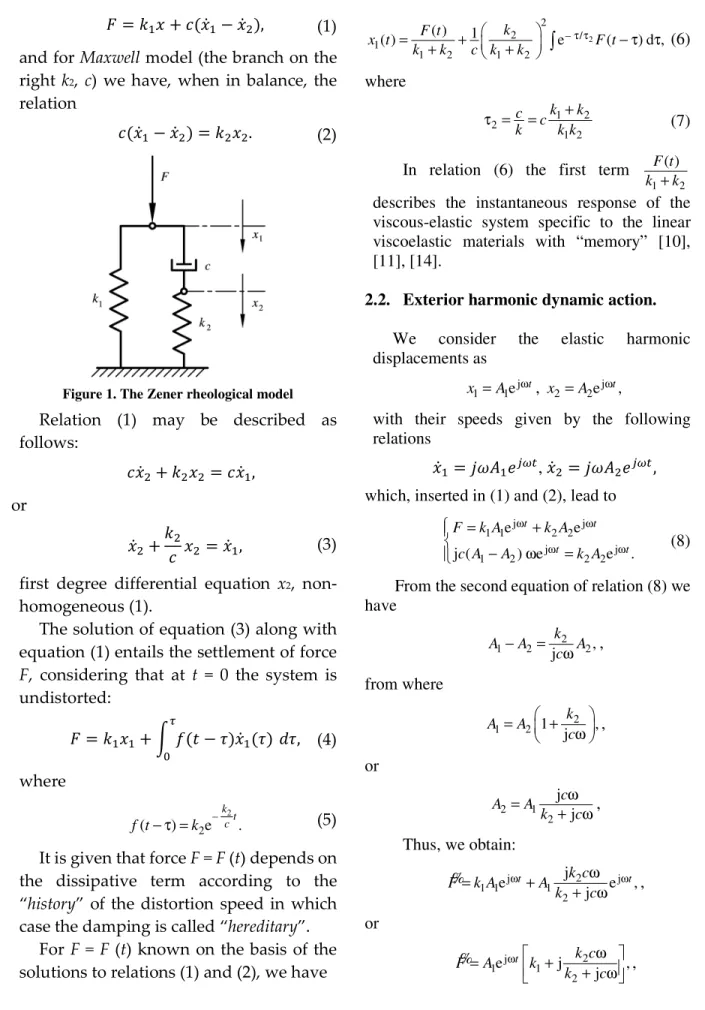
Consider the Zener model in Figure 1 with the elastic characteristics k1, k2 and the viscous characteristic c with mixed bonds so that the Hooke and the Maxwell branches may assure the parallel connection of the entire linear-viscoelastic model [4],[5],[7].
For the external force F(t) applied over a time ∆τ, any instantaneous displacement is obtained where the effect of the "memory" of the "hereditary" material is significantly highlighted [8],[9].
In this case we take into account that the hereditary model consists of the simple Hooke model with elastic constant k1 and the rheological model of the "standard linear deformable solid".
Exterior force F is balanced in any
moment by forces k1x and ( − ), that
= + ( − ), (1)
and for Maxwell model (the branch on the
right k2, c) we have, when in balance, the
relation
( − ) = . (2)
Figure 1. The Zener rheological model
Relation (1) may be described as follows:
+ = ,
or
+ = , (3)
first degree differential equation x2,
non-homogeneous (1).
The solution of equation (3) along with equation (1) entails the settlement of force
F, considering that at t = 0 the system is undistorted:
= + ( − ) ( ) , (4)
where
2 – 2
( ) e .
k t c
f t− τ =k (5)
It is given that force F = F (t) depends on the dissipative term according to the “history” of the distortion speed in which case the damping is called “hereditary”.
For F = F (t) known on the basis of the solutions to relations (1) and (2), we have
2 2
2 – /
1
1 2 1 2
( ) 1
( ) F t k e ( ) d ,
x t F t
k k c k k τ τ
= + + + − τ τ
(6)where
1 2 2
1 2
k k c c
k k k
+
τ = = (7)
In relation (6) the first term
1 2 ( )
F t k +k
describes the instantaneous response of the viscous-elastic system specific to the linear viscoelastic materials with “memory” [10], [11], [14].
2.2. Exterior harmonic dynamic action.
We consider the elastic harmonic displacements as
j 1 1e t
x =A ω , j 2 2e t,
x =A ω
with their speeds given by the following relations
= , = ,
which, inserted in (1) and (2), lead to
j j
1 1 2 2
j j
1 2 2 2
e e
j ( ) e e .
t t
t t
F k A k A
c A A k A
ω ω
ω ω
= +
− ω =
(8)
From the second equation of relation (8) we have
2 1 2 j 2,
k
A A A
c − = ω ,
from where
2 1 2 1 j ,
k
A A
c
= + ω
,
or
2 1 2
j j
c
A A
k c
ω = + ω,
Thus, we obtain:
2
j j
1 1 1
2 j
e e ,
j
t k c t
F k A A
k c
ω ω ω
= + + ω
% ,
or
2 j
1 1
2
e j ,
j
t k c
F A k
k c
ω ω
= + + ω
and, in the end, we have
2 2 2 2
1 2 1 2 2
j
1 2 2 2 2 2
2 2
( )
e t k k k k c j k c
F A
k c k c
ω + + ω ω
= +
+ ω + ω
% (9)
Relation (9) may also be written as
j
1 1
e t ( ) ( ),
F%= ω A K%ω =x K%ω , (10)
where: ( )K%ω is the complex stiffness coefficient or the complex stiffness of the entire hereditary linear viscoelastic system; x1 =A1ejωt– instantaneous harmonic displacement of the application point of force F F t% % = ( ).
Thus, the complex stiffness of (9) may be set as
1 2
( ) ( ) j ( ),
K%ω =K ω + K ω , (11)
where
2 2 2
1 2 1 2
1 2 2
2
( )
( ) k k k k c
K
k c
+ + ω
ω =
+ ω , (12)
is the stiffness coefficient which expresses the predominantly elastic behaviour of the system, and
2 2
2 2 2
2 k c K k c ω =
+ ω , (13)
is the energy internal loss coefficient (dissipation).
Relation (11) may be written as
[
]
1
( ) ( ) 1 j ( ) ,
K%ω =K ω + ∆ ω , (14)
where 2
1 ( ) ( ) ( ) K K ω
∆ ω = ω is the energy loss
(dissipation) internal factor (angle).
Thus, in the end, the analytical expression is obtained as
2
2 2
2 2 2
1 1 2 1 2
( ) ( )
( ) ( )
K k c
K k k k k c
ω ω
∆ ω = ω =
+ + ω
,
(15)
Taking into account relation (15) we have
2 2 2 2
2 2
2 2 2 2 2 2
2 1 2 1 2
( )
( )
ck k c
k c k k k k c
ω + ω
∆ ω = ⋅
+ ω + + ω
,
or
2 2 2 2 2
1 2 1 ( ) ( ) ck K k c ω
∆ ω = ⋅ ω
+ ω ,
Knowing that the internal loss angle for the
viscous-elastic system is
δ = ωc/k, we can similarly write the expression as 1 ( ) , ( ) C Kω
∆ ω = ω , (16)
where C is the viscous damping coefficient equivalent with Voigt-Kelvin system dependent on angular frequency ω. Thus, we have
2 2 2 2 2 2 ( ) sistem
k
C C C c
k c
= = ω =
+ ω , (17)
• The graphical representation of the stiffness coefficient K1(ω) of the hereditary
model according to the excitatory angular frequency ω is achieved taking into account the expressions of the first K1′ ω( ) and second
1( ),
K′′ ω derivates as well as the values of ω it is annulled for.
Thus, we have the following significant functions:
2 2 2
1 2 2 2 1 2 1 2
2 1
( ) ( ) ;
K k k k k c
k c
ω = + ω + + ω , (18)
2
1 2 2
1 2 2 2 2 1 2 2 1 2
2
d 2
( ) ( ) ;
d ( )
K c
K k k k k k
k c
ω
′ ω = ω = + −
+ ω (19)
2 3 2 2 2
2
2
1 2 2 2 2
1 2 2 2 2 4 2
2
2 ( )
d
( ) 3 .
d ( )
c k k c
K
K k c
k c
+ ω
′′ ω = = − ω
ω + ω , (20)
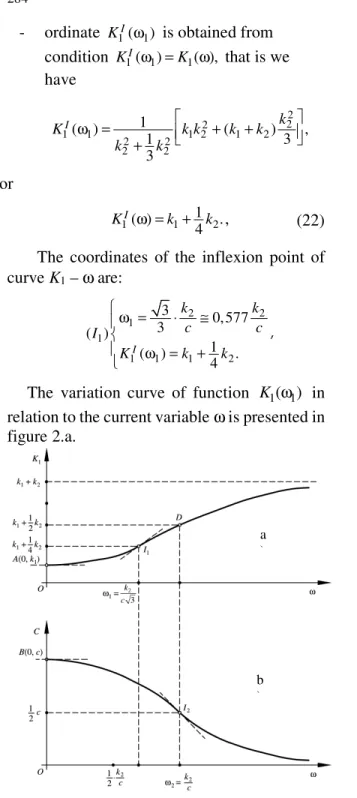
From condition ω ≡0 it emerges K1(0) =k1, which defines the coordinates of point A (0, k1) on figure 2, a. For ω→∞, when
1 1 2
lim K ( ) k k ,
ω→ ∞ ω = + curve K1 – ω
asymptotically tends to the horizontal right
1( ) 1 2
K ω = +k k =const.
The point of inflexion of curve K1 – ω noted with I1
(
ω1,K1I)
has the coordinates ω1 and respectively K1I =K1(ω1). Thus:- condition K1′′ ω =( ) 0 leads to solution
2 2 1 3 1 ; 3 3 k k c c
- ordinate K1I(ω1) is obtained from condition K1I(ω =1) K1( ),ω that is we have
2 2 2
1 1 1 2 1 2
2 2
2 2
1
( ) ( ) ,
1 3
3
I k
K k k k k
k k
ω = + +
+
or
1I( ) 1 14 2.
K ω = +k k , (22)
The coordinates of the inflexion point of curve K1 – ω are:
2 2
1 1
1 1 1 2
3 0, 577
3 ( )
1
( ) .
4 I
k k
c c
I
K k k
ω = ⋅ ≅
ω = +
,
The variation curve of function K1(ω1) in relation to the current variable ω is presented in figure 2.a.
Figure 2. Variation curves of K1 and C in relation
with angular frequency ω
a) Variation of K1(ω); b) Variation of C(ω)
•• Graphical representation of the dissipation coefficient (damping) of the hereditary system, equivalent with the Voigt-Kelvin dissipation mechanism may be achieved in relation to the variation of the excitatory angular frequencyω as follows:
- Function C = C (ω) is
2 2 2 2 2 2
( ) k ,
C c
k c
ω =
+ ω , (23)
which tends to zero for ω→∞ and has value c for ω ≡0, that is point B has coordinates (0, c).
- Function ( ) d d
C C′ ω =
ω is
2 3
2 2 2 2 2 2
d
( ) 2 0,
d ( )
C
C k c
k c
ω
′ ω = ω= − <
+ ω
,
(24)
that is derivative C′ ω( )< 0 for any positive value of ω, which means that function C (ω) is monotonously decreasing.
For C′ ω( )= 0, we have ω ≡0,that is in point
B (0, c) there is a maximum of function C (ω).
- Function ( ) d22 d
C C′′ ω =
ω is as 2 2 2 2 2 3
2 2 2 2 3 2
d
( ) 2 .
d ( )
k c
C
C k c
k c
− ω ′
′′ ω = ω = −
+ ω , (25)
From condition C′′ ω( ) = 0, we have the abscissa of the inflexion point I2(ω2,C2I) that is
2 2
k c
ω = , (26)
and ordinate C2I of point I2 is
2 2
2 2 2
2 2 2
2 2
1
( ) .
2
I k
C c c
k
k c
c
ω = =
+
,
(27)
The coordinates of the inflexion point I2 are:
2 2 2
2 2 ( )
1
( ) .
2 I
k c I
C c
ω =
ω =
,
For ω2 = k2/c we have point D, on curve
K1 – ωof figure 2, a, with the ordinate
1D( 2) 1 12 2.
K ω = +k k ,
The variation curve of function C (ω) in relation to the excitatory angular frequency variation ω is presented in figure 2. b.
a )
3. PARAMETRIC ASSESSMENT BASED
ON EXPERIMENTAL DATA
The trials were conducted in a trial polygon with several categories of stabilized land [12],[13].
For sandy clay, the physic-mechanical characteristics have been established in the laboratory. Within the experimental pilot, based on the methods of resonance instrumental analysis and a vibratory compactor with mass m=104 kg, maximum disturbance force Fmax= 985 KN at 314 rad / s angular frequency with the static moment of the 10 kgm eccentric masses. For successive layers of ecologically stabilized clay, the elastic and damping parameters were determined as static mediation of experimentally obtained numerical values series, as follows:
- stiffness k1=108 N/m - stiffness k2=4⋅108 N/m - stiffness c=8⋅108 Ns/m
Based on the experimentally determined values, the values of the inflection points I1 and I2 were calculated in the specific coordinates, after which it was possible to identify the calculated values with a deviation of maximum 3% by scaling the frequency from zero to 100 Hz. Thus, the parametric values of the stiffness and damping for points I1 and I2 are as follows: - for point I1 at ω1=280 rad/s corresponds the dynamic stiffness k1=2⋅108N/m
- for point I2 at ω2 = 500 rad/s corresponds the damping c2=4⋅105Ns/m
The vibratory compactor with amplitude
A=1mm angular frequency ω=280 rad/s, frequency f=44 Hz, by successive passes on the same layer with an equivalent length of 100 m and the speed of 1m/s achieves a compaction energy equivalent to the dissipated energy. Thus, the energy dissipated per cycle is
Wd=πcωA2, that is Wd=π⋅5,3⋅105⋅280⋅10-6=466 J/cycle.
The total dissipated energy Wt in the stabilized soil layer is Wt=NWd, where N=f∆t = 44 Hz⋅100 s = 4400 cycles, so that we have Wt =4400⋅466=2050 kJ.
Thus, the efficiency of compaction can be assumed by adopting as accurately as possible the Zener hereditary rheological model.
4. CONCLUSIONS
The modelling of soil through rheological schemes as accurate as possible, in relation to the conditions of treatment and use of ecological stabilizers made it possible to solve the following specific problems on the basis of the phenomenological and instrumental analysis:
a) adopting the Zener hereditary model as a result of laboratory tests on specimens taken from the field;
b) assessment of the static and dynamic behaviour of the sample for the identification of the response curves;
c) establishing the global response characteristic in dynamic stiffness depending on variation by continuous sweeping of the excitation angular frequency;
d) defining and identifying the overall damping characteristic curve according to the continuous variation of the excitation angular frequency by sweeping;
e) identifying the remarkable points I1 and I2 for the two characteristic curves;
f) assessment of the compaction energy based on the analytically and experimentally obtained data.
Considering the above, this paper is a realistic basis for assessing the dynamic compaction capacity based on adopting and verifying the characteristics of the adopted Zener model.
5. REFERENCES
1. Adam, D., Kopf, F., Theoretical analysis of dynamically loaded soils, European Workshop: Compaction of soils and granular materials, ETC11 of ISSMGE, Paris, France, 2000;
2. Adam, D., Kopf, F., Operational Devices for Compaction Optimization and Quality
3. Bejan, S., Analiza performanței procesului de compactare dinamică prin vibrații pentru structuri rutiere, PhD thesis, “Dunarea de Jos’’ University of Galati, 2015;
4. Bratu, P., The behavior of nonlinear viscoelastic systems subjected to harmonic dynamic excitation, The 9th International Congress on Sound and Vibration, University of Central Florida Orlando, Florida, 8 – 11 July, 2002; 5. Bratu, P., Dynamic response of nonlinear systems
acoustics and vibration, 11th International Congress on Sound
and Vibration, 2767-2770, St. Petersburg, 5 - 8 July, 2004; 6. Bratu, P., Dynamic analysis in case of compaction
vibrating rollers intended for road works, The 17tg International Congress on Sound& Vibration, ICSV, Cairo, 18-22 July, 2010; 7. Bratu, P., Debeleac, C., The analysis of vibratory
roller motion, Proceedings of the VII International Triennial Conference Heavy Machinery – HM 2011, Session Earth-moving and transportation machinery, Vrnjačka Banja, Serbia, 29 June -2
July, pp.23-26, ISBN 978-86-82631-58-3, 2011; 8. Dobrescu C. F., Braguța E., - Optimization of
Vibro-Compaction Technological Process Considering Rheological Properties, Proceedings of the 14th AVMS Conference, Timisoara, Romania, May 25–26, Springer Proceedings in Physics198, Nicolae Herisanu Vasile Marinca Editors, pp 287-293, ISSN 0930-8989 ISSN 1867-4941 (electronic) Springer Proceedings in Physics ISBN 3-319-69822-9 ISBN
978-3-319-69823-6 (eBook)
https://doi.org/10.1007/978-3-319-69823-6,
2017;
9. Dobrescu C.F), Study concerning bearing assessment of natural and stabilized soils using binders with ecological benefits based on parametric correlations, Romanian Journal of Materials 2017, 47 (1), 112 -116 (Factor de impact 0,612), 2017
10.Dobrescu C. F., Braguța E., ”Dynamic modeling of vibro-compaction process on cohesionless
granular soils” Acoustics and Vibration of Mechanical Structures“ May 25- 26, 2017 - Timișoara, Romania;
11.Leopa, A., Debeleac, C., Năstac,S., Simulation of Vibration Effects on Ground Produced by Technological Equipments, 12th International Multidisciplinary Scientific GeoConference SGEM2012, Conference Proceedings, Vol. 5, Vol. 5, pp. 743-750, ISSN 1314-2704, 2012; 12.Leopa, A., Năstac, S., Debeleac, C., Căpăţână,
G.F., Potirniche, A., Identification of parameters characterizing the nonlinear behavior of viscous-elastic systems on dynamic loadings, The 8th International DAAAM Baltic Conference "Industrial Engineering “, April 19-21, Tallinn, Estonia, 2012;
13.Mooney, M.A., Rinehart, R.V. Field Monitoring of Roller Vibration During Compaction of Subgrade Soil, Journal of Geotechnical and Geoenvironmental Engineering, ASCE, Vol. 133, No. 3, pp. 257–265, 2007;
14.Mooney, M.A., Rinehart, R.V., In-Situ Soil Response to Vibratory Loading and Its Relationship to Roller-Measured Soil Stiffness, Journal of Geotechnical and Geoenvironmental Engineering, ASCE, Vol. 135, No. 8, pp. 1022– 1031, 2009;
15.Pințoi R., Bordos R., Braguța E., - Vibration Effects in the Process of Dynamic Compaction of Fresh Concrete and Stabilized Earth, Journal of Vibration Engineering & Technologies –Volume 5, December 2017, ISSN 2321-3558.
Modelarea viscoelastică Zener reologică
a compactarea dinamică a solurilor stabile din punct de vedere ecologic
Rezumat: Această lucrare tratează conceptul de modulul liniar vascoelastice Zener aplicat în procesul de compactare a vibrațiilor solurilor stabilizate cu substanțe lichide ecologice introduse în stare de atomizare la presiuni și fluxuri semnificative. În acest caz, prin tratarea solurilor cu stabilizatori ecologici în procesul de frezare, amestecare și luare a straturilor rutiere, se obține un amestec adecvat pentru straturile rutiere cu performanțe superioare la solul natural. Efectul de compactare dinamic cu cilindrii cu role vibratoare este determinat de rigiditatea terenului și de amortizare structurală influențată dinamic de frecvența excitației și de valorile inerțiale parametrice în modul static. Astfel, luând în considerare rezultatele experimentale obținute în laborator și "in situ", această cercetare evidențiază comportamentul solului stabilizat în funcție de modelul Zener. Astfel, valorile parametrice ale modelului, precum și variația acestora sunt determinate în funcție de frecvența unghiulară de excitație sunt determinate pentru mai multe cazuri experimentale obținute în zona de testare.
Cornelia-Florentina DOBRESCU, NIRD URBAN-INCERC, Bucharest, Romania;