TECHNICAL UNIVERSITY OF CLUJ-NAPOCA
ACTA TECHNICA NAPOCENSIS
Series: Applied Mathematics, Mechanics, and Engineering Vol. 60, Issue IV, November, 2017
STUDIES ON VIBRATION AND NOISES CONCERNING THE
FUNCTIONING OF THE INJECTED MACHINES, IN TERMS OF USE OF
THE ADDITIVE OIL
Aurora Felicia CRISTEA, Simion HARAGÂŞ, Iuliu NEGREAN
Abstract: The purpose of the measurements of vibration and noises of this paper, along with a few other tests effectuated on injected machines are tested the lubricating unadditive and additive, the last produced by company "Chem Trend"-Italy on these machines. The paper is divided in two main parts, the first includes studies and analyses of vibration and the second includes the noises study regarding function machines.
Key words: Vibration, noise, lubrication oil.
1. INTRODUCTION
As is known, the vibration represents a system response from an internal or external stimulus that makes this system to oscillate. Thus said, the vibrations are oscillations of the elastically systems, i.e. movements of mechanical systems due of elastic return force [1].
All bodies that have mass and elasticity properties can vibrate. A vibrating system has both kinetic energy, stored in the mass in motion, as well as potential energy, stored as energy in the elastic element named the global deformation energy. During the vibration, there is a cyclic transformation of the potential energy into kinetic energy, and vice versa.
Usually, it is thought that the vibrations damaged industrial equipment. In fact, the damage created is due to various types of mechanical and thermal loads on all machines, these conditions lead of the lessening resistance to fatigue of materials. Therefore, the dynamic loads are the cause of the occurrence and development of vibration. Obviously, the different types of machinery present the vibratory behaviour of different tolerances.
Literally, there are hundreds of specific problems [1], [2], which may lead to exposure to excessive vibration of a machine. To find the
source of these vibrations, it is necessary to perform a detailed analysis of vibration.
1.1 Vibration elementary notions
It is having a mechanical system [2] formed of the mass (m), spring (k) and damp (c), that is moving after one direction (x) and it is acting of the harmonically force. It moving equation for this is:
mx&&+cx&+kx=F0sin
ω
nt (1)The equation (1) have the solutions:
x=C1sin
ω
nt+C2cosω
n (2)where ωn and fn - represent the system pulsation
and frequency. 2 , n n n k f m
ω
ω
π
= = (3)
Relations (1)-(2), in the same conditions, its could
be aplied in the torsional vibration too:
vibration [2], [5], [6] on two pneumatic machines that injected aluminium into interior cups of coffee made Bialetti brand.
These machines were chosen because they had the same technical features and in terms of fitting with motors and pumps. Just that: a machine injected is worked with normally liquid lubrication called it machine 2 (Fig1a.), the other side is the injected machine named machine 7 (Fig.1b).
a. Machine 2 b. Machine
Fig. 1 Injected machines.
The tests of measurements in both cases vibration and noises were made for each machine in three stages, the results comparing and analysing their average.
Also, these measurements have surprised the entire injection procedure, pending the removal of parts from moulds.
Apparatus for measurement of vibration and noise (transducers) were mounted or closed (microphone noise) on your machine engine injectors. The reasons for these measurements of vibration and noises were that they were producing vibrations and noises during
made in the same operating conditions in both cases of frequency and time (Fig. 4).
Fig. 2 Mesurements equipments.
Fig. 3 Accelerometer position during of
measurements.
a. b.
Fig. 4 Meseasure settings and registering of them. Fix
Fig. 5 Machine 2 - RMS (root mean square) acceleration [m/s2] function of frequency measurements.
Fig. 6 Machine 2 - RMS (root mean square) acceleration [m/s2] function of time measurements (8s
during the injection process).
2.2Vibration measurements for machine 7
To the measurements of the machine 7 were keeping the same conditions like the machine 2, respectively the same measurements in the frequency and time, the accelerometer kept the same position on the pump 7, the same registering time etc.
Fig. 7 Machine 7 - RMS (root mean square) acceleration [m/s2] function of frequency measurements.
Fig. 8 Machine 7 - RMS (root mean square) acceleration [m/s2] function of time measurements (8s
during the injection process).
3. VIBRATION ANALISES
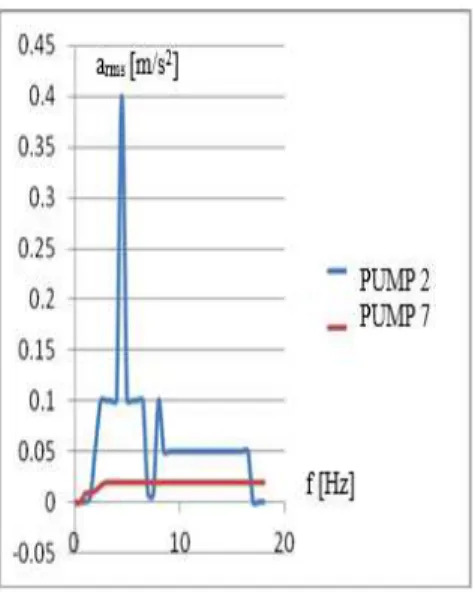
Fig. 9 Comparison between the accelerations measurements of the machines 2 and 7, in frequency (during of the injection process – 8s).
Fig. 10 Comparison between the accelerations measurements of the machines 2 and 7, in time (during
of the injection process – 8s).
The pick of the pump 2 regarding RMS accelerations measurements, in frequency, is 0.4 m/s2, as opposed to the one obtained from the
pump 7 (uses additive produced by CHEM Trend Italy) where the measured value is less than 0.05 m/s2.
wear and friction machine parts.
4. MEASUREMENTS AND NOISES ANALISES
4.1 Noises measurements for machine 7
It performs the same comparative analysis between 2 and 7 machines, under the same conditions, one running with normal oil, another it using additives oil which is produced from the company Chem Trend (machine 7), the purpose being to prove its efficacy in reducing the noise from the operation of the machines.
Noise measurements were performed with a sound-level meter in real-time, instantaneous measurements, and to see the evolution of noise over time, from the beginning of the end of its injection was recorded videos equipment for their initial-final comparison, and then comparison those measurements over two machines 2 and 7.
The microphone might as it was being close to the source of challenging noise (engine pump machine) (Fig. 11).
4.2 Noises analising
Noise measurements were not able to eliminate ambient noise from the industrial hall, the latter adding noise to be measured.
a.
b.
Fig. 11 Noises measurements with sonometer (class 2) (dB).
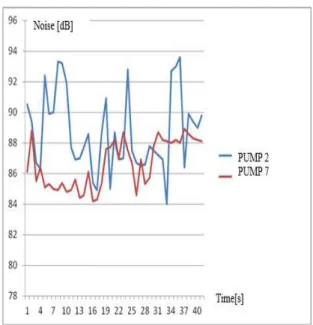
It can be seen that in the two major moments of injection, the noise values are higher, and the difference in noise between machine 2 and 7 measurements (with fluid lubricant CHEM TREND), does not exceed 90 dB, even with the addition of ambient noise from the hall, while in the case of machine 2 (NORMAL lubricating fluid), this reaches in many cases values above 90 dB, anyway more larger than the machine 7 values obtained (Fig. 12).
It can be seen clearly, that the machine 2 (the one with NORMAL lubrication liquid) -graphics blue, the noise level in decibels is vastly superior in comparison with the second machine (the machine 7) - the one use the lubricating fluid produced by CHEM-TREND represented in red.
Fig. 12 Noises measurements.
It is noticed also, some picks at both machines studied, these coincide with the time of injection machine in study or the noises taken from an ambient through another machine that injected.
5. CONCLUSIONS
In conclusion, it can be said that the effectiveness of the adhesive and lubricating product of Chem-Trend, Italy is clearly proved by vibration measurements compared on two identical machines in technical and the same operating conditions for the machine 2 and 7.
The superiority level of this adhesive (Fig. 9-10) symbolized with red on the graph, it can be observed through the lower values than a liquid with the normal lubrication (machine 2-blue symbolized on the graph).
As specified, in the noise analysis shown in the graph of figure 11 that the machine 7 (liquid Chem Trend) and machine 2 (normal liquid) and here as the vibration measurements are observed a net improvement in noise when using this liquid.
If you were to make a report in the use of this fluid, noise values do not exceed 90 dB, whereas in the case of machine 2, they fixed around 90 dB values, smaller or larger up close to 94 dB.
2003, Bd. D. Mangeron, nr. 67,6600 România, Editarea s-a făcut cu finanţare din Grant CNCSIS,Contract 40222/2003, Tema 8, Cod 813, p.291.
Dynamics, Heinemann, London, (2007), Vol I, pp. 1-122.
Studiul vibraţiilor şi a zgomotelor cu privire la funcţionarea maşinilor de injectat, în termeni de utilizare a lubrifianţilor aditivaţi
Lucrarea prezenta îşi propune măsurarea vibraţiilor şi a zgomotelor datorate procesului de injectare de pe maşinile de injectat, maşini alimentate cu ulei neaditivat şi ulei aditivat, ultimul produs de compania "Chem Trend"-Italy. Lucrarea conţine două părţi mari, prima cuprinde studii şi analize de vibraţii şi a doua conţine studii de zgomote, ambele cercetări fiind efectuate pe cele două maşini de injectat.
Aurora Felicia CRISTEA, Lector Ph..D Eng., Technical University of Cluj-Napoca, Building of Machine Faculty, Mechanical Engineering Systems Department, e-mail: [email protected].
Simion HARAGÂŞ, Prof. Ph. D Eng. Technical University of Cluj-Napoca, Building of Machine Faculty, Mechanical Engineering Systems Department, e-mail: [email protected].
![Fig. 8 Machine 7 - RMS (root mean square) acceleration [m/s 2 ] function of time measurements (8s](https://thumb-us.123doks.com/thumbv2/123dok_us/7999034.2120805/3.892.107.424.540.839/fig-machine-rms-root-square-acceleration-function-measurements.webp)