TECHNICAL UNIVERSITY OF CLUJ-NAPOCA
ACTA TECHNICA NAPOCENSIS
Series: Applied Mathematics, Mechanics and Engineering Vol. 58, Issue IV, November, 2015
RESEARCH REGARDING THE EVOLUTION OF TEMPERATURE IN
CASE OF DRY TURNING OF AN ALUMINUM ALLOY
Adrian TRIF, Claudiu Mihai NEDEZKI
Abstract: The purpose of this paper is to analyze the influence of the temperature in case of dry turning of an aluminum alloy. The measured temperature in turning process was compared with the temperature obtained after the simulation using DEFORM 2D software.
Key words: temperature, turning, deform, cutting tools
1. INTRODUCTION
The main objective of this paper is to compare the temperature in turning process, measured with a pirometric camera, with the obtained temperature after the simulation using DEFORM 2D program.
One of the important factors that influence the cutting tool wear is the temperature.
Fig.1. The TempLS infrared camera
The heat in the cutting process depends on the cutting parameters. Is important to study the temperature of the generated surface at the first layer, which can cause deformation and recrystallization; a particular importance has also the temperature of the cutting edge.
The temperature of the cutting insert also depends on the nature of the tool-piece / tool-
chip contact and on the ratio in which it is the thermal conductivity of the elements involved in cutting.
The cutting regime parameters also differently affects the temperature of the chip, of the tool and of the generated surface.
Various methods are used for determination of the temperature in cutting zone.
This paper presents a method of using TempLS infrared camera for measuring temperature.
The TempLS infrared camera is used in a wide temperature range (- 35 ° C to 900 ° C) and allows very precise non-contact measurements to determine the exact temperature of the parts.
This infrared camera includes a temperature sensor type K, using the four lasers for good focus. The USB interface for PC software allows display of results by OPTRIS CONNECT software with the possibility of 20 measurements per second.
2. EXPERIMENTAL DESIGN
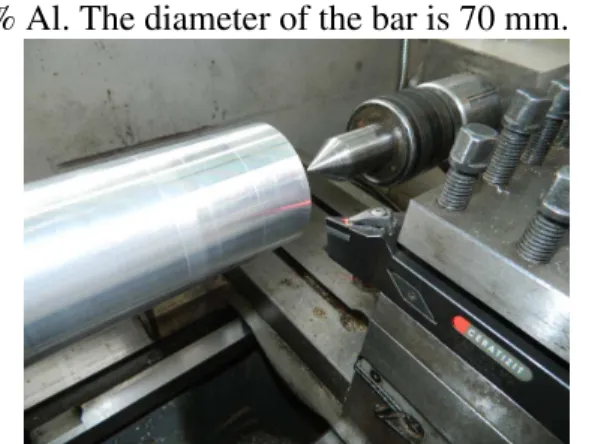
The material used is the 1100 COLD aluminum-based alloy containing minimum 99% Al. The diameter of the bar is 70 mm.
Fig. 2. The material and the insert used in turning process
Fig.3. The insert TOPDEC VCGX used in experiment
The used inserts are TOPDEC VCGX, having as a advantages: the excellent quality surface finish, a constant shape precision, a very good repeatability due to maximum precision sharpening, very high lifetime due the coating material.
For the temperature measurement in different cutting conditions have been changed the cutting speed and feed rate, maintaining the constant cutting depth.
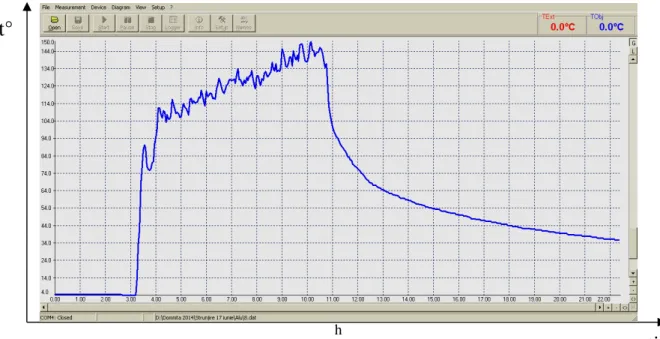
Depending on the cutting regime, by using TempLS infrared camera and the software Opries Connect were obtained cutting tool temperature graphs, corresponding to the 8 experiments in coordinates time – temperature.
Table 1. Cutting conditions
Experiment number
Insert geo-metry
v[m/min] f
[mm/rev] t [mm]
I
α = 6°
γ = 6°
R=
=0,05 mm
123 0.137 1
II 182 0.137 1
III 268 0.137 1
IV 395.6 0.137 1
V 395.6 0.274 1
VI 268 0.274 1
VII 182 0.274 1
VIII 123 0.274 1
a
time
b
c
d
time
t°
time
t°
e
f
g
time
time
time
t°
t°
h
Fig. 4. The eight experimental graphs in coordinates time-temperature (a, b, c, d, e, f, g, h)
The temperature increase with increasing the speed and feed.
3. THE DRY TURNING PROCESS SIMULATION
The simulation of dry turning process is assimilated to the planing operation, given the deployment of the propeller materialized by the chip for a distance of 50 mm. It is considered that the cutting process get to a relative stability in terms of finite element analysis for the distance considered in the simulation (fig.5)
Fig. 5.Assimilation of turning process with the planing operation [10 ],[ 11]
For defining the tool geometry must be inserted the values of its linear and angular parameters, and also it is necessary to introduce the cutting parameters:
Fig. 6. The cutting insert geometry
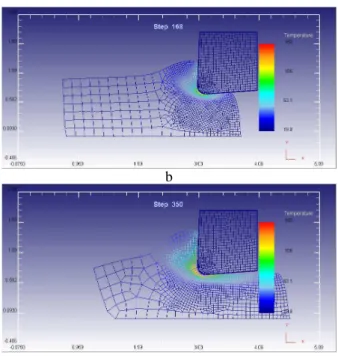
In the simulation process were determined number of steps and the length of cutting simulation in order to generate the required database necessary to calculation: - number of steps: 350; - cutting Length: 50 mm
Using the finite element program DEFORM 2D with which was simulated the cutting process for turning operation it shows the following values of temperatures, step by step:
a
b
c
Fig. 7 a, b, c. The simulated temperature in dif. steps
4. CONCLUSIONS
• This research has presented an experimental study and a modeling of a dry turning, using the finite element method.
• It then compared the results with those which are obtained by simulation using a software.
• The software used to simulate the cutting process is DEFORM 2D Machining.
• Using this software the simulations have been performed for dry turning process of a aluminum alloy.
• The temperature values in turning process, experimentally obtained are similar to those obtained by the simulation with DEFORM 2D software. After cutting was measure a temperature of 58˚C, up to a maximum of 206˚C. With DEFORM 2D program using the same cutting data, we obtained a temperature of
65-240˚C.
• There is an increase of the temperature with increasing feed and cutting speed.
5. REFERENCES
[1] Deacu L., Gurgiuman H., Oancea N., s.a., Bazele aşchierii şi generării suprafeţelor, vol. II, Universitatea Tehnică Cluj-Napoca, Facultatea de Construcţii de Maşini , 1992 [2] Muntean A., Bazele așchierii și generării
suprafețelor, editura Universitații „Lucian Blaga”, Sibiu, 2002
[3] Picoş, C., ş.a., (1992)- Proiectarea
tehnologiilor de prelucrare mecanică prin
aşchiere, Editura Universitas, Chişinău; [4]Picoş C., Coman Gh., ş.a.,(1979) Normarea
tehnică pentru prelucrări prin aşchiere,
editura Tehnica, București
[5] Stețiu Gr., Oprea C., Lazarescu I.D., Stețiu M., (1994) Teoria și practica sculelor așschietoare vol I, editura Universității din Sibiu
[6] Trif, A., Borzan, M., Rus, A., Nedezki, C., Agarski, B.: Studies and Researches on Insert Wear in Turning Process, Proceedings of the International Scientific Conference ETIKUM, Novi Sad 2014
[7] Vlase A., Sturzu A., Mihail A., Bercea I.,(1985) Regimuri de aschiere, adaosuri de
prelucrare și norme tehnice de timp, editura
Tehnică, București;
[8]http://www.journalamme.org/papers_cams0 5/173.pdf
[9]http://www.ijera.com/papers/Vol2_issue6/E 26020027.pdf
[10] www.deform.com
[11] Deform 2D Machining Manual V 9.0
Cercetări privind evoluția temperaturii la strunjirea uscată a unui aliaj de aluminiu
Rezumat: Scopul acestei lucrări este de a analiza influența temperaturii în cazul strunjirii uscate a unui aliaj de aluminiu. Temperatura măsurată în procesul de strunjire a fost comparată cu temperatura obținută după simulare utilizând software-ul DEFORM 2D.
Adrian TRIF, Senior Lecturer, Technical University of Cluj-Napoca, Department of Manufacturing Engineering, [email protected], 0264-401614; Home Address: Răsăritului Street, no 102/11, 400587, Cluj-Napoca, Home Phone: 0264-419601.