Tachyon: Reliable, Memory Speed Storage
for Cluster Computing Frameworks
Haoyuan Li
Ali Ghodsi
University of California, Berkeley {haoyuan,alig}@cs.berkeley.eduMatei Zaharia
MIT, Databricks [email protected]Scott Shenker
Ion Stoica
University of California, Berkeley {shenker,istoica}@cs.berkeley.eduAbstract
Tachyon is a distributed file system enabling reliable data sharing at memory speed across cluster computing frame-works. While caching today improves read workloads, writes are either network or disk bound, as replication is used for fault-tolerance. Tachyon eliminates this bottleneck by pushing lineage, a well-known technique, into the storage layer. The key challenge in making a long-running lineage-based storage system is timely data recovery in case of fail-ures. Tachyon addresses this issue by introducing a check-pointing algorithm that guarantees bounded recovery cost and resource allocation strategies for recomputation under commonly used resource schedulers. Our evaluation shows that Tachyon outperforms in-memory HDFS by 110x for writes. It also improves the end-to-end latency of a realistic workflow by 4x. Tachyon is open source and is deployed at multiple companies.
1.
Introduction
Over the past few years, there have been tremendous efforts to improve the speed and sophistication of large-scale data-parallel processing systems. Practitioners and researchers have built a wide array of programming frameworks [34–
36, 42, 53, 54] and storage systems [14, 15, 25, 26, 39] tailored to a variety of workloads.
As the performance of many of these systems is I/O bound, traditional means of improving their speed is to cache data into memory [12]. While caching can dramati-cally improve read performance, unfortunately, it does not help much with write performance. This is because highly parallel systems need to provide fault-tolerance, and the way they achieve it is by replicating the data written across nodes.
Permission to make digital or hard copies of all or part of this work for personal or classroom use is granted without fee provided that copies are not made or distributed for profit or commercial advantage and that copies bear this notice and the full citation on the first page. Copyrights for components of this work owned by others than ACM must be honored. Abstracting with credit is permitted. To copy otherwise, or republish, to post on servers or to redistribute to lists, requires prior specific permission and/or a fee. Request permissions from [email protected].
SoCC ’14, 3-5 Nov. 2014, Seattle, Washington, USA.
ACM 978-1-4503-3252-1.
http://dx.doi.org/10.1145/2670979.2670985
Even replicating the data in memory can lead to a signifi-cant drop in the write performance, as both the latency and throughput of the network are typically much worse than that of local memory.
Slow writes can significantly hurt the performance of job pipelines, where one job consumes the output of another. These pipelines are regularly produced by workflow man-agers such as Oozie [4] and Luigi [7],e.g.,to perform data extraction with MapReduce, then execute a SQL query, then run a machine learning algorithm on the query’s result. Fur-thermore, many high-level programming interfaces [5, 8,
46], such as Pig [38] and FlumeJava [19], compile programs into multiple MapReduce jobs that run sequentially. In all these cases, data is replicated across the network in-between each of the steps.
To improve write performance, we present Tachyon, an in-memory storage system that achieves high throughput
writes and reads, without compromising fault-tolerance. Tachyon circumvents the throughput limitations of replica-tion by leveraging the concept oflineage, where lost output is recovered by re-executing the operations (tasks) that cre-ated the output. As a result, lineage provides fault-tolerance without the need for replicating the data.
While the concept of lineage has been used before in the context of frameworks such as Spark, Nectar and BAD-FS [16,27,53], there are several important challenges that arise when pushing it into a continuously running distributed storage system. Previous systems do not address these chal-lenges.
The first challenge is bounding the recomputation cost
for a long-running storage system. This challenge does not exist for a single computing job, such as a MapReduce or Spark job, as in this case, the recomputation time is trivially bounded by the job’s execution time. In contrast, Tachyon runs indefinitely, which means that the recomputa-tion time can be unbounded. Previous frameworks that sup-port long running workloads, such as Spark Streaming [54] and BAD-FS [16], circumvent this challenge by using pe-riodic checkpointing. Unfortunately, using the same tech-niques in Tachyon is difficult, as the storage layer is agnostic to the semantics of the jobs running on the data (e.g.,when
outputs will be reused), and job execution characteristics can vary widely. In particular, any fixed checkpoint interval can lead to unbounded recovery times if data is written faster than the available disk bandwidth. Instead, we prefer to se-lect which data to checkpoint based on the structure of the lineage graph in a manner that still bounds recovery time.
The second challenge ishow to allocate resources for
re-computations. For example, if jobs have priorities, Tachyon
must, on the one hand, make sure that recomputation tasks get adequate resources (even if the cluster is fully utilized), and on the other hand, Tachyon must ensure that recompu-tation tasks do not severely impact the performance of cur-rently running jobs with possibly higher priorities.
Tachyon bounds the data recomputation cost, thus ad-dressing the first challenge, by continuously checkpointing files asynchronously in the background. To select which files to checkpoint and when, we propose a novel algorithm, called the Edge algorithm, that provides an upper bound on the recomputation cost regardless of the workload’s access pattern.
To address the second challenge, Tachyon provides re-source allocation schemes that respect job priorities under two common cluster allocation models: strict priority and weighted fair sharing [31,52]. For example, in a cluster us-ing a strict priority scheduler, if a missus-ing input is requested by a low priority job, the recomputation minimizes its im-pact on high priority jobs. However, if the same input is later requested by a higher priority job, Tachyon automatically in-creases the amount of resources allocated for recomputation to avoid priority inversion [33].
We have implemented Tachyon with a general lineage-specification API that can capture computations in many of today’s popular data-parallel computing models, e.g.,
MapReduce and SQL. We also ported the Hadoop and Spark frameworks to run on top of it1. The project is open source, has more than 40 contributors from over 15 institutions, and is deployed at multiple companies.
Our evaluation shows that on average, Tachyon2achieves
110x higher write throughput than in-memory HDFS [2]. In a realistic industry workflow, Tachyon improves end-to-end latency by 4x compared to in-memory HDFS. In addi-tion, because many files in computing clusters are temporary files that get deleted before they are checkpointed, Tachyon can reduce replication-caused network traffic by up to 50%. Finally, based on traces from Facebook and Bing, Tachyon would consume no more than 1.6% of cluster resources for recomputation.
More importantly, due to the inherent bandwidth limita-tions of replication, a lineage-based recovery model might
1Applications can choose to use the lineage feature or not by a
configura-tion parameter.
2This paper focus on in-memory Tachyon deployment. However, Tachyon
can also speed up SSD- and disk-based systems if the aggregate local I/O bandwidth is higher than the network bandwidth.
Media Capacity Bandwith HDD (x12) 12-36 TB 0.2-2 GB/sec SDD (x4) 1-4 TB 1-4 GB/sec Network N/A 1.25 GB/sec Memory 128-512 GB 10-100 GB/sec
Table 1: Typical datacenter node setting [6].
be theonlyway to make cluster storage systems match the speed of in-memory computations in the future. This work aims to address some of the leading challenges in making such a system possible.
2.
Background
This section describes our target workloads and provides background on existing solutions. Section 8 describes re-lated work in greater detail.
2.1 Target Workload Properties
We have designed Tachyon targeting today’s big data work-loads, which have the following properties:
•Immutable data: Data is immutable once written, since dominant underlying storage systems, such as HDFS [2], only support the append operation.
•Deterministic jobs: Many frameworks, such as MapRe-duce [23] and Spark [53], use recomputation for fault tolerance within a job and require user code to be deter-ministic. We provide lineage-based recovery under the same assumption. Nondeterministic frameworks can still store data in Tachyon using replication.
•Locality based scheduling: Many computing frame-works [23,53] schedule jobs based on locality to mini-mize network transfers, so reads can be data-local. •All data vs. working set: Even though the whole data set
is large and has to be stored on disks, the working set of many applications fits in memory [12,53].
•Program size vs. data size: In big data processing, the same operation is repeatedly applied on massive data. Therefore, replicating programs is much less expensive than replicating data in many cases.
2.2 The Case Against Replication
In-memory computation frameworks – such as Spark and Piccolo [42], as well as caching in storage systems – have greatly sped up the performance of individual jobs. However, sharing (writing) data reliably among different jobs often becomes a bottleneck.
The write throughput is limited by disk (or SSD) and network bandwidths in existing big data storage solutions, such as HDFS [2], FDS [14], Cassandra [1], HBase [3], and RAMCloud [39]. All these systems use media with much lower bandwidth than memory (Table1).
The fundamental issue is that in order to be fault-tolerant, these systemsreplicate data across the network and write
Standby Master
Tachyon Master
Standby Master
Workflow Manager
Standby
Standby
Tachyon Worker Worker Daemon
Ramdisk
ZooKeeper Quorum
Tachyon Worker Worker Daemon
Ramdisk Tachyon Worker Worker Daemon
Ramdisk
Figure 1: Tachyon Architecture.
at least one copy onto non-volatile media to allow writes to survive datacenter-wide failures, such as power outages. Because of these limitations and the advancement of in-memory computation frameworks [34,35,42,53], inter-job data sharing cost often dominates pipeline’s end-to-end la-tencies for big data workloads. While some jobs’ outputs are much smaller than their inputs, a recent trace from Cloudera showed that, on average, 34% of jobs (weighted by compute time) across five customers had outputs that were at least as large as their inputs [20]. In an in-memory computing clus-ter, these jobs would be write throughput bound.
Hardware advancement is unlikely to solve the issue. Memory bandwidth is one to three orders of magnitude higher than the aggregate disk bandwidth on a node. The bandwidth gap between memory and disk is becoming larger. The emergence of SSDs has little impact on this since its major advantage over disk is random access la-tency, but not sequential I/O bandwidth, which is what most data-intensive workloads need. Furthermore, throughput in-creases in network indicate that over-the-network memory replication might be feasible. However, sustaining datacen-ter power outages requires at least one disk copy for the system to be fault-tolerant. Hence, in order to provide high throughput, storage systems have to achieve fault-tolerance without replication.
3.
Design Overview
This section overviews the design of Tachyon, while the following two sections (§4 & §5) focus on the two main
challenges that a storage system incorporating lineage faces: bounding recovery cost and allocating resources for recom-putation.
3.1 System Architecture
Tachyon consists of two layers: lineage and persistence. The lineage layer provides high throughput I/O and tracks the se-quence of jobs that have created a particular data output. The persistence layer persists data onto storage without the lin-eage concept. This is mainly used to do asynchronous check-points. The persistence layer can be any existing replication based storage systems, such as HDFS, S3, Glusterfs.
Spark Job
MapReduce Job Spark Job
File
Set A Set BFile File
Set C Set DFile
File Set E
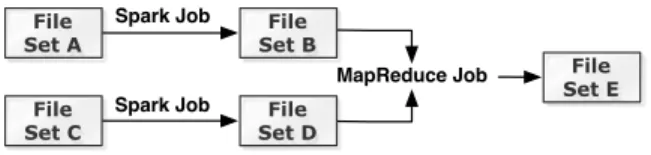
Figure 2: A lineage graph example of multiple frameworks
Tachyon employs a standard master-slave architecture similar to HDFS and GFS (see Figure1). In the remainder of this section we discuss the unique aspects of Tachyon.
In addition to managing metadata, the master also con-tains aworkflow manager. The role of this manager is to track lineage information, compute checkpoint order (§4), and interact with a cluster resource manager to allocate re-sources for recomputation (§5).
Each worker runs a daemon that manages local resources, and periodically reports the status to the master. In addition, each worker uses a RAMdisk for storing memory-mapped files. A user application can bypass the daemon and interact directly with RAMdisk. This way, an application with data locality§2.1can interact with data at memory speeds, while avoiding any extra data copying.
3.2 An Example
To illustrate how Tachyon works, consider the following ex-ample. Assume jobPreads file setAand writes file setB. BeforePproduces the output, it submits its lineage infor-mationLto Tachyon. This information describes how to run
P(e.g., command line arguments, configuration parameters) to generateBfromA. Tachyon recordsLreliably using the persistence layer.Lguarantees that ifBis lost, Tachyon can recompute it by (partially3re-executingP. As a result, lever-aging the lineage,Pcan write a single copy ofB to mem-ory without compromising fault-tolerance. Figure2shows a more complex lineage example.
Recomputation based recovery assumes that input files are immutable (or versioned,c.f.,§9) and that the executions of the jobs are deterministic. While these assumptions are not true of all applications, they apply to a large fraction of datacenter workloads (c.f.,§2.1), which are deterministic applications (often in a high-level language such as SQL where lineage is simple to capture).
Tachyon improves write performance by avoiding repli-cation. However, replication has the advantage of improving read performance as more jobs read the same data. While Tachyon leverages lineage to avoid data replication, it uses a client-side caching technique to mitigate read hotspots trans-parently. That is, if a file is not available on the local ma-chine, it is read from a remote machine and cached locally in Tachyon, temporarily increasing its replication factor.
3The recomputation granularity depends on the framework integration. For
Return Signature Global Unique
Lineage Id
createDependency(inputFiles, output-Files, binaryPrograms, executionCon-figuration, dependencyType)
Dependency Info getDependency(lineageId) Table 2: Submit and Retrieve Lineage API
3.3 API Summary
Tachyon is an append-only file system, similar to HDFS, that supports standard file operations, such as create, open, read, write, close, and delete. In addition, Tachyon provides an API to capture the lineage across different jobs and frame-works. Table 2 lists the lineage API, and Section 6.1 de-scribes this API in detail.
The lineage API adds complexity to Tachyon over repli-cation based file systems such as HDFS, S3. However, only framework programmers need to understand Tachyon’s lin-eage API. Tachyon does not place extra burden on appli-cation programmers. As long as a framework, e.g. Spark, integrates with Tachyon, applications on top of the frame-work take advantage of lineage based fault-tolerance trans-parently4. Furthermore, a user can choose to use Tachyon as a traditional file system if he/she does not use the lineage API. In this case, the application would not have the benefit of memory throughput writes, but will still perform no worse than on a traditional replicated file system.
3.4 Lineage Overhead
In terms of storage, job binaries represent by far the largest component of the lineage information. However, according to Microsoft data [27], a typical data center runs 1,000 jobs daily on average, and it takes up to 1 TB to store the uncompressed binaries of all jobs executed over a one year interval. This overhead is negligible even for a small sized data center.
Furthermore, Tachyon can garbage collect the lineage in-formation. In particular, Tachyon can delete a lineage record after checkpointing (c.f.,§4) its output files. This will dra-matically reduce the overall size of the lineage information. In addition, in production environments, the same binary program is often executed many times,e.g., periodic jobs, with different parameters. In this case, only one copy of the program needs to be stored.
3.5 Data Eviction
Tachyon works best when the workload’s working set fits in memory. In this context, one natural question is what is the eviction policy when the memory fills up. Our answer to this question is influenced by the following characteris-tics identified by previous works [20,44] for data intensive applications:
4We made this configurable in our Spark and MapReduce integration,
which means applications on top of them can choose not to use this feature.
•Access Frequency: File access often follows a Zipf-like distribution (see [20, Figure 2]).
•Access Temporal Locality: 75% of the re-accesses take place within 6 hours (see [20, Figure 5]).
Based on these characteristics, we use LRU as a default policy. However, since LRU may not work well in all scenar-ios, Tachyon also allows plugging in other eviction policies. Finally, as we describe in Section4, Tachyon stores all but the largest files in memory. The rest are stored directly to the persistence layer.
3.6 Master Fault-Tolerance
As shown in Figure1, Tachyon uses a “passive standby” ap-proach to ensure master fault-tolerance. The master logs ev-ery operation synchronously to the persistence layer. When the master fails, a new master is selected from the standby nodes. The new master recovers the state by simply read-ing the log. Note that since the metadata size is orders of magnitude smaller than the output data size, the overhead of storing and replicating it is negligible.
3.7 Handling Environment Changes
One category of problems Tachyon must deal with is changes in the cluster’s runtime environment. How can we rely on re-executing binaries to recompute files if, for example, the version of the framework that an application depends on changes, or the OS version changes?
One observation we make here is that although files’ de-pendencies may go back in time forever, checkpointing al-lows us to place a bound on how far back we ever have to go to recompute data. Thus, before an environment change, we can ensure recomputability by switching the system into a “synchronous mode”, where (a) all currently unreplicated files are checkpointed and (b) all new data is saved syn-chronously. Once the current data is all replicated, the update can proceed and this mode can be disabled5.
For more efficient handling of this case, it might also be interesting to capture a computation’s environment using a VM image [28]. We have, however, not yet explored this option.
3.8 Why Storage Layer
To achieve memory throughput I/O, we need to avoid repli-cation and thus use lineage information. We believe that it is necessary to push lineage into the storage layer because of the followings:
First, a data processing pipeline usually contains more than one job. It is necessary to capture the lineage across jobs. Furthermore, in a production environment, the data producer and its consumers could be written in different frameworks. Therefore, only understanding the lineage at
5Data deletion can be handled as a similar approach. For example, when
a user tries to delete a fileA, if there are other files depending on A,
Tachyon will deleteAasynchronously after the depending data has been
the job level or a single framework level can not solve the issue.
Second, only the storage layer knows when files are re-named or deleted, which is necessary to track lineage cor-rectly and checkpoint data corcor-rectly in long-term operations. Since other layers do not have full control on the storage layer, it is possible that a user may manually delete a file. All files depending on the deleted file will lose fault toler-ance guarantee.
4.
Checkpointing
This section outlines the checkpoint algorithm used by Tachyon to bound the amount of time it takes to retrieve a file that is lost due to failures6. By a file we refer to a distributed file,e.g.,all output of a MapReduce/Spark job. Unlike other frameworks, such as MapReduce and Spark, whose jobs are relatively short-lived, Tachyon runs continu-ously. Thus, the lineage that accumulates can be substantial, requiring long recomputation time in the absence of check-points. Therefore, checkpointing is crucial for the perfor-mance of Tachyon. Note that long-lived streaming systems, such as Spark Streaming [54], leverage their knowledge of job semantics to decide what and when to checkpoint. Tachyon has to checkpoint in absence of such detailed se-mantic knowledge.
The key insight behind our checkpointing approach in Tachyon is that lineage enables us toasynchronously
check-point in the background, without stalling writes, which can
proceed at memory-speed. This is unlike other storage sys-tems that do not have lineage information, e.g.,key-value stores, which synchronously checkpoint, returning to the ap-plication that invoked the write only once data has been per-sisted to stable storage. Tachyon’ background checkpointing is done in a low priority process to avoid interference with existing jobs.
An ideal checkpointing algorithm would provide the fol-lowing:
1.Bounded Recomputation Time.Lineage chains can grow
very long in a long-running system like Tachyon, there-fore the checkpointing algorithm should provide a bound on how long it takes to recompute data in the case of failures. Note that bounding the recomputation time also bounds the computational resources used for recomputa-tions.
2.Checkpointing Hot files.Some files are much more
pop-ular than others. For example, the same file, which rep-resents a small dimension table in a data-warehouse, is repeatedly read by all mappers to do a map-side join with a fact table [12].
3.Avoid Checkpointing Temporary Files. Big data
work-loads generate a lot of temporary data. From our contacts
6In this section, we assume recomputation has the same resource as the
first time computation. In Section5, we address the recomputation resource
allocation issue.
at Facebook, nowadays, more than 70% data is deleted within a day, without even counting shuffle data. Fig-ure 3a illustrates how long temporary data exists in a cluster at Facebook7. An ideal algorithm would avoid checkpointing much of this data.
We consider the following straw man to motivate our algorithm: asynchronously checkpoint every file in the order that it is created. Consider a lineage chain, where fileA1is
used to generateA2, which is used to generate A3,A4, and
so on. By the timeA6is being generated, perhaps only A1
andA2have been checkpointed to stable storage. If a failure
occurs, then A3 through A6 have to be recomputed. The
longer the chain, the longer the recomputation time. Thus, spreading out checkpoints throughout the chain would make recomputations faster.
4.1 Edge Algorithm
Based on the above characteristics, we have designed a sim-ple algorithm, called Edge, which builds on three ideas. First, Edge checkpoints the edge (leaves) of the lineage graph (hence the name). Second, it incorporates priorities, favoring checkpointing high-priority files over low-priority ones. Finally, the algorithm only caches datasets that can fit in memory to avoid synchronous checkpointing, which would slow down writes to disk speed. We discuss each of these ideas in detail:
Checkpointing Leaves. The Edge algorithm models the
relationship of files with a DAG, where the vertices are files, and there is an edge from a file A to a file B if B was generated by a job that readA. The algorithm checkpoints the latest data by checkpointing the leaves of the DAG. This lets us satisfy the requirement of bounded recovery time (explained in Section4.2).
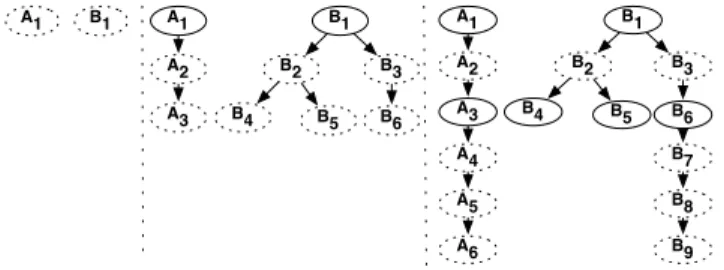
Figure4illustrates how the Edge algorithm works. At the beginning, there are only two jobs running in the cluster, generating filesA1andB1. The algorithm checkpoints both
of them. After they have been checkpointed, filesA3,B4,B5,
andB6become leaves. After checkpointing these, filesA6, B9become leaves.
To see the advantage of Edge checkpointing, consider the pipeline only containingA1toA6in the above example. If a
failure occurs whenA6is being checkpointed, Tachyon only
needs to recompute fromA4throughA6to get the final result.
As previously mentioned, checkpointing the earliest files, instead of the edge, would require a longer recomputation chain.
This type of pipeline is common in industry. For exam-ple, continuously monitoring applications generate hourly reports based on minutely reports, daily reports based on hourly reports, and so on.
7The workload was collected from a 3,000 machine MapReduce cluster at
Access Count 1 3 5 10 Percentage 62% 86% 93% 95%
Table 3: File Access Frequency at Yahoo
100 101 102 103 104 105 Data Existence Duration (sec) 0.0
0.2 0.4 0.6 0.8 1.0
CDF
(a) Estimated temporary data span including shuffle data
Fri Sat Sun Mon Tue Wed Time
0 2000 4000 6000 8000 10000 12000 14000 16000 18000
Output Data Size (GB)
(b) Data generation rates at five minutes granularity
Figure 3: A 3,000 node MapReduce cluster at Facebook
Checkpointing Hot Files. The above idea of
checkpoint-ing the latest data is augmented to first checkpoint high pri-ority files. Tachyon assigns priorities based on the number of times a file has been read. Similar to the LFU policy for eviction in caches, this ensures that frequently accessed files are checkpointed first. This covers the case when the DAG has a vertex that is repeatedly read leading to new vertices being created,i.e.,a high degree vertex. These vertices will be assigned a proportionally high priority and will thus be checkpointed, making recovery fast.
Edge checkpointing has to balance between checkpoint-ing leaves, which guarantee recomputation bounds, and checkpointing hot files, which are important for certain it-erative workloads. Here, we leverage the fact that most big data workloads have a Zipf-distributed popularity (this has been observed by many others [12,20]). Table3shows what percentage of the files are accessed less than (or equal) than some number of times in a 3,000-node MapReduce cluster at Yahoo in January 2014. Based on this, we consider a file high-priority if it has an access count higher than 2. For this workload, 86% of the checkpointed files are leaves, whereas the rest are non-leaf files. Hence, in most cases bounds can be provided. The number can naturally be reconfigured for other workloads. Thus, files that are accessed more than twice get precedence in checkpointing compared to leaves.
A replication-based filesystem has to replicate every file, even temporary data used between jobs. This is because fail-ures could render such data as unavailable. Tachyon avoids checkpointing much of the temporary files created by frame-works. This is because checkpointing later data first (leaves) or hot files, allows frameworks or users to delete temporary data before it gets checkpointed8.
Dealing with Large Data Sets. As observed previously,
working sets are Zipf-distributed [20, Figure 2]. We can
8In our implementation, Tachyon also allows frameworks to indicate
tem-porary data explicitly by path name.
A1 A2 A3 A4 A5 A6
B1
B2 B3
B4 B5 B6
B7 B8 B9 A1
A2 A3
B1
B2 B3
B4 B5 B6
A1 B1
Figure 4: Edge Checkpoint Example. Each node represents a file. Solid nodes denote checkpointed files, while dotted nodes denote uncheckpointed files.
therefore store in memory all but the very largest datasets, which we avoid storing in memory altogether. For example, the distribution of input sizes of MapReduce jobs at Face-book is heavy-tailed [11, Figure 3a]. Furthermore, 96% of active jobs can have their entire data simultaneously fit in the corresponding clusters’ memory [11]. The Tachyon mas-ter is thus configured to synchronously write datasets above the defined threshold to disk. In addition, Figure3bshows that file requests in the aforementioned Facebook cluster is highly bursty. During bursts, Edge checkpointing might checkpoint leafs that are far apart in the DAG. As soon as the bursts finish, Edge checkpointing starts checkpointing the rest of the non-leaf files. Thus, most of the time most of the files in memory have been checkpointed and can be evicted from memory if room is needed (see Section3). If the memory fills with files that have not been checkpointed, Tachyon checkpoints them synchronously to avoid having to recompute long lineage chains. In summary, all but the largest working sets are stored in memory and most data has time to be checkpointed due to the bursty behavior of frame-works. Thus, evictions of uncheckpointed files are rare.
4.2 Bounded Recovery Time
Checkpointing the edge of the DAG lets us derive a bound on the recomputation time. The key takeaway of the bound is that recovery of any file takes on the order of time that it takes to read or generate an edge. Informally, it is indepen-dent of the depth of the lineage DAG.
Recall that the algorithm repeatedly checkpoints the edge of the graph. We refer to the time it takes to checkpoint a particular edgeiof the DAG asWi. Similarly, we refer to the
time it takes to generate an edgeifrom its ancestors asGi.
We now have the following bound.
THEOREM1. Edge checkpointing ensures that any file can
be recovered in3×M, for M=maxi{Ti}, Ti=max(Wi,Gi)9.
This shows that recomputations are independent of the “depth” of the DAG. This assumes that the caching behavior is the same during the recomputation, which is true when working sets fit in memory (c.f.,Section4.1).
The above bound does not apply to priority checkpoint-ing. However, we can easily incorporate priorities by alter-nating between checkpointing the edgecfraction of the time and checkpointing high-priority data 1−cof the time.
COROLLARY2.Edge checkpointing, where c fraction of the
time is spent checkpointing the edge, ensures that any file can
be recovered in3×cM, for M=maxi{Ti}, Ti=max(Wi,Gi).
Thus, configuring c=0.5 checkpoints the edge half of the time, doubling the bound of Theorem1. These bounds can be used to provide SLOs to applications.
In practice, priorities can improve the recomputation cost. In the evaluation(§7), we illustrate actual recomputation times when using edge caching.
5.
Resource Allocation
Although the Edge algorithm provides a bound on recom-putation cost, Tachyon needs a resource allocation strategy to schedule jobs to recompute data in a timely manner. In addition, Tachyon must respect existing resource allocation policies in the cluster, such as fair sharing or priority.
In many cases, there will be free resources for recompu-tation, because most datacenters are only 30–50% utilized. However, care must be taken when a cluster is full. Con-sider a cluster fully occupied by three jobs, J1,J2, andJ3,
with increasing importance (e.g.,from research, testing, and production). There are two lost files,F1andF2, requiring
re-computation jobsR1andR2.J2requestsF2only. How should
Tachyon schedule recomputations?
One possible solution is to statically assign part of the cluster to Tachyon,e.g.,allocate 25% of the resources on the cluster for recomputation. However, this approach limits the cluster’s utilization when there are no recomputation jobs. In addition, the problem is complicated because many factors can impact the design. For example, in the above case, how should Tachyon adjustR2’s priority ifF2is later requested
by the higher priority jobJ3?
To guide our design, we identify three goals:
1.Priority compatibility:If jobs have priorities,
recompu-tation jobs should follow them. For example, if a file is requested by a low priority job, the recomputation should have minimal impact on higher priority jobs. But if the file is later requested by a high priority job, the recovery job’s importance should increase.
2.Resource sharing:If there are no recomputation jobs, the
whole cluster should be used for normal work.
3.Avoid cascading recomputation:When a failure occurs,
more than one file may be lost at the same time. Recom-puting them without considering data dependencies may cause recursive job launching.
We start by presenting resource allocation strategies that meet the first two goals for common cluster scheduling poli-cies. Then, we discuss how to achieve the last goal, which is orthogonal to the scheduling policy.
J1(P1)
R2(P2)
J2(P2) J3(P3) J1(P1)
R2(P3)
J2(P2) J3(P3)
(a) (b)
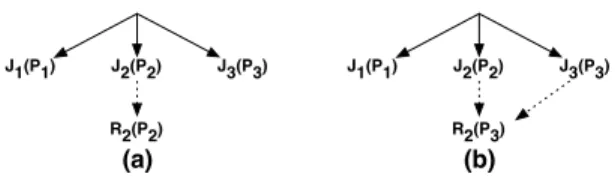
Figure 5: Resource Allocation Strategy for Priority Based Scheduler.
5.1 Resource Allocation Strategy
The resource allocation strategy depends on the scheduling policy of the cluster Tachyon runs on. We present solutions for priority and weighted fair sharing, the most common policies in systems like Hadoop and Dryad [31,52]. Priority Based Scheduler In a priority scheduler, using the same example above, jobsJ1,J2, andJ3have priorities P1,P2, andP3respectively, whereP1<P2<P3.
Our solution gives all recomputation jobs the lowest pri-ority by default, so they have minimal impact on other jobs. However, this may cause priority inversion. For example, be-cause fileF2’s recomputation jobR2has a lower priority than J2, it is possible thatJ2is occupying the whole cluster when
it requestsF2. In this case,R2cannot get resources, andJ2
blocks on it.
We solve this by priority inheritance. When J2requests F2, Tachyon increases R2’s priority to be P2. If F2 is later
read byJ3, Tachyon further increases its priority. Figure5a
and5b show jobs’ priorities before and afterJ3requestsF2.
Fair Sharing Based Scheduler In a hierarchical fair shar-ing scheduler, jobsJ1,J2, andJ3have sharesW1,W2, andW3
respectively. The minimal share unit is 1.
In our solution, Tachyon has a default weight, WR (as
the minimal share unit 1), shared by all recomputation jobs. When a failure occurs, all lost files are recomputed by jobs with a equal share underWR. In our example, bothR1andR2
are launched immediately with share 1 inWR.
When a job requires lost data, part of the requesting job’s share10, is moved to the recomputation job. In our example, whenJ2requestsF2,J2has share (1−a) underW2, andR2
sharea underW2. WhenJ3requests F2 later,J3has share
1−a under W3 and R2 has share a under W3. When R2
finishes,J2andJ3resumes all of their previous shares,W2
andW3respectively. Figure6illustrates.
This solution fulfills our goals, in particular, priority com-patibility and resource sharing. When no jobs are requesting a lost file, the maximum share for all recomputation jobs is bounded. In our example, it isWR/(W1+W2+W3+WR).
When a job requests a missing file, the share of the corre-sponding recomputation job is increased. Since the increased share comes from the requesting job, there is no performance impact on other normal jobs.
W1 W2 W3
J1 J2 J3
WR(1) W1 W2 W3
J1 J2 J3
WR(1)
R2 R3
1 1
W1 W2 W3
J1 J3
WR(1) W1 W2 W3 J1
J2
J3
WR(1)
R2 R3
1 1
1-a a
W1 W2 W3 J3
WR(1) W1 W2 W3 J1
J2
WR(1)
R2 1 R31
1-a a a
1-a
W1 W2 W3 J3 WR(1) W1 W2 W3
J1 J2 WR(1)
R31
Figure 6: Resource Allocation Strategy for Fair Sharing Based Scheduler.
5.2 Recomputation Order
Recomputing a file might require recomputing other files first, such as when a node fails and loses multiple files at the same time. While the programs could recursively make call-backs to the workflow manager to recompute missing files, this would have poor performance. For instance, if the jobs are non-preemptable, computation slots are occupied, wait-ing for other recursively invoked files to be reconstructed. If the jobs are preemptable, computation before loading lost data is wasted. For these reasons, the workflow manager de-termines in advance the order of the files that need to be recomputed and schedules them.
To determine the files that need to be recomputed, the workflow manager uses a logical directed acyclic graph (DAG) for each file that needs to be reconstructed. Each node in the DAG represents a file. The parents of a child node in the DAG denote the files that the child depends on. That is, for a wide dependency a node has an edge to all files it was derived from, whereas for a narrow dependency it has a single edge to the file that it was derived from. This DAG is a subgraph of the DAG in Section4.1.
To build the graph, the workflow manager does a depth-first search (DFS) of nodes representing targeted files. The DFS stops whenever it encounters a node that is already available in storage. The nodes visited by the DFS must be recomputed. The nodes that have no lost parents in the DAG can be recomputed first in parallel. The rest of nodes can be recomputed when all of their children become available. The workflow manager calls the resource manager and executes these tasks to ensure the recomputation of all missing data.
6.
Implementation
We have implemented Tachyon in about 36,000 lines of Java. Tachyon uses an existing storage system as its persis-tence layer, with a pluggable interface (we currently support HDFS, S3, GlusterFS, and NFS). Tachyon also uses Apache ZooKeeper to do leader election for master fault tolerance.
We have also implemented patches for existing frame-works to work with Tachyon: 300 Lines-of-Code (LoC) for Spark [53] and 200 LoC for MapReduce [2]. Applications on top of integrated frameworks can take advantage of the linage transparently, and application programmers do not need to know the lineage concept.
The project is open source, has over 40 contributors from more than 15 companies and universities.
6.1 Lineage Metadata
This section describes the detailed information needed to construct a lineage.
Ordered input files list: Because files’ names could be changed, each file is identified by a unique immutable file ID in the ordered list to ensure that the application’s potential future recomputations read the same files in the same order as its first time execution.
Ordered output files list:This list shares the same insights as the input files list.
Binary program for recomputation: Tachyon launches
this program to regenerate files when necessary. There are various approaches to implement a file recomputation pro-gram. One na¨ıve way is to write a specific program for each application. However, this significantly burdens application programmers. Another solution is to write a single wrapper program which understands both Tachyon’s lineage infor-mation and the application’s logic. Though this may not be feasible for all programs, it works for applications written in a particular framework. Each framework can implement a wrapper to allow applications written in the framework to use Tachyon transparently. Therefore, no burden will be placed on application programmers.
Program configuration: Program configurations can be
dramatically different in various jobs and frameworks. We address this by having Tachyon forego any attempt to un-derstand these configurations. Tachyon simply views them as byte arrays, and leaves the work to program wrappers to understand. Based on our experience, it is fairly straightfor-ward for each framework’s wrapper program to understand its own configuration. For example, in Hadoop, configura-tions are kept inHadoopConf, while Spark stores these in
SparkEnv. Therefore, their wrapper programs can serialize
them into byte arrays during lineage submission, and deseri-alize them during recomputation.
Dependency type:We usewide andnarrow dependencies
for efficient recovery(c.f.,§5).Narrowdependencies repre-sent programs that do operations,e.g.,filter and map, where each output file only requires one input file.Wide dependen-cies represent programs that do operations,e.g.,shuffle and
join, where each output file requires more than one input file. This works similarly to Spark [53].
6.2 Framework Integration
When a program written in a framework runs, before it writes files, it provides the aforementioned information (§6.1) to Tachyon. Then, when the program writes files, Tachyon recognizes the files contained in the lineage. There-fore, the program can write files to memory only, and Tachyon relies on the lineage to achieve fault tolerance. If any file gets lost, and needs to be recomputed, Tachyon launches the binary program, a wrapper under a framework invoking user application’s logic, which is stored in the cor-responding lineage instance, and provides the lineage infor-mation as well as the list of lost files to the recomputation program to regenerate the data.
Recomputation Granularity Framework integration can
be done at different granularity, with different integration complexity and recovery efficiency. An easy but less effi-cient integration is to recompute data at the job level. Sup-pose a Map job produces ten files and one file is lost. For job level integration, Tachyon launches the corresponding wrapper job to recompute all ten files. Another solution is to recompute data at the task (within a job) level, which is harder but more efficient than the above approach. With the same example, for task level integration, Tachyon launches the corresponding wrapper job to only recompute the lost file. Our integrations with MapReduce and Spark are at task level.
Configurable Feature Though applications on an
inte-grated framework can have memory throughput writes trans-parently, we make this feature optional, which is config-urable by applications. This is useful if the application does not tolerate any temporary unavailability for the generated data.
7.
Evaluation
We evaluated Tachyon11through a series of raw benchmarks
and experiments based on real-world workloads.
Unless otherwise noted, our experiments ran on an Ama-zon EC2 cluster with 10 Gbps Ethernet. Each node had 32 cores, 244GB RAM, and 240GB of SSD. We used Hadoop (2.3.0) and Spark (0.9).
We compare Tachyon with an in-memory installation of Hadoop’s HDFS (over RAMFS), which we dub MemHDFS. MemHDFS still replicates data across the network for writes but eliminates the slowdown from disk.
In summary, our results show the following:
•Performance: Tachyon can write data 110x faster than
MemHDFS. It speeds up a realistic multi-job workflow by 4x over MemHDFS. In case of failure, it recovers in around one minute and still finishes 3.8x faster. Tachyon
11We use HDFS (2.3.0) as Tachyon’s persistence layer in our evaluation.
0 100 200 300 400 500
0 10 20 30
Th
ro
ugh
pu
t (
GB
/Sec)
Number of Machines
Write Throughput
Tachyon Write MemHDFS Write TheoreFcal ReplicaFon (2 copies) Based Write
0 200 400 600 800 1000 1200 1400
0 10 20 30
Th
ro
ugh
pu
t (
GB
/Sec)
Number of Machines
Read Throughput
Tachyon Read MemHDFS Read MemHDFS Short Circuit Read HDFS Cache Short Circuit Read
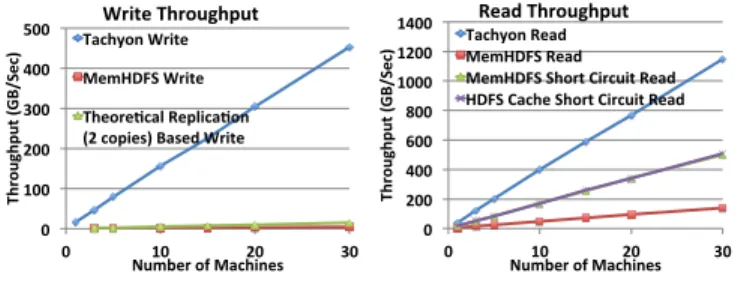
Figure 7: Tachyon and MemHDFS throughput compari-son. On average, Tachyon outperforms MemHDFS 110x for write throughput, and 2x for read throughput.
helps existing in-memory frameworks like Spark im-prove latency by moving storage off-heap. It recovers from master failure within 1 second.
•Asynchronous Checkpointing:The Edge algorithm
out-performs any fixed checkpointing interval. Analysis shows that Tachyon can reduce replication caused net-work traffic up to 50%.
•Recomputation Impact: Recomputation has minor
im-pact on other jobs. In addition, recomputation would consume less than 1.6% of cluster resources in traces from Facebook and Bing.
7.1 Performance
7.1.1 Raw Performance
We first compare Tachyon’s write and read throughputs with MemHDFS. In each experiment, we ran 32 processes on each cluster node to write/read 1GB each, equivalent to 32GB per node. Both Tachyon and MemHDFS scaled lin-early with number of nodes. Figure7shows our results.
For writes, Tachyon achieves 15GB/sec/node. Despite using 10Gbps Ethernet, MemHDFS write throughput is 0.14GB/sec/node, with a network bottleneck due to 3-way replication for fault tolerance. We also show the theoretical maximum performance for replication on this hardware: us-ing only two copies of each block, the limit is 0.5GB/sec/n-ode. On average, Tachyon outperforms MemHDFS by 110x, and the theoretical replication-based write limit by 30x.
For reads, Tachyon achieves 38GB/sec/node. We opti-mized HDFS read performance using two of its most recent features, HDFS caching and short-circuit reads. With these features, MemHDFS achieves 17 GB/sec/node. The reason Tachyon performs 2x better is that the HDFS API still re-quires an extra memory copy due to Java I/O streams.
Note that Tachyon’s read throughput was higher than write. This happens simply because memory hardware is generally optimized to leave more bandwidth for reads.
7.1.2 Realistic Workflow
In this experiment, we test how Tachyon performs with a re-alistic workload. The workflow is modeled after jobs run at
0 20 40 60 80 Tachyon (wo/ failure)
Tachyon (w/ failure) MemHDFS
Minutes
Figure 8: Performance comparison for realistic workflow. Each number is the average of three runs. The workflow ran 4x faster on Tachyon than on MemHDFS. In case of node failure, applications recovers in Tachyon around one minute and still finishes 3.8x faster.
a video analytics company during one hour. It contains peri-odic extract, transform and load (ETL) and metric reporting jobs. Many companies run similar workflows.
The experiments ran on a 30-node EC2 cluster. The whole workflow contains 240 jobs in 20 batches (8 Spark jobs and 4 MapReduce jobs per batch). Each batch of jobs read 1 TB and produced 500 GB. We used the Spark Grep job to emulate ETL applications, and MapReduce Word Count to emulate metric analysis applications. For each batch of jobs, we ran two Grep applications to pre-process the data. Then we ran Word Count to read the cleaned data and compute the final results. After getting the final results, the cleaned data was deleted.
We measured the end-to-end latency of the workflow running on Tachyon or MemHDFS. To simulate the real scenario, we started the workload as soon as raw data had been written to the system, in both Tachyon and MemHDFS tests. For the Tachyon setting, we also measured how long the workflow took with a node failure.
Figure8shows the workflow’s performance on Tachyon and MemHDFS. The pipeline ran in 16.6 minutes on Tachyon and 67 minutes on HDFS. The speedup is around 4x. When a failure happens in Tachyon, the workflow took 1 more minute, still finishing 3.8x faster than MemHDFS.
With Tachyon, the main overhead was serialization and de-serialization since we used the Hadoop TextInputFormat. With a more efficient serialization format, the performance gap is larger.
7.1.3 Overhead in Single Job
When running a single job instead of a pipeline, we found that Tachyon imposes minimal overhead, and can improve performance over current in-memory frameworks by reduc-ing garbage collection overheads. We use Spark as an ex-ample, running a Word Count job on one worker node. Spark can natively cache data either as deserialized Java objects or as serialized byte arrays, which are more com-pact but create more processing overhead. We compare these modes with caching in Tachyon. For small data sizes, ex-ecution times are similar. When the data grows, however, Tachyon storage is faster than Spark’s native modes because
0 50 100 150 200 250 300 350 400
Edge Algo
rithm
Fixed Inter
val 0
Fixed Inter
val 1
Fixed Inter
val 2
Fixed Inter
val 3
Fixed Inter
val 4
Fixed Inter
val 5
Fixed Inter
val 7
Fixed Inter
val 1 0
Fixed Inter
val 2 0
Fixed Inter
val 3 0
Fixed Inter
val 4 0
Fixed Inter
val 5 0
Re
co
ve
ry
T
im
e
(S
ec
)
Figure 9: Edge and fixed interval checkpoint recovery per-formance comparison.
it avoids Java memory management.12 These results show that Tachyon can be a drop-in alternative for current in-memory frameworks. Apache Spark official release 1.0.0 al-ready uses Tachyon as its default off-heap storage solution.
7.1.4 Master Fault Tolerance
Tachyon utilizes hot failovers to achieve fast master recov-ery. We tested recovery for an instance with 1 to 5 million files, and found that the failover node resumed the master’s role after acquiring leadership within 0.5 seconds, with a standard deviation of 0.1 second. This performance is possi-ble because the failover constantly updates its file metadata based on the log of the current master.
7.2 Asynchronous Checkpointing
7.2.1 Edge Checkpointing Algorithm
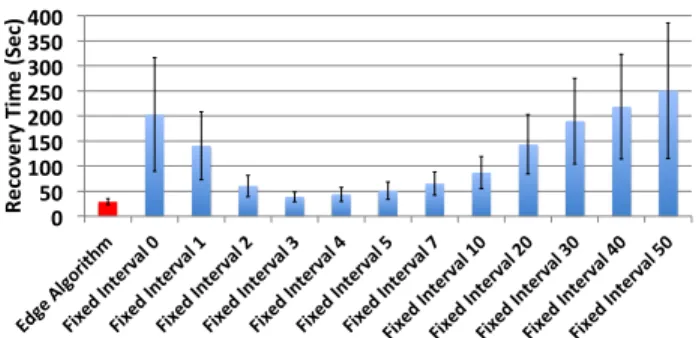
We evaluate the Edge algorithm by comparing it with fixed-interval checkpointing. We simulate an iterative workflow with 100 jobs, whose execution time follows a Gaussian distribution with a mean of 10 seconds per job. The output of each job in the workflow requires a fixed time of 15 seconds to checkpoint. During the workflow, one node fails at a random time.
Figure 9 compares the average recovery time of this workflow under Edge checkpointing with various fixed checkpoint intervals. We see that Edge always outperforms any fixed checkpoint interval. When too small an interval picked, checkpointing cannot keep up with program progress and starts lagging behind.13If the interval is too large, then
the recovery time will suffer as the last checkpoint is too far back in time. Furthermore, even if an optimalaverage
checkpoint interval is picked, it can perform worse than the Edge algorithm, which inherently varies its interval to al-ways match the progress of the computation and can take into account the fact that different jobs in our workflow take different amounts of time.
12Although Tachyon is written in Java, it stores data in a Linux RAMFS.
13That is, the system is still busy checkpointing data from far in the past
We also simulated other variations of this workload,e.g.,
more than one lineage chain or different average job exe-cution times at different phases in one chain. These simula-tions have a similar result, with the gap between Edge algo-rithm and the best fixed interval being larger in more variable workloads.
7.2.2 Network Traffic Reduction
Data replication from the filesystem consumes almost half the cross-rack traffic in data-intensive clusters [22]. Because Tachyon checkpoints data asynchronously some time after it was written, it canavoidreplicating short-lived files alto-gether if they are deleted before Tachyon checkpoints them, and thus reduce this traffic. Networked bounded applications running in the same cluster can therefore leverage saved bandwidth to have better performance.
We analyze Tachyon’s bandwidth savings via simulations with the following parameters:
•Let T be the ratio between the time it takes to checkpoint a job’s output and the time to execute it. This depends on how IO-bound the application is. For example, we mea-sured a Spark Grep program using Hadoop Text Input format, which resulted in T = 4.5,i.e.,the job runs 4.5x faster than network bandwidth. With a more efficient bi-nary format, T will be larger.
•Let X be the percent of jobs that output permanent data. For example, 60% (X = 60) of generated data got deleted within 16 minutes at Facebook (Fig.3a).
•Let Y be the percentage of jobs that read output of previous jobs. If Y is 100, the lineage is a chain. If Y is 0, the depth of the lineage is 1. Y is 84% in an analytics cluster at Twitter.
Based on this information, we set X as 60 and Y as 84. We simulated 1000 jobs using Edge checkpointing. Depending on T, the percent of network traffic saved over replication ranges from 40% at T = 4 to 50% at T≥10.
7.3 Recomputation Impact
7.3.1 Recomputation Resource Consumption
Since Tachyon relies on lineage information to recompute missing data, it is critical to know how many resources will be spent on recomputation, given that failures happen every day in large clusters. In this section, we calculate the amount of resources spent recovering using both a mathematical model and traces from Facebook and Bing.
We make our analysis using the following assumptions: •Mean time to failure (MTTF) for each machine is 3
years. If a cluster contains 1000 nodes, on average, there is one node failure per day.
•Sustainable checkpoint throughput is 200MB/s/node. •Resource consumption is measured in machine-hours. •In this analysis, we assume Tachyon only uses the
coarse-gained recomputation at the job level to compute
worst case, even though it supports fine-grained recom-putation at task level.
Worst-case analysis In the worst case, when a node fails, its memory contains only un-checkpointed data. This re-quires tasks that generate output faster than 200MB/sec: otherwise, data can be checkpointed in time. If a machine has 128GB memory, it requires 655 seconds (128GB / 200MB/sec) to recompute the lost data. Even if this data is recovered serially, and ofallthe other machines are blocked waiting on the data during this process (e.g.,they were run-ning a highly parallel job that depended on it), recomputa-tion takes 0.7% (655 seconds / 24 hours) of the cluster’s run-ning time on a 1000-node cluster (with one failure per day). This cost scales linearly with the cluster size and memory size. For a cluster with 5000 nodes, each with 1TB memory, the upper bound on recomputation cost is 30% of the clus-ter resources, which is still small compared to the typical speedup from Tachyon.
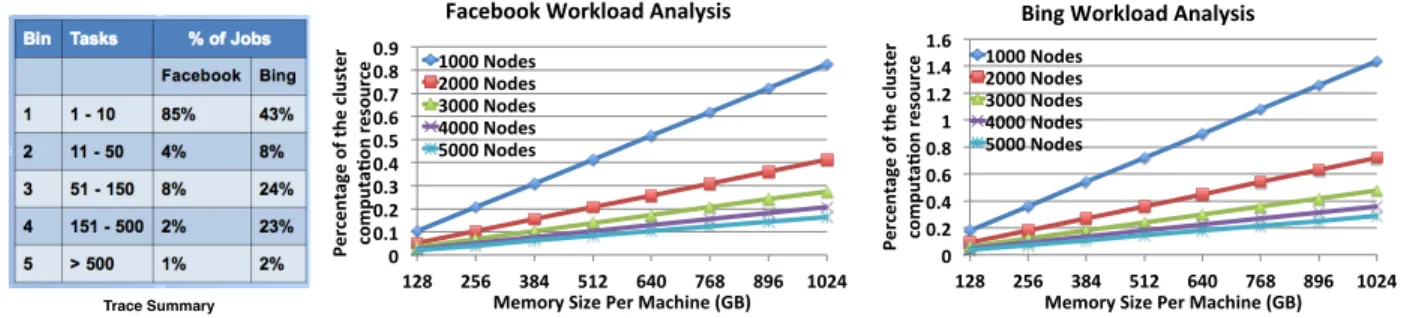
Real traces In real workloads, the recomputation cost is much lower than in the worst-case setting above, because individual jobs rarely consume the entire cluster, so a node failure may not block all other nodes. (Another reason is that data blocks on a failed machine can often be recomputed in parallel, but we do not quantify this here.) Figure10 esti-mates these costs based on job size traces from Facebook and Bing (from Table 2 in [12]), performing a similar com-putation as above with the active job sizes in these clusters. With the same 5000-node cluster, recomputation consumes only up to 0.9% and 1.6% of resources at Facebook and Bing respectively. Given most clusters are only 30–50% utilized, this overhead is negligible.
7.3.2 Impact of Recomputation on Other Jobs
In this experiment, we show that recomputating lost data does not noticeably impact other users’ jobs that do not de-pend on the lost data. The experiment has two users, each running a Spark ETL pipeline. We ran the test three times, and report the average. Without a node failure, both users’ pipelines executed in 85 seconds on average (standard devi-ation: 3s). With a failure, the unimpacted users’s execution time was 86s (std.dev. 3.5s) and the impacted user’s time was 114s (std.dev. 5.5s).
8.
Related Work
Distributed Storage Systems In big data analytics, dis-tributed file systems [15,45,49],e.g.,GFS [26] and FDS [14], and key/value stores [1, 13, 25], e.g., RAMCloud [39] and HBase [3], replicate data to different nodes for fault-tolerance. Their write throughput is bottlenecked by net-work bandwidth. FDS uses a fast netnet-work to achieve higher throughput. Despite the higher cost of building FDS, its throughput is still far from memory throughput. Tachyon leverages the lineage concept in the storage layer to es-chew replication and instead stores a single in-memory copy
Trace Summary
0 0.1 0.2 0.3 0.4 0.5 0.6 0.7 0.8 0.9
128 256 384 512 640 768 896 1024
Percen
ta
ge o
f t
he cl
ust
er
co
mp
ut
a=o
n res
ou
rce
Memory Size Per Machine (GB) Facebook Workload Analysis 1000 Nodes
2000 Nodes 3000 Nodes 4000 Nodes 5000 Nodes
0 0.2 0.4 0.6 0.8 1 1.2 1.4 1.6
128 256 384 512 640 768 896 1024
Percen
ta
ge o
f t
he cl
ust
er
co
mp
ut
a=o
n res
ou
rce
Memory Size Per Machine (GB) Bing Workload Analysis 1000 Nodes
2000 Nodes 3000 Nodes 4000 Nodes 5000 Nodes
Figure 10: Using the trace from Facebook and Bing, recomputation consumes up to 0.9% and 1.6% of the resource in the worst case respectively.
of files. The Apache HDFS community is shifting towards pushing the lineage into the system, which they claimed was partially inspired by Tachyon [29,43]. The proposed system maintains materialized views in un-replicated memory and can recompute them using the required SQL computations.
BAD-FS [16] separates out a scheduler from storage, which provides external control to the scheduler. Users sub-mit jobs to the scheduler through a declarative workflow lan-guage, and thus the system knows the lineage among jobs. However, to make this practical for parallel big data engines (e.g. Spark, MapReduce, Tez), two fundamental issues stood out: (1) ensuring that the interaction between the scheduler and the storage system is correct, e.g. avoiding deadlock-s/priority inversion, (2) bounding recomputation time, which otherwise in a 24/7 system can grow unbounded. For the first problem, we provide mechanisms that avoid deadlocks/pri-ority inversion, while respecting the policy of schedulers. For the second problem, we provide an asynchronous check-pointing algorithm that exploits the structure of the lineage graph to continuously perform checkpointing in the back-ground to guarantee bounded recovery time.
Cluster Computation Frameworks Spark [53] uses
leage information within a single job or shell, all running in-side a single JVM. Different queries in Spark cannot share datasets (RDD) in a reliable and high-throughput fashion, because Spark is a computation engine, rather than a storage system. Our integration with Spark substantially improves existing industry workflows of Spark jobs, as they can share datasets reliably through Tachyon. Moreover, Spark can ben-efit from the asynchronous checkpointing in Tachyon, which enables high-throughput write.
Other frameworks, such as MapReduce [23] and Dryad [30], also trace task lineage within a job. However, as execution engines, they do not trace relations among files, and there-fore can not provide high throughput data sharing among dif-ferent jobs. Like Spark, they can also integrate with Tachyon to improve the efficiency of data sharing among different jobs or frameworks.
Caching SystemsLike Tachyon, Nectar [27] also uses the concept of lineage, but it does so only for a specific pro-gramming framework (DryadLINQ [51]), and in the
con-text of a traditional, replicated file system. Nectar is a data reuse system for DryadLINQ queries whose goals are to save space and to avoid redundant computations. The former goal is achieved by deleting largely unused files and rerun-ning the jobs that created them when needed. However, no time bound is provided to retrieve deleted data. The latter goal is achieved by identifying pieces of code that are com-mon in different programs and reusing previously computed files. Nectar achieves this by heavily resting on the SQL like DryadLINQ query semantics—in particular, it needs to ana-lyze LINQ code to determine when results may be reused— and stores data in a replicated on-disk file system rather than attempting to speed up data access. In contrast, Tachyon’s goal is to provide data sharing acrossdifferentframeworks
withmemory speedandbounded recovery time.
PACMan [12] is a memory caching system for data-intensive parallel jobs. It explores different policies to make data warehouse caching efficient. However, PACMan does not improve the performance of writes, nor the first read of any data item. Therefore, the throughput of many ap-plications remains disk-limited—for example, a multi-job MapReduce workflow will still need to replicate data at disk speed between each step.
LineageBesides the applications in the above fields, lineage has been applied in other areas, such as scientific comput-ing [17,47], databases [21], and distributed computing [9,
10, 37], for applications such as providing the history of data, which can be used for accountability, security, and data audit. [18] and [21] provide detailed surveys of this work. Tachyon applies lineage in a different environment to achieve memory throughput read and write, which entails a different set of challenges.
Checkpoint Research Checkpointing has been a rich
re-search area. Much of the rere-search was on using checkpoints to minimize the re-execution cost when failures happen dur-ing long jobs. For instance, much focus was on optimal checkpoint intervals [48,50], as well as reducing the per-checkpoint overhead [24, 40, 41]. Unlike previous work, which uses synchronous checkpoints, Tachyon does check-pointing asynchronously in the background, which is
en-abled by using lineage information to recompute any miss-ing data if a checkpoint fails to finish.
9.
Limitations and Future Work
Tachyon aims to improve the performance for its targeted workloads(§2.1), and the evaluations show promising re-sults. Although many big data clusters are running our tar-geted workloads, we realize that there are cases in which Tachyon provides limited improvement, e.g., CPU or net-work intensive jobs. In addition, there are also challenges that future work needs to address:
Random Access Abstractions:Data-intensive applications run jobs that output files to storage systems like Tachyon. Often, these files are reprocessed (e.g.,to a DBMS) to allow user-facing applications to use this data. For instance, a Web application might recommend new friends to a user. Thus, enabling Tachyon to provide higher-level read-only random-access abstractions, such as a key/value interface on top of the existing files would shorten the pipeline and enable output of data-intensive jobs to be immediately usable. Mutable data:This is challenging as lineage cannot gen-erally be efficiently stored for fine-grained random-access updates. However, there are several directions, such as ex-ploiting deterministic updates and batch updates.
Multi-tenancy: Memory fair sharing is an important
re-search direction for Tachyon. Policies such as LRU/LFU might provide good overall performance at the expense of providing isolation guarantees to individual users. In addi-tion, security is also another interesting issue to tackle.
Hierarchical storage:Though memory capacity grows
ex-ponentially each year, it is still comparatively expensive to its alternatives. One early adopter of Tachyon suggested that besides utilizing the memory layer, Tachyon should also leverage NVRAM and SSDs. In the future, we will inves-tigate how to support hierarchical storage in Tachyon.
Checkpoint Algorithm Optimizations: In this work, we
proposed the Edge algorithm to provide a bounded recom-putation time. It also checkpoints hot files first and avoids checkpointing temporary files. However, there could be other techniques to make trade-offs among different met-rics, e.g. checkpoint cost, single file recovery cost, and all files recovery cost. We leave those as future work and en-courage the community to explore different algorithms in this area.
10.
Conclusion
As ever more datacenter workloads start to be in mem-ory, write throughput becomes a major bottleneck for ap-plications. Therefore, we believe that lineage-based recov-ery might be the only way to speed up cluster storage sys-tems to achieve memory throughput. We proposed Tachyon, a memory-centric storage system that incorporates lineage to speed up the significant part of the workload consisting of deterministic batch jobs. We identify and address some of the key challenges in making Tachyon practical. Our
evaluations show that Tachyon provides promising speedups over existing storage alternatives. Approaches similar to ours are also being adopted by the HDFS community to lever-age memory efficiently on clusters. We have open sourced Tachyon at tachyon-project.org for people to use in real en-vironments or as a system research platform. It has received contributions from more than 40 individuals and over 15 companies.
11.
Acknowledgements
We thank Adam Oliner, Aurojit Panda, Calvin Jia, Daniel Haas, Dilip Joseph, Evan Sparks, Ganesh Ananthanarayanan, Gene Pang, Jiannan Wang, Joseph Gonzalez, Kaifei Chen, Kay Ousterhout, Liwen Sun, Michael Franklin, Mosharaf Chowdhury, Peter Bailis, Reynold Xin, Sameer Agarwal, Shivaram Venkataraman, Tathagata Das, and our colleagues in AMPLab UC Berkeley providing us many good sugges-tions. We also thank our shepherd, Pradeep Padala, and our reviewers for their feedback. This research is supported in part by NSF CISE Expeditions Award CCF-1139158, LBNL Award 7076018, and DARPA XData Award FA8750-12-2-0331, and gifts from Amazon Web Services, Google, SAP, The Thomas and Stacey Siebel Foundation, Adobe, Apple, Inc., Bosch, C3Energy, Cisco, Cloudera, EMC, Ericsson, Facebook, GameOnTalis, Guavus, HP, Huawei, Intel, Mi-crosoft, NetApp, Pivotal, Splunk, Virdata, VMware, and Ya-hoo!.
References
[1] Apache Cassandra. http://cassandra.apache.org/. [2] Apache Hadoop. http://hadoop.apache.org/. [3] Apache HBase. http://hbase.apache.org/. [4] Apache Oozie. http://incubator.apache.org/oozie/. [5] Apache Crunch. http://crunch.apache.org/. [6] Dell. http://www.dell.com/us/business/p/servers. [7] Luigi. https://github.com/spotify/luigi.
[8] Apache Mahout. http://mahout.apache.org/.
[9] L. Alvisi and K. Marzullo. Message logging: Pessimistic, optimistic, causal, and optimal. Software Engineering, IEEE Transactions on, 24(2):149–159, 1998.
[10] L. Alvisi, K. Bhatia, and K. Marzullo. Causality tracking in causal message-logging protocols.Distributed Computing, 15 (1):1–15, 2002.
[11] G. Ananthanarayanan, A. Ghodsi, S. Shenker, and I. Stoica. Disk-Locality in Datacenter Computing Considered Irrele-vant. InUSENIX HotOS 2011, .
[12] G. Ananthanarayanan, A. Ghodsi, A. Wang, D. Borthakur, S. Kandula, S. Shenker, and I. Stoica. PACMan: Coordinated Memory Caching for Parallel Jobs. InNSDI 2012, .
[13] D. G. Andersen, J. Franklin, M. Kaminsky, A. Phanishayee, L. Tan, and V. Vasudevan. Fawn: A fast array of wimpy nodes. InProceedings of the ACM SIGOPS 22nd Symposium on Operating Systems Principles, pages 1–14. ACM, 2009.
![Table 1: Typical datacenter node setting [6].](https://thumb-us.123doks.com/thumbv2/123dok_us/8522292.2288502/2.918.485.820.108.207/table-typical-datacenter-node-setting.webp)