R E V I E W
Open Access
Extending healthy ageing: nutrient sensitive
pathway and centenarian population
Sergio Davinelli
1, D Craig Willcox
2and Giovanni Scapagnini
1*Abstract
Ageing is a challenge for any living organism and human longevity is a complex phenotype. With increasing life expectancy, maintaining long-term health, functionality and well-being during ageing has become an essential goal. To increase our understanding of how ageing works, it may be advantageous to analyze the phenotype of centenarians, perhaps one of the best examples of successful ageing. Healthy ageing involves the interaction between genes, the environment, and lifestyle factors, particularly diet. Besides evaluating specific gene-environment interactions in relation to exceptional longevity, it is important to focus attention on modifiable lifestyle factors such as diet and nutrition to achieve extension of health span. Furthermore, a better understanding of human longevity may assist in the design of strategies to extend the duration of optimal human health. In this article we briefly discuss relevant topics on ageing and longevity with particular focus on dietary patterns of centenarians and nutrient-sensing pathways that have a pivotal role in the regulation of life span. Finally, we also discuss the potential role of Nrf2 system in the pro-ageing signaling emphasizing its phytohormetic activation.
Introduction
Ageing is an irreversible process associated with numerous physiological alterations across multiple organ systems. Molecular studies in model organisms have identified sev-eral longevity genes and pathways which can extend the lifespan. Although many data are available from these ani-mal models, in humans the situation is much more com-plex. Certainly human ageing is due to interactions between genetic and epigenetic factors but in addition to the genetic background, successful or unsuccessful ageing is also determined by environmental factors associated with social structure, culture and lifestyle. A fascinating, rapidly emerging concept in the biomedical sciences which may help establish a novel and innovative intellec-tual framework in biomedical research is the‘positive biol-ogy paradigm’[1]. Rather than making disease the central focus of researchers’efforts, positive biology seeks to understand the causes of positive phenotypes and which biological mechanisms would explain health and well-being. For instance, a better understanding of exemplars of human exceptional longevity could be a goal of positive biology and could create real benefits for those who are more vulnerable to disease and disability. Life expectancy
for humans has more than doubled in the last two centu-ries and in some European countcentu-ries it is estimated that by 2050 the proportion of persons older than 60 will rise from 20% to almost 40% [2] and the number of centenar-ians will be nearly 3.2 million world-wide [3]. Therefore, even though scientists have elucidated many biological ageing processes providing new strategies that may help to slow the rate of ageing in humans, it is imperative to emphasize research on healthy ageing in order to reduce frailty and disability associated with the“normal”ageing process. Resistance against cellular stress and environmen-tal insults can help promote a more successful ageing pro-cess that results in a longer and healthier lifespan. Despite the fact that genetic, nutritional and pharmacological interventions have been identified as potential means to slow ageing and extend lifespan in lower organisms [4], caloric restriction (CR) appears to be the only common way to increase lifespan in all species [5]. Nutrient sensors modulate lifespan extensions that occur in response to dif-ferent environmental and physiological signals. Nutrient-sensing pathways are essential to the ageing process because several nutrients can activate different pathways directly or indirectly. Many of the genes that act as key regulators of lifespan also have known functions in nutri-ent sensing, and thus are called“nutrient-sensing longevity genes”. Some examples of nutrient-sensing pathways
* Correspondence: [email protected]
1Department of Health Sciences, University of Molise, Campobasso, Italy Full list of author information is available at the end of the article
involved in the longevity response are the kinase target of rapamycin (TOR) [6], AMP kinase (AMPK) [7], sirtuins [8] and insulin and insulin/insulin-like growth factor (IGF-1) signaling [9]. Among the processes and experiential fac-tors that guide successful ageing trajectories, nutrition has been receiving much attention as a modifiable lifestyle factor leading to healthy ageing. Literature concerning the heterogeneity in dietary and nutritional status of centenar-ians seems to indicate that there is not any particular diet-ary pattern that promotes exceptional longevity. Although different nutritional compounds have been analyzed in studies of health ageing and longevity [10], it is crucial to understand how specific nutritional components and diet-ary patterns may affect health and longevity. To date the main dietary intervention that may retard the ageing process is CR and a rare human example could be the Okinawan population in Japan. Okinawans appear to have undergone a mild form of prolonged CR for decades that could have contributed to a lower risk of mortality [11]. A deep knowledge of the mechanisms underlying differences among centenarians from various countries would be ben-eficial, especially elucidating the contribution of country-specific dietary patterns. Here we will focus on country-specific nutritional patterns of centenarians located throughout the world considering the role of nutrient-sensing path-ways in mediating the longevity response and beneficial effects. Finally, considering that CR is a mild stress that actives cytoprotective mechanisms, we discuss the poten-tial role of Nrf2 protective cell-signaling pathway in CR induced longevity.
Nutritional patterns of centenarians: nature vs. nurture A challenge in the area of healthy ageing is to identify dietary patterns, in addition to specific dietary compo-nents, that offer protection against age-related diseases. Dietary patterns are defined mainly for assessing eating behavior and to relate the food intake to disease or health outcomes [12]. Although severe disabilities in persons older than 60 seem to be declining, the prevalence of chronic disease, particularly of those diseases linked to diet and lifestyle, appears to be increasing [13]. Healthy centenarians are‘expert survivors’with important lessons to share, in particular regarding the most modifiable life-style factor: the diet. However, it is necessary to empha-size that several lines of evidence suggest that the genetic contribution to a healthy life span in populations with exceptional longevity may be greater than that seen in the general population [14,15]. A recent study on a cohort of 477 Ashkenazi Jewish centenarians with excep-tional longevity reported that centenarians may possess additional longevity genes that help to buffer them against the harmful effects of an unhealthy lifestyle [16]. Nonetheless, even though studies of dietary patterns are intrinsically complex, several reports have showed that
and nuts [26-28]. The Nicoya Peninsula region in Costa Rica has been reported to be an exceptional longevity area where healthy centenarians live surrounded by a solid support network of friends and family [29]. Although the possible role played by the dietary regimen in Nicoya region in relation to extreme longevity has not yet been investigated, the diet includes garden vegetables, an abundance of fruit (orange, mango, papaya), squash, beans, rice and corn. The water is also particularly high in minerals such as magnesium and calcium [19]. This area has also reported one of the lowest middle-age mor-tality rates in the world. A 60-year -old has more than a fourfold better chance of making it to the age of 90 years than a 60-year-old in North America [30]. Finally, it was reported that people in Ikaria Island, Greece, have also one of the highest life expectancies in the world. Ikarians are three times more likely to reach the age of 90 years than in the U.S. [19]. In this community, scientific evi-dence shows protective health benefits from long-term adherence to the Mediterranean food culture revealing that this diet has a cardioprotective effect and is able to reduce the prevalence of hyperuricaemia in elderly indivi-duals [31]. The above mentioned regions have been labeled as‘Blue Zones’and while scientists try to validate the veracity and variety of associated causes of this exceptional longevity, it is advisable to follow a diet rich in fruits, vegetables, legumes and whole grains but reduced in saturated fat.
‘Nutrient sensors’that modulate ageing
Biochemical pathways capable of‘sensing’the availability of nutrients maintain energy homeostasis both at the cell and at the whole organism levels [32]. Multiple nutrient signaling pathways have been connected to lifespan regu-lation. Although an extremely low-calorie diet is the most effective intervention known to extend lifespan in many species, from yeast to primates [33], we will focus on nutrient-sensing pathways that have been shown to influence ageing in humans. The full understanding of dietary intake and composition to obtain health benefits and pro-longevity effects is a realistic goal for biogeron-tology and drugs that promote human longevity targeting nutrient-sensing pathways require further study. More-over, it has been observed that natural genetic variants in nutrient-sensing pathways are associated with increased human life span [34]. In recent years, some of these path-ways identified in worms or mice have been shown to have human homologs, in particular the IGF-1 pathway. IGF-1 activity is essential in all animals, and surprisingly, altered IGF-1 signaling pathways have been shown to confer an increase in susceptibility to longevity, including human longevity. Recent studies have demonstrated a significant association between mutations in genes involved in the IGF-1 pathway and extension of human
essential for healthy ageing [46]. AMPK is a nutrient and energy sensor that might be involved in the regulation of life span and in the mediation of the beneficial effects of CR. Although this hypothesis is largely unexplored, espe-cially in mammals, it seem likely that the activation of AMPK may have an impact on the activity of FOXO, sir-tuin, and the mTOR pathways, which have been linked to CR and to the promotion of a healthy longevity [47].
Hormetic phytochemicals and Nrf2- signaling pathway in healthy ageing
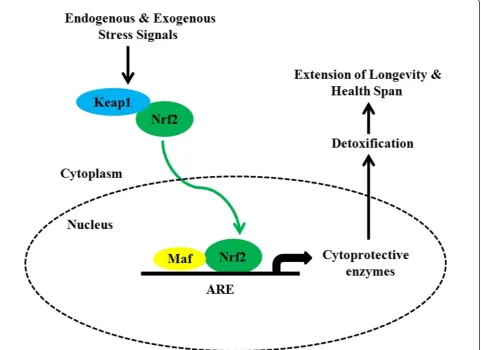
There is a huge volume of data on the beneficial effects of plant-derived extracts to retard ageing and age-associated diseases. Many phytochemicals are synthesized to increase the fitness of the plant by allowing it to interact with its environment, including herbivorous pathogens, and insects. Some well-known phytochemicals may induce in humans beneficial stress responses and with low-dose exposures, they can trigger a cellular stress response and subsequently induce adaptive stress resis-tance, also called hormesis [48]. Stress resistance involves several molecular adaptations and induces many of the nutrient-sensing longevity pathways discussed above. The role of hormesis in ageing has already been exam-ined by Rattan [49] but also its relevance to explain the anti-ageing and life-extending actions of CR in long-lived species [50]. We propose that the anti-ageing responses induced by phytochemicals are caused by phytohormetic stress resistance involving the activation of Nrf2 signal-ing. There is a substantial amount of research supporting oxidative stress as one of the main causes of ageing. In contrast there are few longevity models that have been created to evaluate enhanced anti-oxidative mechanisms. Nrf2 is a central regulator of the adaptive response to oxidative stress but very few studies have investigated the role of Nrf2 in the modulation of ageing and longevity. The Nrf2-signaling pathway has been extensively reviewed elsewhere [51,52] as well as its hormetic func-tion from an evolufunc-tionary perspective [53]. It is impor-tant to delineate the link between oxidative stress, cellular resistance and the rate of ageing. Since Nrf2 reg-ulates the main cytoprotective responses, this pathway may substantially contribute to the determination of healthspan and extension of longevity (Figure 1). More-over, many phytochemicals (e.g. polyphenols, flavonoids, terpenoids, etc.) are major ingredients present in fruits, vegetables, and spices and have been shown to have pro-tective effects- against age-related degeneration [54]. Interestingly, many of these phytochemicals are activa-tors of Nrf2 signaling and through this pathway they can inhibit ROS production and counteract oxidative damage [51]. Furthermore, hormetic phytochemicals have recently received considerable attention for their
pro-longevity effects and for their ability to act as sirtuin acti-vators [55]. Taking into account that the dietary habits of many centenarians seem to be extremely rich in phyto-chemicals, without neglecting the effect of genetic back-ground, we hypothesize that long-lived people may have a constitutively upregulated Nrf2 pathway to respond better to cell stressors and thereby minimize cell damage. Moreover, considering that so-called“Blue Zones”that seem to harbor a high number of centenarians appear also to be areas with high nutrient density and low calo-ric density diets which may have led to a prolonged form of mild CR, the beneficial effects of their CR exposure may be also partially explained by a decrease in oxidative stress sensitivity, suggesting Nrf2 as a plausible effector of longevity signaling. Finally, it is important to consider that emerging evidence shows the close link between nutrient intake and inflammatory biomarkers [56]. It is well established that adipose tissue releases many inflam-matory mediators and experimental studies have revealed the beneficial effects of CR in the attenuation of system-wide inflammatory processes [57]. Moreover, oxidative stress has been recognized to play a major role in deter-mining and maintaining the low grade state of inflamma-tion observed in ageing and age associated diseases [58]. Consistent with these statements, a number of studies have shown that the antioxidant-mediated Nrf2 activa-tion is strongly associated with the protecactiva-tion from pro-inflammatory insults [59]. The activation of Nrf2 pathway might inhibit the production or expression of pro-inflam-matory mediators including cytokines, chemokines, cell adhesion molecules, matrix metalloproteinases, cyclooxy-genase-2 and inducible nitric oxide synthase [60]. There-fore, efficient inducers of Nrf2 activation, some of which are present in the diet of centenarians could be consid-ered as effective means for the prevention of inflamma-tion-mediated diseases.
Conclusions
particular diet able to delay ageing may help to identify new molecules to extend and ameliorate age associated disease, opening new opportunities for drug discovery and companies working in nutrition and pharmacology. Furthermore, our knowledge of nutrient-sensing pathways has greatly increased in recent years and the modulation of these pathways by diet or pharmaceuticals can have a profound impact on health and thus represent a therapeu-tic opportunity for the extension of the human lifespan and quality of life improvement. In addition to the com-mon pathways that regulate biological ageing there are also promising and attractive new targets for therapeutic interventions that can positively affect healthy ageing. The development of strategies that will lead to the extension of healthy life and that would result in slowing the rate of ageing and lowering risk for age associated disease may be
part of the new paradigm for the biomedical sciences that can be termed‘positive biology’.
Acknowledgements
Dr. D. Craig Willcox gratefully acknowledges the support of the Kuakini Hawaii Healthspan Study (1R01AG038707-01A1) and the Kuakini Hawaii Lifespan II Study (5R01AG027060-06).
Author details
1
Department of Health Sciences, University of Molise, Campobasso, Italy. 2Department of Human Welfare, Okinawa International University, Ginowan, Japan.
Authors’contributions
SD, DCW, GS wrote the draft; all authors edited the paper and approved its final version.
Competing interests
The authors declare that they have no competing interests.
Received: 3 April 2012 Accepted: 23 April 2012 Published: 23 April 2012
References
1. Farrelly C:’Positive biology’as a new paradigm for the medical sciences. Focusing on people who live long, happy, healthy lives might hold the key to improving human well-being.EMBO Rep2012,13:186-188. 2. Weiss G:Europe wakes up to aging.Sci Aging Knowledge Environ2002,48:
ns10.
3. World population projections: the 2000 revision. Population Division Department of Economic and Social Affairs, United Nations.[http://www. un.org/spanish/esa/population/wpp2000h.pdf].
4. Vijg J, Campisi J:Puzzles, promises and a cure for ageing.Nature2008,
454:1065-1071.
5. Bishop NA, Guarente L:Genetic links between diet and lifespan: shared mechanisms from yeast to humans.Nat Rev Genet2007,8:835-844. 6. Hansen M, Taubert S, Crawford D, Libina N, Lee SJ, Kenyon C:Lifespan
extension by conditions that inhibit translation in Caenorhabditis elegans.Aging Cell2007,6:95-110.
7. Greer EL, Dowlatshahi D, Banko MR, Villen J, Hoang K, Blanchard D, Gygi SP, Brunet A:An AMPK-FOXO pathway mediates longevity induced by a novel method of dietary restriction in C. elegans.Curr Biol2007,
17:1646-1656.
8. Li Y, Xu W, McBurney MW, Longo VD:SirT1 inhibition reduces IGF-I/IRS-2/ Ras/ERK1/2 signaling and protects neurons.Cell Metab2008,8:38-48. 9. Honjoh S, Yamamoto T, Uno M, Nishida E:Signalling through RHEB-1 mediates intermittent fasting-induced longevity in C. elegans.Nature
2009,457:726-730.
10. Lebel M, Picard F, Ferland G, Gaudreau P:Drugs, nutrients, and phytoactive principles improving the health span of rodent models of human age-related diseases.J Gerontol A Biol Sci Med Sci2012,67:140-151. 11. Willcox DC, Willcox BJ, Todoriki H, Curb JD, Suzuki M:Caloric restriction
and human longevity: what can we learn from the Okinawans?
Biogerontology2006,7:173-177.
12. Román-Viñas B, Ribas Barba L, Ngo J, Martínez-González MA, Wijnhoven TM, Serra-Majem L:Validity of dietary patterns to assess nutrient intake adequacy.Br J Nutr2009,101:(Suppl 2):S12-S20.
13. National Center for Health Statistics:Health, United States, 2004 with chartbook of trends in the health of AmericansHyattsville, MD: National Center for Health Statistics; 2004.
14. Perls TT, Wilmoth J, Levenson R, Drinkwater M, Cohen M, Bogan H, Joyce E, Brewster S, Kunkel L, Puca A:Life-long sustained mortality advantage of siblings of centenarians.Proc Natl Acad Sci USA2002,99:8442-8447. 15. Sebastiani P, Solovieff N, Puca A, Hartley SW, Melista E, Andersen S,
Dworkis DA, Wilk JB, Myers RH, Steinberg MH, Montano M, Baldwin CT, Perls TT:Genetic signatures of exceptional longevity in humans.Science
2010,333:404.
16. Rajpathak SN, Liu Y, Ben-David O, Reddy S, Atzmon G, Crandall J, Barzilai N:
Lifestyle factors of people with exceptional longevity.J Am Geriatr Soc
2011,59:1509-1512.
17. Willcox DC, Willcox BJ, Todoriki H, Suzuki M:The Okinawan diet: health implications of a low-calorie, nutrient-dense, antioxidant-rich dietary pattern low in glycemic load.J Am Coll Nutr2009,28:500S-516S. 18. Willcox BJ, Willcox DC, Todoriki H, Fujiyoshi A, Yano K, He Q, Curb JD,
Suzuki M:Caloric restriction, the traditional Okinawan diet, and healthy aging. The diet of the world’s longest-lived people and its potential impact on morbidity and life span.Ann N Y Acad Sci2007,1114:434-455. 19. Buettner D:The blue zone: lessons for living longer from the people who’ve
lived the longestWashington, DC: National Geographic Society; 2008. 20. Shimizu K, Takeda S, Noji H, Hirose N, Ebihara Y, Arai Y, Hamamatsu M,
Nakazawa S, Gondo Y, Konishi K:Dietary patterns and further survival in Japanese centenarians.J Nutr Sci Vitaminol (Tokyo)2003,49:133-138. 21. Kromhout D:Food consumption patterns in the Seven Countries Study.
Seven Countries Study Research Group.Ann Med1989,21:237-238. 22. Dodge HH, Katsumata Y, Todoriki H, Yasura S, Willcox DC, Bowman GL,
Willcox B, Leonard S, Clemons A, Oken BS, Kaye JA, Traber MG:
Comparisons of plasma/serum micronutrients between Okinawan and Oregonian elders: a pilot study.J Gerontol A Biol Sci Med Sci2010,
65:1060-1067.
23. Arai Y, Hirose N, Nakazawa S, Yamamura K, Shimizu K, Takayama M, Ebihara Y, Osono Y, Homma S:Lipoprotein metabolism in Japanese
centenarians: effects of apolipoprotein E polymorphism and nutritional status.J Am Geriatr Soc2001,49:1434-1441.
24. Johnson MA, Davey A, Hausman DB, Park S, Poon LW, the Georgia Centenarian Study:Dietary differences between centenarians residing in communities and in skilled nursing facilities: the Georgia Centenarian Study.Age2000,28:333-341.
25. Pes GM, Tolu F, Poulain M, Errigo A, Masala S, Pietrobelli A, Battistini NC, Maioli M:Lifestyle and nutrition related to male longevity in Sardinia: an ecological study.Nutr Metab Cardiovasc Dis2011.
26. Fraser GE:Diet as primordial prevention in Seventh-Day Adventists.Prev Med1999,29:S18-S23.
27. Willett W:Lessons from dietary studies in Adventists and questions for the future.Am J Clin Nutr2003,78:539S-543S.
28. Rizzo NS, Sabaté J, Jaceldo-Siegl K, Fraser GE:Vegetarian dietary patterns are associated with a lower risk of metabolic syndrome: the adventist health study 2.Diabetes Care2011,34:1225-1227.
29. Koch T, Power C, Kralik D:Researching with centenarians.Int J Older People Nurs2007,2:52-61.
30. Christensen K, Vaupel JW:Determinants of longevity: genetic, environmental and medical factors.J Intern Med1996,240:333-341. 31. Chrysohoou C, Skoumas J, Pitsavos C, Masoura C, Siasos G, Galiatsatos N,
Psaltopoulou T, Mylonakis C, Margazas A, Kyvelou S, Mamatas S, Panagiotakos D, Stefanadis C:Long-term adherence to the Mediterranean diet reduces the prevalence of hyperuricaemia in elderly individuals, without known cardiovascular disease: the Ikaria study.Maturitas2011,
70:58-64.
32. Rossetti L:Perspective: hexosamines and nutrient sensing.Endocrinology
2000,141:1922-1925.
33. Colman RJ, Anderson RM, Johnson SC, Kastman EK, Kosmatka KJ, Beasley TM, Allison DB, Cruzen C, Simmons HA, Kemnitz JW, Weindruch R:
Caloric restriction delays disease onset and mortality in rhesus monkeys.
Science2009,325:201-204.
34. Bonafè M, Barbieri M, Marchegiani F, Olivieri F, Ragno E, Giampieri C, Mugianesi E, Centurelli M, Franceschi C, Paolisso G:Polymorphic variants of insulin-like growth factor I (IGF-I) receptor and phosphoinositide 3-kinase genes affect IGF-I plasma levels and human longevity: cues for an evolutionarily conserved mechanism of life span control.J Clin Endocrinol Metab2003,88:3299-3304.
35. Suh Y, Atzmon G, Cho MO, Hwang D, Liu B, Leahy DJ, Barzilai N, Cohen P:
Functionally significant insulin-like growth factor I receptor mutations in centenarians.Proc Natl Acad Sci USA2008,105:3438-3442.
36. Kojima T, Kamei H, Aizu T, Arai Y, Takayama M, Nakazawa S, Ebihara Y, Inagaki H, Masui Y, Gondo Y, Sakaki Y, Hirose N:Association analysis between longevity in the Japanese population and polymorphic variants of genes involved in insulin and insulin-like growth factor 1 signaling pathways.Exp Gerontol2004,39:1595-1598.
37. Willcox BJ, Donlon TA, He Q, Chen R, Grove JS, Yano K, Masaki KH, Willcox DC, Rodriguez B, Curb JD:FOXO3A genotype is strongly associated with human longevity.Proc Natl Acad Sci USA2008,
105:13987-13992.
38. Pawlikowska L, Hu D, Huntsman S, Sung A, Chu C, Chen J, Joyner AH, Schork NJ, Hsueh WC, Reiner AP, Psaty BM, Atzmon G, Barzilai N, Cummings SR, Browner WS, Kwok PY, Ziv E, Study of Osteoporotic Fractures:Association of common genetic variation in the insulin/IGF1 signaling pathway with human longevity.Aging Cell2009,8:460-472. 39. Anselmi CV, Malovini A, Roncarati R, Novelli V, Villa F, Condorelli G,
Bellazzi R, Puca AA:Association of the FOXO3A locus with extreme longevity in a southern Italian centenarian study.Rejuvenation Res2009,
12:95-104.
40. Flachsbart F, Caliebe A, Kleindorp R, Blanché H, von Eller-Eberstein H, Nikolaus S, Schreiber S, Nebel A:Association of FOXO3A variation with human longevity confirmed in German centenarians.Proc Natl Acad Sci USA2009,106:2700-2705.
41. Li Y, Wang WJ, Cao H, Lu J, Wu C, Hu FY, Guo J, Zhao L, Yang F, Zhang YX, Li W, Zheng GY, Cui H, Chen X, Zhu Z, He H, Dong B, Mo X, Zeng Y, Tian XL:Genetic association of FOXO1A and FOXO3A with longevity trait in Han Chinese populations.Hum Mol Genet2009,18:4897-4904. 42. Donlon TA, Curb JD, He Q, Grove J, Masaki KH, Rodriguez B, Elliot A,
43. Sengupta S, Peterson TR, Sabatini DM:Regulation of the mTOR complex 1 pathway by nutrients, growth factors, and stress.Mol Cell2010,
40:310-322.
44. Blagosklonny MV:Why human lifespan is rapidly increasing: solving “longevity riddle”with“revealed-slow-aging”hypothesis.Aging (Albany NY)2010,2:177-182.
45. Cao K, Graziotto JJ, Blair CD, Mazzulli JR, Erdos MR, Krainc D, Collins FS:
Rapamycin reverses cellular phenotypes and enhances mutant protein clearance in Hutchinson-Gilford progeria syndrome cells.Sci Transl Med
2011,3, 89ra58.
46. Lopez-Lluch G, Irusta PM, Navas P, de Cabo R:Mitochondrial biogenesis and healthy aging.Exp Gerontol2008,43:813-819.
47. Salminen A, Kaarniranta K:AMP-activated protein kinase (AMPK) controls the aging process via an integrated signaling network.Ageing Res Rev
2012,11:230-241.
48. Mattson MP:Dietary factors, hormesis and health.Ageing Res Rev2008,
7:43-48.
49. Rattan SI:Hormesis in aging.Ageing Res Rev2008,7:63-78.
50. Masoro EJ:The role of hormesis in life extension by dietary restriction.
Interdiscip Top Gerontol2007,35:1-17.
51. Scapagnini G, Vasto S, Abraham NG, Caruso C, Zella D, Fabio G:Modulation of Nrf2/ARE pathway by food polyphenols: a nutritional neuroprotective strategy for cognitive and neurodegenerative disorders.Mol Neurobiol
2011,44:192-201.
52. Sykiotis GP, Bohmann D:Stress-activated cap’n’collar transcription factors in aging and human disease.Sci Signal2010,3:re3.
53. Maher J, Yamamoto M:The rise of antioxidant signaling-the evolution and hormetic actions of Nrf2.Toxicol Appl Pharmacol2010,244:4-15. 54. Kim J, Lee HJ, Lee KW:Naturally occurring phytochemicals for the
prevention of Alzheimer’s disease.J Neurochem2010,112:1415-1430. 55. Calabrese V, Cornelius C, Dinkova-Kostova AT, Iavicoli I, Di Paola R,
Koverech A, Cuzzocrea S, Rizzarelli E, Calabrese EJ:Cellular stress responses, hormetic phytochemicals and vitagenes in aging and longevity.Biochim Biophys Acta2012,1822:753-783.
56. Galland L:Diet and inflammation.Nutr Clin Pract2010,25:634-640. 57. Morgan TE, Wong AM, Finch CE:Anti-inflammatory mechanisms of
dietary restriction in slowing aging processes.Interdiscip Top Gerontol
2007,35:83-97.
58. De la Fuente M, Miquel J:An update of the oxidation-inflammation theory of aging: the involvement of the immune system in oxi-inflamm-aging.Curr Pharm Des2009,15:3003-3026.
59. Khor TO, Yu S, Kong AN:Dietary cancer chemopreventive agents -targeting inflammation and Nrf2 signaling pathway.Planta Med2008,
74:1540-1547.
60. Reuter S, Gupta SC, Chaturvedi MM, Aggarwal BB:Oxidative stress, inflammation, and cancer: How are they linked?Free Radic Biol Med2010,
49:1603-1616.
doi:10.1186/1742-4933-9-9
Cite this article as:Davinelliet al.:Extending healthy ageing: nutrient
sensitive pathway and centenarian population.Immunity & Ageing2012
9:9.
Submit your next manuscript to BioMed Central and take full advantage of:
• Convenient online submission
• Thorough peer review
• No space constraints or color figure charges
• Immediate publication on acceptance
• Inclusion in PubMed, CAS, Scopus and Google Scholar
• Research which is freely available for redistribution